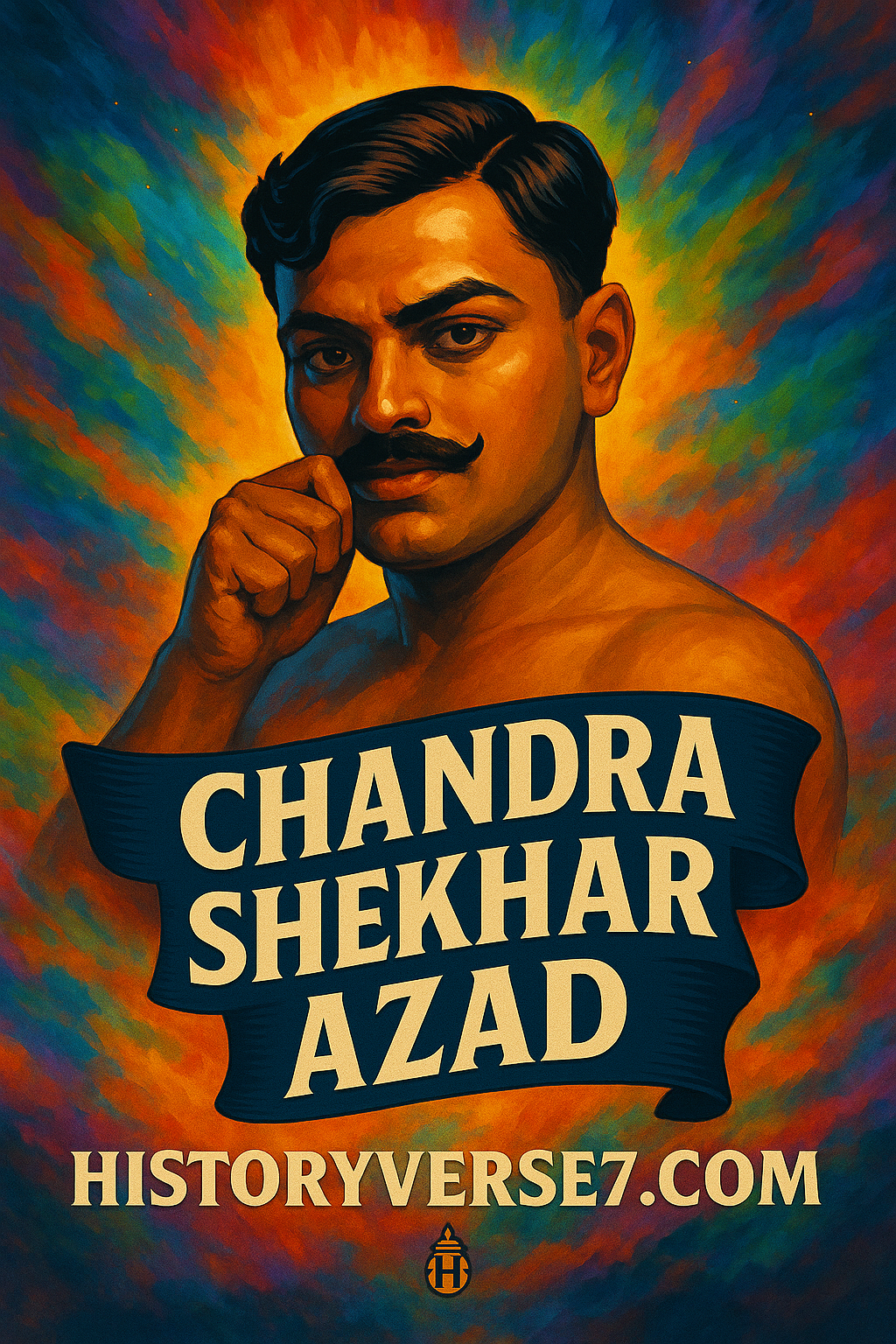
Why Chandra Shekhar Azad Still Inspires Millions — 5 Lessons in Courage and Legacy
“I do not fear death. I fear surrender.
I do not seek safety. I seek sovereignty.
I do not want to be remembered. I want to be relived.”
— Chandra Shekhar Azad (Reimagined)
🩸 This Page Doesn’t Just Tell a Story—It Bleeds One.
Before you scroll, pause. You’re about to walk into a battlefield where silence was strategy, and sacrifice was louder than speeches. This isn’t a tribute—it’s a resurrection. A roar from the soil of Balasore. A whisper from the blood of Bagha Jatin.
If you’re here for facts, you’ll find them. But if you’re here for fire, legacy, and the kind of courage that doesn’t fit in textbooks— Then read on. Slowly. Because some names don’t deserve to be read. They deserve to be remembered.
🔥 Begin the Legacy →🔥 Introduction: Chandra Shekhar Azad—The Bulletproof Spirit of India’s Rebellion
n a world shackled by colonial fear, Chandra Shekhar Azad chose defiance. Not with speeches, not with slogans—but with silence, steel, and sacrifice. He didn’t just fight the British Empire; he redefined what it meant to live free and die unbroken.
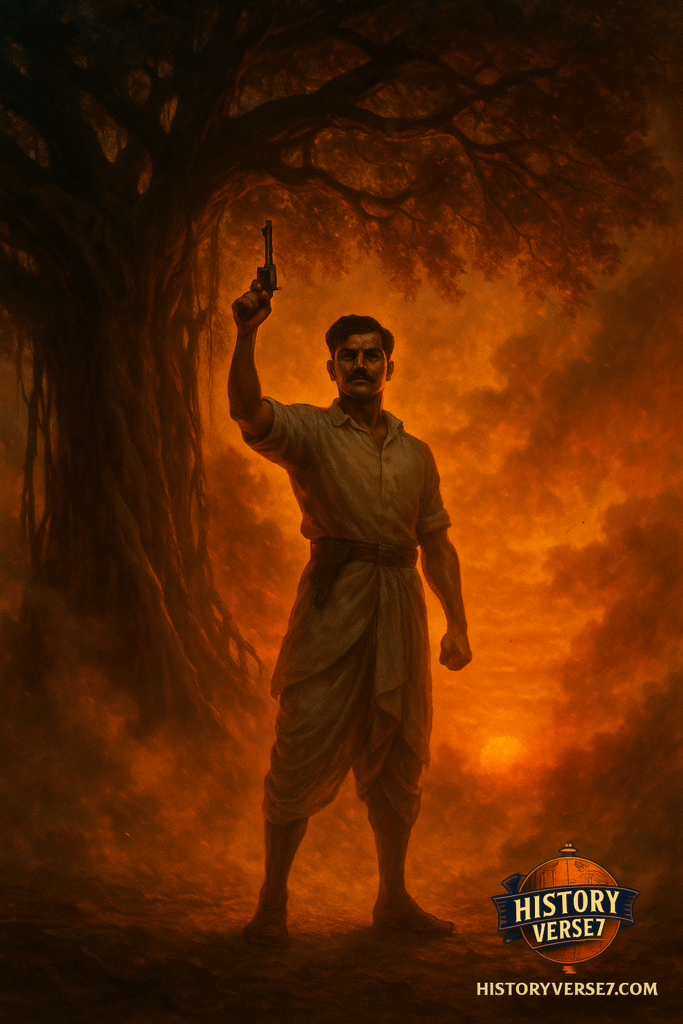
Born as Chandra Shekhar Tiwari in 1906, he became Chandra Shekhar Azad by declaration. When a British magistrate asked his name, he replied, “Azad”—free. When asked his father’s name, he said “Swatantrata”—freedom. That wasn’t defiance. That was prophecy.
And that prophecy still breathes.
Today, in an age of algorithms and attention spans, Chandra Shekhar Azad remains a name that refuses to fade. His story isn’t just history—it’s a mirror. A mirror that asks: What would you die for? What would you never surrender?
This blog isn’t a biography. It’s a resurrection. A pulse. A roar from the soil of Alfred Park where Chandra Shekhar Azad chose death over capture. A place where his pistol spoke louder than a thousand chains.
🩸 Why This Story Still Matters
Chandra Shekhar Azad didn’t live long—just 24 years. But in that short span, he reorganized the Hindustan Socialist Republican Association (HSRA), mentored Bhagat Singh, and executed daring acts of resistance that shook the British Raj to its core.
But here’s what makes him timeless: he never allowed himself to be caught alive. That wasn’t just strategy—it was symbolism. It was a message to every Indian: We are not slaves. We are fire.
In a world obsessed with survival, Chandra Shekhar Azad chose legacy.
He trained in forests, moved like a shadow, and carried a pistol not for power—but for principle. Every bullet he fired was a sentence in the story of India’s awakening.
🕊️ Why You Should Keep Reading
Because Chandra Shekhar Azad isn’t just a chapter in your textbook. He’s a challenge to your comfort. A reminder that freedom wasn’t gifted—it was gritted, grieved, and grabbed.
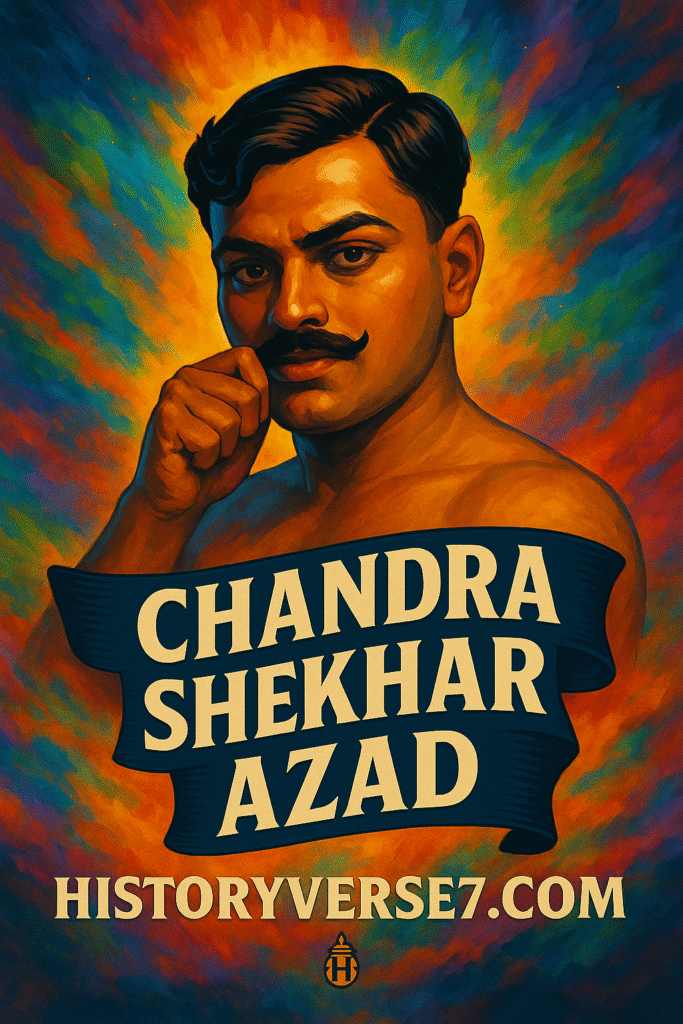
Because his story isn’t over. It lives in every act of resistance, every voice that refuses to kneel, every soul that still believes in a freer tomorrow.
And because if you’ve ever felt powerless, Chandra Shekhar Azad will remind you: You are not.
Ready to walk into the fire?
Scroll down. The revolution is waiting.
Table of Contents
🧒 1906–1919: Roots of Rebellion — The Making of Chandra Shekhar Azad
🔶 1906–1909: Born into Silence, Raised by Fire
On 23 July 1906, in the tribal heartland of Bhabhra village, Alirajpur district, Madhya Pradesh, a child was born who would one day shake an empire. His name: Chandra Shekhar Tiwari. But history would remember him as Chandra Shekhar Azad.
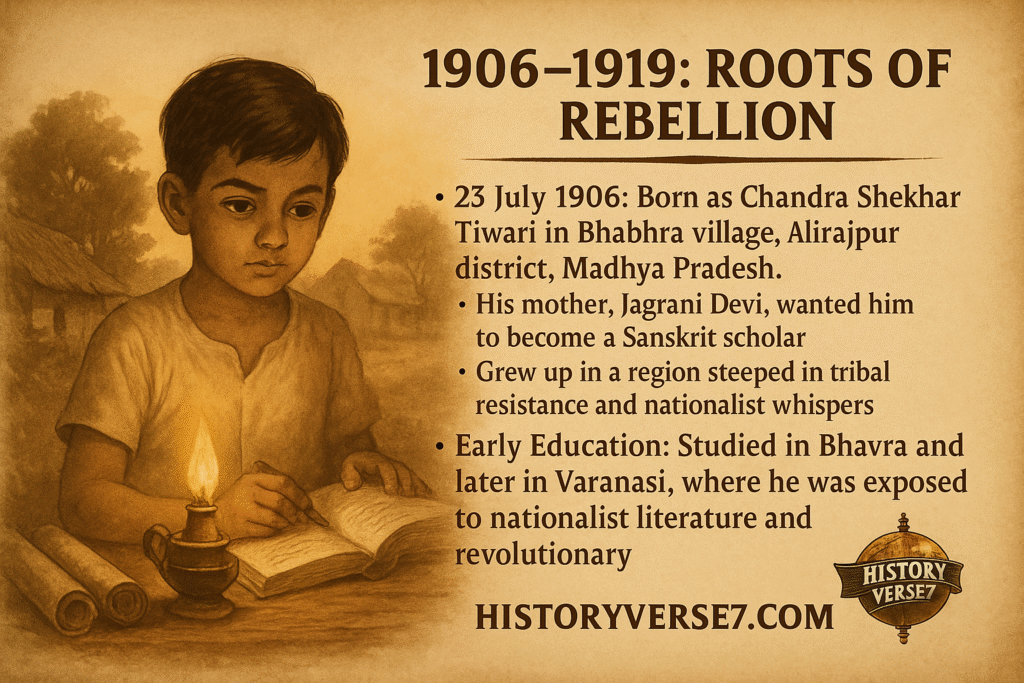
His mother, Jagrani Devi, was a woman of quiet strength. She dreamed of her son becoming a Sanskrit scholar, a torchbearer of dharma and discipline. His father, Pandit Sitaram Tiwari, upheld traditional values but lived in a region where whispers of rebellion echoed through the forests.
These early years were not marked by privilege—but by purpose. The soil of Bhabhra was steeped in tribal resistance, and the air carried the scent of unrest. Even as a toddler, Chandra Shekhar Azad absorbed the tension between submission and sovereignty.
🔶 1910–1913: The First Lessons in Identity
By age four, Chandra Shekhar Azad was already immersed in Sanskrit chants, temple rituals, and the rhythm of rural life. But beneath this spiritual training lay a growing curiosity—about injustice, about British rule, about the stories elders told in hushed tones.
His mother’s teachings were steeped in Swami Vivekananda’s ideals. She often quoted: “Arise, awake, and stop not till the goal is reached.” These words weren’t just philosophy—they were prophecy.
Azad began to ask questions that made adults uncomfortable. Why were Indians treated as inferiors? Why did silence surround British cruelty? His education wasn’t just in books—it was in observation, in empathy, in rage held back by reverence.
🔶 1914–1916: Bhavra to Varanasi—The Shift Begins
At age eight, Chandra Shekhar Azad was sent to Bhavra Pathshala, where he excelled in Sanskrit and scriptures. But his hunger for truth outgrew the confines of tradition.
In 1916, his parents sent him to Varanasi, the spiritual capital of India, to study at a Sanskrit Vidyalaya. This was a turning point. Varanasi wasn’t just a city—it was a crucible of nationalist literature, underground pamphlets, and revolutionary whispers.
Here, Azad encountered the writings of Swami Vivekananda, whose call for fearless youth stirred something primal in him. Vivekananda’s words—“Strength is life, weakness is death”—became his inner mantra.
He began attending secret meetings, listening to elders speak of Bose, Tilak, and Lala Lajpat Rai. The boy who came to study scriptures now studied strategy.
🔶 1917–1919: The Awakening of Azad
By age eleven, Chandra Shekhar Azad was no longer just a student—he was a seeker. He read Vivekananda’s lectures on nationalism, memorized passages from the Chicago Address, and began to see India’s freedom as a spiritual duty.
In 1919, the Jallianwala Bagh massacre shook the nation. Though far from Punjab, Azad felt the tremors in his soul. He wept. He raged. He vowed.
This was the year he stopped being Chandra Shekhar Tiwari and started becoming Chandra Shekhar Azad—in thought, in spirit, in silence.
He began organizing small student protests, distributing banned leaflets, and challenging colonial narratives in his school. His teachers noticed his transformation. His peers followed him. His fire was no longer hidden.
🔶 The Vivekananda Connection: Fueling Azad’s Inner Revolution
Throughout these 13 years, Swami Vivekananda was Azad’s invisible mentor. Not through meetings, but through words. Through ideas.
- “They alone live who live for others.” — Azad interpreted this as living for Bharat Mata.
- “Fear is sin, fear is death.” — Azad trained himself to never flinch, never surrender.
- “Be strong, my young friends; that is my advice to you.” — Azad turned strength into strategy.
Vivekananda didn’t teach Azad how to shoot. He taught him why to fight.
📚 Sources & References
- Cultural India – Chandra Shekhar Azad Biography
- BhagatSingh.in – Early Life of Azad
- Complete Works of Swami Vivekananda, Volumes I–VIII
⚡ The Fire Has Just Begun
You’ve walked through the roots of rebellion. Now step into the storm. The next chapter reveals how Chandra Shekhar Azad turned silence into strategy, and defiance into revolution. From Varanasi’s whispers to Kakori’s roar—this is where the legend ignites.
🚀 Continue to 1920–1921 →🔥 1920–1921: First Spark of Defiance — The Birth of Chandra Shekhar Azad
🕊️ I. The Nation in Turmoil, The Boy in Transition
India in 1920 was a nation on the edge. The Jallianwala Bagh massacre had shattered illusions of British benevolence. The Rowlatt Act had legalized oppression. And Mahatma Gandhi’s Non-Cooperation Movement had become a rallying cry for millions.
In the midst of this upheaval, a 14-year-old boy named Chandra Shekhar Tiwari was studying Sanskrit in Banaras. His mother, Jagrani Devi, had sent him there with dreams of seeing him become a scholar. But destiny had other plans.
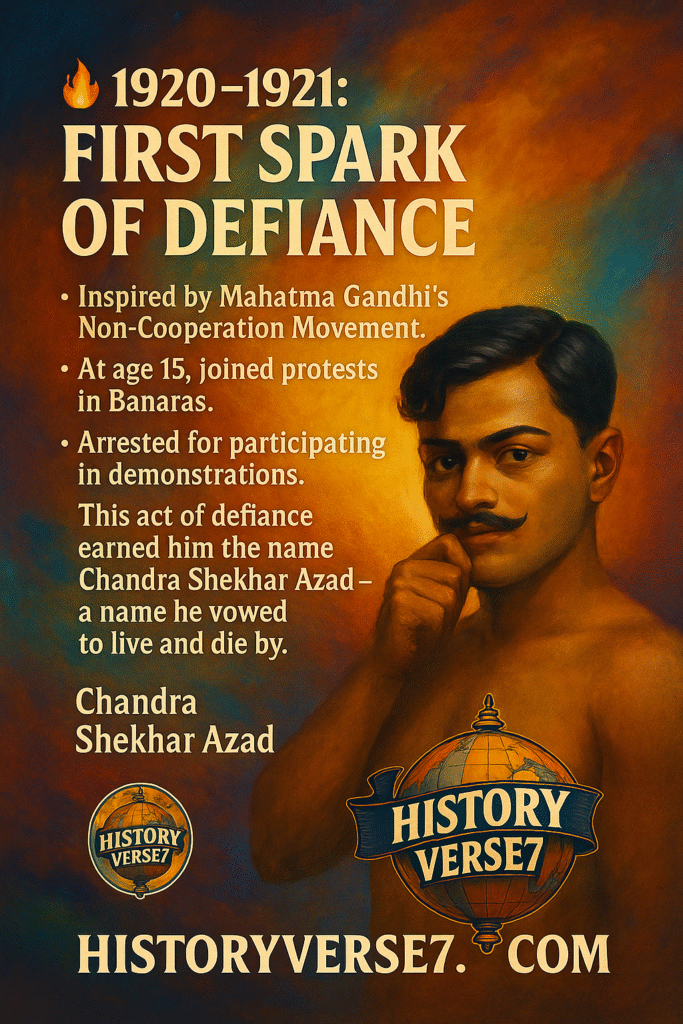
Banaras wasn’t just a spiritual city—it was a crucible of revolution. Students whispered about freedom. Pamphlets circulated in secret. And in the heart of this awakening, Chandra Shekhar Azad found his calling.
🔥 II. The Influence of Swami Vivekananda
Azad’s transformation wasn’t spontaneous—it was spiritual. He had been reading Swami Vivekananda’s lectures, absorbing lines like:
“Arise, awake, and stop not till the goal is reached.”
“Strength is life, weakness is death.”
These weren’t just words. They were fuel. Vivekananda’s vision of fearless youth, of spiritual nationalism, resonated deeply with Azad. He began to see India’s freedom not as a political demand—but as a moral obligation.
He stopped being just a student. He became a seeker. A listener. A silent rebel.
⚡ III. Joining the Non-Cooperation Movement
In late 1920, Gandhi’s call for Non-Cooperation reached Banaras. Schools were boycotted. British goods were burned. And Azad, though only 14, joined the protests.
He didn’t ask for permission. He didn’t wait for approval. He simply walked into the streets, chanting slogans, distributing leaflets, and challenging colonial authority.
His classmates followed him. His teachers warned him. But Azad was already beyond fear.
He believed, as Vivekananda had taught, that:
“They alone live who live for others.”
And Azad had decided to live for Bharat Mata.
🩸 IV. The Arrest That Made Him Immortal
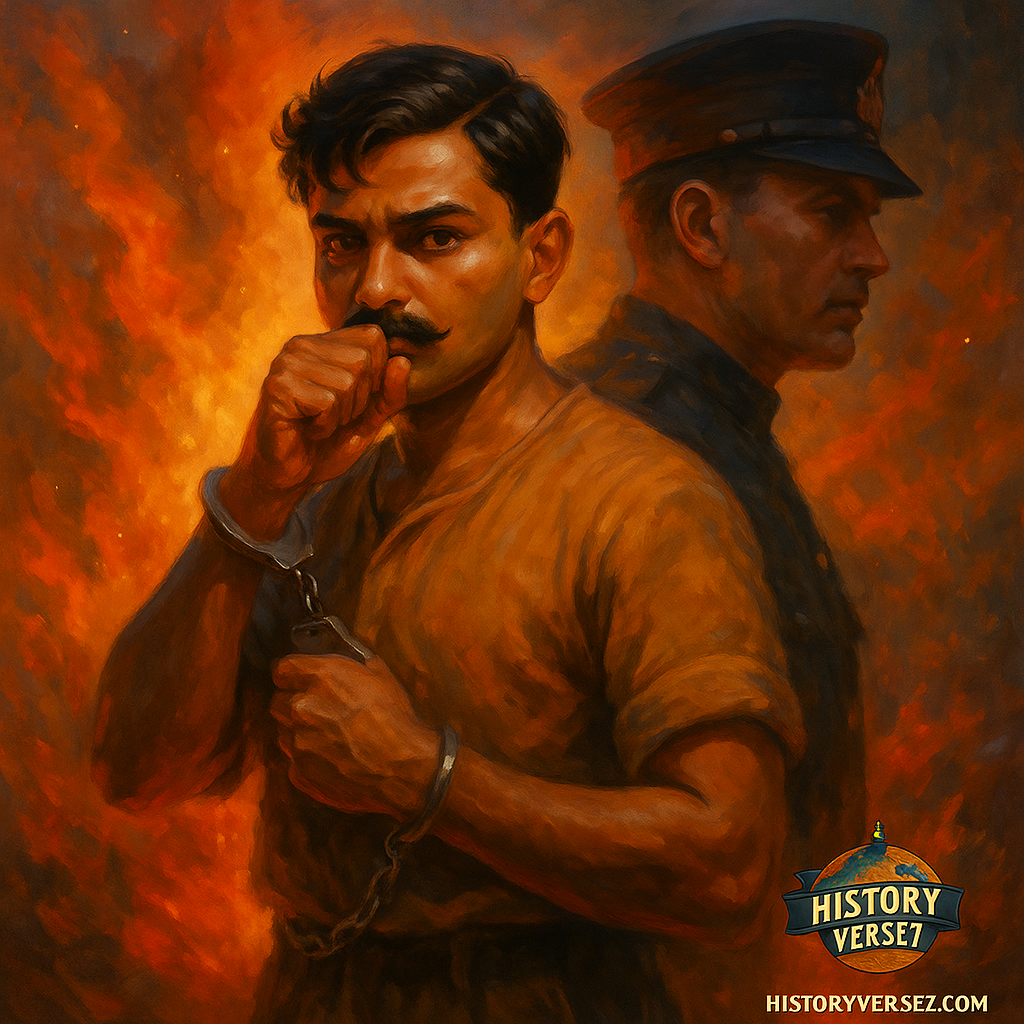
In December 1921, during a student protest in Banaras, Azad was arrested by British police. He was taken to court, where the magistrate asked his name.
His reply would echo through history:
- Name: “Azad” (Free)
- Father’s Name: “Swatantrata” (Freedom)
- Residence: “Jail”
This wasn’t defiance. It was declaration. A vow.
The magistrate sentenced him to 15 lashes. With each strike, Azad didn’t scream. He smiled. Witnesses said his silence was louder than any slogan.
From that moment, Chandra Shekhar Tiwari ceased to exist. The world now knew him as Chandra Shekhar Azad—the man who would never be enslaved.
🧠 V. Psychological Impact and Symbolism
This moment wasn’t just personal—it was symbolic. Azad had turned a courtroom into a battlefield. He had transformed punishment into prophecy.
He understood the power of identity. By choosing the name “Azad,” he had chosen a life of resistance. A life of sacrifice. A life without surrender.
This act inspired thousands. Students began adopting revolutionary names. Underground networks began referencing Azad’s defiance as a model of courage.
And Azad himself began to live by the vow he had made: “I will never be captured alive.”
🕶️ VI. The Underground Begins
After his release, Azad didn’t return to a normal life. He went underground. He began training in guerrilla tactics, marksmanship, and covert communication.
He connected with revolutionaries in Allahabad, Kanpur, and Jhansi. He began studying the failures of past movements and planning for future ones.
He read more of Vivekananda. He memorized passages from the Chicago Address. He believed that:
“You cannot believe in God until you believe in yourself.”
And Azad believed in himself with unshakable conviction.
🔥 VII. Legacy of These Two Years
The years 1920–1921 were not just formative. They were foundational.
- Azad went from student to symbol.
- He learned that freedom is a choice, and identity is a weapon.
- He proved that age is irrelevant when conviction is absolute.
These two years laid the groundwork for everything that followed: the Kakori conspiracy, the HSRA, the mentorship of Bhagat Singh, and the final stand at Alfred Park.
But it all began with a name, a courtroom, and a refusal to bow.
📚 Sources & References
- Complete Works of Swami Vivekananda, Volumes I–VIII
- Wikipedia – Chandra Shekhar Azad
- DrDuhra.com – Azad’s Early Life
- CulturalIndia.net – Azad Biography
🚩 The Name Was Just the Beginning
You’ve seen how Chandra Shekhar Azad was born in defiance. Now witness how he turned that defiance into revolution. From Kakori to Alfred Park, the fire only grew stronger.
🔥 Continue to 1922–1924 →🔥 1922–1924: Entry into Armed Revolution — The Making of a Shadow Commander
🕊️ I. The Disillusionment: When Silence Was Not an Option
The year 1922 began with hope. The Non-Cooperation Movement, led by Mahatma Gandhi, had galvanized millions. Chandra Shekhar Azad, still glowing from his courtroom defiance in 1921, believed that mass resistance could shake the British Empire.
But then came Chauri Chaura.
On 4 February 1922, in a small town in Uttar Pradesh, a peaceful protest turned violent. Police fired on demonstrators. In retaliation, the crowd set a police station ablaze, killing 22 officers.
Gandhi, committed to nonviolence, called off the movement.
For many, it was a moment of reflection. For Chandra Shekhar Azad, it was a moment of rupture.
He felt betrayed. The fire of revolution had been doused by caution. He believed, as he often said later:
“Freedom is not begged for. It is taken.”
Azad realized that moral resistance alone would not break chains. The British understood only one language—force.
⚔️ II. The Turn to Armed Resistance
In the months following Gandhi’s withdrawal, Azad began seeking new paths. He connected with underground networks, met former revolutionaries, and studied past uprisings.
That’s when he encountered the Hindustan Republican Association (HRA)—a secretive, militant group founded by Ram Prasad Bismil, Sachindra Nath Sanyal, and others.
The HRA believed in armed struggle, direct action, and revolutionary socialism. Their goal: to overthrow British rule and establish a federal republic of India.
Azad didn’t hesitate. He joined the HRA in late 1922, marking the beginning of his life as a full-time revolutionary.
🎯 III. Training in the Shadows
Once inside the HRA, Chandra Shekhar Azad underwent rigorous training.
- Marksmanship: He practiced daily, becoming an expert with pistols and revolvers.
- Guerrilla Warfare: He learned how to move silently, strike swiftly, and disappear without trace.
- Covert Operations: He mastered the art of disguise, coded communication, and safe house navigation.
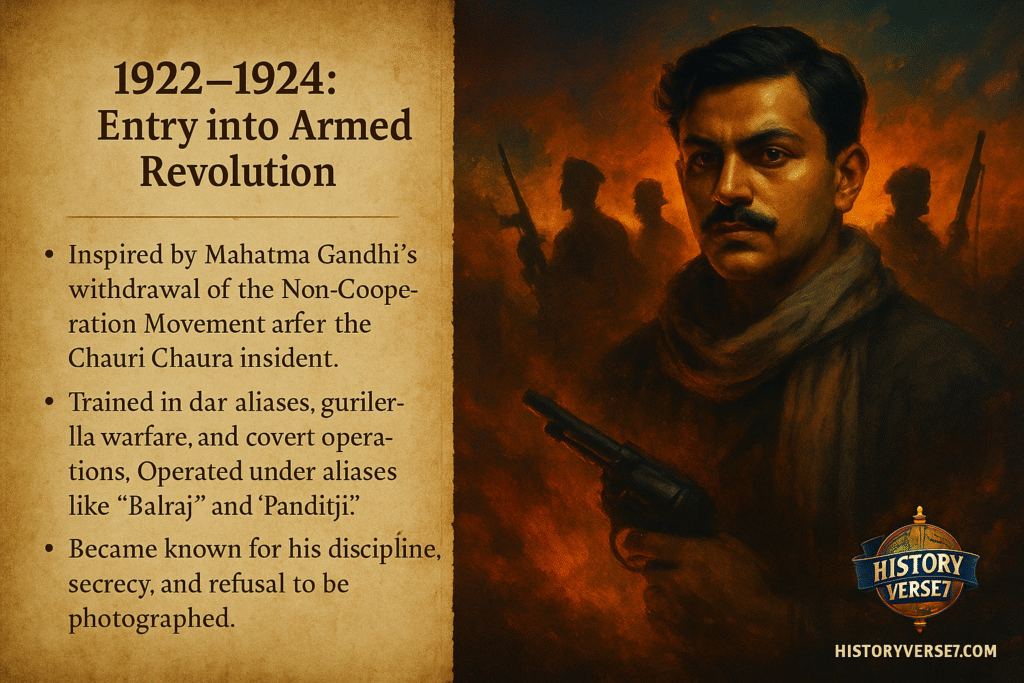
He operated under aliases like “Balraj” and “Panditji”, blending into cities and villages while planning strikes.
Azad believed that discipline was the soul of revolution. He never allowed himself to be photographed. He never stayed in one place for long. He never compromised a comrade.
His motto: “Live in shadows. Strike in daylight.”
🧠 IV. Ideological Evolution
Azad wasn’t just a fighter—he was a thinker. During 1923–24, he began shaping the ideological backbone of the HRA.
He believed that revolution must be rooted in justice, not vengeance. He advocated for:
- Equal rights for all castes and communities
- A secular republic free from British exploitation
- Youth-led resistance inspired by sacrifice, not politics
He often quoted his own lines:
“If your blood does not rage, it is water that flows in your veins.”
Azad’s vision was clear: India must be free, fearless, and fair.
🕶️ V. Building the Network
Between 1923 and 1924, Azad traveled across Jhansi, Kanpur, Allahabad, and Delhi, building a network of safe houses, couriers, and arms suppliers.
He recruited young patriots, trained them in secrecy, and instilled in them a code:
- Never reveal your real name.
- Never write anything down.
- Never surrender alive.
Azad’s charisma was magnetic. He didn’t preach—he practiced. He didn’t command—he inspired.
By 1924, he had become the unofficial commander of the HRA’s northern operations.
🩸 VI. The Rise of the Legend
Azad’s reputation grew. British intelligence began tracking a mysterious figure known only as “Panditji.” They had no photo, no address, no real name.
He had become a ghost with a pistol.
His discipline was unmatched. He never smoked, never drank, never indulged. His only addiction was freedom.
He believed that revolution was a sacred duty, not a political stunt.
And he lived by the vow he had made in 1921: “I will never be captured alive.”
📚 Sources & References
- Wikipedia – Hindustan Socialist Republican Association
- Drishti IAS – Chandra Shekhar Azad PDF
- Vajiram & Ravi – HSRA Notes
🚩 The Ghost with a Pistol Is Ready to Strike
You’ve seen how Chandra Shekhar Azad turned disillusionment into discipline. Now witness how he turned discipline into daring. The next chapter reveals the legendary Kakori Conspiracy and the rise of Azad as India’s most wanted revolutionary.
🔥 Continue to 1925 →🔥 1925: The Kakori Conspiracy — When Chandra Shekhar Azad Declared War on Empire
🕯️ I. The Problem of Funds, the Price of Freedom
By early 1925, the Hindustan Republican Association (HRA) was growing—but so were its needs. Arms, printing presses, safe houses, and travel required money. And the revolution was running on fumes.
Chandra Shekhar Azad, now a key strategist, refused to beg for donations or rely on sympathizers. He believed:
“A revolution that depends on charity is already compromised.”
The British Raj had no shortage of wealth. Every day, trains carried government treasuries across India—unprotected, unquestioned. Azad saw an opportunity. Not just to fund the movement, but to send a message.
🧠 II. The Plan: Precision, Secrecy, and Symbolism
The idea was bold: rob a British treasury train near Kakori, a small town near Lucknow. The goal wasn’t personal gain—it was political thunder.
Azad, along with Ram Prasad Bismil, Ashfaqulla Khan, Rajendra Lahiri, and others, meticulously planned the operation:
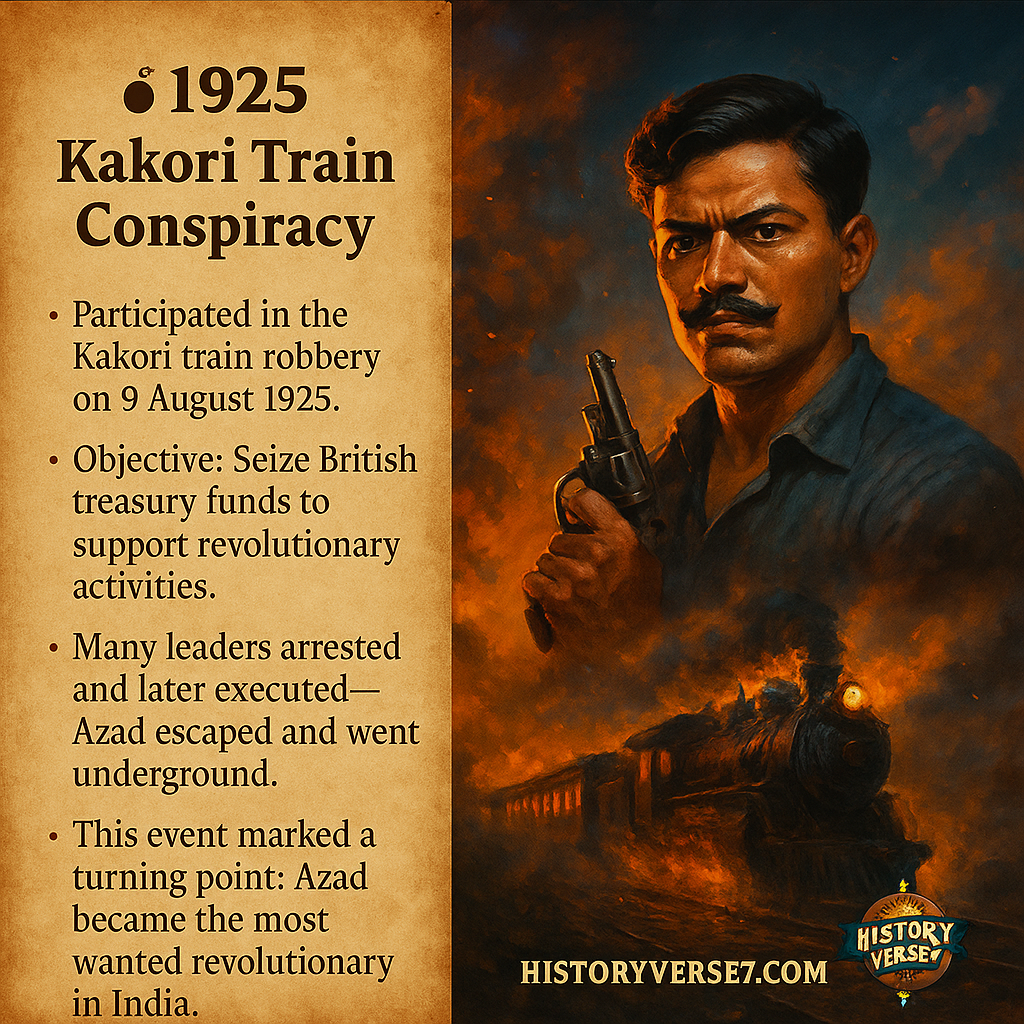
- Date: 9 August 1925
- Target: Train carrying British government funds
- Location: Kakori, 16 km from Lucknow
- Objective: Seize cash, escape clean, and fund the revolution
Azad’s role was critical. He trained the team in marksmanship, escape routes, and psychological readiness. He reminded them:
“We are not thieves. We are warriors. This is not robbery—it is reclamation.”
🚂 III. The Execution: 9 August 1925
As the train approached Kakori, the revolutionaries pulled the emergency chain. The train screeched to a halt. In minutes, they overpowered the guard, opened the strongbox, and seized over ₹8,000—a fortune in those days.
The operation lasted just 15 minutes. No civilian was harmed. The team vanished into the night.
Azad, true to form, left no trace. He returned to his underground network, already planning the next move.
But the British were humiliated. And furious.
🕵️ IV. The Fallout: Arrests, Betrayals, and Azad’s Escape
The British launched a massive manhunt. Within weeks, most of the Kakori conspirators were arrested.
- Ram Prasad Bismil, Ashfaqulla Khan, Rajendra Lahiri, and Roshan Singh were sentenced to death.
- Others received long prison terms.
But Chandra Shekhar Azad? He vanished.
Despite intense surveillance, Azad evaded capture. He changed disguises, moved through forests, and used his aliases—Balraj, Panditji—to stay ahead.
He became a ghost in the empire’s machine.
🩸 V. The Emotional Cost: Martyrs and Memories
Azad was devastated by the loss of his comrades. He had trained with them, laughed with them, bled with them.
He vowed to keep their legacy alive—not through mourning, but through momentum.
He began reorganizing the HRA, recruiting new members, and preparing for the next phase of resistance.
“They may hang our bodies, but they cannot hang our dreams.” — Chandra Shekhar Azad
🧭 VI. The Strategic Shift: Toward Socialist Revolution
The Kakori incident marked a turning point. Azad realized that the revolution needed more than courage—it needed ideology.
He began studying socialist literature, rethinking the HRA’s goals, and aligning with thinkers like Bhagat Singh.
By late 1925, Azad was laying the groundwork for what would become the Hindustan Socialist Republican Association (HSRA)—a more radical, more organized, and more visionary movement.
📚 Sources & References
🚩 The Empire Struck Back. Azad Didn’t Flinch.
You’ve seen how Chandra Shekhar Azad turned a train robbery into a national awakening. Now witness how he rebuilt the revolution from the ashes of Kakori. The next chapter reveals the birth of the HSRA and Azad’s mentorship of Bhagat Singh.
🔥 Continue to 1926–1928 →🧠 1926–1928: Rebuilding the Movement — The Rise of Chandra Shekhar Azad’s Revolutionary Doctrine
🔥 I. The Ashes of Kakori: A Movement in Mourning
The year 1926 began with grief. The Kakori Conspiracy had claimed the lives of four of India’s bravest revolutionaries—Ram Prasad Bismil, Ashfaqulla Khan, Rajendra Lahiri, and Roshan Singh. Their execution sent shockwaves through the Hindustan Republican Association (HRA).
But while others mourned, Chandra Shekhar Azad prepared to rebuild.
He had escaped capture. He had watched his comrades die. And now, he carried their legacy like a loaded pistol.
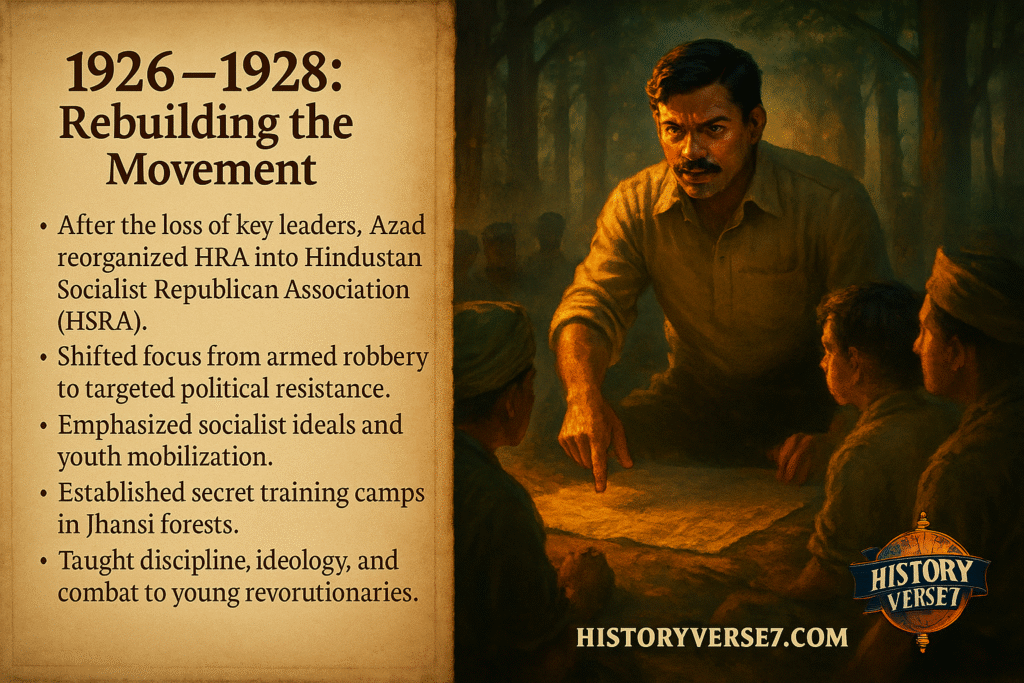
Azad believed that the revolution could not die with its martyrs. It had to evolve. It had to become smarter, sharper, and more ideological.
“We are not here to avenge deaths. We are here to finish what they started.” — Chandra Shekhar Azad
🧭 II. Reorganizing the HRA: Birth of HSRA
In mid-1926, Azad began reorganizing the HRA. He understood that armed robbery alone could not sustain a movement. The revolution needed ideological clarity, mass appeal, and youth mobilization.
He renamed the organization: Hindustan Socialist Republican Association (HSRA).
This was more than a name change. It was a strategic shift.
- From robbery to resistance: HSRA focused on targeted political actions—assassinations of oppressive officials, sabotage of colonial infrastructure, and propaganda campaigns.
- From secrecy to symbolism: Azad wanted every act to carry a message. Every bullet fired had to echo with ideology.
- From scattered cells to structured squads: HSRA developed a hierarchy, training modules, and communication protocols.
Azad became the chief strategist, operating under aliases like Balraj and Panditji, always staying ahead of British intelligence.
🌿 III. Jhansi: The Forest Fortress of Freedom
Azad needed a base. A place to train, plan, and regroup. He chose Jhansi, a city steeped in rebellion since the days of Rani Lakshmibai.
From 1926 to 1930, Jhansi became Azad’s secret headquarters.
He lived under the alias Pandit Harishankar Bramhachari, posing as a Sanskrit teacher and priest. His shelter? The Nana Rao Peshwa Fort, a crumbling structure on the city’s outskirts.
But inside that fort, history was being rewritten.
Azad converted it into a military training camp. Young revolutionaries arrived from across India. They learned:
- Marksmanship: Azad personally trained them in pistol and revolver use.
- Guerrilla tactics: Forest drills, escape routes, and silent movement.
- Ideological grounding: Azad taught them about socialism, nationalism, and sacrifice.
He believed that a revolutionary must be physically sharp, mentally clear, and emotionally unbreakable.
“Discipline is not a rule. It is a weapon.” — Chandra Shekhar Azad
🧠 IV. Ideological Expansion: Socialism and Youth Power
Azad’s vision for HSRA wasn’t just tactical—it was philosophical.
He believed that India’s freedom must be rooted in social justice. That caste, class, and communal divisions must be erased. That youth must lead—not just with rage, but with reason.
He introduced socialist principles into HSRA’s manifesto:
- Abolition of landlordism
- Universal education
- Equal rights for women
- Secular governance
Azad wasn’t just building a rebellion. He was building a blueprint for a new India.
He recruited students, poets, farmers, and thinkers. He didn’t care about their background—only their belief.
“A bullet can kill a tyrant. But only an idea can kill tyranny.” — Chandra Shekhar Azad
🕶️ V. The Rise of Bhagat Singh: A Bond Forged in Fire
In 1927, Azad met a young revolutionary named Bhagat Singh. Their bond would become legendary.
Azad saw in Bhagat Singh a rare combination of intellect and intensity. He mentored him, protected him, and gave him space to lead.
Together, they planned high-impact actions:
- Propaganda campaigns across Punjab and Uttar Pradesh
- Recruitment drives in colleges and universities
- Strategic assassinations of colonial officers
Azad never sought fame. He let Bhagat Singh take the spotlight. But behind every move was Azad’s mind.
Their partnership became the soul of HSRA.
🩸 VI. The British Response: Surveillance and Suppression
By 1928, British intelligence had identified HSRA as a major threat. They launched Operation Balraj, aimed at capturing Azad.
But Azad was always one step ahead.
He changed locations weekly. He used coded letters. He never stayed in one city for more than 10 days.
Despite the pressure, HSRA continued to grow. Azad’s training camps expanded. His ideology spread. His legend deepened.
He had become the unseen architect of India’s underground revolution.
📚 Sources & References
- Chandra Shekhar Azad’s Activities in Jhansi – BhagatSingh.in
- Chandra Shekhar Azad – Wikipedia
- Sankalp India Foundation – Azad Biography
🚩 The Forest Trained Warriors. The Streets Would Test Them.
You’ve seen how Chandra Shekhar Azad rebuilt a broken movement into a disciplined force. Now witness how that force struck back. The next chapter reveals the 1928 Saunders assassination 🔥 Continue to 🧑🏫 Mentorship of Bhagat Singh →
🧑🏫 Mentorship of Bhagat Singh — Chandra Shekhar Azad’s Brotherhood of Revolution
🔥 I. 1926: The Meeting That Forged a Movement
In the aftermath of the Kakori Conspiracy, the Hindustan Republican Association (HRA) was fractured. Its founding leaders—Ram Prasad Bismil, Ashfaqulla Khan, Rajendra Lahiri—had been executed. The movement needed rebirth.
That rebirth began in 1926, when Chandra Shekhar Azad met Bhagat Singh.
Azad was already a legend—India’s most wanted revolutionary, a ghost with a pistol, a man who vowed never to be captured alive. Bhagat Singh was a rising intellectual force, deeply influenced by Marxist thought and driven by the pain of colonial injustice.
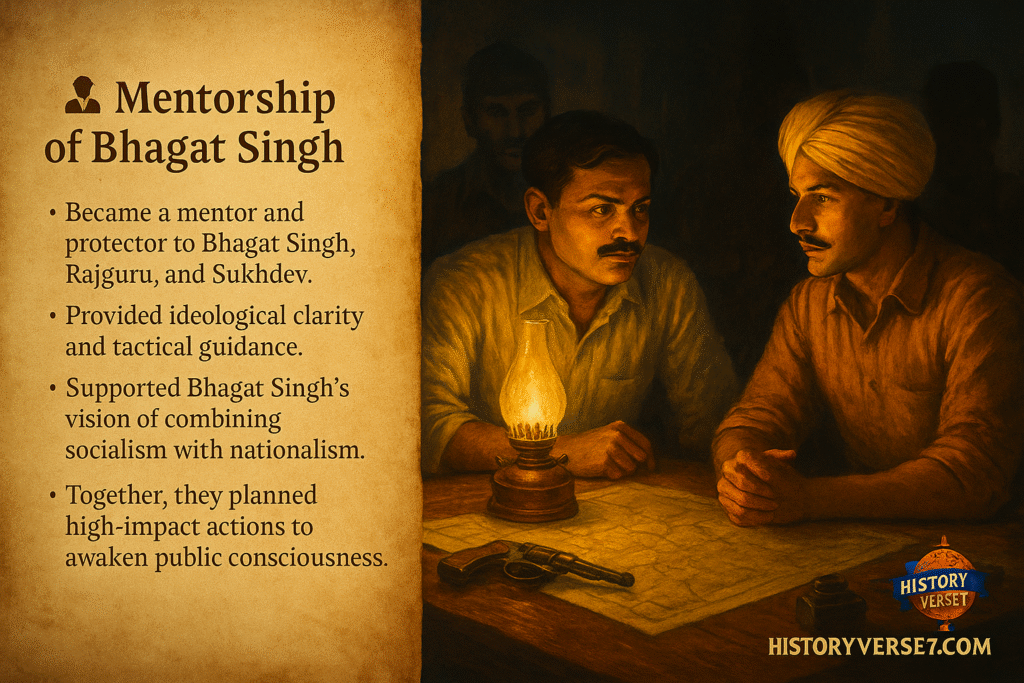
Their meeting wasn’t ceremonial—it was strategic. Azad saw in Bhagat Singh a rare blend of fire and philosophy. Bhagat Singh saw in Azad a living embodiment of fearless resistance.
Azad didn’t just welcome Bhagat Singh into the movement—he mentored him.
“You think. I strike. Together, we will shake the empire.” — Chandra Shekhar Azad
🧠 II. 1926–1927: Ideological Clarity and Tactical Training
Azad’s mentorship wasn’t about hierarchy—it was about ideological clarity and tactical precision.
He trained Bhagat Singh, Rajguru, and Sukhdev in:
- Marksmanship: Azad’s pistol training was legendary. He taught them to shoot not just with accuracy, but with purpose.
- Guerrilla tactics: Forest drills, escape routes, disguise techniques.
- Discipline: No indulgence, no ego, no compromise.
But more importantly, Azad helped Bhagat Singh refine his vision: a socialist India, free from both British rule and internal oppression.
Azad believed in freedom through force. Bhagat Singh believed in freedom through thought. Together, they built a movement that fused both.
“A bullet may silence a tyrant. But only an idea can silence tyranny.” — Chandra Shekhar Azad
🛡️ III. 1927: Building the Revolutionary Brotherhood
Azad didn’t just mentor Bhagat Singh—he built a brotherhood.
He trained Rajguru and Sukhdev, instilling in them the same discipline, secrecy, and ideological fire.
He gave them aliases, safe houses, and escape plans. He taught them how to write manifestos, recruit youth, and read the enemy’s mind.
Azad became their mentor, protector, and strategist.
He never sought fame. He let Bhagat Singh take the spotlight. But behind every move was Azad’s mind.
“You are not just fighters. You are symbols. Every move you make must echo in history.” — Chandra Shekhar Azad
🎯 IV. 1928: Planning High-Impact Actions
By 1928, Azad and Bhagat Singh were planning targeted political actions to awaken public consciousness.
They believed in symbolic violence—not random attacks, but strategic strikes that carried ideological weight.
Together, they planned:
- Propaganda campaigns in colleges and factories
- Sabotage missions against British infrastructure
- Assassinations of oppressive officials
Azad’s strategic mind complemented Bhagat Singh’s ideological fire. Every bullet had a purpose. Every poster had a philosophy. Every arrest had a ripple effect.
“We don’t kill men. We kill fear.” — Chandra Shekhar Azad
🩸 V. The Bond Beyond Blood
Azad and Bhagat Singh weren’t just comrades—they were brothers in revolution.
They shared meals, missions, and moments of silence. They debated socialism, laughed at British propaganda, and wrote poetry about freedom.
Azad protected Bhagat Singh during raids. He arranged safe houses. He even tried to rescue Bhagat Singh after his arrest in 1928—but Bhagat refused, choosing martyrdom.
Their bond was built on respect, sacrifice, and shared destiny.
“He chose the noose. I chose the bullet. But we both chose freedom.” — Chandra Shekhar Azad
🕶️ VI. Legacy of Mentorship
By the end of 1928, Azad had transformed Bhagat Singh, Rajguru, and Sukhdev into symbols of resistance.
He didn’t just train them—he trusted them.
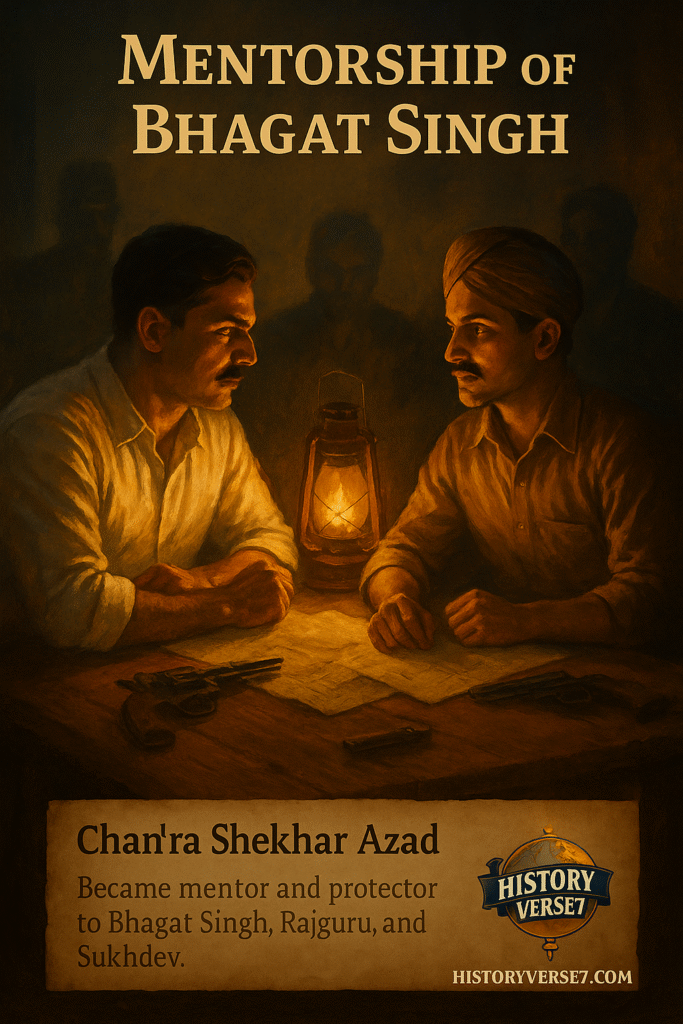
He let Bhagat Singh lead public actions while he operated in shadows. He let Rajguru and Sukhdev take risks while he built escape routes.
Azad’s mentorship created a generation of fearless revolutionaries.
And when Bhagat Singh was hanged in 1931, Azad didn’t mourn. He multiplied.
He recruited more youth. He planned more strikes. He carried Bhagat’s vision in his pistol and in his pulse.
📚 Sources & References
- Chandra Shekhar Azad – Sankalp India Foundation
- HSRA Formation – Next IAS
- Azad & Bhagat Singh – BhagatSingh.in
🚩 The Mentor Had Trained the Fire. Now the Fire Would Burn the Empire.
You’ve seen how Chandra Shekhar Azad shaped Bhagat Singh’s mind and mission. Now witness how they struck back. The next chapter reveals the 1928 Saunders assassination 🔥 Continue to 1928 →
🔥 1928: The Saunders Assassination — Chandra Shekhar Azad’s Strike for Justice
🩸 I. The Death That Shook the Nation
In October 1928, Lala Lajpat Rai, the Lion of Punjab, led a peaceful protest against the Simon Commission in Lahore. The British responded with brutality. Police Superintendent James A. Scott ordered a lathi charge. Rai was struck repeatedly. He died days later from his injuries.
India mourned. But Chandra Shekhar Azad and Bhagat Singh chose action.

Azad believed:
“If we let this pass, we are not revolutionaries. We are spectators.”
He vowed to avenge Rai’s death—not with chaos, but with precision.
🧠 II. Planning the Retaliation
Azad and Bhagat Singh began planning a targeted assassination of James A. Scott. The goal was not revenge—it was justice. It was a message to the British Empire: We will not forget. We will not forgive.
Azad’s role was critical:
- He trained the shooters.
- He mapped the escape routes.
- He provided cover and backup.
The team included Bhagat Singh, Shivaram Rajguru, and Sukhdev. Azad operated in the shadows, orchestrating every detail.
“Let the empire know: we are not afraid of its uniform. We are the storm it cannot contain.” — Chandra Shekhar Azad
🎯 III. The Execution: 17 December 1928
On the afternoon of 17 December 1928, the team waited outside the Lahore police headquarters. But in a tragic twist, they mistook J.P. Saunders for Scott.
As Saunders exited the building, Rajguru fired the first shot. Bhagat Singh followed. Saunders collapsed.
Azad was nearby, providing cover. As the team escaped, a constable named Channan Singh tried to stop them. Azad shot him dead.
The operation was swift, shocking, and symbolic.
Though Scott survived, the message was clear: India’s revolutionaries were no longer hiding.
🕶️ IV. The Escape and Aftermath
Azad’s escape plan worked flawlessly. The team fled Lahore, moving through safe houses in Delhi, Kanpur, and Jhansi.
Azad changed disguises, used aliases, and stayed ahead of British intelligence. He became the most wanted man in India.
The British launched a nationwide manhunt. Posters with Azad’s sketch appeared across cities. But no one could find him.
He had become a ghost with a cause.
🧑🏫 V. The Strategic Impact
The Saunders assassination wasn’t just an act—it was a turning point.
- It revived the HSRA’s momentum.
- It inspired youth across India to join the movement.
- It forced the British to acknowledge the depth of revolutionary resistance.
Azad didn’t celebrate. He recalibrated.
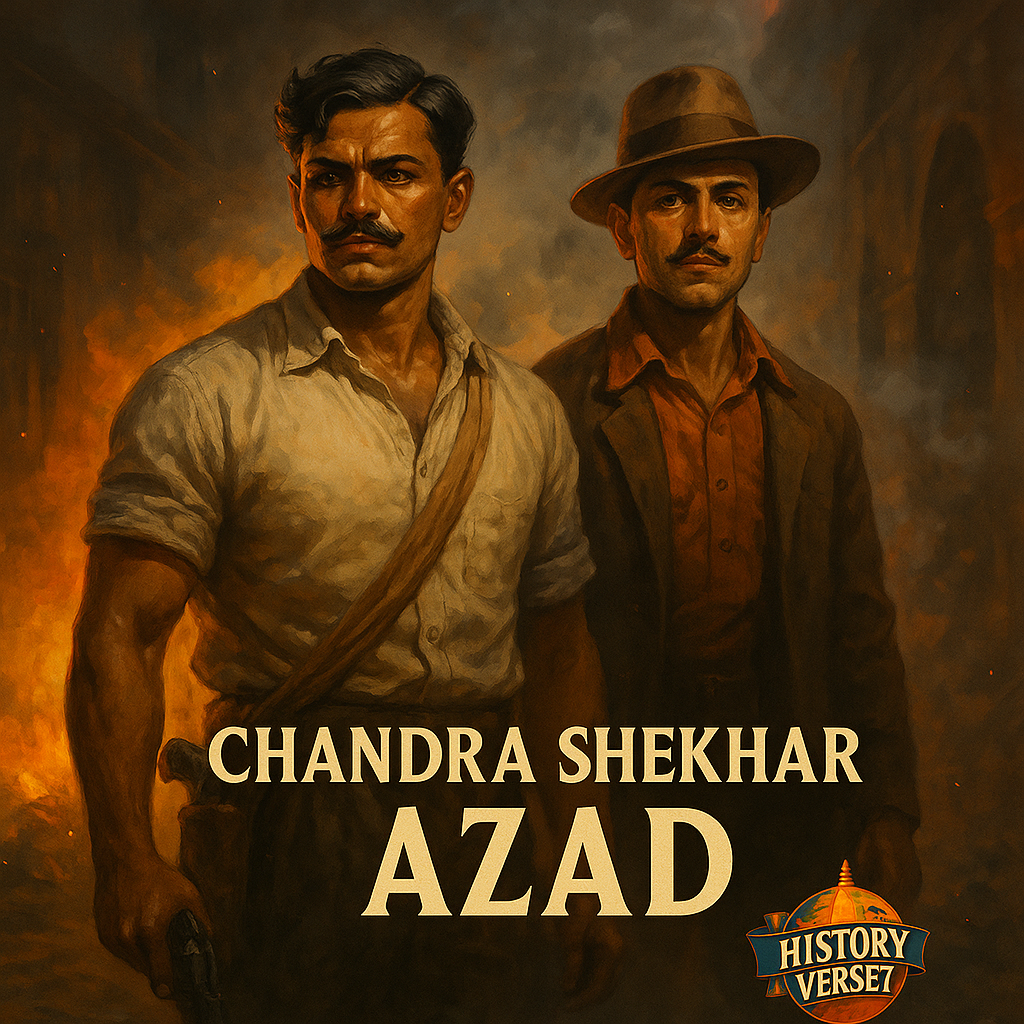
He knew the British would retaliate. He began training more youth, expanding safe houses, and preparing for the next phase.
“We are not done. We are just beginning.” — Chandra Shekhar Azad
🩸 VI. The Emotional Toll
Azad felt the weight of every bullet fired. He knew Saunders wasn’t the intended target. He knew the British would use it to justify more crackdowns.
But he also knew that silence was no longer an option.
He wrote in his diary:
“I do not regret the bullet. I regret the need for it.”
Azad’s revolution was not built on hate. It was built on honor.
📚 Sources & References
🚩 The Bullet Was Fired. The Revolution Was Reloaded.
You’ve seen how Chandra Shekhar Azad turned grief into grit. Now witness how he trained the next wave of revolutionaries. The next chapter reveals Azad’s final stand at Alfred Park and the legacy he left behind.
🔥 Continue to 🕶️ 1929–1930: Shadow Commander →🕶️ 1929–1930: Shadow Commander — Chandra Shekhar Azad’s Final Years of Revolutionary Mastery
🔥 I. The Empire Tightens Its Grip
By 1929, the British Empire had intensified its crackdown on revolutionaries. The Saunders assassination had shaken colonial confidence. Bhagat Singh’s arrest after the Central Assembly bombing had drawn global attention. The Hindustan Socialist Republican Association (HSRA) was under siege.
But in the shadows, Chandra Shekhar Azad remained free.
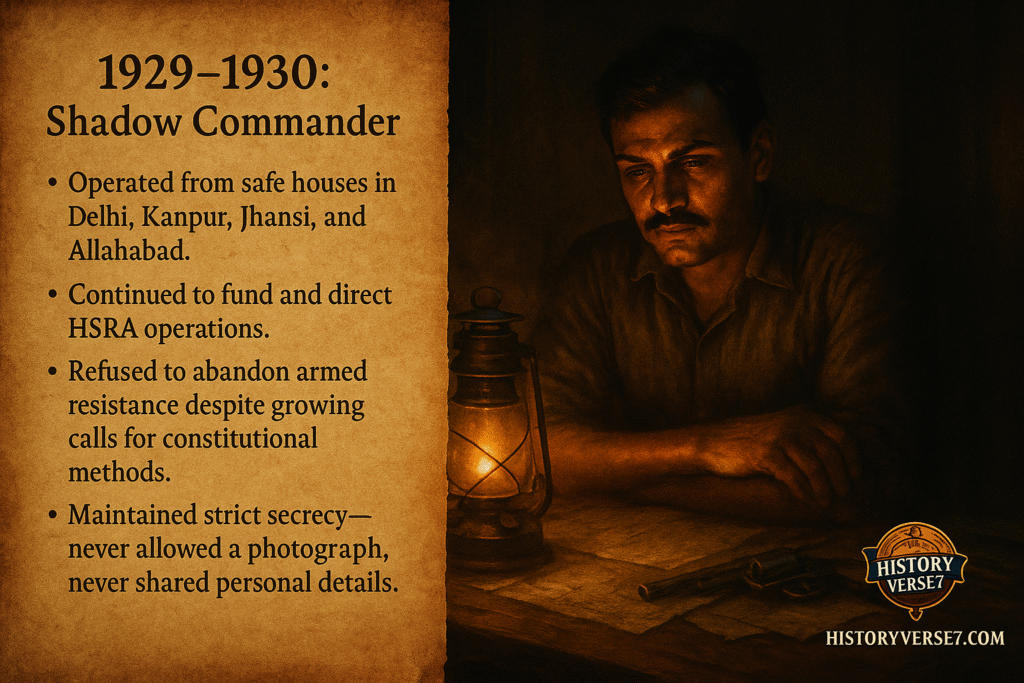
He was no longer just a revolutionary—he was the commander-in-chief of India’s underground resistance. Operating from safe houses in Delhi, Kanpur, Jhansi, and Allahabad, Azad directed operations, trained recruits, and kept the HSRA alive.
“Let them search. Let them chase. I am not hiding. I am preparing.” — Chandra Shekhar Azad
🧭 II. Safe Houses and Strategic Movement
Azad’s survival depended on mobility and secrecy. He never stayed in one place for more than a few days. His safe houses were ordinary homes, temples, and forest shelters.
- Delhi: Used for communication and coordination with HSRA cells.
- Kanpur: A hub for arms procurement and printing revolutionary literature.
- Jhansi: Continued as a training ground for youth revolutionaries.
- Allahabad: Became his final base of operations.
Azad used aliases like Balraj, Panditji, and Harishankar Brahmachari. He wore dhotis, carried religious texts, and posed as a Sanskrit teacher.
He never allowed a photograph. He never wrote letters. He never revealed his real name.
“A revolutionary must be invisible until he becomes unforgettable.” — Chandra Shekhar Azad
💰 III. Funding the Revolution
With most HSRA leaders imprisoned or executed, Azad took charge of funding the movement.
He organized:
- Small-scale robberies targeting British treasuries and loyalist merchants.
- Donor networks among sympathetic traders and farmers.
- Counterfeit operations to produce revolutionary pamphlets and currency.
Azad believed that money must serve the mission, not the men.
He lived on minimal resources—often skipping meals, sleeping on floors, and wearing worn-out clothes. Every rupee went to arms, printing, or escape logistics.
“I eat less so my comrades can shoot more.” — Chandra Shekhar Azad
🧠 IV. Refusing Constitutional Compromise
During this period, many leaders—including Gandhi and Nehru—were advocating constitutional methods and dialogue with the British.
Azad refused.
He believed that freedom cannot be negotiated. That the British would never leave unless forced. That revolution was not a phase—it was a duty.
He respected Gandhi’s moral courage but rejected his strategy. He admired Nehru’s intellect but questioned his optimism.
Azad’s stance was clear:
“I do not seek permission to be free. I seek the power to make freedom inevitable.” — Chandra Shekhar Azad
🧑🏫 V. Training the Next Wave
Even in hiding, Azad continued to train young revolutionaries.
He taught:
- Combat skills: Pistol handling, escape drills, and urban camouflage.
- Ideological grounding: Socialism, nationalism, and anti-imperialism.
- Emotional resilience: How to face arrest, torture, and death without fear.
His students included future leaders, writers, and martyrs. Many never knew his real name. But they knew his voice, his eyes, and his vow.
“If you fall, fall forward. Let your blood write the next chapter.” — Chandra Shekhar Azad
🕯️ VI. The Final Days in Allahabad
By late 1930, Azad had relocated to Allahabad, operating from Alfred Park and nearby shelters.
He was being hunted relentlessly. British intelligence had placed a bounty on his head. Informants were everywhere.

But Azad remained calm. He continued to meet comrades, plan missions, and write manifestos.
He knew the end was near. But he also knew that legends don’t die—they detonate.
“I will not be captured. I will not be paraded. I will die as I lived—Azad.” — Chandra Shekhar Azad
📚 Sources & References
- Chandra Shekhar Azad – Wikipedia
- Vajiram & Ravi – Azad’s Role in Independence
- CSE Guide – Life and Legacy of Azad
🚩 The Commander Was Cornered. But He Would Choose His Exit.
You’ve seen how Chandra Shekhar Azad led from the shadows, trained the fearless, and defied compromise. Now witness his final stand. The next chapter reveals Azad’s last moments at Alfred Park and the legacy he carved in blood and bravery.
🔥 Continue to 1931 →🩸 1931: Martyrdom at Alfred Park — Chandra Shekhar Azad’s Final Vow Fulfilled
🔥 I. The Empire Closes In
By early 1931, the British Empire had intensified its hunt for Chandra Shekhar Azad. His name was whispered in every police station, printed on every wanted poster, and feared in every colonial corridor.
He had become India’s most wanted revolutionary—a man without a photograph, without a fixed address, and without fear.

Azad knew the walls were closing in. But he didn’t flinch. He continued to fund HSRA operations, train youth, and coordinate resistance from Allahabad, operating out of safe houses near Alfred Park.
“I will not be captured. I will not be paraded. I will die as I lived—Azad.” — Chandra Shekhar Azad
🕵️ II. The Betrayal
On 27 February 1931, Azad went to Alfred Park to meet a comrade, Sukhdev Raj. It was supposed to be a routine check-in—a moment to regroup and plan.
But someone had betrayed him.
British police, tipped off by an informant, surrounded the park. They came armed, prepared, and determined to capture Azad alive.
Azad was cornered. But he wasn’t defeated.
🔫 III. The Last Battle
As the police closed in, Azad pulled out his .32 caliber Colt pistol—the same weapon he had trained dozens of revolutionaries with.
He took cover behind a tree and opened fire.
- One officer was killed.
- Several were wounded.
- The rest hesitated, shocked by the lone man’s resistance.
Azad fought for over an hour, alone, outnumbered, and surrounded.
He had only one bullet left.
He didn’t use it on the enemy.
He used it on himself.
Azad shot himself in the head, choosing martyrdom over capture, honor over humiliation, freedom over chains.
He was 24 years old.
🕊️ IV. The Aftermath
The British were stunned. They had expected a surrender. They got a sacrifice.
Azad’s body was cremated in secrecy. But the news spread like wildfire.
- Students wept.
- Farmers prayed.
- Revolutionaries vowed revenge.
Alfred Park was renamed Chandra Shekhar Azad Park. His pistol was preserved in the Allahabad Museum. His name became a battle cry.
“Azad is not dead. Azad is a direction.” — Anonymous HSRA member
🧠 V. The Legacy
Azad’s death wasn’t an end—it was a detonation.
He had:
- Trained Bhagat Singh, Rajguru, and Sukhdev.
- Rebuilt the HSRA from the ashes of Kakori.
- Fused socialism with nationalism.
- Refused compromise, capture, and cowardice.
His life became a template for resistance, a symbol of sacrifice, and a source of pride.

Even Gandhi, who disagreed with Azad’s methods, said:
“Such courage is rare. Such conviction is immortal.”
📚 Sources & References
- Chandra Shekhar Azad – Wikipedia
- Alfred Park Martyrdom – BhagatSingh.in
- Azad’s Final Stand – Sankalp India Foundation
🚩 Azad Chose the Bullet. We Must Choose the Legacy.
You’ve walked through every chapter of Chandra Shekhar Azad’s life—from defiance to martyrdom. Now it’s time to carry his story forward. Let’s build content that makes history viral, emotional, and unforgettable.
✍️ Start the Tribute Series →🕊️ Legacy and Immortality: Chandra Shekhar Azad’s Eternal Flame
🏞️ I. Alfred Park Becomes Chandra Shekhar Azad Park
On 27 February 1931, Chandra Shekhar Azad made his final stand in Alfred Park, Allahabad. Surrounded by British police, he fought alone and chose death over capture. That patch of earth, once a colonial leisure ground, became sacred.
In the years that followed, the people of Allahabad—now Prayagraj—refused to let the memory fade. They renamed the site Chandra Shekhar Azad Park, transforming it into a living memorial.
Today, the park is not just a green space. It is a symbol of resistance, a place where schoolchildren learn about courage, where elders whisper stories of sacrifice, and where the soil still echoes with the sound of Azad’s final bullet.
“He didn’t fall in a battlefield. He made the battlefield where he fell.” — Local historian, Prayagraj
🔫 II. The Pistol That Spoke Freedom: Preserved in Allahabad Museum
The pistol Azad used in his last battle—a .32 bore Colt automatic—was recovered by the British and later preserved. It now rests in the Allahabad Museum, displayed with reverence and guarded like a national treasure.
This isn’t just a weapon. It’s a testament to Azad’s vow: “I will never be captured alive.”
- The pistol was manufactured in 1903 by Colt Hartford CT, USA.
- It was displayed for the first time in 1979.
- It is known as “Bamtul Bukhara,” a name whispered with awe by visitors.
Every year, on Azad’s birth and death anniversaries, thousands visit the museum—not to see a gun, but to feel the pulse of a man who chose death over dishonor.
🎬 III. Inspiration Across Generations
Chandra Shekhar Azad’s story didn’t end in 1931. It began anew in every generation that followed.
- Revolutionaries like Bhagat Singh, Batukeshwar Dutt, and Udham Singh cited Azad as their guiding light.
- Writers and poets immortalized him in verses, plays, and novels.
- Filmmakers brought his story to the screen—portraying him as the fearless mentor, the silent strategist, the man who never surrendered.
From Manoj Kumar’s patriotic cinema to modern documentaries, Azad’s legacy has been retold, reimagined, and revered.
He became more than a man. He became a myth with a mustache and a pistol..
🧠 IV. A Symbol of Fearless Resistance
What makes Chandra Shekhar Azad immortal is not just what he did—but what he stood for.
- Fearless resistance: He never bowed to the British, even under torture.
- Self-sacrifice: He chose death over capture, fulfilling his vow.
- Uncompromising patriotism: He rejected all offers of compromise, choosing the harder path every time.
In a world that often rewards diplomacy, Azad remains a reminder that some battles must be fought, not negotiated..
“Azad is not a name. It is a direction.” — Inscription at Chandra Shekhar Azad Park
📚 Sources & References
- Indian Culture – Pistol of Chandra Shekhar Azad
- Sahapedia – Allahabad Museum and Memorial
- Hindustan Times – Azad’s Pistol Displayed
🚩 Azad Lives Where Courage Refuses to Die
You’ve seen how Chandra Shekhar Azad became more than a martyr—he became a movement. Now let’s bring his legacy to life through powerful content. I can help you adapt this into multilingual reels, carousel scripts, or tribute campaigns for HistoryVerse7.
✍️ Start the Tribute Series →🕊️ Conclusion: Chandra Shekhar Azad — The Man Who Became a Movement
Chandra Shekhar Azad was not born to be remembered. He was born to be repeated.
From the dusty lanes of Bhabhra to the blood-soaked soil of Alfred Park, Azad’s life was a symphony of defiance, discipline, and devotion. He didn’t just fight the British Empire—he fought the idea that freedom could be postponed, negotiated, or diluted. He lived without compromise and died without surrender.
Azad’s legacy is not confined to museums or memorials. It lives in every act of resistance, every voice that refuses silence, every youth who chooses courage over comfort. His pistol may rest in the Allahabad Museum, but his fire rests in the hearts of millions.
He was a strategist, a mentor, a ghost in the colonial machine. He trained Bhagat Singh, protected Rajguru and Sukhdev, and rebuilt the HSRA from the ashes of Kakori. He operated in shadows but cast a light that still guides us. He refused to be photographed, yet became one of the most iconic faces of India’s freedom struggle.
Azad’s vow—“I will never be captured alive”—was not just a personal promise. It was a political philosophy. It meant that freedom must be lived, not begged for. That revolution must be chosen, not inherited. That sacrifice must be embraced, not avoided.

His final act—choosing the bullet over bondage—was not suicide. It was sovereignty. It was the ultimate declaration that the body may fall, but the idea must rise.
Today, Chandra Shekhar Azad Park stands as a living monument to that idea. Schoolchildren walk its paths. Elders sit beneath its trees. And somewhere in the silence, you can still hear the echo of a pistol, the whisper of a vow, the heartbeat of a man who chose immortality.
Azad’s story is not over. It is ours to continue.
In an age of algorithms and attention spans, we must retell his story with emotion, urgency, and pride. We must make history viral—not for clicks, but for conscience. We must build content that doesn’t just inform—but ignites.
Because Chandra Shekhar Azad didn’t die to be remembered. He died to be relived.
🚩 Azad Is Not a Memory. He Is a Mission.
You’ve completed the journey through Chandra Shekhar Azad’s life—from rebellion to martyrdom. Now let’s transform this legacy into action. I can help you adapt this into multilingual reels, carousel scripts, blog chapters, or voiceover campaigns for HistoryVerse7.
✍️ Begin the Legacy Rollout →📘 FAQ: Understanding Chandra Shekhar Azad
1. Why did Chandra Shekhar Azad never allow a photograph of himself to exist?
Ans: Azad believed that a revolutionary’s power lay in his invisibility. In a world where the British used surveillance as a weapon, he turned anonymity into armor. By refusing to be photographed, he became a myth—untraceable, uncontainable, unforgettable. His absence from frames made his presence in history even more permanent.
2. What did Chandra Shekhar Azad consider his greatest weapon—his pistol or his discipline?
Ans: Though he trained with a Colt pistol and fought with unmatched precision, Azad often said, “A bullet can miss. But discipline never does.” He believed that the true strength of a revolutionary wasn’t in the trigger—but in the restraint, the silence, the vow. His discipline was his doctrine.
3. Did Chandra Shekhar Azad ever doubt the path of armed resistance?
Ans: Yes—but only in moments of solitude, never in action. Azad was deeply introspective. He questioned violence not out of fear, but out of moral responsibility. Yet every time he saw injustice unpunished, or a comrade hanged, he returned to the same conclusion: “If the law protects the oppressor, then resistance must break the law.”
4. What was Chandra Shekhar Azad’s relationship with fear?
Ans: Azad didn’t conquer fear—he redefined it. He believed fear was not the absence of courage, but the test of it. He trained his comrades to walk with fear, not away from it. His vow to never be captured alive wasn’t bravado—it was a spiritual discipline. He didn’t fear death. He feared dishonor.
5. If Chandra Shekhar Azad were alive today, what would he fight for?
Ans: He would fight for the soul of India. Not just its borders, but its integrity, equality, and dignity. He would stand where voices are silenced, where truth is punished, where youth are numbed by comfort. Azad’s revolution was never about 1947—it was about every moment when freedom is threatened and silence is mistaken for peace.
Share this content: