
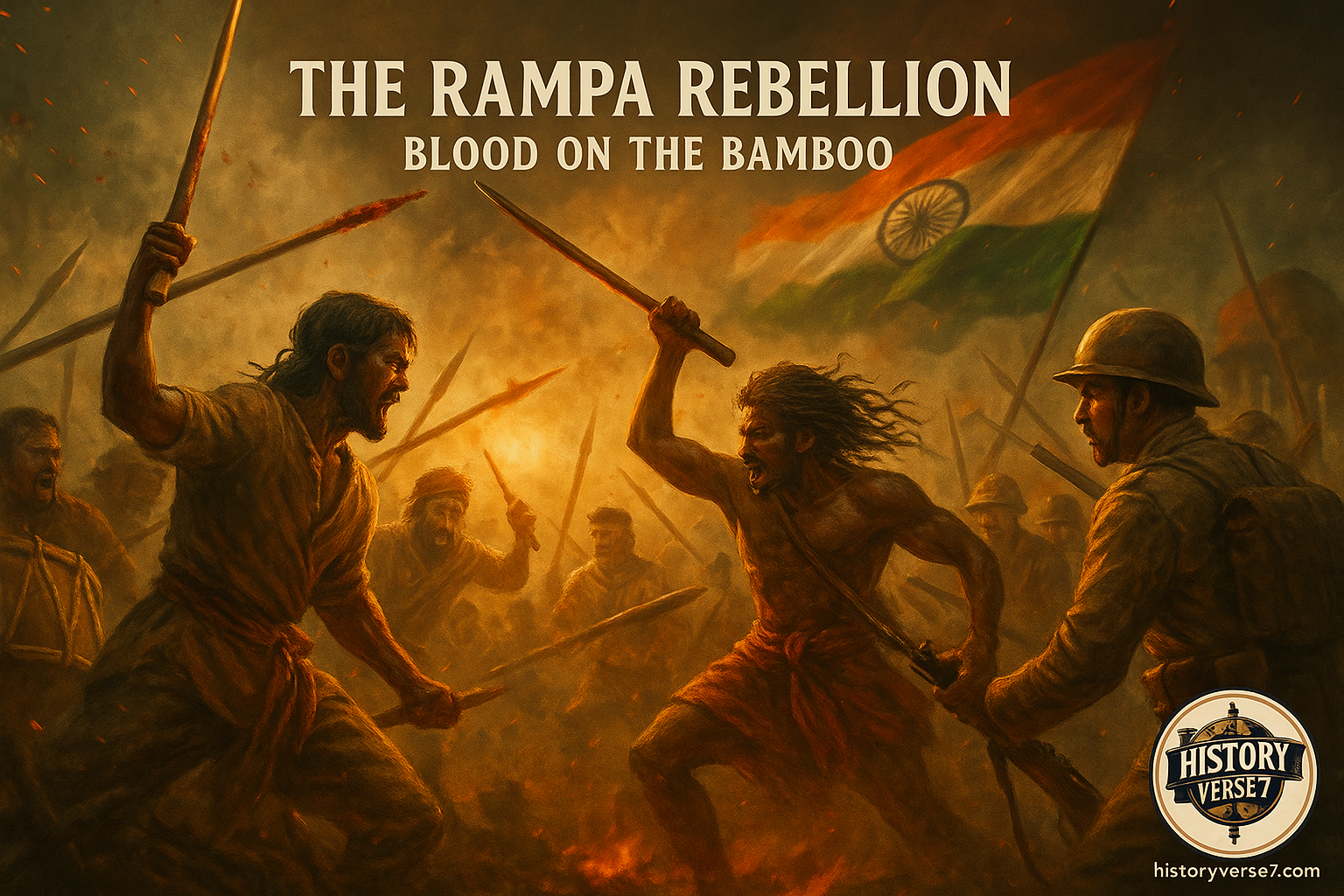
⚡ Call to Action
Before you scroll past another name in history — pause.
This isn’t just a story. It’s a storm.
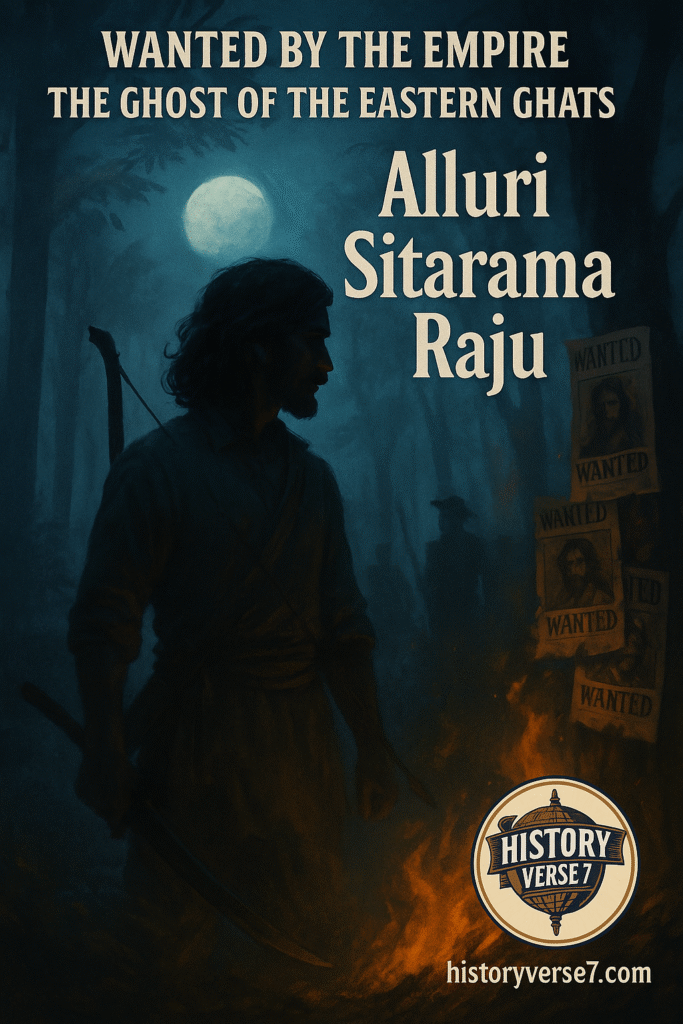
Alluri Sitarama Rajudidn’t fight for headlines. He fought for forests, for freedom, for forgotten voices.
If you believe resistance is more than rebellion…
If you believe legacy is louder than memory…
Then read on.
Because Alluri Sitarama Raju still echoes. And today, you’ll hear why.
🪶 Introduction: Alluri Sitarama Raju — The Roar of the Eastern Ghats
In the quiet village of Pandrangi, nestled in the lush folds of Andhra Pradesh’s Eastern Ghats, a child was born on 4 July 1897 who would one day shake the spine of the British Empire. His name was Alluri Sitarama Raju, and though history often remembers him as a rebel, his story is far deeper — a tale of empathy, transformation, and fearless resistance.

Alluri grew up in a modest Telugu-speaking family. His father, Venkata Rama Raju, passed away early, leaving young Alluri to be raised by his uncle. From a young age, he showed signs of spiritual depth and intellectual curiosity. He studied at Mission High School in Visakhapatnam and Taylor High School in Narsapur, but formal education could not contain his spirit. He left college and began traveling across India, absorbing the philosophies of Swami Vivekananda, the strategies of revolutionaries, and the suffering of common people..
But it was in the Godavari Agency region, among the Koya tribal communities, that Alluri found his true calling. The British had imposed the Madras Forest Act of 1882, which stripped tribal people of their ancestral rights — banning them from collecting firewood, grazing cattle, or cultivating land. Alluri didn’t just witness this injustice. He felt it. He lived among the tribes, learned their language, and earned their trust. He didn’t arrive as a leader. He became one through love, listening, and shared struggle.
By 1922, Alluri had transformed into a revolutionary force. He launched the Rampa Rebellion, also known as the Manyam Rebellion, a guerrilla uprising that would span two years. Armed with stolen rifles and tribal courage, Alluri led over 60 raids on British police stations, disrupting colonial control across the Eastern Ghats. His tactics were swift, precise, and deeply rooted in the terrain he knew like the back of his hand. The British called him a ghost. The people called him “Manyam Veerudu” — Hero of the Jungle.
But Alluri was more than a fighter. He was a philosopher in uniform. He believed in non-violence as a principle, but saw armed resistance as a necessity when peaceful protest failed. He never sought personal power. He never claimed a throne. His mission was singular: to restore dignity to the oppressed.
His rebellion was not just military — it was moral. He inspired tribal youth to rise, not with hatred, but with purpose. He taught them discipline, unity, and pride. He didn’t just fight the British. He fought the idea that tribal lives were expendable, that their voices didn’t matter.
On 7 May 1924, at the age of just 27, Alluri was captured and executed without trial by British forces in Koyyuru village. His death was brutal, but his legacy was immortal. The rebellion may have ended, but the echo of his courage still reverberates through the hills of Andhra Pradesh.

Today, Alluri Sitarama Raju is honored with statues, memorials, and school lessons, but his true tribute lies in the hearts of those who still fight for justice, land, and identity. His story is a reminder that freedom is not given — it is claimed, and that even the quietest village can birth a roar that shakes empires.
Alluri’s life teaches us that leadership is not about command — it’s about compassion. That resistance is not rage — it’s responsibility. And that legacy is not memory — it’s momentum.
He didn’t live long. But he lived loud.
He didn’t wear a crown. But he wore courage.
He didn’t ask to be remembered. But he made forgetting impossible.
Alluri Sitarama Raju was not just a freedom fighter.
He was a flame.
He was a forest.
He was a force.
Table of Contents
🧒 1897 – Birth and Early Life of Alluri Sitarama Raju
📍 Birthplace and Cultural Roots
On 4 July 1897, in the serene village of Pandrangi, nestled in the Visakhapatnam district of the Madras Presidency, a child was born who would one day become the thunder of tribal resistance. His name: Alluri Sitarama Raju.
Pandrangi was no political hotspot. It was a quiet, agrarian settlement surrounded by forests and tribal communities. But it was here that the seeds of rebellion were sown — not through violence, but through the lived experience of injustice and empathy.
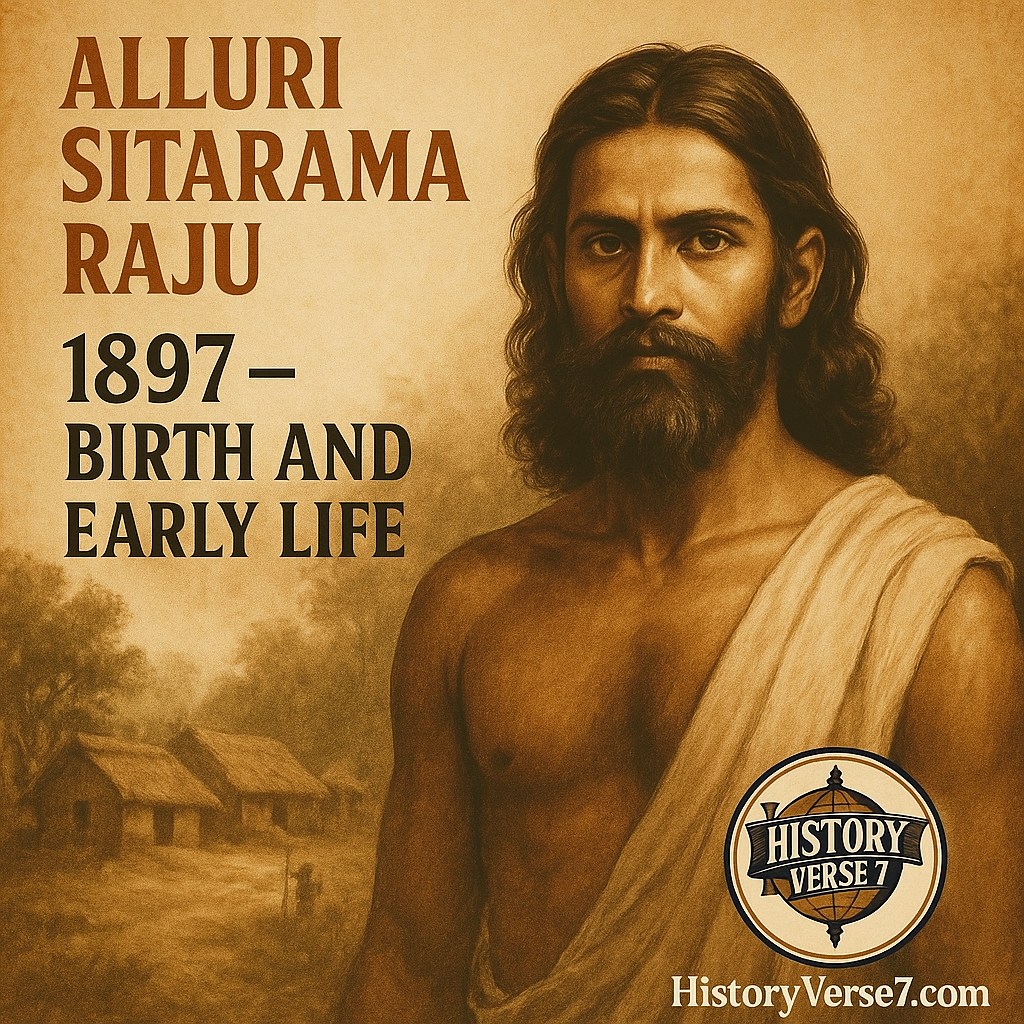
Alluri Sitarama Raju was born into a Telugu-speaking Kshatriya family, a lineage traditionally associated with valor and leadership. His father, Alluri Venkata Rama Raju, was a respected figure, but fate had other plans. The young Alluri lost his father early in life — a loss that would shape his emotional depth and spiritual resilience.
🧔♂️ Raised by His Uncle in Tuni
After his father’s death, Alluri Sitarama Raju was sent to live with his uncle in Tuni, a town that offered more educational opportunities and exposure to nationalist ideas. This transition was not just geographical — it was emotional. The absence of a father figure left a void, but it also gave Alluri the space to observe, reflect, and grow independently.
In Tuni, he was introduced to basic schooling, but more importantly, to the realities of colonial rule. British officers, forest laws, and the marginalization of tribal voices were not abstract concepts — they were daily experiences. Alluri saw how the British treated the land and its people, and these impressions stayed with him.
📚 Education and Intellectual Awakening
Though formal education was part of his journey, Alluri Sitarama Raju was never confined by classrooms. He attended Mission High School in Visakhapatnam and later Taylor High School in Narsapur, where he was known for his sharp intellect and quiet demeanor.
But Alluri’s real education came from travel and observation. He journeyed across India — to Banaras, Bengal, and the Himalayas — absorbing the teachings of Swami Vivekananda, the strategies of revolutionaries, and the spiritual philosophies of sages. He was deeply influenced by the non-cooperation movement, but he also saw its limitations, especially in tribal regions where peaceful protest was met with brutal suppression.
🌿 Connection with Tribal Communities
By the early 1910s, Alluri Sitarama Raju had begun spending time in the Godavari Agency region, home to the Koya tribal communities. These were people who lived in harmony with nature, but were being crushed under the weight of colonial forest laws — especially the Madras Forest Act of 1882, which banned them from collecting firewood, grazing cattle, or cultivating land.
Alluri didn’t just observe their pain — he lived it. He learned their language, shared their meals, and earned their trust. He wasn’t a tribal by birth, but he became one by spirit. This bond would later become the backbone of the Rampa Rebellion.
🔥 Emotional and Spiritual Formation
The loss of his father, the mentorship of his uncle, the exposure to nationalist thought, and the suffering of tribal communities — all these experiences forged Alluri Sitarama Raju into a revolutionary with a rare blend of spiritual depth and tactical brilliance.
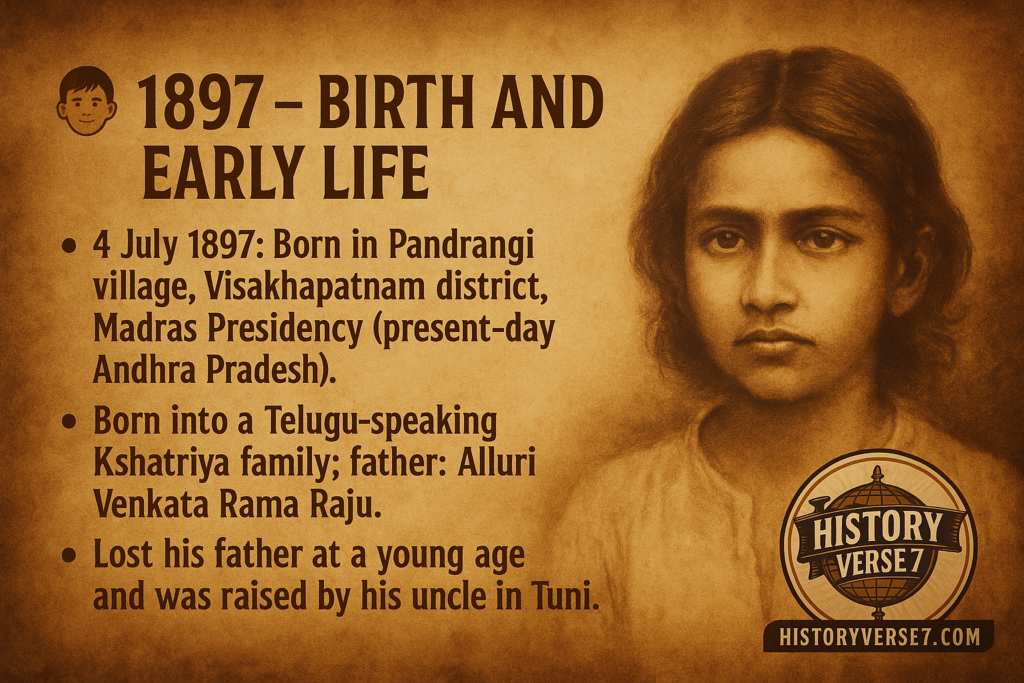
He was known to meditate, read scriptures, and practice celibacy. His rebellion was not born out of rage, but out of moral conviction. He believed that freedom was a birthright, and that dignity could not be negotiated.
📖 Book References and Sources
- “Alluri Sitarama Raju” by B. R. Raju – A detailed biography exploring his early life and revolutionary journey.
- “Tribal Rebellions in Colonial India” by K.S. Singh – Offers context on the forest laws and tribal resistance.
- Wikipedia: Alluri Sitarama Raju
- StarsUnfolded: Biography & Family
- Wikigraphy: Early Life and Education
🧭 Legacy of the Early Years
The early life of Alluri Sitarama Raju was not just a chapter — it was the foundation of a movement. His empathy for the marginalized, his spiritual grounding, and his exposure to nationalist thought made him a revolutionary unlike any other.
He didn’t inherit rebellion. He earned it.
He didn’t seek power. He sought justice.
And he didn’t wait for history to remember him. He carved his name into its soul.
🔜 Ready for the Rebellion?
Alluri Sitarama Raju’s early life was just the beginning. The fire he carried into the forests would soon ignite one of India’s fiercest uprisings — the Rampa Rebellion.
Click below to explore how Alluri turned tribal pain into power, and why his roar still echoes through the Eastern Ghats.
Explore the Rebellion →📚 1909–1917: The Education and Awakening of Alluri Sitarama Raju
🏫 Mission High School, Visakhapatnam (1909–1912)
In 1909, a young Alluri Sitarama Raju stepped into the corridors of Mission High School in Visakhapatnam, a coastal city that was slowly becoming a hub of intellectual and nationalist ferment. The school, run by Christian missionaries, offered a structured curriculum — but for Alluri, it was more than textbooks. It was his first exposure to Western education, colonial contradictions, and the power of ideas.

He was a quiet student, introspective and observant. Teachers noted his sharp memory, discipline, and spiritual leanings. But beneath the calm exterior, Alluri was absorbing the injustices of British rule, especially how education was used to condition obedience, not cultivate freedom.
This period also marked his growing interest in Indian scriptures, Vivekananda’s teachings, and local folklore — a blend that would later define his revolutionary philosophy.
🏫 Taylor High School, Narsapur (1912–1914)
After completing his initial schooling, Alluri Sitarama Raju moved to Taylor High School in Narsapur, a town known for its cultural vibrancy and nationalist undercurrents. Here, he began to question colonial narratives more openly.
He read Bharati’s poems, Tilak’s speeches, and Bankim Chandra’s writings. He also began interacting with local freedom activists, who introduced him to the Swadeshi movement — a call to boycott British goods and revive indigenous pride.
It was in Narsapur that Alluri began to see education as a tool of resistance, not just personal advancement. He started organizing student discussions, distributing pamphlets, and even challenging teachers who echoed colonial bias.
🎓 Andhra National College, Machilipatnam (1914–1915)
In 1914, Alluri Sitarama Raju briefly enrolled at Andhra National College in Machilipatnam, a progressive institution aligned with the Indian nationalist movement. The college was a hotbed of Swadeshi ideology, anti-colonial lectures, and student activism.
Here, Alluri was deeply influenced by the Non-Cooperation Movement, the ideals of self-rule, and the spiritual nationalism of Aurobindo and Vivekananda. He began to see British rule not just as political oppression, but as a moral failure.
But formal education could no longer contain his spirit. He found the classroom too narrow, the syllabus too colonial, and the silence around tribal suffering too deafening.
In 1915, he left college — not in defeat, but in defiance.
🧭 Spiritual Travels Across India (1915–1917)
After leaving college, Alluri Sitarama Raju embarked on a transformative journey across India. He traveled to:
- Banaras: Studied Hindu philosophy, yogic discipline, and scriptural texts.
- Himalayas: Meditated in ashrams, interacted with sadhus, and deepened his spiritual resolve.
- Bengal: Witnessed the impact of revolutionary groups, including Anushilan Samiti, and absorbed the urgency of armed resistance.
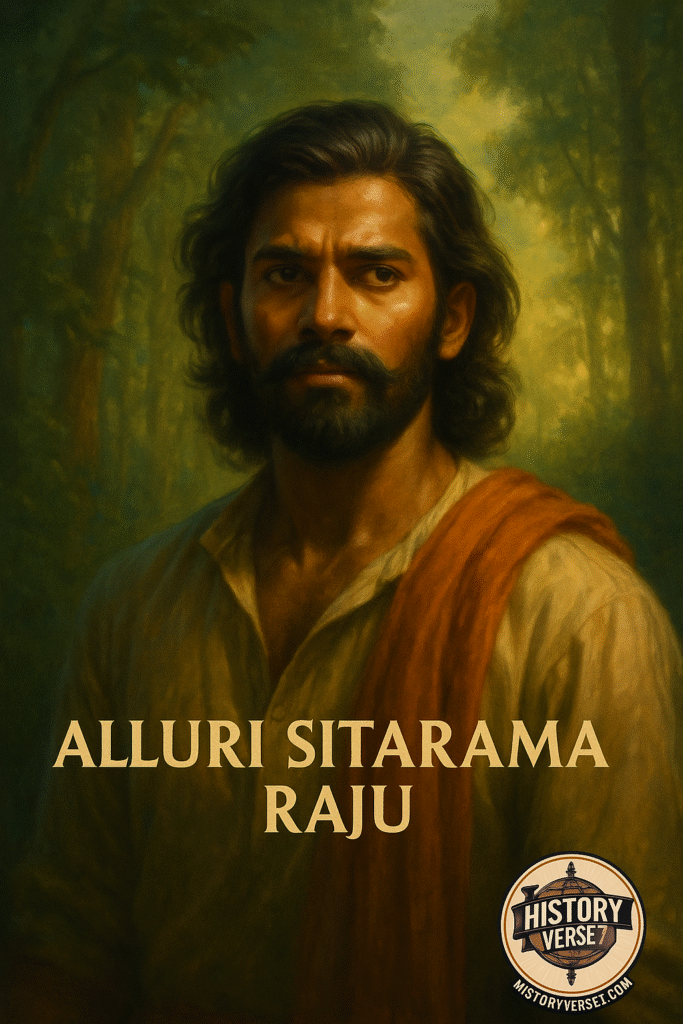
These travels were not tourism — they were pilgrimages of purpose. Alluri was seeking answers, clarity, and a path. He met freedom fighters, spiritual leaders, and tribal elders, each adding a layer to his evolving ideology.
By 1917, he returned to Andhra Pradesh — not as a student, but as a seer-warrior, ready to lead.
🔍 What These Years Reveal
- Alluri Sitarama Raju’s education was not linear — it was layered.
He moved from textbooks to tribal truths, from classrooms to caves, from theory to action. - His awakening was both intellectual and emotional.
He didn’t just learn facts — he felt injustice, absorbed suffering, and chose resistance. - He blended spiritual discipline with revolutionary fire.
His rebellion was not rage — it was responsibility. Not chaos — but clarity.
📖 Book References and Sources
- Alluri Sitarama Raju: The Hero of Jungle Warfare by B. R. Raju
- Tribal Movements in India by K.S. Singh
- Modern Indian History by Bipin Chandra
- Wikipedia
- Wikigraphy
- Vajiram & Ravi UPSC Notes
🔜 The Forest Beckons
Alluri Sitarama Raju’s mind was now awakened. But his mission was just beginning. The next chapter takes us deep into the Eastern Ghats, where Alluri turned tribal pain into power and launched one of India’s fiercest uprisings — the Rampa Rebellion.
Click below to explore how education became action, and how a student became a storm.
Enter the Rebellion →🌱 1918–1921: The Spiritual Transformation and Tribal Bonding of Alluri Sitarama Raju
🏞️ The Return to Godavari Agency: A Journey Back to Purpose
After years of travel, study, and soul-searching, Alluri Sitarama Raju returned to the Godavari Agency region — a forested terrain in present-day Andhra Pradesh. This wasn’t a retreat. It was a return to purpose.

The land was rich in natural beauty but scarred by colonial exploitation. British officers, forest contractors, and zamindars had turned the region into a zone of oppression. The Madras Forest Act of 1882 had criminalized tribal life — banning firewood collection, grazing, and cultivation. The forest, once a source of life, had become a prison.
Alluri saw this — and chose to stay.
🤝 Living Among the Koyas: Becoming One of Them
Rather than lead from above, Alluri Sitarama Raju chose to live among the Koya tribal communities. He wore their clothes, ate their food, and walked their paths. He didn’t arrive with slogans — he arrived with silence, service, and sincerity.
He learned their dialects, listened to their stories, and earned their trust. He didn’t preach nationalism. He practiced empathy. In the eyes of the Koyas, he was not an outsider. He was “Manyam Veerudu” — the Hero of the Jungle.
This bond was sacred. It wasn’t political. It was personal.
🔍 Witnessing Oppression: The Spark Beneath the Silence
While living among the tribes, Alluri Sitarama Raju witnessed the brutal impact of the Madras Forest Act. Tribal elders were fined for collecting wood. Women were harassed for grazing cattle. Children were jailed for cultivating ancestral land.
British police raided villages, destroyed crops, and humiliated families. The Koyas were treated not as citizens, but as criminals on their own soil.
Alluri didn’t just observe this. He absorbed it. He felt their pain as his own. And slowly, the fire began to rise.
🛡️ Organizing Resistance: The Birth of a Movement
Between 1918 and 1921, Alluri Sitarama Raju began quietly organizing the Koyas. He didn’t call it rebellion. He called it self-respect.
He taught them how to document abuses, how to stand united, and how to resist illegal taxes. He trained youth in guerrilla tactics, mapped British outposts, and built secret networks of messengers.
But more than strategy, he gave them hope. He reminded them that they were not forgotten. That their pain mattered. That their forest was worth fighting for.
🧘♂️ The Spiritual Warrior: Dharma Over Destruction
This phase also marked Alluri’s deepening spiritual discipline. Influenced by Swami Vivekananda, Ramakrishna Paramhansa, and the Bhagavad Gita, he practiced celibacy, meditation, and self-restraint.
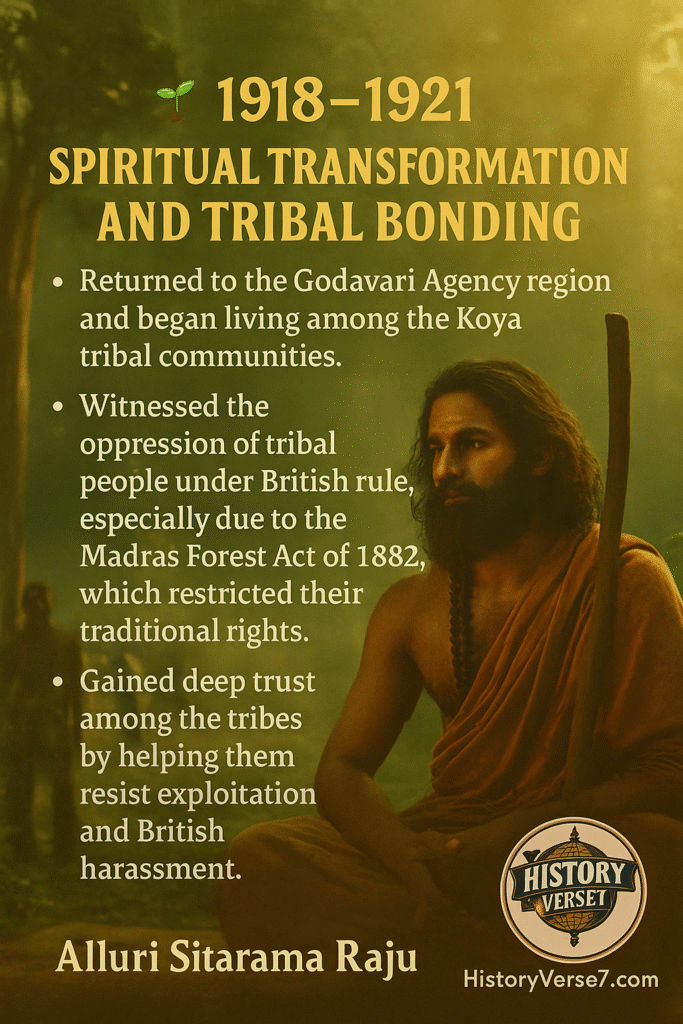
He saw the forest as a temple, the rebellion as a dharma, and the Koyas as his sacred family. His leadership was not fueled by ego, but by duty.
He believed that true revolution begins within — with clarity, compassion, and courage.
📖 Book References and Sources
- Alluri Sitarama Raju – Wikipedia
- The Tribal Leader Who Shook the Empire – Bharathiyam
- Story of Alluri Sitarama Raju – Dastaan-e-Hind
🧭 Legacy of These Years
The years 1918 to 1921 were the soul-forging phase of Alluri Sitarama Raju’s life. He didn’t fire a bullet. But he built a brotherhood. He didn’t raise a flag. But he raised a forest of resistance.
These years transformed him from a student into a sage, from a wanderer into a warrior. When the Rampa Rebellion erupted in 1922, it wasn’t sudden. It was the natural eruption of years of silent suffering, sacred bonding, and spiritual preparation.
🌳 The Forest Fights Back
Alluri Sitarama Raju’s bond with the Koyas was now unbreakable. But the British were tightening their grip. The next chapter unveils how Alluri transformed tribal pain into armed resistance — launching the legendary Rampa Rebellion.
Click below to witness how a forest became a fortress, and a rebel became a legend.
Enter the Rebellion →🔥 1922: The Launch of the Rampa Rebellion — Alluri Sitarama Raju’s Call to Arms
🌋 The Boiling Point: Why the Forest Rose
By 1922, the Godavari Agency was a land under siege. The Madras Forest Act of 1882 had stripped tribal communities — especially the Koyas — of their ancestral rights. They could no longer collect firewood, graze cattle, or cultivate land without facing fines, beatings, or imprisonment.

The British had turned the forest into a fortress of fear. But they had also made a fatal mistake: they underestimated the resolve of the people — and the fire in the heart of Alluri Sitarama Raju.
After years of spiritual preparation and tribal bonding (1918–1921), Alluri knew the time for silence was over. The forest didn’t need a savior. It needed a storm.
⚔️ August 1922: The Rebellion Begins
In August 1922, Alluri Sitarama Raju launched the Rampa Rebellion, also known as the Manyam Rebellion. It was not a spontaneous outburst — it was a meticulously planned guerrilla uprising.
Armed with tribal courage, stolen rifles, and unbreakable unity, Alluri led a series of coordinated attacks on British police stations across the Eastern Ghats. His objectives were clear:
- Seize weapons from British outposts
- Disrupt communication lines
- Demoralize colonial forces
- Reclaim tribal dignity
Within weeks, over 60 police stations were raided. British officers were caught off guard. Telegraph lines were cut. Ammunition was looted. The jungle had turned into a battlefield — and the British were losing ground.
🐾 Guerrilla Warfare: The Forest as Fortress
Alluri didn’t fight like a conventional soldier. He fought like the forest — silent, swift, and unstoppable.
He used guerrilla tactics inspired by tribal hunting methods. His fighters knew every trail, every cave, every stream. They struck at night, vanished by dawn, and left behind only fear.
He trained his men in discipline, code of conduct, and respect for civilians. No looting. No harming innocents. This wasn’t chaos — it was organized resistance.
The British called him a ghost. The people called him “Manyam Veerudu” — Hero of the Jungle.
🗣️ The Message Behind the Musket
Though armed, Alluri Sitarama Raju was not driven by violence. He was driven by dharma — the sacred duty to protect the oppressed.
He believed that when peaceful protest is crushed, resistance becomes a moral obligation. His rebellion was not against a race, but against injustice.

He often told his followers:
“We are not thieves. We are not murderers. We are sons of this soil, fighting for our right to live with dignity.”
📉 British Panic and Retaliation
The British were stunned. They had never faced such a coordinated tribal uprising. They responded with:
- Massive troop deployments
- Bounties on Alluri’s head
- Brutal crackdowns on villages
- Censorship of news about the rebellion
But the more they tried to crush the movement, the more it spread. Alluri had become a symbol of fearless defiance — not just in Andhra, but across India.
📖 Book References and Sources
- Alluri Sitarama Raju – Wikipedia
- Rampa Rebellion – Vajiram & Ravi
- PMF IAS – Alluri Sitarama Raju and the Manyam Rebellion
🧭 Legacy of 1922: When the Forest Spoke
The launch of the Rampa Rebellion in 1922 was not just a military act — it was a moral earthquake. It proved that even the most marginalized voices can shake empires when united by purpose and led by conviction.
Alluri Sitarama Raju didn’t just fight for freedom. He fought for forgotten people, stolen forests, and silenced histories.
He didn’t wait for permission. He became the permission.
He didn’t ask for justice. He demanded it.
And in doing so, he became immortal.
⚔️ The Rebellion Rages On
Alluri Sitarama Raju had lit the fire. But the British were preparing to strike back. The next chapter reveals how Alluri sustained the rebellion, evaded capture, and became a living legend — until the final bullet.
Click below to follow the journey from uprising to ultimate sacrifice.
Continue the Fight →⚔️ 1922–1924: Guerrilla Warfare and British Crackdown — The Legend of Alluri Sitarama Raju
🔥 1922: The Rebellion Ignites
In August 1922, after years of spiritual preparation and tribal bonding, Alluri Sitarama Raju launched the Rampa Rebellion — a full-scale guerrilla uprising against British colonial rule in the Godavari Agency.
The rebellion was triggered by the Madras Forest Act of 1882, which had stripped tribal communities of their rights to cultivate, graze, and live freely in their ancestral lands. Alluri, having lived among the Koya tribes, had seen their suffering firsthand. He knew that petitions and protests would not work. The forest needed to fight back.
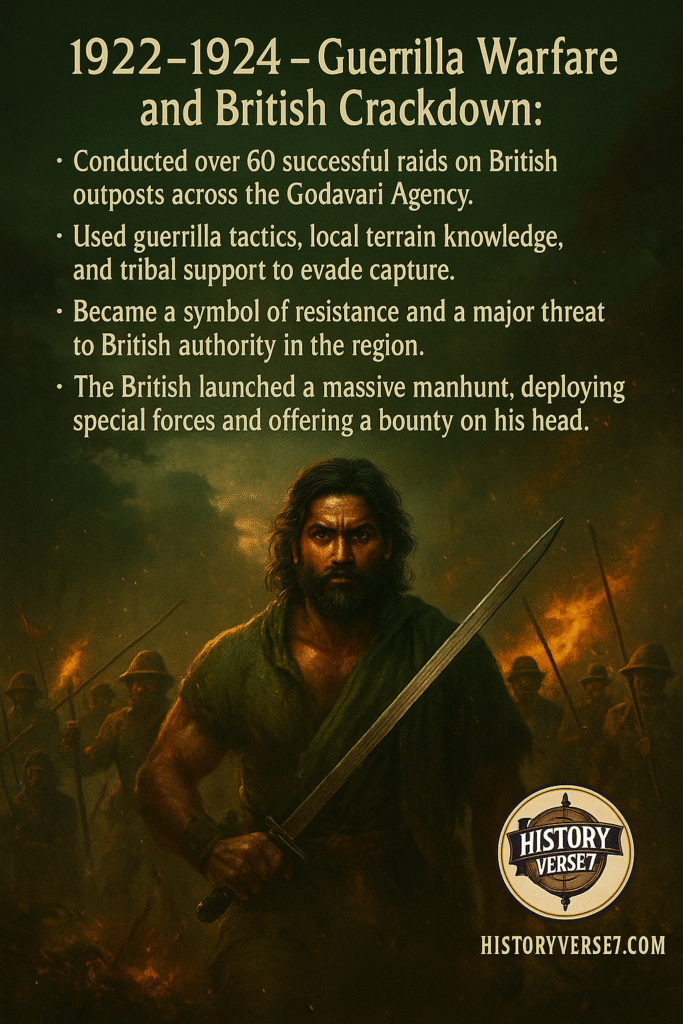
With a band of tribal warriors, Alluri began raiding British police stations, seizing weapons, and cutting off communication lines. His tactics were swift, precise, and deeply rooted in the terrain he knew like the back of his hand.
🐾 1923: The Forest Becomes a Battlefield
By 1923, Alluri Sitarama Raju had conducted over 60 successful raids on British outposts. These weren’t random attacks — they were strategic strikes designed to weaken British control and boost tribal morale.
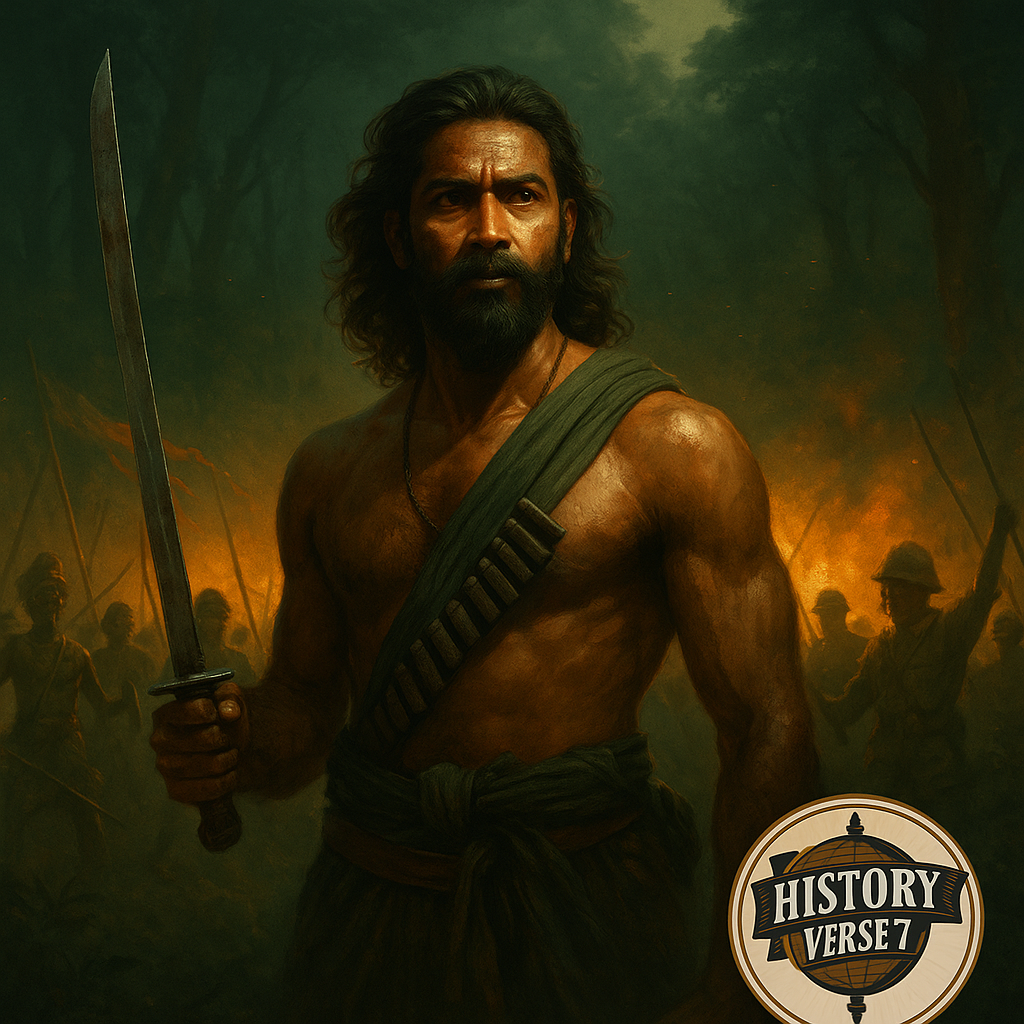
He used guerrilla warfare — a method unfamiliar to the British. His fighters would strike at night, vanish into the jungle by dawn, and leave behind only fear and confusion. They used local terrain knowledge, tribal intelligence networks, and camouflage tactics to stay one step ahead.
Alluri’s leadership was marked by discipline and ethics. He forbade looting, protected civilians, and ensured that the rebellion remained a moral movement, not a descent into chaos.
🧭 1924: The British Strike Back
The British were alarmed. Alluri had become a symbol of resistance, not just in Andhra Pradesh, but across India. His name was whispered in villages, sung in tribal ballads, and feared in colonial offices.
In response, the British launched a massive manhunt. They:
- Deployed special forces trained in jungle warfare
- Offered a bounty on Alluri’s head
- Burned villages suspected of aiding the rebels
- Imposed martial law in parts of the Godavari Agency
But Alluri remained elusive. His movements were unpredictable. His network was loyal. His spirit was unbreakable.
🗣️ The Man Behind the Myth
Despite the violence, Alluri Sitarama Raju remained deeply spiritual. He meditated daily, followed a strict vegetarian diet, and believed that his mission was divinely ordained. He often quoted the Bhagavad Gita, saying:
“When injustice becomes law, resistance becomes duty.”
He didn’t seek power. He sought liberation — not just from British rule, but from fear, silence, and submission.
📖 Book References and Sources
- Alluri Sitarama Raju – Wikipedia
- Rampa Rebellion – Vajiram & Ravi
- Alluri Sitarama Raju: A Revolutionary Leader – IJMER Journal (PDF)
🕊️ Legacy of 1922–1924
These years transformed Alluri Sitarama Raju from a tribal leader into a national icon. He proved that resistance doesn’t need armies — it needs conviction. That a forest can fight, and that a single voice can echo louder than an empire.
He didn’t just challenge British rule. He challenged the idea that some lives mattered less. He reminded India that freedom is not given — it is claimed.
🩸 The Final Stand
Alluri Sitarama Raju had outwitted the British for two years. But the empire was closing in. The next chapter reveals the betrayal, the capture, and the martyrdom of a man who became the soul of India’s tribal resistance.
Click below to witness the final moments of a legend — and the birth of a legacy.
Read the Final Chapter →🩸 1924: The Martyrdom of Alluri Sitarama Raju — When a Bullet Tried to Silence a Roar
⚔️ The Final Phase of the Rebellion
By early 1924, Alluri Sitarama Raju had become the most wanted man in the Eastern Ghats. For nearly two years, he had led the Rampa Rebellion, conducting over 60 successful raids on British police stations, seizing weapons, and inspiring tribal communities to rise against colonial oppression.
The British Empire, humiliated and desperate, launched a massive manhunt. They deployed special forces, offered bounties, and burned villages suspected of aiding the rebels. But Alluri, with his deep knowledge of the terrain and unwavering tribal support, remained elusive.
Yet, even legends have limits. And the British were closing in.
🕵️♂️ The Betrayal and Capture
In the summer of 1924, Alluri Sitarama Raju was reportedly betrayed by an informant — a tactic the British often used when brute force failed. The exact details remain debated, but most accounts agree that he was captured in Koyyuru village, in the East Godavari district.
He was unarmed, possibly resting or in transit between hideouts. The British forces, having finally cornered their most formidable adversary, did not offer a trial. They did not follow protocol. They did not wait.
They had one goal: to make an example of him.
🔫 The Execution: 7 May 1924
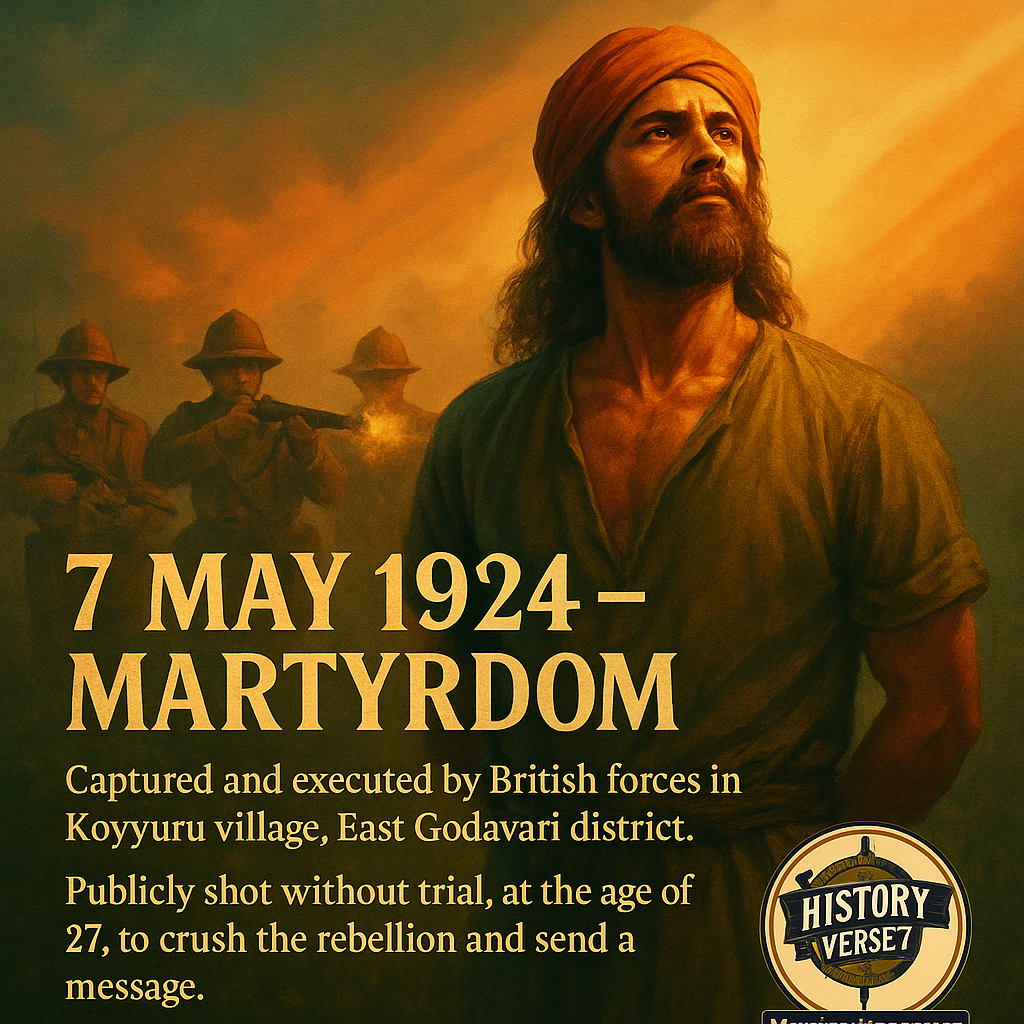
On 7 May 1924, Alluri Sitarama Raju was publicly executed by gunfire — without trial, without defense, and without dignity. He was just 27 years old.
The execution was carried out in front of villagers, a deliberate act of psychological warfare. The British believed that by killing the man, they could kill the movement.
But they were wrong.
Alluri’s final moments were marked by calm defiance. Eyewitnesses say he stood tall, refused to beg, and faced death with the same courage he had shown in life. His last words, though undocumented, are believed to have been a blessing to the forest and its people.
⚰️ Burial and Memorial
After the execution, Alluri Sitarama Raju’s body was buried in Krishnadevipeta, a small village that would later become a site of pilgrimage. A memorial now stands there — not just as a tomb, but as a testament to tribal resistance, moral courage, and uncompromising patriotism.
Every year, thousands visit the site to pay homage. Songs are sung. Stories are retold. And the soil remembers.
🕊️ The Aftermath: A Death That Sparked a Legacy
The British believed they had silenced a rebel. But they had awakened a legend.
After Alluri’s death, the Rampa Rebellion slowly subsided, but its spirit lived on. His story spread across Andhra Pradesh and beyond, inspiring future generations of freedom fighters, tribal leaders, and social reformers.

He became a folk hero, a symbol of resistance, and a cultural icon. Statues were erected. Ballads were composed. And his name was etched into the soul of a nation.
📖 Book References and Sources
- Alluri Sitarama Raju – Wikipedia
- BYJU’S – This Day in History: May 7
- InsightsIAS – Hero of Tribal Resistance
🧭 Legacy of 7 May 1924
Alluri Sitarama Raju’s martyrdom was not a defeat. It was a declaration.
It declared that freedom is worth dying for. That tribal lives matter. That justice cannot be colonized.
He didn’t die in a palace. He died in a forest.
He didn’t wear medals. He wore mud and courage.
He didn’t leave behind wealth. He left behind a roar that still echoes.
🌺 The Legacy Lives On
Alluri Sitarama Raju may have fallen, but his spirit never did. The next section explores how his legacy shaped modern India — from statues and songs to tribal rights and national pride.
Click below to discover how a 27-year-old rebel became a timeless icon of resistance.
Explore His Legacy →🌺 The Legacy of Alluri Sitarama Raju — Echoes That Refused to Die
🕊️ A Martyr Remembered, A Movement Immortalized
On 7 May 1924, when Alluri Sitarama Raju was executed without trial by British forces in Koyyuru village, they believed they had crushed the Rampa Rebellion. But what they failed to understand was that Alluri was not just a man — he was a movement.

His death at the age of 27 did not silence him. It amplified him. Across Andhra Pradesh, his name became a chant of resistance, a song of pride, and a symbol of tribal dignity. Villagers passed down his story through ballads, elders recited his bravery around fires, and children grew up hearing tales of the man who turned forests into fortresses.
🗿 Memorials and Statues: Cementing the Legend
In the decades following independence, Alluri Sitarama Raju was honored with statues, memorials, and cultural tributes across Andhra Pradesh and India. The most notable include:
- Krishnadevipeta Memorial: Built at the site of his burial, this memorial is visited by thousands every year, especially on July 4th (his birth anniversary) and May 7th (his martyrdom day).
- Tank Bund Statue, Hyderabad: A prominent bronze statue stands among other freedom fighters, immortalizing Alluri’s legacy in the heart of Telangana.
- Alluri Sitarama Raju District: In 2022, the Andhra Pradesh government renamed a district in his honor, acknowledging his deep connection to the region and its people.
These tributes are not just stone and metal. They are reminders of resistance, monuments of memory, and anchors of identity.
🎓 Educational Legacy: From Forgotten Rebel to Textbook Hero
For years, Alluri Sitarama Raju remained a regional hero, known primarily in Andhra Pradesh. But his story slowly entered national consciousness through:
- School textbooks: His role in the Rampa Rebellion is now taught in history curricula, especially in CBSE and state boards.
- University research: Scholars have explored his guerrilla tactics, spiritual philosophy, and tribal leadership in academic papers and seminars.
- Civil services preparation: His name features prominently in UPSC and state PSC syllabi, especially under the topic of tribal revolts and freedom movements.
This educational inclusion ensures that future generations know his name, understand his mission, and carry forward his message.
🎥 Cultural Representations: Cinema, Literature, and Folk Art
Alluri’s life has inspired films, novels, and folk performances, each capturing a different facet of his legacy:
- “Alluri Seetharama Raju” (1974): A Telugu film starring Krishna, this cinematic portrayal brought Alluri’s story to the masses, blending action with emotional depth.
- Ballads and Burrakatha: Traditional storytelling forms like Burrakatha have kept Alluri’s legend alive in rural Andhra, often performed during festivals and village gatherings.
- Literary works: Books like “Alluri Sitarama Raju: The Hero of Jungle Warfare” and “Tribal Movements in India” explore his life with scholarly rigor and emotional nuance.
These cultural expressions ensure that Alluri is not just remembered — he is relived.
🌳 Tribal Rights and Political Recognition
Alluri’s rebellion was not just about freedom from the British — it was about tribal dignity, land rights, and cultural survival. His legacy continues to influence:
- Tribal movements: Activists fighting for forest rights, land ownership, and indigenous autonomy often invoke Alluri’s name as a moral compass.
- Government programs: Initiatives aimed at tribal welfare in Andhra Pradesh are sometimes named after him, symbolizing his enduring relevance.
- Political speeches: Leaders across party lines have paid tribute to Alluri, especially during anniversaries, recognizing his role in shaping India’s grassroots resistance.
His legacy reminds India that freedom must include its forests, its tribes, and its forgotten voices.
🧘♂️ Spiritual Legacy: Dharma, Discipline, and Defiance
Unlike many revolutionaries, Alluri Sitarama Raju was deeply spiritual. He practiced celibacy, meditation, and self-restraint, drawing inspiration from Swami Vivekananda, Ramakrishna Paramhansa, and the Bhagavad Gita.
His rebellion was not fueled by hatred. It was guided by dharma — the sacred duty to protect the oppressed. His life teaches:
- Leadership is service
- Resistance is responsibility
- Courage is compassion in action
This spiritual legacy makes Alluri not just a fighter, but a philosopher-warrior, whose teachings resonate with seekers, activists, and thinkers alike.
📖 Book References and Sources
- Alluri Sitarama Raju – Wikipedia
- InsightsIAS – Hero of Tribal Resistance
- WikiLifeStory – Alluri Sitarama Raju
🧭 Final Reflection: Why Alluri Still Matters
Alluri Sitarama Raju’s legacy is not locked in the past — it is alive in every forest, every tribal voice, and every act of moral courage.
He reminds us that freedom is not a gift — it is a fight. That justice is not inherited — it is earned. And that even the quietest village can birth a roar that shakes empires.
He didn’t live long. But he lived loud.
He didn’t wear a crown. But he wore courage.
He didn’t ask to be remembered. But he made forgetting impossible.
📜 Ready for the Next Legend?
Alluri Sitarama Raju’s legacy is eternal. But he was not alone. The next tribute explores another forgotten warrior who defied empire, inspired millions, and carved their name into India’s soul.
Click below to continue your journey through India’s fiercest freedom stories.
→🌺 The Living Legacy of Alluri Sitarama Raju
🗿 Memorials and Cultural Honors
After his execution, Alluri Sitarama Raju became a folk hero across Andhra Pradesh. His memory was preserved through:

- Statues and Memorials: His statue at Hyderabad’s Tank Bund Road is among the most iconic. A memorial was also built at Krishnadevipeta, where he was buried.
- District Naming: In 2022, the Andhra Pradesh government officially created the Alluri Sitarama Raju district, headquartered at Paderu, to honor his contributions.
- Cultural Programs: His birth and martyrdom anniversaries are commemorated with public events, especially in tribal regions, where he is revered as a savior.
🎓 Educational and Political Recognition
Alluri’s story has been integrated into India’s educational and political consciousness:
- School Curriculum: His role in the Rampa Rebellion is taught in Indian history textbooks, especially in Andhra Pradesh and CBSE syllabi.
- UPSC and Civil Services: His leadership is cited in the context of tribal uprisings and early resistance movements.
- Government Tributes: On his 128th birth anniversary in 2025, India’s Defence Minister praised his legacy and reaffirmed the government’s commitment to tribal welfare.
🎥 Cinema and Folk Culture
Alluri’s life has inspired multiple cultural retellings:
- Films: The 1974 Telugu film Alluri Seetharama Raju, starring Krishna, brought his story to the silver screen.
- Folk Art: Burrakatha performances and tribal ballads continue to narrate his bravery in rural Andhra Pradesh.
- Literature: His life is documented in books like Alluri Sitarama Raju: The Hero of Jungle Warfare and featured in journals exploring tribal resistance.
🌳 Tribal Identity and Rights
Alluri’s rebellion was rooted in tribal dignity. His legacy continues to empower:
- Tribal Movements: Activists fighting for forest rights and indigenous autonomy invoke his name as a symbol of resistance.
- Development Projects: In 2025, the electrification of remote tribal villages in the Alluri Sitarama Raju district was seen as a symbolic fulfillment of his dream for tribal upliftment.

🧘♂️ Spiritual and Philosophical Influence
Alluri’s life was deeply spiritual. Influenced by Swami Vivekananda and Ramakrishna Paramhansa, he practiced celibacy, meditation, and self-discipline. His rebellion was not born of hatred, but of dharma — the sacred duty to protect the oppressed.
📖 Sources
- InsightsIAS – Hero of Tribal Resistance
- Alluri Sitarama Raju – Wikipedia
- WikiLifeStory – Alluri Sitarama Raju
- NewsMeter – Electrification in ASR District
- New Indian Express – Tribal Families See Light
- Alluri Sitharama Raju District – Wikipedia
- DistrictsInfo – ASR District Overview
- Indian Culture Portal – Alluri Sitarama Raju
- Heritage Explorer – Janjati Hero
🚩 The Legacy Is Yours Now
Alluri Sitarama Raju didn’t just fight for freedom — he fought for forgotten voices, sacred forests, and the soul of a nation.
His story isn’t just history. It’s a mirror. A challenge. A torch.
If you believe resistance is a duty…
If you believe legacy is louder than memory…
Then carry his fire forward.
Because the forest still whispers his name. And India still needs rebels who remember.
Explore More Legends →🏁 Conclusion: The Echo of Alluri Sitarama Raju
Alluri Sitarama Raju was not just a name in India’s freedom struggle — he was a force of nature, a soul forged in silence, and a roar that rose from the forest. His journey from Pandrangi village to martyrdom in Koyyuru was not linear. It was layered — with pain, purpose, and profound transformation.
He didn’t wear a uniform. He wore conviction.
He didn’t lead with speeches. He led with sacrifice.
He didn’t ask for freedom. He claimed it — for the voiceless, the tribal, the forgotten.
Between 1897 and 1924, Alluri Sitarama Raju lived a life that defied colonial logic. He was educated, spiritual, and deeply empathetic — yet chose to walk barefoot into the jungle, not to escape, but to engage. He saw the forest not as a hiding place, but as a homeland. He saw the Koya tribes not as victims, but as warriors waiting to be awakened.

His rebellion — the Rampa Rebellion — was not just a military campaign. It was a moral uprising. He didn’t fight for territory. He fought for dignity. He didn’t seek revenge. He sought restoration. And in doing so, he became “Manyam Veerudu” — the Hero of the Jungle.
From 1922 to 1924, Alluri Sitarama Raju conducted over 60 raids, outwitted British forces, and built a resistance rooted in terrain, trust, and tribal wisdom. His guerrilla tactics were revolutionary, but his leadership was spiritual. He meditated before battles, fasted during campaigns, and believed that every act of resistance must be anchored in dharma.
On 7 May 1924, when he was captured and executed without trial, the British believed they had silenced a rebel. But they had only amplified a legend. His death at 27 was not a conclusion — it was a catalyst. The soil of Krishnadevipeta, where he was buried, became sacred. The ballads sung in his name became immortal. And the memory of Alluri Sitarama Raju became a compass for every Indian who believes in justice beyond law, freedom beyond borders, and courage beyond fear.
Today, his legacy lives in statues, textbooks, and district names. But more importantly, it lives in the hearts of those who still fight for tribal rights, forest dignity, and cultural pride. He reminds us that freedom is not a gift — it is a responsibility. That leadership is not command — it is compassion. And that history is not written by victors — it is remembered by the brave.
Alluri Sitarama Raju’s story is not just history. It is heritage.
It is not just a chapter. It is a challenge.
And it is not just a tribute. It is a torch.
So when you walk through a forest, listen.
When you hear silence, remember.
And when you speak of freedom, include his name.
Because the jungle still whispers.
And Alluri Sitarama Raju still echoes.
📘 FAQ: Understanding Alluri Sitarama Raju
1. Why did Alluri Sitarama Raju choose the forest over the city?
Answer:
Because the forest didn’t just offer shelter — it offered truth. Alluri Sitarama Raju believed that real India lived in its roots, not its roads. While cities echoed with speeches, the jungle echoed with silence, suffering, and strength. He chose the forest not to hide, but to listen — to the unheard, the unseen, the unprotected. In the rustle of leaves and the rhythm of tribal drums, he found his purpose.
2. Was Alluri Sitarama Raju a rebel or a monk?
Answer:
Both — and neither. He was a rebel with the discipline of a monk and a monk with the fire of a rebel. He meditated before battles, fasted before raids, and believed that every bullet should be fired with moral clarity. His rebellion wasn’t born of rage — it was born of responsibility. He didn’t fight for revenge. He fought for restoration.
🪶 3. What made the British fear Alluri more than armies?
Answer:
Because he didn’t just fight them — he unmasked them. Alluri Sitarama Raju didn’t need battalions. He had belief. He didn’t need cannons. He had conviction. The British feared him because he turned barefoot tribals into strategists, forests into fortresses, and silence into resistance. He was a ghost they couldn’t catch, a voice they couldn’t silence, and a fire they couldn’t extinguish.
🌿 4. Why did tribal people call him “Manyam Veerudu” — Hero of the Jungle?
Answer:
Because he didn’t lead from the front — he walked beside them. Alluri Sitarama Raju didn’t arrive with orders. He arrived with empathy. He slept under the same trees, ate the same food, and bled for the same land. To the Koyas, he wasn’t a leader from above — he was a brother from within. The jungle didn’t just shelter him. It crowned him.
🕊️ 5. What is Alluri Sitarama Raju’s legacy in one sentence?
Answer:
He proved that even in silence, barefoot and alone, a man can roar so loud that empires tremble.
Share this content:

“Manyam Veerudu” — Hero of the Jungle.💪💪
Gooood ✨🔥🚩