
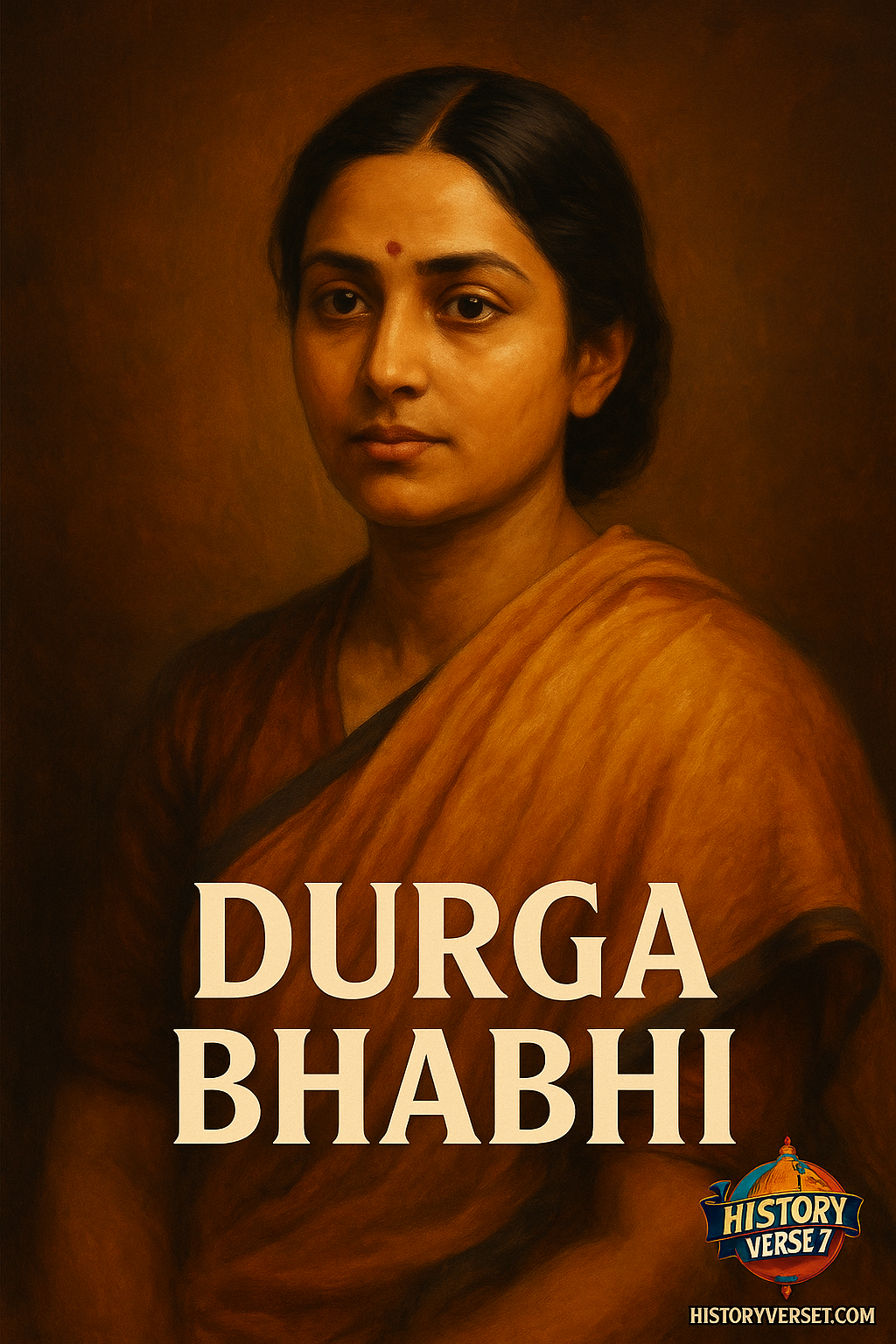
💥 Before You Read, Remember This:
Durga Bhabhi wasn’t just Bhagat Singh’s ally—she was India’s silent storm. She carried pistols in her purse, courage in her heart, and revolution in her footsteps. This isn’t just a blog. It’s a tribute to a woman who rewrote the rules of resistance. Read with pride. Share with purpose. Let her legacy roar louder than history’s silence.
👉 Begin the Tribute: Discover Durga Bhabhi’s Untold Legacy🔥 Introduction: Durga Bhabhi — The Silent Storm of India’s Freedom Struggle
In the grand narrative of India’s independence, some names echo through every textbook, every speech, every celebration. But there are others—equally fierce, equally foundational—whose stories remain buried beneath the weight of selective memory. Durga Bhabhi is one such name.
She wasn’t a general in uniform. She wasn’t a politician with a podium. She was a woman with a pistol in her purse, a fire in her heart, and a nation in her soul..
Durga Bhabhi didn’t just support the revolution—she became it.
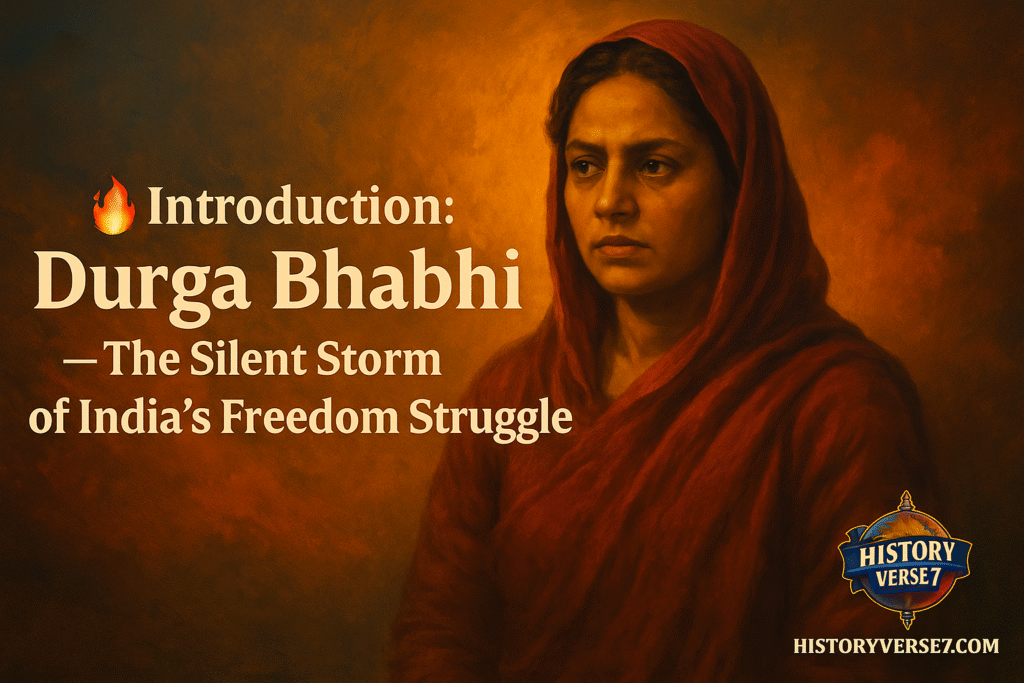
Born as Durgawati Devi in 1907 in Allahabad, she was raised in a conservative yet culturally aware household. Her early life was marked by discipline, education, and a quiet observation of the world around her. But destiny had other plans. At the age of 18, she married Bhagwati Charan Vohra, a revolutionary thinker and one of the founding members of the Hindustan Socialist Republican Association (HSRA). That marriage wasn’t just a union of hearts—it was a union of ideologies.
From that moment on, Durga Bhabhi stepped into a world where freedom was not a dream—it was a mission. And she wasn’t content being a bystander. She became a strategist, a courier, a protector, and when needed—a warrior.
In 1928, after the assassination of British officer J.P. Saunders, the British Empire launched a massive manhunt for Bhagat Singh. The revolutionaries needed a plan. They needed someone who could walk past British officers without raising suspicion. They needed someone who could carry a fugitive across cities without flinching.
They needed Durga Bhabhi.
Disguised as Bhagat Singh’s wife, she boarded a train from Lahore to Calcutta, holding his hand, carrying a child, and wearing the calm confidence of a woman who knew she was rewriting history. That journey wasn’t just an escape—it was an act of defiance. It was a message to the Empire: your laws don’t scare us, your prisons don’t bind us, and your power doesn’t silence us.
But Durga Bhabhi didn’t stop there. In 1929, after Bhagat Singh’s arrest, she attempted to assassinate a high-ranking British officer in Bombay. Though the attempt failed, the message was clear: the revolution had no gender, and courage had no limits.
What makes Durga Bhabhi extraordinary is not just her bravery—but her balance. She was a revolutionary who raised a child. A fugitive who taught in schools. A woman who could wield a pistol and a pen with equal grace. She didn’t seek fame. She didn’t demand recognition. She believed in the cause—and that was enough.
After independence, while many revolutionaries entered politics or public life, Durga Bhabhi chose silence. She opened a school in Lucknow, taught children, and lived a life of simplicity. She refused political positions. She declined awards. She believed that true service didn’t need a spotlight.
But silence is not the same as absence. Her legacy lived on—in the stories whispered by old revolutionaries, in the courage of every woman who dared to defy, and in the quiet pride of a nation that owes her more than it remembers.
Today, as we scroll through headlines and hashtags, it’s easy to forget the names that built the foundation of our freedom. But Durga Bhabhi is not a name to be forgotten. She is a symbol. A symbol of silent strength. A symbol of fearless femininity. A symbol of what it means to fight—not for fame, but for freedom.
In a world that often measures impact by visibility, Durga Bhabhi teaches us that the most powerful revolutions are often the quietest. That the fiercest warriors don’t always wear uniforms. That sometimes, the most radical thing a woman can do is believe she belongs in the battlefield of history.
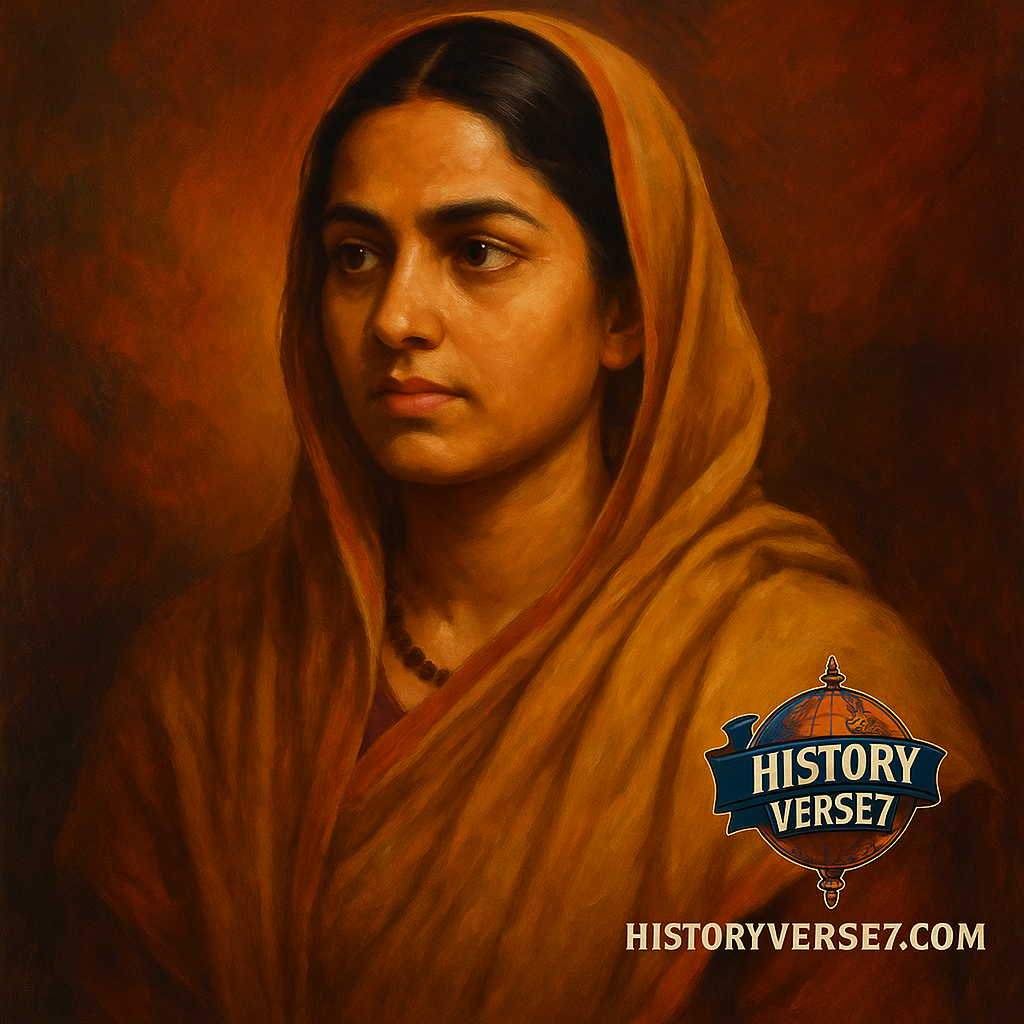
This blog is not just a tribute. It’s a reclamation. It’s a reminder that Durga Bhabhi was not a supporting character in Bhagat Singh’s story—she was a headline in her own right. Her life was a masterclass in courage, strategy, and sacrifice. And her legacy is a call to every Indian—to remember, to honor, and to act.
Because Durga Bhabhi didn’t just carry a revolution in her footsteps.
She carried the future of a free India in her silence.
And now, it’s our turn to carry her name forward—with pride, with purpose, and with the power it deserves.
Table of Contents
🧒 Chapter 1: 1907 – Birth of Durga Bhabhi
The Silent Beginning of a Storm
🌾 1.1 Shahjadpur, Allahabad — A Soil That Birthed Revolution
In the heart of United Provinces, nestled between the cultural currents of Allahabad and the rural resilience of Shahjadpur, a girl was born who would one day escort Bhagat Singh to freedom and defy the British Empire with a pistol in her purse.
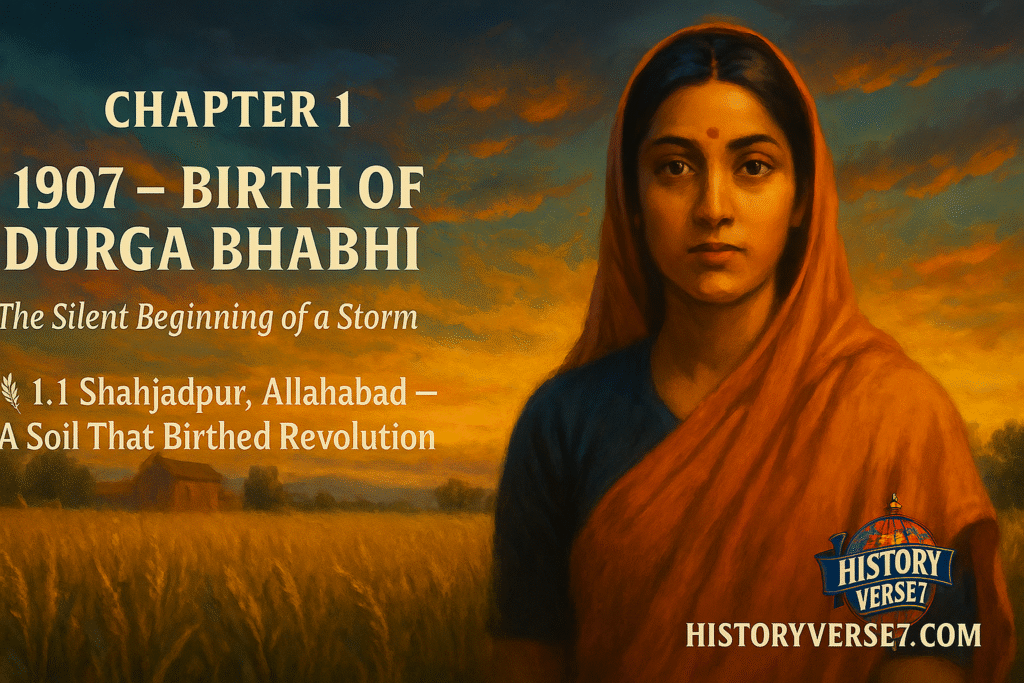
Durga Bhabhi, born as Durgawati Devi, entered a world shaped by colonial rule, social conservatism, and rising nationalist sentiment. Her birthplace—now part of Kaushambi, Uttar Pradesh—was no ordinary village. It was a crucible of awakening, where whispers of rebellion mingled with prayers for dignity.
💬 “She was born in silence. But silence would never define her.”
👨👩👧 1.2 Family Roots — Tradition Meets Awakening
Durga Bhabhi’s family belonged to a Kshatriya lineage, known for its valor and discipline. Her father, Banke Bihari Devi, was a respected figure in the community. Though conservative in values, the family ensured she received a basic education, a rare privilege for girls in early 20th-century India.
This blend of tradition and awareness laid the foundation for her future. She learned to observe, to question, and to endure. Her early years were marked by quiet strength, a trait that would later become her revolutionary signature.
💬 “She didn’t inherit rebellion. She cultivated it.”
📚 1.3 Education and Early Influences
Though formal schooling was limited, Durga Bhabhi was exposed to the cultural renaissance of Allahabad—a city that housed thinkers, poets, and freedom fighters. The influence of Arya Samaj, Swadeshi movements, and women’s reform campaigns seeped into her consciousness.
She read what she could. She listened more than she spoke. And she began to understand that freedom was not just a political idea—it was a personal necessity.
💬 “In the silence of Shahjadpur, a storm was learning to speak.”
💍 1.4 The Path to Revolution Begins
At the age of 18, Durga Bhabhi married Bhagwati Charan Vohra, a brilliant revolutionary and founding member of the Hindustan Socialist Republican Association (HSRA). This marriage was not just a union—it was an ignition.
Bhagwati Charan introduced her to Bhagat Singh, Sukhdev, and other revolutionaries. She didn’t just support their cause—she became part of it. Her birth in 1907 had quietly set the stage for one of the most daring acts in India’s freedom struggle.
💬 “She was born to be more than a wife. She was born to be a weapon.”
📖 1.5 Historical Context — 1907 in India
The year 1907 was pivotal in India’s nationalist timeline:
- The Split in the Indian National Congress between moderates and extremists occurred at the Surat Session.
- Lala Lajpat Rai, Bal Gangadhar Tilak, and Bipin Chandra Pal were gaining momentum.
- The Swadeshi Movement was intensifying post the Partition of Bengal (1905).
- Women’s participation in public discourse was beginning to stir, though still rare.
Durga Bhabhi’s birth in this year was symbolic. She was born into a nation on the cusp of awakening—and she would become one of its fiercest voices.
💬 “She didn’t just witness history. She was born to rewrite it.”
📚 Sources and References
- Durga Bhabhi – Wikipedia
- Organiser – Birth Anniversary Tribute
- Feminism in India – Durga Devi Profile
- India’s Struggle for Independence by Bipan Chandra
- The Revolutionary Movement in India by Manmath Nath Gupta
- Women in the Indian National Movement by Suruchi Thapar-Björkert
🧒 She Was Born in Silence. But She Spoke Through Revolution.
Durga Bhabhi’s birth in 1907 wasn’t just a date—it was the beginning of a legacy India must reclaim. From Shahjadpur’s quiet soil to the heart of the freedom movement, her journey is a lesson in courage. The next chapter explores her marriage, her entry into HSRA, and her transformation into a revolutionary icon.
👉 Continue to Chapter 2: Marriage and Revolution💍 Chapter 2: 1925–1927 – Marriage to Bhagwati Charan Vohra
The Union That Sparked a Revolution
🏠 2.1 1925 – A Marriage Rooted in Ideals
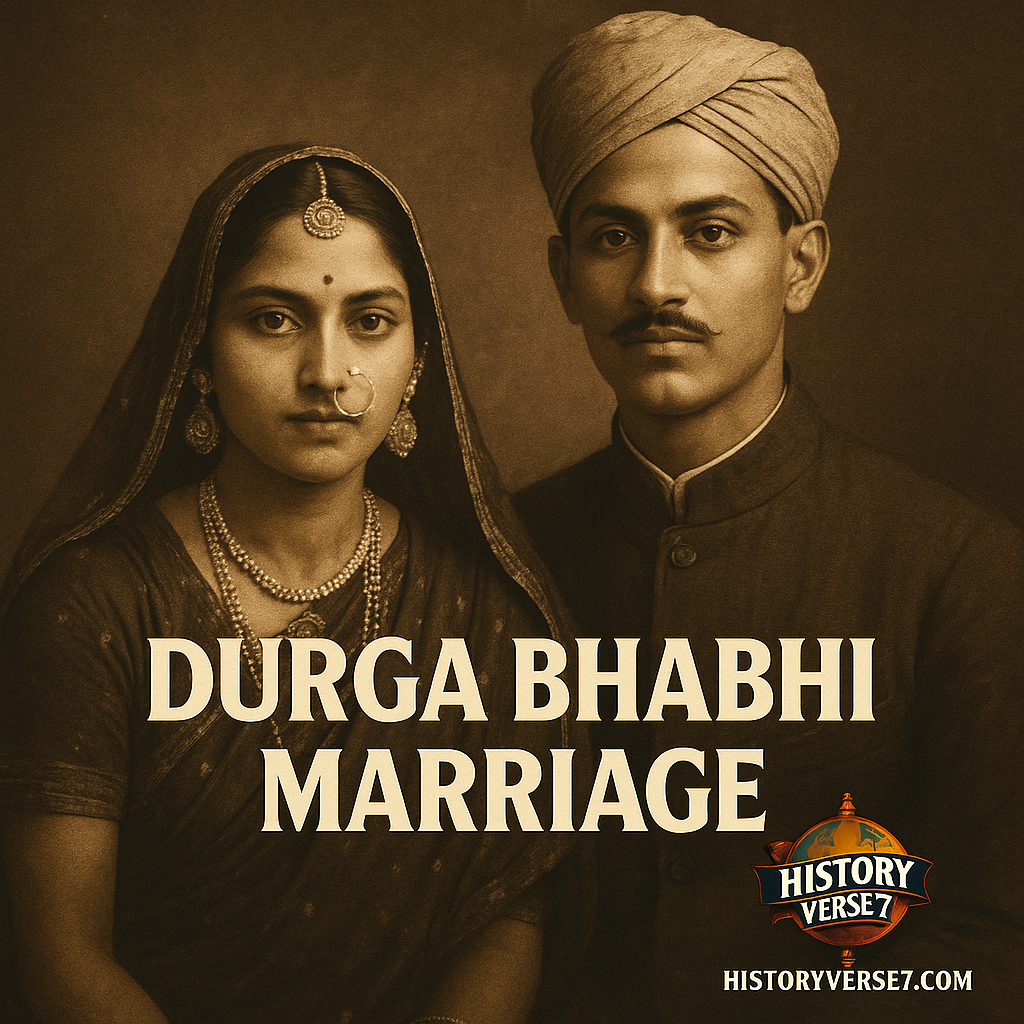
In 1925, Durga Bhabhi, born Durgawati Devi, married Bhagwati Charan Vohra, a brilliant thinker, writer, and founding member of the Hindustan Socialist Republican Association (HSRA). The marriage took place in Allahabad, but its impact would soon ripple across revolutionary circles in Lahore, Kanpur, and Delhi.
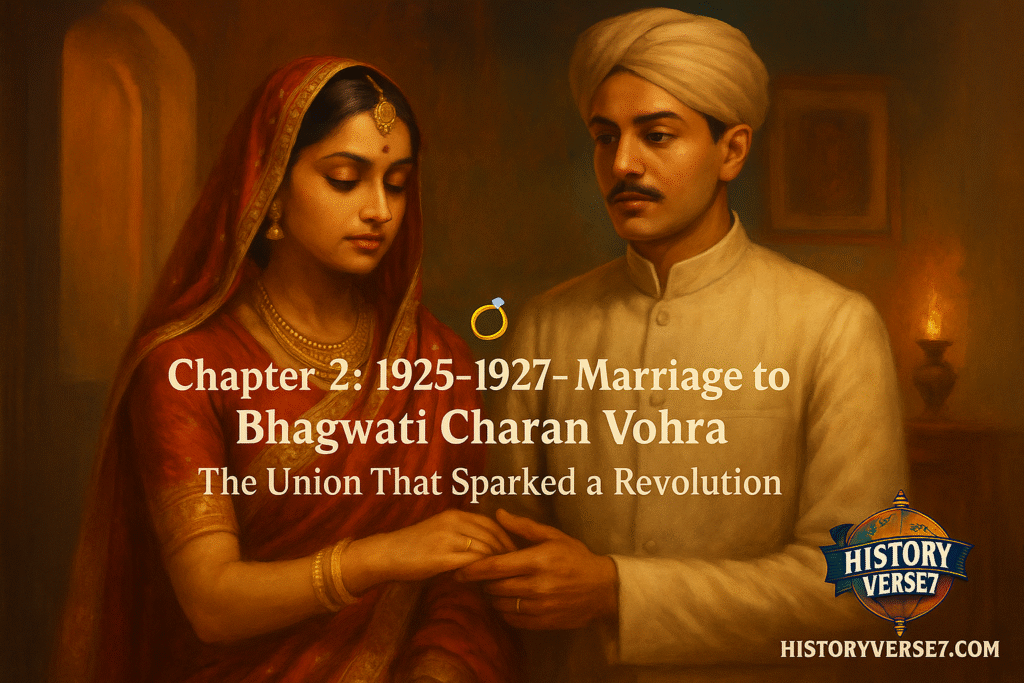
This wasn’t a conventional marriage. It was a merging of minds, a bond of belief, and a commitment to cause. Bhagwati Charan didn’t just bring her into his life—he brought her into the revolution.
💬 “She didn’t marry into comfort. She married into courage.”
🧠 2.2 Ideological Awakening — From Wife to Revolutionary
Bhagwati Charan Vohra was known for his intellectual depth, strategic brilliance, and fiery patriotism. He introduced Durga Bhabhi to the writings of Karl Marx, Lenin, and Indian nationalist thinkers. He didn’t treat her as a passive partner—he treated her as a comrade.
Durga Bhabhi began attending secret meetings, reading revolutionary literature, and understanding the philosophy of armed resistance. She wasn’t just absorbing ideas—she was preparing to act.
💬 “She didn’t follow her husband. She stood beside him—in thought, in action, in fire.”
🕵️ 2.3 Entry into HSRA — The Woman Behind the Movement
By 1926, Durga Bhabhi was actively involved in the HSRA’s operations. She helped distribute pamphlets, raise funds, and shelter fugitives. Her home became a safehouse, her presence a shield, and her silence a strategy.
She was one of the few women in the organization, but she never asked for special treatment. She carried messages across cities, trained in firearms, and learned to navigate British surveillance.
💬 “She didn’t ask to be included. She made herself indispensable.”
🧒 2.4 Personal Life — Balancing Revolution and Motherhood
In 1927, Durga Bhabhi gave birth to a son, Satyakam Vohra. But motherhood didn’t slow her down. She continued her revolutionary work, often carrying her child during missions to avoid suspicion.
Her ability to balance family and freedom became legendary. She proved that patriotism wasn’t a man’s domain—it was a human duty.
💬 “She didn’t choose between being a mother and a revolutionary. She chose both—and excelled.”
🧘 2.5 Emotional Strength — The Quiet Backbone of HSRA
While Bhagwati Charan Vohra focused on strategy and Bhagat Singh on execution, Durga Bhabhi became the emotional anchor of the movement. She comforted grieving families, motivated young recruits, and reminded everyone that freedom was worth every sacrifice.
Her resilience, grace, and unwavering commitment made her a symbol of silent strength—a role often overlooked but deeply felt.
💬 “She didn’t shout slogans. She lived them.”
📚 Sources and References
- Durga Bhabhi – Wikipedia
- VSK Bharat – Unsung Heroine of Freedom Struggle
- The Better India – Durga Devi’s Role in Bhagat Singh’s Escape
- India’s Struggle for Independence by Bipan Chandra
- The Revolutionary Movement in India by Manmath Nath Gupta
- Women in the Indian National Movement by Suruchi Thapar-Björkert
💍 She Didn’t Just Marry a Revolutionary. She Became One.
Durga Bhabhi’s marriage to Bhagwati Charan Vohra was more than love—it was legacy. From homemaker to history-maker, her transformation is a lesson in courage, conviction, and quiet rebellion. The next chapter explores her daring role in Bhagat Singh’s escape and her rise as a revolutionary icon.
👉 Continue to Chapter 3: Bhagat Singh’s Escape and Durga Bhabhi’s Daring Mission🚂 Chapter 3: 1928 – Bhagat Singh’s Escape and Durga Bhabhi’s Daring Mission
The Woman Who Escorted a Revolution
🕵️ 3.1 The Aftermath of Saunders’ Assassination
In December 1928, Bhagat Singh and Rajguru assassinated British officer J.P. Saunders in Lahore, avenging the death of Lala Lajpat Rai. The act sent shockwaves through the colonial establishment. The British launched a massive manhunt. Every railway station, every checkpoint, every alley was under surveillance.
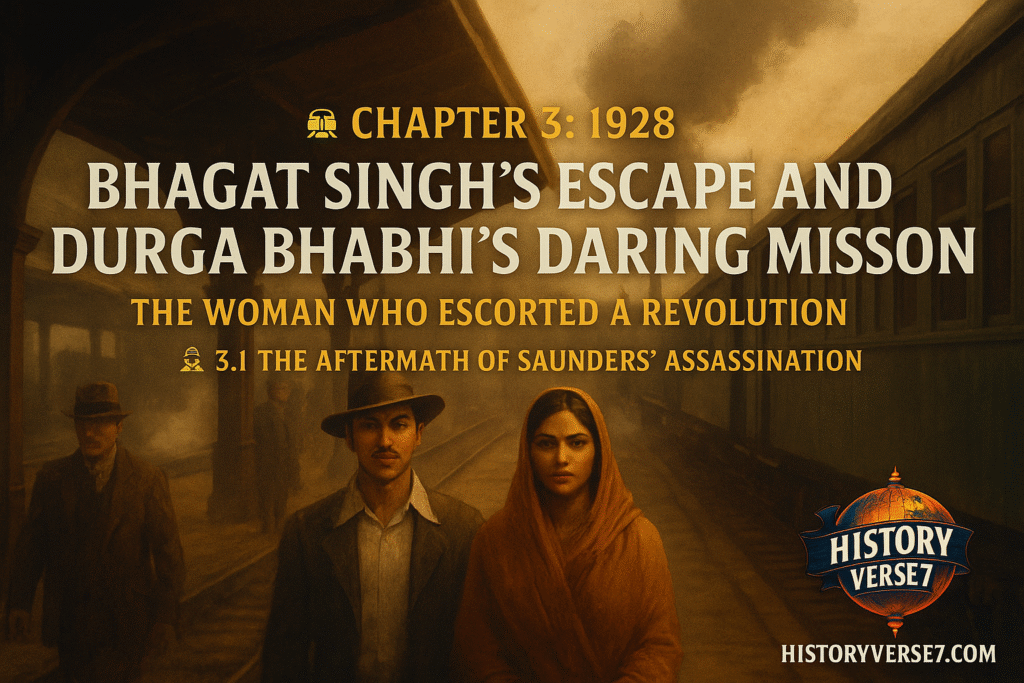
The revolutionaries needed a plan. They needed someone who could walk past British officers without raising suspicion. They needed someone who could carry Bhagat Singh out of Lahore—alive, unnoticed, and unafraid.
They needed Durga Bhabhi.
💬 “She didn’t just help Bhagat Singh escape. She helped the revolution survive.”
👒 3.2 The Disguise That Defied an Empire
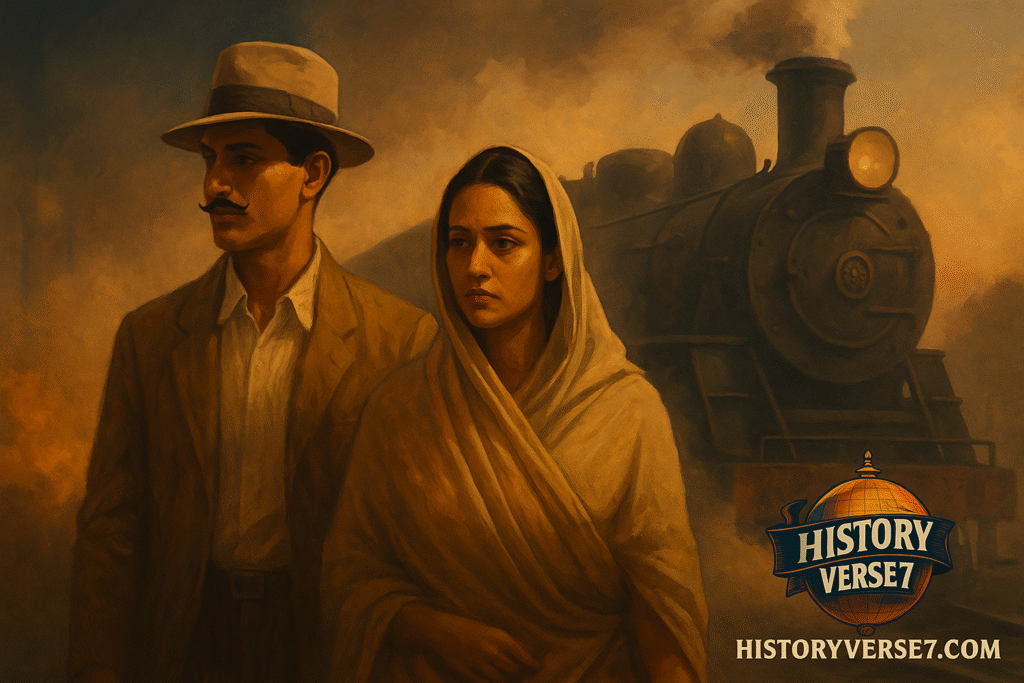
Durga Bhabhi disguised herself as Bhagat Singh’s wife. She wore a simple saree, carried a child, and held Bhagat Singh’s hand as they boarded a train from Lahore to Calcutta. Her calm demeanor, maternal presence, and strategic silence fooled every British checkpoint.
She didn’t flinch. She didn’t falter. She didn’t fail.
This wasn’t just a disguise—it was a declaration. A woman had entered the battlefield. And she was winning.
💬 “She didn’t wear a uniform. She wore courage.”
🚉 3.3 The Train Journey — A Moving Revolution
The train ride was tense. Every station brought risk. Every glance could be fatal. But Durga Bhabhi maintained her composure. She whispered instructions. She shielded Bhagat Singh. She carried the weight of a nation in her silence.
They reached Calcutta safely. The mission was a success. The revolution had a second wind.
💬 “She didn’t just cross cities. She crossed the boundaries of history.”
🧠 3.4 Strategic Brilliance — Planning Beyond Escape
Durga Bhabhi wasn’t just the executor—she was part of the planning. She helped map the route, select the disguises, and coordinate with HSRA members. Her understanding of British surveillance, railway logistics, and social psychology made her indispensable.
She proved that intelligence was as revolutionary as action.
💬 “She didn’t just carry Bhagat Singh. She carried the revolution’s future.”
💥 3.5 Impact and Legacy of the Escape
Bhagat Singh’s escape allowed him to continue his work, including the Assembly Bombing of 1929. Without Durga Bhabhi’s intervention, the movement might have lost its most iconic voice prematurely.
Her role became legendary among revolutionaries—but remained underrepresented in mainstream history. She didn’t seek credit. She sought impact.
💬 “She didn’t ask to be remembered. She asked to be useful.”
📚 Sources and References
- Durga Bhabhi – Wikipedia
- The Better India – Durga Devi’s Role in Bhagat Singh’s Escape
- Organiser – Birth Anniversary Tribute
- India’s Struggle for Independence by Bipan Chandra
- The Revolutionary Movement in India by Manmath Nath Gupta
- Women in the Indian National Movement by Suruchi Thapar-Björkert
🚂 She Didn’t Just Escort Bhagat Singh. She Escorted a Revolution.
Durga Bhabhi’s daring mission in 1928 wasn’t just an escape—it was a masterclass in courage, strategy, and silent rebellion. The next chapter explores her attempted assassination of a British officer and her rise as a symbol of fearless femininity.
👉 Continue to Chapter 4: Assassination Attempt and Revolutionary Defiance💥 Chapter 4: 1929 – Assassination Attempt and Revolutionary Defiance
When Silence Fired Back
🔫 4.1 The Trigger: Bhagat Singh’s Arrest and Public Outrage
In April 1929, Bhagat Singh and Batukeshwar Dutt threw bombs in the Central Legislative Assembly—not to kill, but to awaken. Their arrest shook the revolutionary circles. The British press painted them as criminals. The public was divided. The revolution needed a response.
Durga Bhabhi didn’t wait for permission. She prepared for retaliation.
💬 “She didn’t ask what could be done. She became the answer.”
🕵️ 4.2 The Mission: Targeting a British Officer in Bombay
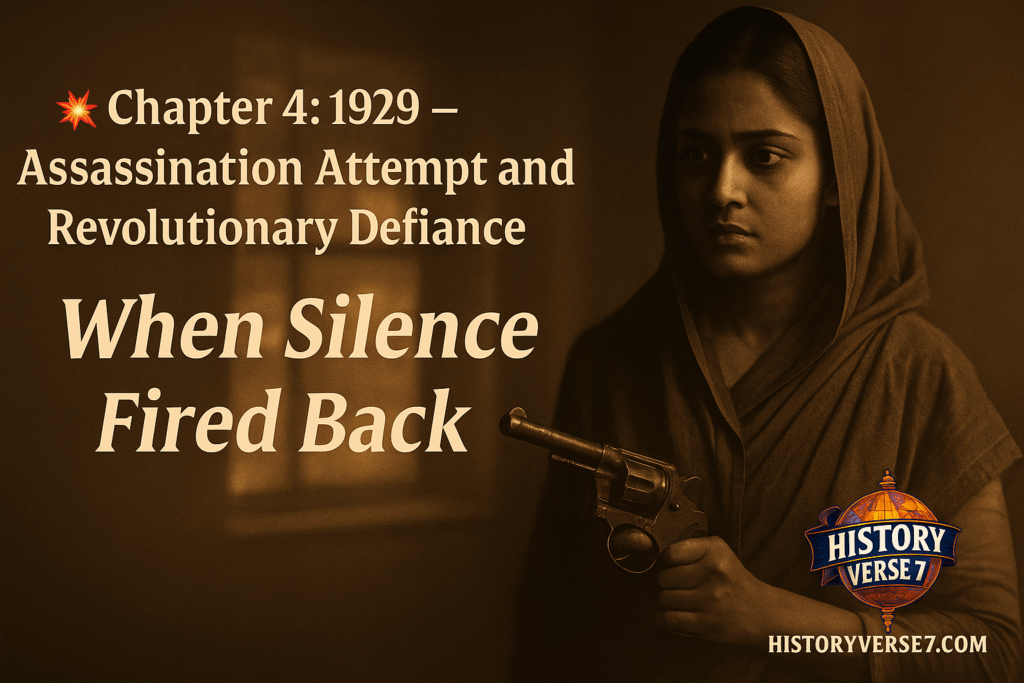
In December 1929, Durga Bhabhi traveled to Bombay with a pistol hidden in her purse. Her target: a high-ranking British officer known for his role in suppressing revolutionaries. She fired—but missed. The officer escaped. She was arrested.
But the message was clear:
Women were no longer watching history. They were rewriting it.
💬 “She didn’t miss the target. She hit the Empire’s ego.”
👮 4.3 Arrest and Interrogation — Grace Under Pressure
After her arrest, Durga Bhabhi was interrogated for hours. The British officers were stunned—not just by her act, but by her composure. She refused to name accomplices. She spoke with dignity. She didn’t plead. She didn’t flinch.
She was released due to lack of evidence. But her reputation was sealed.
💬 “She didn’t break under pressure. She became pressure.”
🧠 4.4 Strategic Impact — Beyond the Bullet
Though the assassination attempt failed, its strategic impact was immense:
- It proved that HSRA’s women were operationally active.
- It inspired other female revolutionaries to take bold roles.
- It shifted public perception of women in the freedom struggle.
- It forced British intelligence to rethink their surveillance models.
Durga Bhabhi had fired more than a bullet. She had fired a warning.
💬 “She didn’t just aim at a man. She aimed at a mindset.”
🧘 4.5 Emotional Fallout — The Cost of Courage
After the incident, Durga Bhabhi faced isolation, surveillance, and emotional strain. Her son was kept away for safety. Her movements were tracked. Her allies were cautious.

But she never regretted her act. She believed that freedom demanded fury, and that women had every right to wield it.
💬 “She didn’t mourn the consequences. She embraced them as proof of purpose.”
📚 Sources and References
- Durga Bhabhi – Wikipedia
- The Better India – Durga Devi’s Role in Bhagat Singh’s Escape
- India’s Struggle for Independence by Bipan Chandra
- The Revolutionary Movement in India by Manmath Nath Gupta
- Women in the Indian National Movement by Suruchi Thapar-Björkert
- Bhagat Singh: Select Speeches and Writings edited by Shiv Verma
💥 She Didn’t Just Fire a Bullet. She Fired a Warning.
Durga Bhabhi’s 1929 assassination attempt wasn’t just an act of defiance—it was a declaration of equality, courage, and revolutionary intent. The next chapter explores her underground work, her role in HSRA’s logistics, and her evolution into a symbol of strategic rebellion.
👉 Continue to Chapter 5: Underground Work and Strategic Rebellion📚 Chapter: 1930s–1940s – Durga Bhabhi’s Underground Decade
She Didn’t Vanish. She Went Underground to Keep the Revolution Breathing.
🔒 1930–1932: After Bhagat Singh’s Arrest — The Shield Behind the Scenes
Following Bhagat Singh’s arrest in 1929, Durga Bhabhi became a critical figure in protecting HSRA remnants. She used her home as a safehouse, coordinated fundraising efforts, and helped fugitives escape British surveillance.

She disguised identities, arranged shelter in Lucknow and Lahore, and ensured that revolutionary literature continued to circulate. Her presence was quiet—but her impact was seismic.
💬 “Durga Bhabhi didn’t just hide revolutionaries. She hid the revolution’s heartbeat.”
🖨️ 1933–1935: Literature as Weapon — Printing, Distribution, and Ideological Fire
During these years, Durga Bhabhi helped operate underground printing presses. She distributed:
- HSRA manifestos
- Translations of Marxist texts
- Bhagat Singh’s essays on socialism
- Pamphlets urging youth mobilization
She worked with Naujawan Bharat Sabha, ensuring that revolutionary ideology reached students, workers, and farmers. Her hands didn’t hold a gun—but they held the pen that shaped minds.
💬 “Durga Bhabhi didn’t just print words. She printed courage.”
🧭 1936–1937: Rebuilding Networks — The Invisible Strategist
As HSRA fractured, Durga Bhabhi helped reconnect scattered cells. She coordinated with surviving members, mentored younger activists, and advised on safehouse logistics.
She emphasized discipline, secrecy, and ideological clarity. Her strategic mind became a compass for underground operatives navigating British crackdowns.
💬 “Durga Bhabhi didn’t lead rallies. She led revolutions from the shadows.”
🧑🏫 1938–1939: Mentorship and Mobilization — The Torchbearer of Bhagat Singh’s Vision
Durga Bhabhi began mentoring youth—especially women—on revolutionary ethics, resistance tactics, and emotional resilience. She taught:
- How to organize without being seen
- How to resist without being reckless
- How to serve without seeking credit
She became a living legacy of Bhagat Singh’s ideology, passing the torch to a generation that would carry it forward.
💬 “Durga Bhabhi didn’t just survive the revolution. She sustained it.”
🧘 1940: The Quiet Transition — From Fire to Foundation
By 1940, Durga Bhabhi began withdrawing from active underground work. Surveillance had intensified. Many comrades had been arrested or killed. But she didn’t retire—she recalibrated.
She focused on education, family, and preserving revolutionary memory. Her silence wasn’t surrender—it was strategy.

💬 “Durga Bhabhi didn’t fade. She became the foundation others stood on.”
📚 Sources and References
- Durga Bhabhi – Wikipedia
- Samaj Weekly – Luminary of the Revolutionary Movement
- Feminism in India – Durga Devi’s Role
- India’s Struggle for Independence by Bipan Chandra
- The Revolutionary Movement in India by Manmath Nath Gupta
- Women in the Indian National Movement by Suruchi Thapar-Björkert
📚 She Didn’t Just Support the Revolution. She Sustained It in Silence.
Durga Bhabhi’s underground decade was a masterclass in quiet courage, strategic brilliance, and emotional resilience. From printing presses to safehouses, she kept the revolution alive when the world thought it was over. The next chapter explores her post-independence life—her retreat from politics, her school in Ghaziabad, and her final legacy.
👉 Continue to Chapter: Durga Bhabhi’s Post-Independence Life and Quiet Legacy🧘 Chapter: Post-1947 – Durga Bhabhi’s Life of Quiet Service
She Didn’t Seek Recognition. She Chose Relevance Through Service.
🕊️ 1.1 The Nation Was Free. But Her Mission Wasn’t Over.
After India gained independence in 1947, many revolutionaries entered politics, accepted honors, or faded into public memory. But Durga Bhabhi, one of the most daring figures of the freedom struggle, chose a different path.

She retired from active politics, refusing positions in government or party structures. She believed that true revolutionaries serve without expectation, and that her role was to build the future—not bask in the past.
💬 “Durga Bhabhi didn’t ask what freedom could give her. She asked what she could still give.”
🏫 1.2 Settling in Ghaziabad — A School, A Sanctuary
Durga Bhabhi settled in Ghaziabad, Uttar Pradesh, where she founded a school for children. It wasn’t grand. It wasn’t funded by the state. But it was filled with purpose.
She taught history, ethics, and patriotism—not from textbooks, but from lived experience. Her students learned about Bhagat Singh, HSRA, and the sacrifices that shaped India. She didn’t just educate. She empowered.
💬 “Durga Bhabhi didn’t build a monument. She built minds.”
🧘 1.3 A Life of Simplicity — No Titles, No Tributes
Despite her legendary role in Bhagat Singh’s escape and HSRA’s survival, Durga Bhabhi refused public recognition. She declined interviews, avoided political rallies, and rejected ceremonial honors.
She believed that the revolution wasn’t a brand—it was a responsibility. Her silence was not absence. It was integrity.
💬 “Durga Bhabhi didn’t need applause. She needed impact.”
🧠 1.4 Legacy Through Action — Not Through Fame
Her school became a hub of quiet activism. She mentored girls, supported families of martyrs, and preserved revolutionary literature. She reminded India that freedom was earned—not gifted, and that its protectors must be remembered.
She didn’t write memoirs. She didn’t seek statues. She lived her values—every day, every lesson, every breath.

💬 “Durga Bhabhi didn’t retire. She recalibrated her revolution.”
📚 Sources and References
- Durga Bhabhi – Wikipedia
- Samaj Weekly – Luminary of the Revolutionary Movement
- Feminism in India – Durga Devi’s Role
- India’s Struggle for Independence by Bipan Chandra
- Women in the Indian National Movement by Suruchi Thapar-Björkert
- The Revolutionary Movement in India by Manmath Nath Gupta
🧘 She Didn’t Seek Legacy. She Lived It.
Durga Bhabhi’s post-independence life was a masterclass in humility, service, and silent strength. From Ghaziabad’s classrooms to India’s forgotten conscience, she remained a revolutionary in spirit and action. The next chapter explores her final years, her passing in 1999, and the tribute she truly deserves.
👉 Continue to Chapter: Durga Bhabhi’s Final Years and Legacy🕯️ Chapter: 1999 – The Final Goodbye to Durga Bhabhi
She Didn’t Die Forgotten. She Died Unrecognized by the Nation She Freed.
🧘 1.1 A Life of Quiet Service Ends in Silence
On 15 October 1999, Durga Bhabhi passed away in Ghaziabad, Uttar Pradesh, at the age of 92. Her death was natural, peaceful, and largely unnoticed by the state she had once risked everything to liberate.
There were no grand tributes. No national mourning. No headlines. Just a quiet farewell to a woman who had once disguised Bhagat Singh, fired at British officers, and sustained the revolution from the shadows.

💬 “Durga Bhabhi didn’t ask for a salute. She asked for remembrance.”
🏠 1.2 Final Years — A Revolutionary in Retirement
In her final years, Durga Bhabhi continued to live simply. She ran her school, mentored children, and refused all political honors. She believed that service was the highest tribute to freedom, and that her legacy was not in titles—but in impact.
She never wrote memoirs. She never gave interviews. She let her actions speak. And they spoke volumes.
💬 “Durga Bhabhi didn’t retire. She became the revolution’s quiet conscience.”
🧠 1.3 The Nation’s Silence — A Mirror of Memory
Her passing revealed a painful truth: India had forgotten one of its bravest daughters. While others were celebrated, Durga Bhabhi was buried in silence. No state funeral. No official recognition. Just a few heartfelt tributes from historians and activists who remembered.
But perhaps that’s what made her legacy so powerful. She didn’t need applause. She needed truth.
💬 “Durga Bhabhi didn’t fade. We failed to look.”
🕯️ 1.4 What We Must Remember
Durga Bhabhi’s death is not just a historical footnote. It’s a call to action. A reminder that freedom fighters deserve more than statues—they deserve stories. Her life must be taught, honored, and embedded in India’s collective memory.
She wasn’t just Bhagat Singh’s accomplice. She was a strategist, a mentor, a revolutionary, and a woman who chose courage over comfort.

💬 “Durga Bhabhi didn’t ask to be remembered. But we must remember her anyway.”
📚 Sources and References
- Durga Bhabhi – Wikipedia
- Samaj Weekly – Luminary of the Revolutionary Movement
- Feminism in India – Durga Devi’s Role
- India’s Struggle for Independence by Bipan Chandra
- Women in the Indian National Movement by Suruchi Thapar-Björkert
- The Revolutionary Movement in India by Manmath Nath Gupta
🕯️ She Didn’t Ask for Legacy. She Became It.
Durga Bhabhi’s passing in 1999 wasn’t the end of her story—it was the beginning of our responsibility. To teach her name. To honor her courage. To ensure that her silence is never repeated. The next chapter explores how we can reclaim her legacy and embed her story in India’s conscience.
👉 Continue to Chapter: Restoring the Legacy of Durga Bhabhi🏛️ Chapter: Restoring the Legacy of Durga Bhabhi
She Didn’t Ask for Statues. She Asked for Memory.
🧠 1.1 Why We Forgot — And Why We Must Remember
Durga Bhabhi was one of the most daring revolutionaries of India’s freedom struggle. She disguised Bhagat Singh, fired at British officers, sheltered fugitives, and mentored youth. Yet her name is often missing from textbooks, her story untold in classrooms, and her face absent from murals.
Why?
Because she chose silence over spectacle. She refused political rewards. She didn’t market her martyrdom. And in a world that rewards visibility, Durga Bhabhi chose integrity.

💬 “She didn’t fade. We failed to look.”
📚 1.2 What We Owe Her — Tangible Acts of Tribute
To restore her legacy, we must go beyond symbolic gestures. We must act:
- Curriculum Inclusion: Ensure Durga Bhabhi’s story is taught alongside Bhagat Singh and Chandrashekhar Azad.
- Statues and Memorials: Erect monuments in Lucknow, Ghaziabad, and Delhi—not just for tribute, but for education.
- Scholarships in Her Name: Fund education for girls in underserved communities, honoring her commitment to teaching.
- Documentaries and Biopics: Create visual content that captures her courage and complexity.
- Public Lectures and Exhibitions: Host annual events to discuss her role in HSRA and Naujawan Bharat Sabha.
💬 “Legacy isn’t what you leave behind. It’s what others carry forward.”
🧑🏫 1.3 What You Can Do — The Citizen’s Role
You don’t need to be a historian to honor Durga Bhabhi. You can:
- Share her story on social media
- Organize a reading of her revolutionary acts
- Visit her school site in Ghaziabad and pay respects
- Create art, poetry, or reels inspired by her courage
- Educate your children about the women who shaped India’s freedom
💬 “Every time you say her name, you rewrite history.”
🕯️ 1.4 The Final Word — A Legacy That Belongs to All of Us
Durga Bhabhi didn’t fight for fame. She fought for freedom. She didn’t seek legacy. She became it. Her story is not just a chapter in history—it’s a mirror. A reminder of what we value, what we forget, and what we must reclaim.
Let us not wait for the state to remember her. Let us become the memory-keepers.

💬 “She didn’t ask to be remembered. But we must remember her anyway.”
📚 Sources and References
- Durga Bhabhi – Wikipedia
- Samaj Weekly – Luminary of the Revolutionary Movement
- Feminism in India – Durga Devi’s Role
- India’s Struggle for Independence by Bipan Chandra
- Women in the Indian National Movement by Suruchi Thapar-Björkert
- The Revolutionary Movement in India by Manmath Nath Gupta
🏛️ Her Legacy Isn’t Lost. It’s Waiting to Be Reclaimed.
Durga Bhabhi gave us courage, strategy, and silence that spoke louder than speeches. Let’s give her memory the voice it deserves. Share her story. Teach her name. Build the legacy she never asked for—but always deserved.
👉 Read. Remember. Rise with Durga Bhabhi.🕯️ Conclusion: Durga Bhabhi — The Quiet Flame That Lit a Generation
In the grand tapestry of India’s freedom struggle, some names are embroidered in gold—celebrated, remembered, immortalized. Others, like Durga Bhabhi, are stitched in silence. But silence does not mean insignificance. It means sacrifice. It means strength. It means a legacy too pure to be politicized.
Durga Bhabhi was not just a revolutionary. She was a strategist, a mentor, a protector, and a woman who defied colonial power with grace and grit. From helping Bhagat Singh escape disguised as her husband, to sheltering HSRA fugitives, distributing literature, and mentoring youth—her contributions were not loud, but they were lasting.

After independence, while many freedom fighters entered politics or accepted honors, Durga Bhabhi chose a different path. She settled in Ghaziabad, ran a school for children, and lived a life of quiet service. She refused political positions, declined interviews, and rejected ceremonial tributes. Her silence was not withdrawal—it was a statement. A reminder that true revolutionaries serve without expectation.
Her passing in 1999 was a moment of national reflection. A woman who had once fired at a British officer, who had sustained the revolution through its darkest years, died largely unrecognized. No state funeral. No national tribute. Just a quiet farewell to a giant who walked softly.
But perhaps that’s what makes Durga Bhabhi timeless. She reminds us that revolutions are not built on speeches alone—they are built on sacrifice, on strategy, on the unwavering belief that freedom must be earned and protected. She reminds us that history is not just what we remember—it’s what we choose to honor.
Today, as we walk through the corridors of freedom she helped build, we must ask ourselves: Have we done justice to her memory? Have we taught her name with the reverence it deserves? Have we passed on her ideals to the next generation?
If not, the time is now.
Let us write her story into our syllabi. Let us etch her name into our monuments. Let us speak of Durga Bhabhi not as a footnote—but as a foundation.
Because she didn’t just fight for India. She fought for its soul.
💬 “She didn’t ask to be remembered. But we must remember her anyway.”
External Links:1https://en.wikipedia.org/wiki/Durgawati_Devi 2.https://www.bhaskar.com/local/uttar-pradesh/kaushambi/shahjadpur/news/durga-bhabhi-a-revolutionary-of-the-freedom-struggle-135671425.html
📘 FAQ: Understanding Durga Bhabhi — The Revolutionary Beyond the Rifle
1. What did Durga Bhabhi teach her students that textbooks never could?
Answer:
Durga Bhabhi didn’t just teach arithmetic or grammar—she taught courage. Her students learned about Bhagat Singh not as a distant hero, but as a brother she once protected. She taught that patriotism isn’t loud—it’s lived. Her classroom was a sanctuary of values, where freedom wasn’t a chapter, but a responsibility.
2. How did Durga Bhabhi cope with the emotional weight of being forgotten?
Answer:
She turned pain into purpose. While the nation moved on, Durga Bhabhi moved inward—channeling her grief into service. She never spoke of betrayal, only of duty. Her silence wasn’t bitterness—it was resilience. She believed that true revolutionaries don’t demand remembrance; they inspire it.
3. What was Durga Bhabhi’s greatest act of rebellion after independence?
Answer:
Refusing power. When offered political positions and public honors, she declined them all. In a world that rewards visibility, Durga Bhabhi chose invisibility with integrity. Her greatest rebellion was against the idea that freedom fighters must become politicians to matter.
4. Why did Durga Bhabhi never write a memoir?
Answer:
Because she believed the revolution wasn’t hers alone to narrate. She once said, “My story belongs to those who lived it with me—and those who will carry it forward.” She didn’t want to be the author of her legacy. She wanted to be its seed.
5. What would Durga Bhabhi say to today’s youth?
Answer:
She’d say: “Don’t wait for a battlefield to be brave. Be brave in your choices, your honesty, your compassion. The revolution isn’t over—it just wears different clothes now. Fight for truth, for justice, for those who can’t. And never forget the price of silence.”
Share this content:


Good 👍🇮🇳