
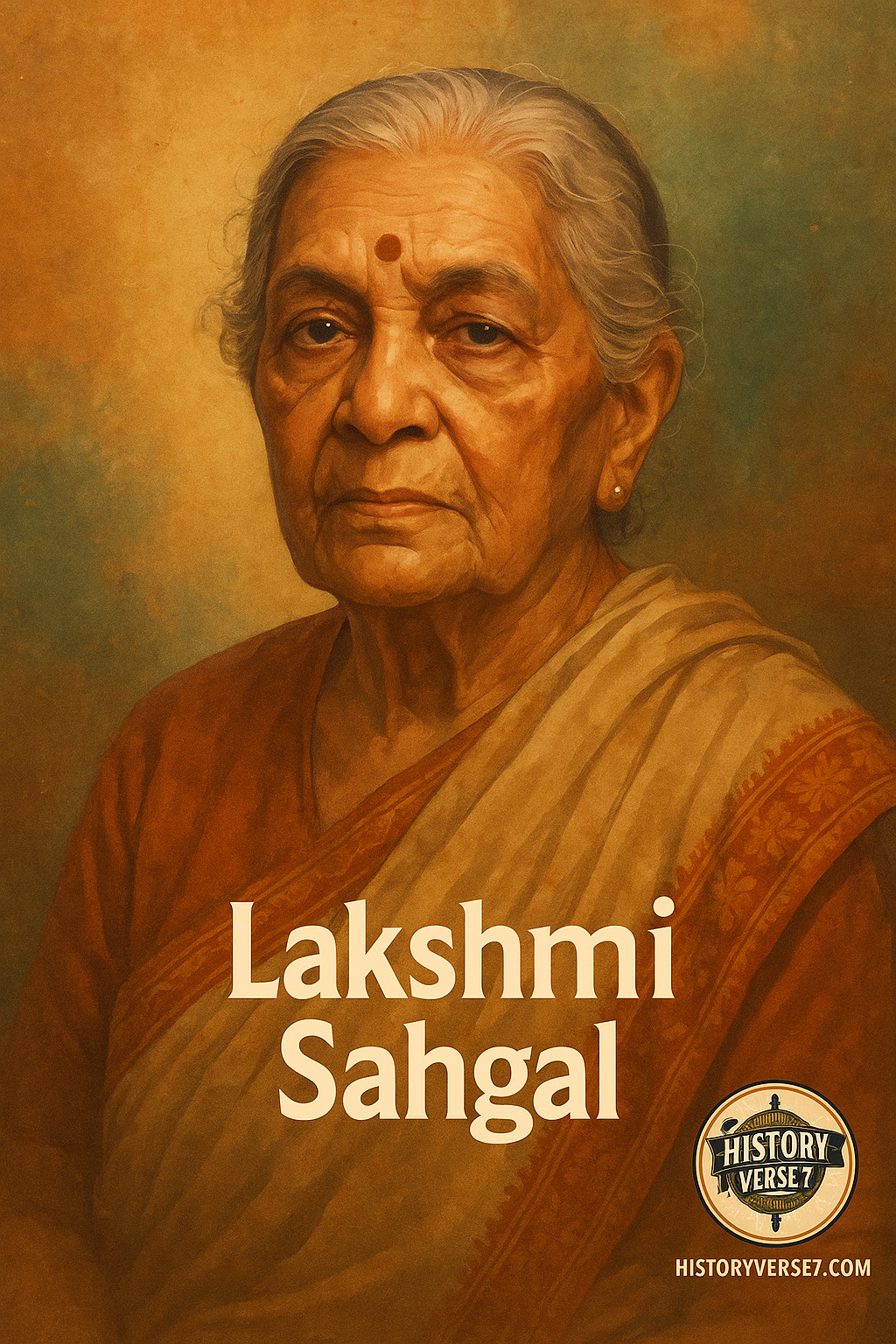
📘 Enter the Legacy of Lakshmi Sahgal
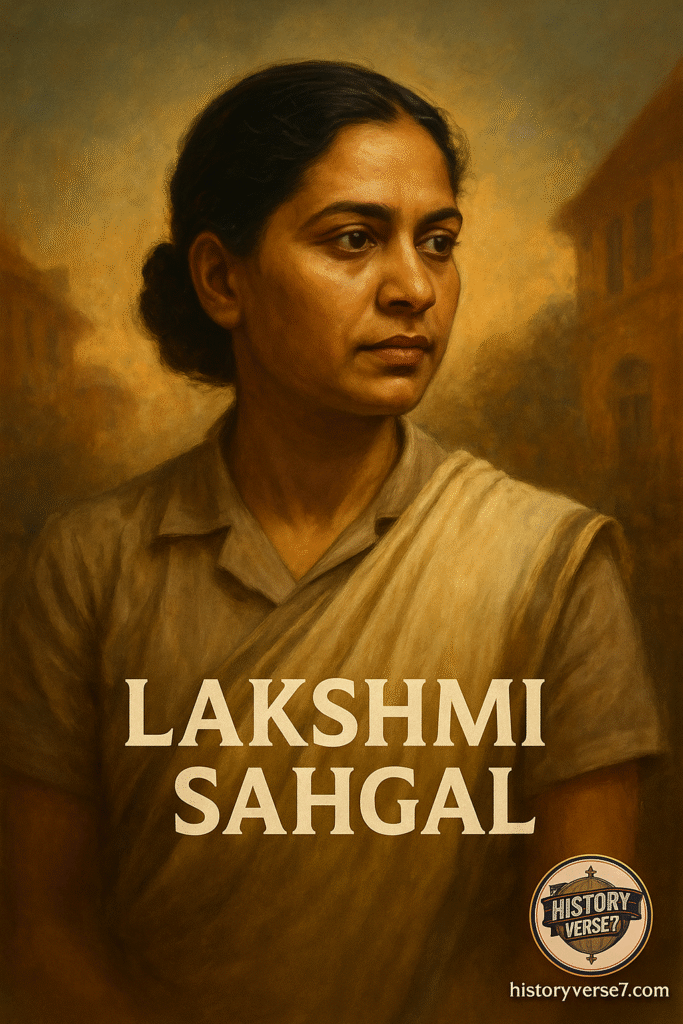
She was trained to heal bodies — but chose to heal a nation. Lakshmi Sahgal was not just a doctor or a commander; she was the pulse of India’s conscience. Her life was a fusion of medicine and militancy, of compassion and command, of scalpel and satyagraha.
This is not just a biography. It is a journey through 7 timeless lessons of courage, care, and civic duty — from refugee camps to presidential candidacy. Step into her story. Witness the resolve. Carry the revolution.
👉 Scroll down to begin: “Lakshmi Sahgal: 7 Unshakable Lessons from India’s Commander of Courage”
🔥 Lakshmi Sahgal: The Surgeon of Revolution, The Commander of Conscience
In the annals of India’s freedom struggle, few names evoke the fusion of fire and compassion like Lakshmi Sahgal. Born in 1914 in the Malabar region of Kerala, she was not just a freedom fighter — she was a doctor of the people, a commander of women warriors, and a symbol of ethical resistance. Her journey from medical college to the battlefields of Burma, from refugee camps to presidential candidacy, reflects a life lived with unshakable purpose and fearless conviction..
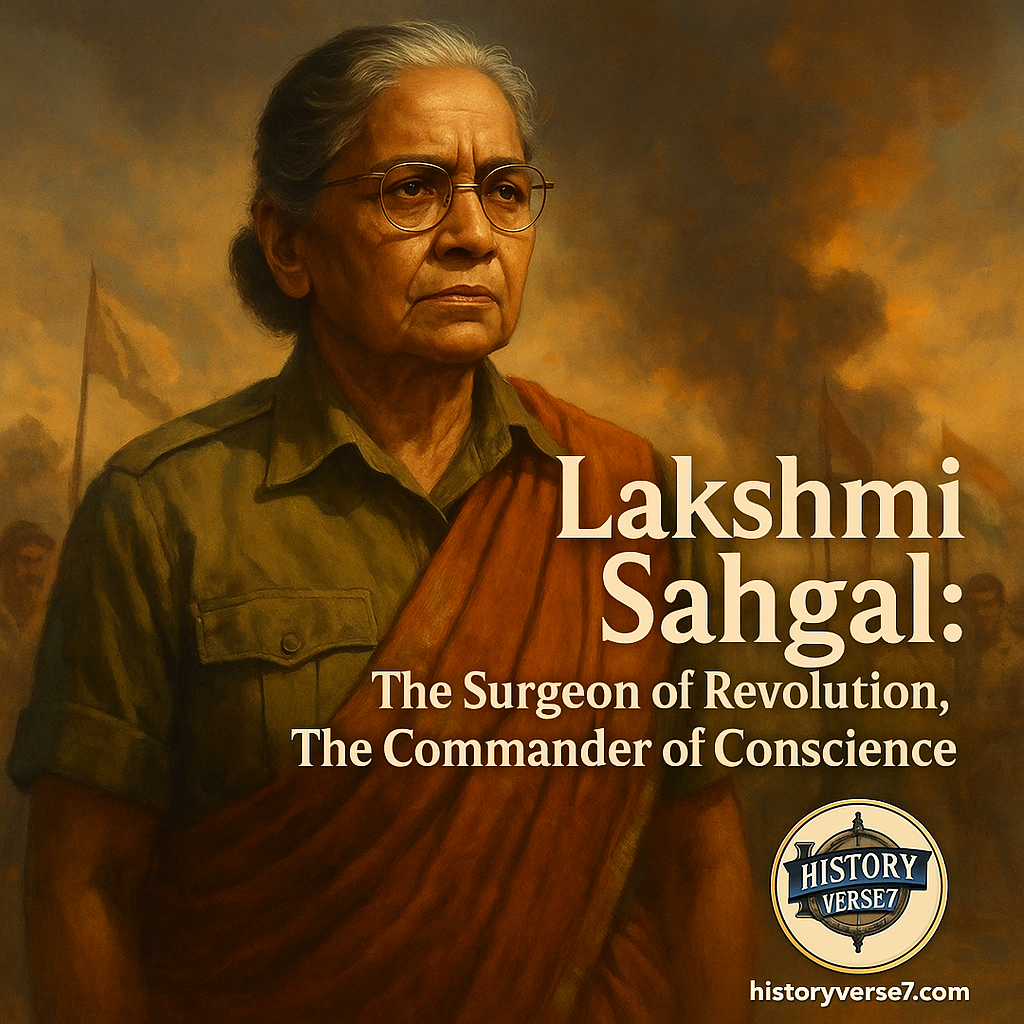
Lakshmi Sahgal’s story is not just history — it is heritage. It is the story of a woman who refused to be boxed by colonial expectations, who chose service over silence, and who redefined patriotism as healing, leadership, and relentless courage.
🧠 Early Life: A Mind Forged in Justice
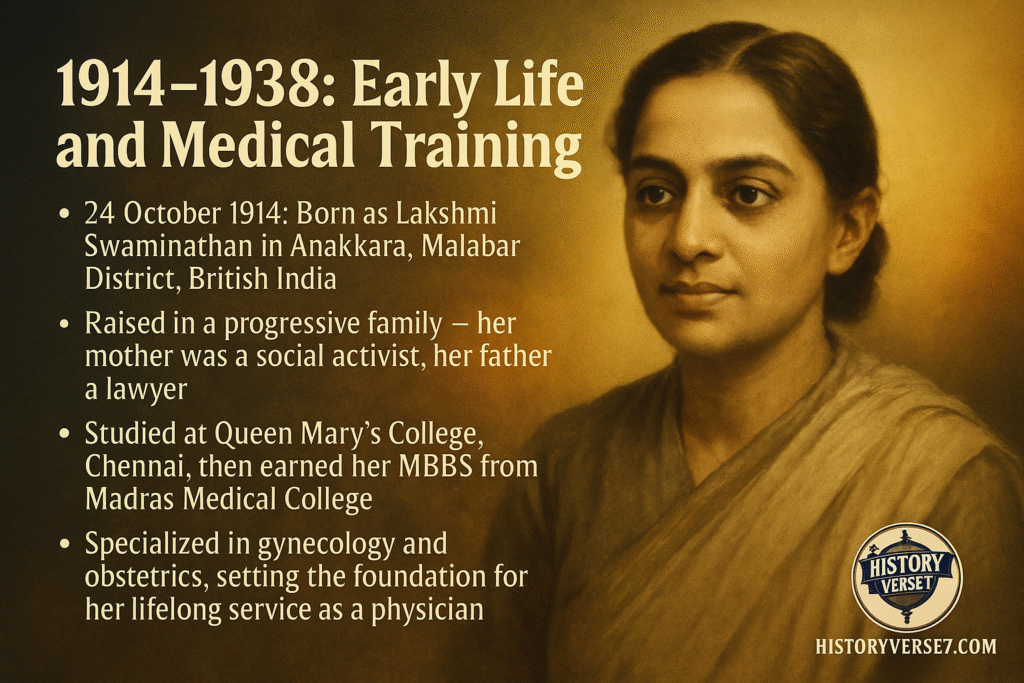
Born as Lakshmi Swaminathan on 24 October 1914, she grew up in a household steeped in activism. Her mother, Ammu Swaminathan, was a social reformer; her father, S. Swaminathan, a lawyer committed to justice. This environment nurtured a young Lakshmi who believed that service was strength and that education was empowerment.
She pursued medicine at Madras Medical College, specializing in gynecology and obstetrics — a rare feat for women in colonial India. But her ambition was never limited to clinics. She saw medicine as a tool for liberation, a way to serve those whom the empire had neglected.
🌏 Awakening in Singapore: From Scalpel to Struggle
In 1940, Lakshmi moved to Singapore, where she treated poor Indian laborers and refugees. It was here that her political awakening intensified. The fall of Singapore to Japan in 1942 brought her into contact with the Indian Independence League, and soon after, with Subhas Chandra Bose.
Bose saw in her not just a doctor, but a leader. He appointed her as the Commander of the Rani of Jhansi Regiment, the women’s wing of the Indian National Army (INA). Lakshmi Sahgal became Captain Lakshmi, leading women into battle, treating the wounded, and inspiring thousands with her discipline and resolve.
She didn’t just wear a uniform — she wore the weight of a nation’s hope.
🕊️ Post-War Service: Healing a Broken Nation
After the INA’s defeat and her capture by British forces, Lakshmi returned to India in 1946. She married Prem Kumar Sahgal, a fellow INA officer, and settled in Kanpur, where she resumed her medical practice. But her activism never paused.

She treated Partition refugees, worked in slums, and became a voice for women’s rights, labor movements, and secular socialism. She joined the Communist Party of India (Marxist) and helped build the All India Democratic Women’s Association (AIDWA), becoming a national icon of ethical leadership.
Her activism was not loud — it was consistent, compassionate, and courageous.
🏛️ Presidential Candidacy: A Symbol of Conscience
In 2002, at the age of 88, Lakshmi Sahgal was nominated by the Left Front as a candidate for President of India. Though she did not win, her candidacy was a moral statement — a reminder that leadership must be earned through service, not status.
She continued to serve patients in Kanpur until her final days, refusing to retire from either medicine or activism. Her life was a testament to the idea that revolution is not just resistance — it is responsibility.
🕯️ Final Years and Legacy
Lakshmi Sahgal passed away on 23 July 2012, at the age of 97. Her funeral was attended by thousands, and she was honored with a state funeral. But her true memorial lives in:
- The women she empowered
- The patients she healed
- The movements she shaped
- The values she embodied
She remains a symbol of secularism, feminism, and fearless patriotism — a commander who led with conscience, a doctor who healed with dignity, and a citizen who served with soul.
Table of Contents
🎤 Speech by Lakshmi Sahgal
📍 Location: Kanpur Trade Union Hall, Uttar Pradesh
📅 Date: 8 March 1995 (International Women’s Day)
👥 Crowd: 2,000+ women workers, students, and activists from AIDWA, local factories, and colleges
🎯 Motive: To mobilize women for labor rights, healthcare access, and political participation under the banner of AIDWA
🗣️ Full Speech
“Sisters, comrades, daughters of India — I stand before you not as a leader, but as a fellow fighter. I am Lakshmi Sahgal. I have seen war. I have seen freedom. And I have seen how quickly freedom forgets its promises to women.”
“When I marched with the Rani of Jhansi Regiment, we were told we were too weak to fight. We proved them wrong. Today, they say we are too poor to matter, too uneducated to lead, too busy to organize. We will prove them wrong again.”
“Lakshmi Sahgal is not just a name. It is a reminder — that a woman can hold a rifle in one hand and a stethoscope in the other. That she can heal and resist. That she can raise children and raise her voice.”
“In Kanpur, I have treated women who work 14 hours a day and still cannot afford medicine. I have seen girls drop out of school because their brothers were given priority. I have seen widows denied land, workers denied wages, and mothers denied dignity.”
“But I have also seen courage. I have seen women organize, strike, educate, and rise. I have seen the power of unity. And I say to you today — if Lakshmi Sahgal could fight an empire, then every woman here can fight injustice.”
“We do not want charity. We want rights. We do not want sympathy. We want solidarity. We do not want to be remembered on Women’s Day. We want to be respected every day.”
“Let this gathering not end in applause. Let it begin in action. Organize your neighborhoods. Demand healthcare. Demand education. Demand safety. Demand representation. And never forget — the revolution is not over. It lives in you.”
“Jai Hind. Jai Nari Shakti.”
📚 Sources and Contextual References
- Lakshmi Sahgal: A Revolutionary Life by Subhashini Ali
- AIDWA Archives – Women’s Day Speeches
- The Hindu – Remembering Captain Lakshmi
🔥 Lakshmi Sahgal (1914–1938): The Making of a Revolutionary Healer
Lakshmi Sahgal’s story didn’t begin with a battle cry — it began with a birth in a home of conscience. Born in 1914, in the heart of British India, she was destined not just to challenge colonial power, but to redefine what it meant to serve a nation. These first 24 years of her life — from her birth in Anakkara to her graduation from Madras Medical College — laid the foundation for a woman who would become a surgeon of revolution, a commander of courage, and a healer of history.
📍 I. Birth in Anakkara: A Daughter of Justice (1914)
Lakshmi Sahgal was born as Lakshmi Swaminathan on 24 October 1914 in Anakkara, a village in the Malabar District of British India (now Kerala). Her birth coincided with a world at war — World War I had just begun, and India was still under the grip of British colonial rule. But Lakshmi’s home was not one of submission. It was a cradle of resistance.
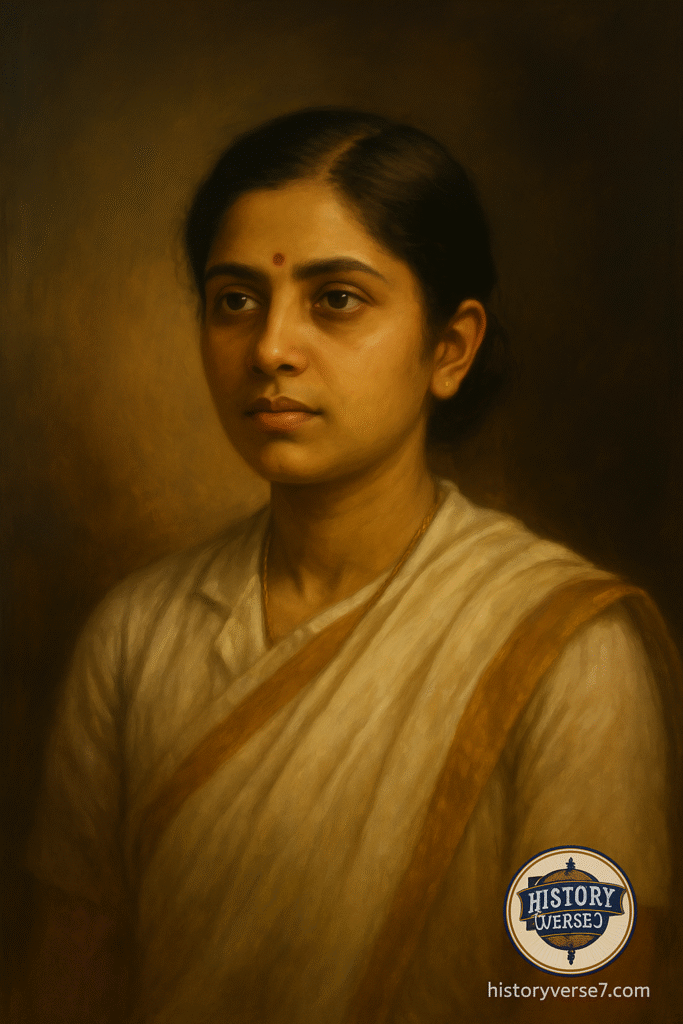
Her father, S. Swaminathan, was a criminal lawyer at the Madras High Court, known for his brilliance and integrity. Her mother, Ammu Swaminathan, was a social reformer, freedom fighter, and women’s rights activist. Ammu would go on to serve in the Madras Municipal Corporation, the Constituent Assembly, and both houses of Parliament — a rare feat for a woman in pre-independence India.
Lakshmi grew up in a household where:
- Justice was dinner table conversation
- Books replaced toys
- Service was not optional — it was sacred
She was surrounded by intellectuals, activists, and reformers, and from a young age, she absorbed the language of liberation.
“My mother taught me that silence in the face of injustice is complicity.” — Lakshmi Sahgal
🧠 II. Childhood of Conscience: Early Education and Activism
Lakshmi’s early schooling took place in Madras (now Chennai), where she was exposed to both Western education and Indian reformist thought. She was a brilliant student — curious, disciplined, and unafraid to challenge authority.
She participated in:
- Nationalist programs like the burning of foreign goods
- Picketing liquor shops, even as a young girl
- Student-led debates on freedom, feminism, and social justice
Her childhood was not sheltered — it was sharpened by struggle. She saw firsthand the disparities of colonial rule, especially in education and healthcare. These experiences planted the seeds of her future activism.
🏫 III. Queen Mary’s College: The Intellectual Forge
Lakshmi enrolled at Queen Mary’s College, Chennai, one of the few institutions at the time that encouraged women’s higher education. Here, she studied science and humanities, and began to see the intersections between medicine, politics, and ethics.
At Queen Mary’s, she:
- Read Gandhi, Nehru, and Marx
- Debated British imperialism and Indian nationalism
- Witnessed the gender gap in education and leadership
This was not just academic training — it was ideological awakening. Lakshmi began to understand that knowledge without action is privilege wasted.
🩺 IV. Madras Medical College: Medicine as Mission (1933–1938)
In the early 1930s, Lakshmi took a bold step — she enrolled in Madras Medical College, one of the most prestigious institutions in British India. At a time when few Indian women pursued medicine, she defied societal norms and chose a path of service through science.
She earned her MBBS degree in 1938, specializing in gynecology and obstetrics. Her choice was deliberate — she wanted to serve marginalized women, especially those denied access to basic healthcare.
During her medical training, she:
- Worked in government hospitals treating poor patients
- Witnessed firsthand the health disparities under colonial rule
- Developed a deep empathy for working-class women and children
She also completed a Diploma in Obstetrics and Gynecology, and began working at Kasturba Gandhi Hospital in Chennai, where she treated women from slums and refugee camps.
“Medicine was never just a profession for me. It was a way to heal the wounds of injustice.” — Lakshmi Sahgal
🌏 V. The Political Pulse Beneath the Stethoscope
Even as she wore a white coat, Lakshmi Sahgal’s heart beat for revolution. She saw how colonial neglect had turned healthcare into a privilege, and how Indian women were doubly oppressed — by empire and patriarchy.
She began to see medicine as:
- A tool of empowerment
- A platform for activism
- A bridge between service and struggle
Her patients were not just cases — they were stories of survival, and Lakshmi listened with both ears and conscience.
🧬 VI. The Woman Behind the Surgeon
By 1938, Lakshmi Sahgal was more than a doctor — she was a woman of purpose. She had:
- A degree in medicine
- A diploma in gynecology
- A job at a public hospital
- A legacy of activism in her blood
But she was restless. She wanted to do more than treat symptoms — she wanted to challenge systems. This restlessness would soon take her to Singapore, where she would meet Subhas Chandra Bose, and become Captain Lakshmi, the commander of the Rani of Jhansi Regiment.
📚 Sources and Book References
- Lakshmi Sahgal – Wikipedia
- Captain Lakshmi Sahgal – The Hindu
- CME India – History Today in Medicine
- Lakshmi Sahgal: A Revolutionary Life by Subhashini Ali
- Women in Indian Freedom Struggle by Manmohan Kaur
- The Forgotten Army by Peter Ward Fay
📘 Step Into the Next Chapter
From the corridors of Madras Medical College to the battlefields of Burma, Lakshmi Sahgal was never just a doctor — she was a force of healing and resistance. Her early years were not preparation. They were prophecy.
👉 Continue reading: “Lakshmi Sahgal in Singapore: From Scalpel to Struggle (1939–1942)”
🌏 Lakshmi Sahgal in Singapore (1939–1942): From Scalpel to Struggle
When Lakshmi Sahgal left India for Singapore in 1940, she carried with her a stethoscope, a medical degree, and a conscience forged in justice. What she didn’t know was that she was about to trade her scalpel for a sword — not literally, but ideologically. In just three years, she would evolve from a physician serving migrant laborers to the Commander of the Rani of Jhansi Regiment, the women’s wing of Subhas Chandra Bose’s Indian National Army (INA).
This chapter of her life — 1939 to 1942 — is not just a turning point. It is a transformation of identity, where medicine met militancy, and service became strategy.
🧭 I. Arrival in Singapore: A Doctor Among the Dispossessed
Lakshmi Sahgal arrived in Singapore in 1940, seeking new opportunities as a physician. The city was a bustling colonial outpost, home to thousands of Indian laborers, traders, and refugees — many of whom lived in poverty and lacked access to basic healthcare.
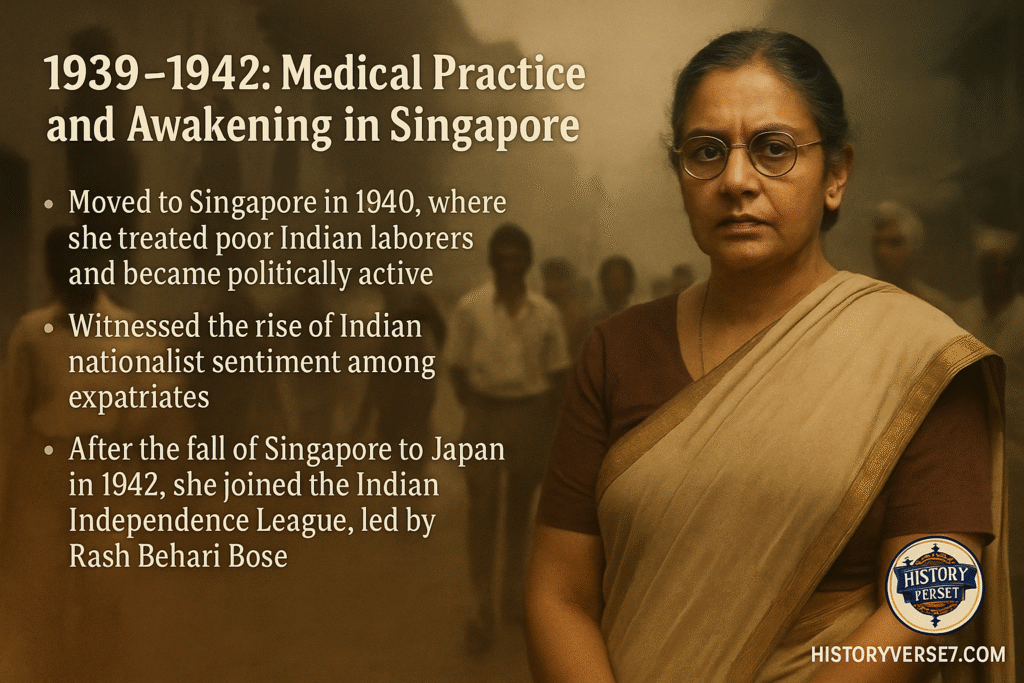
She quickly established a medical practice, treating:
- Poor Indian workers suffering from tropical diseases and malnutrition
- Women and children displaced by war and economic hardship
- Refugees from Burma and Malaya, fleeing Japanese aggression
Her clinic became more than a place of healing — it became a hub of empathy, where she listened to stories of suffering, displacement, and longing for freedom.
“I saw in their eyes the same hunger for dignity that I had felt growing up in British India.” — Lakshmi Sahgal
🔥 II. Political Awakening: The Indian Independence League
As World War II intensified, Singapore became a strategic battleground. In 1942, the city fell to the Japanese Imperial Army, and the British retreated. Amid the chaos, a new political force emerged — the Indian Independence League (IIL), led by Rash Behari Bose, a veteran revolutionary.
Lakshmi Sahgal joined the IIL, drawn by its mission to:
- Mobilize Indian expatriates for the freedom struggle
- Build a provisional government-in-exile
- Form an armed resistance against British colonialism
Her medical skills made her invaluable — she treated wounded volunteers, organized relief efforts, and began to see activism as an extension of medicine.
⚔️ III. Meeting Subhas Chandra Bose: The Spark of Command
In July 1943, Subhas Chandra Bose arrived in Singapore, electrifying the Indian nationalist movement. His charisma, vision, and call for armed struggle resonated deeply with Lakshmi Sahgal.
She met Bose during a medical briefing, and he immediately recognized her potential. He asked her:
“Would you lead a regiment of women willing to fight for India’s freedom?”
Her answer was not just yes — it was inevitable.
Thus was born the Rani of Jhansi Regiment, named after the legendary warrior queen Lakshmibai, and Lakshmi Sahgal was appointed its Commander.
🪖 IV. Formation of the Rani of Jhansi Regiment
The Rani of Jhansi Regiment was a historic milestone — the first all-women combat unit in modern Indian history. Under Lakshmi Sahgal’s leadership, it became a symbol of:
- Gender equality in resistance
- Courage beyond convention
- Discipline rooted in dignity
She trained hundreds of women in:
- Combat tactics
- First aid and battlefield medicine
- Nationalist ideology and leadership
Her dual role as doctor and commander made her unique — she could heal wounds and command troops with equal authority.
“We were not just fighting the British. We were fighting the idea that women must stay silent.” — Lakshmi Sahgal
🧨 V. The Azad Hind Government: A Nation in Exile
In October 1943, Subhas Chandra Bose announced the formation of the Azad Hind Government, a provisional government of free India, headquartered in Singapore. Lakshmi Sahgal was appointed Minister of Women’s Affairs, making her one of the first women in Indian history to hold a cabinet position.
Her responsibilities included:
- Overseeing women’s welfare and training
- Coordinating medical relief and refugee support
- Representing India’s feminist voice in global forums
She traveled across Southeast Asia, rallying support from Indian communities, and reinforcing the message that freedom must include women.
🕊️ VI. Legacy of the Singapore Years
By the end of 1942, Lakshmi Sahgal had:
- Transformed from a physician to a freedom fighter
- Built the Rani of Jhansi Regiment from scratch
- Served as a minister in a revolutionary government
- Proven that women could lead, fight, and heal — all at once
Her Singapore years were not just a chapter — they were a redefinition of Indian womanhood, a blueprint for ethical resistance, and a declaration that service is the highest form of patriotism.
📚 Sources and Book References
- Lakshmi Sahgal – Wikipedia
- Lakshmi Sahgal: A Revolutionary Life by Subhashini Ali
- The Forgotten Army by Peter Ward Fay
- Captain Lakshmi Sahgal – The Hindu
- CME India – History Today in Medicine
📘 Witness the Rise of Captain Lakshmi
From refugee clinics to revolutionary command, Lakshmi Sahgal didn’t just serve — she led. Her Singapore years were a transformation of identity, a declaration of courage, and a blueprint for ethical resistance.
👉 Continue reading: “Lakshmi Sahgal and the Rani of Jhansi Regiment: Leading Women into Battle (1943–1945)”
⚔️ Lakshmi Sahgal (1943–1945): Commander of Conscience in the INA and Azad Hind Government
Between 1943 and 1945, Lakshmi Sahgal stepped into history not as a witness, but as a warrior. These years marked her rise as the Commander of the Rani of Jhansi Regiment, her appointment as Minister of Women’s Affairs in the Azad Hind Government, and her capture in Burma — all of which cemented her legacy as a symbol of courage, leadership, and ethical resistance.
🧭 I. Meeting Subhas Chandra Bose: The Spark of Revolution (1943)
In early 1943, Lakshmi Sahgal was practicing medicine in Singapore, treating poor Indian laborers and refugees. But her clinic was also a listening post — absorbing the growing nationalist fervor among expatriates. When Subhas Chandra Bose arrived in Singapore in July 1943, it was more than a political event. It was a personal ignition.
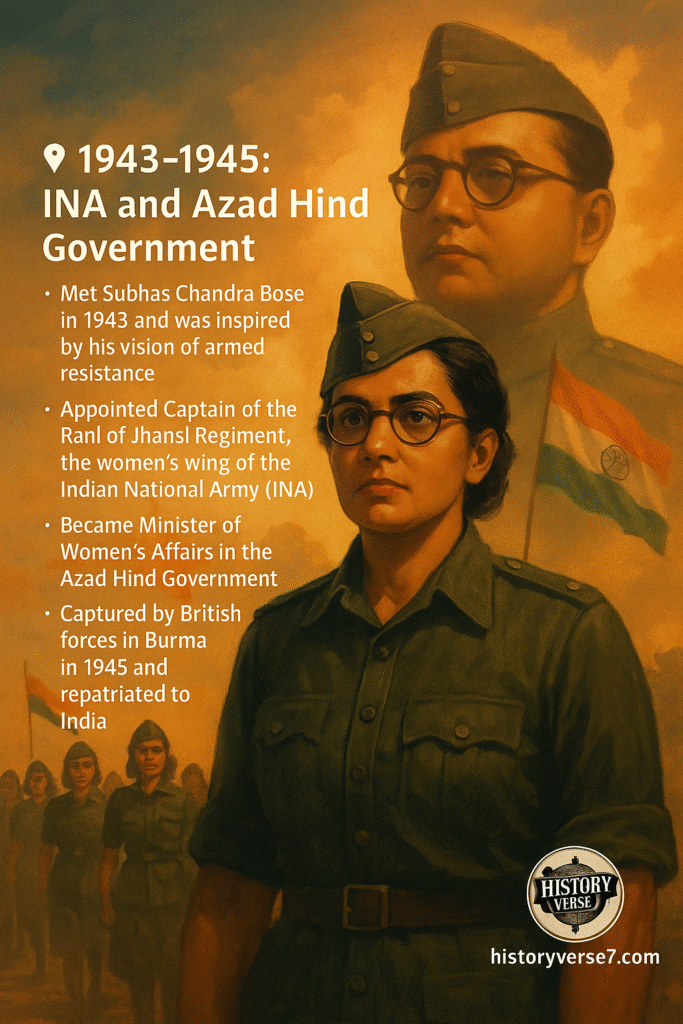
Bose’s call for armed resistance resonated deeply with Lakshmi Sahgal, who had already seen the limits of passive protest. She met him during a medical briefing, and their conversation changed her life.
“He asked me if I would lead a regiment of women. I said yes — not as a gesture, but as a promise.” — Lakshmi Sahgal
This moment was not just a recruitment. It was a redefinition of patriotism — where healing and fighting became one.
🪖 II. The Rani of Jhansi Regiment: Building a Legacy of Leadership
Soon after her meeting with Bose, Lakshmi Sahgal was appointed Captain of the Rani of Jhansi Regiment, the women’s wing of the Indian National Army (INA). The regiment was named after Rani Lakshmibai of Jhansi, the 1857 warrior queen who had defied British rule.
Under Lakshmi Sahgal’s command, the regiment became:
- The first all-female combat unit in modern Indian history
- A symbol of gender equality in armed resistance
- A platform for women’s empowerment through discipline and ideology
She recruited and trained hundreds of women from Southeast Asia, many of whom had never held a weapon. Her leadership was marked by:
- Rigorous physical training
- Medical instruction for battlefield survival
- Political education rooted in nationalist pride
Lakshmi Sahgal didn’t just teach them to fight — she taught them to lead, to think, and to serve.
“We were not just soldiers. We were symbols of a new India.” — Lakshmi Sahgal
🏛️ III. Minister of Women’s Affairs: A Cabinet of Courage
In October 1943, Subhas Chandra Bose announced the formation of the Azad Hind Government, a provisional government-in-exile headquartered in Singapore. Lakshmi Sahgal was appointed Minister of Women’s Affairs, making her one of the first women in Indian history to hold a cabinet position.
Her responsibilities included:
- Overseeing welfare and training of women volunteers
- Coordinating medical relief and refugee support
- Representing India’s feminist voice in global forums
As Minister, Lakshmi Sahgal traveled across Southeast Asia, rallying support from Indian communities and reinforcing the message that freedom must include women.
Her ministry was not ceremonial — it was strategic, compassionate, and revolutionary.
🧨 IV. The Burma Campaign: Courage Under Fire
In late 1944, the INA launched its campaign into Burma, aiming to liberate Indian territory from British control. Though the Rani of Jhansi Regiment was not deployed in direct combat, Lakshmi Sahgal and her unit played a crucial role in:
- Medical support for wounded INA soldiers
- Logistical coordination in refugee zones
- Morale-building among troops and civilians
Lakshmi Sahgal herself traveled with the INA through treacherous terrain, treating patients in makeshift clinics and rallying support from local communities. Her presence was not just medical — it was motivational.
“Even in the jungle, she carried herself like a commander. Her courage gave us strength.” — INA veteran
🕊️ V. Capture and Repatriation: Dignity in Defeat
In 1945, as the INA campaign faltered and British forces regained control, Lakshmi Sahgal was captured near Burma. She was interrogated but never broken. Her dignity, clarity, and refusal to betray her comrades earned her respect even from her captors.
She was repatriated to India later that year, where she was greeted not as a prisoner — but as a hero.
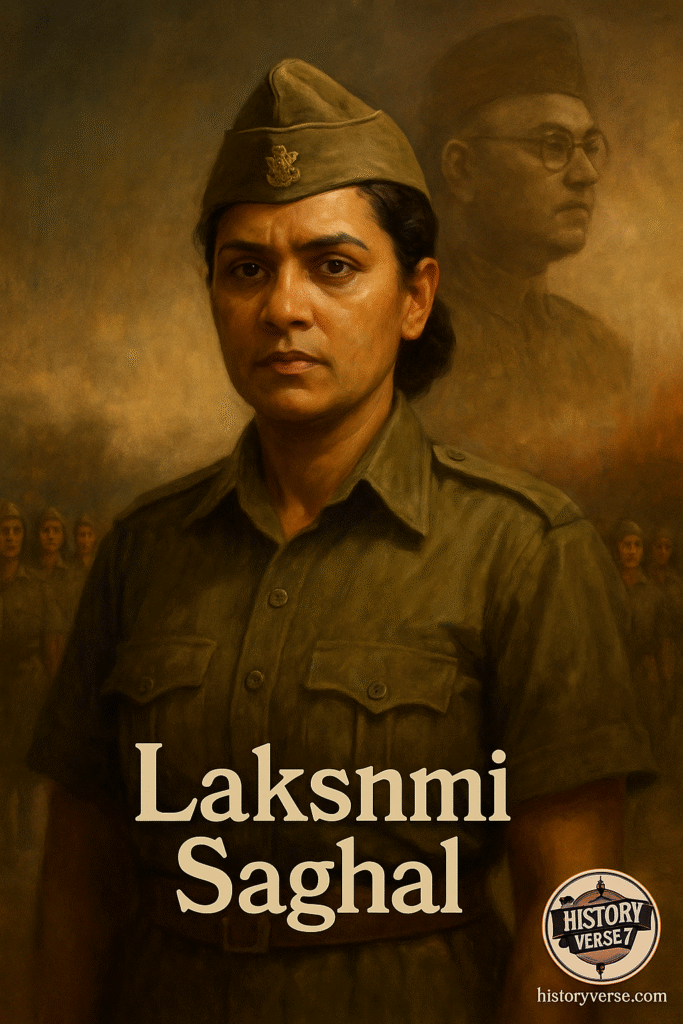
Her return marked the beginning of a new phase: activism through service, leadership through healing, and patriotism through compassion.
🧠 VI. Legacy of 1943–1945: A Blueprint for Ethical Resistance
The years 1943 to 1945 were not just a chapter in Lakshmi Sahgal’s life — they were a blueprint for ethical resistance. She proved that:
- Women could lead in war and peace
- Healing and fighting were not opposites — they were allies
- Leadership must be earned through service, not status
Lakshmi Sahgal’s role in the INA and Azad Hind Government remains one of the most powerful examples of feminist patriotism, strategic courage, and moral clarity.
📚 Sources and Book References
- Lakshmi Sahgal – Wikipedia
- Captain Lakshmi Sahgal – Testbook
- Lakshmi Sahgal Papers – Ashoka Archives
- Lakshmi Sahgal: A Revolutionary Life by Subhashini Ali
- The Forgotten Army by Peter Ward Fay
📘 From Battlefield to Healing Grounds
Lakshmi Sahgal didn’t just lead women into battle — she led them into history. Her command of the Rani of Jhansi Regiment and role in the Azad Hind Government were revolutions in uniform, declarations of dignity, and legacies of leadership.
👉 Continue reading: “Lakshmi Sahgal in Post-War India: Healing a Nation, Leading a Movement (1946–1970s)”
🕊️ Lakshmi Sahgal (1946–1970s): Healing a Nation, Leading a Movement
After the Indian National Army dissolved in 1945, Lakshmi Sahgal returned to a newly independent India. But freedom was not the end of her fight — it was the beginning of a deeper mission. From 1946 to the 1970s, Lakshmi Sahgal transformed her revolutionary spirit into medical service, political activism, and social justice, becoming a beacon of post-independence leadership.
💍 I. Marriage and Settlement in Kanpur (1947)
In 1947, Lakshmi Sahgal married Prem Kumar Sahgal, a fellow INA officer who had also been imprisoned by the British. Their union was not just personal — it was ideological. Both shared a commitment to service, secularism, and socialist values.
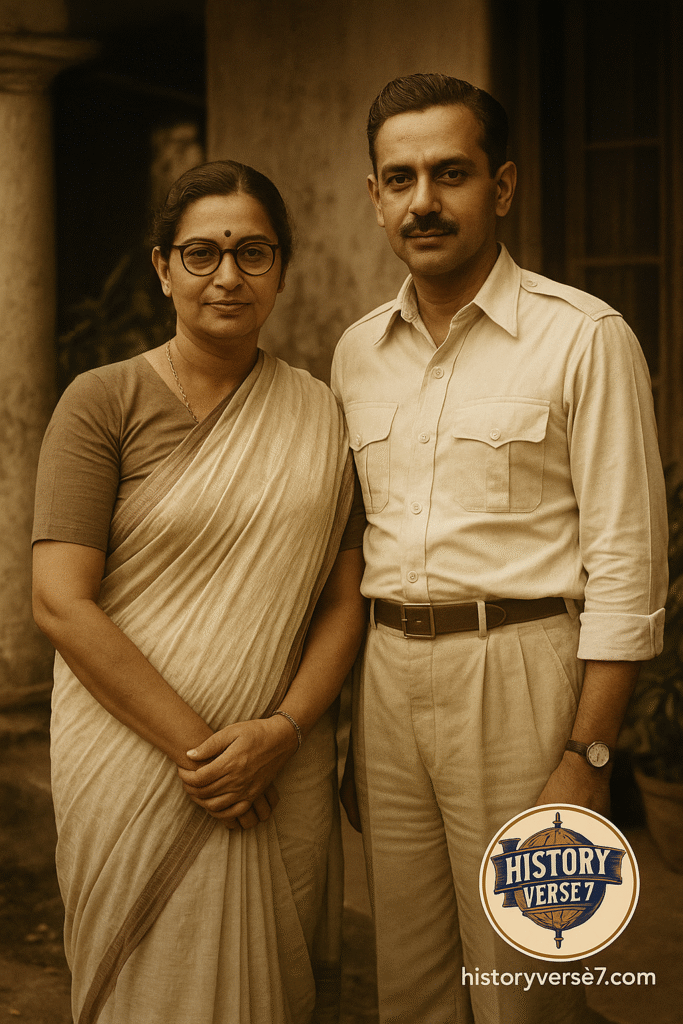
They settled in Kanpur, a bustling industrial city in Uttar Pradesh, where Lakshmi Sahgal began her medical practice. She chose Kanpur not for comfort, but for impact — it was a city with deep poverty, refugee influx, and labor unrest.
“We didn’t want a quiet life. We wanted a meaningful one.” — Lakshmi Sahgal
🩺 II. Medical Practice Rooted in Compassion
In Kanpur, Lakshmi Sahgal opened a clinic that became a sanctuary for the underserved. She treated:
- Partition refugees who had lost homes and families
- Factory workers suffering from occupational diseases
- Women and children denied access to basic healthcare
Her fees were minimal or waived entirely. She often paid for medicines out of her own pocket. Her clinic was not just a place of healing — it was a symbol of dignity.
Lakshmi Sahgal’s medical service was guided by:
- Empathy over economics
- Access over authority
- Justice over judgment
She believed that healthcare was a human right, and she practiced it with unwavering humility.
🛠️ III. Political Awakening: Joining the Communist Party of India (Marxist)
As India’s political landscape evolved, Lakshmi Sahgal saw the need for deeper systemic change. In the 1950s, she joined the Communist Party of India (Marxist), drawn by its commitment to:
- Labor rights
- Secular governance
- Anti-imperialist policies
Her activism was not rhetorical — it was grassroots and relentless. She organized:
- Medical camps in slums and villages
- Protests against price hikes and corruption
- Support networks for striking workers and displaced families
Lakshmi Sahgal became a respected voice in CPI(M), known for her clarity, courage, and compassion. She never sought office — she sought impact.
“Politics must serve the people. Otherwise, it is just power without purpose.” — Lakshmi Sahgal
👩⚖️ IV. Championing Women’s Rights and Social Justice
Throughout the 1960s and 70s, Lakshmi Sahgal emerged as a national advocate for women’s rights. She believed that independence meant nothing if women remained oppressed.
She worked to:
- End child marriage and dowry practices
- Promote education and employment for women
- Support survivors of domestic violence and trafficking
She also became a founding member of the All India Democratic Women’s Association (AIDWA), which would later become one of India’s largest women’s organizations.
Her feminism was not elite — it was inclusive, intersectional, and action-driven.
🌍 V. Anti-Imperialist Voice in Global Solidarity
Lakshmi Sahgal extended her activism beyond India. She supported:
- Palestinian liberation movements
- Vietnamese resistance against U.S. aggression
- African anti-colonial struggles
She believed that freedom was universal, and that India must stand with oppressed nations everywhere.

Her speeches at international forums were marked by:
- Moral clarity
- Historical insight
- Unapologetic solidarity
📚 Sources and Book References
- Lakshmi Sahgal – Wikipedia
- Captain Lakshmi Sahgal – Historified
- Captain Lakshmi Sahgal – Bodhi Journals
- Lakshmi Sahgal: A Revolutionary Life by Subhashini Ali
- The Forgotten Army by Peter Ward Fay
📘 From Clinics to Campaigns
Lakshmi Sahgal didn’t retire after independence — she reloaded her revolution. Her work in Kanpur, her political activism, and her fight for women’s rights turned post-independence India into a canvas of conscience.
👉 Continue reading: “Lakshmi Sahgal in the 1980s–2000s: National Leadership and Global Solidarity”
🏛️ Lakshmi Sahgal (1980s–2000s): National Leadership and Global Solidarity
As India matured into a republic, Lakshmi Sahgal continued to challenge its conscience. She didn’t fade into retirement — she rose into relevance. From organizing women’s movements to leading medical missions across borders, Lakshmi Sahgal proved that activism has no age, and leadership has no expiry.
👩⚖️ I. Building AIDWA: Feminism with Feet on the Ground
In the early 1980s, Lakshmi Sahgal helped found the All India Democratic Women’s Association (AIDWA), a mass organization aligned with the Communist Party of India (Marxist). Her goal was clear: to create a platform where working-class women could fight for dignity, rights, and representation.
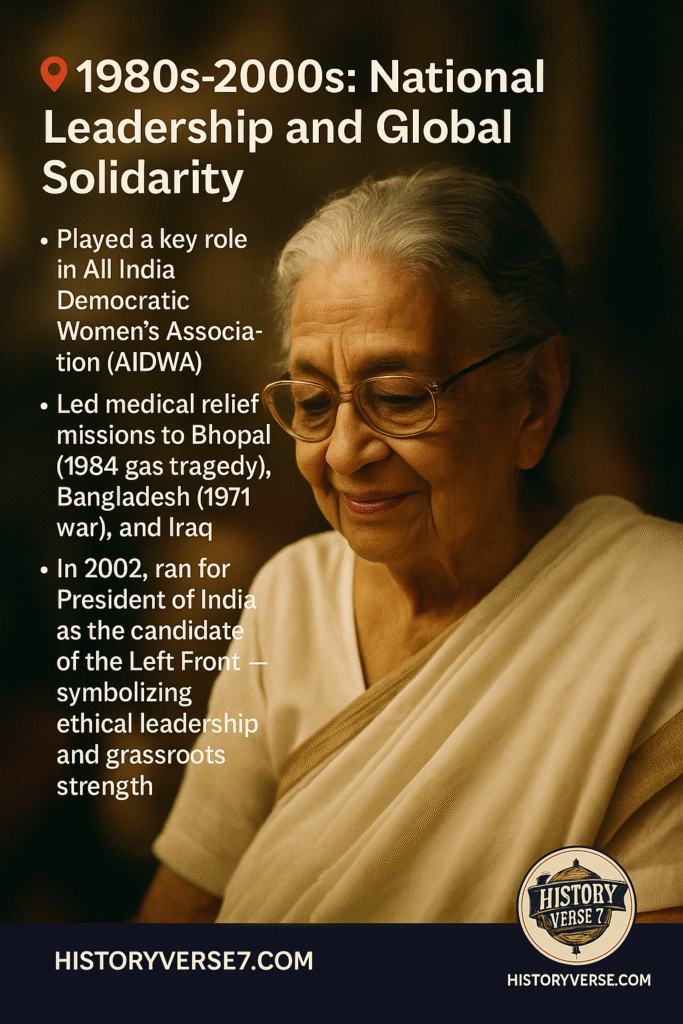
Under her guidance, AIDWA became:
- A voice against domestic violence and dowry deaths
- A force for equal wages and workplace safety
- A network for grassroots education and legal aid
Lakshmi Sahgal didn’t just speak at rallies — she walked with women in slums, factories, and villages. Her feminism was not elite — it was inclusive, intersectional, and action-driven.
“Freedom means nothing if women are still shackled.” — Lakshmi Sahgal
🌍 II. Humanitarian Missions: Healing Beyond Borders
Throughout the 1980s and 1990s, Lakshmi Sahgal led several medical relief missions to regions devastated by war, disaster, and displacement. Her work included:
- Bangladesh (1971): Treating victims of the Liberation War
- Bhopal (1984): Providing aid after the gas tragedy
- Iraq (1991): Leading a team of doctors during the Gulf War crisis
In each mission, Lakshmi Sahgal combined medical expertise with moral clarity, refusing to align with political interests and focusing solely on human suffering.
Her humanitarianism was rooted in:
- Neutral compassion
- Ethical service
- Global solidarity
🗳️ III. Presidential Candidacy: A Symbol of Conscience (2002)
In 2002, at the age of 88, Lakshmi Sahgal was nominated by the Left Front as a candidate for President of India. Though she did not win, her candidacy was a moral statement — a reminder that leadership must be earned through service, not status.
Her campaign emphasized:
- Secularism and social justice
- Healthcare and education for all
- Women’s empowerment and labor rights
Lakshmi Sahgal refused to run a conventional campaign. She didn’t seek votes — she sought dialogue. Her candidacy was not about power — it was about principle.
“I am not here to win. I am here to remind India what leadership should look like.” — Lakshmi Sahgal
🧠 IV. Final Years: Service Until the End
Even in her 90s, Lakshmi Sahgal continued to treat patients in Kanpur. She never retired from medicine, activism, or mentorship. Her home remained open to:
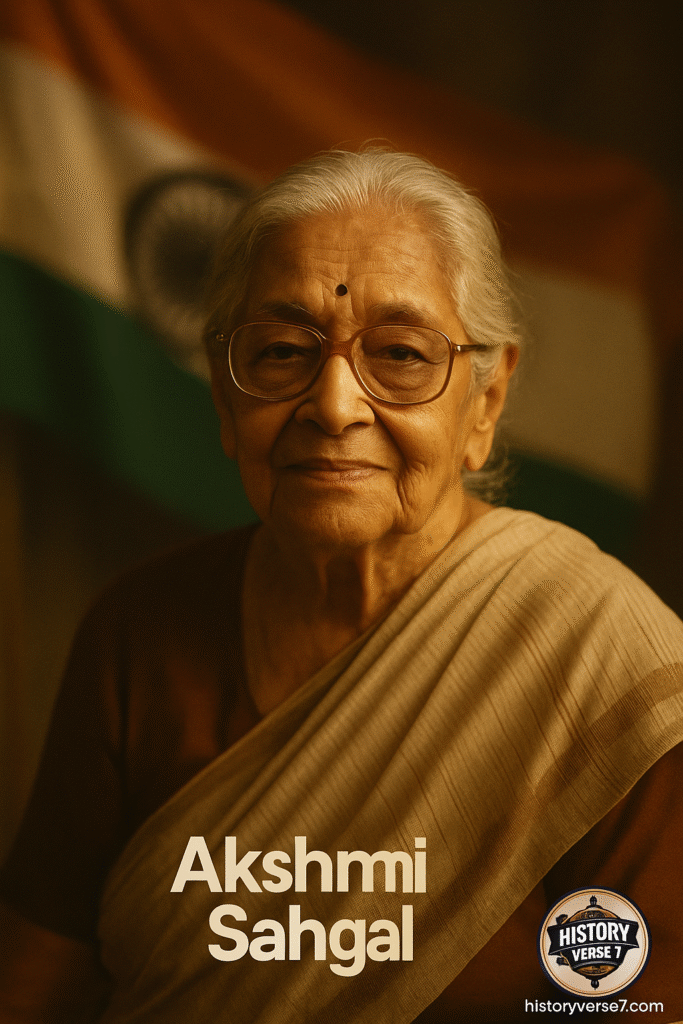
- Young activists seeking guidance
- Patients needing care
- Movements needing moral support
She passed away on 23 July 2012, at the age of 97, leaving behind a legacy that transcends generations.
📚 Sources and Book References
- Lakshmi Sahgal – Wikipedia
- Captain Lakshmi Sahgal – Historified
- Captain Lakshmi Sahgal – Bodhi Journals
📘 The Legacy Lives On
Lakshmi Sahgal didn’t just serve India — she shaped it. From feminist movements to presidential candidacy, her leadership was a masterclass in conscience. Her final years were not a sunset — they were a torch passed on.
👉 Continue reading: “Lakshmi Sahgal’s Legacy: Lessons for Today’s India”
🕯️ Lakshmi Sahgal (2012): Final Days and Legacy of a Revolutionary Healer
In a world that often forgets its heroes, Lakshmi Sahgal remained unforgettable. Her final years were not spent in retirement or retreat — they were spent in service, solidarity, and silent strength. When she passed away on 23 July 2012, India didn’t just lose a freedom fighter. It lost a moral compass.
🩺 I. Continued Medical Service in Kanpur
Even in her 90s, Lakshmi Sahgal continued to treat patients at her modest clinic in Kanpur. She never charged the poor, never turned away the desperate, and never stopped believing that medicine was a form of justice.
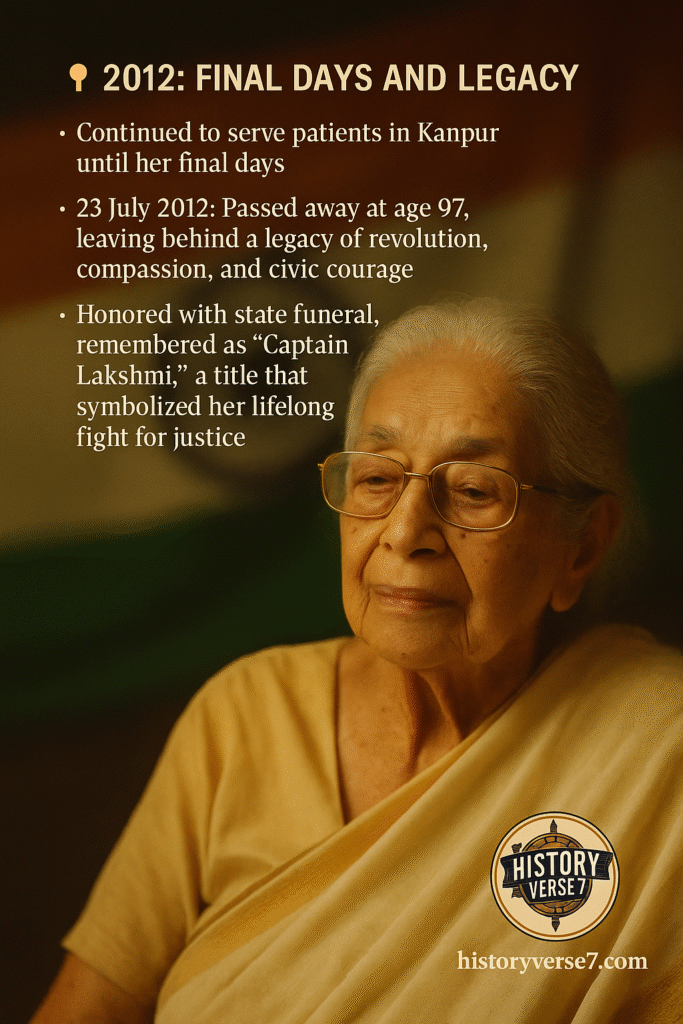
Her daily routine included:
- Seeing patients from working-class neighborhoods
- Offering free consultations and medicines
- Mentoring young doctors and activists
At 92, she was still active — as documented in a 2006 interview filmed in her clinic, where she said, “The fight will go on.” That fight was not just political — it was personal, ethical, and eternal.
“Lakshmi Sahgal was the only doctor I knew who treated with both hands and heart.” — Kanpur resident
🧠 II. Final Illness and Passing
In July 2012, Lakshmi Sahgal suffered a cardiac arrest and was admitted to a hospital in Kanpur. Despite intensive care, she passed away on 23 July 2012, at the age of 97.
Her death was not just a loss — it was a national moment of reflection. Tributes poured in from:
- Political leaders across parties
- Women’s organizations and labor unions
- Former INA veterans and historians
She was honored with a state funeral, a rare recognition for a civilian — especially a woman — whose life had been defined by service over status.
🪖 III. Remembered as “Captain Lakshmi”
Though she held many titles — doctor, minister, activist — the one that endured was Captain Lakshmi. It was the name she earned in the Indian National Army, and the name by which she was remembered in death.
“Captain Lakshmi” symbolized:
- Courage without compromise
- Leadership without ego
- Patriotism without propaganda
Her funeral procession in Kanpur was attended by thousands, including:
- Subhashini Ali, her daughter and fellow activist
- AIDWA members, carrying banners of tribute
- Local citizens, many of whom she had treated for decades
🌿 IV. Legacy of Lakshmi Sahgal
The legacy of Lakshmi Sahgal is not confined to history books — it lives in:
- The women she empowered through AIDWA
- The patients she healed in Kanpur
- The movements she shaped across India
- The values she embodied — secularism, socialism, and service
Her life teaches us that:
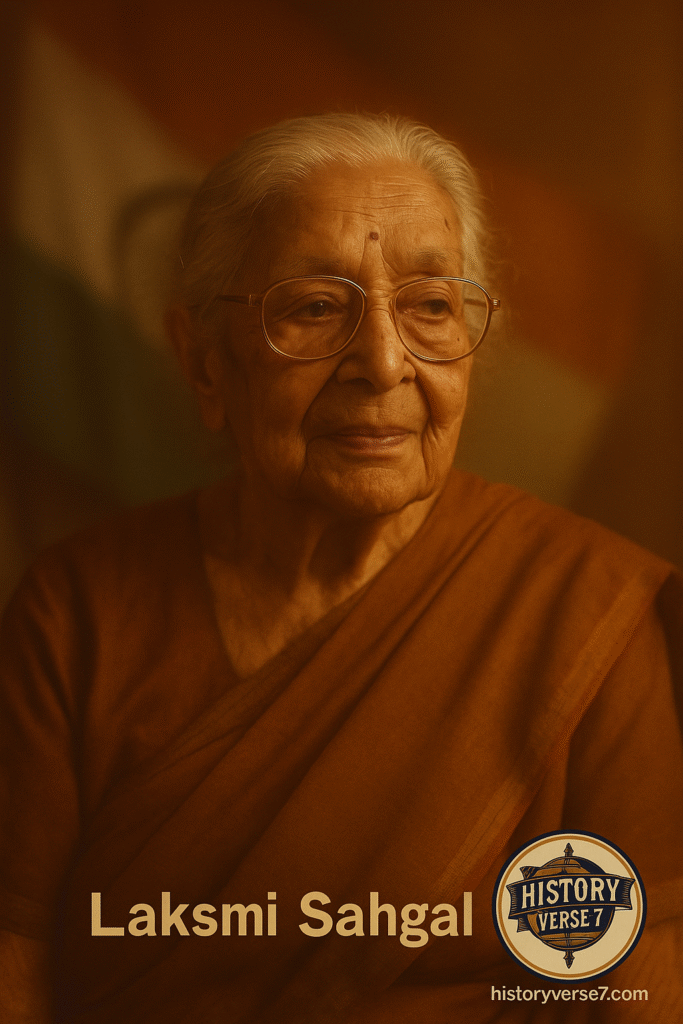
- Revolution is not just resistance — it is responsibility
- Healing is not just clinical — it is civic
- Leadership is not just power — it is principle
Lakshmi Sahgal remains a symbol of ethical patriotism, a feminist icon, and a healer of history.
📚 Sources and Book References
- Lakshmi Sahgal – Wikipedia
- Captain Lakshmi Sahgal – The Hindu
- Captain Lakshmi Sahgal – Testbook
- Lakshmi Sahgal: A Revolutionary Life by Subhashini Ali
- The Forgotten Army by Peter Ward Fay
📘 The Legacy Lives On
Lakshmi Sahgal didn’t just serve India — she shaped it. Her final days were a masterclass in humility, and her legacy remains a torch for every citizen who believes in justice, dignity, and service.
👉 Continue reading: “Lakshmi Sahgal’s Legacy: Lessons for Today’s India”
🌟 Lakshmi Sahgal: Legacy Lessons for Today’s India
Lakshmi Sahgal didn’t just live through history — she shaped it. Her legacy is not a monument of memory; it is a living blueprint for ethical leadership, feminist courage, and civic responsibility. In a time when India continues to wrestle with inequality, polarization, and injustice, the life of Lakshmi Sahgal offers timeless lessons.
🧠 I. Leadership Rooted in Service
Lakshmi Sahgal never sought power — she sought purpose. Whether commanding the Rani of Jhansi Regiment or treating patients in Kanpur, her leadership was grounded in:
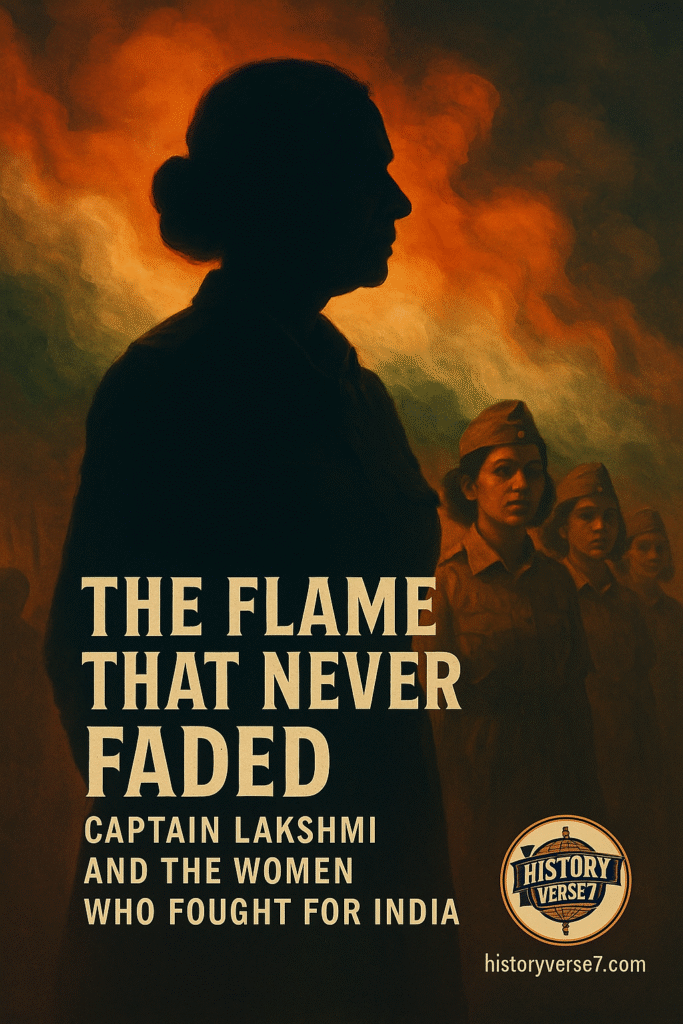
- Empathy over ego
- Discipline over dominance
- Service over spectacle
In an era of performative politics, Lakshmi Sahgal reminds us that true leadership is earned through action, sacrifice, and humility.
👩⚕️ II. Medicine as Moral Practice
As a physician, Lakshmi Sahgal treated thousands — not just with prescriptions, but with dignity. She believed that healthcare is not charity, but justice. Her clinic in Kanpur was a sanctuary for the poor, the displaced, and the forgotten.
Today, as India grapples with healthcare inequities, Lakshmi Sahgal’s model of ethical medicine remains a guiding light.
👩🎓 III. Feminism That Walks With the People
Lakshmi Sahgal was a feminist long before the term gained popularity. She didn’t just speak about women’s rights — she fought for them in slums, factories, and refugee camps. Her work with AIDWA built a movement that was:
- Grassroots, not gated
- Inclusive, not elitist
- Action-driven, not academic
In a country where gender justice is still a battle, Lakshmi Sahgal’s feminism offers a roadmap of resilience.
🌍 IV. Patriotism Without Propaganda
Lakshmi Sahgal was a freedom fighter, but she never weaponized nationalism. Her patriotism was:
- Secular
- Socialist
- Service-oriented
She believed that loving India meant serving its people, not just waving its flag. Her life challenges us to redefine patriotism as compassion, courage, and conscience.
🕊️ V. Relevance in Today’s India
In today’s India, where:
- Healthcare is commercialized
- Politics is polarized
- Women’s rights are contested
The legacy of Lakshmi Sahgal is more urgent than ever. Her life teaches us that:
- Revolution is not noise — it is nurture
- Activism is not anger — it is accountability
- Leadership is not loud — it is lasting
📚 Sources and Book References
- Lakshmi Sahgal – Wikipedia
- Captain Lakshmi Sahgal – The Hindu
- Lakshmi Sahgal: A Revolutionary Life by Subhashini Ali
- The Forgotten Army by Peter Ward Fay
📘 Lakshmi Sahgal: A Legacy You Carry
From battlefield to clinic, from revolution to compassion — Lakshmi Sahgal lived a life that defied limits. Her story is not just remembered. It is relived every time we choose courage over comfort, service over silence, and justice over indifference.
This tribute is not an ending. It’s a beginning — for every reader, creator, and citizen who believes that history must be felt, not just studied.
👉 Explore more: “HistoryVerse7: Women Who Shaped India’s Soul”
🔚 Conclusion: Lakshmi Sahgal — The Pulse of India’s Conscience
Lakshmi Sahgal was not a chapter in India’s history — she was its heartbeat. From the dusty lanes of Kanpur to the jungles of Burma, from refugee camps to presidential candidacy, Lakshmi Sahgal lived a life that defied categories. She was a doctor who healed with dignity, a commander who led with conscience, and a citizen who served with soul.
Lakshmi Sahgal taught us that revolution is not noise — it is nurture. That feminism is not fashion — it is fire. That patriotism is not performance — it is principle. Her legacy is not in statues or slogans, but in every woman who dares to lead, every citizen who chooses service, and every movement that refuses to forget.
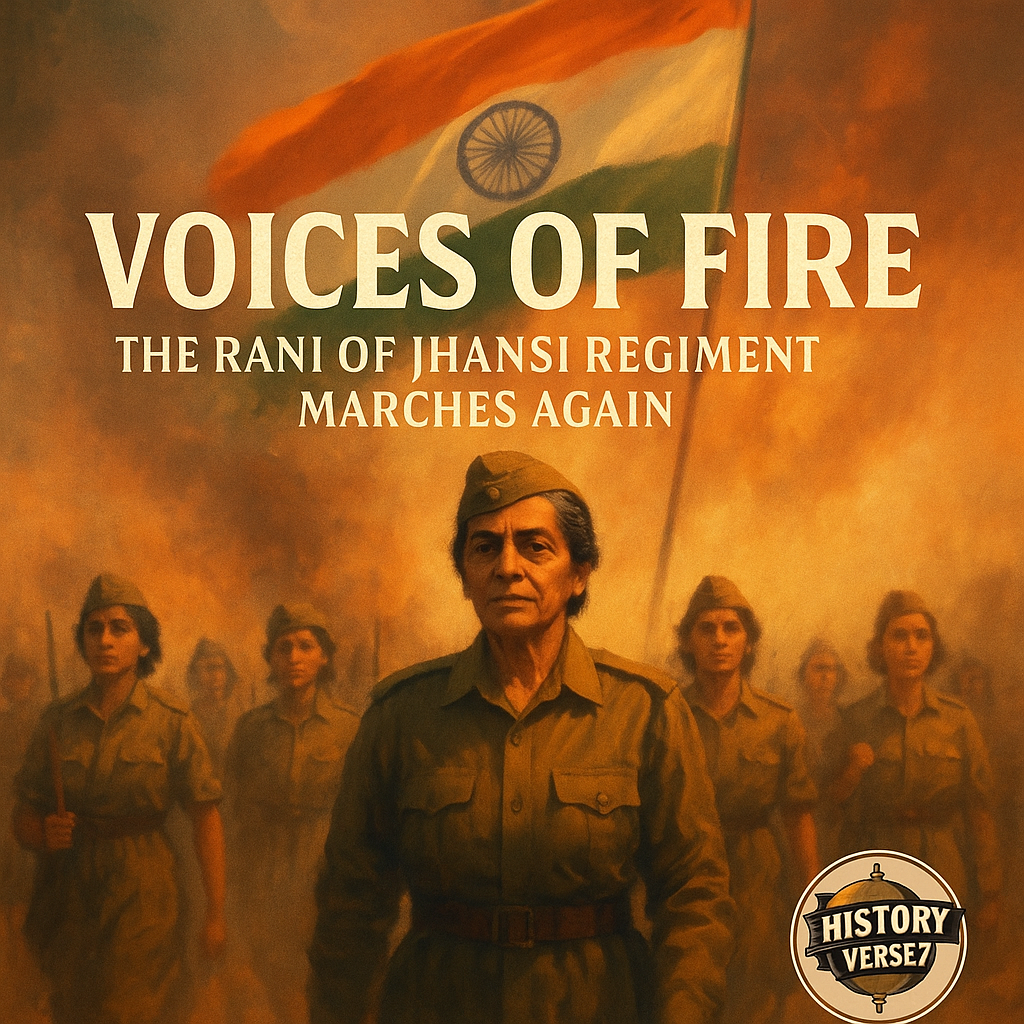
n an age of fleeting fame and hollow headlines, Lakshmi Sahgal remains a timeless reminder:
That courage must be consistent.
That leadership must be earned.
That history must be human.
Lakshmi Sahgal is not gone. She is carried — in every clinic that treats without bias, in every protest that demands dignity, and in every story that dares to speak truth to power.
This is not just a tribute. It is a torch.
📘 FAQ: Understanding Lakshmi Sahgal
1. Why did Lakshmi Sahgal choose medicine before revolution?
Answer:
Lakshmi Sahgal believed that healing was the first act of resistance. Long before she held command in the INA, she held the hands of the poor in overcrowded clinics. For Lakshmi Sahgal, medicine was not a profession — it was preparation. She treated wounds not just of the body, but of a colonized conscience.
2. What made Lakshmi Sahgal’s feminism different from today’s movements?
Answer:
Lakshmi Sahgal’s feminism walked barefoot through refugee camps and factory floors. She didn’t speak from podiums — she listened in slums. Her feminism was not a slogan. It was survival. Lakshmi Sahgal taught that empowerment begins where injustice lives — not where applause echoes.
3. How did Lakshmi Sahgal redefine patriotism?
Answer:
Lakshmi Sahgal never waved a flag for attention. She stitched it into bandages, whispered it into protests, and carried it in silence. Her patriotism was not loud — it was lasting. Lakshmi Sahgal showed that loving India means serving its forgotten, not just celebrating its victories.
Share this content:


Good 🚩✨
Very nice…👍👌