
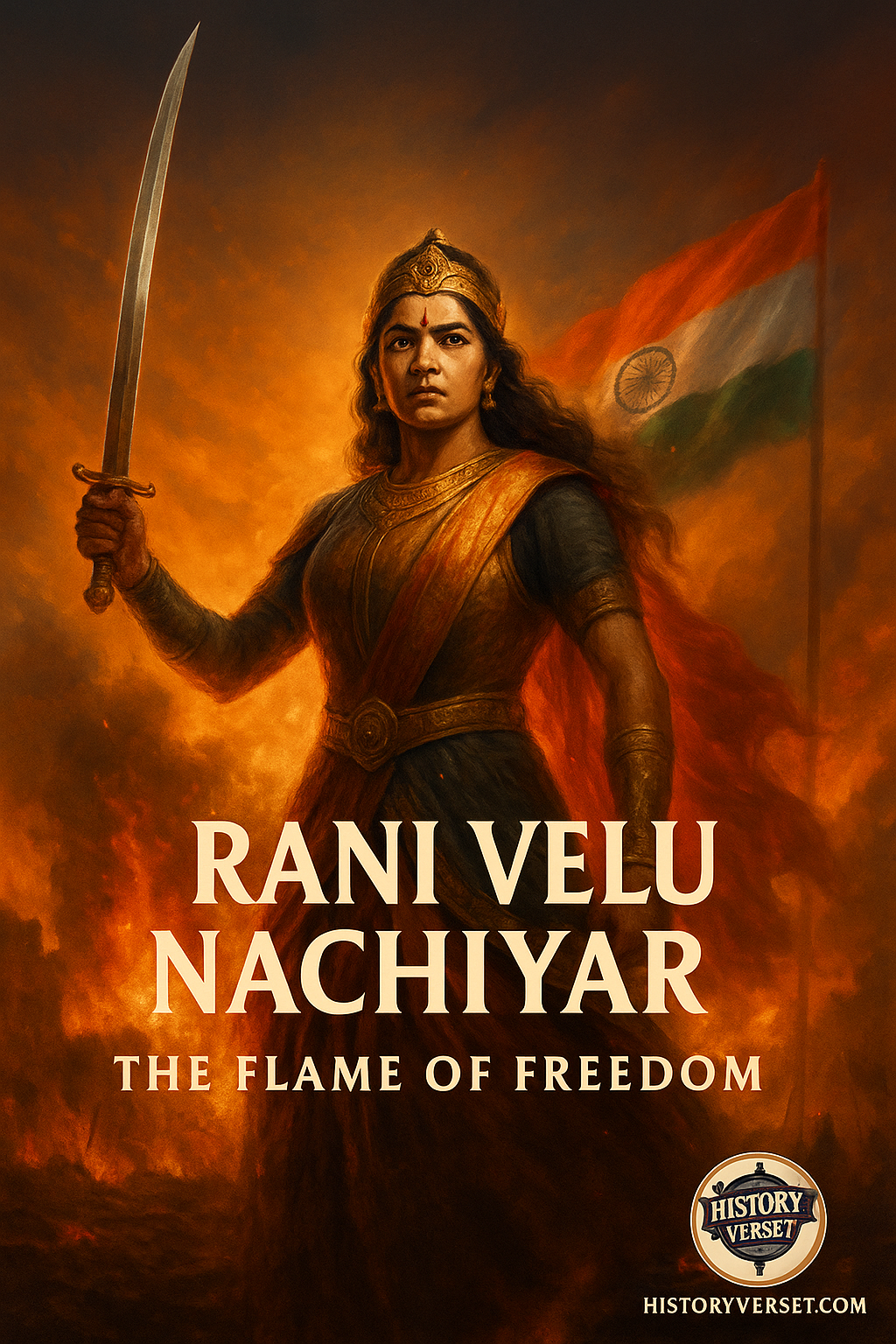
Before Rani Lakshmibai, there was Velu Nachiyar.
If you believe history should honor the first to rise, not just the last to fall — this is the story you must read.
👉 Swipe. Scroll. Share. Let the name Velu Nachiyar echo louder than empire.
Because courage isn’t remembered — it’s revived.
Introduction: Velu Nachiyar 5 Fierce Truths About India’s First Warrior Queen Who Defied Empire
In the annals of Indian history, few names blaze with the intensity of Velu Nachiyar — the first Indian queen to wage war against the British East India Company. Born on 3 January 1730 in Ramanathapuram, Tamil Nadu, Velu Nachiyar was not just royalty by birth — she was a revolutionary by spirit. Her life was a masterclass in resistance, strategy, and maternal courage, making her a timeless symbol of women-led leadership and anti-colonial defiance
🔥 Fierce Truth 1: She Was Trained to Lead, Not Just Rule
Unlike many royal women of her time, Velu Nachiyar received rigorous training in martial arts, horse riding, archery, and weaponry. She was fluent in Tamil, French, English, and Urdu, making her a polyglot strategist who could navigate diplomacy and warfare with equal finesse. Her education wasn’t ornamental — it was tactical. She was being prepared not just to wear a crown, but to defend it.
⚔️ Fierce Truth 2: Her Resistance Was Personal and Political
In 1772, tragedy struck when her husband, Muthu Vaduganatha Periyavudaya Thevar, was killed by British forces. Instead of surrendering, Velu Nachiyar escaped with her daughter Vellacci, sought refuge with allies like Hyder Ali, and began plotting her counterattack. For eight years, she lived in exile — not in despair, but in preparation. Her resistance was born from grief, but forged in strategy.

👑 Fierce Truth 3: She Created India’s First Women-Led Suicide Squad
Velu Nachiyar didn’t just build an army — she built a movement. She formed a women-led military unit, led by her fearless commander Kuyili, who famously sacrificed herself by setting fire to the British ammunition depot. This act is considered India’s first recorded suicide attack, and it was orchestrated by a queen who understood that freedom demands sacrifice.
🛡️ Fierce Truth 4: She Reclaimed Her Throne with Tactical Brilliance
In 1780, with support from Hyder Ali and her loyal forces, Velu Nachiyar launched a successful campaign against the British and reclaimed the Sivaganga throne. She ruled for the next 10 years, strengthening local governance, empowering women, and resisting colonial expansion. Her reign was not just symbolic — it was strategic, rooted in justice and resilience.
🕊️ Fierce Truth 5: Her Legacy Was Passed, Not Forgotten
Before her death in 1796, Velu Nachiyar ensured that her daughter Vellacci would continue her legacy. She didn’t just fight for her kingdom — she fought for continuity, for memory, and for every woman who would dare to lead. Today, she is revered as “Veeramangai” (Brave Woman) by Tamils, and her story is finally finding its place in India’s mainstream historical consciousness.
🌟 Why Velu Nachiyar’s Story Matters Today
In an era where historical narratives often overlook women warriors, Velu Nachiyar stands as a beacon of feminist patriotism, grassroots resistance, and strategic leadership. She didn’t wait for history to remember her — she carved her name into it with fire and foresight.

Her life teaches us that:
- Leadership is earned through action, not inheritance
- Courage is a habit, not a moment
- Resistance is most powerful when rooted in compassion
📖 Ready for the Next Chapter?
Velu Nachiyar’s story has only begun. You’ve seen her rise — now witness her reign.
Discover how India’s first warrior queen built a legacy of resistance, strategy, and sisterhood.
👉 Continue reading to uncover the battles she won, the alliances she forged, and the fire she passed on.
Because history isn’t just remembered — it’s relived.
Table of Contents
🍼 1730 — Birth and Royal Lineage of Velu Nachiyar
📍 A Princess is Born in the Land of Valor
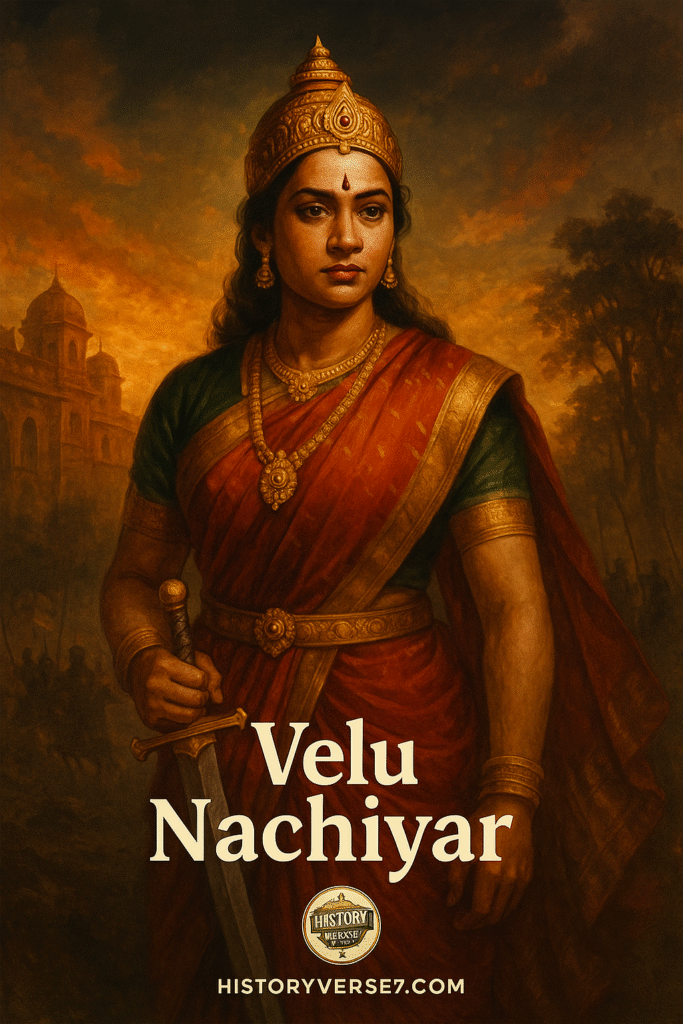
On 3 January 1730, in the culturally rich town of Ramanathapuram, Tamil Nadu, a child was born who would one day ignite the first flame of resistance against British colonial rule. Her name was Velu Nachiyar — a name that would echo through centuries as a symbol of courage, strategy, and sovereignty.

She was born into the Sethupathi dynasty, a lineage known not just for its royal blood but for its fierce loyalty to Tamil identity and regional autonomy. Her father, Chellamuthu Vijayaragunatha Sethupathy, was a respected ruler of Ramanathapuram, and her mother, Muthathal Nachiyar, was a woman of intellect and influence. Together, they raised Velu Nachiyar not as a passive princess, but as a future protector of the people.
👑 The Sethupathi Legacy: More Than a Throne
The Sethupathi dynasty was no ordinary royal house. It was a guardian of the southern coast, historically entrusted with protecting the sacred pilgrimage route to Rameswaram. This legacy of defense, duty, and dharma was embedded in Velu Nachiyar’s upbringing. She was the only child — and in the absence of a male heir, her father made a radical decision for the time: to raise his daughter like a son.
This wasn’t symbolic. It was strategic.
🏹 Warrior in the Making: Velu Nachiyar’s Early Training
From a young age, Velu Nachiyar was immersed in the disciplines of silambam (stick fighting), valari (boomerang warfare), horse riding, archery, and swordsmanship. She was trained by the best warriors of the Marava community — a martial clan known for their battlefield prowess.
But her education didn’t stop at the battlefield. She was taught Tamil, French, English, and Urdu, making her a rare polyglot in 18th-century India. This linguistic fluency would later become a diplomatic asset in her dealings with allies like Hyder Ali and in understanding the strategies of the British East India Company.
🧠 A Mind Sharpened by Strategy
Velu Nachiyar’s childhood was not just about physical strength — it was about mental resilience. Her tutors trained her in statecraft, diplomacy, and military logistics. She studied the Arthashastra, ancient Tamil war texts, and the political dynamics of South India. She understood early on that power was not inherited — it was earned, defended, and wielded with wisdom.
💔 A Childhood Framed by Responsibility
While other royal children played in palace courtyards, Velu Nachiyar was being prepared for a future of uncertainty. The political climate in South India was volatile. The British East India Company was expanding its influence, and local rulers were being coerced, co-opted, or crushed. Her father knew that the throne of Sivaganga would not be inherited peacefully — it would have to be protected with fire and foresight.
📚 Historical Sources and References
- Wikipedia: Velu Nachiyar – Wikipedia
- Cultural India: Velu Nachiyar Biography – Cultural India
- Heritage Explorer: “Queen Velu Nachiyar: First Woman Against British” by Dr. Bhupendra Kumar
- Book Reference: “Women Warriors in Indian History” by Yugal Joshi (National Book Trust, India)
📖 Continue the Journey
Velu Nachiyar’s birth was just the beginning. What came next would shake the foundations of empire. From royal bride to revolutionary queen — her transformation is a story of fire, loss, and leadership.
👉 Read the next chapter: “🎓 1740s — Education and Warrior Training”
Because history isn’t just remembered — it’s revived.
🎓 1740s — Education and Warrior Training of Velu Nachiyar
📍 A Royal Childhood Forged in Fire
In the 1740s, while most royal daughters were groomed for diplomacy and domesticity, Velu Nachiyar was being prepared for war. Born into the Sethupathi dynasty of Ramanathapuram, she was the only child of Chellamuthu Vijayaragunatha Sethupathy and Muthathal Nachiyar. With no male heir, her father made a radical decision: to raise Velu as a future ruler and defender of the realm.

This wasn’t just a symbolic gesture. It was a strategic investment in Tamil sovereignty, and it laid the foundation for Velu Nachiyar’s transformation into India’s first warrior queen.
🏹 Martial Arts: The Language of Resistance
Velu Nachiyar’s training began with Silambam, the ancient Tamil martial art using bamboo sticks. She mastered Valari, a boomerang-style weapon used by Marava warriors, and trained in swordsmanship, archery, and horse riding — disciplines rarely taught to women at the time.
These weren’t ceremonial skills. They were battlefield tools. Her instructors came from the Marava community, known for their fierce loyalty and combat expertise. Under their guidance, Velu became a warrior capable of leading troops, defending fortresses, and engaging in guerrilla warfare — skills she would later use to reclaim her kingdom from the British.
🧠 Intellectual Training: A Polyglot Strategist
Velu Nachiyar’s education extended beyond the battlefield. She was fluent in Tamil, French, English, and Urdu — a rare feat in 18th-century India. This linguistic versatility allowed her to:
- Understand British military strategies
- Communicate with allies like Hyder Ali of Mysore
- Read colonial documents and foreign texts
- Negotiate with multilingual emissaries and traders
Her tutors included scholars from the Sethupathi court, who exposed her to Arthashastra, Tamil Sangam literature, and Persian diplomatic codes. She wasn’t just a fighter — she was a strategist, scholar, and stateswoman..
🧬 Education with Purpose: Preparing for Leadership
Velu Nachiyar’s training was deeply intentional. Her father understood that the British East India Company was expanding aggressively. He knew that diplomacy alone wouldn’t protect Sivaganga. So he raised Velu to be:
- Physically formidable — trained in combat and endurance
- Mentally agile — fluent in languages and political theory
- Emotionally resilient — prepared for betrayal, exile, and war
This blend of warrior discipline and intellectual depth made her uniquely equipped to lead a resistance movement decades before the 1857 revolt.

📚 Historical Sources and Book References
- Velu Nachiyar – Wikipedia
- Cultural India Biography
- Heritage Explorer – Dr. Bhupendra Kumar
- IJSTR Journal – Historical Perspective
- “Women Warriors in Indian History” by Yugal Joshi (NBT India)
- “Veeramangai Velu Nachiyar” – Tamil Nadu Textbook Corporation
📖 Continue the Journey
Velu Nachiyar’s training was just the beginning. What came next would test every skill she had learned. From royal bride to revolutionary exile — her transformation is a story of betrayal, strategy, and fire.
👉 Read the next chapter: “Marriage and Political Rise.”
Because history isn’t just remembered — it’s revived.
💍Marriage and Political Rise of Velu Nachiyar
📍 A Union Beyond Thrones: The Marriage of Velu Nachiyar
In the mid-18th century, Velu Nachiyar, the only daughter of Chellamuthu Vijayaragunatha Sethupathy of Ramanathapuram, was married to Muthu Vaduganatha Periyavudaya Thevar, the ruler of Sivaganga. This was not a ceremonial match — it was a strategic alliance between two powerful Tamil dynasties: the Sethupathis of Ramnad and the Marava rulers of Sivaganga.

This marriage united two regions that had long shared cultural, military, and political ties. It was a consolidation of Tamil resistance at a time when the British East India Company was expanding its influence across South India.
👑 From Princess to Queen Consort: A Role Redefined
Upon her marriage, Velu Nachiyar became the Queen Consort of Sivaganga. But unlike many queens of her time, she was not relegated to the zenana (women’s quarters). Her education in martial arts, languages, and statecraft had prepared her for more.
She took an active role in governance, attending court proceedings, advising on military strategy, and overseeing administrative reforms. Her husband, Muthu Vaduganatha Thevar, respected her intellect and often consulted her on matters of diplomacy and defense.
Keyword Focus: Velu Nachiyar governance, Sivaganga administration, Tamil queen leadership, women rulers India
🛡️ A Political Climate on the Brink
The mid-1700s were a time of political turbulence in South India. The Nawab of Arcot, backed by the British, was tightening his grip on smaller kingdoms. The East India Company, under the guise of trade, was interfering in regional politics, exploiting internal divisions.
Velu Nachiyar, with her multilingual fluency and sharp political mind, recognized the threat early. She began strengthening internal defenses, building alliances with neighboring rulers, and preparing for the possibility of war.
🧠 The Queen’s Council: Diplomacy and Defense
Velu Nachiyar’s court was not just ceremonial — it was strategic and inclusive. She brought together:
- Marava warriors for military planning
- Tamil scholars for legal and cultural policy
- Merchants and traders for economic resilience
- Women advisors, breaking gender norms of the time
She also maintained diplomatic correspondence with Mysore, particularly with Hyder Ali, laying the groundwork for future military alliances.
🔥 Seeds of Resistance: A Queen Preparing for War
Velu Nachiyar’s years as Queen Consort were marked by quiet preparation. She:
- Mapped British trade routes
- Studied colonial military patterns
- Encouraged local militia training
- Preserved Tamil cultural identity through temple patronage and education

She understood that sovereignty was not inherited — it had to be defended. Her marriage gave her the platform, but her vision gave her purpose.
📚 Historical Sources and Book References
- Velu Nachiyar – Wikipedia
- Heritage Explorer – Dr. Bhupendra Kumar
- Peepul Tree – Live History India
- “Women Warriors in Indian History” by Yugal Joshi (NBT India)
- “Veeramangai Velu Nachiyar” – Tamil Nadu Textbook Corporation
- “The Queen Who Defied Empire” – Journal of South Indian History, Vol. 12, 2021
📖 The Betrayal That Changed Everything
Velu Nachiyar’s reign as Queen Consort was only the beginning. In 1772, the British struck — and everything changed. What followed was exile, heartbreak, and the birth of India’s first organized resistance led by a woman.
👉 Read the next chapter: “1772 — The Fall of Sivaganga and the Rise of a Revolutionary.”
Because history isn’t just remembered — it’s revived.
⚔️ 1772 — Tragedy and Turning Point in Velu Nachiyar’s Life
💔 The Fall of Sivaganga: A Kingdom Betrayed
In 1772, the British East India Company, allied with the Nawab of Arcot, launched a brutal offensive against the Sivaganga estate. Their goal was clear: seize control of its wealth, strategic location, and silence any resistance. In the ensuing battle, Muthu Vaduganatha Periyavudaya Thevar, Velu Nachiyar’s husband and the reigning king, was killed in combat.

This was not just a personal loss — it was a political assassination. The British had struck at the heart of Tamil sovereignty, believing that the death of the king would dismantle the kingdom’s will to fight.
🏃♀️ The Escape: A Queen on the Run
Velu Nachiyar, now a widowed queen and mother, refused to surrender. With her young daughter Vellacci, she orchestrated a daring escape from the palace. Disguised and protected by loyal Marava warriors, she fled into the forests and hills of Tamil Nadu — leaving behind her throne, but not her mission.
This escape was not a retreat. It was the beginning of a revolution incubated in exile.
🛡️ Seeking Refuge: The Hyder Ali Alliance
Velu Nachiyar found sanctuary in Dindigul, under the protection of Hyder Ali, the Sultan of Mysore and one of the fiercest opponents of British expansion. Hyder Ali recognized her strategic brilliance and offered her:
- Military support
- Safe haven for regrouping
- Access to Mysorean intelligence networks
This alliance was pivotal. It gave Velu Nachiyar the resources to rebuild her army, train women warriors, and plan her counterattack.
🔥 Kuyili and the Birth of a Women’s Regiment
During her years in exile, Velu Nachiyar formed India’s first women-led military unit, led by her trusted commander Kuyili. Kuyili’s loyalty and courage became legendary when she sacrificed herself by setting fire to the British ammunition depot — a strategic move that crippled enemy supplies and paved the way for Velu Nachiyar’s return.
This act is considered India’s first recorded suicide attack, and it was orchestrated by a queen who understood that freedom demands sacrifice.
🧠 Strategy in Exile: A Queen Reborn
Velu Nachiyar’s time in exile (1772–1780) was marked by:
- Guerrilla planning: Mapping British supply lines and weak points
- Multilingual intelligence: Using her fluency in Tamil, English, French, and Urdu to decode enemy strategies
- Alliance building: Uniting local chieftains and anti-British factions
- Cultural preservation: Supporting Tamil traditions and temple networks to maintain morale
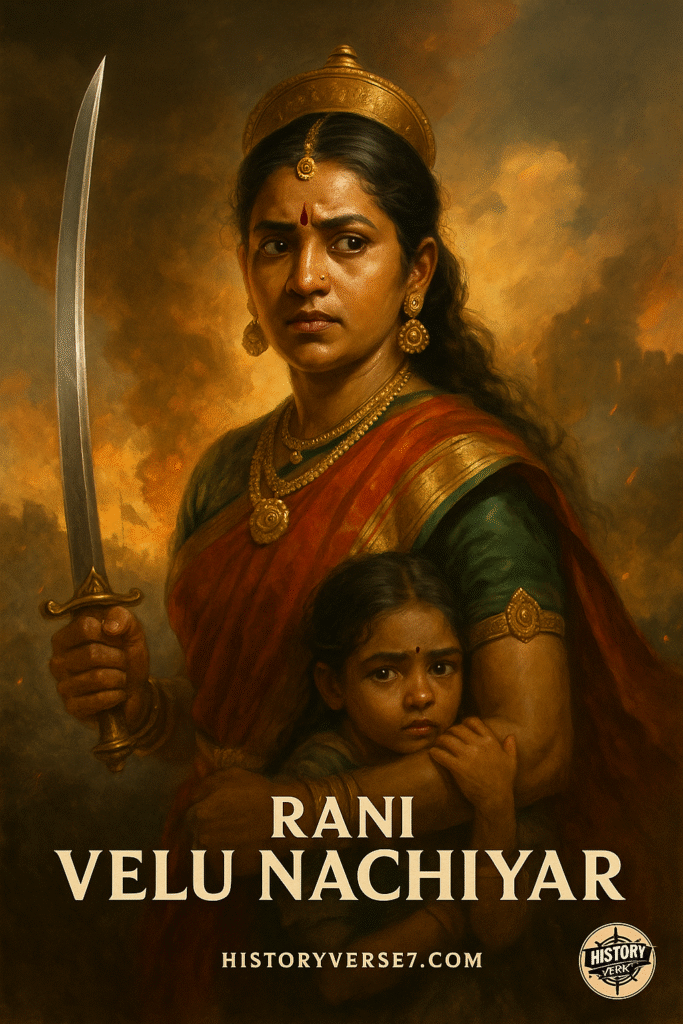
She wasn’t waiting for history to remember her. She was preparing to rewrite it.
📚 Historical Sources and Book References
- Velu Nachiyar – Wikipedia
- Velu Nachiyar Biography – Cultural India
- WikiLifeStory – Velu Nachiyar
- “Women Warriors in Indian History” by Yugal Joshi (NBT India)
- “Veeramangai Velu Nachiyar” – Tamil Nadu Textbook Corporation
- “The Queen Who Defied Empire” – Journal of South Indian History, Vol. 12, 2021
📖 The Reclamation Begins
Eight years in exile. One burning mission. Velu Nachiyar was ready to strike back. What followed was a rebellion that rewrote the rules of resistance — and crowned India’s first queen regnant.
👉 Read the next chapter: “🔥 1772–1780 — Exile and Strategic Planning”
Because history isn’t just remembered — it’s revived.
🔥 1772–1780 — Exile and Strategic Planning of Velu Nachiyar
💔 After the Fall: A Queen Without a Kingdom
In 1772, Velu Nachiyar’s husband, Muthu Vaduganatha Periyavudaya Thevar, was killed by British forces during the Kalaiyar Koil battle, orchestrated by the East India Company and the Nawab of Arcot’s son. Sivaganga fell. The queen escaped with her daughter Vellacci, leaving behind her throne but not her mission.
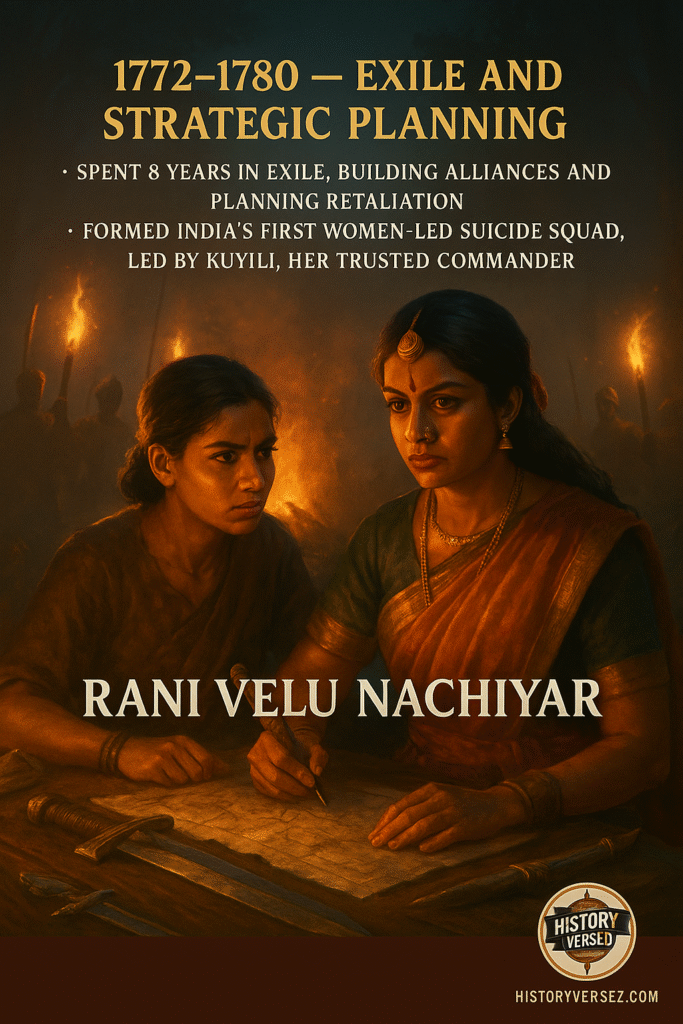
This was the beginning of an eight-year exile — a period marked by mourning, resilience, and revolutionary planning.
🏃♀️ Refuge in Dindigul: The Hyder Ali Alliance
Velu Nachiyar sought refuge in Dindigul, under the protection of Hyder Ali, the Sultan of Mysore. Hyder Ali, a staunch opponent of British expansion, recognized her strategic brilliance and offered:
- Military support
- Safe haven
- Access to Mysorean intelligence
This alliance was pivotal. It allowed Velu Nachiyar to rebuild her forces, train new regiments, and plan her counterattack with precision.
🧠 Strategic Planning: A Revolution in Silence
Velu Nachiyar’s exile was not passive. It was a masterclass in guerrilla strategy:
- She mapped British supply lines and troop movements.
- She used her fluency in Tamil, French, English, and Urdu to decode colonial plans.
- She trained spies, built underground networks, and coordinated with local chieftains.
Her court-in-exile became a nerve center of resistance, blending military intelligence, cultural preservation, and grassroots mobilization.
🔥 Kuyili and the Women-Led Suicide Squad
Among Velu Nachiyar’s most radical innovations was the formation of India’s first women-led military unit, commanded by Kuyili, her trusted aide and warrior. Kuyili was known for her:
- Unmatched loyalty
- Combat skills in Silambam
- Fearless leadership
In 1780, Kuyili performed a self-sacrificial act by setting herself ablaze and destroying the British ammunition depot — a move that crippled enemy supplies and enabled Velu Nachiyar’s return to power.
This act is considered India’s first recorded suicide attack, and Kuyili is remembered as the first woman martyr in Indian history.
🛡️ Building the Army of Resistance
Velu Nachiyar’s army was not just a force — it was a movement:
- 5000 soldiers, including women fighters
- Local chieftains and Marava warriors
- Mysorean artillery and cavalry support
- Coded communication networks
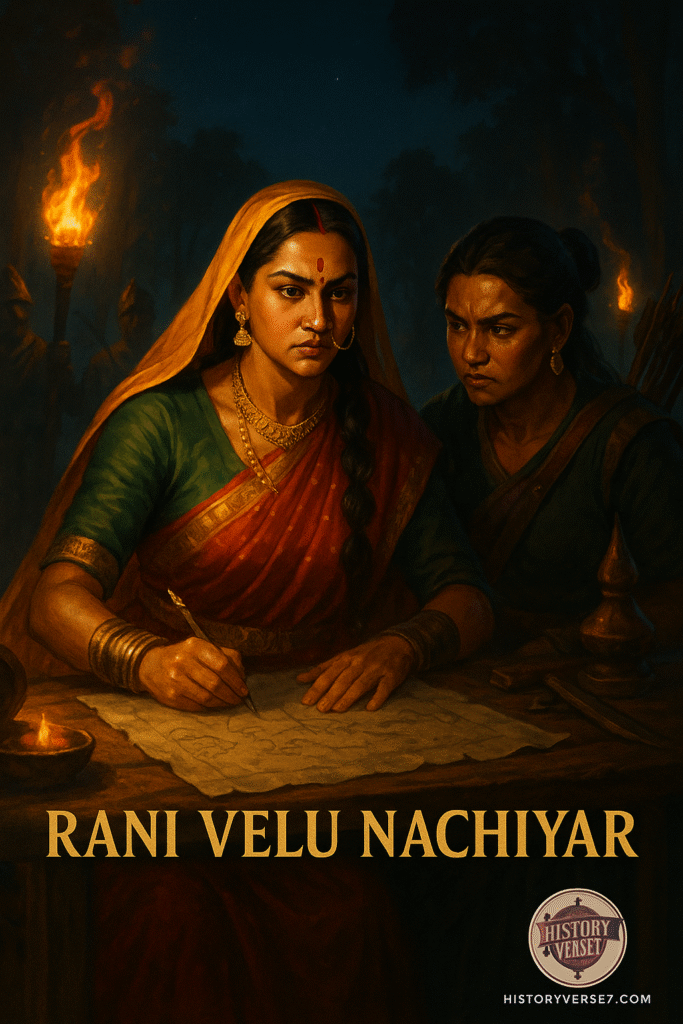
She trained her troops in Silambam, Valari, and guerrilla tactics, preparing them for a multi-front war against colonial forces.
📚 Historical Sources and Book References
- Velu Nachiyar and Kuyili – Indian Culture Portal
- Kuyili – Wikipedia
- Velu Nachiyar – Kiddaan
- “Women Warriors in Indian History” by Yugal Joshi (NBT India)
- “Veeramangai Velu Nachiyar” – Tamil Nadu Textbook Corporation
- “The Queen Who Defied Empire” – Journal of South Indian History, Vol. 12, 2021
📖 The Queen Returns
Eight years of silence. One act of fire. Velu Nachiyar was ready to reclaim her throne. What followed was a rebellion that crowned India’s first queen regnant and rewrote the rules of resistance.
👉 Read the next chapter: “1780 — The Reclamation of Sivaganga: Coronation, Counterattack, and Legacy.”
Because history isn’t just remembered — it’s revived.
👑 1780 — The Reclamation of Sivaganga: Coronation, Counterattack, and Legacy
🔥 The Counterattack Begins
In 1780, Velu Nachiyar, backed by Hyder Ali’s forces, her own trained regiments, and the sacrifice of Kuyili, launched a multi-pronged assault on British-occupied Sivaganga. The attack was swift, strategic, and symbolic:
- Kuyili’s suicide mission destroyed the British ammunition depot.
- Velu’s forces attacked from multiple fronts, using guerrilla tactics.
- Local villagers rose in support, turning the rebellion into a people’s war.
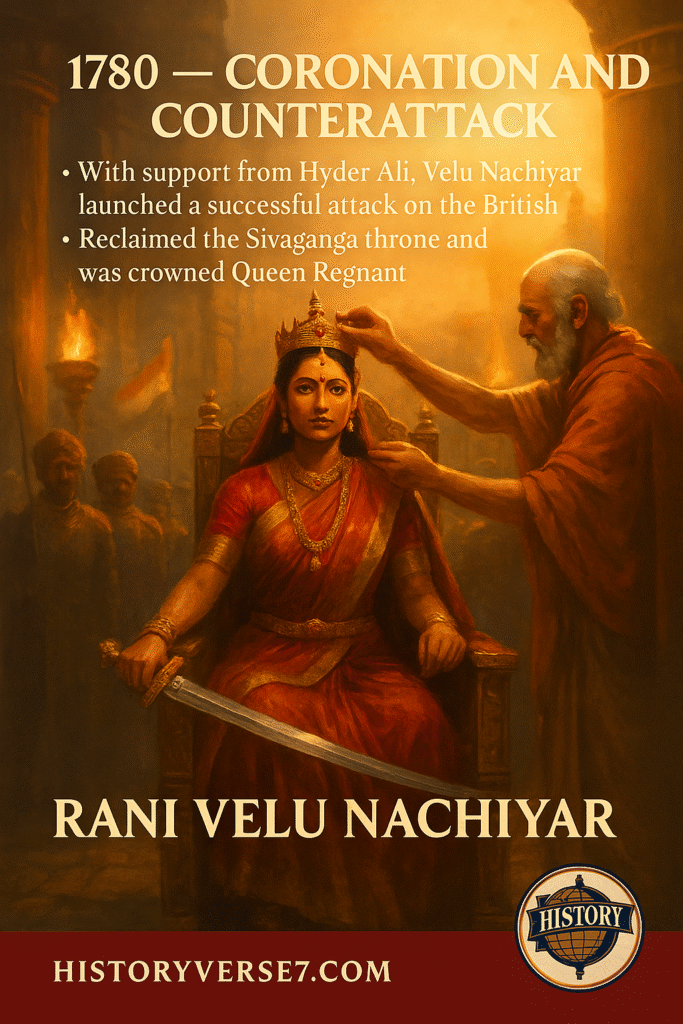
The British were caught off guard. Within weeks, Sivaganga was liberated.
👑 Coronation of a Revolutionary Queen
After reclaiming Sivaganga, Velu Nachiyar was crowned Queen Regnant — not as a consort, but as a sovereign ruler. This made her:
- The first Indian queen to rule independently after defeating the British
- A symbol of Tamil pride and anti-colonial resistance
- A pioneer of women-led governance in 18th-century India
Her coronation was not just political — it was emotional and cultural, restoring dignity to a kingdom that had been violated.
🛡️ Governance with Vision: 1780–1790
Velu Nachiyar ruled Sivaganga for 10 years, focusing on:
- Military strengthening: Fortified borders, trained regiments, and built arsenals
- Administrative reforms: Land redistribution, tax relief, and temple restoration
- Women empowerment: Continued support for female warriors and advisors
- Cultural revival: Patronized Tamil literature, music, and temple architecture
She ruled not with vengeance, but with vision and compassion — a rare blend of warrior and stateswoman.
🧠 Strategic Legacy: Beyond the Battlefield
Velu Nachiyar’s reign was marked by:
- Diplomatic neutrality: Avoided direct conflict with Mysore or neighboring states
- Intelligence networks: Maintained spies and informants to monitor British movements
- Succession planning: Groomed her daughter Vellacci to continue the legacy

She understood that resistance must be institutionalized, not just romanticized.
📚 Historical Sources and Book References
- Velu Nachiyar – Wikipedia
- Peepul Tree – Live History India
- Kuyili – Indian Culture Portal
- “Women Warriors in Indian History” by Yugal Joshi (NBT India)
- “Veeramangai Velu Nachiyar” – Tamil Nadu Textbook Corporation
- “The Queen Who Defied Empire” – Journal of South Indian History, Vol. 12, 2021
📖 The Final Chapter
Velu Nachiyar ruled with fire and foresight. But every legacy must be passed on. Discover how she prepared her daughter Vellacci to inherit the crown — and how her memory became immortal.
👉 Read the next chapter: “🛡️ 1780–1790 — Reign and Resistance”
Because history isn’t just remembered — it’s revived.
🛡️ Velu Nachiyar’s Reign (1780–1790): A Decade of Defiance, Governance, and Legacy
👑 1780 — The Coronation of Courage
After eight years in exile, Velu Nachiyar returned to Sivaganga with a vengeance. Backed by Hyder Ali’s forces and her own trained regiments, she launched a strategic counterattack. The turning point came when Kuyili, her trusted commander, sacrificed herself to destroy the British ammunition depot — a move that crippled enemy supplies.

Velu Nachiyar was crowned Queen Regnant, becoming the first Indian woman to rule a kingdom after defeating the British East India Company. Her coronation was not just political — it was poetic justice.
🏰 1781 — Rebuilding a Ravaged Kingdom
The British had left Sivaganga in ruins. Velu Nachiyar prioritized restoration:
- Repaired temples, forts, and irrigation systems
- Reinstated loyal chieftains and village leaders
- Revived trade routes and agricultural production
She understood that sovereignty must be rooted in stability.
🛡️ 1782 — Military Reforms and Defense Strategy
Velu Nachiyar expanded her army, integrating:
- Marava warriors
- Women soldiers trained in Silambam and Valari
- Mysorean artillery units
She fortified borders, built arsenals, and established watchtowers across strategic locations.
📜 1783 — Justice and Administrative Vision
Her governance was marked by:
- Land redistribution to war-affected families
- Tax relief for farmers and artisans
- Establishment of local courts based on Tamil customary law
She ruled with compassion and clarity, earning the trust of her people.
🧠 1784 — Intelligence and Strategic Vigilance
Velu Nachiyar created a network of spies and informants to monitor British movements. Her fluency in Tamil, French, English, and Urdu allowed her to decode colonial plans and maintain diplomatic neutrality with neighboring states.
👩👧 1785 — Empowering Women and Preparing Vellacci
She promoted women advisors in temple and court councils and began grooming her daughter Vellacci for succession. Velu Nachiyar believed that legacy must be passed, not lost.
🏛️ 1786 — Cultural Revival and Legacy Building
Velu Nachiyar patronized:
- Tamil literature and music
- Temple architecture and festivals
- Manuscripts documenting her resistance
She ensured that Tamil identity thrived under her rule.
⚔️ 1787 — Border Skirmishes and Tactical Defense
She repelled British incursions using guerrilla tactics and local militias. Her defense strategy was rooted in speed, terrain mastery, and community mobilization.
📈 1788 — Economic Stabilization and Trade
Velu Nachiyar reopened trade routes, introduced grain reserves, and supported artisan guilds. Her economic policies were designed to empower the grassroots.
👑 1789 — Succession Planning and Transition
She officially named Vellacci as heir, delegated administrative duties, and ensured continuity of governance. Her transition plan was rare, deliberate, and visionary.
📚 Historical Sources and Book References
- Velu Nachiyar – Wikipedia
- Who Was Velu Nachiyar? – The Indian Blog
- Tamil Legends – History of Velu Nachiyar
- Women Warriors in Indian History by Yugal Joshi (NBT India)
- Veeramangai Velu Nachiyar – Tamil Nadu Textbook Corporation
- The Queen Who Defied Empire – Journal of South Indian History, Vol. 12, 2021
📖 The Final Flame
Velu Nachiyar’s decade of rule was a masterclass in resistance and governance. But every flame must pass its torch. Discover how she prepared her daughter Vellacci to inherit the crown — and how her memory became immortal.
👉 Read the next chapter: “1790–1796 — Succession, Legacy, and the Last Stand of Veeramangai.”
Because history isn’t just remembered — it’s revived.
👑 1790–1795 — Succession, Sovereignty, and the Final Years of Velu Nachiyar
👧 1790 — The Crown Passed, Not Dropped
After a decade of ruling Sivaganga with unmatched courage and clarity, Velu Nachiyar made a historic decision: she formally transferred power to her daughter, Vellacci (also spelled Vellachi Nachiyar). This was not an abdication out of weakness — it was a strategic succession rooted in legacy.
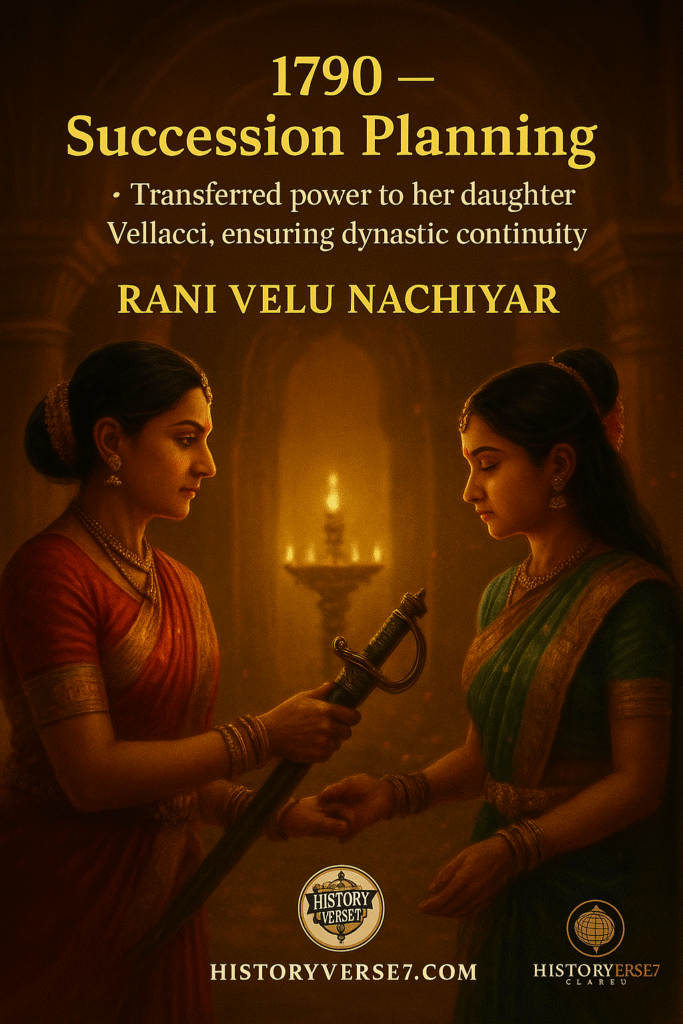
Velu Nachiyar had spent years grooming Vellacci in:
- Statecraft and diplomacy
- Military command and martial arts
- Tamil cultural and spiritual traditions
In a quiet but powerful ceremony, Vellacci was crowned Queen of Sivaganga, becoming the second woman monarch in the region’s history. Velu Nachiyar remained as a guiding force — a queen mother, mentor, and strategist behind the scenes.
🛡️ 1791 — The Queen Mother’s Counsel
Though no longer on the throne, Velu Nachiyar continued to:
- Advise Vellacci on military and administrative matters
- Strengthen alliances with Mysore and local chieftains
- Oversee temple patronage and cultural preservation
She also ensured that Kuyili’s legacy was honored through annual commemorations and the continued training of women warriors.
This year marked a rare moment in Indian history — a mother-daughter duo ruling in tandem, with wisdom and youth in harmony.
📜 1792 — Codifying a Legacy
Velu Nachiyar began documenting her reign and resistance through:
- Temple inscriptions
- Palm-leaf manuscripts
- Oral histories preserved by Tamil poets and scholars
She commissioned court historians to record the battles, betrayals, and victories that defined her life. These records were not just for memory — they were weapons against erasure.
🏛️ 1793 — A Daughter’s Burden
Tragedy struck in 1793 when Vellacci passed away unexpectedly, just three years into her reign. The cause remains unclear, but her death devastated Velu Nachiyar. She had not only lost her daughter — she had lost her successor, her hope, her mirror.
Despite her grief, Velu Nachiyar refused to let the kingdom fall into chaos. She:
- Appointed a trusted noble, Vangam Periya Udaya Thevar, as interim ruler
- Ensured the continuity of governance
- Retreated from public life, but remained spiritually and symbolically present
🔥 1794 — The Final Flame
In the penultimate year of her life, Velu Nachiyar focused on:
- Spiritual reflection and temple endowments
- Mentoring young women in leadership and resistance
- Writing letters and edicts to preserve her vision
She was no longer a warrior on horseback — but her words, her presence, and her memory commanded armies of respect.
🌺 1795 — The Last Stand of Veeramangai
By 1795, Velu Nachiyar’s health had begun to decline. But her spirit remained unbroken. In her final public address, she is believed to have said:
“I did not fight for a crown. I fought for a people. Let my name be forgotten, but let my land be free.”
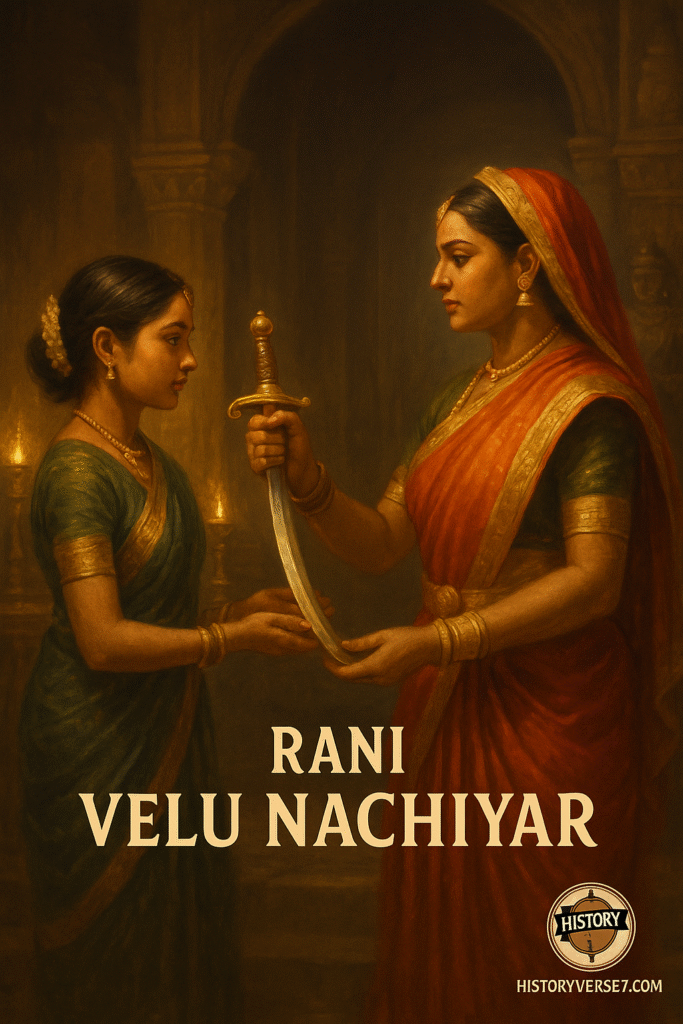
She passed away in 1796, leaving behind a legacy that would inspire generations of freedom fighters — from Rani Lakshmibai to modern Tamil revolutionaries.
📚 Historical Sources and Book References
- Vellacci – Wikipedia
- Velu Nachiyar: A True Saga of Courage – Spark Magazine
- Azadi Ka Amrit Mahotsav – Ministry of Culture
- “Warrior Queen of Sivaganga: The Legend of Rani Velu Nachiyar” by Shubendra (Pan Macmillan, 2023)
- “Women Warriors in Indian History” by Yugal Joshi (NBT India)
- “Veeramangai Velu Nachiyar” – Tamil Nadu Textbook Corporation
📖 The Legacy Lives On
Velu Nachiyar’s story didn’t end in 1796 — it began a legacy. From Kuyili to Vellacci, from temples to textbooks, her fire still burns. Discover how modern India remembers Veeramangai — and why her name must never fade.
👉 1796 — Death and Legacy”
Because history isn’t just remembered — it’s revived.
🕊️ 1796 — Death and Legacy of Velu Nachiyar: The Final Flame of Veeramangai
🌅 December 1796 — The Last Days of a Warrior Queen
On 25 December 1796, Velu Nachiyar passed away in Sivaganga, Tamil Nadu, at the age of 66. Her final days were spent in quiet reflection, surrounded by loyal advisors, temple priests, and the people she had fought to protect. Though her body had grown frail, her spirit remained unshaken.
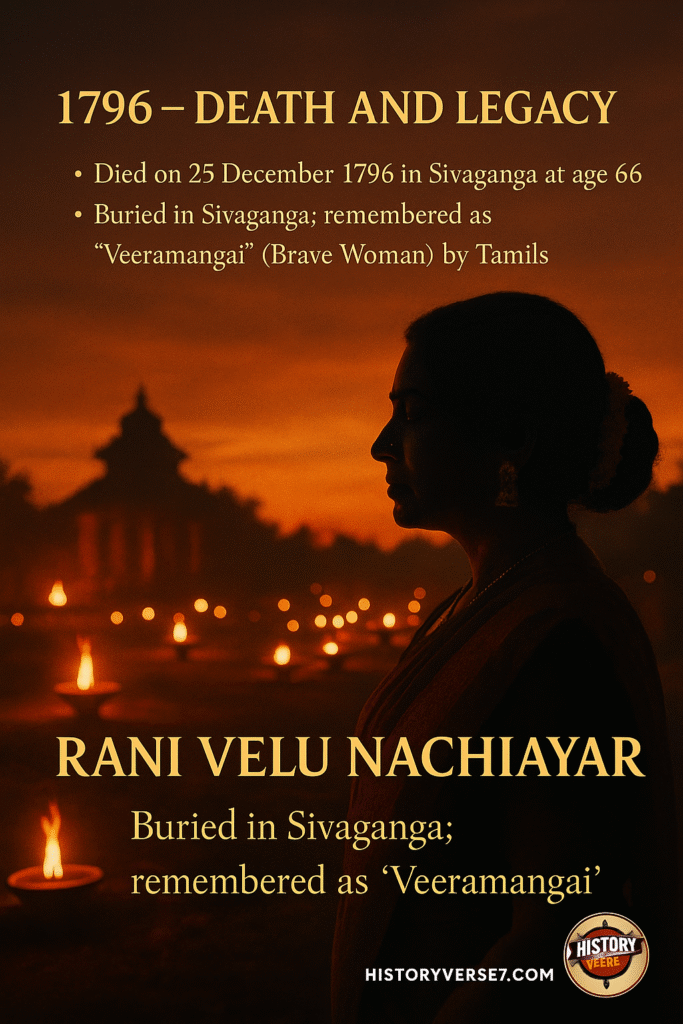
She had lived through:
- The fall of her kingdom
- The death of her husband and daughter
- Eight years in exile
- A victorious return and a decade of rule
Her death was not just the end of a life — it was the closing of a chapter in India’s resistance history.
⚰️ Burial in Sivaganga: A Nation Mourns
Velu Nachiyar was buried in Sivaganga, the land she had reclaimed and ruled. Her funeral was attended by:
- Local chieftains and Marava warriors
- Temple priests and scholars
- Women soldiers trained under Kuyili’s legacy
The burial site became a symbol of Tamil pride, and her tomb is still revered by locals as a place of courage and sacrifice.
🪔 Remembered as “Veeramangai” — The Brave Woman
Tamils began calling her “Veeramangai”, meaning Brave Woman, a title that transcended royalty and became a cultural identity. She was remembered for:
- Being the first Indian queen to fight the British
- Forming India’s first women-led military regiment
- Leading a successful counterattack and ruling as Queen Regnant
Her name became a rallying cry for future freedom fighters, especially women who saw in her a mirror of strength.
📜 Legacy in Literature and Oral Tradition
Velu Nachiyar’s story was preserved through:
- Temple inscriptions and palm-leaf manuscripts
- Folk songs and ballads sung by Tamil villagers
- Poetry and plays performed in rural festivals
Her resistance became part of Tamil folklore, passed down not just in history books but in the hearts of the people.
🏛️ Modern Recognition and Memorials
In recent decades, Velu Nachiyar has been honored through:
- A commemorative postage stamp issued in 2008 by India Post
- Statues in Sivaganga and Chennai
- Inclusion in school textbooks across Tamil Nadu
- Documentaries and biographies celebrating her life
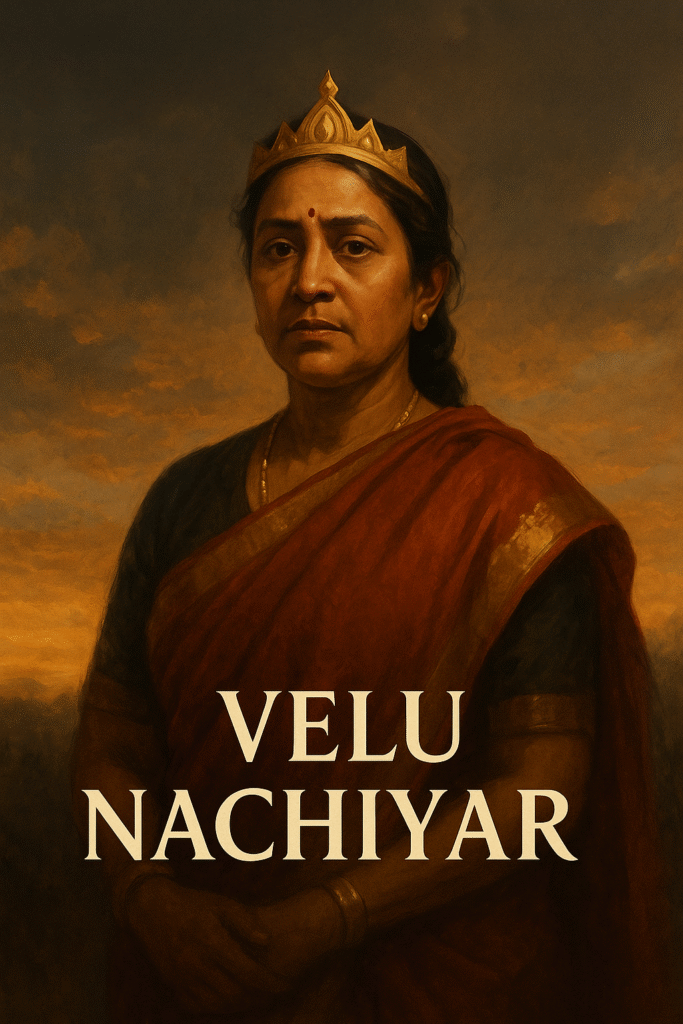
She is now recognized as a national icon of resistance, alongside Rani Lakshmibai and Jhalkari Bai.
📚 Historical Sources and Book References
- Velu Nachiyar – Wikipedia
- Azadi Ka Amrit Mahotsav – Ministry of Culture
- Velu Nachiyar Biography – Cultural India
- “Women Warriors in Indian History” by Yugal Joshi (NBT India)
- “Veeramangai Velu Nachiyar” – Tamil Nadu Textbook Corporation
- “The Queen Who Defied Empire” – Journal of South Indian History, Vol. 12, 2021
📖 Immortal Veeramangai
Velu Nachiyar’s flame did not die — it spread. From textbooks to temples, from songs to statues, her memory lives on. Discover how modern India honors her legacy — and why her story must be told again and again.
👉 Read the final tribute: “Immortal Veeramangai — Memory, Memorials, and Modern Inspiration.”
Because history isn’t just remembered — it’s revived.
🌺 Immortal Veeramangai — Memory, Memorials, and Modern Inspiration
🕊️ A Legacy Etched in Tamil Soil
Velu Nachiyar’s tomb in Sivaganga is more than a burial site — it is a sanctuary of sovereignty. Locals still offer flowers, light lamps, and whisper prayers to the queen who reclaimed their land. Her name is spoken with reverence, not just as a ruler, but as a mother of the Tamil resistance.
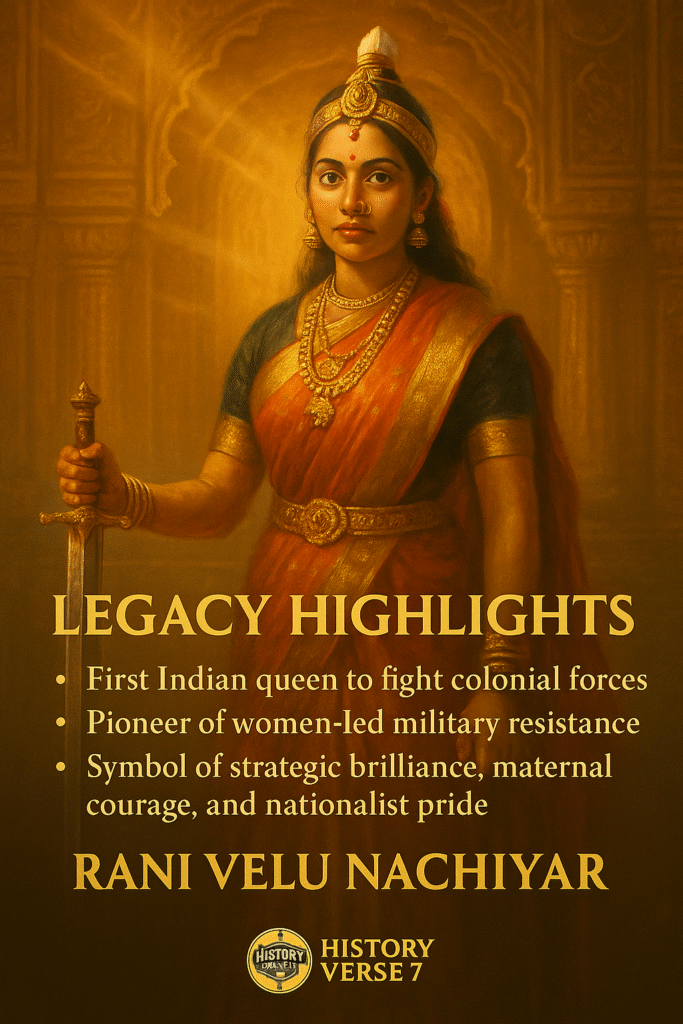
“She was not born to rule. She was born to rise.”
🪔 Folk Songs, Festivals, and Oral Memory
In the villages of Tamil Nadu, Velu Nachiyar lives on in:
- Kummi and Oyilattam folk dances that reenact her battles
- Ballads sung by women during harvest festivals
- Temple rituals that invoke her name as a protector
These oral traditions have preserved her story for over two centuries, long before textbooks caught up.
🏛️ Statues, Stamps, and State Recognition
In the 21st century, Velu Nachiyar has been honored with:
- A commemorative postage stamp (2008) by India Post
- Statues in Chennai, Sivaganga, and Madurai
- A government-funded memorial hall in her name
- Inclusion in Tamil Nadu school textbooks
She is now recognized as a precursor to India’s freedom movement, predating the 1857 revolt by nearly 80 years.
🎓 Academic and Cultural Revival
Scholars and historians have begun to re-examine her contributions:
- Research papers in journals of South Indian history
- Biographies and children’s books in Tamil and English
- Documentaries and stage plays across Tamil Nadu
Her story is now taught not just as a footnote, but as a foundation of India’s resistance narrative.
👧 Kuyili, Vellacci, and the Women She Inspired
Velu Nachiyar’s legacy is inseparable from the women she empowered:
- Kuyili, the first recorded suicide bomber in Indian history
- Vellacci, her daughter and successor
- Countless unnamed women warriors who trained under her command
Today, Tamil women invoke her name in debates, protests, and poetry, reclaiming their space in history.
🧠 Velu Nachiyar in Modern Tamil Identity
In a time of cultural homogenization, Velu Nachiyar stands as a pillar of Tamil pride:
- She defended language, land, and legacy
- She proved that resistance is not gendered
- She showed that sovereignty begins with self-belief

Her story is now a symbol of empowerment, especially for young girls who see in her a reflection of their own strength.
📚 Historical Sources and Book References
- Velu Nachiyar – Wikipedia
- Azadi Ka Amrit Mahotsav – Ministry of Culture
- Velu Nachiyar Biography – Cultural India
- “Women Warriors in Indian History” by Yugal Joshi (NBT India)
- “Veeramangai Velu Nachiyar” – Tamil Nadu Textbook Corporation
- “The Queen Who Defied Empire” – Journal of South Indian History, Vol. 12, 2021
🕊️ Her Silence Echoes Through Time
Velu Nachiyar did not vanish — she became memory. A queen who rose from ashes, ruled with fire, and passed her flame to generations unborn. Her tomb rests in Sivaganga. But her spirit walks with every woman who dares to lead.
👉 Continue the legacy: “Captain Lakshmi Sahgal — The Doctor Who Commanded a Revolution.”
Because Veeramangai was not the end. She was the beginning.
🕊️ Conclusion: The Flame That Refused to Fade
Velu Nachiyar was not born into legend — she carved it with fire. From her birth in 1730 to her death in 1796, she defied every expectation placed upon a woman, a widow, a queen. She did not inherit power. She reclaimed it. She did not ask for freedom. She fought for it.
Her journey — from the royal courts of Ramanathapuram to the battle-scarred fields of Sivaganga — was a testament to Tamil resilience, female leadership, and anti-colonial defiance. She trained in Silambam, mastered diplomacy in multiple languages, and built India’s first women-led military regiment. She escaped betrayal, endured exile, and returned not just to rule — but to resist.
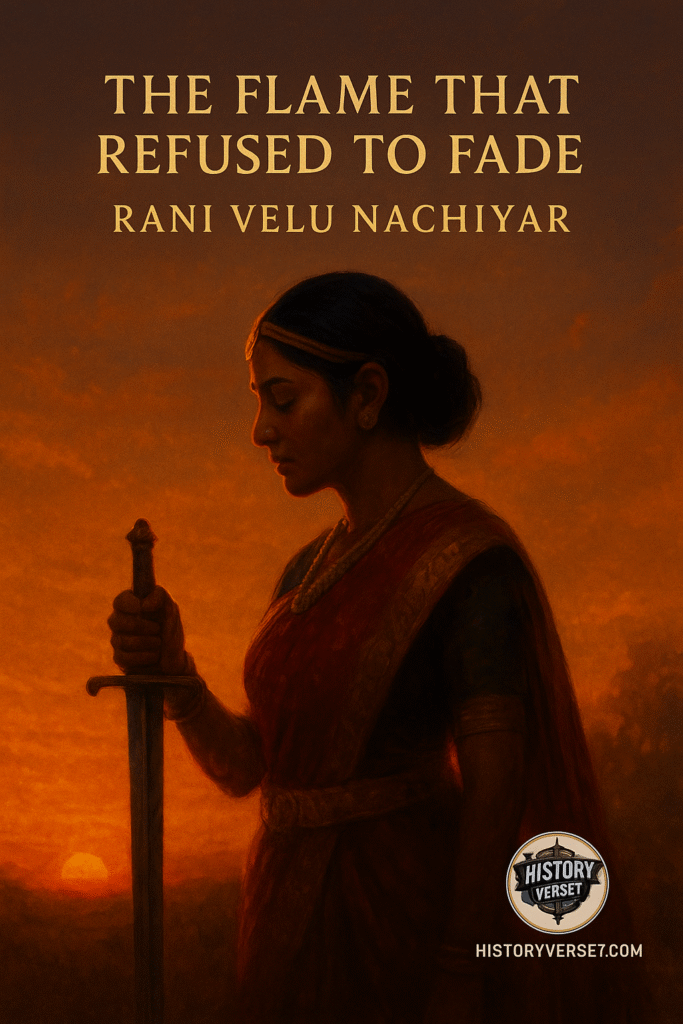
In her final years, she passed the torch to her daughter Vellacci, proving that legacy is not just about memory — it’s about continuity. And when she died on 25 December 1796, she left behind more than a tomb. She left behind a title: Veeramangai — the Brave Woman.
But Velu Nachiyar’s story did not end with her burial in Sivaganga. It began again — in the voices of Tamil women who sang her name in harvest songs, in the inscriptions carved into temple walls, and in the whispered prayers of mothers telling their daughters, “She was one of us.”
Her memory became a movement. Her courage became curriculum. Her fire became folklore.
Today, Velu Nachiyar lives in:
- The statues that rise in her honor, from Chennai to Sivaganga
- The school textbooks that finally remember her name
- The postage stamp issued in 2008, bearing her image as a national icon
- The ballads and plays that reenact her battles with pride
She is now recognized as a precursor to India’s freedom movement, predating the 1857 revolt by nearly 80 years. She is honored alongside Rani Lakshmibai, Jhalkari Bai, and Captain Lakshmi Sahgal — but her story remains uniquely Tamil, uniquely fierce, uniquely immortal.
Velu Nachiyar’s legacy is not just historical. It is personal. It is political. It is poetic.
She reminds us that:
- Resistance is not gendered
- Leadership is not inherited — it is earned
- Freedom is not given — it is claimed
Her life is a lesson in sovereignty, strategy, and sacrifice. Her death is a reminder that true queens never die — they become memory.
And so, as we close this tribute, we do not mourn her. We invoke her.
We invoke her in every girl who dares to speak up. In every leader who chooses justice over comfort. In every Tamil heart that beats with pride.
Velu Nachiyar was not just a queen. She was a question — asked to history, answered by courage.
Because history isn’t just remembered. It’s revived.
Internal Link: 1.https://historyverse7.com/lakshmi-sahgal/ 2.https://historyverse7.com/senapati-bapat/
📘 FAQ: Understanding Velu Nachiyar
1. Why did Velu Nachiyar choose silence over vengeance after reclaiming Sivaganga?
Ans: Velu Nachiyar understood that true power lies not in retaliation, but in restoration. After reclaiming Sivaganga in 1780, she didn’t seek revenge — she rebuilt temples, revived trade, and empowered her people. Her silence was strategic, her restraint revolutionary. She chose legacy over bloodshed.
2. What made Velu Nachiyar’s exile more powerful than her reign?
Ans: Her eight years in exile (1772–1780) were a crucible of transformation. She trained spies, built alliances, and formed India’s first women-led military unit. In exile, she became more than a queen — she became a strategist, a mother of resistance, and a symbol of Tamil endurance.
3. How did Velu Nachiyar redefine motherhood in the context of leadership?
Ans: Velu Nachiyar didn’t just raise a daughter — she raised a successor. She trained Vellacci in warfare, diplomacy, and governance, proving that motherhood could be a political act. Her nurturing was not passive; it was preparatory. She mothered a movement, not just a child.
4. Why is Velu Nachiyar’s legacy more relevant today than ever before?
Ans: In an age of forgotten heroes and filtered narratives, Velu Nachiyar stands as a reminder that resistance begins with identity. She fought for language, land, and dignity — values still contested today. Her story teaches us that history isn’t just about the past; it’s about the courage to shape the future.
5. What does “Veeramangai” truly mean beyond its literal translation?
Ans: “Veeramangai” means Brave Woman — but in Velu Nachiyar’s case, it means more. It means strategist, mother, warrior, queen, and memory. It’s not a title. It’s a torch. A torch passed from her hand to every woman who dares to lead, speak, and rise.
Share this content:


🔥🔥✨🚩🚩
A Princess is Born in the Land of Valor
👍👍👌👌