The Chola Empire: History, Kings, Navy, Trade & Legacy
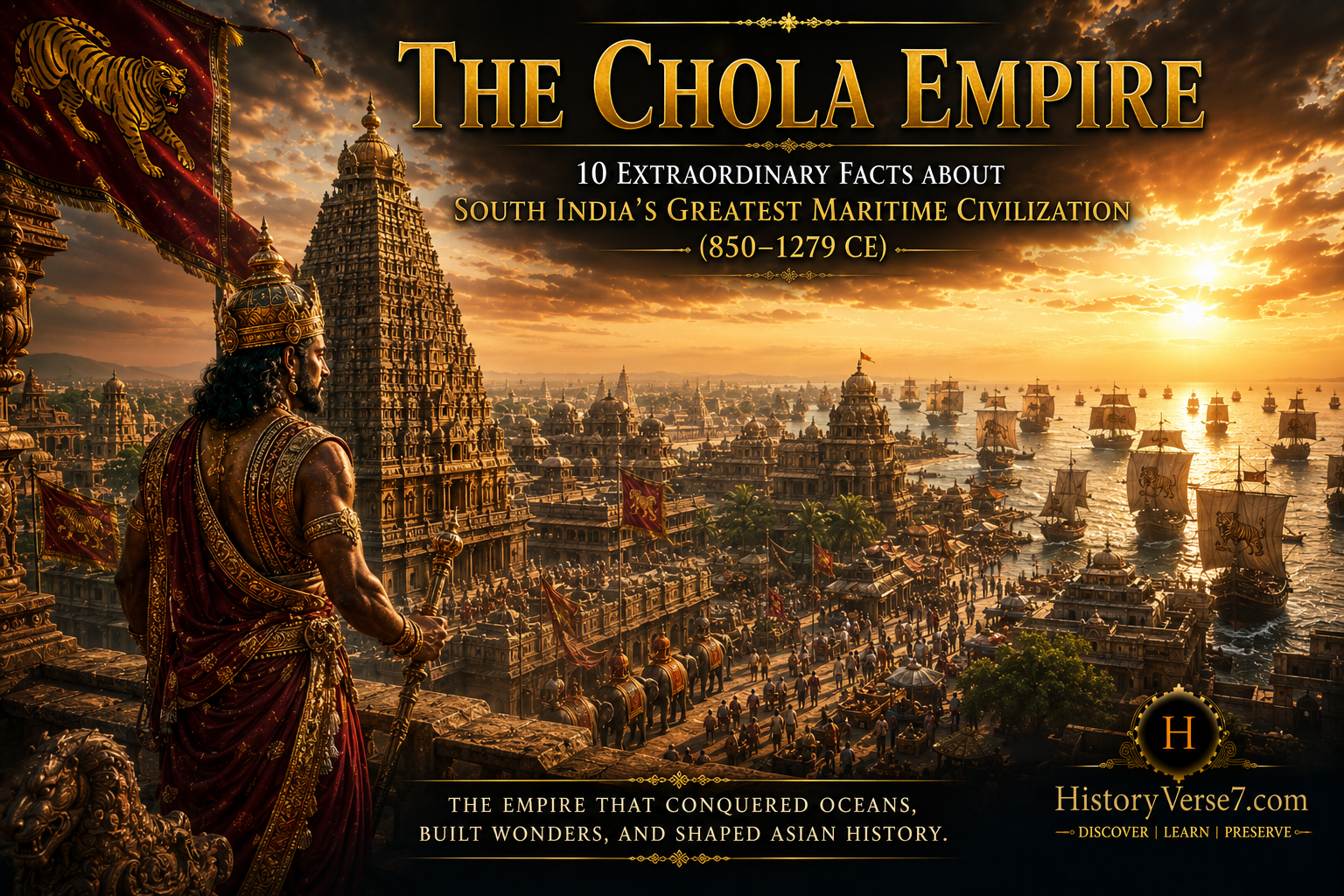
⚔️ The Chola Empire — The Extraordinary Maritime Civilization That Transformed South India into One of the World’s Greatest Naval Powers The history of medieval India is far more than the story of kingdoms and wars. It is also the story of civilizations that mastered government, naval power, trade, architecture, culture, and global influence. Among…
Table of Contents
The Complete History of South India’s Greatest Maritime Empire
HistoryVerse7 | Pillar Article | International Edition.
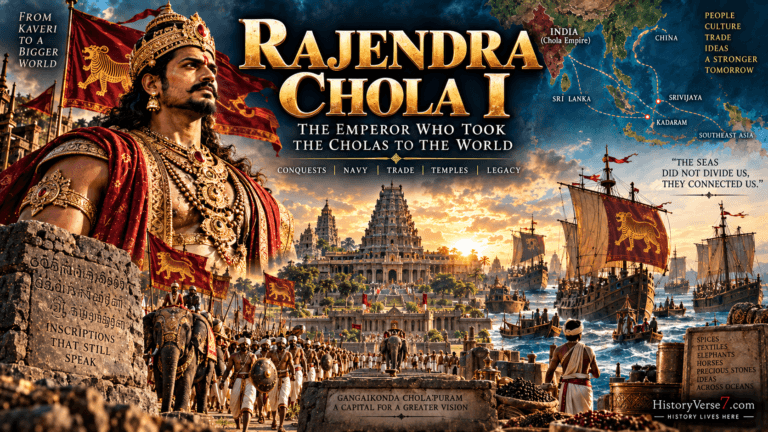
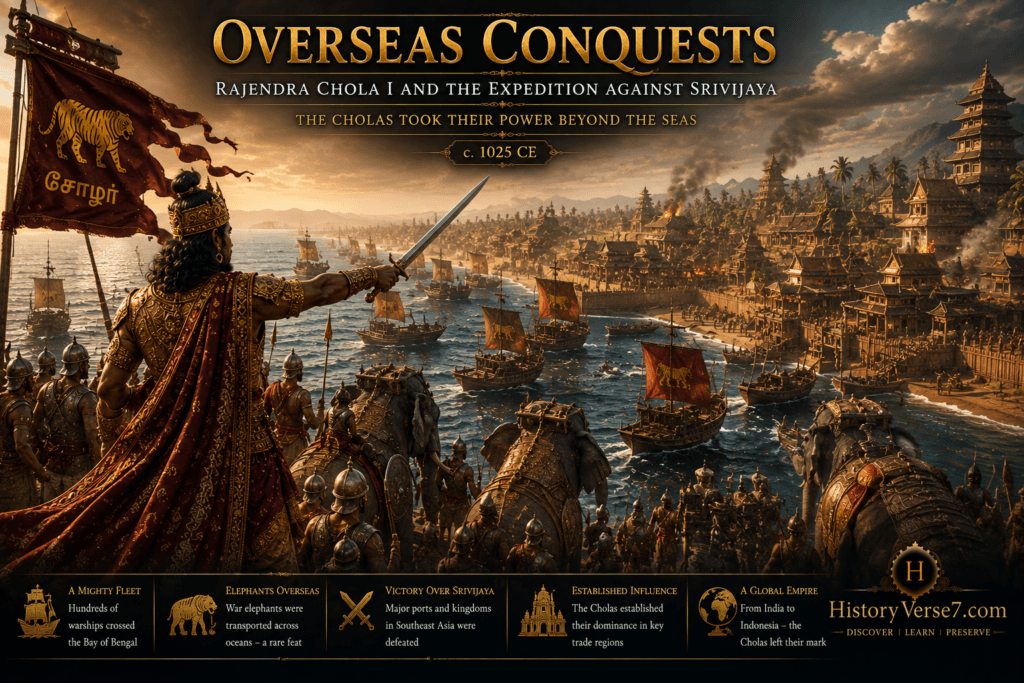
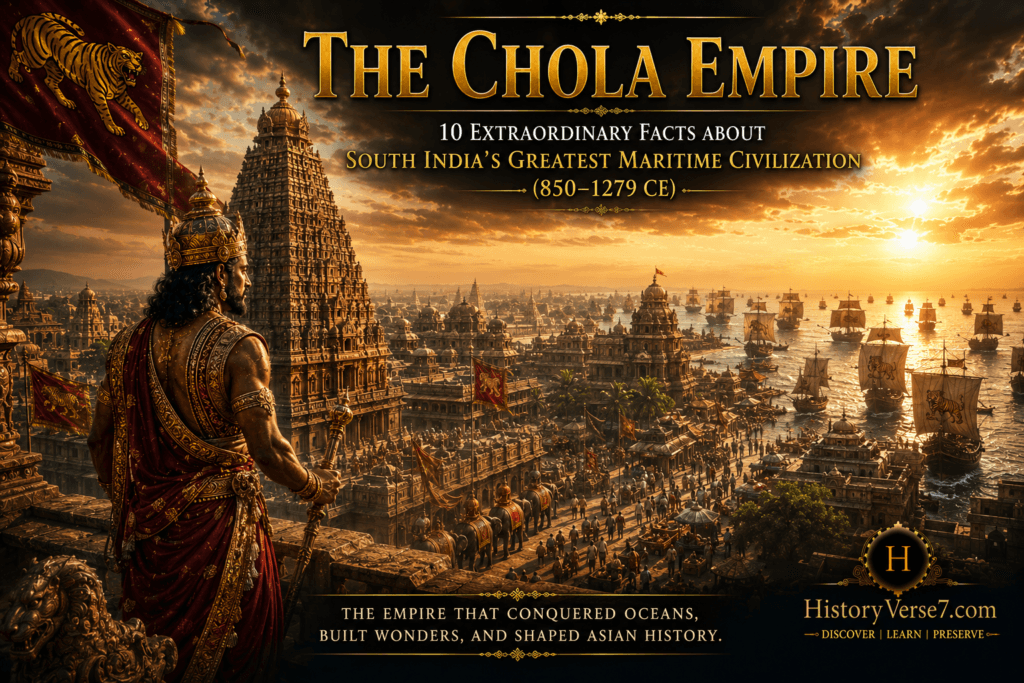
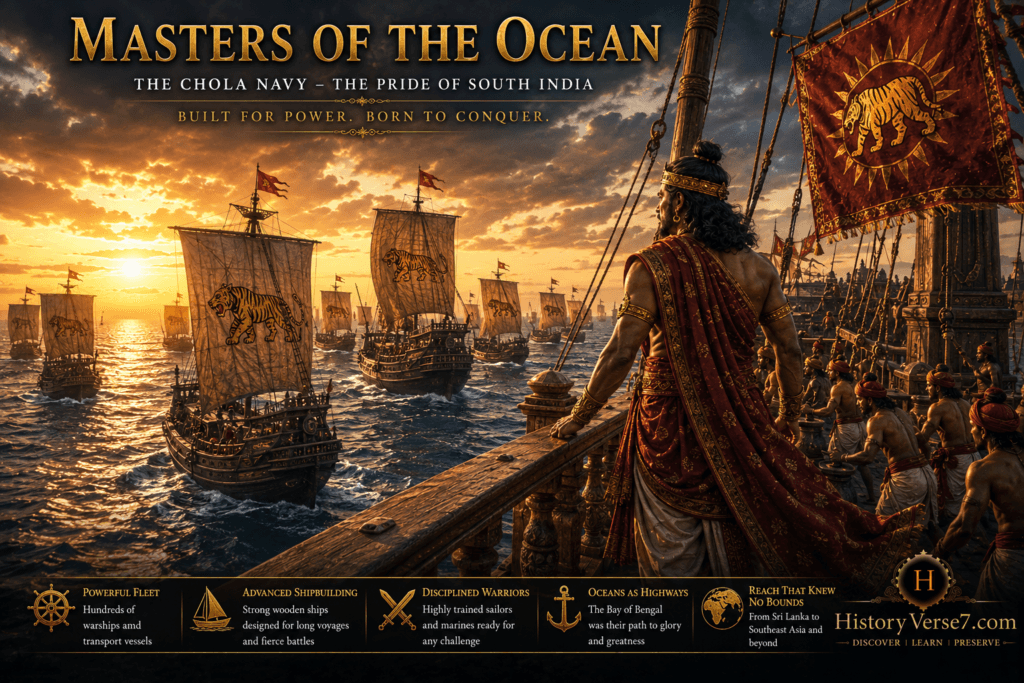
In the year 1025 CE, a fleet unlike anything the Indian Ocean had ever seen cut through the waters between the Bay of Bengal and the Strait of Malacca. Hundreds of warships, their prows carved with the Chola tiger insignia, carried an army that had already subjugated Sri Lanka, the Maldives, and much of the eastern coast of the Indian subcontinent. Their destination: the wealthy trading ports of Srivijaya in Southeast Asia. Their commander: the most powerful sovereign in Asia south of the Himalayas Rajendra Chola I, who would soon call himself Gangaikonda, the Conqueror Who Brought the Ganges.
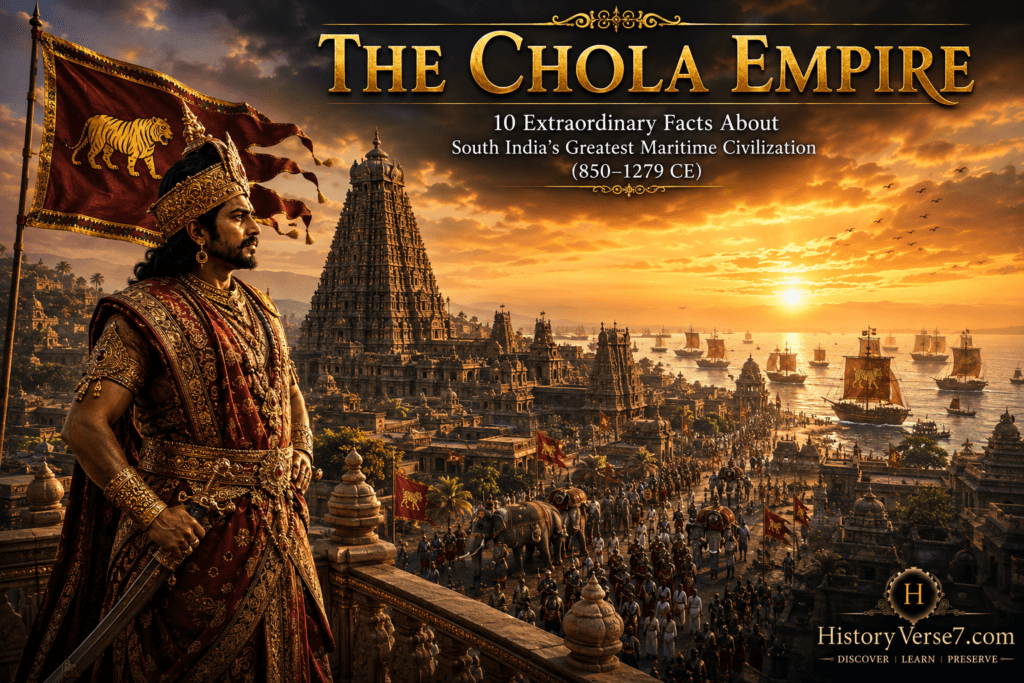
This was not a raid. It was a calculated assertion of maritime supremacy the culmination of nearly two centuries of Chola expansion that had transformed a regional Tamil kingdom in the Kaveri delta into an empire whose influence stretched from the Ganges plain in the north to the shores of the Malay Peninsula in the east. No other medieval Indian power projected force across the open ocean on this scale. No other South Asian dynasty left temples, inscriptions, bronze sculptures, and administrative records of such breathtaking completeness.
The Chola Empire is one of history’s most extraordinary civilizational achievements and one of its most underappreciated outside South Asia. This article sets out to change that. Drawing on epigraphic evidence, archaeological scholarship, Tamil literary sources, and the work of leading historians including K.A. Nilakanta Sastri, Upinder Singh, and Burton Stein, what follows is the most comprehensive account of Chola history available in a single resource.
Origins and Early History: The Ancient Cholas Before the Imperial Age
The Chola name is ancient far older than the imperial dynasty that made it immortal. Tamil Sangam literature, composed between roughly the 3rd century BCE and the 3rd century CE, mentions Chola kings ruling from Uraiyur (near modern Tiruchirappalli) and later from Kaveripattinam, a bustling port city at the mouth of the Kaveri River. These early Cholas were one of three great Tamil confederacies the Cheras, Pandyas, and Cholas whose rivalries and alliances define the heroic age of Tamil civilization.
The Sangam poems are not mere myth. Archaeological excavations at Kaveripattinam have uncovered Roman amphorae, Mediterranean pottery, and evidence of a sophisticated trading economy that connected Tamil Nadu to Rome, Arabia, and Southeast Asia in the first centuries CE. The early Cholas were already maritime traders before they became imperial conquerors. This oceanic orientation the instinct to look outward across the sea would define the dynasty for more than a thousand years.
After the Sangam age, the Cholas entered a historical shadow. Between approximately the 4th and 9th centuries CE, they appear to have been subordinated to or eclipsed by the Kalabhras, the Pallavas of Kanchipuram, and the Pandyas of Madurai. Medieval inscriptions composed by later Chola kings contain genealogies that attempt to bridge this gap, but historians treat these claims cautiously. What is clear is that by the mid-9th century, a line of Chola chiefs based in the Kaveri delta, the region known as Cholamandalam, or Coromandel, was reasserting itself with growing confidence.
Vijayalaya Chola and the Rebirth of Chola Power (c. 848 CE)
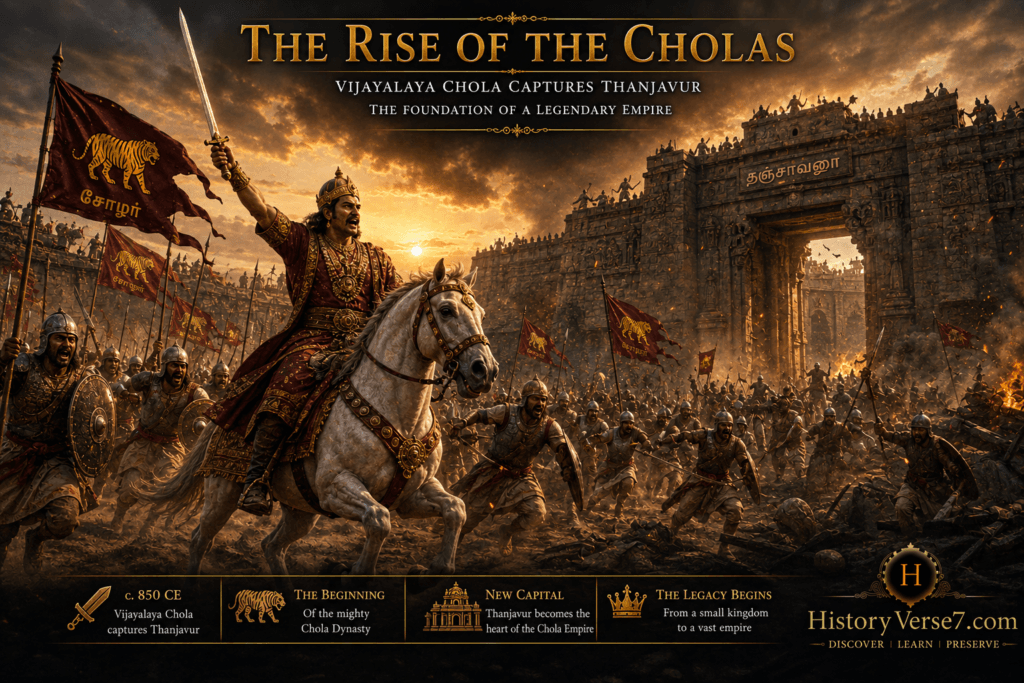
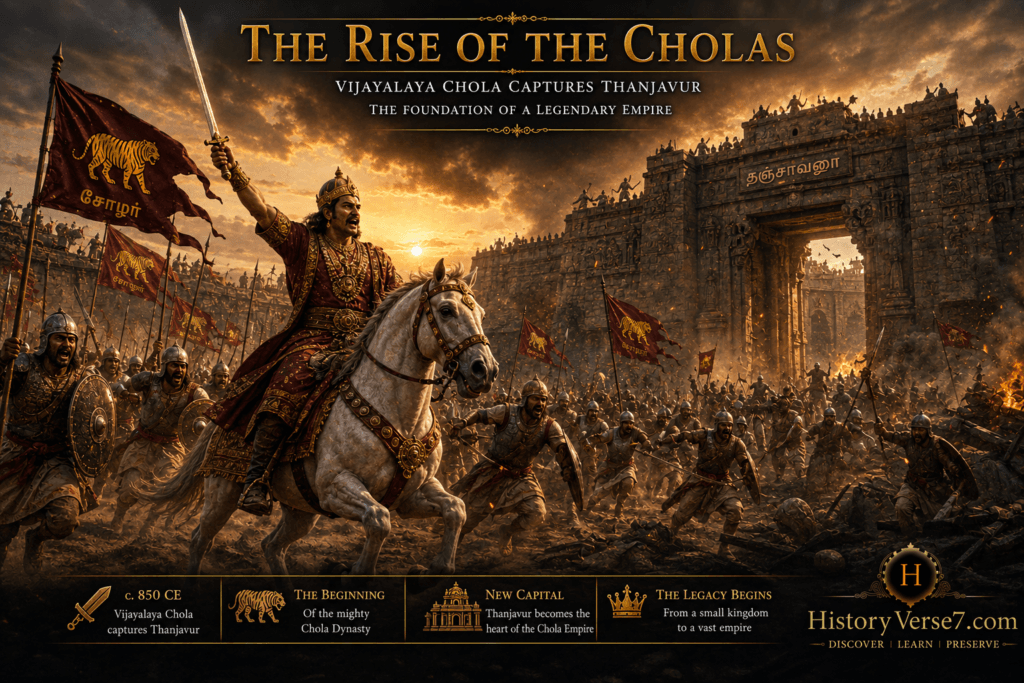
The conventional starting point for the Imperial Chola period is the reign of Vijayalaya Chola, who around 848 CE seized the town of Thanjavur (Tanjore) from the Mutharaiyar chiefs while those chiefs were distracted by conflict with the Pandyas. Thanjavur set in the fertile Kaveri delta, surrounded by some of the most productive agricultural land in South Asia would become the heart of the Chola empire for the next four centuries.
Vijayalaya was apparently a subordinate of the Pallava king, but his capture of Thanjavur gave him an independent territorial base. He dedicated his victory to the goddess Nishumbhasudani and built a temple to her establishing from the very beginning the intimate connection between Chola kingship and temple patronage that would become one of the dynasty’s defining characteristics. His son Aditya I (r. c. 871–907 CE) continued the expansion, defeating the last significant Pallava king Aparajita and absorbing much of the former Pallava heartland into the growing Chola domain.
By the death of Aditya I, the Cholas had transformed themselves from regional chiefs into the dominant power in Tamil Nadu. But the greatest chapters of Chola history were still to come.
Parantaka I and the First Flowering of Chola Power (907–955 CE)
Parantaka I, who reigned for nearly half a century, was the first Chola king to truly think in imperial terms. His campaigns carried Chola arms far beyond the Kaveri delta. He defeated the Pandyas, who had long disputed supremacy in the deep south, and briefly seized Sri Lanka a prize that would obsess Chola kings for generations. He also pushed northward into the territories of the Rashtrakutas and the Eastern Chalukyas of Vengi.
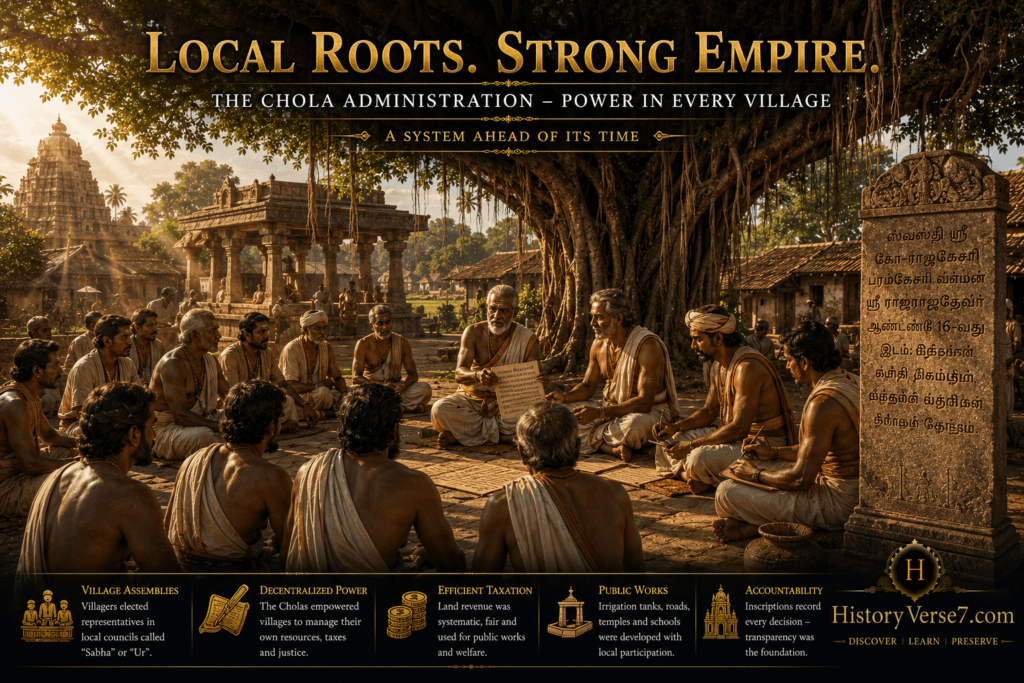
It was during Parantaka’s reign that the Chola administrative and revenue system began to take its mature form. The fertile Kaveri delta was organized into a hierarchy of territorial units the nadu (district) subdivided into urs (villages) each with their own assemblies and administrative functions. The inscriptional record from this period begins to mention these assemblies explicitly, revealing a system of governance that was sophisticated, relatively decentralized, and deeply embedded in local social structures.
Parantaka also introduced the tradition of sheathing the towers (gopuras) of temples in gold a spectacular act of piety and royal munificence that became a hallmark of Chola royal identity. His reign ended in setback, however. Around 949 CE, the Rashtrakuta king Krishna III defeated the Cholas at the Battle of Takkolam, killing Parantaka’s son Rajaditya and pushing the Chola frontier back significantly. Parantaka died shortly afterward, and a period of relative weakness followed under his successors Gandaraditya and Arinjaya.
Rajaraja Chola I: The King Who Built an Empire (985–1014 CE)
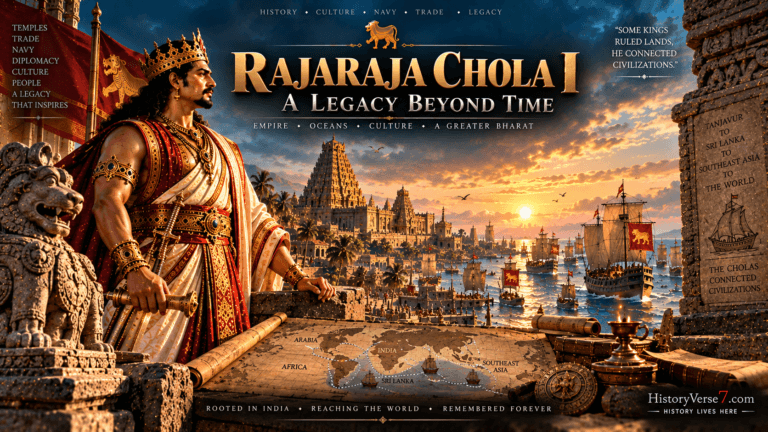
Of all the Chola kings, it is Rajaraja I born Arulmozhi Varman who most decisively transformed the dynasty into an empire. His thirty-year reign is one of the most consequential in South Asian history, and he remains one of the greatest rulers medieval India produced.
Rise to Power
Rajaraja came to the throne after a brief period of uncertainty following the death of his uncle Uttama Chola. The circumstances of his accession are not entirely clear from the sources, but what is clear is that from the moment he took power, Rajaraja moved with remarkable strategic focus. He bore the throne name Rajaraja ‘King of Kings’ and he set about earning it.
His first major campaigns were directed against the traditional Chola enemies in the south and west. He subdued the Pandyas, defeated the king of Kerala (the Chera ruler of Villarvattam), and reduced the Gangas of Mysore to submission. He then turned north, launching a naval expedition that overwhelmed the kings of Ceylon (Sri Lanka) and captured the northern half of the island, establishing Chola dominance over a territory that would remain contested for decades.
Naval Supremacy and the Maldives Campaign
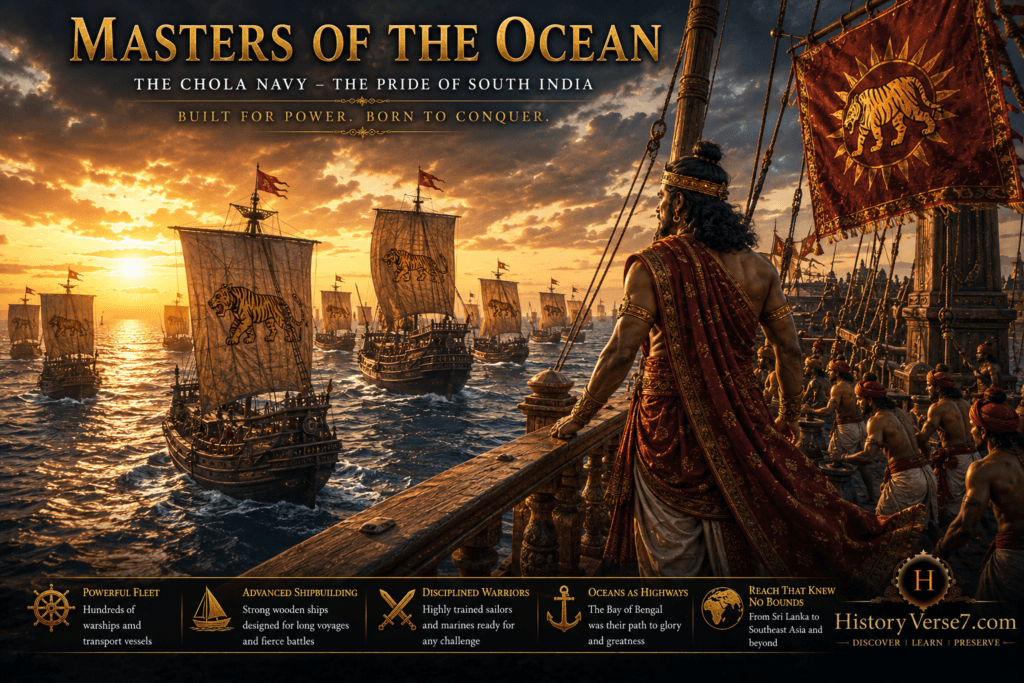
Rajaraja’s most strategically significant innovation was his systematic development of Chola naval power. His campaigns against the ‘old islands of the seas’ the Maldives demonstrate that the Cholas were not merely conducting coastal warfare but projecting power across hundreds of miles of open ocean. The Lakshadweep (Laccadive) Islands were also brought under Chola influence during this period.
The strategic logic was clear the Indian Ocean trade routes that connected the Persian Gulf to the South China Sea passed through waters the Cholas were now policing. Control of Sri Lanka and the Maldives gave the Chola navy leverage over the most commercially valuable sea lanes in Asia. Rajaraja was not merely a conqueror; he was a geostrategist who understood that maritime dominance meant economic dominance.
The Brihadeeswara Temple: A Monument for Eternity
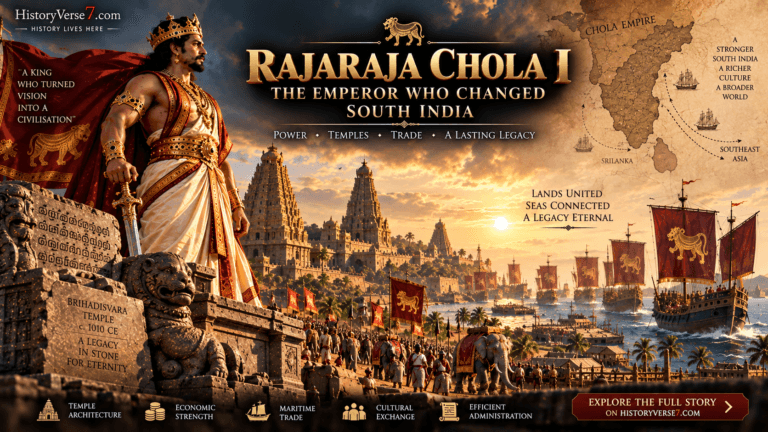
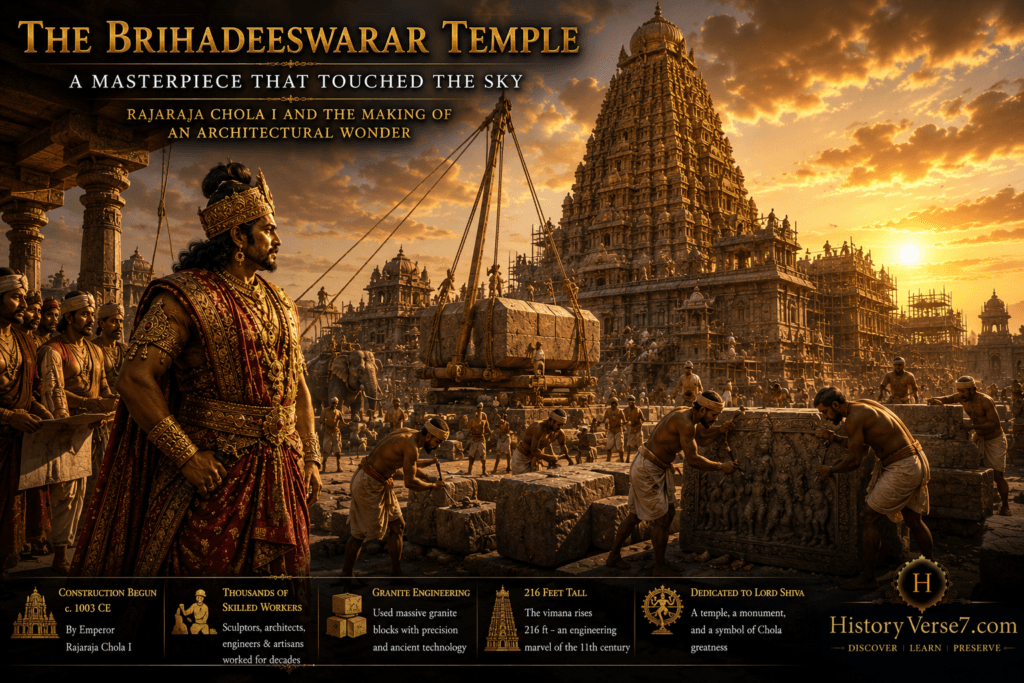
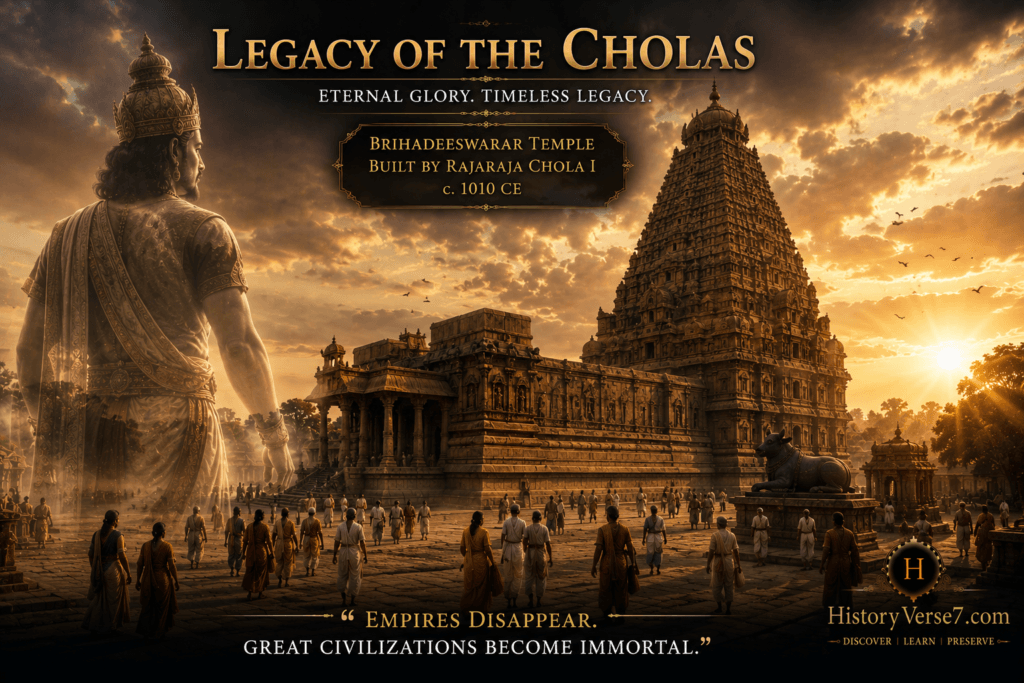
Among Rajaraja’s achievements, none is more enduring than the Brihadeeswara Temple at Thanjavur, consecrated around 1010 CE. This is not simply a great building it is one of the supreme architectural achievements of human civilization, now a UNESCO World Heritage Site and one of the finest examples of Dravidian temple architecture ever created.
The temple’s vimana (central tower) rises to approximately 66 meters the tallest in India at the time of its construction and still among the tallest temple towers on earth. The engineering feat this represented in the early 11th century was extraordinary the capstone alone weighs an estimated 80 tonnes, and it was raised to the top of the tower using a ramp that may have extended several kilometers. Contemporary inscriptions record in meticulous detail the enormous endowments Rajaraja made to the temple land grants, gold, jewels, dancing girls, musicians, priests, and administrative staff numbering in the hundreds.
The Brihadeeswara Temple was not merely a place of worship. It was a statement of cosmic and political authority a physical representation of the Chola king’s identification with Shiva, the supreme deity of the Tamil Shaivite tradition. Its bronze sculptures, many of which survive in Indian and international museum collections, represent the pinnacle of Chola artistic achievement. The famous Nataraja (Dancing Shiva) image, now considered one of the greatest sculptures ever created anywhere in the world, belongs to the Chola artistic tradition that found its highest expression in Rajaraja’s reign.
Administrative Genius: The Chola State under Rajaraja
Rajaraja’s administrative achievements were as significant as his military and architectural ones. He undertook a systematic survey of land in the Chola heartland, recording the extent, productivity, and revenue obligation of agricultural land with a precision unusual for medieval states anywhere in the world. These surveys preserved in temple inscriptions allow modern historians to reconstruct the economic geography of Chola Tamil Nadu with remarkable accuracy. He also reorganized the administrative divisions of the empire, replacing the older territorial units with a more systematic hierarchy of territories (mandalam, valanadu, kurram, and ur) whose boundaries were carefully defined. This reorganization, documented in detail by K.A. Nilakanta Sastri in his foundational study ‘The Colas,’ gave the Chola state an administrative
Rajendra Chola I: The Conqueror of the World (1014–1044 CE)
If Rajaraja built the empire, his son Rajendra I extended it to its farthest reach and in doing so, created one of the most remarkable military and diplomatic records of the medieval world.
The Northern Campaign and the Ganges
Around 1019–1023 CE, Rajendra launched an extraordinary overland campaign northward through the eastern Deccan and Odisha. His armies marched through the territories of the Chalukyas of Vengi, the Eastern Gangas, the Palas of Bengal, and multiple other kingdoms, reaching as far as the Ganges River. The campaign was not a conquest in the traditional sense Rajendra did not attempt to establish permanent administration over these territories. Instead, he extracted symbolic submission, tribute, and most strikingly sacred water from the Ganges itself.
This Ganges water was carried back to Tamil Nadu, where Rajendra used it to fill a great artificial reservoir he constructed near his new capital, Gangaikondacholapuram ‘The City of the Chola Who Took the Ganges.’ The name itself was his new royal title: Gangaikonda Chola. The reservoir, still visible today as a large tank, served both practical irrigation purposes and profound symbolic ones, positioning Rajendra as a universal sovereign whose dominion extended from the sacred rivers of the north to the seas of the south and east.
The Southeast Asian Expedition of 1025 CE
The most audacious achievement of Rajendra’s reign and arguably the most remarkable single military operation in the history of medieval South Asia was his naval expedition against the Srivijaya Empire in 1025 CE.
Srivijaya, based in Sumatra and controlling much of the Malay Peninsula, was the dominant maritime power in Southeast Asia. Its ports at Palembang and along the Strait of Malacca were the indispensable transit points for trade between the Indian Ocean and the South China Sea. Chinese, Arab, and Indian merchants all passed through Srivijayan ports, paying tolls and duties that made the Srivijayan rulers fabulously wealthy. The Cholas, whose commercial interests were directly affected by Srivijayan control of these sea lanes, had apparently been building toward a confrontation for years.
The Larger Leiden Plate inscription a copper plate inscription discovered in the Netherlands, originally from a Tamil trading community in Sumatra records diplomatic exchanges between the Chola court and the Song Dynasty of China in the 1010s, suggesting that the Cholas were cultivating Chinese support or at minimum Chinese awareness of their maritime ambitions before the expedition was launched.
In 1025, the Chola fleet struck. The inscription known as the Tanjore Inscription of Rajendra records the capture of Kadaram (Kedah), Srivijaya’s principal port in the Malay Peninsula, along with a list of other conquered territories that includes locations in modern Malaysia, Thailand, and possibly Burma. The Chola forces apparently captured the king of Srivijaya’s son, seizing enormous war booty and demonstrating in the most dramatic possible terms that no maritime power in Asia could ignore the Chola navy.
Historians debate the precise nature and long-term consequences of this expedition. It does not appear to have resulted in permanent Chola administration over Southeast Asian territories. What it achieved was the demonstration of Chola power, the disruption of Srivijayan commercial dominance, and critically the opening of Southeast Asian sea lanes to Tamil traders operating under Chola protection. The Tamil merchant guild known as the Ayyavole (or Aihole-500) expanded its commercial operations throughout Southeast Asia in the decades following the expedition, and Chinese sources from the period record Tamil merchant communities active in ports across the region.
Gangaikondacholapuram: A Capital for a World Empire
Rajendra built a new capital city Gangaikondacholapuram to commemorate his northern conquests. The city no longer exists in any significant form above ground, but its great temple, the Gangaikondacholapuram Temple, survives as one of the finest examples of Chola architecture in existence. Slightly smaller than the Brihadeeswara at Thanjavur but widely considered even more refined in its sculptural program, the Gangaikondacholapuram Temple contains some of the most extraordinary stone sculptures produced anywhere in India during the medieval period.
The choice to build a new capital rather than simply expand Thanjavur reflects Rajendra’s ambition to define his reign as a new chapter — not merely a continuation of his father’s achievements but a fresh imperial statement. The city’s name, proclaiming his conquest of the Ganges, was itself a political manifesto inscribed in geography.
The Architecture of Power: Chola Administration and Governance
The Chola Empire was one of the most administratively sophisticated states of the medieval world. Its system of governance documented in extraordinary detail in thousands of stone inscriptions reveals a polity that balanced central authority with robust local self-governance in ways that have fascinated historians and political scientists alike.
The Imperial Hierarchy
At the apex of the Chola state stood the king, whose authority was expressed through an elaborate ideology of divine kingship rooted in Tamil Shaivite tradition. The king was not merely a ruler he was Shiva’s representative on earth, the guarantor of cosmic order (dharma), the protector of Brahmin learning and temple worship, and the supreme military commander. Royal titles accumulated over generations into elaborate strings of epithets that proclaimed conquest, piety, lineage, and divine favor.
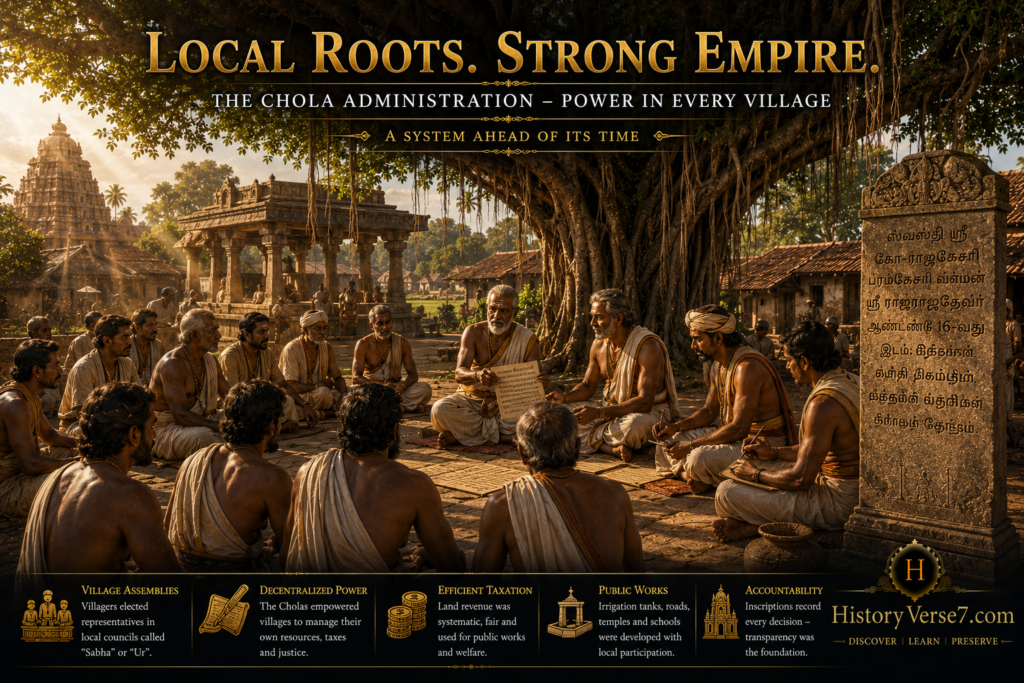
Below the king, the empire was divided into a hierarchy of territorial units. The largest were the mandalams (provinces), each roughly corresponding to a major geographical or cultural region. The mandalams were subdivided into valanadus (sub-provinces), then into nadus (districts), and finally into individual urs (villages and towns). This hierarchy was not merely administrative each level had its own assembly the mahasabha at the village level, the periyanadu at higher levels with defined responsibilities for local governance, revenue collection, and dispute resolution.
Village Assemblies: A Remarkable Democratic Tradition
The most celebrated feature of Chola governance is the system of village self-government documented in the Uthiramerur inscriptions of the late 9th and early 10th centuries. These inscriptions record in remarkable detail the rules governing the election of members to the village sabha (assembly) in the village of Uthiramerur in the former Pallava heartland.
The Uthiramerur inscriptions specify qualifications for membership (age, property ownership, literacy in Sanskrit and Tamil), disqualifications (corruption, certain moral failings), the use of a lottery system (kudavolai drawing names written on palm leaves from a pot), and the responsibilities of elected committees for tax collection, irrigation maintenance, and temple administration. This is one of the earliest documented systems of representative local government in world history, and it is extraordinary that it appears in such sophisticated form in 10th-century South India.
Historians debate how representative or democratic this system actually was membership was restricted to landowners and the literate, excluding much of the population but its sophistication is undeniable. Burton Stein’s influential model of the Chola state as a ‘segmentary state’ (which he later revised) drew attention to the degree to which local assemblies retained real power even under imperial rule, and subsequent scholars including Kesavan Veluthat and Y. Subbarayalu have further refined our understanding of how the Chola center and periphery interacted.
Revenue and Taxation
The Chola revenue system rested primarily on agricultural land tax, typically assessed as a proportion of the expected yield of each field. The land surveys carried out by Rajaraja I and his successors created a detailed cadastral record that allowed the state to track revenue obligations across thousands of villages. Temple inscriptions recording land grants in which the state alienated revenue from specific villages to specific temples allow modern historians to reconstruct both the geography of Chola agriculture and the mechanics of royal patronage.
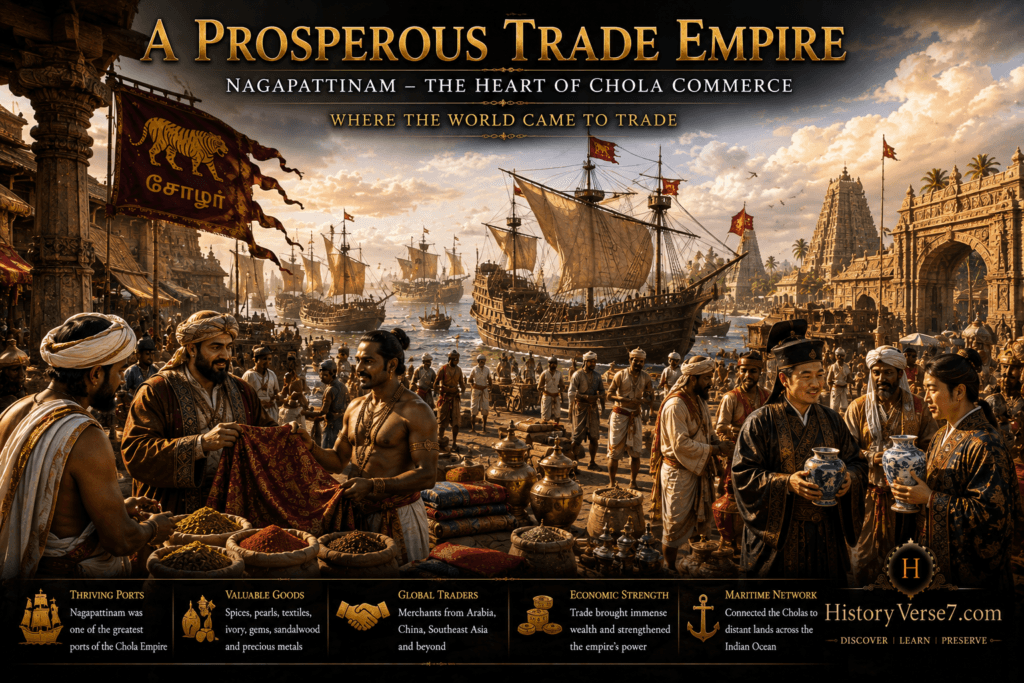
Trade taxes, port duties, and levies on artisanal production also contributed to Chola revenues, though these are less systematically documented than agricultural taxes. The great ports of the Coromandel coast Nagapattinam, Mahabalipuram, Kaveripattinam generated substantial revenue from the Indian Ocean trade, and the Chola navy’s role in protecting (and taxing) this commerce was a significant source of imperial income.
The Role of Temples in Chola Governance
No account of Chola administration is complete without attention to the role of temples. Chola temples were not merely religious institutions they were economic powerhouses, social welfare organizations, employers of thousands, and repositories of the community’s wealth. Temple endowments from royal and elite donors gave temples control over vast landholdings, whose revenues supported priests, musicians, dancers, scholars, and the maintenance of the temple complex itself.
The Brihadeesvara Temple at Thanjavur, for example, held endowments that supported over 400 professional staff according to inscriptions from Rajaraja’s reign. Temples functioned as banks, lending money at interest to merchants and cultivators. They served as granaries in times of shortage. They hosted schools and libraries. In many respects, the great Chola temples were the most important institutions in their localities more significant in daily life than any purely administrative office.
This intimate relationship between temple and state was not incidental. Royal patronage of temples was both an act of genuine piety and a calculated political strategy. By endowing temples, kings demonstrated their dharmic credentials, distributed wealth in ways that built local loyalties, and created permanent physical monuments to their reign that outlasted any military victory.
The Chola War Machine: Military Organization and Strategy
The Chola military was one of the most powerful and versatile forces in medieval Asia. Its capacity to project power both overland and across thousands of miles of open ocean demonstrated repeatedly between the 9th and 12th centuries sets the Chola apart from virtually every other medieval Indian polity.
Land Forces
The Chola army was organized around a core of royal household troops (the velaikkarar, or personal guards of the king), supplemented by professional standing armies and the forces of tributary chiefs and allies. Inscriptions mention various specialized military units elephant corps, cavalry, infantry formations with distinctive names suggesting regional or functional specialization. The elephant corps was particularly important; war elephants remained decisive on South Asian battlefields throughout the medieval period, and the Chola kings maintained large herds of trained war elephants sourced from the forests of Kerala and Sri Lanka.
The Chola army does not appear to have developed the elaborate strategic cavalry tradition that characterized the armies of northern India and the Islamic world. South Indian terrain dense forest, river-crossed coastal plains, and the broken topography of the Deccan favored infantry and elephants over large cavalry formations. Chola military success relied more on logistical organization, siege capability, and the coordination of land and naval forces than on cavalry shock tactics.
Naval Power: The Chola’s Greatest Military Asset
The Chola navy was the dynasty’s most remarkable military innovation and its greatest strategic advantage. The construction of a fighting fleet capable of operating across the Bay of Bengal and the Andaman Sea required enormous investment in shipbuilding, seamanship, navigational knowledge, and logistical infrastructure. The ports of the Coromandel coast particularly Nagapattinam served as naval bases and shipbuilding centers.
The Chola ships were almost certainly built in the traditional South and Southeast Asian plank-sewn construction technique, in which planks were stitched together with coir rope rather than nailed. This technique, well-attested in the region, produced vessels that were flexible and seaworthy in the Indian Ocean’s conditions. The largest Chola warships carried substantial numbers of troops the Southeast Asian expedition of 1025 CE apparently transported an army large enough to overwhelm the Srivijayan defenses.
Navigation across the Bay of Bengal required knowledge of seasonal monsoon winds, ocean currents, and coastal landmarks accumulated over generations of commercial voyaging. Tamil merchant communities had been sailing to Southeast Asia for centuries before the Chola navy arrived the military expedition essentially followed routes already well-charted by Tamil traders.
Commerce, Craft, and Prosperity: The Chola Economy
The Chola Empire presided over one of the most commercially dynamic economies in the medieval world. Situated at the intersection of Indian Ocean trade routes connecting the Persian Gulf, the Red Sea, South and Southeast Asia, and China, the Chola heartland in Tamil Nadu was superbly positioned to participate in and profit from long-distance commerce.
Agriculture and the Kaveri Delta
The material foundation of Chola power was agriculture, and specifically the extraordinarily productive rice cultivation of the Kaveri delta. The Kaveri River, rising in the Coorg highlands and flowing eastward to the Bay of Bengal, deposits immensely fertile alluvial soil across a broad delta that has been continuously cultivated for at least two millennia. Chola irrigation works tanks, channels, and weirs extended the area of cultivated land and regulated water distribution with an efficiency that maximized rice yields.
The famous Grand Anicut (Kallanai), a dam across the Kaveri attributed by tradition to the early Chola king Karikalan (though probably developed and improved over many centuries), redirected river water into irrigation channels serving hundreds of villages. Modern engineers studying the Kallanai have marveled at its hydraulic intelligence it functions on the same principles today that it did when first constructed. The Chola state’s investment in and management of irrigation infrastructure was a crucial element of its economic success.
Long-Distance Trade and the Tamil Merchant Guilds
Tamil merchant guilds were among the most sophisticated commercial organizations of the medieval world. The best-documented is the Ayyavole (or Ainurruvar, ‘The Five Hundred’), a merchant corporation whose inscriptions have been found across India, Sri Lanka, Southeast Asia, and even East Africa. These guilds maintained their own armed retinues, arbitrated commercial disputes, enforced standards of weights and measures, and negotiated with local rulers over trading rights.
The commodities flowing through Chola ports were immensely valuable. Spices pepper, cardamom, cinnamon from Kerala and Sri Lanka commanded extraordinary prices in Mediterranean markets. Cotton textiles woven in Tamil Nadu found buyers across the Indian Ocean world. Coral, pearls, and precious stones moved in both directions. Chinese porcelain, silk, and copper coins appeared in Chola ports in exchange for Indian goods. Arab and Persian merchants brought horses (always in demand in South India, which could not breed them in sufficient quantities) and carried away textiles and spices.
The Chola state benefited from this commerce through port duties and taxes, but its role was primarily facilitative rather than directive. The Chola kings provided security and naval protection against piracy, and diplomatic frameworks for commercial relationships, while leaving the actual conduct of trade largely to merchant communities operating under guild regulations.
Coinage and Monetary Economy
The Chola monetary system relied primarily on gold coins the kahavanu or kasu though silver and copper coins also circulated. The sophistication of the Chola monetary economy is evident from inscriptions recording complex financial transactions: loans at specified interest rates, long-term endowments whose revenue was carefully calculated, commercial contracts whose terms were recorded and witnessed. This level of monetization and commercial sophistication was unusual in the medieval world and reflects the deep integration of Tamil Nadu into Indian Ocean commercial networks.
Civilization at Its Height: Culture, Religion, and the Arts
The Chola period represents one of the great flowerings of Indian civilization. In architecture, sculpture, literature, music, and dance, the Chola centuries produced works of enduring world-historical significance.
Shaivism and the Religious World of the Cholas
The Chola kings were devoted Shaivite worshippers of Shiva, and their patronage of Shaivite institutions was the central cultural commitment of the dynasty. The Tamil Shaivite tradition known as Shaiva Siddhanta, which flowered in the period immediately before and during the Chola imperial age, produced a remarkable body of devotional poetry, the Tevaram, composed by the Nayanmars, a group of poet-saints whose verses became central to Tamil religious and cultural identity.
The Chola kings did not merely recite these verses they institutionalized them. Rajaraja I had the Tevaram hymns collected, organized, and incorporated into temple worship at the Brihadeeswara and other temples, giving these poems a canonical status they retain to this day. He also commissioned a series of bronze portraits of the Nayanmars for temple installation, creating what may be the world’s first systematic program of religious portraiture on behalf of a devotional tradition rather than a ruling family.
The Chola relationship with Vaishnavism and other traditions was more complex. There is no evidence of systematic persecution of non-Shaivite communities, and some Chola kings patronized Vaishnava institutions. But the royal religious identity was predominantly Shaivite, and the temples built with royal patronage were overwhelmingly dedicated to Shiva.
Bronze Casting: The Chola’s Greatest Artistic Legacy
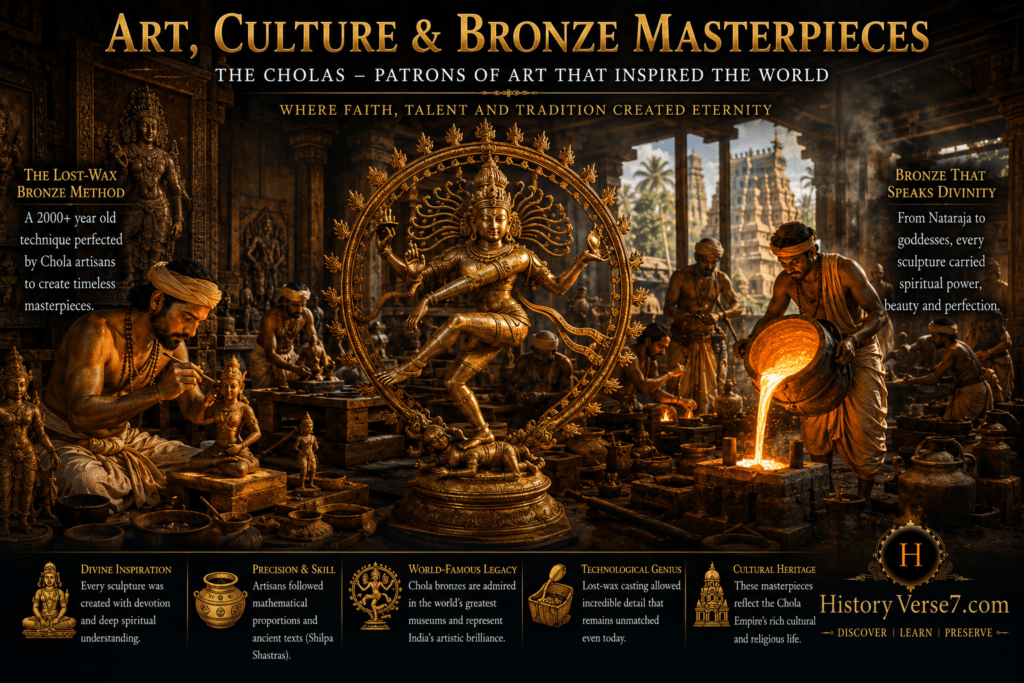
The Chola bronze sculptures are among the finest metalwork ever produced in human history. Working in the lost-wax (cire perdue) technique, Chola craftsmen created figures of breathtaking technical mastery and spiritual expressiveness. The Nataraja Shiva as Lord of the Dance is their masterpiece: a dynamic, perfectly balanced image that simultaneously represents cosmic creation and destruction, the rhythm of the universe, and the triumph of divine consciousness over illusion.
Chola bronze Natarajas have been described by art historians including Ananda Coomaraswamy as among the greatest sculptures ever made. The image’s iconic form Shiva dancing within a ring of fire, one leg raised, one hand holding a drum of creation, one pointing to the lifted foot as the place of refuge from samsara was essentially codified during the Chola period and has been reproduced in every medium in every century since.\
Other Chola bronzes images of Parvati, Subrahmanya, various Vishnu avatars, and portrait images of royal donors display the same mastery of human form and spiritual symbolism. Many Chola bronzes were cult objects still actively worshipped in Tamil Nadu temples, while others have entered museum collections worldwide. The Metropolitan Museum of Art in New York, the British Museum, the Musée Guimet in Paris, and the National Museum in Chennai hold significant Chola bronze collections.
Temple Architecture: The Dravidian Style Perfected
Chola temple architecture represents the mature expression of the Dravidian style, one of the two great traditions of Hindu sacred architecture (the other being the Nagara style dominant in northern India). Key features of the Dravidian style as developed by the Cholas include the pyramidal vimana (central tower) built in progressive tiers, the elaborately carved gopura (gateway tower) that came to dominate the architectural composition in later periods, the mandapa (columned hall) for assembly and worship, and the tank for ritual bathing.
The Brihadeeswara at Thanjavur and the Gangaikondacholapuram Temple remain the supreme achievements of Chola temple architecture. Both are now designated as UNESCO World Heritage Sites under the collective designation ‘Great Living Chola Temples’ (which also includes the Airavatesvara Temple at Darasuram, built by Rajaraja II in the 12th century). These three temples together demonstrate the evolution of Chola architectural thinking across more than two centuries.
Tamil Literature in the Chola Period
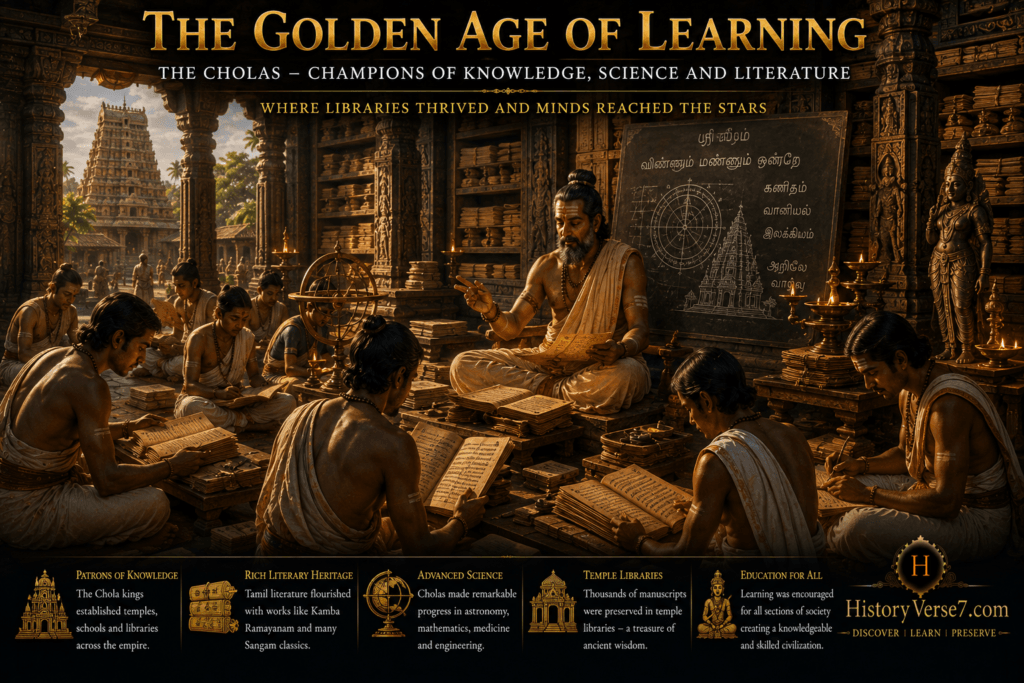
The Chola period was a golden age for Tamil literature. The religious poetry of the Nayanmars (Shaivite) and Alvars (Vaishnavite), though composed largely in the preceding Pallava period, was compiled, systematized, and elevated to canonical status under Chola patronage. New literary works of the first rank were also produced: the Kambaramayanam, Kamban’s Tamil version of the Ramayana, is one of the great works of Tamil literature, composed in the 12th century during the reign of the Later Cholas.
Court poetry, grammatical treatises, and devotional literature all flourished under Chola patronage. The sophisticated Tamil literary tradition — with its own distinct poetic conventions, metres, and thematic categories going back to the Sangam age continued to develop and innovate throughout the imperial period.
The Later Chola Kings: Zenith and Decline (1044–1279 CE)
The death of Rajendra I in 1044 CE did not immediately signal decline. His successors Rajadhiraja I, Rajendra II, and Virarajendra were capable kings who maintained Chola dominance in South India, fending off persistent challenges from the Western Chalukyas of Kalyani (modern Karnataka) and the resurgent Pandyas. The Chola-Chalukya wars of the 11th century were some of the most sustained military conflicts in medieval South Indian history, with advantage shifting multiple times between the two powers.
Kulottunga I: Reunion and Renaissance (1070–1122 CE)
One of the most remarkable rulers of the Later Chola period was Kulottunga I, who came to the throne through an unusual combination of Chola and Eastern Chalukya (Vengi) descent, effectively uniting the two rival dynasties in his own person. His long reign of over fifty years (1070–1122 CE) was a period of internal consolidation and cultural achievement.
Kulottunga is particularly notable for his administrative reforms. He reportedly abolished certain tolls and internal trade taxes a reform celebrated in the famous poem Kalingattuparani composed by his court poet Jayamkondar. He also conducted a major land survey. His reign saw the continued expansion of temple construction and the flourishing of Tamil literature.
The Chola relationship with Southeast Asia remained active under Kulottunga. Inscriptions record diplomatic and commercial exchanges with kingdoms in the Malay Peninsula and the dispatch of craftsmen from Tamil Nadu to assist in temple construction in the region. The Tamil merchant guild networks continued to operate throughout Southeast Asia.
The Twilight of Chola Power (12th–13th Centuries)
After Kulottunga I, the Chola dynasty entered a long, slow decline punctuated by brief revivals. The Later Chola kings including Vikrama Chola, Kulottunga II, Rajaraja II (builder of the Airavatesvara Temple), Kulottunga III, and Rajaraja III faced mounting challenges from three directions, the Hoysalas of Karnataka pushing from the northwest, the resurgent Pandyas of Madurai pushing from the south, and internal conflicts within the Chola royal family itself.
The Pandyas, under their king Maravarman Sundara Pandya and then Jatavarman Sundara Pandya, proved increasingly capable adversaries. By the mid-13th century, the Pandyas had wrested control of much of the traditional Chola heartland. The last significant Chola king, Rajendra III, was essentially a Pandya client by the time of his reign in the 1260s–1270s. The empire that Rajaraja I had built over the course of three decades was extinguished not in a single catastrophic defeat but in a gradual erosion that accelerated through the 13th century.
The conventional date for the end of the Chola Empire is 1279 CE, when the last Chola king disappears from the inscriptional record. By this time, the Pandyas were the dominant power in Tamil Nadu, and within half a century, the Delhi Sultanate’s general Malik Kafur would bring the military power of the Islamic north for the first time into the Tamil south.
Diplomacy, Trade, and Foreign Relations
The Chola Empire’s engagement with the wider world was more systematic and sophisticated than that of virtually any other medieval Indian state. Through diplomatic missions, commercial networks, and military operations, the Cholas interacted with powers across an enormous arc from the Arab world to Song Dynasty China.
Relations with China
The most striking aspect of Chola foreign relations is the series of diplomatic missions to Song Dynasty China recorded in both Chinese sources and Tamil inscriptions. Three Chola embassies to the Song court are documented in 1015, 1033, and 1077 CE bringing gifts including pearls, camphor, cotton cloth, and glass. The Chinese records describe Tamil ambassadors and record the Chola king’s request for trading privileges and recognition.
The 1077 embassy is particularly well documented on the Chinese side. The Song court records note the arrival of 72 Tamil merchants and their gifts, and a Chinese imperial inscription from Guangzhou commemorating the visit survives. These exchanges were not merely ceremonial they underpinned a substantial trade relationship in which Tamil merchants carried South Asian goods to Chinese ports and returned with Chinese silk, porcelain, and copper coins.
Relations with the Arab and Persian World
Arab and Persian merchants had been trading in South Indian ports since at least the early Islamic period, and by the Chola era, Muslim merchant communities were established at Quilon (Kollam) in Kerala and at various ports on the Coromandel coast. The Chola state’s relationship with these communities appears to have been pragmatic and commercially oriented the Chola kings had no interest in religious conflict with their most commercially valuable foreign partners.
Arab geographers of the period including al-Biruni (who visited India in the early 11th century) and later Idrisi mention the Chola kingdom and its commercial significance, though their accounts of the Chola heartland are less detailed than their accounts of western Indian ports. The Arab horse trade in which Arabian horses were imported to South India in exchange for spices, cloth, and other goods was economically crucial and politically significant the Chola military depended on imported horses to maintain its cavalry arm.
Southeast Asian Connections
The Chola engagement with Southeast Asia went far beyond the famous 1025 expedition. Tamil merchant communities were present in ports throughout the Malay Peninsula, Sumatra, Java, and mainland Southeast Asia throughout the Chola period. Tamil inscriptions have been found in Thailand (then the Dvaravati/Khmer sphere), suggesting the geographic reach of Tamil commercial networks.
Temple inscriptions from Southeast Asian kingdoms record donations by Tamil merchants and occasionally by Chola royal representatives. The Chola kings sent craftsmen and religious specialists to assist Southeast Asian rulers with temple construction a form of cultural diplomacy that disseminated South Indian artistic and religious traditions across a vast region. The Hindu-Buddhist temples of Angkor Wat (Khmer), Prambanan (Java), and numerous other Southeast Asian sites show the influence of Indian including Tamil artistic and religious traditions.
Historiography: How Scholars Have Understood the Cholas
The modern scholarly study of the Chola Empire began in earnest in the late 19th and early 20th centuries with the systematic decipherment and publication of Tamil inscriptions by epigraphers working under the Archaeological Survey of India. The work of scholars like V. Venkayya and T.A. Gopinatha Rao established the basic chronological and political framework of Chola history.
The definitive modern study of the Cholas remains K.A. Nilakanta Sastri’s ‘A History of South India’ (1955) and his more specialized ‘The Colas’ (1935, revised 1955). Nilakanta Sastri synthesized the epigraphic evidence with literary sources and archaeological data to produce a comprehensive political and cultural history that remains the essential starting point for Chola scholarship. His work, though now dated in some respects, established the field.
Burton Stein’s ‘Peasant State and Society in Medieval South India’ (1980) proposed an influential ‘segmentary state’ model for understanding Chola governance arguing that the Chola state was less centralized than Nilakanta Sastri’s account suggested and that local assemblies and nadus retained substantial autonomy. This model generated significant scholarly debate; subsequent researchers including Kesavan Veluthat, Y. Subbarayalu, and Cynthia Talbot have refined, critiqued, and partially rehabilitated elements of both the Nilakanta Sastri and Stein positions.
More recent scholarship has emphasized the economic history of the Chola period (Meera Abraham, Kenneth Hall), the social history of temple institutions (Leslie Orr on devadasis and temple women), the art historical dimensions of Chola culture (Vidya Dehejia, Padma Kaimal), and the global historical significance of Chola maritime expansion (Tansen Sen, Hermann Kulke). The field continues to develop as new inscriptions are discovered and published and as interdisciplinary approaches bring new methodologies to bear on the evidence.
Legacy: What the Cholas Left Behind
The Chola Empire ended more than seven centuries ago, but its legacy permeates South Asian and increasingly, global civilization in ways that are only beginning to receive the scholarly and popular attention they deserve.
Architectural and Artistic Heritage
The most immediately tangible Chola legacy is architectural. The great temples of Thanjavur, Gangaikondacholapuram, and Darasuram are not ruins they are living places of worship, visited by millions of pilgrims and tourists each year. The Brihadeeswara Temple at Thanjavur has been in continuous religious use for over a thousand years. These are among the oldest continuously functioning sacred buildings in the world.
Chola bronze casting established a tradition of metalwork in Tamil Nadu that has never entirely died. Bronze images made today in Swamimalai and other traditional casting centers use techniques descended directly from Chola practice. The Nataraja image codified during the Chola period has become one of the most recognized and reproduced artistic symbols in the world, appearing in everything from physics textbooks (CERN has a Nataraja statue at its Geneva campus, a gift from the Indian government) to popular culture.
Administrative and Cultural Traditions
The Chola system of temple governance and land administration influenced subsequent South Indian dynasties the Pandyas, the Vijayanagara Empire, and the Nayaks of Thanjavur all drew on Chola administrative precedents. The village assembly tradition documented in the Uthiramerur inscriptions is sometimes cited as an early example of representative governance in South Asian history.
Tamil cultural identity its language, literature, religious traditions, and artistic heritage was profoundly shaped by the Chola centuries. The canon of Tamil literature as taught in schools, the devotional songs sung in temples, the classical dance form of Bharatanatyam (whose origins are partly rooted in Chola temple dance traditions), the bronze sculptures that define South Indian artistic identity worldwide — all bear the indelible imprint of the imperial Chola era.
Maritime Legacy and Southeast Asian Connections
The Chola maritime legacy has only recently begun to receive the global historical attention it deserves. The 1025 expedition to Srivijaya was one of the earliest examples of a state-organized naval power projection across open ocean in history. The Tamil merchant guild networks that operated under Chola protection created commercial and cultural connections between South Asia and Southeast Asia that helped shape the civilization of the latter region.
Tamil diaspora communities in Malaysia, Singapore, Thailand, and Indonesia trace their roots in part to the commercial migrations of the Chola and post-Chola periods. Hindu temples built by Tamil communities in Southeast Asia often show iconographic and architectural features derived from the Chola tradition. The 1025 expedition, long overlooked in global historiography, is now recognized as a pivotal moment in the history of Asian maritime power.
20 Lesser-Known Facts About the Chola Empire
- Modern molecular anthropological studies of Tamil diaspora communities in Sri Lanka, Malaysia, and Singapore trace significant genetic markers to the population movements of the Chola period.
- The Chola navy’s 1025 expedition to Srivijaya is considered by some historians the world’s first recorded transoceanic military operation mounted by an organized state.
- The Brihadeeswara Temple’s capstone weighs approximately 80 tonnes and was raised to 66 meters height using a construction ramp — an extraordinary engineering feat for 1010 CE.
- CERN (the European nuclear research organization) in Geneva has a large bronze Nataraja sculpture — a gift from the Indian government symbolizing the ‘cosmic dance’ of subatomic particles.
- The Uthiramerur inscriptions describe a voting system using palm leaves (kudavolai) that is one of the earliest documented forms of representative local government in world history.
- Chola bronze casting workshops in Swamimalai, Tamil Nadu, still use the same lost-wax technique developed over a thousand years ago.
- The Chola merchant guild known as the Ayyavole (Five Hundred) had its own armed escort and maintained trading posts across India, Sri Lanka, Southeast Asia, and possibly East Africa.
- Rajendra I’s title ‘Gangaikonda Chola’ — Chola who took the Ganges — was commemorated by naming his new capital city Gangaikondacholapuram, the ruins of which still exist in Tamil Nadu.
- The Larger Leiden Plate inscription — discovered in the Netherlands — records an early Chola diplomatic exchange with Southeast Asian rulers and is one of the most important documents of Chola maritime history.
- Chinese Song Dynasty records document three Chola diplomatic missions to the Chinese imperial court, in 1015, 1033, and 1077 CE.
- The Chola general who served Rajaraja I, Krishnan Raman, is credited in some inscriptions with conducting the conquest of Sri Lanka over several campaigns spanning nearly a decade.
- The Airavatesvara Temple at Darasuram has a chariot-shaped mandapa — its stone wheels are so perfectly carved that they can reportedly be turned.
- Tamil inscriptions have been found in Thailand, suggesting the geographic reach of Chola-period Tamil commercial networks into mainland Southeast Asia.
- The devadasis — women dedicated to temple service — performed the classical dance forms that evolved into modern Bharatanatyam; this institution was extensively documented in Chola temple inscriptions.
- Rajaraja I’s personal name before assuming the throne was Arulmozhi Varman — meaning ‘the one whose word is grace’ reflecting Tamil naming conventions that differed from his Sanskrit royal title.
- The Kaveri River’s Grand Anicut (Kallanai) dam, attributed by tradition to an early Chola king, is one of the oldest water-diversion structures in the world still in use.
- Chola-period copper plates recording land grants have been found not only across South India but in Sri Lanka and Southeast Asian archaeological sites.
- The Chola military used a specialized fighting unit called the velaikkarar — the king’s personal household guards — who took oaths of extraordinary personal loyalty, vowing to die with their king.
- Ibn Battuta, the 14th-century Arab traveler who visited South India a century after the Chola collapse, still described Chola temples and commercial centers with evident awe.
- The Chola annexation of the northern Maldive atolls established Tamil cultural and linguistic influence in those islands that persisted for centuries.
Author Commentary
There is a particular kind of injustice that history sometimes inflicts on civilizations that do not fit neatly into the narratives that dominate global historical consciousness. The Chola Empire is a case in point. Here was a dynasty that built temples still functioning after a thousand years, created bronze sculptures that art historians rank among the greatest ever made, projected naval force across thousands of miles of open ocean, administered a complex empire through institutions of local self-governance remarkable for their time and yet outside South Asia and the community of specialists, the Cholas are largely unknown.
Part of this invisibility is structural: the Cholas left their record primarily in Tamil and Sanskrit inscriptions rather than in narratives that reached European or Chinese historiographers in easily accessible form. Part of it reflects the persistent underrepresentation of South Asian history in global curricula. And part of it reflects a tendency to see Indian history primarily through the lens of the Mughal Empire and the British Raj a lens that obscures the extraordinary richness of pre-Islamic South Indian civilization.
The Chola story deserves to be told on the largest possible stage not as a footnote to Indian history but as a central chapter in the history of human civilization. The empire that Rajaraja built and Rajendra extended was not merely South Asian in its significance; it was global. Its navy operated where no other medieval South Asian fleet had ventured. Its traders connected markets from Arabia to China. Its temples and bronzes gave the world some of its most sublime artistic achievements. The Cholas were not a regional power that happened to build nice temples. They were a civilization at the peak of its powers and the world is poorer for not knowing their story better.
Conclusion: An Empire Worth Remembering
The Chola Empire endured for more than four centuries as South Asia’s dominant maritime power. From the capture of Thanjavur by Vijayalaya in 848 CE to the disappearance of the last Chola king in 1279 CE, the dynasty presided over one of the most remarkable civilizational achievements in world history.
In politics and military affairs, the Cholas transformed a regional Tamil kingdom into an empire whose influence stretched from the Ganges plain to the shores of the Malay Peninsula. The 1025 naval expedition to Srivijaya remains one of the most audacious military operations of the medieval world a demonstration of oceanic power projection that would not be equaled by any South Asian state until the age of European colonialism.
In administration, the Cholas developed systems of local governance the village assemblies, the elected committees, the intricate hierarchy of territorial units that balanced central authority with local self-rule in ways that have attracted admiring attention from historians and political scientists alike.
In culture and the arts, the Chola contribution to human civilization is simply magnificent. The Brihadeeswara Temple at Thanjavur, the Gangaikondacholapuram Temple, the Airavatesvara at Darasuram these are not archaeological curiosities; they are living sacred spaces, continuously used for a thousand years. The Chola bronzes above all the Nataraja have entered the vocabulary of world art as images of universal significance. The Tamil literary and devotional traditions shaped under Chola patronage remain alive and generative in the 21st century.
In commerce, the Chola era was a period of extraordinary connectivity. Tamil merchants, operating under the protection of Chola naval power, carried South Asian goods to the ports of China, Southeast Asia, and the Arab world, returning with commodities that enriched Tamil society and the royal treasury. The Indian Ocean, in the Chola centuries, was in many respects a Tamil lake.
The Chola Empire is gone, absorbed into the larger flow of South Asian history. But its monuments endure. Its bronzes speak across centuries. Its administrative innovations informed later South Indian governance. Its cultural legacy lives in the temples of Tamil Nadu, in the dance studios where Bharatanatyam is taught, in the diaspora communities of Southeast Asia, and in the devotional songs sung in Tamil temples around the world.
History remembers empires that leave the deepest marks on human civilization. By that measure, the Chola Empire deserves to stand alongside Rome, Tang Dynasty China, and the Byzantine Empire in any honest account of the medieval world’s greatest political and cultural achievements. This article is a small step toward giving them the recognition they deserve.
References and Further Reading
- UNESCO World Heritage Listing: Great Living Chola Temples. whc.unesco.org
- Nilakanta Sastri, K.A. — The Colas (2 vols). University of Madras, 1935 (revised 1955). [Foundational scholarly study]
- Nilakanta Sastri, K.A. — A History of South India. Oxford University Press, 1955.
- Stein, Burton — Peasant State and Society in Medieval South India. Oxford University Press, 1980.
- Singh, Upinder — A History of Ancient and Early Medieval India. Pearson Education, 2008.
- Sen, Tansen — Buddhism, Diplomacy, and Trade: The Realignment of India-China Relations, 600–1400. University of Hawai’i Press, 2003.
- Dehejia, Vidya — Art of the Imperial Cholas. Columbia University Press, 1990.
- Hall, Kenneth R. — Trade and Statecraft in the Age of the Colas. Abhinav Publications, 1980.
- Kulke, Hermann & Rothermund, Dietmar — A History of India. Routledge, 1990.
- Epigraphia Indica — Multiple volumes. Archaeological Survey of India.
- Annual Reports on Indian Epigraphy. Archaeological Survey of India.
Written & Researched by Abhishek Chavan — HistoryVerse7| © 2026 HistoryVerse7 | Pillar Article
FAQ — The Chola Empire
Q1: When did the Chola Empire exist?
The Imperial Chola period conventionally runs from approximately 848 CE, when Vijayalaya Chola captured Thanjavur, to 1279 CE, when the last Chola king disappears from the historical record. The dynasty’s greatest power was concentrated between the reigns of Rajaraja I (985–1014) and Kulottunga I (1070–1122).
Q2: Who was the greatest Chola king?
Rajaraja Chola I and his son Rajendra Chola I are both strong candidates. Rajaraja built the administrative and military foundation of the empire and created the Brihadeeswara Temple. Rajendra extended Chola power to its farthest geographical reach, including the famous Southeast Asian expedition of 1025 CE. Most historians regard the two reigns together as the Chola zenith.
Q3: What made the Chola navy so powerful?
The Chola navy benefited from centuries of Tamil maritime tradition, access to excellent timber in Kerala and Sri Lanka, sophisticated navigation knowledge accumulated by Tamil merchant communities, and substantial royal investment in shipbuilding and naval infrastructure. It was the first South Asian naval force capable of sustained transoceanic military operations.
Q4: What is the Brihadeesvara Temple?
The Brihadeeswara Temple at Thanjavur, built by Rajaraja Chola I and consecrated around 1010 CE, is the masterpiece of Chola architecture and one of the supreme achievements of Indian civilization. Its central tower rises approximately 66 meters, making it the tallest temple tower in India at the time of construction. It is a UNESCO World Heritage Site and remains an active place of worship today.
Q5: Were the Cholas tolerant of other religions?
The Chola kings were devoted Shaivites who directed the overwhelming majority of their religious patronage to Shiva temples. However, there is no evidence of systematic persecution of Vaishnavas, Jains, or Buddhists. Tamil Vaishnava devotional poetry was composed and circulated during the Chola period. Buddhist and Jain institutions continued to function in Chola territory. The Cholas’ religious policy was oriented toward enthusiastic Shaivite patronage rather than exclusionary suppression of other traditions.
Share this content: