
Chhatrapati Shivaji Maharaj: The Remarkable Journey from Shivba to Swarajya – Chapter 1
HISTORYVERSE7 • MARATHA HISTORY • CHAPTER 1 Chhatrapati Shivaji Maharaj: From Shivba to the Founder of Swarajya Before the coronation, before the title of Chhatrapati, there was Shivba — a young figure growing up in the politically fractured Deccan of the seventeenth century. This chapter follows the making of that political force: the world of…
Chhatrapati Shivaji Maharaj: From Shivba to the Founder of Swarajya
Before the coronation, before the title of Chhatrapati, there was Shivba — a young figure growing up in the politically fractured Deccan of the seventeenth century.
This chapter follows the making of that political force: the world of Shahaji Raje and Jijabai, the Pune and Maval region, the first forts, the emergence of Swarajya, the conflict with Bijapur, Afzal Khan and Pratapgad, the growing Mughal confrontation, Surat, Purandar, Agra, and the rebuilding of Swarajya.
But this is not simply a story of battles.
It is the story of how geography, forts, political alliances, military organisation, local networks and changing Deccan politics allowed a young regional ruler to build something far more durable than a collection of captured forts.
Read the chapter with the evidence in mind: contemporary sources, later traditions and popular stories do not always tell the same story.
External references are provided for readers who want to explore the historical geography, Deccan political context and documentary study surrounding Shivaji Maharaj and the Maratha polity.
The Deccan Before Shivaji Maharaj
HistoryVerse7.com | Article:Chhatrapati Shivaji Maharaj (Chapter 1) | International English Edition
Picture the Deccan plateau in the early seventeenth century, not as a single country but as a patchwork of ambition. To the north, the Mughal Empire was pressing steadily south from Delhi and Agra, hungry for the wealth and the strategic depth that the peninsula offered. In the middle of the plateau sat two rival Muslim sultanates, Ahmadnagar and Bijapur, descendants of the older Bahmani kingdom that had splintered a century earlier. Further south and east, the Qutb Shahi sultanate of Golconda controlled the diamond country around Hyderabad, and along the western coast the Siddis of Janjira and the Portuguese held their own fortified footholds, watching the trade routes rather than the mountains.
This was not a settled world. Borders moved with campaigns, and campaigns moved with the monsoon. Armies converged in the dry months and dissolved back into garrisons when the rains made the roads impassable. Loyalty was rarely permanent. A nobleman who served Ahmadnagar one decade might serve Bijapur the next, and a fortress that changed hands twice in a generation was nothing unusual. Political survival in the Deccan depended less on abstract loyalty to a dynasty and more on the practical arithmetic of who could pay, who could protect, and who was winning.

Geography did as much to shape this world as any sultan’s ambition. The Sahyadri range, what most people today call the Western Ghats, runs down the western edge of the plateau in a long, broken wall of basalt. It rises steeply from the narrow coastal strip of the Konkan and then falls away more gently into the rolling uplands of the Deccan interior. Erosion over millions of years had carved this range into isolated table-topped hills and near-vertical cliffs, many of them naturally suited to fortification. Whoever controlled these hill forts controlled the passes, and whoever controlled the passes controlled trade between the coast and the interior, as well as any army’s ability to move safely through the region.
This is why hill forts, known locally as gad or killa, mattered so much in Deccan warfare. A fort was not simply a defensive structure. It was an administrative centre, a granary, a treasury, a garrison, and a symbol of authority over the surrounding countryside, all at once. Sultans granted forts, along with the revenue rights of the land around them, to military commanders as part of the jagir system, in which a nobleman was assigned the income of a territory in exchange for maintaining troops and serving the state. A jagirdar with several forts under his control was, in effect, a regional power broker whose cooperation any sultan needed to secure.
Among the many military families competing for jagirs, service, and status in this world were groups that Persian and Marathi sources of the period describe as Maratha or Deshastha military households: land-controlling families of the Deccan uplands, many with roots as deshmukhs and patils, hereditary local administrators and headmen who had long managed revenue collection and local justice in their districts. Over generations, some of these families had converted local standing into military service under the Bahmani successor states, rising through the ranks of Ahmadnagar’s and Bijapur’s armies. It was into one such family, the Bhosales, that Shivaji Maharaj was born.
Understanding this world matters because Shivaji Maharaj did not appear from nowhere, nor did he rise in a political vacuum. He was born into a Deccan already accustomed to shifting alliances, contested forts, and ambitious regional families testing how far loyalty to a distant sultan could be stretched before it broke. What made his career remarkable was not that he tried to build independent power in this environment; several Maratha families had tried something similar before him. What made it remarkable was how far he succeeded, and how durable what he built turned out to be.
Chronological Timeline
| Date | Event | Significance |
| 19 February 1630 | Birth of Shivaji at Shivneri Fort | Widely accepted date, though historically debated; marks the beginning of the Bhosale family’s central role in Deccan and later Indian history. |
| Circa 1636 onward | Ahmadnagar’s collapse and Shahaji’s transfer to Bijapur | Reshapes the family’s political alignment and sets the stage for the Pune jagir under Jijabai’s administration. |
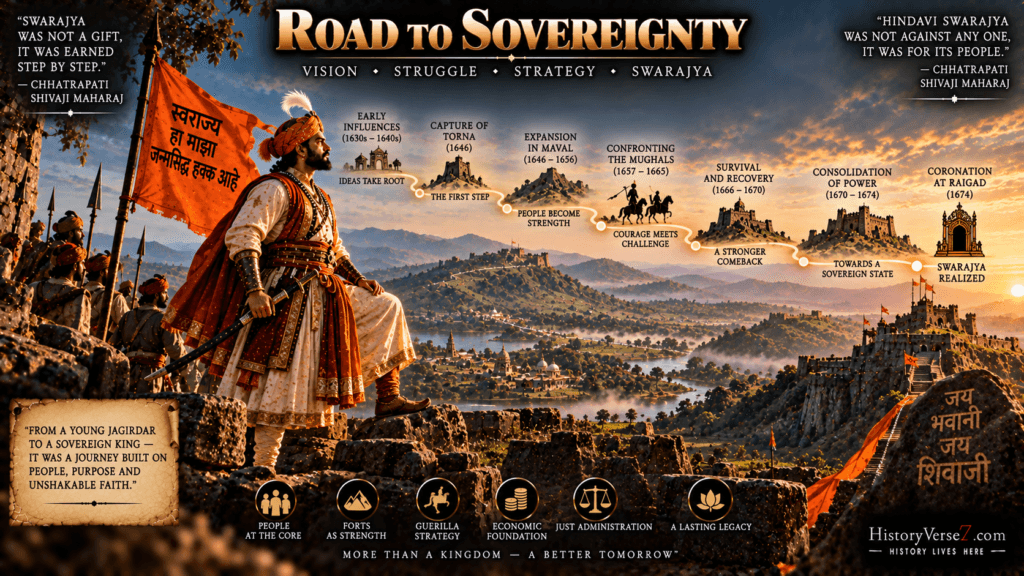
| 1645 to 1646 | Capture of Torna Fort | Shivaji’s first independently held stronghold; traditional starting point of Swarajya. |
| Late 1640s | Securing of Kondana (later Sinhagad) and continued Maval alliance-building | Expands Swarajya’s early fort network and local political base. |
| 1648 | Imprisonment of Shahaji Raje by Bijapur | Direct consequence of concern over Shivaji’s growing independence; a serious family and political crisis. |
| Early 1650s | Purandar comes under Shivaji’s control | Adds a major stronghold through exploitation of an internal succession dispute. |
| 1659 | Afzal Khan’s campaign and the meeting at Pratapgad | Major Bijapuri military effort against Shivaji ends in Afzal Khan’s death and a decisive Maratha victory. |
| Early 1660s | Expansion into the Konkan | Extends Swarajya to the coast, adding economic resources and the beginnings of naval capacity. |
| April 1663 | Raid on Shaista Khan at Lal Mahal, Pune | Daring strike against Mughal governor; leads to his injury, his son’s death, and his transfer from the Deccan. |
| January 1664 | Raid on Surat | Major strike on a key Mughal commercial city; corroborated by English and Dutch merchant accounts. |
| 1665 | Mirza Raja Jai Singh’s campaign and the Treaty of Purandar | Sustained Mughal military pressure forces Shivaji to cede twenty-three forts and accept Mughal suzerainty over ceded territory. |
| 1666 | Journey to Agra, court insult, and confinement | Shivaji travels north under treaty obligations; a court protocol dispute leads to his confinement by Mughal authorities. |
| 1666 | Escape from Agra and return to the Deccan | Shivaji evades Mughal custody and pursuit, successfully returning south. |
| Late 1660s into early 1670s | Rebuilding and expansion of Swarajya | Recovery of ceded forts, renewed campaigning, and strengthening of administrative institutions. |
| Early 1670s | Swarajya as an unresolved sovereignty | Despite substantial territorial and institutional strength, Shivaji still lacks formal recognition as a sovereign king, setting up the events of Chapter Two. |
Birth and Family: Shivneri, Shahaji, and Jijabai
Shivaji Maharaj was born at Shivneri Fort, near the town of Junnar in what is now Pune district, Maharashtra. The most widely accepted date for his birth is 19 February 1630, corresponding to Falgun Vadya Tritiya in the Shalivahana Shaka calendar, though readers should know that the exact date has been a subject of historical debate for well over a century, with some scholars and Marathi sources proposing alternative dates. The Maharashtra government officially recognises 19 February, and this is the date on which Shivaji Jayanti is now widely celebrated, but responsible historical writing should note that this was settled through later scholarly and political consensus rather than being free of all dispute.
His father was Shahaji Raje Bhosale, and his mother was Jijabai, herself born into the Jadhavrao family of Sindkhed, another prominent Deccan military lineage that served Ahmadnagar. The marriage of Shahaji and Jijabai was itself a product of Deccan politics: both families served the same sultanate, moved in the same military and courtly circles, and such alliances between leading Maratha houses were a normal way of consolidating status and influence.

Shivneri was chosen partly for safety. At the time of Shivaji’s birth, the region around Junnar was unstable, caught between the declining fortunes of Ahmadnagar and growing Mughal pressure, and Jijabai is understood to have taken refuge at the hill fort during this period of upheaval. Readers should be cautious of popular narratives that turn this into an elaborately dramatic escape story; the core, well-supported fact is simply that Shivneri offered a fortified and relatively secure place for the birth to take place during unsettled times.
The Bhosale family traced its lineage back through several generations of Deccan service, and later court chronicles and genealogical traditions, particularly those compiled after Shivaji’s coronation, connected the family to the Sisodia Rajputs of Mewar. This claim served an important political purpose in the 1670s, when establishing a suitably elevated Kshatriya lineage helped justify Shivaji’s claim to kingship. Modern historians treat this Rajput descent as a later genealogical construction rather than a documented historical fact from the period of Shivaji’s birth, and it is best understood as part of the story of his later assertion of sovereignty, not as settled biographical history of his ancestry.
Shahaji Raje Bhosale: A Political Figure in His Own Right
It would be a mistake to introduce Shahaji Raje simply as “the father of Shivaji Maharaj,” because Shahaji was, in his own lifetime, one of the more significant military figures of the Deccan. He served first under the Nizam Shahi rulers of Ahmadnagar, where he became a prominent commander during the sultanate’s final, desperate years of resistance against Mughal expansion in the 1620s and 1630s.
When Ahmadnagar finally collapsed under sustained Mughal pressure in the 1630s, Shahaji did something notable: rather than simply submit, he attempted, for a period, to prop up a shadow Nizam Shahi state around a young claimant to the throne, continuing to resist Mughal absorption of the territory from fortress bases in the region. This resistance eventually proved unsustainable against the resources of the Mughal Empire under Shah Jahan, and Shahaji ultimately transferred his service to the Adil Shahi sultanate of Bijapur, the other major regional power, where he was given significant jagirs and rose to high military rank.

Bijapur eventually granted Shahaji extensive holdings, including jagirs around Pune in the north and, significantly, territories far to the south around Bangalore, where Bijapur was expanding its own power against the declining Vijayanagara successor states and other southern polities. Shahaji spent much of Shivaji’s childhood and youth occupied with this southern campaigning, commanding Bijapuri forces hundreds of kilometres from Pune.
This geographic separation is important for understanding Shivaji’s upbringing. Shahaji was often physically distant, engaged in Bijapur’s southern ambitions, while the Pune jagir, and the raising of the young Shivaji Maharaj, fell substantially to Jijabai and to trusted administrators Shahaji had appointed to manage the estate in his absence. Shahaji’s relationship with Jijabai during these years was complicated by his later second marriage, a common practice among Deccan nobility of the period securing political alliances, but the two remained connected through Shivaji, and Shahaji continued to take an active interest in his son’s fortunes even while occupied elsewhere.
Jijabai and a Childhood in Pune
The Pune jagir that Jijabai administered on Shahaji’s behalf, and where Shivaji Maharaj spent much of his boyhood, was not in good condition when the family’s stewardship began. Years of warfare between Ahmadnagar, Bijapur, and the Mughals had left the region depopulated in places, with agriculture disrupted and administration in disarray. Rebuilding it required real governance: resettling cultivators, restoring irrigation, encouraging trade, and re-establishing order, work that was carried out under Jijabai’s supervision together with Shahaji’s appointed officials.
Dadoji Konddev is the figure most commonly named in later tradition as the administrator who managed the Pune jagir and oversaw Shivaji’s early training during these years. Here, however, historians urge caution. Dadoji Konddev clearly existed and clearly held an administrative role of real importance in Pune. But the popular image of him as Shivaji’s primary childhood tutor, personally shaping the boy’s character and skills in a close mentor-student relationship, rests heavily on later Marathi bakhars, semi-historical narrative chronicles composed well after the events they describe, which are valuable as tradition but must be used carefully as evidence. Some modern historians have questioned how central Dadoji Konddev’s personal role in Shivaji’s upbringing actually was, as opposed to his documented administrative function. Readers should treat the extent and nature of this relationship as an area of continuing historical discussion rather than settled fact.

What can be said with more confidence is the environment in which Shivaji Maharaj grew up. Jijabai was, by all credible accounts, deeply devout, and religious practice, including devotion connected to local deities and traditions of the region, shaped the household. The court and administration around young Shivaji Maharaj included Brahmin officials handling revenue and correspondence, Maratha military retainers, and a working relationship with the diverse communities, both Hindu and Muslim, who populated the Pune region and the wider Bijapur administrative structure. This was not an isolated or purely martial upbringing; it exposed Shivaji from childhood to the practical business of governance, negotiation, and the management of a mixed and often difficult population.
What responsible historical writing must resist is inventing scenes: imagined conversations between Jijabai and her son, dramatic oaths sworn in childhood, or precise anecdotes presented as verified fact when they in truth come from later devotional or nationalist retellings written generations afterward. These stories are part of Maharashtra’s rich cultural memory of Shivaji Maharaj, and they matter as tradition, but a serious biography needs to mark clearly where documented history ends and cherished legend begins.
Pune, Maval, and the Political Geography of the Uplands
To understand how Shivaji Maharaj built his early power base, it helps to understand the Maval region specifically, the belt of valleys and hill country lying along the eastern face of the Sahyadri range, west and southwest of Pune. This was not open plains country; it was a landscape of narrow river valleys, terraced cultivation, and steep approaches to fortified hilltops, inhabited by agricultural communities whose local leadership rested with hereditary deshmukh and patil families, much like the Bhosales themselves at a smaller scale.
It is tempting, and historically lazy, to describe the Maval simply as “a land of fearless warriors,” a phrase that shows up often in popular retellings. The reality is more interesting. The Maval communities were primarily agricultural and pastoral populations who, like most rural communities in a militarised political landscape, also had traditions of local self-defence and were accustomed to providing infantry and irregular troops to whichever regional power could offer them security, employment, and a fair hearing in disputes. Their loyalty was not automatic. It had to be earned through practical relationships: fair treatment, protection from predatory taxation, and genuine local alliances rather than commands issued from a distant court.
This is precisely the kind of relationship Shivaji Maharaj began building as a young man. Rather than simply inheriting authority, he cultivated personal ties with Maval deshmukhs and local leaders, offering them a stake in a project of regional consolidation under his own leadership, distinct from, and increasingly independent of, direct Bijapuri administration. This was less a single dramatic decision and more a sustained process of political relationship-building carried out over several years during his adolescence and early adulthood, using the administrative base that Jijabai and Shahaji’s officials had already established in the Pune jagir.
From Young Nobleman to Independent Political Actor
By the mid-1640s, while still a teenager, Shivaji Maharaj began acting with a degree of independent authority that went beyond what would normally be expected of a jagirdar’s son managing an inherited estate on his father’s behalf. He started to draw Maval leaders and local Deshmukh families into direct alliance with himself personally, began asserting control over revenue collection in the surrounding hill country, and moved to secure key forts, not through formal grants from Bijapur, but through a combination of negotiation, purchase, and, where necessary, force or the threat of it.
This transition should be understood as a process rather than a single event. Historical sources allow us to trace Shivaji’s growing independent authority through a sequence of specific, documentable actions involving particular forts and particular local alliances, rather than through any single declaration of intent. It is this sequence that historians point to as the true beginning of what would become Swarajya.
Torna and the First Forts
Torna Fort, southwest of Pune in the Sahyadri hills, is generally identified as the first fort Shivaji Maharaj brought under his own control, traditionally dated to around 1645 to 1646, when Shivaji was in his mid-teens. The fort belonged nominally to Bijapur’s administration but was, like many hill forts in this contested zone, loosely garrisoned and vulnerable to a determined local claimant with the right regional support. Shivaji is understood to have secured it primarily through the cooperation of local Maval leaders and a relatively limited use of force, rather than through a set-piece battle of the kind popular imagination sometimes supplies.
Securing Torna mattered because it gave Shivaji his first independently controlled fortress, a base from which to project authority over the surrounding hill country and negotiate from a position of greater strength. According to tradition, treasure discovered at Torna helped fund the construction or reinforcement of a nearby fort, later developed and known as Rajgad, which would go on to become one of Shivaji’s principal strongholds and, for a long period, effectively his capital. This treasure story appears across multiple traditional accounts but should be treated as probable rather than rigorously documented in contemporary records; what is better established is that Rajgad’s rapid development into a major stronghold followed closely on Shivaji’s acquisition of Torna.

Kondana, later renamed Sinhagad after events later in Shivaji’s career, was another fort brought under his control during this same early period, again through a combination of local alliance-building and limited military pressure rather than prolonged siege warfare. Purandar, an important and strongly built fort southeast of Pune, came under Shivaji’s influence somewhat later, in the early 1650s, through more complicated circumstances involving a dispute within the family that held it, which Shivaji was able to exploit to bring the fort and its garrison over to his side.
Each of these early acquisitions followed a broadly similar pattern: they exploited local political openings, relied on relationships with Maval leaders and regional families rather than large conventional armies, and reflected weaknesses or distractions in Bijapur’s own attention, which throughout this period was increasingly consumed by its southern campaigns and its always uneasy relationship with the Mughal Empire to the north. Readers should be wary of accounts that dramatise every one of these fort acquisitions as a major pitched battle. The documented record more often shows a young leader exploiting political weaknesses and local relationships with considerable skill, not winning a rapid string of conventional military victories.
The Emergence of Swarajya
Swarajya, literally “self-rule” or “one’s own rule,” is the term that became attached, retrospectively and during Shivaji’s own lifetime, to the political project he was building. It is important not to project later, especially twentieth-century nationalist, meanings onto this seventeenth-century term. In its original context, Swarajya referred to Shivaji Maharaj establishing independent, self-governing authority over a defined territory, free from the direct control of Bijapur, the Mughals, or any other outside power, rather than to a modern concept of national self-determination in the sense that later Indian nationalist movements would use the word.
What made Swarajya distinct from simply being an unusually successful or unruly jagirdar was the combination of territorial control, fort-based defence, an emerging structure of local administration, and, crucially, growing political and military capacity to defend these gains against powerful neighbours. By the early 1650s, Shivaji controlled a connected cluster of forts and the agricultural territory around them, collected revenue through his own officials rather than through Bijapur’s administrative channels, and maintained armed forces answerable to himself.
This did not mean Shivaji Maharaj had formally broken with Bijapur, at least not yet, or that he had declared any kind of sovereign kingdom in these early years. His position remained, for some time, ambiguous: he was simultaneously the son of a prominent Bijapuri jagirdar, technically still connected to Bijapuri administrative structures in some respects, and increasingly the independent ruler of a compact and growing territory that Bijapur had not authorised him to control. This ambiguity would not last indefinitely, and it is precisely this tension that would draw Bijapur’s attention, and eventually its hostility, toward the young Maratha leader.
Building the Early Swarajya State
What distinguished Swarajya from a mere collection of captured hilltops was the beginning of real administrative structure. Shivaji Maharaj appointed his own officials to manage fort garrisons, oversee revenue collection from the agricultural land under his control, and maintain records, a state apparatus that, while modest in these early years compared to what it would become after 1674, was already functioning as more than an improvised military occupation.
Revenue administration drew on existing Deccan practices, adapted local land-revenue assessment systems that jagirdars and sultanate administrations had long used, but applied them under Shivaji’s own authority rather than passing the proceeds up to a distant sultan’s treasury. Local officials, often drawn from the same Brahmin administrative families that had long served Deccan courts, and Maratha military commanders trusted by Shivaji, managed this system on his behalf.
Communication between the growing network of forts, and the ability to move troops and information quickly across difficult hill terrain, was itself becoming a form of infrastructure. This capacity for rapid coordination across a fort network would later prove central to Shivaji’s military method, discussed further below, but its foundations were being laid in this early consolidation period, as Swarajya grew from a handful of forts into a genuinely administered territory with its own emerging institutions.
Shivaji Maharaj and Bijapur: A Relationship Under Strain
It would be a serious oversimplification to describe the conflict that eventually developed between Shivaji Maharaj and Bijapur as “Shivaji Maharaj versus the entire Bijapur Empire,” as though two fully formed states collided from the outset. The reality was more gradual and more political. Through the late 1640s and into the 1650s, Bijapur’s court watched Shivaji’s growing independent authority in the Pune region with rising concern, but the sultanate’s attention and resources were substantially occupied elsewhere, particularly in its ongoing southern campaigns, in which Shahaji himself was a leading commander, and in managing its own uneasy relationship with Mughal power to the north.
This distraction bought Shivaji Maharaj valuable time. Bijapur’s court was aware of what was happening in the Pune jagir, and diplomatic and administrative pressure was applied at various points, but a full military response against Shivaji Maharaj specifically was, for years, neither the sultanate’s top priority nor an easy undertaking given the difficult terrain and Shivaji’s local support. Only as Shivaji’s territorial gains and defiance of Bijapuri authority became harder to ignore did the relationship shift from uneasy tolerance toward active confrontation.
Shahaji’s Difficult Position
Shivaji’s growing independence placed his father in a genuinely difficult position. Shahaji Raje remained a senior and valuable commander in Bijapuri service, deployed on campaigns far to the south, and Bijapur’s court had every reason to view his son’s activities in the north as at minimum an embarrassment, and potentially as evidence of a wider Bhosale family ambition that needed to be checked.
This tension came to a head in 1648, when Bijapur, evidently viewing Shahaji Raje as answerable for his son’s conduct, had Shahaji Raje arrested and imprisoned. The precise political calculations behind this episode are debated by historians, and later Marathi tradition frames it in various ways, but the documented core is that Shahaji’s imprisonment was connected to pressure over Shivaji’s growing independent power in the north, and it represented a serious crisis for the family. Shahaji was released after a period of imprisonment, following negotiation and the intervention of Bijapuri figures with their own reasons to see the matter resolved, including reported involvement from Mughal quarters interested in destabilising Bijapur’s internal politics, though the precise diplomatic mechanics of his release remain a matter of some historical discussion rather than uniform certainty.
This episode is a useful corrective to any narrative that treats Shivaji’s rise as an uncomplicated triumph. His actions had real and dangerous consequences for his father, and the family’s position throughout this period involved calculated risk rather than confident, guaranteed success.
Afzal Khan’s Campaign
By the late 1650s, Shivaji’s continued expansion, and a series of further territorial gains at Bijapur’s expense, had made him impossible for the Adil Shahi court to tolerate any longer. Bijapur decided on a decisive military response and dispatched a senior and experienced commander, Afzal Khan, with a substantial force, to bring Shivaji Maharaj to heel, whether through submission, capture, or, if it came to it, his death.
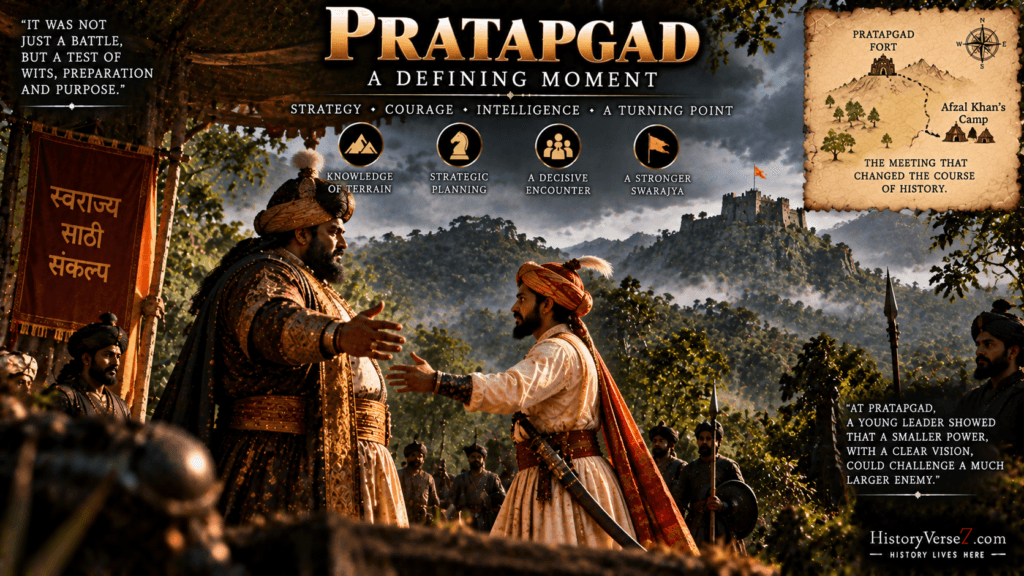
Afzal Khan’s campaign moved into the hill country toward Shivaji’s stronghold territory in 1659. This was a serious undertaking by an experienced general commanding meaningful Bijapuri military resources, not a minor punitive expedition, and it represented the most significant external threat Swarajya had faced to that point. Shivaji Maharaj, whose forces were considerably smaller and less equipped for open-field confrontation with a large conventional Bijapuri army, withdrew to Pratapgad, a fort he had constructed in the Sahyadri hills specifically suited to defensive terrain, and prepared to meet the threat on ground of his own choosing rather than in open battle.
The Meeting at Pratapgad
What followed is one of the most famous episodes in Maratha history, and also one where the gap between popular retelling and verifiable historical detail is widest. Negotiations were arranged between Shivaji Raje and Afzal Khan, apparently intended by both sides as a meeting to resolve the confrontation short of full battle, to take place at the foot of Pratapgad, with each leader agreeing, according to convention, to come lightly armed and accompanied by only a small personal escort.
The meeting ended with Afzal Khan’s death at Shivaji’s hands, followed immediately by an attack on Afzal Khan’s surrounding forces, who were unprepared for the sudden collapse of the negotiation, resulting in a serious defeat for the Bijapuri army at Pratapgad in November 1659.
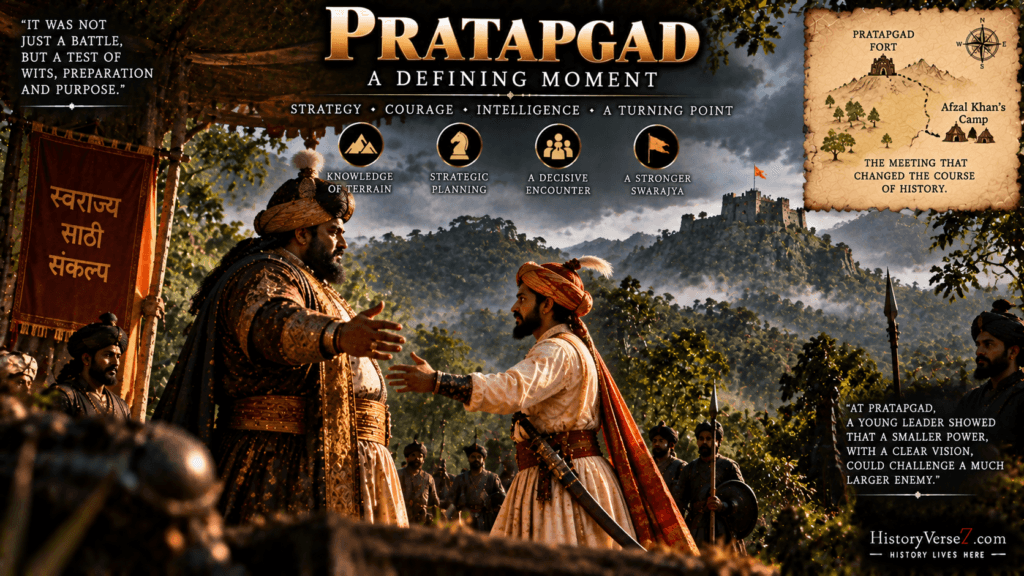
Contemporary and near-contemporary Persian and Marathi sources broadly agree that Afzal Khan died during this meeting and that his forces were then routed, but they differ considerably on the exact sequence of events at the meeting itself, on who struck first, and on the precise circumstances that led to violence breaking out. Later Marathi bakhars developed increasingly elaborate and dramatic versions of the encounter over subsequent generations, including specific and vivid details of concealed weapons, exact words exchanged, and precise physical description of the fight, that go well beyond what the earlier and more contemporary sources can support. A responsible historical account should state plainly what can be established with reasonable confidence, namely that Afzal Khan died at this meeting and his army was subsequently defeated, while treating the most cinematic details of exactly how the killing unfolded as later tradition rather than settled documented fact, since no surviving eyewitness account from either side gives us that level of verified detail.
Aftermath of Pratapgad
The political and military consequences of Pratapgad were substantial, but they should not be overstated into a claim that Bijapur was instantly broken as a power. What changed was Shivaji’s standing and reach. The defeat of a senior Bijapuri commander and his army dramatically raised Shivaji’s military reputation and confidence, both within Swarajya and among neighbouring powers who had previously viewed him as a troublesome but manageable regional irritant.
In the months following Pratapgad, Shivaji Maharaj forces moved to capture further Bijapuri territory and forts in the surrounding region, consolidating and expanding Swarajya’s boundaries considerably. Bijapur, having lost a major army and a senior commander, was forced into a more defensive posture and had to reconsider how to deal with Shivaji Raje going forward, though the sultanate remained a functioning state with substantial resources and would continue to contest Maratha expansion in various forms for years afterward.
Konkan and Regional Expansion
Shivaji Raje ambitions were never confined to the Sahyadri uplands alone. The Konkan, the narrow, humid coastal strip running between the Sahyadri range and the Arabian Sea, held real strategic value: access to the sea, control over coastal trade routes, and a set of forts and harbours that, if secured, would give Swarajya both economic resources and a maritime dimension that a purely inland power would lack.

Through the early 1660s, Shivaji Maharaj extended his control into parts of the Konkan, bringing coastal forts and territory under Swarajya’s administration and beginning to develop the naval capacity that would become far more significant in the following decade. This Konkan expansion also inevitably brought Swarajya into closer contact, and eventually friction, with other regional powers who had their own coastal interests, including the Siddis of Janjira and European trading powers operating along the coast, though the full development of Maratha naval power belongs more properly to the period covered in Chapter Two.
The Mughals Enter the Story
While Shivaji Maharaj was consolidating his position against Bijapur, the far larger and more powerful Mughal Empire, under Emperor Aurangzeb, was pursuing its own long-term project of Deccan expansion, a policy that had already absorbed Ahmadnagar decades earlier and that increasingly pressed against Bijapur and Golconda as well. Shivaji Maharaj’s rise did not occur in a vacuum separate from this Mughal ambition; sooner or later, Swarajya’s growing power was bound to attract Mughal attention, either as a potential threat to be crushed or, in more pragmatic moments, as a possible instrument to be used against Bijapur.

The first major direct confrontation between Shivaji Maharaj and Mughal authority in the region came through the governorship of Shaista Khan, a senior Mughal noble and Aurangzeb’s maternal uncle, who was appointed to the Deccan with instructions to curb Shivaji’s growing power and secure the region more firmly for Mughal administration.
Shaista Khan and the Raid on Pune
Shaista Khan established his headquarters at Pune itself, occupying the Lal Mahal, the residence that had earlier served as Jijabai and Shivaji Maharaj’s own family home in the city, an occupation that carried real symbolic as well as strategic weight. From this base, Shaista Khan’s forces pressed against Swarajya’s territory with the resources of the Mughal state behind them, representing a far more formidable threat than Bijapur alone had posed.

In April 1663, Shivaji Maharaj led a daring night raid directly into the occupied Lal Mahal in Pune, penetrating Mughal security to reach Shaista Khan’s own quarters. In the resulting confrontation, Shaista Khan was wounded, losing fingers as he attempted to escape through a window, and one of his sons was killed in the fighting, while Shivaji Maharaj and his men withdrew successfully despite the enormous risk involved in the operation. Persian chronicle sources confirm the essential facts of this raid, including Shaista Khan’s injury, even as they naturally frame the episode from a Mughal perspective as a humiliating security failure. The raid’s political consequences were considerable: Aurangzeb, embarrassed by the episode, had Shaista Khan transferred away from the Deccan, and the raid dramatically reinforced Shivaji’s reputation for daring and unconventional warfare, both a propaganda victory and a genuine military success carried out under extraordinary risk.
The Surat Raid
Surat, on the Gujarat coast under direct Mughal administration, was one of the wealthiest commercial port cities in the entire Mughal Empire, a major hub for trade connecting India with the Middle East and, increasingly, with European trading companies including the English and Dutch East India Companies who maintained factories there. Its wealth and its symbolic status as a jewel of Mughal commercial power made it an obvious target for a leader seeking both plunder and a demonstration of Mughal vulnerability.

In January 1664, Shivaji Maharaj forces raided Surat directly, extracting substantial wealth from the city’s merchants and administrative establishment over several days before withdrawing. Contemporary accounts, including records left by English and Dutch merchants present in the city at the time, provide reasonably detailed and broadly corroborating testimony of the raid, describing the panic among the city’s population and administration and the considerable value of goods and treasure carried away.
The raid’s significance extended well beyond the immediate financial gain to Swarajya’s treasury, substantial as that was. It struck directly at Mughal prestige, demonstrating that Aurangzeb’s empire could not guarantee the security of even its most important commercial centres against Maratha raiding, and it provoked a serious and determined Mughal response that would follow within the year.
Mughal Pressure and the Treaty of Purandar
Stung by the Surat raid and the broader pattern of Maratha defiance, Aurangzeb dispatched Mirza Raja Jai Singh, one of the Mughal Empire’s most capable and trusted generals, to the Deccan in 1665 with a large, well-resourced army and clear instructions to subdue Shivaji Maharaj decisively. Jai Singh’s campaign was methodical rather than reckless: he moved to besiege and threaten key Swarajya forts, most significantly Purandar itself, applying sustained military and political pressure that Shivaji Maharaj forces, however skilled at raiding and mobile warfare, were not positioned to resist indefinitely against a Mughal army of this scale.
Facing this pressure, and recognising the limits of what Swarajya’s military resources could withstand against the full weight of Mughal power, Shivaji Maharaj negotiated with Jai Singh, resulting in the Treaty of Purandar, signed in June 1665. Under its terms, Shivaji Maharaj ceded a substantial number of forts, twenty-three by most accounts, to Mughal control, retaining only a smaller core of strongholds, and agreed to Mughal suzerainty over the ceded territory along with an obligation to provide military assistance to Mughal campaigns.

The treaty should not be read simply as either an outright defeat or a clever victory, and readers should be wary of accounts that flatten it into either extreme. It was a pragmatic and genuinely costly settlement, reflecting the real limits of Swarajya’s military power against the Mughal Empire at that particular moment, but it also preserved the core of Shivaji’s territory and authority rather than ending it, and it opened, for better or worse, a period of formal Mughal-Maratha cooperation that would shape the events leading directly to the Agra crisis discussed next.
Shivaji Maharaj at Agra
One of the terms and expectations flowing from the Treaty of Purandar, and from the broader diplomatic relationship it established, was that Shivaji Maharaj would travel north to the Mughal court to formally meet Emperor Aurangzeb, a step intended to confirm his position as a Mughal-aligned tributary commander and, from the Mughal perspective, to bring him more securely under imperial authority and courtly hierarchy. Shivaji Maharaj undertook this journey to Agra in 1666, accompanied by his young son Sambhaji and a modest retinue.

The visit did not go as either side may have originally hoped. At the formal court reception, Shivaji was placed in a position within the court hierarchy, standing among a rank of nobles, that he considered a serious insult given his own status and the terms he understood to have been agreed. Accounts describe Shivaji Maharaj reacting with open indignation at this treatment, a breach of court protocol serious enough that he was placed under effective confinement, initially at his residence in Agra and then under closer guard, as Mughal authorities debated how to handle the increasingly awkward situation of a nominal ally who had publicly embarrassed the imperial court.
This confinement lasted for a period of weeks. Persian court chronicles, most notably later Mughal historical works, and Marathi tradition both confirm the essential shape of events, the court insult, the confinement, and the eventual escape, though, as with Pratapgad, they diverge considerably on precise details, on exactly how serious Aurangzeb’s intentions toward Shivaji’s life were at this stage, and on the finer points of what happened during the confinement itself. What can be said with confidence is that this was a genuine crisis, not a minor diplomatic hiccup, and that Shivaji Maharaj;s position at Agra, deep inside Mughal territory hundreds of miles from Swarajya, was for a time seriously precarious.
The Agra Escape: Evidence Versus Legend
The escape from Agra deserves its own careful treatment, because this is precisely the kind of episode where popular tradition has produced a single, widely repeated version that has come to be treated in general retellings as straightforward historical fact, when the underlying source picture is considerably more layered.
The most familiar popular account describes Shivaji Maharaj arranging for large baskets or boxes, ostensibly containing sweets or offerings being distributed as part of a show of piety and generosity during his confinement, to be carried in and out of his residence regularly, until guards grew accustomed to the traffic and stopped inspecting them closely, at which point Shivaji concealed himself in one such basket and was carried out undetected, while his son Sambhaji Raje was smuggled out separately, and the two made their way back to the Deccan disguised and travelling by a difficult, indirect route to avoid Mughal pursuit.

The core outline, escape from confinement at Agra achieved through deception involving disguise and concealment, followed by a difficult journey home, is corroborated across multiple sources, including some near-contemporary accounts, and can be treated as probable to strongly probable. However, the specific and vivid detail of the sweet-baskets, so central to the popular version, appears prominently in later bakhar traditions and in retellings compiled well after the event, and the degree to which it reflects a precisely accurate account of the mechanics of the escape versus a dramatized and simplified version of a more complicated and improvised escape is genuinely disputed among historians. Some scholars treat it as broadly plausible and consistent with what we know of Mughal court customs of gift-giving; others regard it as an appealing simplification of a messier reality. What is well established beyond reasonable doubt is that Shivaji Maharaj did escape Mughal confinement at Agra through subterfuge rather than force, evaded a determined Mughal pursuit across hundreds of miles of hostile or uncertain territory, and successfully returned to the Deccan, an achievement that significantly enhanced his reputation regardless of the precise mechanics involved.
Rebuilding Swarajya
Shivaji Maharaj return to the Deccan after the Agra crisis was followed by a sustained period of political and military recovery. The forts and territory ceded under the Treaty of Purandar were, over the following years, substantially recovered through renewed campaigning, as the formal Mughal-Maratha alliance that had followed the treaty broke down amid mutual distrust deepened by the Agra episode itself.

This period also saw renewed friction and negotiation with Bijapur, whose own position in the wider Deccan struggle between Mughal expansion and regional resistance was increasingly precarious, creating both opportunities and complications for Shivaji Maharaj as he worked to rebuild and then extend Swarajya’s territory and institutions. Alongside renewed military campaigning, this period saw real strengthening of Swarajya’s internal administrative and military institutions, groundwork that would prove essential to supporting the far more formal and elaborate structure of governance Shivaji Maharaj would establish after his coronation.
By the early 1670s, Swarajya was, in territorial and institutional terms, considerably stronger and more securely established than it had been at the time of the Treaty of Purandar, a recovery achieved through the same combination of political skill, calculated risk, and military adaptability that had characterised Shivaji’s rise from his earliest fort acquisitions in the 1640s.
Shivaji Maharaj Emerging Military Method
Even in this earlier period, well before the more elaborate military system of his later reign, the essential features of Shivaji Maharaj’s approach to warfare were already visible, and it is worth pausing to introduce them here in outline, since they explain so much of how a comparatively small regional power was able to repeatedly outmanoeuvre larger rivals.
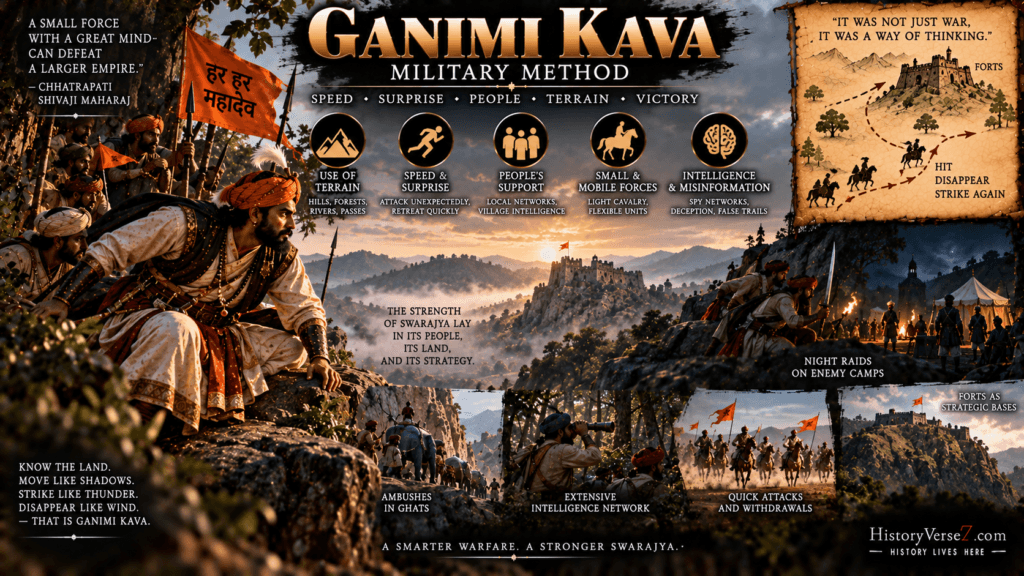
Central to this method was the fort network itself: a connected system of hill strongholds that provided secure bases, storage for supplies and treasure, defensible positions from which to withdraw when facing superior conventional forces, as seen clearly at Pratapgad, and points of control over the surrounding countryside and its revenue. Alongside this, mobility and terrain knowledge were essential; Maratha forces, particularly light cavalry, were used to strike quickly, disrupt an opponent’s supply and communication, and withdraw before a larger, less mobile force could bring its full weight to bear, an approach well suited to the broken hill terrain of the Sahyadris, where large conventional armies with heavy equipment struggled to manoeuvre effectively.
This style of warfare is often referred to using the Marathi term Ganimi Kava, sometimes translated loosely into English as guerrilla tactics. It is worth being precise about what this term does and does not mean. It should not be understood as a single secret technique or trick, but rather as a broader and more integrated approach to warfare: combining terrain knowledge, intelligence gathering, disciplined mobility, careful timing, and a realistic assessment of when to fight and when to withdraw, all built around the fort network as a secure foundation. This was less a matter of exotic tactics and more a coherent strategic philosophy, one well adapted to Swarajya’s actual resources and its very real disadvantages against larger and better-equipped Bijapuri and Mughal armies.
The Fort Network as the Backbone of Swarajya
By the period this chapter covers, Swarajya’s fort network extended well beyond the initial acquisitions of Torna, Rajgad, and Kondana. Purandar, secured in the early 1650s, and Pratapgad, purpose-built in the Sahyadri hills and forever associated with the confrontation with Afzal Khan, were joined over time by other significant strongholds, including Panhala in the southern reaches of Swarajya’s expanding territory and, later in this period, Raigad, which would go on to serve as Shivaji Maharaj’s formal capital and coronation site, developments belonging more fully to the story told in Chapter Two.
Each fort in this network served overlapping functions. Defensively, forts provided secure, easily defended positions in difficult terrain that a besieging army could only reduce with great difficulty, time, and resources, exactly the kind of sustained effort that neither Bijapur nor, for long stretches, even the Mughals could always afford to commit. Administratively, forts served as centres for local revenue collection and governance, extending Swarajya’s institutional reach into the surrounding countryside. As storage sites, forts held grain, treasure, and military supplies, giving Swarajya a resilience that a purely field-based military force would have lacked. And as a communication system, the network of forts, positioned with real attention to sightlines and terrain across the Sahyadri hills, allowed information and, where needed, reinforcements to move with a speed and security that gave Swarajya a real strategic advantage over less coordinated rivals.
This was, in short, a genuinely thought-through military and administrative system, not an accidental accumulation of captured hilltops, and it deserves to be understood on those terms rather than reduced to a simple list of picturesque fort names for tourists to visit.
Early Administration Before the Coronation
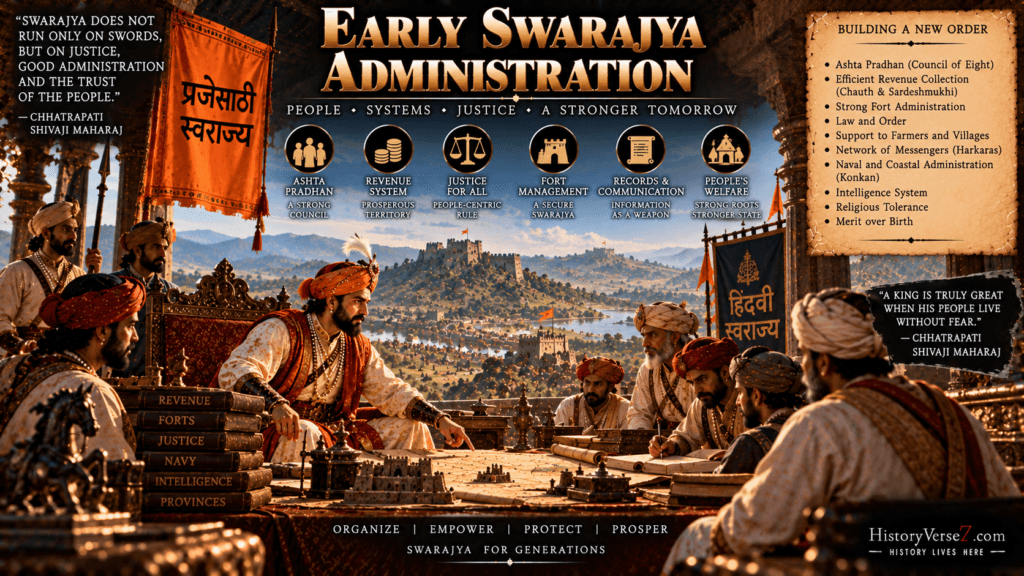
Even before the far more elaborate administrative structure Shivaji Maharaj would establish after 1674, discussed in full in Chapter Two, the early Swarajya state had already developed real institutional substance. Revenue was assessed and collected through officials answerable to Shivaji Maharaj rather than to Bijapur or the Mughals, drawing on established Deccan land-revenue practices adapted to the new political reality. Fort administration involved dedicated officers responsible for garrisons, supplies, and local governance within each stronghold’s surrounding territory. Military command structures, distinct from the informal Maval alliances of the earliest years, were becoming more defined, with named commanders holding recognised positions of authority over troops and campaigns. And a basic system of justice and local dispute resolution operated within Swarajya’s territory, continuing and adapting practices long familiar to the region’s deshmukh and patil administrative traditions rather than imposing something entirely alien on the population.
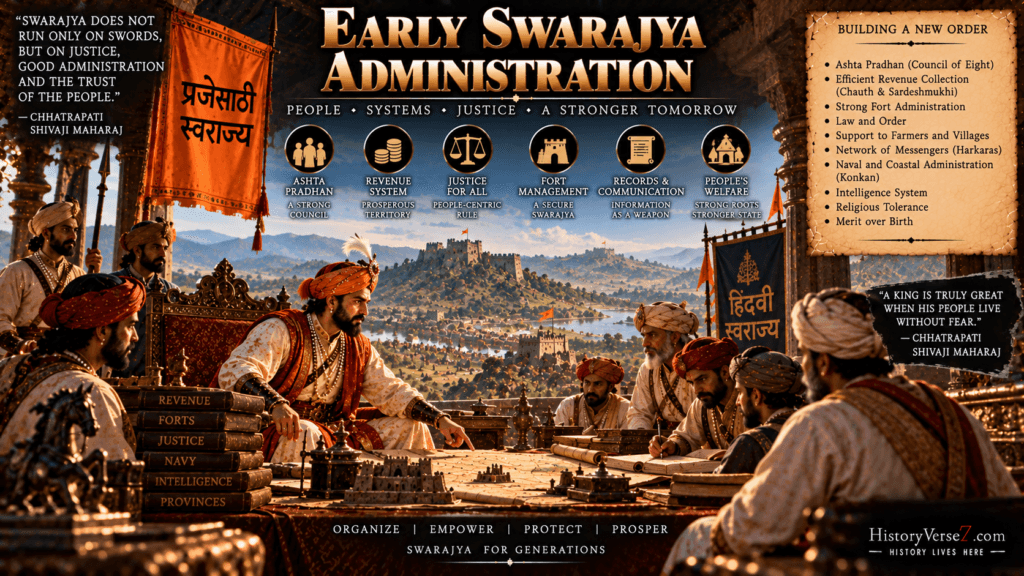
This should be understood as the foundation on which the more famous Ashtapradhan council of ministers and the more elaborate revenue and judicial systems of Shivaji Maharaj’s later reign as a crowned king would be built, rather than as a fully developed state administration in its own right during this earlier period.
Shivaji Maharaj and Ordinary People
The story of Swarajya’s rise is often told almost entirely through the actions of kings, generals, and courts, but it is worth pausing to consider, where the evidence allows, how this period of sustained warfare and state formation affected the ordinary population of the region: farmers, villagers, merchants, soldiers, and artisans whose labour and resources ultimately sustained every fort, every army, and every treasury involved.
Contemporary sources, including administrative records and later Maratha tradition, suggest that Shivaji Maharaj placed real emphasis on discipline among his troops with regard to the civilian population, including instructions against looting and mistreatment of local farmers and villagers during campaigns, a policy that, if consistently enforced, would have marked a meaningful contrast with the more predatory behaviour civilian populations often suffered at the hands of armies passing through Deccan territory during this era of near-constant warfare. This should be stated as a documented aspect of Shivaji Maharaj’s administrative approach and reputation rather than idealised into an implausible claim that warfare under Swarajya was somehow free of hardship for ordinary people; campaigning armies, however disciplined, inevitably disrupted agricultural life, and the broader decades of Deccan conflict during this period took a real toll on rural communities across the region regardless of whose forces were involved.
Merchants and artisans, meanwhile, found in the growing and increasingly secure Swarajya territory a market and, at least at points, a degree of protected trade, particularly as Shivaji’s control extended into Konkan coastal areas with genuine commercial significance. Soldiers recruited from Maval and other communities found in Swarajya’s expanding military structure a source of employment, status, and, for successful commanders, real advancement, part of what made Shivaji Maharaj;s project attractive to local populations beyond any purely coercive explanation for their cooperation.
Religion in the Early Swarajya
The religious landscape of early Swarajya reflected the broader religious diversity of the Deccan itself, and it deserves careful, non-anachronistic treatment. Shivaji Maharaj’s own household and personal devotional practice were rooted in Hindu tradition, including patronage extended to temples and religious institutions within Swarajya’s growing territory, a pattern consistent with expectations of a regional Hindu ruler of the period and one that would become more formalised after his coronation.
At the same time, Swarajya’s administration and military included Muslim officials and soldiers in meaningful numbers, a reality well documented in contemporary and near-contemporary sources and entirely consistent with the practical realities of Deccan political life, where military service and administrative employment crossed religious lines routinely under Bijapur, Ahmadnagar, and other regional powers, and where Shivaji Maharaj’s own father had spent his career in the service of a Muslim sultanate. Shivaji Maharaj’s conflicts, with Bijapur and later with the Mughals, were fundamentally political and territorial in character, contests over regional power, sovereignty, and control of resources between competing states and military commanders, rather than being reducible to a straightforward religious conflict in the way that some modern political narratives, on more than one side of contemporary debates, have sometimes chosen to present them.

This is an area where historical writing needs particular discipline, avoiding both the anachronistic imposition of modern religious-political categories onto seventeenth-century Deccan politics and any unsupported claim of some idealised, uncomplicated religious harmony that the available evidence does not clearly establish either. The honest position is one of careful attention to the actual, mixed, and pragmatic religious and political realities the sources describe.
Women in the Early Swarajya
Jijabai remains the best-documented woman connected to this period of Shivaji Maharaj’s life, and her role, first in managing the Pune jagir during Shahaji’s long absences in the south, and later as a figure of continuing influence and counsel as Swarajya developed, is well established in the historical record, even if, as noted earlier, many popular anecdotes about her specific words and actions belong more properly to later tradition than to contemporary documentation.

Beyond Jijabai, the sources for this early period offer more limited direct evidence about other women connected to Swarajya’s political and military networks, a limitation common to much premodern historical documentation generally, which tends to record the activities of male political and military figures far more thoroughly. What can be said is that, as with any society sustaining prolonged warfare across this period, women within Swarajya’s territory, whether connected to leading families or to the ordinary agricultural and artisan population, bore real consequences from the military campaigns and political instability of the era, including the disruptions that come with garrisoned forts, campaigning armies, and contested territory changing hands. Responsible historical writing should acknowledge this reality plainly rather than fill the evidentiary gap with invented anecdotes simply because they would make for a more satisfying narrative.
Important Early Commanders and Allies
Shivaji Maharaj rise was never a solitary achievement, and several documented commanders and allies deserve mention here for the roles they played within Swarajya’s growing structure during this period, without turning this chapter into a set of separate biographies that belong more properly elsewhere on HistoryVerse7.
Baji Prabhu Deshpande, a Maratha commander, is most closely associated with a later and celebrated defensive action protecting Shivaji Maharaj’s retreat during a difficult campaign period, an episode whose full detail belongs more to the broader military narrative of Swarajya’s consolidation than to this chapter’s scope, but his documented loyalty and command capacity mark him as one of the more significant figures to emerge from this period. Tanaji Malusare, another Maratha commander closely associated with Shivaji Maharaj, is remembered particularly for later fort operations, again falling slightly beyond this chapter’s chronological focus but worth noting as part of the wider circle of capable commanders Swarajya was cultivating during these years. Netaji Palkar rose to become one of Shivaji’s most prominent early cavalry commanders, playing a significant documented role in Swarajya’s military campaigns during the 1650s and 1660s, before a later and more complicated period in his career involving Mughal service that lies beyond this chapter. Moropant Pingle served as an important administrative figure within Swarajya’s developing governance structure, representative of the Brahmin administrative class whose expertise Shivaji Maharaj drew on extensively in building functional revenue and record-keeping systems. Yesaji Kank and Prataprao Gujar likewise appear in the documented record as capable Maratha military commanders contributing to Swarajya’s campaigns during this consolidation period.
These figures illustrate an important point about Swarajya’s early development: its growth depended on Shivaji Maharaj’s ability to attract, retain, and effectively employ genuine talent across military and administrative roles, drawn from Maratha military families, Brahmin administrative traditions, and the wider Deccan population, rather than resting on Shivaji Maharaj’s individual efforts alone.
The Road to Sovereignty
By the early 1670s, tracing the arc of this chapter from beginning to end, Shivaji Maharaj had travelled an extraordinary political distance. He had begun as a young nobleman managing, alongside his mother, a modest jagir on behalf of a father largely occupied with campaigns far to the south. He had become, through a sustained and carefully managed process rather than any single dramatic turning point, the ruler of a compact but genuinely administered territory built around a network of hill forts. He had survived direct military confrontation with Bijapur at Pratapgad, daring and dangerous strikes against Mughal power at Pune and Surat, the serious costs of the Treaty of Purandar, and the genuinely perilous crisis of his confinement and escape from Agra. And in the years following his return from Agra, he had rebuilt and substantially expanded Swarajya once again, recovering lost territory and strengthening the institutions of governance that would need to support whatever came next.
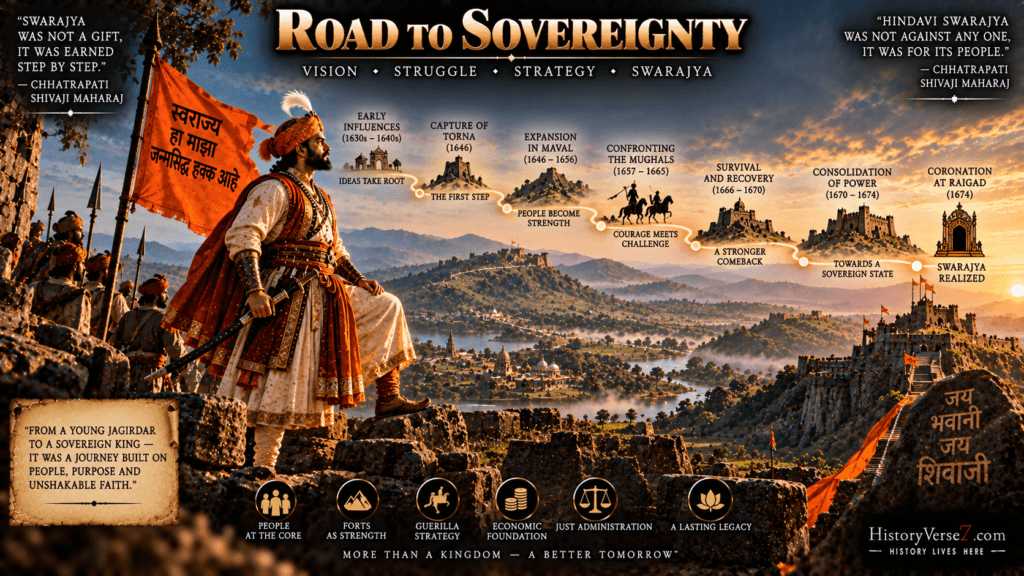
By this point, Shivaji Maharaj was no longer simply a successful regional commander or an unusually capable jagirdar’s son. He was a political power in his own right, one that Bijapur, the Mughal Empire, and other regional actors all had to reckon with directly in their own calculations, someone who negotiated treaties, commanded loyalty across a substantial and growing territory, and had built durable institutions of administration and defence. Yet for all of this real and substantial achievement, Shivaji Maharaj’s formal status remained, in the eyes of the wider political world of the seventeenth century, curiously undefined. He was not recognised as a sovereign king by any of the major powers around him; he held no formally acknowledged royal title that would place him on genuinely equal diplomatic footing with the Mughal emperor, the Bijapuri sultan, or other established rulers of the region, a status question with real practical consequences for diplomacy, legitimacy, and the long-term durability of everything Swarajya had built.
Military success and administrative competence, however impressive, were proving insufficient on their own to resolve this problem of formal status and legitimacy. That unresolved question, whether Swarajya could evolve from a powerful but ambiguously defined regional territory into a formally sovereign kingdom recognised on its own terms, was the challenge now standing before Shivaji Maharaj as the events told in this chapter drew to a close.
Chapter Two picks up exactly here, with the question that would define the next and decisive phase of Shivaji Maharaj’s career: why did Shivaji Maharaj need to become a formally crowned king?
15 Lesser-Known Facts
- Despite years of dramatic military and diplomatic success by the early 1670s, Shivaji still held no internationally recognised royal title, a status gap with genuine diplomatic and legal consequences that could not be resolved by military victories alone, setting up the central question of Chapter Two.
- Shivaji’s mother Jijabai came from the Jadhavrao family of Sindkhed, itself a prominent Deccan military lineage in Ahmadnagar’s service, meaning Shivaji’s parents represented two established military households rather than one modest family rising alone.
- Shahaji Raje briefly attempted to sustain a shadow Nizam Shahi state around a young claimant to the Ahmadnagar throne after the sultanate’s main collapse, resisting Mughal absorption from fortress bases before eventually transferring service to Bijapur, a detail that shows Shahaji’s own independent political ambition years before Shivaji’s rise.
- Shahaji held jagirs not only around Pune but also far to the south near Bangalore, meaning the Bhosale family’s political and military reach spanned an enormous distance across the peninsula during Shivaji’s childhood.
- Because Shahaji was so often occupied with Bijapur’s southern campaigns, the effective governance of the Pune jagir during Shivaji’s formative years rested substantially with Jijabai and appointed administrators, a genuinely significant, if under-celebrated, feature of Swarajya’s institutional origins.
- The claimed Sisodia Rajput ancestry of the Bhosale family, prominent in accounts written after Shivaji’s coronation, is treated by most modern historians as a later genealogical construction serving the political needs of establishing royal legitimacy, rather than as documented fact about the family’s earlier history.
- Shahaji was imprisoned by Bijapur in 1648, a serious family crisis connected to concern over Shivaji’s growing independent power, showing that Shivaji’s early rise carried real, dangerous consequences for people close to him.
- Kondana fort, secured in this early period, would only later be renamed Sinhagad, after events belonging to a later phase of Swarajya’s history, so readers should be careful about which name applies to which period when tracing the fort’s story.
- Purandar, the fort that later gave its name to the 1665 treaty with the Mughals, had earlier come under Shivaji’s control partly through exploiting an internal family dispute among those who held it, a reminder that political opportunism, not only battlefield force, repeatedly shaped Swarajya’s early growth.
- Contemporary European traders, including English and Dutch merchants stationed at Surat, left independent written records of the 1664 raid, making it one of the better cross-documented events of this entire period, corroborated from outside any Marathi or Persian court tradition.
- The Treaty of Purandar required Shivaji to cede twenty-three forts to Mughal control, a substantial reduction of Swarajya’s territory that later campaigning would work to reverse.
- Shivaji’s son Sambhaji, still a child, accompanied him to the Mughal court at Agra in 1666 and was smuggled out separately during the escape, meaning the crisis at Agra was a family ordeal, not simply a personal or political one for Shivaji alone.
- Aurangzeb’s embarrassment over the Shaista Khan raid led directly to the governor’s transfer away from the Deccan, showing that Maratha raids could shape Mughal personnel decisions at the highest level.
- Netaji Palkar, one of Shivaji’s most capable early cavalry commanders during this period, later had a complicated career involving a period of Mughal service, illustrating how fluid loyalties among Deccan military commanders could remain even for those closely associated with Swarajya’s rise.
- Moropant Pingle’s administrative work represented the ongoing contribution of Brahmin administrative expertise to Swarajya’s governance, a collaboration across community lines that was essential, though sometimes underappreciated, in building functional revenue and record-keeping systems.
Author Perspective — HistoryVerse7
What strikes me most about this early phase of Shivaji Maharaj’s life is not any single dramatic episode, though there are plenty, but the sheer consistency of political judgment across nearly three decades. From a teenager securing a loosely garrisoned fort through local alliances, to a grown commander negotiating the Treaty of Purandar with a full understanding of what Swarajya could and could not withstand, the pattern is one of careful, adaptive political calculation rather than reckless bravado.
That is, I think, the part of this story most worth sitting with. Swarajya was not simply willed into existence by courage or by a single decisive battle. It was built, fort by fort, alliance by alliance, negotiation by negotiation, by someone who understood both the terrain of the Sahyadris and the terrain of Deccan politics with equal precision. State formation, fort strategy, military adaptation, local partnership, and diplomacy, these are not the most cinematic words, but they are the real engine behind everything that made Swarajya durable enough to survive Bijapur, survive the Mughals, and survive the crisis of Agra.
That is exactly why this chapter stops where it does. Everything achieved by the early 1670s was real and substantial, but it still lacked one thing that mattered enormously in the seventeenth-century political world: formal, recognised sovereignty. What Shivaji Maharaj would do about that gap is where this story goes next.
Written & Researched by Abhishek Chavan — HistoryVerse7| © 2026 HistoryVerse7 | Article: Chhatrapati Shivaji Maharaj
FAQ — Chhatrapati Shivaji Maharaj
Who was Chhatrapati Shivaji Maharaj?
Shivaji Maharaj was a seventeenth-century Maratha ruler who built an independent political and military power, known as Swarajya, in the western Deccan, eventually becoming a formally crowned sovereign king in 1674, an event covered in Chapter Two of this series.
Who were Shivaji Maharaj’s parents?
His father was Shahaji Raje Bhosale, a senior military commander who served Ahmadnagar and later Bijapur, and his mother was Jijabai, of the Jadhavrao family of Sindkhed.
What was Shivaji Maharaj’s childhood like?
He grew up substantially in the Pune jagir under his mother Jijabai’s administration, in an environment shaped by Deccan court practices, religious devotion, and exposure to governance, while his father was often occupied with campaigns far to the south.
What was Swarajya?
Swarajya, meaning self-rule, was the term applied to the independent territory and system of governance Shivaji built, centred on a network of hill forts, free from direct Bijapuri or Mughal control.
What comes next in Shivaji Maharaj’s story?
Chapter Two picks up with the question of why Shivaji Maharaj needed to become a formally crowned king, covering his 1674 coronation, his administration, his southern campaigns, and the final years of his reign.
The Rise of Swarajya Was Only the Beginning
Shivaji Maharaj had built a political order powerful enough to raise a larger question — what would Swarajya become next?
Chapter 2 — From Swarajya to Sovereignty
Why did Shivaji Maharaj need formal kingship? Chapter 2 continues from this exact turning point — leading into sovereignty, kingship and the coronation of 1674.
Continue Exploring Maratha History
Explore the Forts of Shivaji Maharaj
Official Maharashtra Tourism resources for the forts and landscapes connected with the history of Swarajya.
Maharashtra Government Resources
Government-published material on Maharashtra’s forts, Maratha history and the historical landscape of Swarajya.
Heritage & Historical Research
HistoryVerse7 — Exploring Indian history through evidence, context, people and the forces that shaped political change.
Share this content: