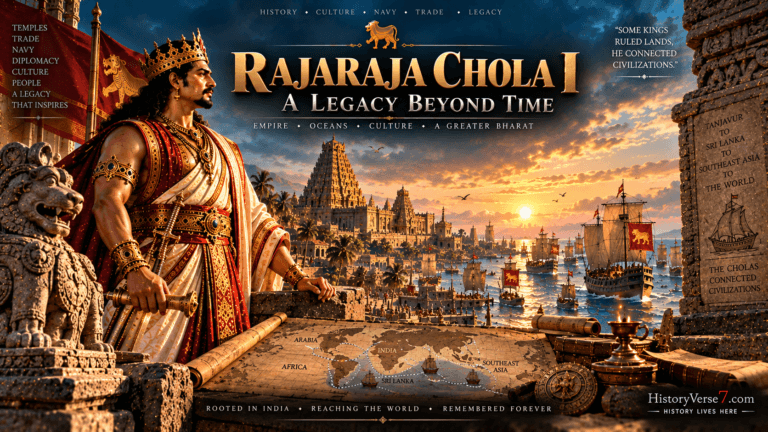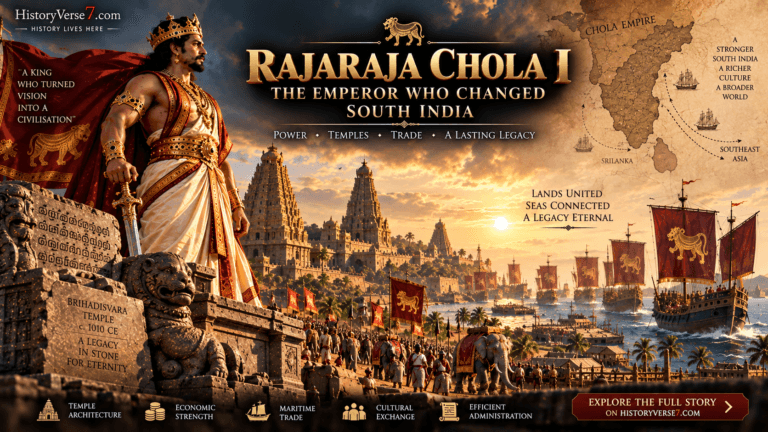
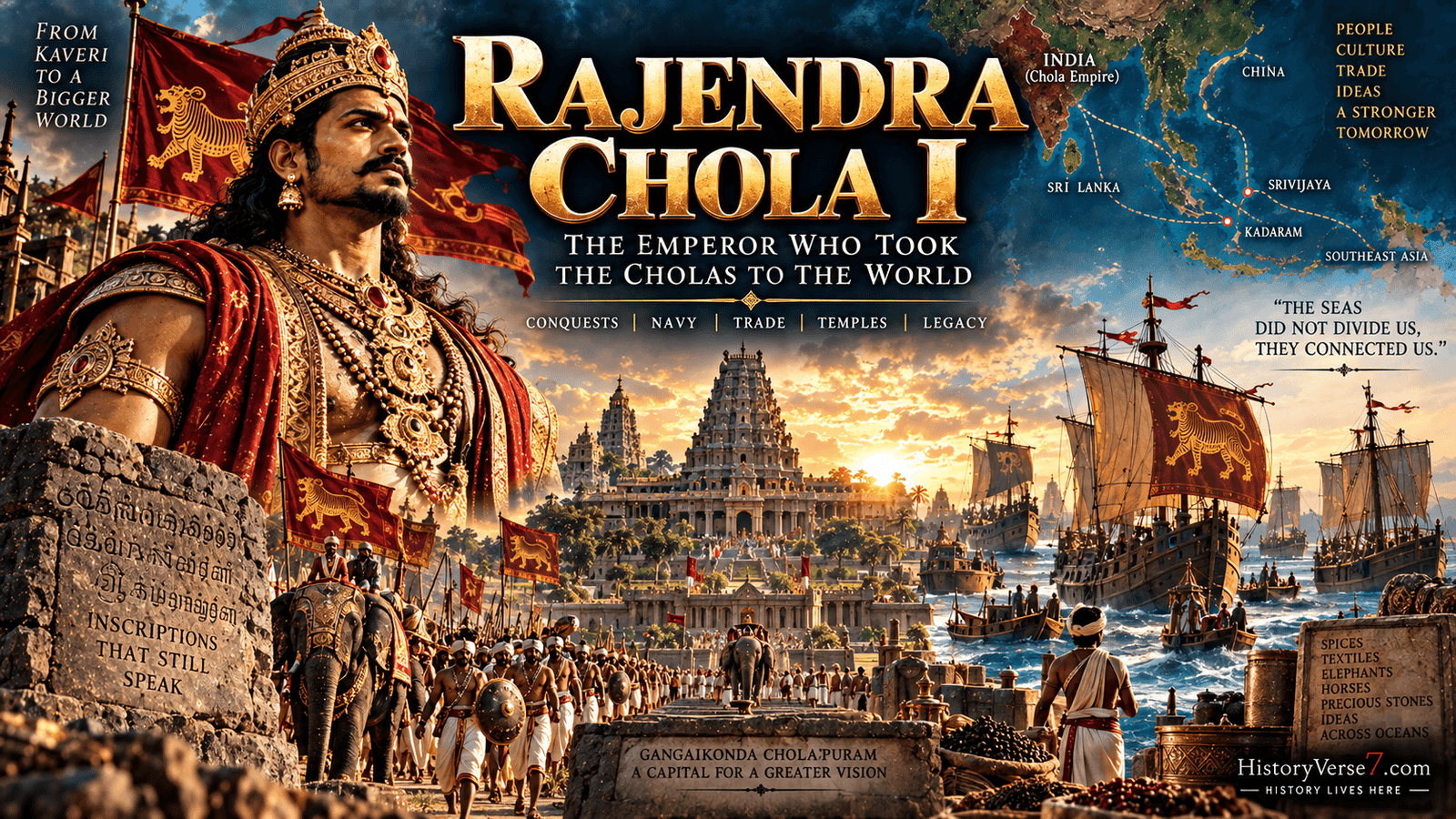
Rajendra Chola I: 15 Fascinating Facts About the Chola Emperor
HISTORYVERSE7 • CHOLA EMPIRE RESEARCH SERIES Rajendra Chola I: Reading the Evidence The history of Rajendra Chola I survives through a combination of inscriptions, temples, archaeological evidence and modern historical research. Where popular accounts simplify his campaigns, this article follows the evidence and distinguishes between documented events, later traditions and scholarly interpretation. For readers who…
Table of Contents: Rajendra Chola I
The Emperor After Rajaraja
HistoryVerse7.com |Cluster Article:Rajendra Chola I| International English Edition
By the early 1010s, the Chola state looked nothing like it had a generation earlier. Rajaraja Chola I had spent close to thirty years turning a strong but regionally bounded Tamil kingdom into the dominant power of southern India: a professional army, a navy capable of striking across the sea to Sri Lanka, a revenue and land-survey system detailed enough to still be studied by historians a thousand years later, and a new imperial temple at Thanjavur that announced, in stone, exactly how far Chola ambition now reached. That story belongs to Rajaraja’s own article on HistoryVerse7, and this one does not need to retell it. What matters here is simpler: by the time Rajaraja was in his sixties, he had built something genuinely formidable, and the question facing the Chola court was what his successor would do with it.
That successor was already, in practice, running much of the show. Rajendra had spent years at his father’s side, not as a passive heir waiting his turn but as an active commander and administrator in his own right, and in 1012 Rajaraja made this arrangement formal, appointing Rajendra as co-regent so that father and son ruled, for a couple of years, as something close to equals. When Rajaraja died in early 1014, the transition to Rajendra as sole ruler happened without the drama that succession disputes could bring to premodern courts. There was no rival claimant scrambling for the throne, no interregnum, no visible crisis. This is worth stating plainly, because it is not always what happened when a powerful medieval king died, and it tells us something about how carefully Rajaraja had prepared his son for this exact moment.
What Rajendra inherited, then, was not a fragile inheritance he had to fight to secure. It was a functioning empire, a battle-tested army, a navy, an administrative apparatus reaching down to the village level, and roughly a decade of hands-on political experience. The real question of Rajendra’s reign was never whether he could hold what his father had built. It was what he would do with the power now fully in his hands.
Rajendra Chola I — Timeline
| Date | Event | Significance |
| 971 CE | Birth of Rajendra | Born to Rajaraja Chola I and Vanavan Mahadevi; exact circumstances of childhood not well documented. |
| c. 992 CE onward | Rajendra serves as Senathipathi | Leads Chola military campaigns on Rajaraja’s behalf for roughly two decades before his own accession. |
| c. 1002 CE | Early campaigns in the Deccan | Rajendra leads operations connected to Rashtrakuta territory and early confrontation with the Western Chalukyas. |
| 30 May 1012 | Rajendra appointed co-regent | Father and son rule jointly with full regal status for the following two years. |
| 1014 CE | Death of Rajaraja I and accession of Rajendra | Smooth succession following the co-regency arrangement. |
| 1018 CE | Conquest campaign in Sri Lanka | Chola forces overrun Anuradhapura; King Mahinda V is captured. |
| 1018 CE | Rajadhiraja appointed co-regent | Rajendra repeats his father’s succession strategy with his own eldest son. |
| c. 1019 to 1021 CE | Battle of Maski against the Western Chalukyas | Rajendra claims victory over Jayasimha II; the underlying rivalry continues. |
| c. 1019 to 1021 CE | The Ganges expedition | Chola forces march north through Kalinga and Bengal, defeating Mahipala I of the Pala dynasty and reaching the Ganges. |
| 1022 CE | Coronation of Rajaraja Narendra in Vengi | Chola-backed claimant secured after the Ganges expedition’s return; sealed by marriage to Rajendra’s daughter Ammangadevi. |
| c. 1023 CE onward | Founding of Gangaikonda Cholapuram | New capital built to commemorate the Ganges expedition. |
| 1025 CE | Naval expedition against Srivijaya | Chola forces attack Kadaram, the city of Srivijaya, and several other named cities, capturing King Sangrama Vijayottunggavarman. |
| 1044 CE | Death of Rajendra Chola I | Succeeded smoothly by his co-regent son, Rajadhiraja I. |
Who Was Rajendra Chola I?
Rajendra was born around 971 CE, the son of Rajaraja Chola I and his queen Vanavan Mahadevi, also known as Tribhuvana Mahadevi. Like most Chola princes of this period, he grew up inside a court that was simultaneously a royal household, a military headquarters, and an administrative centre, and the sources give us very little reliable detail about his childhood specifically. What they do give us, in reasonable abundance, is evidence of his adult political life well before he became king, which is really where his biography as a historical figure begins.
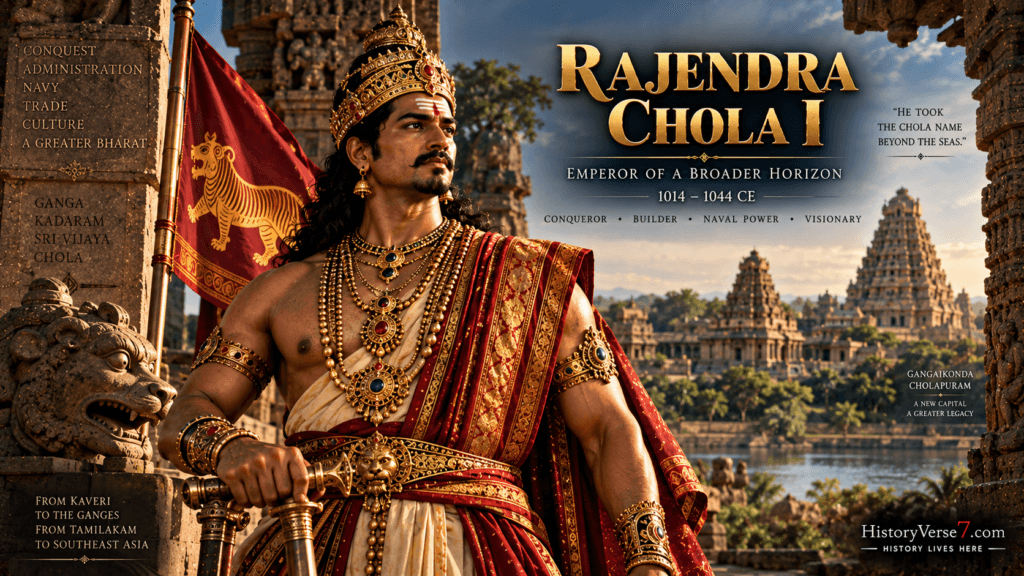
He held the military rank of Senathipathi, commander of forces, from around 992, meaning Rajendra was leading troops on his father’s behalf for roughly two decades before his own accession. His formal titles as king included Parakesarivarman and, later, the famous epithet Gangaikonda Chola, “the Chola who took the Ganges,” a title earned rather than inherited, as we will see. He married several times over the course of his life, and his sons, several of whom would themselves become Chola emperors, place him firmly at the centre of the dynasty’s most successful stretch of rule. None of this required speculation about his inner life or childhood impressions; it comes directly from inscriptional and genealogical evidence, and that is the kind of evidence this article will lean on throughout.
Rajendra Before Becoming King
It is a mistake to treat Rajendra’s reign as beginning only in 1014. By the time he formally ascended the throne, he had already been shaping Chola military and political affairs for years, and understanding this earlier record matters for understanding why his own reign moved so quickly once it began.
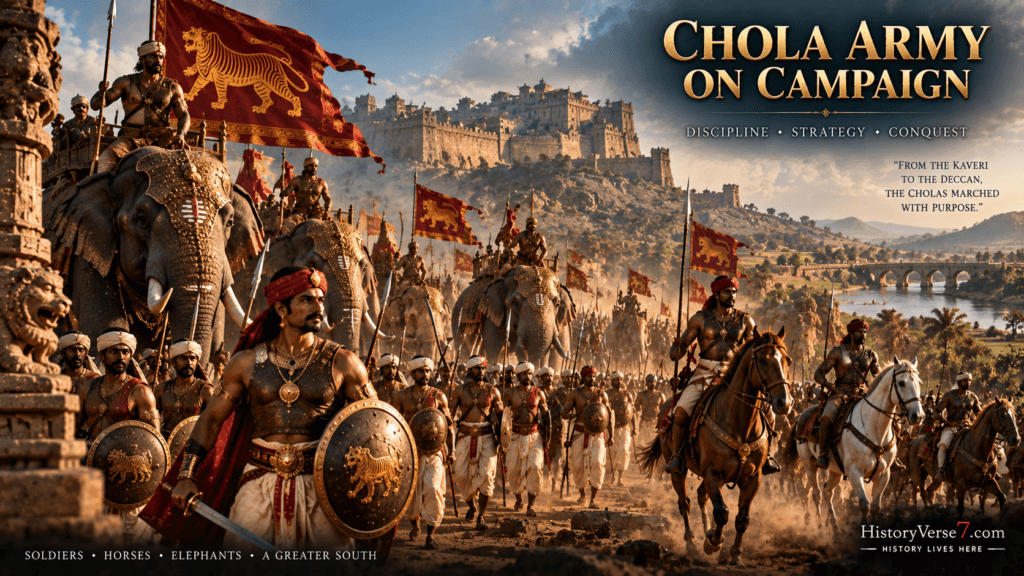
Chola inscriptions credit Rajendra with campaigns he undertook on his father’s behalf from around 1002 onward, including operations against Rashtrakuta territory and the region around what is now northwestern Karnataka, and later, more direct confrontation with the Western Chalukyas under their ruler Satyashraya, in which Rajendra’s forces crossed the Tungabhadra River and carried fighting into Chalukya territory itself. He also played a leading role in later campaigns against Vengi and Kalinga during the final years of his father’s reign, the kind of frontline command that a king trusts only to someone he genuinely believes can execute a campaign, not merely someone he is obligated to include for dynastic reasons.
Then, in 1012, Rajaraja made the relationship official, elevating Rajendra to co-regent. For roughly two years, inscriptions from this period show both men issuing orders and holding court with full regal status, an arrangement some historians read as a deliberate strategy to make the eventual succession as seamless as possible, since a co-regent who has already been ruling in practice has little need to seize power through force once the throne technically becomes vacant. Whatever the precise motivation, it worked. By the time Rajaraja died, Rajendra was not a prince stepping into an unfamiliar role. He was a seasoned commander and co-ruler simply continuing, under a new title, work he had already been doing.
Accession to the Chola Throne
Rajaraja Chola I died in early 1014, and Rajendra’s accession followed without the kind of upheaval that so often accompanies the death of a powerful medieval ruler. This was not an accident. It was the direct result of the co-regency arrangement discussed above, and it deserves to be stated as plainly as the evidence allows: this was a smooth transition, not a dramatic one, and readers looking for a succession crisis in the Rajaraja-to-Rajendra handover will not find one in the sources.
What changed with Rajendra’s formal accession was less about the practical business of governing, which continued much as before, and more about the freedom it gave him to set his own priorities. Within a few years of becoming sole ruler, Rajendra was moving in directions his father never had, toward Sri Lanka in full force, toward the Ganges, and eventually toward the sea lanes of Southeast Asia. The stability of the succession is precisely what made this ambition possible; a new king spending his early years managing internal rivals rarely has the resources left over for expeditions a thousand miles from home.
The Empire Rajendra Inherited
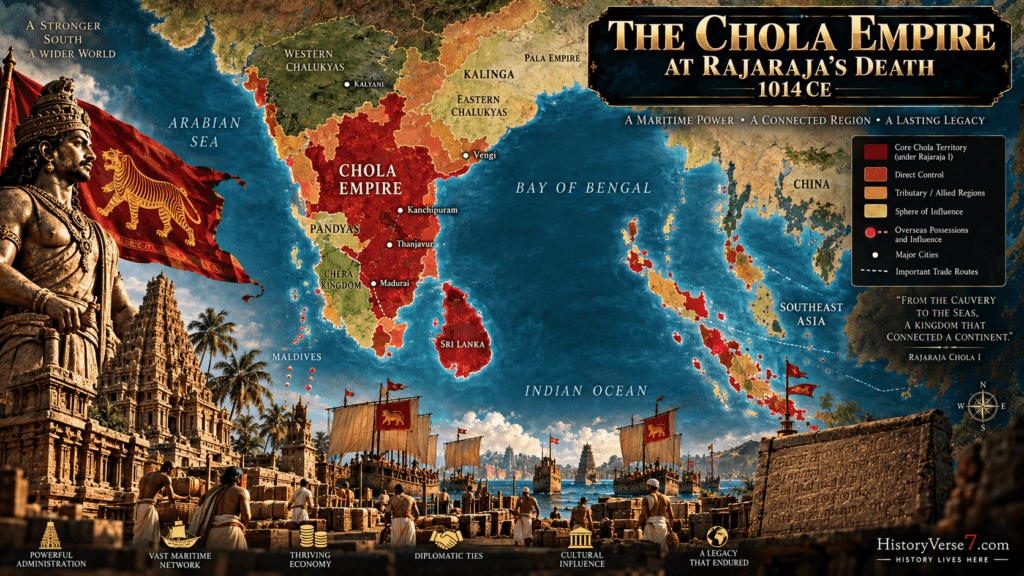
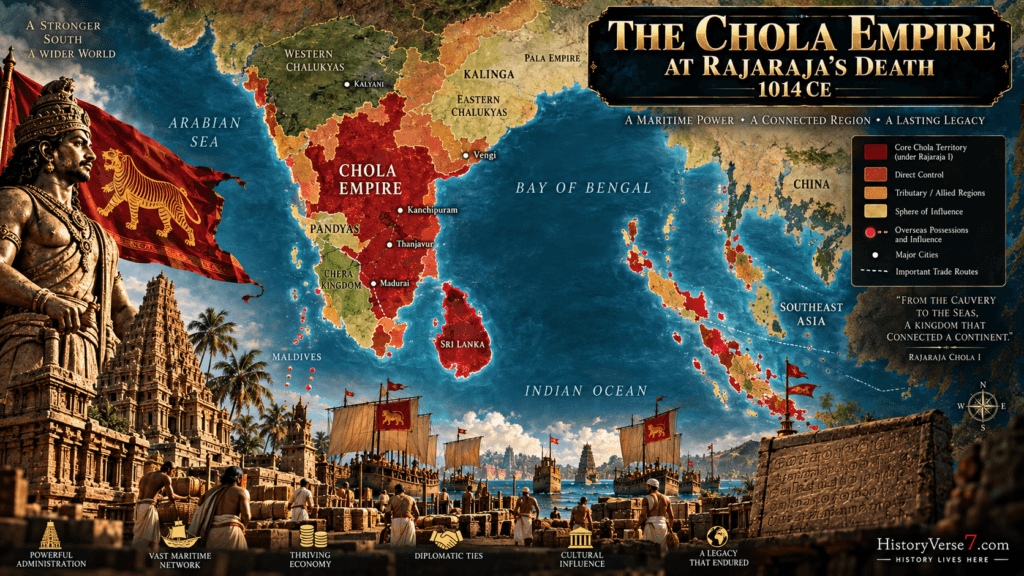
Understanding what Rajendra built requires a clear picture of what he started with. By 1014, Chola authority extended across the Tamil core of the far south, a heartland the dynasty had controlled and steadily developed for generations. Rajaraja had already brought much of Sri Lanka’s northern regions under Chola control through his own campaigns late in his reign, giving Rajendra a foothold on the island rather than a blank slate. The Chera and Pandya territories to the west and south had, by this point, been drawn substantially into the Chola political orbit, their rulers operating as subordinate or tributary powers rather than fully independent rivals. Chola interests extended into the Deccan as well, where earlier campaigns against Rashtrakuta successor territory had already brought Rajendra himself into direct conflict with Western Chalukya power well before he became king.
Beyond the strictly territorial picture, Rajendra inherited something just as important: a navy capable of independent, long-distance operation, a legacy of Rajaraja’s own naval campaigns against Sri Lanka and the Maldives, and a set of maritime and commercial connections reaching into the wider Bay of Bengal trading world. None of this should be read through the lens of a modern map with fixed borders. Chola authority in this period operated through a layered system of direct rule in the core territory, tributary and subordinate relationships in conquered or allied regions, and looser commercial and diplomatic influence further afield, and Rajendra’s task was to work within, and eventually expand, all three of these layers at once.
Early Campaigns Under Rajendra
Once sole ruler, Rajendra moved quickly to extend and consolidate this inheritance. Chola authority over Pandya and Chera territory in the far south was reinforced through continued military pressure and administrative integration during the early years of his reign, part of a broader pattern in which Rajendra treated the southern Tamil region less as external territory to be conquered and more as core Chola land to be fully absorbed into the state’s institutions, complete with Chola officials, temple patronage, and land administration operating alongside or in place of older local structures.
Further north, Rajendra continued the pressure his father had already applied against the Eastern Chalukyas of Vengi, working to install and support a Chola-aligned claimant to the Vengi throne, a policy that would eventually tie the two dynasties together through marriage, discussed further below. Each of these campaigns should be read as part of a coherent strategy rather than a disconnected list of victories: consolidate the southern Tamil base, secure influence over the eastern Deccan through Vengi, and use both as a platform for the far more ambitious northern and maritime projects that would define the middle years of his reign.
Sri Lanka
Rajaraja had already brought significant portions of northern Sri Lanka under Chola control before his death, but the conquest of the island remained incomplete when Rajendra came to power. In 1018, Rajendra launched a major campaign that pushed Chola authority decisively further, and Chola naval forces overran Anuradhapura, the Sinhalese capital, in the process.
The Sinhalese king, Mahinda V, was captured and taken as a prisoner to Chola territory, where he remained in captivity for the rest of his life; sources place his death in captivity roughly a decade later. Chola inscriptions from this period claim the capture of the Pandya regalia that Sinhalese kings had earlier taken from Chola hands, along with the Sinhalese king’s own crown, treasures, and family members, language that reflects the triumphant conventions of royal inscription-writing as much as it documents precise military detail.
It would be an overstatement to describe the result as the Cholas ruling a fully pacified, uniformly administered Sri Lanka for the remainder of Rajendra’s reign. Chola control over the island, referred to in Tamil inscriptions as Iramandalam, was real and substantial, particularly in the northern and central regions, but resistance and instability continued in various parts of the island across the following decades, and Chola authority in Sri Lanka should be understood as a dominant but contested and evolving presence rather than a settled, permanent annexation completed once and for all in 1018.
Pandyas and Cheras
The Pandya and Chera territories of the far south had already been drawn substantially into the Chola orbit under Rajaraja, and Rajendra’s reign continued and deepened this process rather than opening an entirely new front. Chola princes and officials were installed in positions of authority over Pandya territory, and Chola administrative practices, including land surveys and temple patronage on the Rajaraja and Rajendra model, extended into these southern regions alongside continued military pressure where local resistance required it.
This integration mattered enormously for Rajendra’s broader ambitions. A secure, administratively absorbed southern base freed Chola military and naval resources for the much larger projects further afield, the Ganges expedition and the Southeast Asian campaign, that would define his historical reputation. Without a settled south, neither would have been possible.
Conflict with the Western Chalukyas
The rivalry between the Cholas and the Western Chalukyas was not a single war but a long, recurring political contest over control of the Deccan, particularly the Raichur Doab region between the Krishna and Tungabhadra rivers, and over influence in Vengi, the Eastern Chalukya kingdom that both powers wanted as an ally rather than an enemy. This contest ran through Rajendra’s own earlier campaigns as a prince and continued, in various forms, for decades after his death under his successors.
The most significant confrontation of Rajendra’s own reign came around 1019 to 1021, at a site called Musangi, identified with the modern town of Maski in Karnataka, against the Western Chalukya ruler Jayasimha II. Rajendra’s own inscriptions describe a decisive victory, claiming Jayasimha fled the field in disgrace after suffering serious losses. Other evidence complicates this triumphant picture somewhat: later Chalukya-era records indicate Jayasimha retained real authority up to the Tungabhadra and continued to contest the border region afterward, and Rajendra does not appear to have pursued his advantage south of that river into the Chalukya heartland. The most accurate reading is that Maski was a genuine and significant Chola victory in the field, commemorated by Rajendra’s assumption of the title Parakesarivarman, but that it did not produce a lasting territorial settlement, and the underlying Chola-Chalukya rivalry over Vengi and the Deccan borderlands continued to simmer for the rest of the century.
The Vengi question was ultimately settled, at least for a time, not by battle but by marriage. Rajendra backed his nephew Rajaraja Narendra, born to a Vengi king and a Chola princess, against a rival claimant supported by Jayasimha, and after years of contested succession, Rajaraja Narendra was finally crowned in Vengi following the triumphant return of the Ganges expedition in 1022. Rajendra sealed the alliance by giving his own daughter, Ammangadevi, in marriage to Rajaraja Narendra, binding the Eastern Chalukya line directly into the Chola family and setting up a dynastic connection whose descendants would, generations later, come to rule the Chola throne itself.
The Northern Expedition
The campaign that gave Rajendra his most famous title is generally dated to around 1019 to 1021, based primarily on the Tiruvalangadu copper-plate inscription, one of the most detailed surviving records of the Chola state during this period. According to this and related inscriptions, Rajendra’s forces marched north through Kalinga, roughly coastal Odisha, and continued through territory corresponding to parts of modern Chhattisgarh, Jharkhand, Bengal, and Bihar, encountering and defeating a sequence of regional rulers along the way, including a ruler named Ranasura, the ruler Dharmapala of Dandabhukti, and finally Mahipala I, the reigning king of the powerful Pala dynasty of Bengal and Bihar.
The inscriptions describe this as a rapid campaign, completed in under two years, and frame the defeat of Mahipala as its dramatic high point, the moment Chola power reached, symbolically and literally, the banks of the Ganges. It is worth being precise about what this expedition actually was and was not. This was a military expedition demonstrating Chola reach and power over an extraordinary distance, not a war of territorial annexation in any lasting sense. No credible evidence indicates that Rajendra’s administration retained direct, ongoing control over Kalinga, Bengal, or any of the other northern territories his army passed through. The kingdoms defeated along the route were left as defeated, humbled powers rather than absorbed Chola provinces, and the campaign’s significance lies in what it demonstrated about Chola military capacity and royal ambition rather than in any permanent redrawing of the political map of eastern India.
The Ganges and the Gangaikonda
Why would a South Indian king march an army a thousand miles from his own territory, through terrain and against powers he had no realistic intention of governing? The answer lies less in strategy and more in ideology. In the political and religious symbolism of premodern India, the Ganges carried enormous prestige, and a king who could bring its waters south, physically or symbolically, was making an extraordinarily powerful statement about the scale of his authority, one that older, more established northern dynasties could not easily dismiss.
According to tradition recorded in later sources, the defeated northern kings were made to carry Ganges water back to Chola territory as a mark of their submission, and Rajendra used this symbolism directly, adopting the title Gangaikonda Chola, “the Chola who took the Ganges,” a title that appears repeatedly across his later inscriptions and that became one of the defining markers of his reign. This was not a modest or accidental piece of self-promotion. It was a calculated assertion, aimed at every rival power watching from the Deccan, Sri Lanka, or further afield, that the Chola dynasty now belonged in the same conversation as the great dynasties of the north, a claim to a kind of pan-Indian imperial prestige that went well beyond simple regional dominance.
Gangaikonda Cholapuram
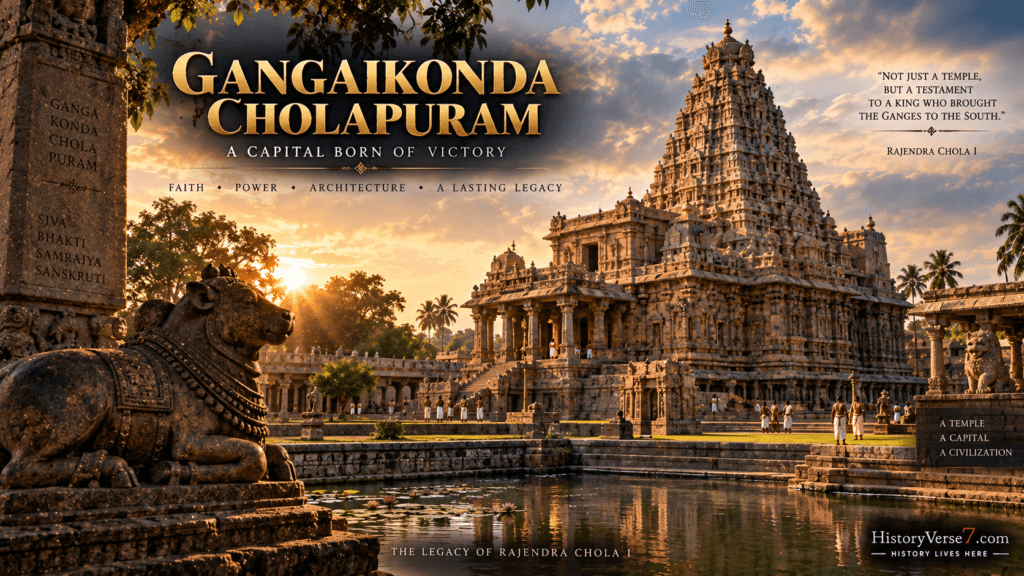
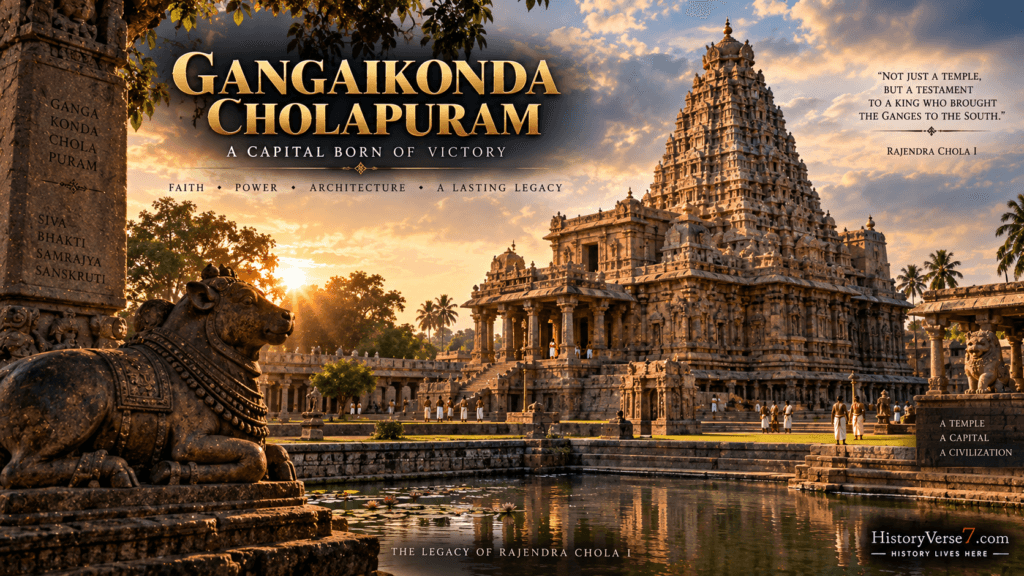
To make this claim permanent, Rajendra founded an entirely new capital, Gangaikonda Cholapuram, in the Kaveri delta region, built specifically to commemorate the northern expedition and to serve as the political and ceremonial centre of his reign going forward. This was a considerable undertaking: an entirely new royal city, complete with its own major Shiva temple, deliberately built to echo the great Brihadisvara temple his father had raised at Thanjavur, along with the administrative infrastructure and water management systems a functioning capital required.
The choice to build an entirely new capital rather than simply expanding Thanjavur carried its own message. It announced a new phase of the dynasty’s history, one associated with Rajendra’s own achievements rather than his father’s, and it gave the Ganges expedition a permanent physical monument rather than letting its memory rest solely on inscriptions and oral tradition. A separate, dedicated HistoryVerse7 article covers Gangaikonda Cholapuram’s architecture and urban development in full detail; what matters here is understanding the city as Rajendra’s deliberate, lasting answer to the question of how a southern king converts a distant military campaign into a permanent claim on imperial legitimacy.
Chola Imperial Ideology
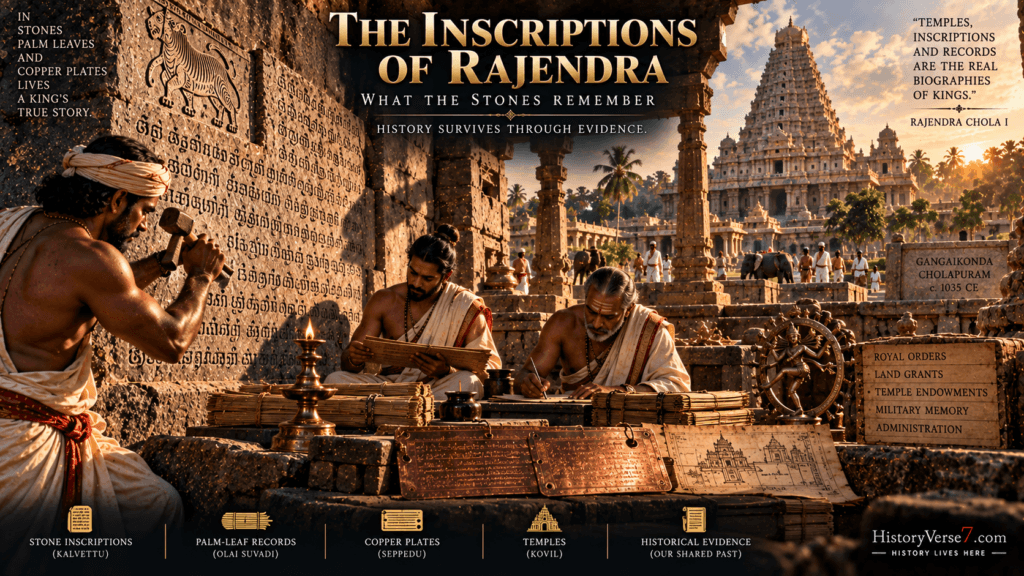
Royal inscriptions of this period were never neutral historical reports. They were carefully composed statements of legitimacy, written in the conventional language of royal triumph, and a responsible historian reads them with that in mind rather than treating every claim of conquest as an equally verified fact. When Rajendra’s inscriptions describe humbled kings carrying Ganges water south, or list a long chain of defeated rulers along the northern route, they are doing real historical work, telling us what Rajendra wanted his subjects, rivals, and descendants to believe about his reign, which is itself valuable evidence. But this is a different kind of evidence from, say, an administrative land grant recording an actual transfer of revenue rights, and the two should not be treated with identical confidence.
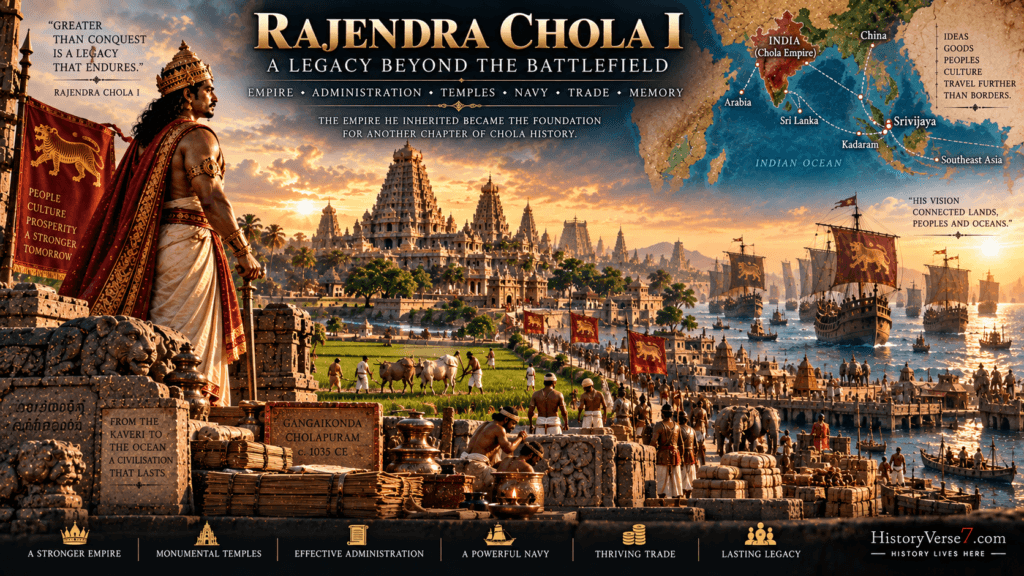
Rajendra’s imperial self-presentation drew on titles, temple building, a new capital city, and the powerful symbolism of the Ganges to construct an image of universal, almost cosmic kingship, an image that went beyond a simple claim to have won battles and asserted something closer to civilisational pre-eminence. Historians studying this material generally treat it as an accurate guide to how the Chola court wanted to be perceived, and as reasonably reliable evidence that major campaigns described did in fact take place, while remaining more cautious about the precise territorial and administrative claims layered on top of that basic narrative.
The Chola Navy Under Rajendra
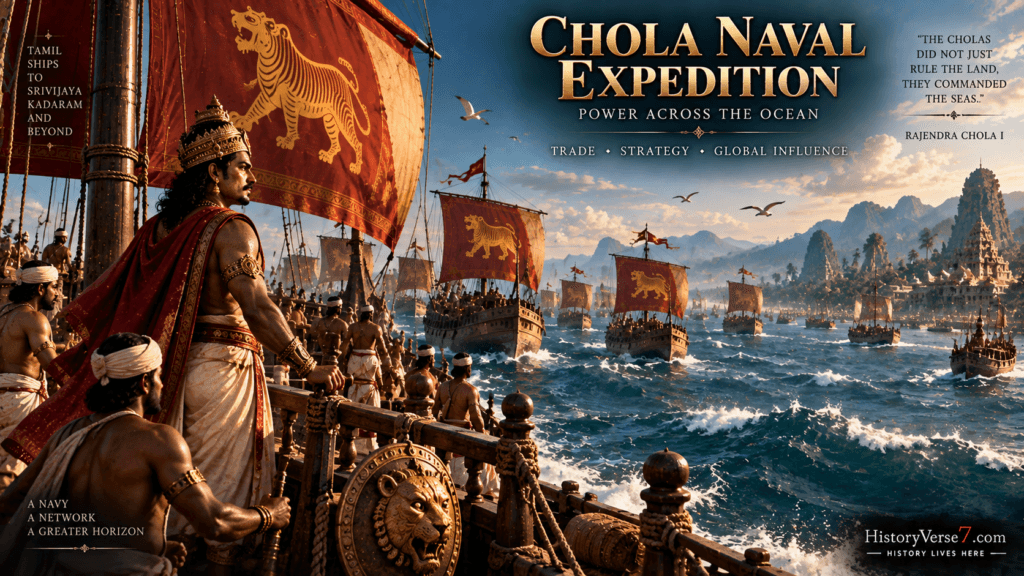
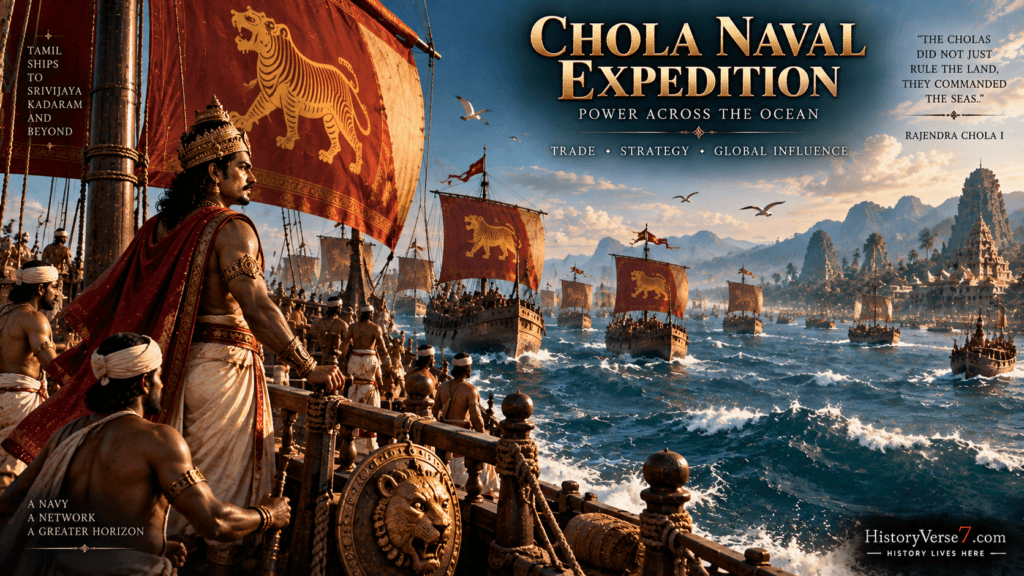
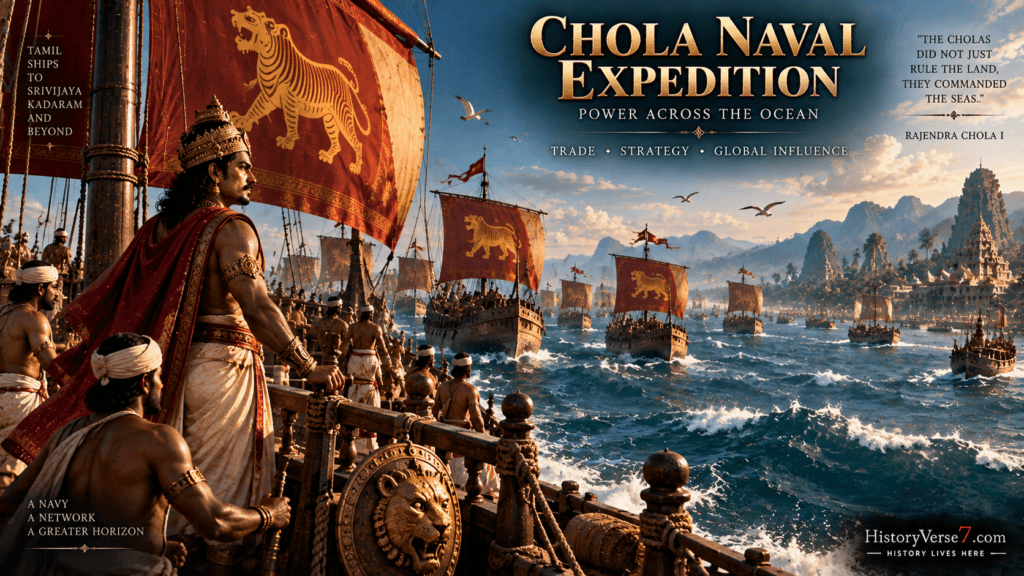
By Rajendra’s reign, the Chola navy had developed into one of the most capable maritime forces in the wider Indian Ocean and Bay of Bengal world, a legacy substantially built under Rajaraja but expanded and put to even more ambitious use under his son. This navy operated from ports along the Coromandel coast and supported both the Sri Lankan campaigns discussed above and, most dramatically, the long-distance expedition against Srivijaya described below.
A separate HistoryVerse7 article treats the Chola navy’s organisation and capabilities in fuller detail. What matters for understanding Rajendra’s reign specifically is the basic fact that this maritime capacity, ships capable of transporting substantial land forces across open ocean and operating effectively against fortified coastal cities thousands of kilometres from Chola territory, was not a minor supporting feature of his reign but one of its central instruments, the tool that made his most famous and most historically debated campaign possible at all.
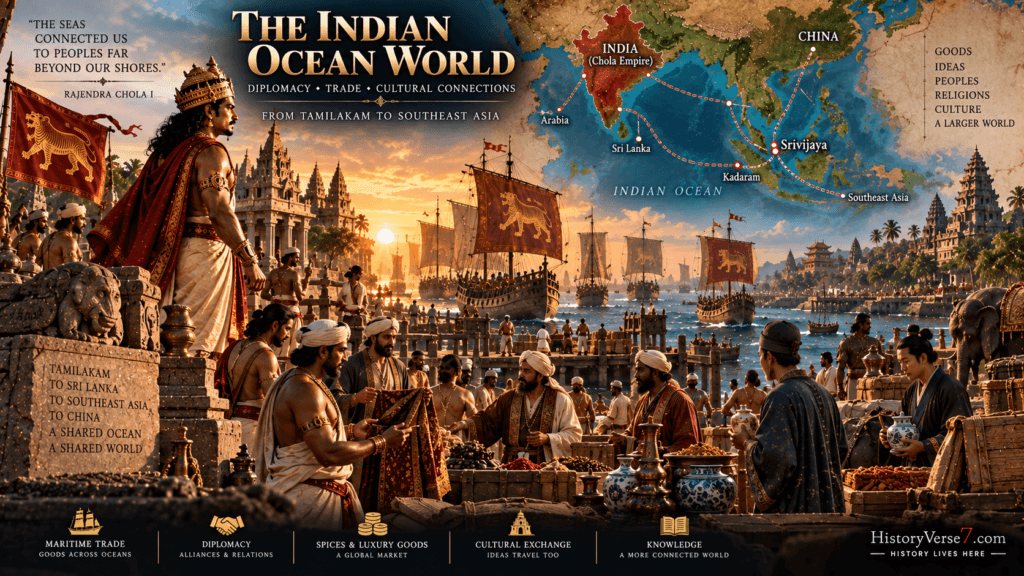
The Srivijaya Expedition
Srivijaya, by the early eleventh century, was a major maritime empire controlling key stretches of the Malacca and Sunda straits from its base at Palembang in southern Sumatra, with authority and influence extending across the Malay Peninsula, including the important port polity of Kadaram, generally identified with the Kedah region of modern Malaysia. This was not a minor or peripheral state. Srivijaya sat astride one of the most valuable maritime trade corridors in the medieval world, the sea route connecting the Indian Ocean to China, and its rulers had, for generations, profited enormously from controlling and taxing the ships that passed through.
In 1025, Rajendra launched a major naval expedition against Srivijaya. According to the Tamil prasasti inscribed at the Thanjavur temple, Chola forces captured Sangrama Vijayottungavarman, the Srivijayan king, along with elephants from his army and a substantial accumulation of treasure. The inscription goes on to list a sequence of specific places attacked: the fortified gateway of the city of Srivijaya itself, described with considerable ceremonial detail; Pannai, noted for its bathing ghats; the ancient city of Malaiyur, described as defended by a strong mountain rampart; Mayirudingam, protected by the surrounding sea; and further named locations generally identified with sites across the Malay Peninsula and Sumatra, including territory associated with Langkasuka and the Tambralinga kingdom. Historians reconstructing the geography of this campaign generally agree it struck a series of major Srivijayan port cities and dependent territories across a wide stretch of the Malacca Strait region, rather than a single isolated target.
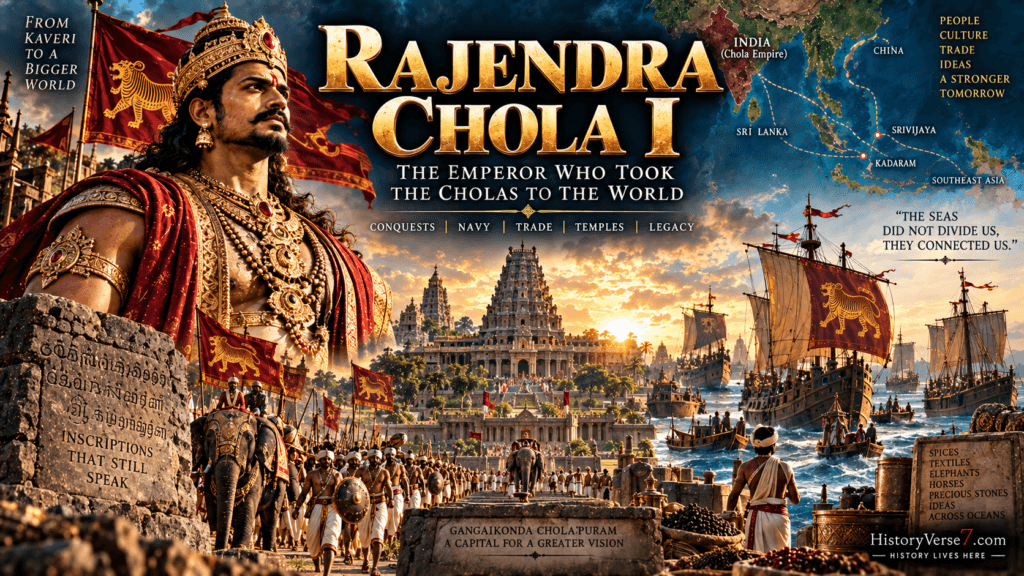
Why did Rajendra do this? Historians have offered several overlapping explanations rather than a single settled answer, and honesty requires presenting the disagreement rather than picking one interpretation and treating it as fact. Some scholars emphasise trade, arguing that Srivijaya’s control over the strait had become a costly obstacle for Chola and South Indian merchants trading with China, and that a punishing naval strike was intended to break that chokehold and open the route to freer commercial access. Others point to political and prestige considerations, suggesting that an emperor who had just conquered his way to the Ganges had every incentive to project Chola power over the sea as well, matching a northern land triumph with a maritime one. Diplomatic context also plays a role in some accounts: Chola relations with rival Southeast Asian polities, including the Tambralinga kingdom and its Srivijayan patron, appear to have deteriorated in the years before the attack, and some historians read the expedition as connected to these regional political tensions as much as to any single economic grievance. Most serious modern scholarship treats the campaign as a genuine convergence of these factors, trade access, political prestige, and immediate regional rivalry, rather than the product of any one, easily isolated cause.
Did Rajendra Build an Overseas Empire?
This question deserves a direct and careful answer, because popular retellings routinely get it wrong in one direction or the other. What the evidence supports is this: Rajendra’s forces attacked, defeated, and in several cases plundered a substantial list of Srivijayan cities and dependent territories in 1025, and this was a genuine, large-scale naval military campaign, not a minor raid. The Srivijayan king was captured. Significant treasure was taken. The campaign is corroborated not only by Chola inscriptions but by the fact that Srivijaya’s political structure appears to have been seriously disrupted in its aftermath, with other regional rulers stepping into positions of authority in the years that followed.
What the evidence does not support is a claim of lasting Chola territorial rule over Southeast Asia. There is no reliable documentary or archaeological record of a continuing Chola administrative apparatus, garrisons, or provincial governors installed across Sumatra and the Malay Peninsula in the decades following the campaign. Later Chola rulers, including Virarajendra several decades on, would launch further naval operations connected to Kadaram, but these appear in the sources as renewed interventions responding to fresh political circumstances, most plausibly evidence that direct Chola control had not persisted continuously, rather than a demonstration of unbroken imperial administration. The most historically responsible summary is that Rajendra achieved a major naval military victory and a real, if likely temporary, disruption of Srivijayan power, securing Chola commercial and strategic interests in the Malacca Strait region, without establishing anything resembling a colonial administration of the kind later European powers would eventually impose on the same waters. Describing this as the Cholas “conquering Southeast Asia” or “ruling Indonesia” considerably overstates what the evidence can actually support.
Indian Ocean and Bay of Bengal Networks
The Srivijaya expedition makes far more sense once it is placed within the wider commercial world the Cholas operated in. By Rajendra’s reign, South Indian ports were tied into a dense web of maritime trade connecting the Arabian Sea and the Persian Gulf in the west to the Bay of Bengal, the Malacca Strait, and the South China Sea in the east. Ships, cargoes, and merchant communities moved along this network constantly, carrying textiles, spices, metals, and luxury goods between India, Southeast Asia, and China.
Rajendra’s reign also produced direct diplomatic evidence of this wider world: Chola embassies were sent to the Song dynasty court in China, part of a documented pattern of contact between South India and China during this period that reflects genuine, ongoing interest in maintaining and protecting these trade connections at the highest political level. Understanding Rajendra’s Southeast Asian campaign purely as a military story misses this larger picture. It was, at least in significant part, a projection of power in defence of an economic system the Chola state had every reason to want secured and functioning smoothly.
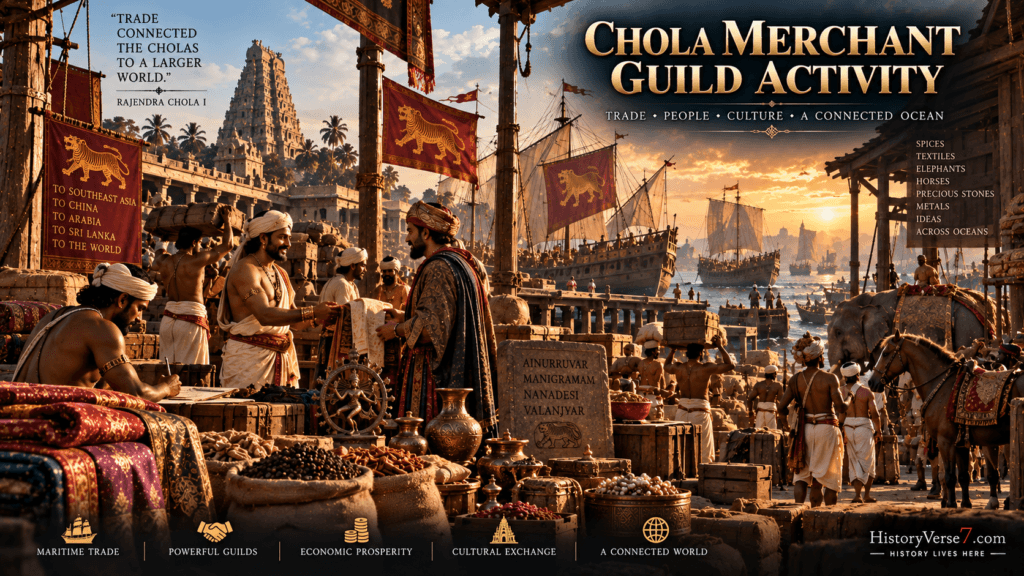
Merchant Guilds
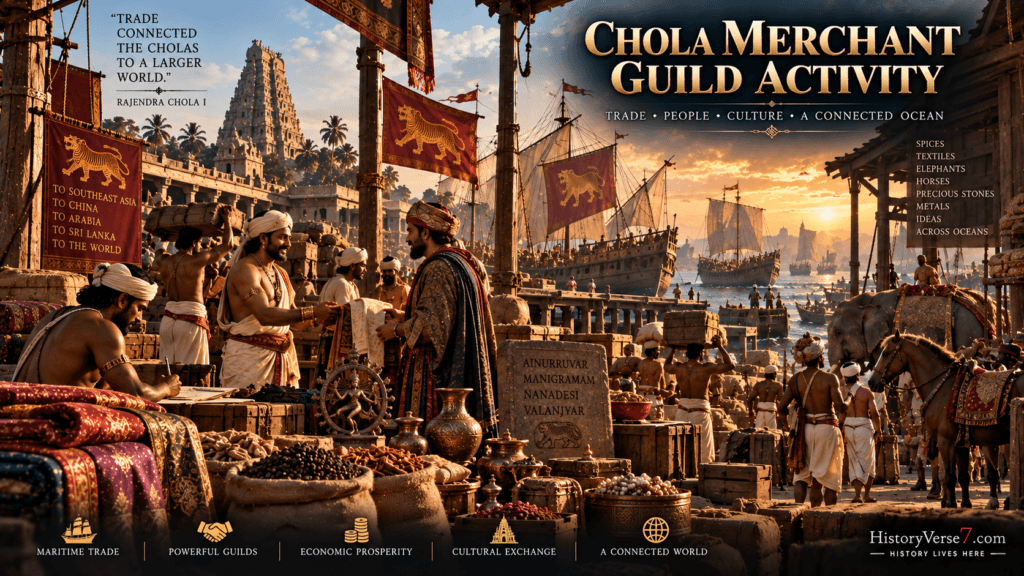
South Indian trade during this period was organised substantially through powerful merchant guild organisations, most notably the Ayyavole, also known as the Five Hundred of Ayyavole, alongside other documented bodies such as the Manigramam and Nanadesi guilds. These organisations coordinated the movement of goods and merchants across enormous distances, maintained their own networks of trading posts and protective arrangements, and, in some documented cases, operated well beyond the Tamil country itself, with evidence of their presence in inscriptions found in Southeast Asia.
These guilds should be understood as important economic actors whose interests genuinely intersected with state policy, rather than as independent political powers capable of directing Chola foreign policy on their own account. The relationship worked in both directions: merchant communities benefited from the security a powerful, trade-conscious Chola state could provide along key routes, and the Chola state, in turn, drew real economic and political benefit from the wealth, information, and connections these merchant networks generated.
Administration Under Rajendra
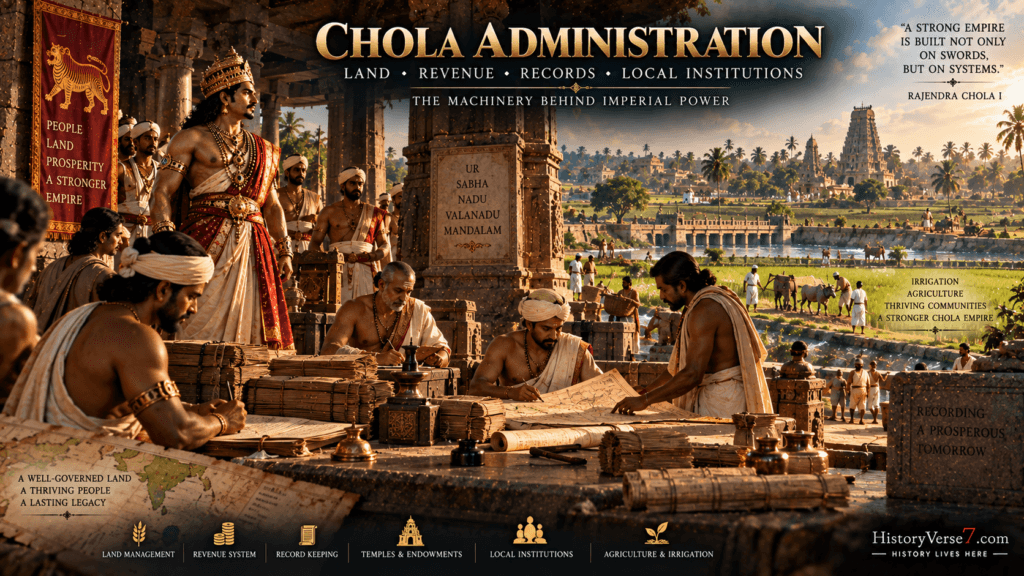
The Chola administrative system Rajendra inherited from his father was already sophisticated by the standards of the period, and his reign is best understood as one of continuity and refinement rather than wholesale reinvention. The empire was organised into provinces and smaller administrative units, with land revenue assessed through detailed surveys, a Chola specialty inherited and continued from Rajaraja’s own administrative reforms. Village-level institutions, particularly temple-centred assemblies that handled local administrative and financial matters, continued to play a significant role in the actual day-to-day governance of rural Tamil society, working alongside royally appointed officials rather than being replaced by them.
A full account of Chola administrative structure belongs to HistoryVerse7’s dedicated article on the subject rather than being repeated at length here. What is worth emphasising in Rajendra’s specific case is how this existing administrative machinery supported his far more ambitious military and diplomatic projects: a state capable of assessing and collecting revenue with real precision, and of coordinating resources across a large and complex territory, was also a state capable of funding and sustaining a two-year land expedition to the Ganges and a major naval campaign to Southeast Asia in the same decade. The administration was the quiet infrastructure making the dramatic campaigns possible.
Economy and Revenue
Rajendra’s ambitious foreign policy did not come free, and the Chola economy of this period, resting on a combination of agricultural revenue, temple-centred economic activity, and increasingly significant maritime trade, had to sustain considerable military expenditure across multiple simultaneous fronts. Agriculture remained the foundational source of state revenue, supported by an irrigation and water-management system, discussed further below, that Chola administration actively maintained and, in places, expanded.
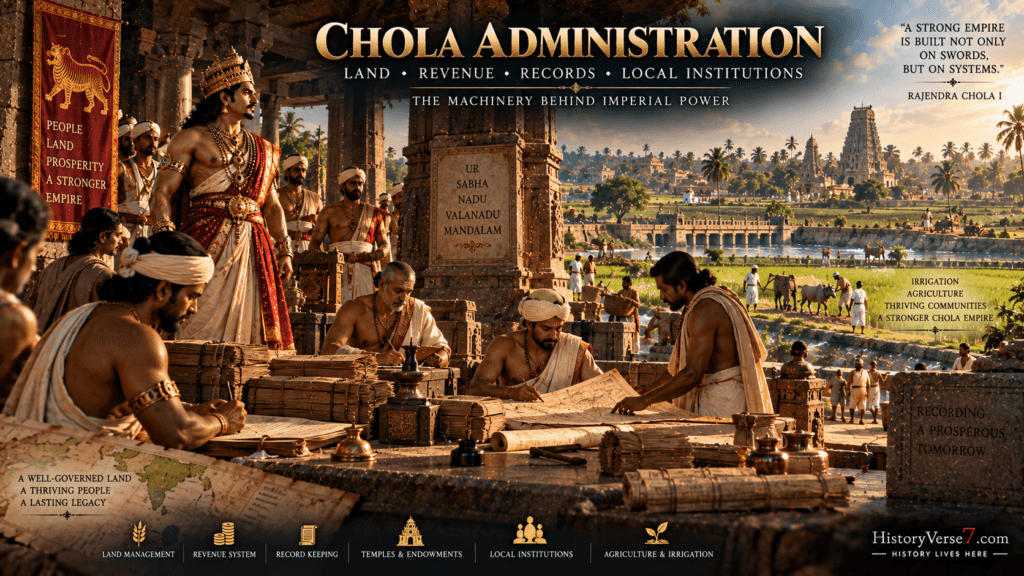
Temples functioned as genuine economic institutions during this period, not merely religious ones, accumulating land, managing endowments, and employing substantial numbers of people connected to ritual, maintenance, and temple-linked craft production. Trade revenue, drawn from customs and the activity of the port cities and merchant networks discussed above, added a further and, over the course of Rajendra’s reign, increasingly important stream of state income. Surviving evidence does not allow for confident modern-style statistics on the relative weight of these different revenue sources, and readers should be wary of any account that presents precise percentages or totals; what the inscriptional record supports is the general shape of a mixed agricultural, religious-institutional, and commercial economy capable of funding an unusually ambitious and expensive foreign policy.
Irrigation and Water Management
Water management remained a serious and continuous concern of Chola administration throughout this period, reflecting the simple reality that Tamil agriculture, and therefore Chola state revenue, depended heavily on reliable irrigation from tanks, canals, and the seasonal management of the Kaveri and other regional river systems. Inscriptions from Rajendra’s reign, as from his father’s, record grants and arrangements connected to irrigation works and temple-linked water management, evidence of continued state and local attention to this infrastructure rather than a project Rajendra personally initiated from nothing.
Responsible history should resist the temptation to credit every specific irrigation development of this era directly to Rajendra’s personal initiative; much of this activity reflects the ongoing, collaborative work of local institutions, temple administrations, and regional officials operating within a state structure that supported and coordinated such projects rather than personally commissioning each one from the top down.
Temples and Royal Patronage
Rajendra continued his father’s strong association with Shaiva religious patronage, most visibly through the great Shiva temple he built at his new capital of Gangaikonda Cholapuram, consciously designed to echo the Brihadisvara temple at Thanjavur while asserting its own distinct identity as the monument of a new reign. Temple patronage under Rajendra extended well beyond this single flagship project, encompassing land grants, donations, and support extended to religious institutions across Chola territory, including expansions to existing temples such as those at Trincomalee in Sri Lanka, reflecting the way temple patronage served simultaneously as religious devotion, political statement, and practical administrative tool, since temple grants and endowments were themselves part of how the Chola state organised land, labour, and local authority.
It would be a mistake to reduce the Chola state to a purely religious institution on the strength of this patronage. Temples functioned as religious, economic, social, and administrative centres all at once, and Rajendra’s investment in them reflects an understanding of this multiple function rather than piety alone, though piety, expressed through the specifically Shaiva devotional idiom the Chola court favoured throughout this period, was certainly a genuine part of the picture as well.
Gangaikonda Cholapuram Temple
The temple Rajendra built at his new capital deserves brief mention here, though its full architectural and artistic story belongs to a separate, dedicated HistoryVerse7 article. Built explicitly in dialogue with the Thanjavur Brihadisvara temple, it represented both continuity with his father’s architectural legacy and Rajendra’s own distinct claim to comparable, or even greater, imperial achievement, its construction and consecration standing as the religious and political centrepiece of the new capital, tying the city’s identity directly to the Ganges expedition it was built to commemorate.
Society Under Rajendra
Inscriptions from this period, largely concerned with land grants, temple donations, and administrative matters, offer only a partial and unevenly distributed window into the wider society Rajendra ruled over. Farmers working the irrigated agricultural land that formed the backbone of state revenue, merchants and artisans connected to the temple economy and the wider trade networks discussed above, temple personnel of many different specialised functions, and soldiers drawn from across Chola territory and its subordinate regions all appear, in varying degrees of detail, across the surviving documentary record.
What these sources cannot provide is anything resembling a complete social history of ordinary life under Rajendra’s rule. Inscriptions record transactions, disputes, and grants, generally involving people with enough property or status to appear in such records at all, and the experience of the wider agricultural and labouring population, while certainly shaped by the same military campaigns, tax demands, and temple economy discussed throughout this article, is only glimpsed indirectly rather than documented in its own right.
Women During Rajendra’s Reign
Rajendra’s several queens appear across inscriptions connected to temple donations, grants, and court ceremonial, evidence of the recognised and, in some cases, genuinely significant role royal women played within Chola court life and religious patronage during this period. His daughter Ammangadevi, discussed earlier, played a direct and documented role in the dynasty’s diplomatic strategy through her marriage to Rajaraja Narendra of Vengi, a marriage that was itself a deliberate political instrument tying two ruling houses together.
Beyond the royal family specifically, inscriptions occasionally record women, generally of some property or status, involved in land transactions, temple donations, and similar dealings, offering scattered but genuine evidence of women’s participation in the economic and religious life of the period. This evidence does not support sweeping generalisations about the status of women across Chola society as a whole, and this article resists making any such claim; what can be responsibly said is that royal and propertied women appear in the record as active participants in specific, documented transactions and relationships, not as passive or invisible figures.
Rajendra’s Family and Succession
Rajendra fathered several sons who would go on to rule the Chola throne themselves, a remarkable run of dynastic continuity by the standards of any premodern state. His eldest son, Rajadhiraja, was made co-regent in 1018, following the same successful pattern of shared rule his own father had used with him, and Rajadhiraja spent the following decades at the forefront of Chola military campaigns before finally becoming sole ruler on Rajendra’s death in 1044. Other sons, including Rajendra II and Virarajendra, would each in turn hold the Chola throne after Rajadhiraja’s own reign, making Rajendra I the direct father of an unbroken run of Chola emperors across several subsequent decades, a genuinely unusual outcome in medieval dynastic history.
This article will not attempt full biographies of these later rulers, whose own reigns and campaigns belong to their own dedicated treatment. What matters here is the basic structural point: by repeating his father’s co-regency strategy with his own eldest son, Rajendra built a succession mechanism that proved durable across multiple transitions, a quiet but genuinely significant institutional achievement sitting alongside his more famous military exploits.
Rajendra’s Later Years
The final years of Rajendra’s reign continued to combine military engagement, particularly the ongoing, unresolved rivalry with the Western Chalukyas over the Deccan borderlands, with the steady work of administering an empire that now stretched from Sri Lanka to the fringes of Bengal in terms of demonstrated reach, and included a documented Southeast Asian maritime dimension besides. Rajadhiraja’s growing prominence as co-regent through this period suggests a king increasingly comfortable delegating frontline military command to a well-prepared heir, much as Rajendra himself had once been delegated such responsibility by his own father.
Sources for this final stretch of the reign are less dramatic than the material covering the Ganges and Srivijaya campaigns, largely because there was no comparably spectacular new expedition to record; the emphasis in the surviving evidence shifts toward continued administration, temple patronage, and the ongoing, lower-intensity friction with the Chalukyas that neither side had managed to resolve decisively.
Death of Rajendra Chola I
Rajendra died in 1044, generally understood to have been in his early seventies, an unusually long reign and life by the standards of the period. Later Sri Lankan tradition, recorded in inscriptions discovered considerably after the fact and connected to a rival claim about the fate of the Srivijayan royal line, includes an account suggesting Rajendra was assassinated during a visit to Srivijaya. This claim does not appear in Chola epigraphic or administrative records, which instead treat his death and Rajadhiraja’s succession as a straightforward transition, and it should be presented clearly as a specific, later, and contested tradition rather than as an established alternative account of equal historical weight. The responsibly cautious position is that Rajendra died in 1044 after a long reign, most likely from natural causes given his advanced age, while readers should be aware that at least one later tradition offers a considerably more dramatic and unverified account.
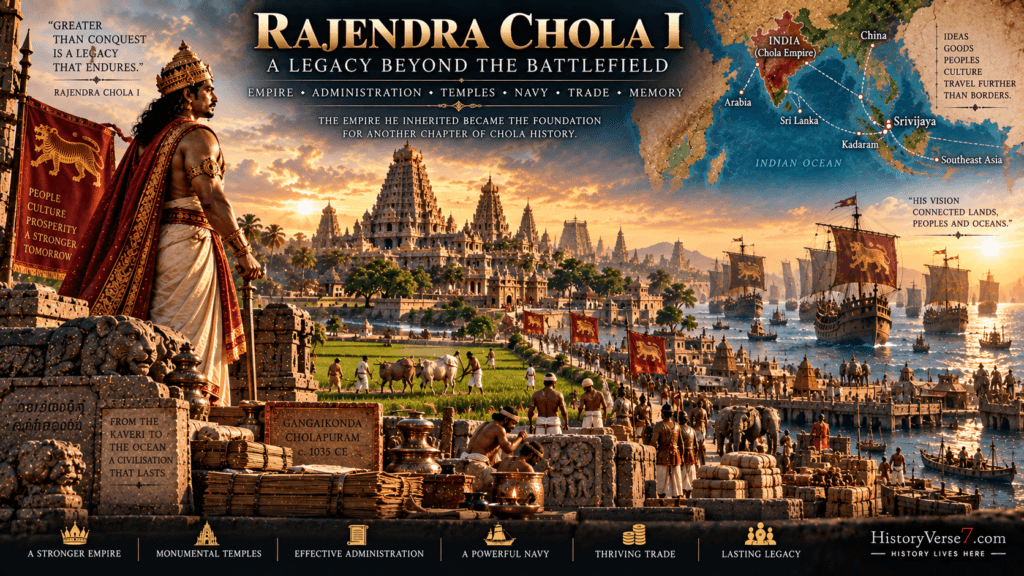
His son Rajadhiraja I, already functioning as co-regent for over two decades, succeeded him without the kind of disruption that might be expected after the death of a ruler who had reigned for thirty years, a final testament to how effectively Rajendra’s own succession planning, modelled on his father’s, had worked.
Limitations of Rajendra’s Empire
An honest assessment cannot stop at achievement alone. The Western Chalukya rivalry was never resolved during Rajendra’s lifetime; Jayasimha II retained real power north of the Tungabhadra despite the Chola victory at Maski, and this unresolved border conflict would continue to consume Chola military resources for decades after Rajendra’s death. Sri Lankan control, while substantial, faced continued resistance and remained an ongoing military and administrative burden rather than a settled, cost-free acquisition. The Ganges expedition, for all its prestige value, produced no lasting territorial gain in the north whatsoever, and the Srivijaya campaign, while a genuine military triumph, does not appear to have translated into any durable Chola administrative presence in Southeast Asia, with later rulers apparently needing to intervene again in the same region.
More broadly, Rajendra’s reign illustrates a recurring pattern in premodern imperial expansion generally: the ability to win a distant campaign and the ability to permanently govern the territory reached are two very different capacities, and Rajendra, for all his genuine military success, achieved the first far more consistently than the second outside his own secure Tamil, Sri Lankan, and Deccan-border core.
Did Rajendra Surpass Rajaraja?
This is a question historians raise more often than they answer definitively, and this article will not attempt to settle it either, because the honest answer depends heavily on which criteria one weighs most heavily. Rajaraja’s achievement lies substantially in consolidation and foundation: building the administrative machinery, the navy, and the military tradition that made everything Rajendra later did possible, along with the monumental statement of the Thanjavur temple. Rajendra’s achievement lies substantially in expansion and projection: taking that foundation and extending Chola reach further than any Tamil dynasty had gone before, to the Ganges in the north and across the sea to Southeast Asia.
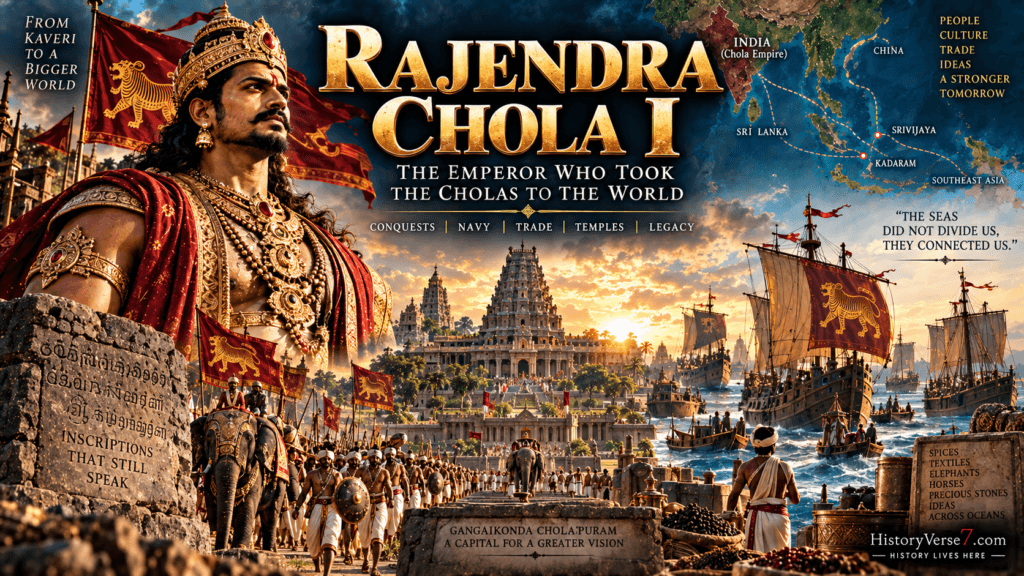
Some historians emphasise Rajaraja’s foundational role as the more historically decisive contribution, since without it Rajendra’s campaigns would have been logistically impossible. Others point to the sheer geographic and symbolic scale of Rajendra’s achievements as evidence of a reign that, in terms of raw ambition realised, surpassed anything his father attempted. Both readings are defensible, and treating this as a competition with a clear winner misses the more interesting historical point: father and son together, across roughly six decades of connected rule, built something neither could plausibly have achieved alone.
Rajendra Chola I in Historiography
Modern scholarship on Rajendra has approached his reign from several distinct angles. Historians working on state formation and administrative history, building on the foundational work of scholars such as K. A. Nilakanta Sastri, have studied how the sophisticated Chola bureaucratic and revenue system supported such an ambitious and geographically wide-ranging foreign policy. Maritime and Indian Ocean historians, including scholars associated with the influential Nagapattinam to Suvarnadwipa research collection on Chola naval activity, have focused particular attention on the Srivijaya campaign as a case study in medieval Indian Ocean naval warfare and its relationship to long-distance trade. Scholars of Southeast Asian history, drawing on regional inscriptions and archaeology alongside the Tamil evidence, have worked to reconstruct the Srivijayan side of the encounter and to assess how seriously and how permanently the campaign actually disrupted Srivijayan power. Economic historians examining South Indian trade, merchant guild organisation, and temple economy, meanwhile, have situated Rajendra’s reign within the broader story of medieval Indian Ocean commerce rather than treating it purely as a military narrative.
This range of approaches reflects a genuinely rich and still-developing scholarly conversation rather than settled, uncontested consensus on every point, particularly regarding the precise motivations and lasting consequences of the Srivijaya campaign, an area where this article has tried throughout to present genuine historical disagreement honestly rather than manufacturing false certainty in either direction.
15 Lesser-Known Facts
- A later Sri Lankan inscriptional tradition claims Rajendra was assassinated during a visit to Srivijaya, a story that does not appear in Chola records and illustrates how differently the same reign could be remembered depending on which side of a conflict was doing the remembering.
- Rajendra held the military rank of Senathipathi, army commander, from around 992, meaning he was leading Chola forces for roughly two decades before he ever became king.
- His formal co-regency with Rajaraja began on 30 May 1012, a precisely dated arrangement recorded in inscriptions, under which father and son ruled with equal regal status for close to two years.
- Rajendra installed his own eldest son, Rajadhiraja, as co-regent in 1018, repeating the exact succession strategy his father had used with him, a deliberate institutional choice rather than a coincidence.
- The Battle of Maski, one of the major confrontations of Rajendra’s reign against the Western Chalukyas, took place at a site in modern Karnataka later famous for an entirely unrelated discovery, a rock edict of the ancient emperor Ashoka, found there in 1915.
- Rajendra’s daughter Ammangadevi married Rajaraja Narendra of Vengi, a marriage that eventually connected the Chola line to the later Eastern Chalukya-Chola dynasty eight generations on.
- The Tiruvalangadu copper-plate inscription, one of the principal sources for the Ganges expedition, describes the campaign as lasting less than two years despite the enormous distance covered.
- Chola inscriptions describe the defeated northern kings of the Ganges campaign as being made to carry Ganges water south to Chola territory, the origin of Rajendra’s title Gangaikonda Chola.
- The Srivijayan king captured in 1025, Sangrama Vijayottunggavarman, is known to history largely through the Chola victory inscription that names him, a striking example of how South Indian records preserve details of Southeast Asian political history.
- The list of places attacked during the Srivijaya campaign, recorded in Rajendra’s Tamil prasasti, includes cities identified by modern historians with sites across both the Malay Peninsula and the island of Sumatra, indicating a campaign covering an unusually wide maritime geography.
- Rajendra’s reign produced documented diplomatic contact with Song dynasty China, part of a broader, ongoing pattern of Chola interest in the maritime trade routes connecting South India to East Asia.
- Mahinda V, the Sinhalese king captured during the 1018 Sri Lanka campaign, remained a Chola prisoner for roughly a decade before his death in captivity.
- Gangaikonda Cholapuram, Rajendra’s new capital, was built specifically to commemorate the Ganges expedition, making it one of the relatively rare premodern examples of an entire royal city founded to memorialise a single military campaign.
- Merchant guild organisations such as the Ayyavole are documented in inscriptions found well beyond the Tamil country itself, including in parts of Southeast Asia, reflecting the reach of the commercial networks connected to Chola-era trade.
- Three of Rajendra’s sons, Rajadhiraja I, Rajendra II, and Virarajendra, each went on to rule the Chola throne in turn, an unusually long unbroken run of direct father-to-son-line succession for a medieval dynasty.
Author Perspective
What keeps pulling me back to Rajendra Chola I is not any single campaign, impressive as they all are, but the sheer geographic imagination of the reign taken as a whole. Here is a Tamil king who fought the Chalukyas on the Deccan plateau, marched an army to the Ganges through kingdoms his own court had probably never seen with their own eyes, and then turned his navy east and struck at a maritime empire on the far side of the Bay of Bengal, all within roughly a decade of each other. That range, land power reaching a river a thousand miles north and sea power reaching an empire a thousand miles east, is genuinely rare in medieval world history.
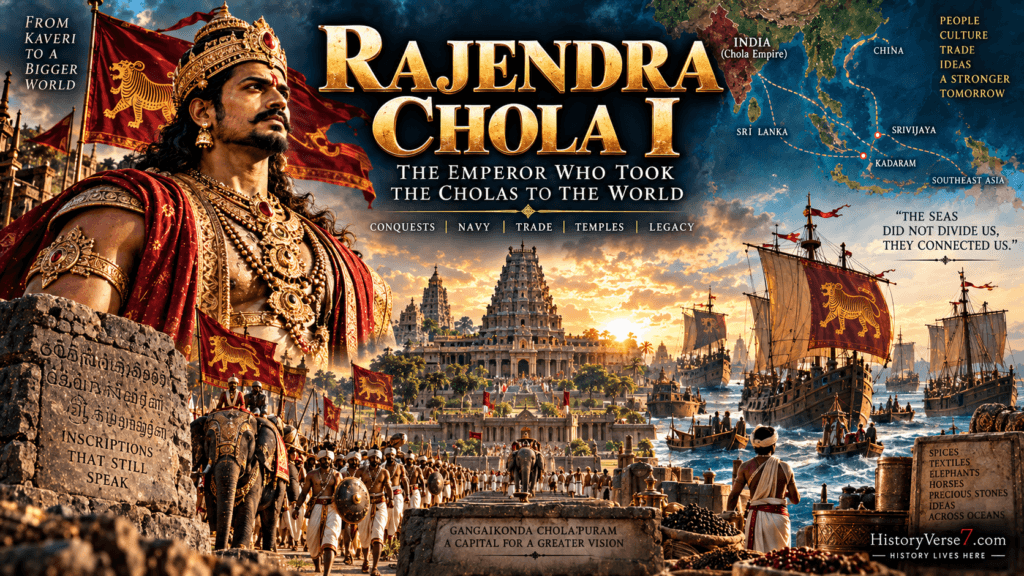
What I try to hold onto, and what I hope this article has held onto as well, is the difference between what Rajendra demonstrated and what he permanently built. He demonstrated, convincingly, that Chola power could reach almost anywhere his ambition pointed. What he permanently built was narrower and, in its own way, more interesting: a secured southern and Sri Lankan core, a new capital carrying his name and his achievement forward in stone, a diplomatic marriage that tied two dynasties together, and a succession system that put three of his own sons on the Chola throne in turn. The Ganges expedition and the Srivijaya campaign made his reputation. The quieter administrative and dynastic work is what actually lasted.
Written & Researched by Abhishek Chavan — HistoryVerse7| © 2026 HistoryVerse7 | Pillar Article: Rajendra Chola I
FAQ — Rajendra Chola I
Who was Rajendra Chola I?
Rajendra Chola I was a Chola emperor who reigned from 1014 to 1044 CE, the son and successor of Rajaraja Chola I, known for completing the conquest of Sri Lanka, leading a famous military expedition to the Ganges, and launching a major naval campaign against Srivijaya in Southeast Asia
When did Rajendra Chola I rule?
He served as co-regent alongside his father from 1012 and ruled as sole emperor from 1014 until his death in 1044.
Who was Rajendra Chola’s father?
His father was Rajaraja Chola I, who built the Chola Empire into the dominant power of South India and constructed the great Brihadisvara temple at Thanjavur.
How did Rajendra Chola become king?
He was appointed co-regent by his father in 1012 after years of leading military campaigns on Rajaraja’s behalf, and succeeded smoothly as sole ruler when Rajaraja died in 1014.
What happened after Rajendra Chola’s death?
His eldest son, Rajadhiraja I, already serving as co-regent, succeeded him smoothly in 1044, continuing the Chola dynasty’s remarkable run of capable rulers.
Share this content: