Chhatrapati Shivaji Maharaj: Coronation, State-Building, Southern Campaigns and Legacy (Chapter 2 Final)
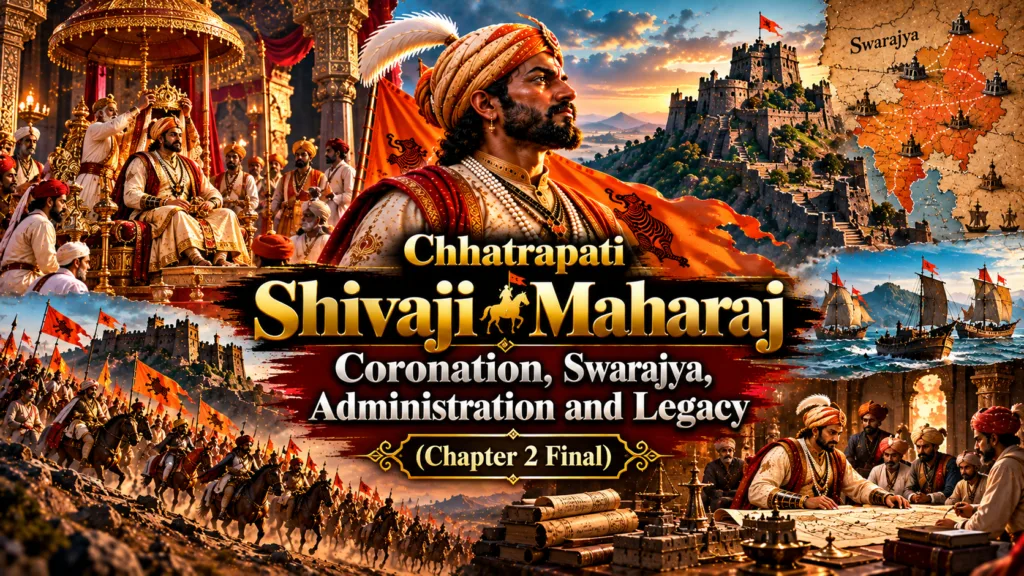
HISTORYVERSE7 • MARATHA HISTORY • CHAPTER 2 Chhatrapati Shivaji Maharaj: From Swarajya to Sovereignty The story of Chhatrapati Shivaji Maharaj did not end with the rise of Swarajya. The next stage was the transformation of that political power into a formally recognised kingdom with a sovereign ruler, organised administration, military institutions, maritime policy and expanding…
Chhatrapati Shivaji Maharaj: From Swarajya to Sovereignty
The story of Chhatrapati Shivaji Maharaj did not end with the rise of Swarajya. The next stage was the transformation of that political power into a formally recognised kingdom with a sovereign ruler, organised administration, military institutions, maritime policy and expanding political influence.
This chapter examines that transformation through historical evidence, modern scholarship and authoritative sources.
Table of Contents
The Kingdom Before the Coronation
HistoryVerse7.com | Article: Chhatrapati Shivaji Maharaj (Chapter 2) | International English Edition
By the early 1670s, Shivaji Maharaj had rebuilt what the crisis years around the Treaty of Purandar and the Agra confinement had cost him. Swarajya once again controlled a substantial and connected block of territory across the Sahyadri uplands and into the Konkan, its fort network restored and, in several places, extended beyond its earlier limits. Bijapur remained a functioning state but an increasingly weakened one, distracted by its own internal politics and unable to mount the kind of sustained campaign against Shivaji that Afzal Khan had once led. The Mughal Empire, having failed to fully absorb Shivaji into its own hierarchy through the Treaty of Purandar and having badly mishandled the Agra episode, treated Swarajya warily rather than as a settled subordinate. Golconda, the third major Deccan power, remained largely on the sidelines of this particular contest, watching Mughal expansion with its own concerns.
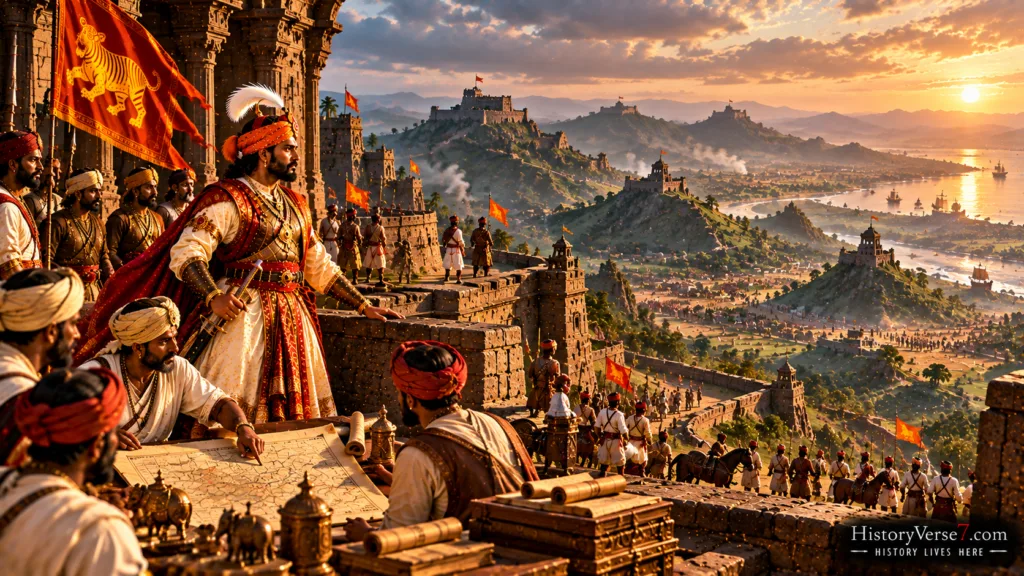
By this point, Shivaji Maharaj possessed real power: territory, forts, revenue, an army capable of both offence and defence, and a functioning, if still developing, administration. He lacked formal recognition as a sovereign ruler from any of the major political systems around him. This distinction matters more than it might seem. In the political world of seventeenth-century India, controlling territory and commanding armies was not automatically the same thing as being acknowledged as a king with the standing to issue land grants in his own name, mint his own coinage with full royal authority, conduct treaties as an equal with other sovereigns, or pass on a recognised throne to an heir. Shivaji Maharaj’s ambiguous status, technically outside any clear hierarchy- neither a Bijapuri jagirdar nor a Mughal mansabdar nor a crowned king in his own right- created real practical problems that pure military strength could not resolve on its own.
Why Did Shivaji Maharaj Need a Coronation?
A coronation in this period was not simply a religious ceremony or a piece of theatre. It was a political and legal act with concrete consequences. Formal, ritually sanctioned kingship gave a ruler the standing to be treated as a sovereign equal by other kings and empires, rather than as an upstart commander who happened to hold territory by force. It gave legal weight to land grants, administrative appointments, and judicial rulings issued in the ruler’s name, grounding them in recognised royal authority rather than in the more fragile authority of a successful warlord. It established a clear basis for dynastic succession, addressing a question that any long-term state needs answered: who rules after the current ruler is gone, and by what right.
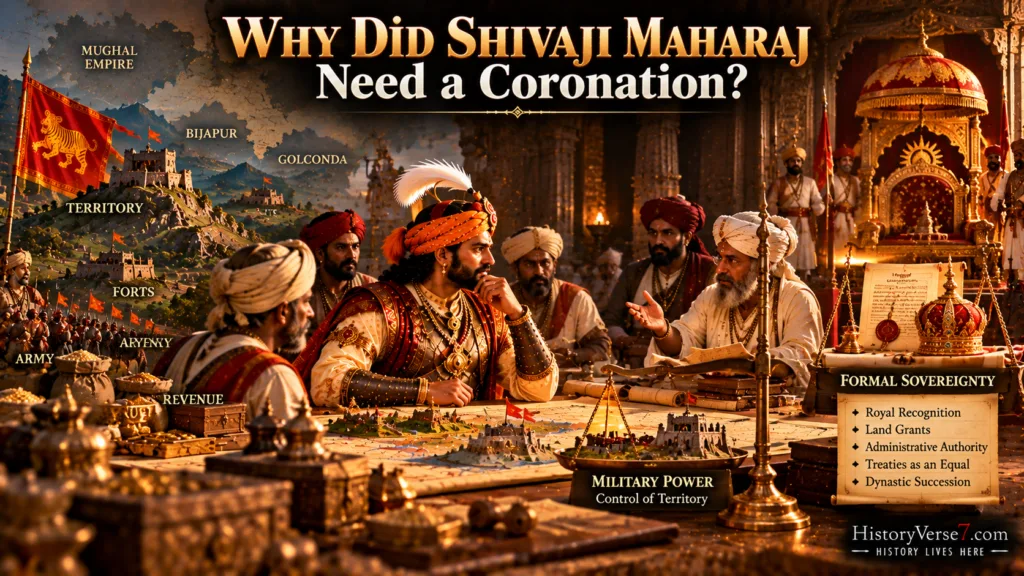
It is worth being precise about what coronation was and was not. It was not the invention of a modern nation-state, and readers should resist reading twentieth-century ideas of sovereignty and nationhood back into a seventeenth-century Deccan ritual. Nor was it merely decorative. Religious ritual, court ceremony, and political legitimacy were deeply intertwined in this period across South Asia, and a ruler’s formal coronation, performed according to recognised Vedic and Puranic ritual tradition, was understood by contemporaries as conferring a real change in status, not simply confirming a status that already existed. This is the essential difference between control of territory, which Shivaji Maharaj already had in abundance, and formal sovereignty, which he did not, and which only a proper coronation could supply.
The Bhosale Dynasty and the Kshatriya Question
Establishing this formal sovereignty required addressing a genealogical and ritual problem. Vedic coronation ritual, of the kind Shivaji and his advisors wished to use, traditionally required the person being crowned to belong to the Kshatriya varna, the traditional warrior-ruler class recognised in Brahmanical social and ritual theory. The Bhosale family’s status within this framework was, in the eyes of some contemporary Brahmin authorities, not straightforwardly established; Maratha military families of the Deccan occupied a genuinely contested position within traditional caste hierarchy as understood by different Brahmin communities of the period, some of whom questioned whether they qualified for full Kshatriya ritual status.
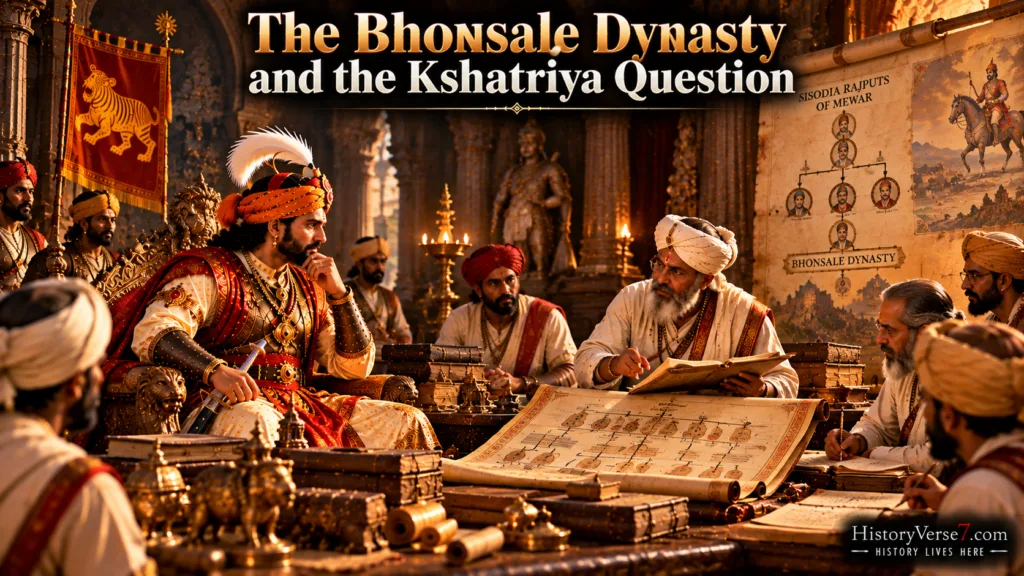
This is where Gagabhatt, a learned Brahmin scholar from Varanasi with recognised authority in matters of Vedic ritual, became central to the coronation project. Gagabhatt was engaged, after considerable negotiation and, by most accounts, payment for his services and for the elaborate ritual preparations involved, to formally validate Shivaji’s Kshatriya status and to conduct the coronation according to full Vedic rite. Genealogical claims tracing the Bhosale family back to the Sisodia Rajputs of Mewar, a lineage with long-established and widely recognised Kshatriya credentials, were compiled and presented as part of this process.
Here, historical responsibility requires real care. What is documented is that this genealogical claim was actively constructed and promoted in the period immediately surrounding the coronation, and that it served a clear and understandable political purpose: providing the ritual and social basis needed for a full Vedic coronation to proceed. What is not established with the same confidence is that this Sisodia descent reflects verified historical fact about the Bhosale family’s origins going back centuries. Modern historians generally treat the Mewar connection as a later genealogical tradition constructed to meet the ritual and political needs of 1674, rather than as settled history, while acknowledging that the Bhosale family did have long-standing, genuine status as a locally prominent Deccan military lineage regardless of the more distant and more doubtful Rajput claim. Readers should hold these two things together: the coronation’s ritual requirements were real and were met through a real historical process, and the deep genealogical claims used to meet them belong more to constructed tradition than to verified ancestry.
The Coronation of 1674
The coronation took place at Raigad, the hill fortress in the Sahyadri range that Shivaji had developed as his capital, on 6 June 1674. This was, by any reasonable account, one of the most consequential single events of Shivaji Maharaj’s career, and it deserves treatment as a major political occasion rather than a brief ceremonial footnote.
Preparations were extensive and expensive. Raigad itself had been developed with the kind of architectural and administrative infrastructure appropriate to a royal capital, and the ceremony drew together religious authorities, court officials, military commanders, and representatives from across Swarajya’s territory. Gagabhatt presided over the Vedic rites, which included the ceremonial bathing and anointing of the king, the recitation of prescribed mantras, and the formal conferral of royal insignia and titles. Shivaji took the formal title of Chhatrapati, meaning, roughly, lord of the royal umbrella, a title carrying clear royal and sovereign connotations within the political vocabulary of the period, alongside other honorifics associated with the occasion.
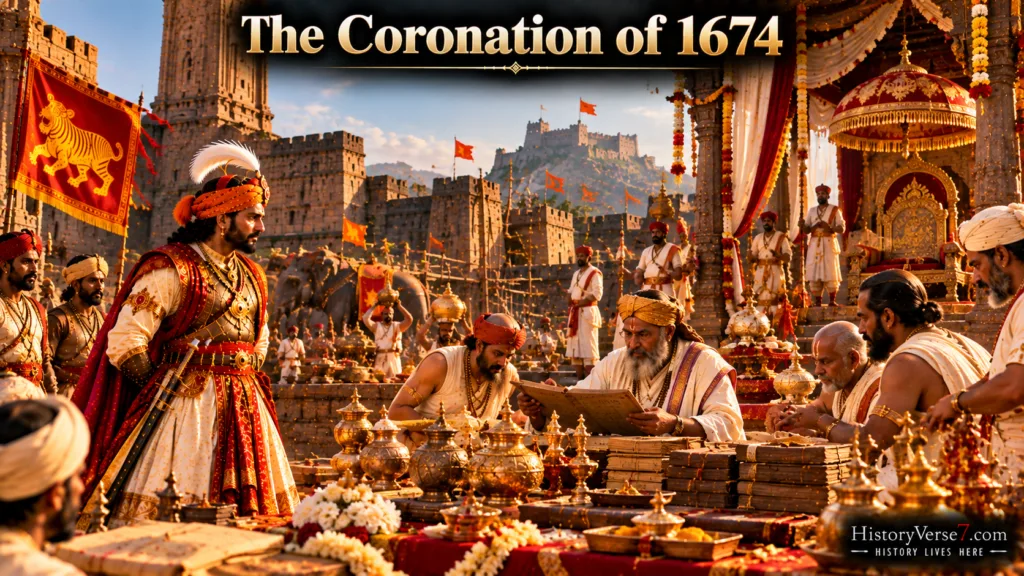
What did the coronation actually change? In practical administrative terms, the transformation was significant rather than merely symbolic. As a formally crowned sovereign, Shivaji could now issue land grants and administrative orders with the full legal weight of royal authority, rather than the more provisional authority of a successful regional commander. A new calendar era, the Rajyabhisheka Shaka, was inaugurated to mark royal years from the coronation, and new coinage was struck in Shivaji’s name as sovereign, both standard practices by which a new kingship asserted its own independent chronological and economic identity rather than continuing to operate within someone else’s. The coronation also gave concrete shape to the Ashtapradhan council of ministers, discussed further below, formalising an administrative structure that had existed in a more improvised form during the earlier, pre-coronation years of Swarajya’s development.
Politically, the coronation forced other regional powers, however reluctantly, to reckon with Shivaji in a different register: no longer simply a troublesome and unusually capable commander to be negotiated with or suppressed, but a crowned king whose sovereignty, once ritually established, carried its own diplomatic and legal weight, even for rivals who refused to formally recognise it.
The Second Coronation-Related Ceremony
A further ceremony connected to Shivaji Maharaj’s kingship took place later in 1674, generally dated to around September of that year. The reasons behind this second ceremony are not settled with complete certainty in the historical record, and different sources and different historians offer somewhat different explanations.
One line of explanation, reflected in some traditional accounts, connects the second ceremony to concerns, raised after the June coronation, about the ritual correctness or completeness of the first ceremony, possibly connected to the influence of Jijabai, who died shortly after the June coronation, and to a desire to ensure the ritual foundation of the new kingship was placed beyond religious doubt. Other historians treat the second ceremony as a Shakta-oriented ritual, connected to goddess worship traditions distinct from the primarily Vedic Brahmanical rite of June, reflecting the genuinely composite religious world of Deccan royal ritual rather than any deficiency in the first ceremony.

What can be said with reasonable confidence is that a second, distinct ceremony did take place at Raigad later in 1674, and that it reinforced rather than replaced the sovereignty established in June. What remains less certain is the precise motivation and full ritual content of this second occasion, and readers should treat detailed explanations of exactly why it happened, beyond this general picture, as resting on a more limited and more debated evidentiary base than the June coronation itself.
Becoming Chhatrapati: What Formal Kingship Meant
With the coronation complete, Shivaji Maharaj’s position changed in ways that rippled through every level of Swarajya’s political life. As Chhatrapati, he held formal, ritually and legally sanctioned authority to govern, tax, judge, grant land, wage war, and conduct diplomacy as a sovereign, not as a delegate of Bijapur or the Mughal emperor, and not as a regional strongman whose authority rested purely on the loyalty of his troops and allies.
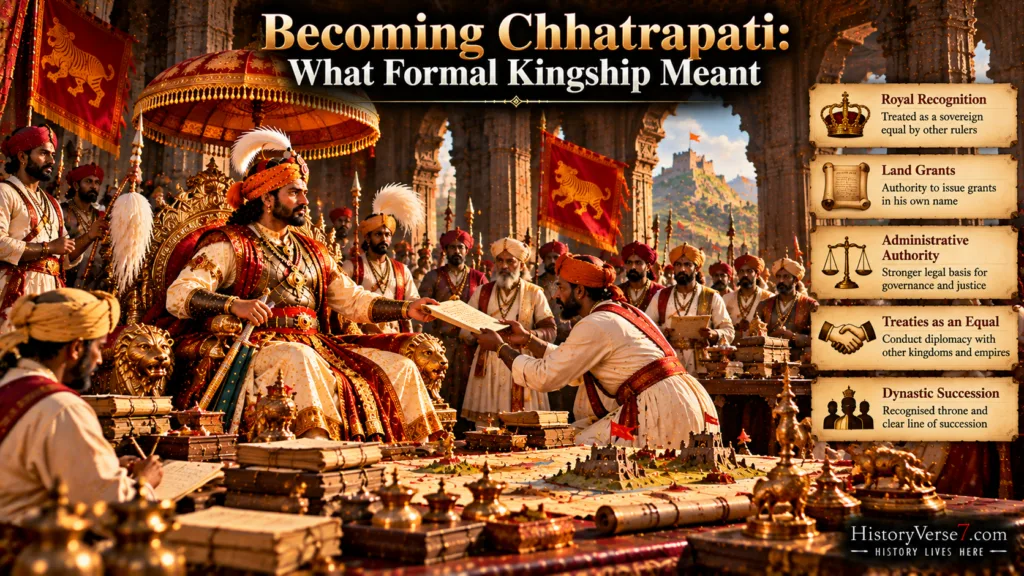
This formal status also reshaped the relationship between the king and his administration. Officials who had served Shivaji Maharaj as trusted lieutenants and commanders during the earlier, more improvised years of Swarajya’s growth now held their positions within a more clearly defined royal hierarchy, one with recognised titles, formal responsibilities, and a clearer chain of authority running from the crowned king downward. And in relations with other powers, however grudging their acknowledgment, Shivaji’s coronation changed the terms on which negotiation, conflict, and diplomacy with Bijapur, the Mughals, and other regional actors would proceed going forward.
Administration of Swarajya: The Mature State
The administrative system Shivaji Maharaj built after his coronation deserves to be understood on its own terms, as a working system adapted to seventeenth-century Deccan conditions, rather than measured against the standards of a modern bureaucracy it was never designed to resemble.
At the centre, the king remained the final authority on all major matters, advised by his council of ministers but not bound by it in the way a modern constitutional monarch might be. Below this central level, fort administration formed a crucial layer of governance, with each significant fort under officials responsible for garrison discipline, supply management, local revenue collection, and basic justice within their surrounding territory, a system that gave Swarajya real administrative reach into the countryside even in areas some distance from Raigad itself. Correspondence, carried by messengers moving between forts and the capital, kept the central administration informed of developments across the kingdom’s territory and allowed royal instructions to reach distant officials, though the speed and reliability of this system inevitably lagged behind what later, more developed states would achieve.
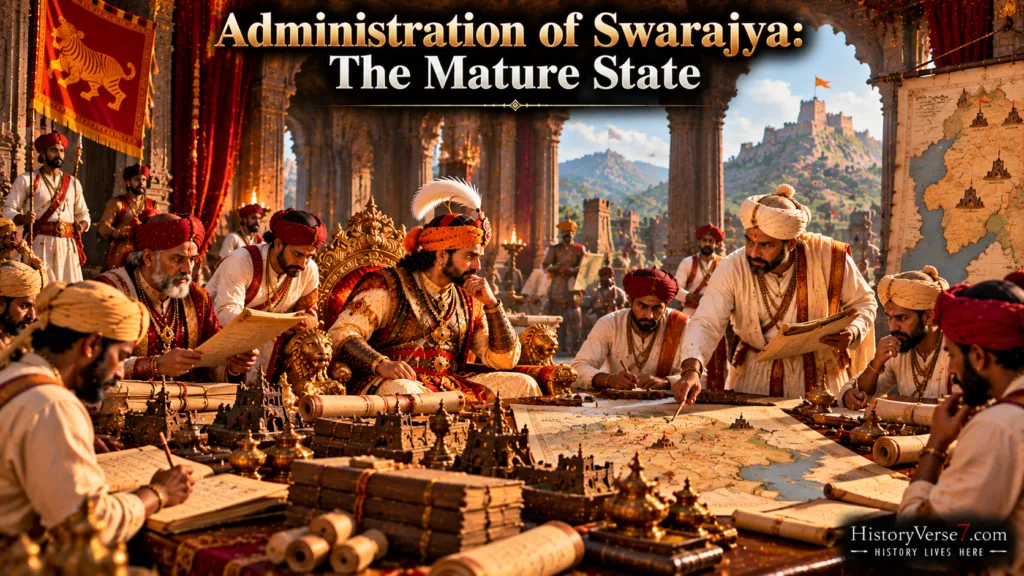
The system had real limitations, and honest history should acknowledge them. Administrative capacity varied considerably across Swarajya’s territory, with some regions, particularly newly acquired or more remote areas, receiving less consistent oversight than the core Sahyadri territory around Raigad and Pune. The system depended heavily on the personal energy, judgment, and continued military success of the king himself, a dependency that would become starkly apparent in the succession crisis following Shivaji Mahraj’s death.
The Ashtapradhan System
The Ashtapradhan, literally the council of eight ministers, gave formal structure to Swarajya’s central administration after the coronation, though several of these roles had informal precedents in the earlier, pre-coronation years. The Peshwa served as the principal minister, overseeing general administration and, in later Maratha history, would grow into a position of far greater independent power than it held under Shivaji Maharaj himself; readers should be careful not to project the Peshwa’s later eighteenth-century prominence back onto this earlier period. The Amatya managed revenue and finance, the Sachiv handled royal correspondence and records, and the Mantri served as a close adviser and, in some accounts, an intelligence or personal-affairs coordinator for the king. The Senapati commanded the army in the field, the Sumant managed foreign affairs and diplomatic relations with other powers, the Nyayadhish oversaw judicial matters, and the Panditrao supervised religious and charitable affairs within the kingdom.
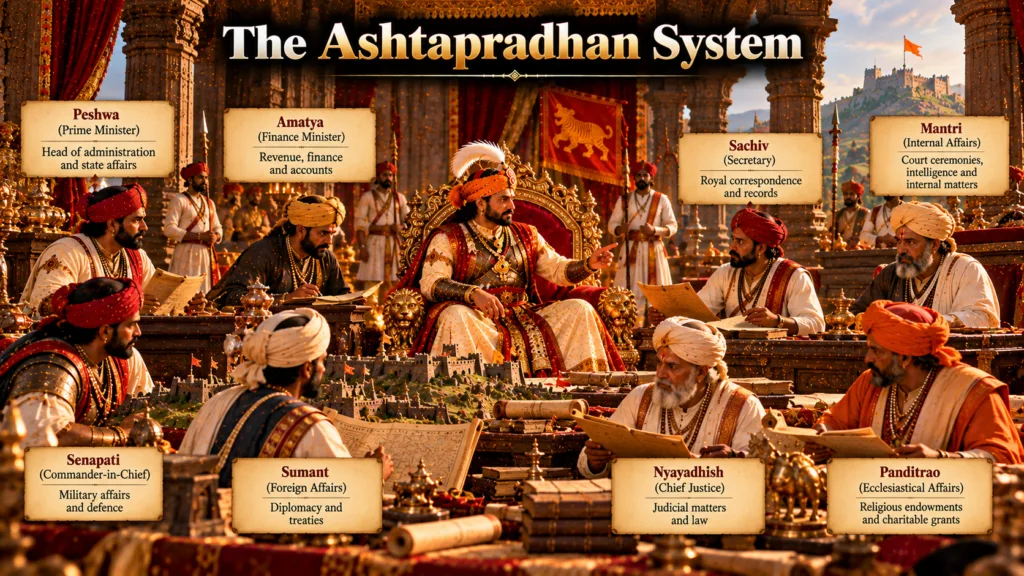
It would be a serious overstatement to describe the Ashtapradhan as equivalent to a modern cabinet or parliament, with independent political power checking that of the sovereign. These were royal appointees serving at the king’s pleasure, with real administrative responsibility but without the kind of institutional independence a modern reader might associate with ministerial government. Their practical authority depended considerably on the individual minister’s personal standing and the king’s own working relationship with them, a pattern consistent with premodern courts generally rather than a distinctive weakness unique to Swarajya.
Land and Revenue Administration
Revenue underpinned everything else the state did, and Shivaji Maharaj’s administration paid close attention to it. Land assessment drew on established Deccan practices for measuring and classifying agricultural land by productivity, adapted and applied under royal authority rather than through the jagirdari intermediaries common under Bijapuri and Mughal administration. This shift mattered: rather than granting large tracts of revenue rights to nobles in exchange for military service, a system that had often meant real power over local populations passing into the hands of intermediaries with their own interests, Swarajya’s administration under Shivaji Maharaj leaned toward more direct state collection of revenue through salaried officials, at least as an aspiration and, in significant parts of the kingdom, as a working practice.
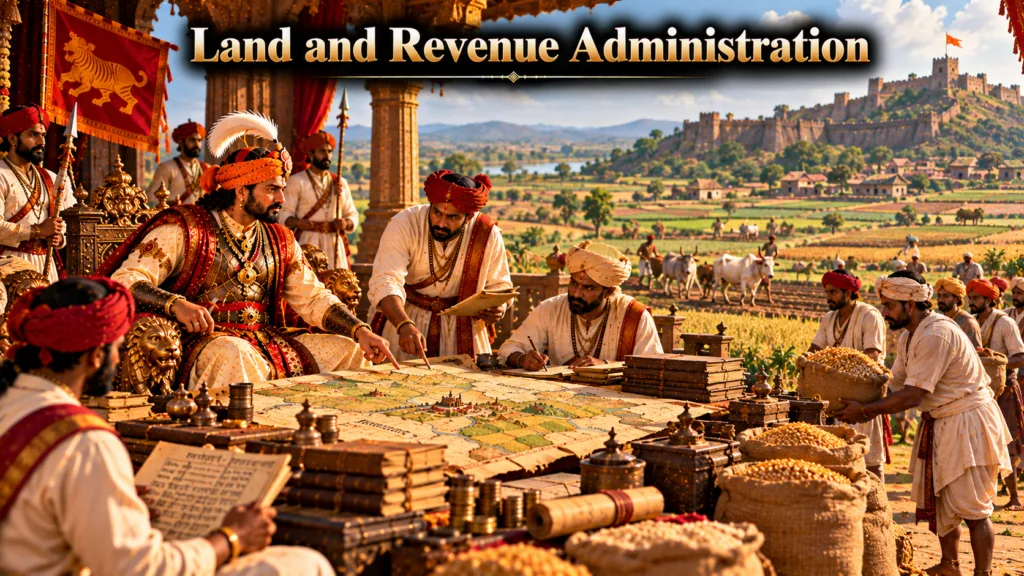
Regional variation was real and should not be minimised. The degree to which this more centralised revenue model actually operated, as opposed to remaining a stated preference, varied across Swarajya’s territory, and newly incorporated regions, particularly in the south, often continued to operate under revenue arrangements closer to existing local practice for some time after coming under Swarajya’s control. Documentary evidence, including surviving revenue records and royal correspondence, supports the general shape of this system while leaving many specific details of implementation, region by region, less fully documented than a modern reader might wish.
Agriculture and Rural Society
Behind every fort garrison, every campaign, and every court ceremony stood the agricultural labour of Swarajya’s rural population, whose experience of the kingdom deserves attention beyond the usual focus on kings and commanders. Continuous warfare across the wider Deccan throughout this period placed real burdens on farming communities, through military requisitioning, the disruption of agricultural cycles by campaigning armies, and the general instability that comes with contested territory.
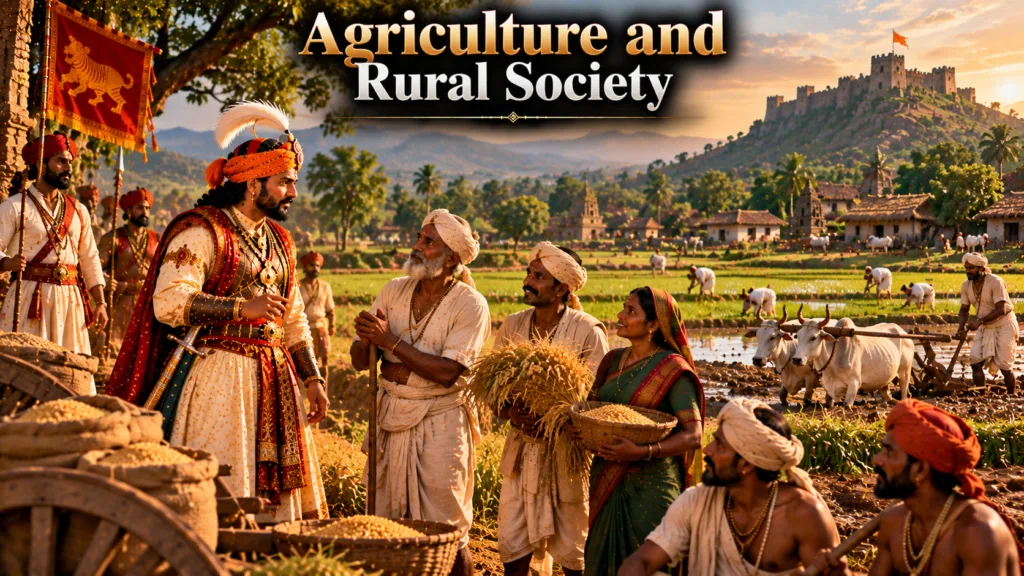
At the same time, evidence suggests that Shivaji Maharaj’s administration took rural stability more seriously than many of its Deccan contemporaries, with policies aimed at limiting looting of agricultural communities by Swarajya’s own troops and at providing a degree of consistent, if not always light, taxation rather than the more arbitrary and predatory extraction that could accompany less disciplined military administration elsewhere in the region. This should be understood as a genuine documented feature of Shivaji Maharaj’s governance rather than an idealised claim that rural life under Swarajya was untouched by the hardships of a near-constantly militarised society; the surviving evidence supports a picture of relative, comparative stability rather than an absence of burden.
Forts as the Backbone of the Mature Kingdom
The fort network that had underpinned Swarajya’s earlier growth, discussed at length in Chapter One, matured after the coronation into the clear administrative and military skeleton of the kingdom. Raigad itself, developed as the capital, combined defensive strength with the architectural and administrative infrastructure appropriate to a royal court, including audience halls, markets, and residential quarters supporting a genuinely functioning seat of government rather than a purely military garrison.
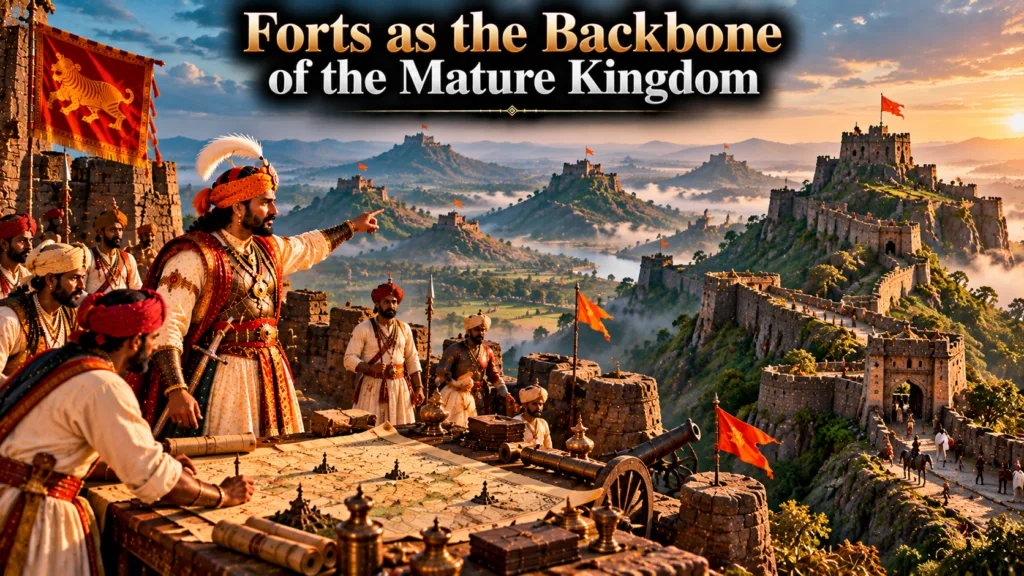
Rajgad and Pratapgad continued to serve important strategic and symbolic roles from Swarajya’s earlier history, while Panhala, in the kingdom’s southern reaches, and Sinhagad and Purandar closer to the core Sahyadri territory, remained significant strongholds within the broader network. Sindhudurg, a purpose-built sea fort constructed off the Konkan coast beginning in the early 1660s and continuing into this later period, represented a distinct and important addition: a fortress designed specifically to project and protect Swarajya’s growing maritime interests, discussed further below. Collectively, these forts continued to serve the same overlapping functions established earlier in Swarajya’s development, military defence, administrative reach, supply storage, and secure communication, now operating within a more fully developed and formally sovereign state structure.
Mature Military Organisation
By this period, Swarajya’s military had grown considerably in scale and organisation from the smaller Maval-based forces of Shivaji Maharaj’s early career, though a full account of Maratha military structure belongs to a separate, dedicated HistoryVerse7 article rather than to this chapter. In outline, the army combined disciplined infantry, increasingly significant cavalry forces, both organised under Swarajya’s direct command and, in some cases, drawn from allied or auxiliary contingents, and the dispersed but coordinated garrisons of the fort network itself.
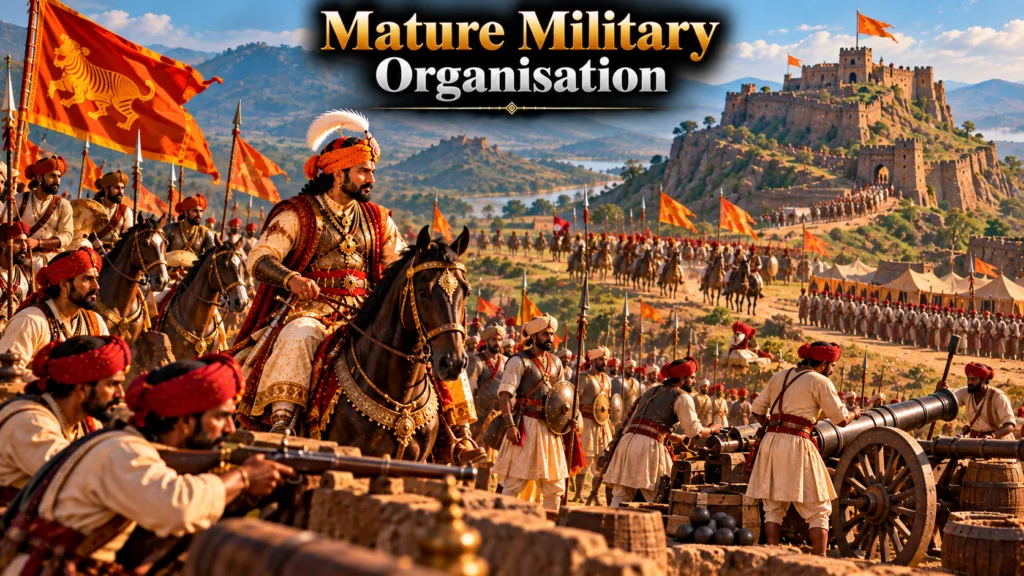
Command structure had become more formalised under the Senapati and subordinate commanders, with clearer lines of authority than the more informal Maval alliances of the earlier period. Logistics, intelligence gathering, and the mobility that had always characterised Shivaji’s approach to warfare remained central strengths, allowing Swarajya’s forces to operate effectively against larger and better-resourced Bijapuri and Mughal armies even as the scale of conflict grew. Discipline, including the restraints on looting and mistreatment of civilian populations noted earlier, remained a documented and distinctive feature of the army’s conduct, though, as with any premodern military force operating across extended campaigns, this discipline should be understood as a genuine institutional priority rather than a claim of flawless consistency in every instance.
Naval Policy
Shivaji Maharaj’s turn toward maritime power reflected a clear strategic logic: control of the Sahyadri hill country alone could not fully secure the Konkan coast or protect Swarajya’s growing coastal trade and territory from threats arriving by sea, including the Siddis of Janjira, who maintained their own naval power along the coast in uneasy and often hostile relations with Swarajya, and the European trading and naval powers, principally the Portuguese and the English, whose commercial and, at times, military interests intersected with Swarajya’s coastal ambitions.
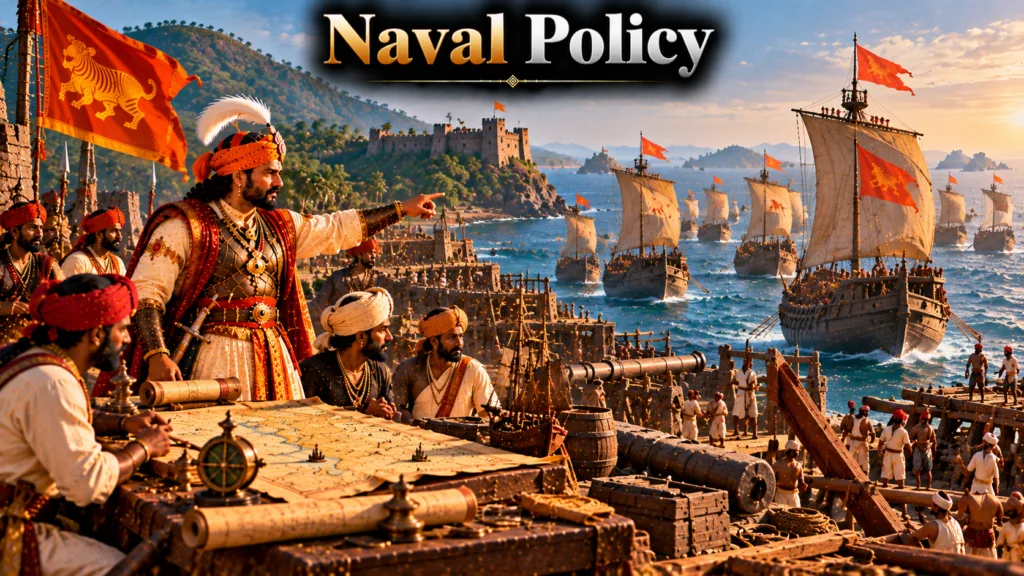
Sindhudurg, constructed as a dedicated sea fort off the Konkan coast, exemplified this maritime strategy, providing a secure base for naval operations and a clear statement of Swarajya’s intent to be a genuine coastal power rather than a purely land-based kingdom. Shivaji Maharaj’s naval forces, while real and strategically significant within the regional context of the Konkan coast, should not be overstated into a claim of broader Indian Ocean naval dominance; Swarajya’s maritime power was substantial by regional Deccan standards and represented a genuinely forward-looking element of state policy, but it operated within a coastal and regional theatre rather than projecting power across the wider Indian Ocean trading world in the way contemporary Portuguese, and later English and Dutch, maritime power did. A separate HistoryVerse7 article on the Maratha Navy covers this subject in fuller detail.
Trade and Commerce
Military security and territorial control under Swarajya had a direct commercial dimension. Control of key passes and coastal territory allowed Shivaji Maharaj’s administration to regulate and, where advantageous, tax trade moving between the Konkan coast and the Deccan interior, while Swarajya’s ports and coastal holdings connected the kingdom to broader regional and, at points, international trade networks in which European trading companies were increasingly significant participants.

This commercial dimension of state policy was not incidental to Swarajya’s military and administrative development but closely bound up with it: secure forts and disciplined military conduct made trade routes more viable, customs revenue from regulated trade contributed to state income alongside land revenue, and control of strategic points along both coastal and inland trade routes gave Swarajya real leverage in dealings with merchant communities and, at times, with European trading interests operating in the region.
Diplomacy
Shivaji Maharaj’s diplomatic record deserves recognition as a genuine strength of his statecraft, distinct from and complementary to his military reputation. His relationships with the major regional powers, the Mughal Empire, Bijapur, and Golconda, shifted repeatedly across his career, moving between open conflict, negotiated treaty, temporary cooperation, and calculated non-aggression as circumstances and Swarajya’s own interests dictated, rather than following any single consistent pattern of pure hostility toward any one power.
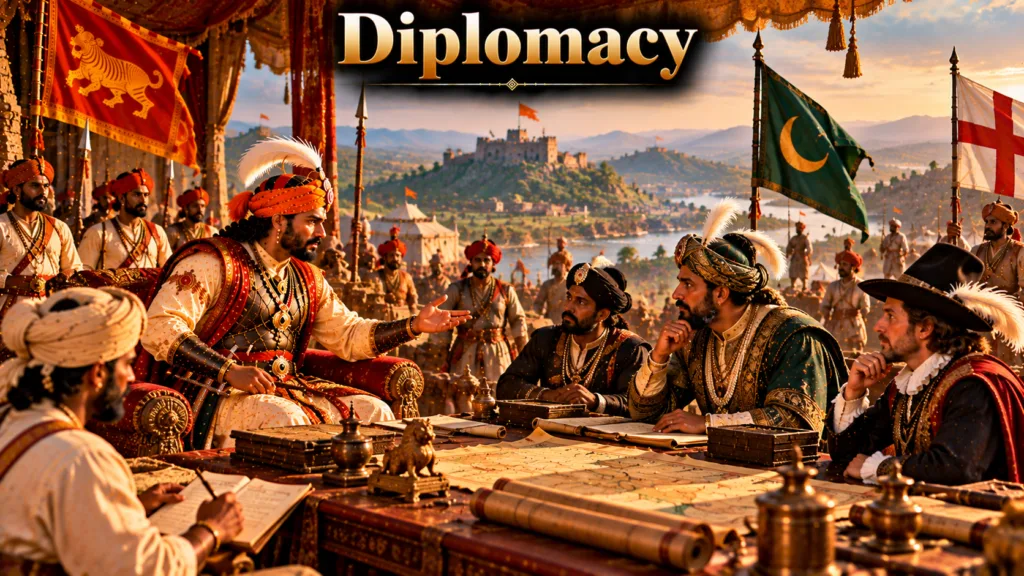
His dealings with the Portuguese and the English reflected a similarly pragmatic approach: negotiation and, at points, cooperation where interests aligned, alongside friction and conflict where they did not, particularly over coastal territory and trade. Relations with the Siddis of Janjira remained largely hostile throughout this period, reflecting direct competition over control of the same stretch of Konkan coastline. This pattern of strategic flexibility, choosing conflict, negotiation, or cooperation based on a clear-eyed assessment of Swarajya’s interests and capacities at any given moment, rather than any fixed ideological commitment to fighting every neighbouring power at all times, is a more accurate and more historically interesting picture than the simpler “Shivaji Maharaj defeated everyone” narrative sometimes found in popular retellings.
Religion and the State
Religion within Swarajya’s mature state, as in the earlier period covered in Chapter One, reflected the genuinely mixed religious landscape of the Deccan, and this section again calls for particular historical care to avoid both anachronism and unsupported idealisation.
As a formally crowned Hindu sovereign, Shivaji Maharaj’s kingship after 1674 carried explicit religious dimensions, reflected in the Vedic coronation ritual itself, in continued patronage of temples and religious institutions within Swarajya’s territory, and in the religious symbolism attached to titles such as Chhatrapati and to Shivaji Maharaj’s broader public image as a protector of dharma within Deccan political and religious tradition. At the same time, Swarajya’s administration and military continued to include Muslim officials and soldiers in documented and meaningful numbers, consistent with the practical, cross-communal realities of Deccan political and military life throughout this period.
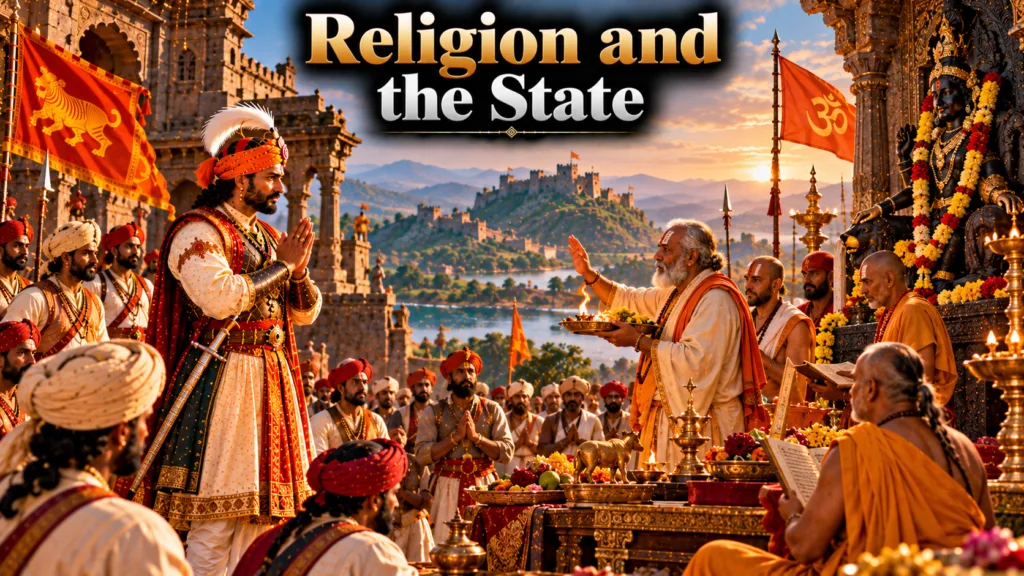
Shivaji Maharaj’s conflicts with Bijapur and the Mughal Empire remained, as in the earlier period, fundamentally political and territorial contests over sovereignty, revenue, and regional power between competing states, rather than being reducible to a straightforward religious war, even as religious symbolism and language, on various sides, was genuinely present in the political culture of the period and should not be entirely written out of the picture either. The responsible historical position holds both realities together: real religious dimensions to Shivaji Maharaj’s kingship and public identity, and a genuinely mixed, pragmatic religious composition to Swarajya’s administration and military, without collapsing either fact into a simpler, more convenient modern narrative.
Women in Swarajya
The historical record for women’s lives within the mature Swarajya state remains, as in the earlier period, considerably thinner than the record for male political and military figures, a limitation of premodern documentation generally rather than a gap specific to Maratha history. Jijabai’s continued influence until her death shortly after the June 1674 coronation is reasonably well documented, and her presence at this pivotal moment in Swarajya’s history, living to see her son formally crowned before her death soon after, is itself a notable and well-attested fact, even where specific anecdotal details of her final months belong more to tradition than to firm documentation.
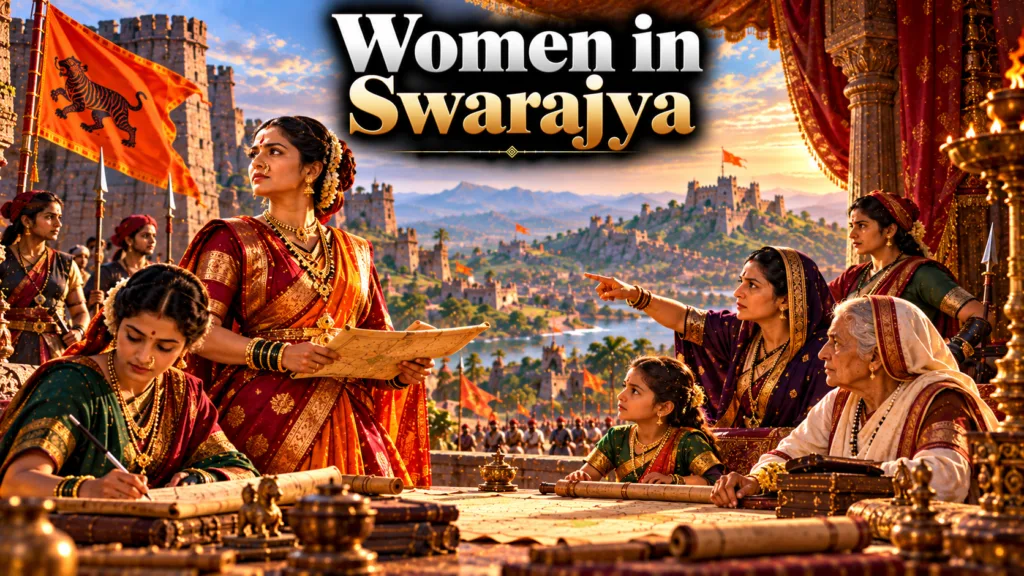
Beyond Jijabai, royal women connected to Shivaji Maharaj’s court, and the wider population of women within Swarajya’s territory, including the families of soldiers stationed at forts across the kingdom and women in agricultural and artisan communities affected by the ongoing warfare of the period, experienced the consequences of state formation and military campaigning in ways the surviving sources document only unevenly. Responsible historical writing should acknowledge this evidentiary gap honestly rather than filling it with unverified anecdote simply because a fuller, more satisfying narrative would be more appealing to readers.
The Southern Campaign: Why Did Shivaji Maharaj Move South?
One of the most significant, and often underexplained, developments of Shivaji Maharaj’s later reign was his major campaign into the Karnataka region and further south, undertaken primarily in 1677 and 1678. Understanding why this campaign mattered requires setting aside the simplified idea that Shivaji Maharaj “conquered South India,” a phrase that considerably overstates and oversimplifies what actually took place.
Several distinct motivations converged in this southern push. Shahaji Raje’s own long career in Bijapuri service in the south, discussed in Chapter One, had left the Bhosale family with existing landed interests and connections around the Bangalore region, interests that Shivaji Maharaj had a personal and dynastic stake in securing, particularly given ongoing family disputes over this southern inheritance involving his half-brother Venkoji, also known as Ekoji, who held territory in the Thanjavur region as a result of Shahaji’s earlier southern career. Beyond family interest, the campaign offered Shivaji Maharaj the strategic opportunity to draw revenue, territory, and political influence away from an increasingly weakened Bijapur and from other regional powers in the Karnataka region, extending Swarajya’s resource base at a time when the kingdom’s core northern territory remained under continued Mughal pressure. There was also a clear strategic logic in establishing a secure southern territorial and financial base, one that could provide Swarajya with resources and, if needed, a zone of relative security somewhat removed from the most direct and sustained Mughal military pressure concentrated in the Deccan’s northern reaches.
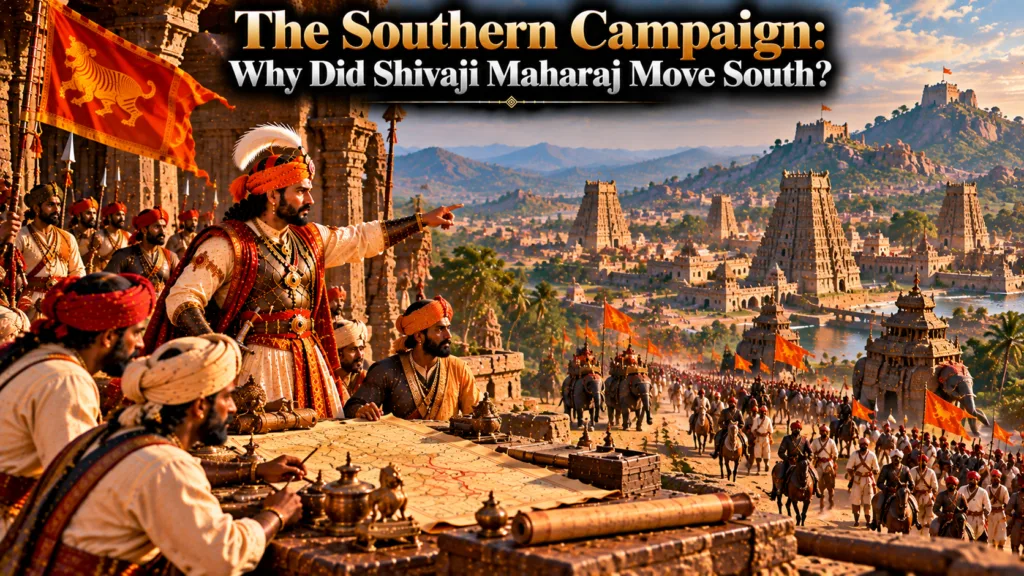
The campaign’s results should be described with precision rather than sweeping claims. Shivaji Maharaj secured substantial new territory and important forts in the Karnataka region, established a degree of direct administrative control in some areas, and secured tribute, political influence, and negotiated arrangements rather than outright annexation in others. This was a genuinely significant extension of Swarajya’s reach and resources, but it involved a considered mixture of direct conquest, negotiated alliance, tribute arrangements, and strategic positioning, not a uniform wave of outright annexation across the entire south.
Shivaji Maharaj and Golconda
Golconda’s role in this southern campaign deserves specific attention, because it illustrates the pragmatic, calculated character of Shivaji Maharaj’s diplomacy discussed earlier. Rather than treating Golconda as simply another rival Deccan sultanate to be fought, Shivaji negotiated a cooperative arrangement with the Qutb Shahi court ahead of and during the southern campaign, securing both financial support and a degree of strategic cooperation for operations that, not coincidentally, were directed substantially against Bijapuri and other territory rather than against Golconda’s own interests.
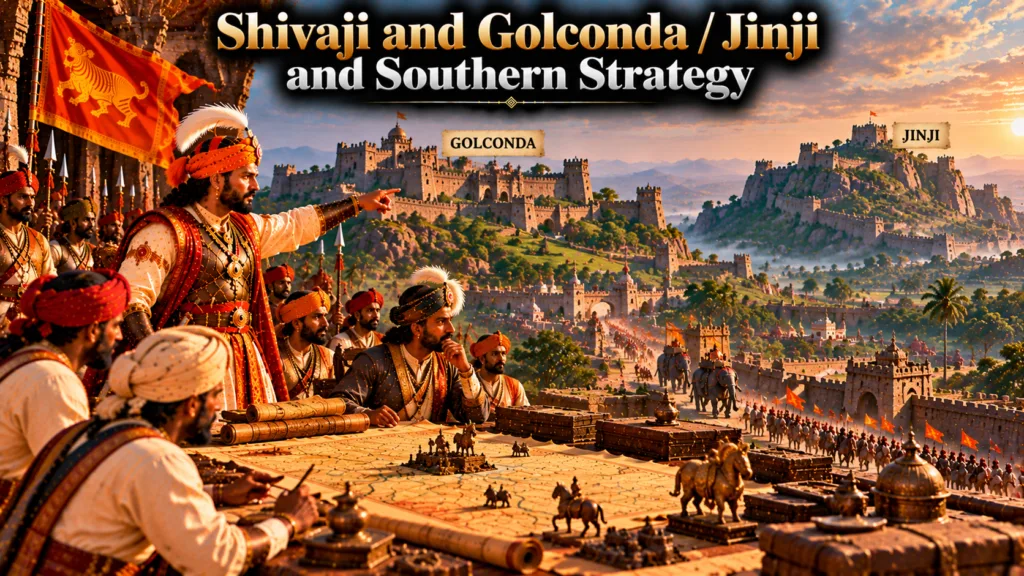
This Golconda arrangement reflected a broader and recurring pattern in Deccan politics of the period, where a shared, if often uneasy, regional interest in checking both Bijapur’s remaining influence and, more fundamentally, continued Mughal expansion could produce genuine, if temporary and carefully bounded, cooperation between powers that had no particular ideological alignment beyond immediate strategic calculation. Sources describing the exact terms and full extent of the Golconda-Swarajya cooperation vary in detail, and historians continue to debate precisely how far this arrangement extended, but the basic fact of meaningful diplomatic and material cooperation between Shivaji and the Qutb Shahi court during this period is well supported.
Jinji and Southern Strategy
Jinji, a formidable hill fortress in the Tamil country far to the south, became an important strategic objective during Shivaji’s southern campaign, valued for its strong natural defences and its position securing Swarajya’s newly extended southern interests. It is essential to be precise here about chronology and to avoid a common source of confusion in popular retellings: Jinji’s far greater historical prominence came later, after Shivaji Maharaj’s death, when his son Rajaram Maharaj made the fortress his base and centre of resistance during the prolonged Mughal war that followed Aurangzeb’s invasion of the Deccan in the 1680s and 1690s.
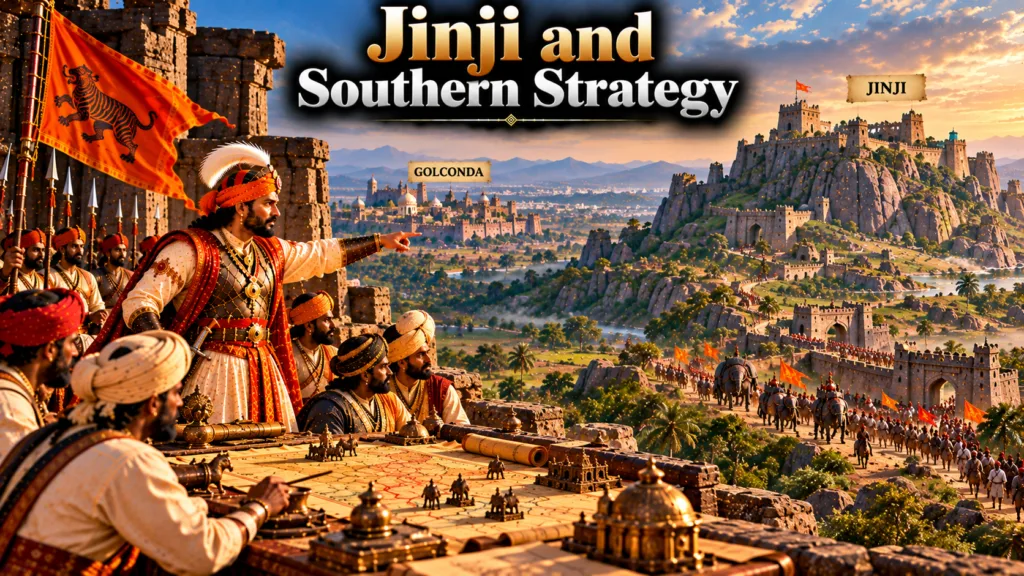
What Shivaji Maharaj himself established at Jinji during his own southern campaign was its initial incorporation into Swarajya’s southern holdings, part of the broader territorial and strategic gains of the 1677 to 1678 campaign, rather than the extended, historically dramatic role the fortress would go on to play under Rajaram’s later and quite different circumstances. Readers should keep these two distinct chapters of Jinji’s history clearly separated: what Shivaji Maharaj achieved there belongs to this southern campaign narrative, while Jinji’s later significance belongs properly to the different and later story of Rajaram Maharaj’s resistance, a subject for its own separate HistoryVerse7 treatment.
Shivaji Maharaj and His Officials
Swarajya’s mature administration depended on a circle of capable officials and commanders whose documented contributions deserve brief acknowledgment here, without turning this section into separate biographies better suited to their own dedicated articles. Moropant Pingle, introduced in Chapter One, continued to serve in a senior administrative capacity into this later period, reflecting the ongoing importance of experienced Brahmin administrative expertise to Swarajya’s governance. Annaji Datto held significant administrative responsibility within the developing Ashtapradhan structure, particularly connected to revenue and record-keeping functions central to the state’s operation. Prataprao Gujar and Hambirrao Mohite both held senior military command, with Hambirrao Mohite in particular rising to prominence as a trusted commander during the later years of Shivaji Maharaj’s reign, while Yesaji Kank, also introduced in Chapter One, continued to serve as a capable and experienced Maratha commander into this mature period of Swarajya’s development.
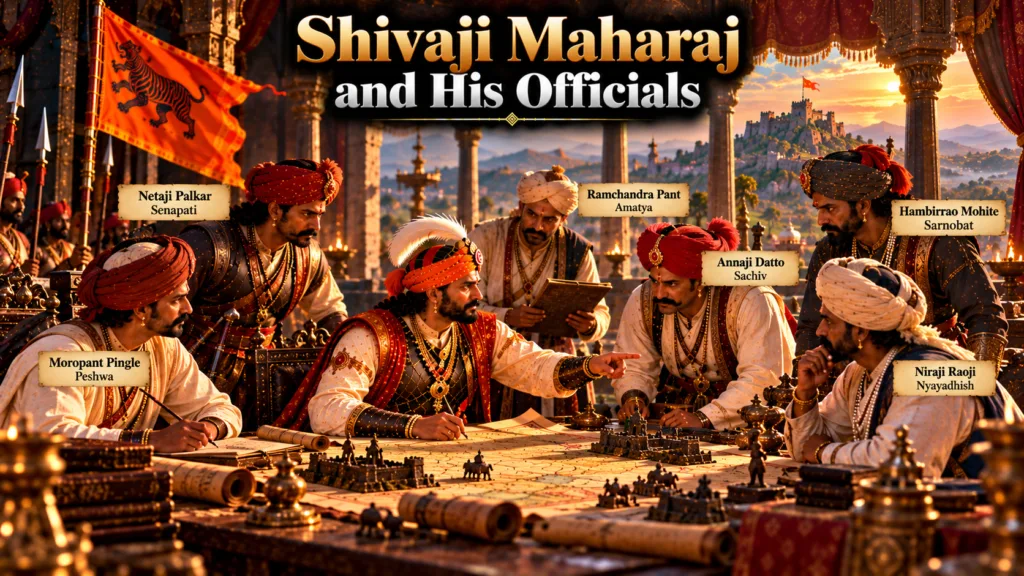
These officials collectively illustrate a consistent feature of Shivaji Maharaj’s governance across both the earlier and later periods of his career: a genuine reliance on capable individuals drawn from across Maratha military families and Brahmin administrative traditions, integrated into a functioning state structure rather than concentrated in the hands of a narrow court favourite class.
The Human Side of the Kingdom
Beyond the court, the Ashtapradhan, and the named commanders, Swarajya’s mature kingdom functioned through the ordinary labour of soldiers stationed across its fort network, farmers whose agricultural production sustained the state’s revenue base, merchants whose trade activity connected the kingdom to wider regional and international commercial networks, artisans producing the goods, weapons, and materials the state and its military required, and fort workers and coastal communities whose labour maintained the physical infrastructure of forts and, increasingly, naval installations like Sindhudurg.

The surviving documentary record allows only a partial view of these lives, concentrated as it is on royal, administrative, and military activity, but the basic shape of the kingdom’s functioning, a state resting on the coordinated, if unevenly documented, contribution of a genuinely broad cross-section of Deccan society, deserves acknowledgment as part of any honest account of what Shivaji Maharaj built, rather than allowing the kingdom’s history to collapse entirely into the actions of its king and his named officials alone.
Shivaji Maharaj’s Final Years
The years following the southern campaign and Shivaji Maharaj return to the Deccan core saw continued, complex political activity rather than a settled or peaceful retirement from active rule. Mughal pressure on Swarajya’s northern territory continued, requiring ongoing military and administrative attention even as the kingdom absorbed and consolidated its southern gains. Relations with a weakened but still functioning Bijapur remained an active concern, and internal administration, including the continuing work of the Ashtapradhan and fort officials across an now considerably larger and more geographically dispersed kingdom, demanded sustained royal attention.
Family and succession questions also became more pressing during this period. Shivaji Maharaj’s elder son, Sambhaji Raje, had a documented and at times difficult relationship with his father, including a well-attested period of estrangement during which Sambhaji Maharaj, for reasons that remain a matter of some historical discussion, spent time within the Mughal administrative orbit before returning to Swarajya. Shivaji Maharaj’s younger son, Rajaram, born to his wife Soyarabai, was considerably younger than Sambhaji Maharaj during this final period of Shivaji Maharaj reign. Soyarabai and various ministers within the court held differing views and interests regarding the succession question, dynamics that would become fully apparent only after Shivaji Maharaj’s death but that were, on the evidence available, already present as an undercurrent within court politics during these final years. Historians rightly urge caution here: the surviving sources for these court dynamics are neither fully complete nor entirely free of later partisan shaping, and confident, detailed reconstruction of exactly who favoured which succession outcome, and why, during Shivaji Maharaj’s own lifetime goes beyond what the evidence can firmly support.
Sambhaji Raje and the Succession Question
The succession question that would erupt fully after Shivaji Maharaj’s death had its roots in this final period of his reign. Sambhaji Raje, as the elder son, held a documented claim to succession by conventional expectation, but his earlier estrangement from his father and the presence of Soyarabai and her supporters within the Raigad court, with their own evident interest in Rajaram’s prospects, meant that the succession was not, in the final years of Shivaji Maharaj’s life, an entirely settled or uncontested matter in practice, even if it may have appeared more settled in principle.
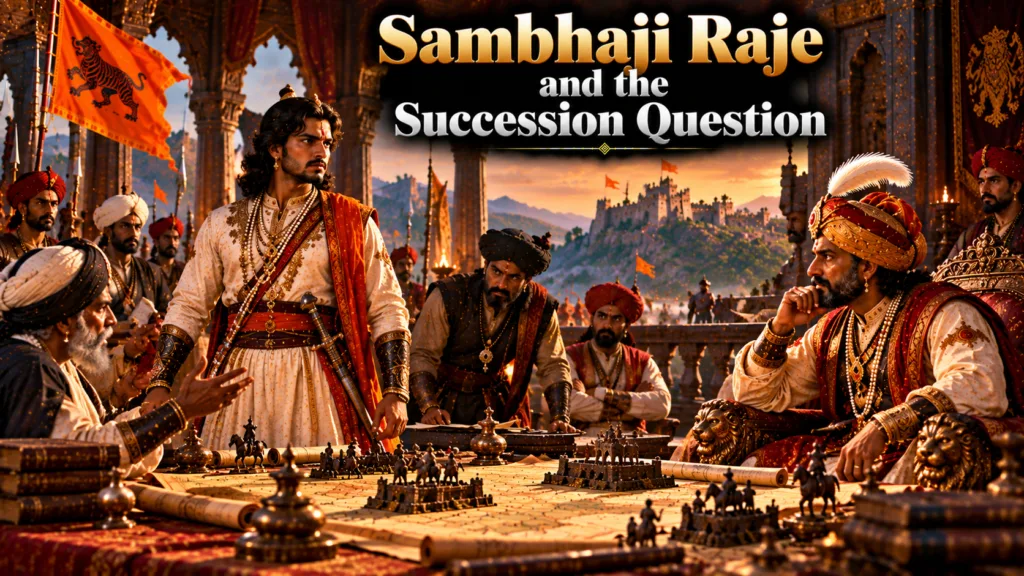
It would be a mistake to read back into this period the full-blown succession crisis that erupted immediately after Shivaji Maharaj’s death, discussed below, as though it were already a fully formed and clearly documented conflict during his own lifetime. What can be responsibly said is that the underlying tensions, between Sambhaji Maharaj’s position as elder son and the court faction with an interest in Rajaram, existed in some form before Shivaji Maharaj’s death and provide necessary context for understanding how quickly and how seriously the succession crisis unfolded once he died, rather than that crisis representing some sudden and unforeshadowed rupture.
Death of Shivaji Maharaj
Shivaji Maharaj died at Raigad on 3 April 1680, generally understood from contemporary and near-contemporary sources to have followed a period of illness. The precise nature of this illness is not established with full certainty in the surviving record, and various traditions and later accounts offer differing descriptions of his final sickness.
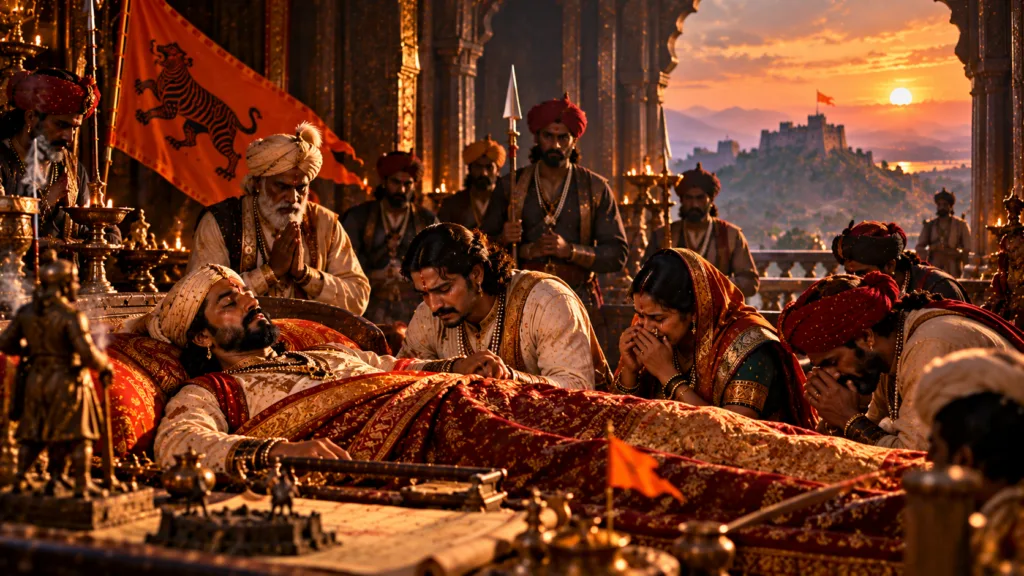
Readers should be aware that theories of poisoning or deliberate foul play connected to Shivaji Maharaj’s death circulate in some popular and traditional accounts, generally connected to court faction rivalries of the kind discussed above. These theories are not supported by reliable contemporary evidence sufficient to treat them as established historical fact, and responsible historical writing should present them, if mentioned at all, clearly labelled as unverified tradition rather than as a plausible alternative account carrying comparable weight to the documented picture of death following illness. The honest historical position is one of genuine uncertainty about the precise medical cause of Shivaji Maharaj’s final illness, combined with reasonably solid confidence about the basic facts of when and where he died.
What Happened After His Death?
Shivaji Maharaj’s death triggered an immediate and serious succession crisis at Raigad, a subject whose full detail belongs properly to a dedicated HistoryVerse7 article on Sambhaji Maharaj rather than to an extended treatment here, but which deserves brief and accurate acknowledgment as the direct continuation of the tensions described above.

In the immediate aftermath, a court faction connected to Soyarabai moved to have the young Rajaram installed on the throne rather than Sambhaji Raje, who was, at the time, positioned at some distance from Raigad. Sambhaji Maharaj responded decisively, moving quickly to assert his own claim, securing control of Raigad, and establishing himself as Shivaji’s actual successor within a matter of weeks, a resolution achieved through his own political and military assertiveness rather than through any smooth, uncontested transfer of power. This crisis, brief but genuinely serious, illustrates clearly how much of Swarajya’s stability had depended on Shivaji Maharaj’s own personal authority, a dependency whose consequences became immediately visible the moment that authority was removed by his death.
What Did Shivaji Maharaj Actually Build?
Assessing Swarajya honestly at the moment of Shivaji Maharaj’s death requires looking clearly at what had genuinely matured into durable institutions and what remained more dependent on his personal leadership than any stable state can safely be.
Territorially, Swarajya at Shivaji Maharaj’s death controlled a substantial and, by regional Deccan standards, genuinely impressive expanse of land, stretching from the Sahyadri core through the Konkan coast and into significant holdings in Karnataka and the south, secured by an extensive and well-developed fort network representing perhaps the single most mature and durable institutional achievement of the reign. The army, while it would face severe tests in the Mughal war that followed under Aurangzeb’s direct invasion of the Deccan in subsequent years, had developed genuine organisational sophistication and a demonstrated capacity for effective, adaptive warfare against larger opponents. The navy, though regionally rather than globally significant, represented a genuinely forward-looking and largely successful innovation, unusual among contemporary Deccan land powers. Revenue administration and the broader civil administration, including the Ashtapradhan system, had developed real institutional substance, though, as noted throughout this chapter, with meaningful regional variation in how consistently and completely these systems actually operated across the kingdom’s full territory. Diplomacy had proven itself a genuine strength, with Shivaji Maharaj’s flexible, interest-driven approach to relations with Bijapur, Golconda, the Mughals, and European powers securing real strategic benefit repeatedly across his career. And royal legitimacy itself, absent before 1674, had been successfully and durably established through the coronation, an achievement whose importance is easy to underrate precisely because it succeeded so completely that it can be taken for granted in hindsight.
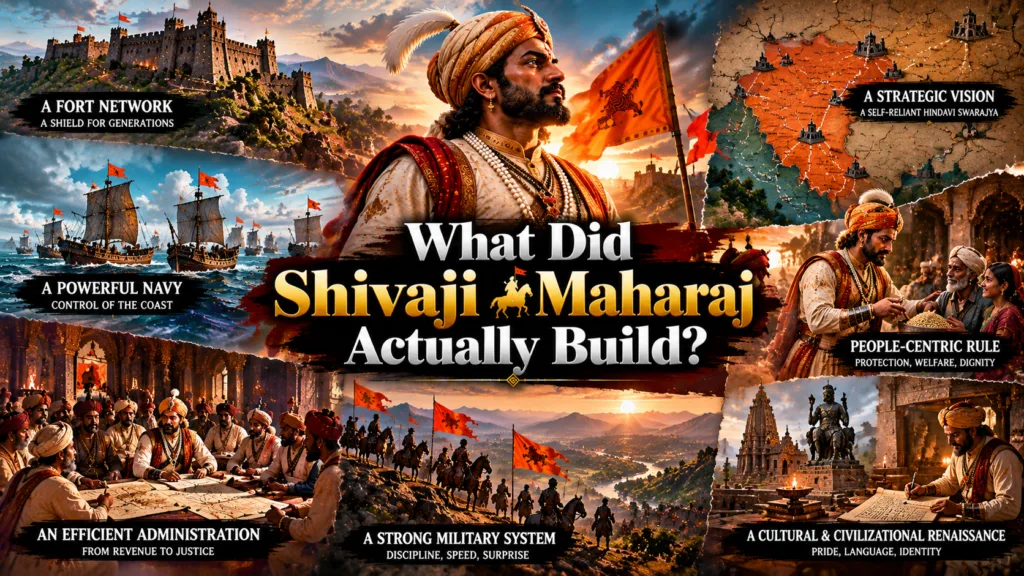
Set against these real achievements, several things remained genuinely unfinished or precarious at Shivaji Maharaj’s death. Administrative consistency across the kingdom’s full, and by this point quite extensive, territory remained uneven, with newer southern acquisitions in particular less deeply integrated into Swarajya’s institutional structure than the older Sahyadri core. Succession, despite the formal establishment of hereditary Chhatrapati kingship through the coronation, proved immediately and seriously contested the moment Shivaji Maharaj died, revealing that dynastic legitimacy in principle had not yet translated into a fully secure, uncontested mechanism for the actual, practical transfer of power. And the kingdom’s overall stability, for all its genuine institutional development, remained more heavily dependent on Shivaji Maharaj’s personal political and military judgment than a fully mature state built to outlast any single ruler ideally should be, a dependency the swift and serious succession crisis following his death made unmistakably clear.
Shivaji Maharaj and the Later Maratha Empire
The state Shivaji Maharaj built became, without question, the essential foundation on which later Maratha power was constructed, but this connection should be described with precision rather than treated as a direct, seamless continuity in which Shivaji Maharaj himself is credited with achievements that properly belong to his successors.

Sambhaji Maharaj, Shivaji Maharaj’s immediate successor, faced and ultimately did not survive the massive Mughal invasion of the Deccan personally led by Aurangzeb beginning in the 1680s, a war of an entirely different scale from anything Shivaji Maharaj himself had faced. Rajaram Maharaj, ruling after Sambhaji Maharaj, continued Maratha resistance during this prolonged Mughal war partly from the southern fortress of Jinji, whose earlier, more limited role under Shivaji was discussed above. Tarabai, Rajaram’s widow, subsequently played a crucial role in sustaining Maratha resistance during a further period of crisis. The dramatic eighteenth-century expansion of Maratha power across much of the Indian subcontinent, achieved under later Peshwa leadership operating from Pune with a political structure and geographic scope considerably different from and considerably larger than Shivaji’s own kingdom, represents a genuinely later development built upon the foundation Shivaji established rather than something Shivaji Maharaj himself accomplished or could reasonably be said to have directly authored. Crediting these later, larger achievements directly to Shivaji, rather than to the successors and institutions that built upon his foundation across subsequent generations, would blur an important and historically meaningful distinction.
Shivaji Maharaj in Historiography
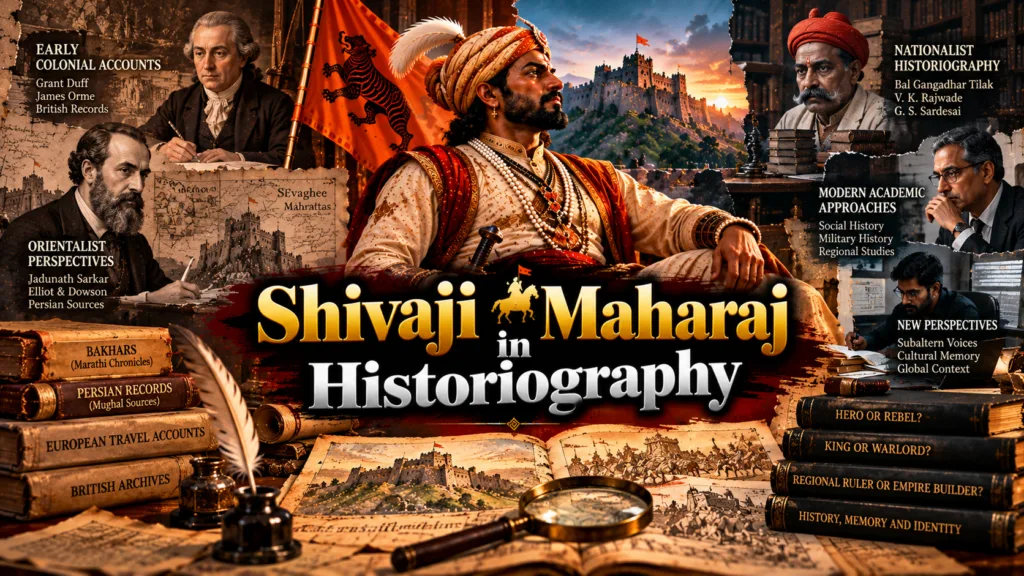
Historians working from different disciplinary angles have illuminated different aspects of Shivaji Maharaj’s career and its wider significance. Military historians have examined Swarajya’s fort-based, mobility-centred warfare as a case study in how a smaller regional power could sustain effective resistance against far larger conventional forces. Scholars of state formation have studied Swarajya’s administrative development as an example of premodern South Asian state-building under conditions of sustained external military pressure. Specialists in Deccan and Mughal-Maratha relations have worked to place Shivaji Maharaj’s career within the fuller, more complex political landscape of seventeenth-century Deccan politics, correcting narratives that isolate his story from its broader regional context. Economic historians have examined Swarajya’s revenue and trade policies, while maritime historians have assessed the genuine but regionally bounded significance of Shivaji Maharaj’s naval initiatives discussed earlier in this chapter. Scholars of religion and Deccan society, meanwhile, have worked to place Swarajya’s religious policy within the genuinely mixed and pragmatic religious landscape of the period discussed above, resisting both anachronistic modern political framing and unsupported idealisation in either direction. This chapter, and its companion, has drawn on the general shape of this varied scholarship rather than manufacturing artificial disagreement where genuine, careful historical consensus exists, while flagging, as this biography has tried to do throughout, the specific points where real and legitimate historical debate remains open.
15 Lesser-Known Facts
- Modern academic historiography on Shivaji Maharaj spans military history, state formation studies, economic and maritime history, and religious history, reflecting how many different scholarly angles are needed to assess the full range of what his reign actually involved.
- Shivaji’s coronation required the specific ritual validation of Kshatriya status by Gagabhatt, a process that involved real negotiation and expense rather than being an automatic formality available to any successful regional ruler.
- A new calendar era, the Rajyabhisheka Shaka, was inaugurated to mark royal years from the June 1674 coronation, a standard practice by which new sovereignty asserted its own independent chronological identity.
- New coinage was struck in Shivaji’s name as part of establishing his formal sovereignty, a concrete economic expression of the coronation’s legal and political significance.
- Jijabai died shortly after witnessing her son’s June 1674 coronation, meaning she lived to see the formal culmination of a political project she had helped sustain from Shivaji’s earliest childhood in the Pune jagir.
- A second, distinct ceremony connected to Shivaji’s kingship took place later in 1674, whose precise motivation remains a matter of genuine historical discussion rather than settled consensus.
- The Peshwa under Shivaji Maharaj held a position of real but bounded administrative responsibility, considerably less independently powerful than the office would become under later eighteenth-century Peshwa leadership.
- Sindhudurg, the purpose-built sea fort off the Konkan coast, represented one of the more genuinely innovative elements of Swarajya’s later state-building, reflecting a deliberate strategic turn toward maritime power.
- Shivaji’s southern campaign of 1677 to 1678 involved real cooperation with Golconda, a reminder that Deccan politics of this period could produce practical alliances between powers with no particular ideological alignment beyond shared immediate interest.
- Jinji’s later fame as a centre of Maratha resistance belongs to Rajaram Maharaj’s occupation of the fortress after Shivaji’s death, not to Shivaji’s own, more limited southern campaign, a distinction popular retellings sometimes blur.
- Sambhaji’s relationship with his father included a documented period of estrangement, during which he spent time within the Mughal administrative orbit before returning to Swarajya, a complicating detail often left out of simpler succession narratives.
- Annaji Datto’s administrative role within the Ashtapradhan structure reflected the continuing importance of specialised record-keeping and revenue expertise to Swarajya’s mature governance.
- Hambirrao Mohite rose to particular prominence as a senior military commander during the later years of Shivaji’s reign, illustrating the continued importance of capable Maratha commanders beyond the more famous names of the earlier period.
- Shivaji’s relations with the Siddis of Janjira remained largely and consistently hostile throughout this later period, reflecting direct and ongoing competition over the same stretch of Konkan coastline that Swarajya’s naval policy was designed to secure.
- The succession crisis following Shivaji’s death was resolved within weeks rather than dragging on for an extended period, a fact that is sometimes lost in popular retellings that treat the crisis as either nonexistent or as a prolonged civil war.
Author Perspective — HistoryVerse7
If Chapter One is the story of how Swarajya was built, Chapter Two is the story of how it was made to last, or at least how hard Shivaji Maharaj worked to make it last, because the succession crisis that erupted within weeks of his death is a sober reminder that no amount of coronation ritual or administrative structure can fully substitute for a ruler’s own presence.
What I find most historically significant about this later period is not the coronation ceremony itself, dramatic and important as it was, but everything it made possible afterward: a calendar of his own, coinage of his own, ministers operating within a formally sovereign hierarchy, a navy built from nothing to secure a coastline that land power alone could never fully protect, and a southern campaign conducted with real diplomatic sophistication rather than blunt force. State formation, political legitimacy, military adaptation, maritime policy, and diplomacy- the same threads from Chapter One- now operating at the scale of an actual kingdom rather than an emerging one.
And that is why this chapter has tried just as hard as the first not to flatten the story into simple triumph. Swarajya at Shivaji Maharaj’s death was a genuine, mature, historically significant state. It was also unfinished business in real and specific ways, administratively uneven, still at war, and immediately contested at the moment of succession. Both things are true, and a serious account of his legacy has to hold onto both.
Conclusion
The story told across these two chapters traces a genuinely remarkable transformation: a boy born at a hill fort during an unsettled moment in Deccan politics, raised substantially by his mother while his father pursued his own considerable military career far to the south, who built, fort by fort and alliance by alliance, an independent political project that survived confrontation with Bijapur, daring strikes against Mughal power, the costly Treaty of Purandar, and the genuinely dangerous crisis of Agra, before finally securing, through the 1674 coronation, the formal sovereignty that transformed Swarajya from a powerful but ambiguously defined territory into a recognised kingdom with its own king, its own calendar, its own coinage, and its own institutions of government.
What Shivaji Maharaj left behind at his death in 1680 was substantial and real: a functioning state with a mature administrative structure, an extensive and strategically coherent fort network, a capable army and a genuinely innovative regional navy, a demonstrated capacity for flexible and effective diplomacy, and, perhaps most fundamentally, a durable template of formally legitimate Hindu Maratha sovereignty in the Deccan that his successors, across the difficult and dangerous decades that followed his death, would draw upon even as they faced challenges, above all the full-scale Mughal invasion under Aurangzeb himself, of a scale Shivaji Maharaj had never had to confront directly. What remained unfinished- the uneven integration of newly won southern territory, the unresolved fragility of succession mechanisms exposed within weeks of his death, and the unrelenting pressure of Mughal power that would soon test everything Swarajya had built far more severely than anything faced during Shivaji’s own lifetime, is as much a part of this history as the achievements themselves.
That combination, real and lasting achievement alongside real and unresolved limitation, is the honest note on which this two-chapter biography of Chhatrapati Shivaji Maharaj closes: not a story of flawless or complete triumph, but the genuinely significant, carefully documented history of how a regional Deccan family built, against considerable odds, a sovereign kingdom whose institutions, memory, and example would shape the following century and a half of South Asian history in ways its founder could not have fully foreseen from the ramparts of Shivneri.
Written & Researched by Abhishek Chavan — HistoryVerse7| © 2026 HistoryVerse7 | Article: Chhatrapati Shivaji Maharaj (Chapter – 2)
FAQ — Chhatrapati Shivaji Maharaj (Chapter – 2)
Why was Shivaji Maharaj crowned?
Formal coronation gave Shivaji recognised sovereign legitimacy, standing to be treated as an equal by other kings, legal authority for grants and administration, and a basis for dynastic succession, none of which territorial control alone could provide.
When was Shivaji Maharaj crowned?
The main coronation took place on 6 June 1674, with a second, related ceremony following later that year.
Where was Shivaji Maharaj crowned?
The coronation took place at Raigad Fort, which Shivaji had developed as his capital.
Who performed the coronation?
Gagabhatt, a Brahmin ritual scholar from Varanasi, validated Shivaji’s Kshatriya status and conducted the Vedic coronation rites.
How did Shivaji Maharaj administer Swarajya?
Through a combination of central ministers, fort-based local administration, and revenue officials, with real institutional substance but meaningful regional variation in consistency.
From Shivba to Chhatrapati — The Making of Swarajya
Shivaji Maharaj’s historical journey was not simply a story of battles and territorial expansion. It was also a story of sovereignty, administration, forts, military organisation, maritime policy, diplomacy and the construction of a durable political system.
Chapter 2 continues the story from the foundation established in Chapter 1 and follows the transformation of Swarajya into a formally organised kingdom.
Share this content: