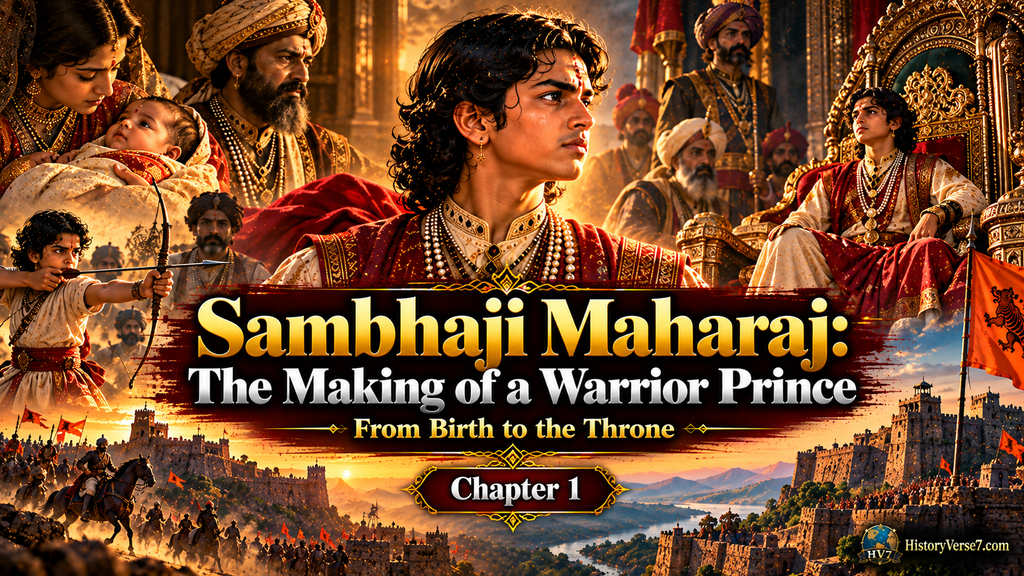
Sambhaji Maharaj: The Making of a Warrior Prince—From Birth to the Throne(Chapter 1)
HISTORYVERSE7 • SAMBHAJI MAHARAJ • CHAPTER 1 Sambhaji Maharaj: The Making of a Warrior Prince Before Sambhaji Maharaj became Chhatrapati, he had already lived through war, diplomacy, education, royal politics and the difficult question of succession. His early life cannot be understood separately from the political world created by Shivaji Maharaj and the wider Deccan….
Sambhaji Maharaj: The Making of a Warrior Prince
Before Sambhaji Maharaj became Chhatrapati, he had already lived through war, diplomacy, education, royal politics and the difficult question of succession. His early life cannot be understood separately from the political world created by Shivaji Maharaj and the wider Deccan.
This HistoryVerse7 chapter examines Sambhaji Maharaj’s formative years through historical evidence, scholarly research, government sources and documented heritage records. Where sources disagree, the distinction between evidence and later tradition is maintained.
The story continues in four days — with Sambhaji Maharaj’s accession, the challenges of ruling Shivaji Maharaj’s state, the Mughal conflict, diplomacy, warfare and the difficult years of his reign.
HistoryVerse7 Source Principle: Contemporary evidence, official records, academic scholarship and documented heritage sources are distinguished from later traditions and popular narratives.
Table of Contents
Timeline
| Date | Event | Significance |
| 1636 to 1655 | Shahaji Raje’s southern career under Bijapur | Provides the wider family and political context into which Sambhaji was born; not a direct event in his own life. |
| 1657 (14 May) | Birth of Sambhaji Maharaj at Purandar Fort | Widely accepted date in modern scholarship; eldest son of Shivaji Maharaj and Saibai. |
| 1659 (5 September) | Death of Saibai at Rajgad Fort | Sambhaji, aged two, loses his mother; his upbringing passes substantially to his grandmother Jijabai. |
| 1665 (June) | Treaty of Purandar | Draws the young Sambhaji directly into Mughal-Maratha diplomatic arrangements for the first time. |
| 1666 | Agra journey, confinement, and escape | Sambhaji, around age nine, accompanies his father to Aurangzeb’s court, experiences house arrest, and takes part in the escape and return to the Deccan. |
| 1667 (November) | Sambhaji serves under Prince Muazzam | Visits the Mughal viceroy at Aurangabad; granted revenue rights in Berar; Maratha forces under his nominal association cooperate with Mughal forces against Bijapur. Date disputed in some later retellings regarding exact chronology of associated events. |
| 1667 to 1670 | Period of Mughal-Maratha cooperation | Sambhaji’s forces, alongside commanders including Prataprao Gujar, operate jointly with Mughal troops against Bijapur. |
| 1674 (6 June) | Coronation of Shivaji Maharaj | Sambhaji, aged seventeen, formally recognized as heir apparent; an English observer records his seated position of honor at the ceremony. |
| Mid-1670s (date uncertain) | Confinement of Sambhaji at Panhala Fort | Reasons for the confinement are disputed among sources; later tradition and near-contemporary accounts differ. |
| 1678 (13 December) | Sambhaji defects to the Mughals | Leaves Sajjangad to join Diler Khan at Pedgaon; granted elevated Mughal rank and the title of Raja by Aurangzeb. |
| 1679 (April) | Battle of Bhupalgad | Sambhaji present with Diler Khan’s forces during the fall of the fort; garrison and sheltering civilians treated with significant cruelty. |
| 1679 to 1680 (exact date uncertain) | Sambhaji returns to the Maratha side | Sources do not provide a fully clear account of the circumstances of his return. |
Who Was Sambhaji Maharaj Before He Became Chhatrapati?
HistoryVerse7.com | Article: Sambhaji Maharaj (Chapter 1) | International English Edition
Sambhaji Maharaj is remembered, in most popular accounts, through the final nine years of his life: the years of open war against the Mughal Empire, capture, and a brutal execution that turned him into a lasting symbol of resistance. That story matters, and it belongs to its own chapter. But it tends to crowd out a different, equally important question: who was this man before 1680, before he inherited a throne and a war he did not start but would eventually die defending?
The answer is not simple, and it should not be made simple. By the time Sambhaji Raje became Chhatrapati, he had already lost his mother before he could remember her, grown up largely under his grandmother’s supervision, spent time as a child hostage at the Mughal court, escaped confinement alongside his father, served briefly under a Mughal prince against Bijapur, been confined by his own father under circumstances that remain genuinely disputed, defected to the Mughal side for close to a year, returned to the Maratha fold, and finally seized the throne against a rival faction within his own family. This is not the biography of a man who arrived at kingship as a blank page. It is the biography of someone shaped, sometimes roughly, by a decade and a half of war, diplomacy, education, and family politics and understanding that shaping is necessary before any fair judgment can be made about the king he became.
This chapter covers that formation: birth to accession. It does not attempt to explain or evaluate his reign as Chhatrapati. That is the subject of Chapter Two.
The World Into Which Sambhaji Was Born
Sambhaji was born into a Deccan already reshaped by his father’s political project. By the mid-1650s, Shivaji Maharaj’s Swarajya was no longer a fragile cluster of hill forts held together by local alliances; it was a functioning, expanding territory with its own administration, contesting Bijapur directly and beginning to draw the attention of the Mughal Empire, which had already absorbed Ahmadnagar decades earlier and was steadily extending its reach south.
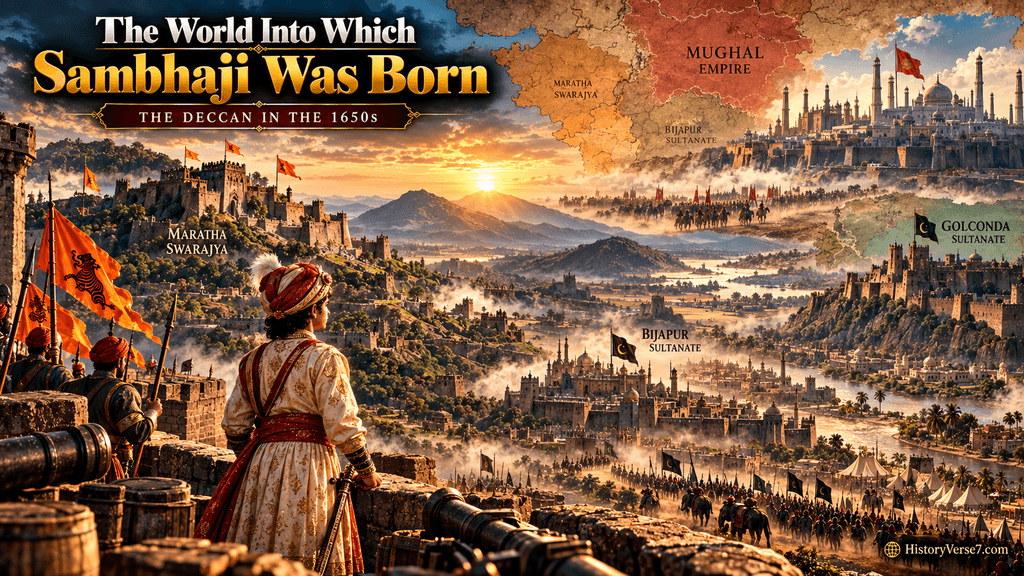
Shahaji Raje, Sambhaji’s grandfather, remained a significant figure in Bijapuri service in the south during these years, and the wider Bhonsale family’s position, split between Shahaji’s southern career and Shivaji’s northern consolidation, formed the immediate political backdrop of Sambhaji’s earliest years. Bijapur, weakened but still functioning, and the Mughal Empire, patient and expansionist, were the two large powers any Maratha heir would eventually have to reckon with. Golconda sat further to the east, a third Deccan sultanate whose relevance to Sambhaji’s life would only become significant later, in the context of the southern campaigns covered in Chapter Two.
This is the world Sambhaji Maharaj was born into: not a settled kingdom at peace, but an ambitious, still-consolidating state surrounded by larger and more established rivals, in a region where warfare, negotiation, and shifting alliances were the normal conditions of political life rather than exceptions to it.
Birth and Family
Sambhaji Maharaj was born on 14 May 1657 at Purandar Fort, in what is now Pune district. This date is the one most consistently cited in modern biographical treatments and is generally accepted in scholarship, though readers should note that, as with many births recorded before the Chola-style precision of later administrative documentation, contemporary corroboration is not the same as for, say, a treaty or a coronation. The location, Purandar, is well attested and fits the broader pattern of Sambhaji Maharaj’s family using secure hill forts for events of this kind.

His mother was Saibai, born Saibai Nimbalkar, of the Nimbalkar family of Phaltan, and the first and, by most accounts, most deeply loved of Shivaji Maharaj’s wives. They married in 1640, and by the time Sambhaji was born, Saibai had already given birth to three daughters—Sakhubai, Ranubai, and Ambikabai. Sambhaji was her only son and, as the eldest son of Shivaji Maharaj, was from birth positioned as the presumptive heir to whatever Swarajya would become, long before anyone could have predicted the scale it would eventually reach.
The Loss of Saibai
Saibai died on 5 September 1659, at Rajgad Fort. Sambhaji was two years old. This is one of the more solidly documented personal facts of his early life, and it deserves to be stated plainly rather than dramatized: a two-year-old losing his mother is a significant early loss by any reasonable standard, but the sources do not allow us to say anything specific about how this loss affected him personally, what he understood of it, or what emotional consequences it carried into his later life. Any account that describes his inner experience of this event is writing fiction, however sympathetically intended.
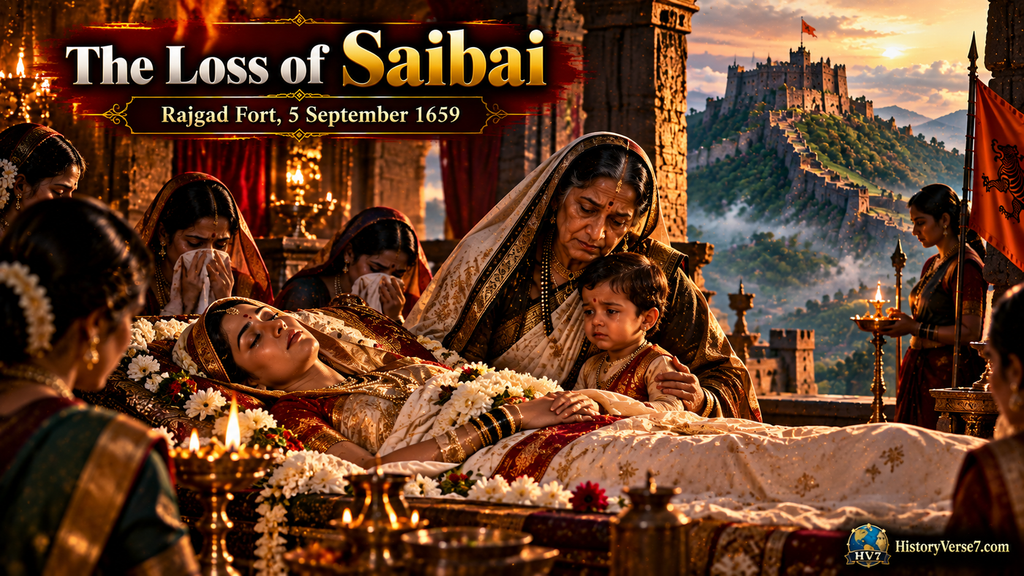
What can be said with more confidence is what happened administratively and practically. Care of the young heir passed substantially to his grandmother, Jijabai, who had already, a generation earlier, managed the Pune jagir during Shahaji’s long absences and who remained a central figure in the Bhosale household. Sambhaji Maharaj’s early upbringing, in other words, took place within an already-established pattern of the royal women of the family taking direct responsibility for raising the next generation, a pattern that had shaped Shivaji Maharaj’s own childhood and now shaped his son’s.
Childhood Inside an Expanding Political State
Sambhaji Maharaj did not grow up in a settled nursery removed from politics. He grew up inside a state that was, through the 1660s, expanding its fort network, fighting Bijapur, absorbing new territory, and beginning its long and complicated relationship with Mughal power. Movement between forts, exposure to the administrators, military commanders, and court officials who ran Swarajya’s day-to-day affairs, and proximity to the constant business of governance and warfare were simply the ordinary conditions of his childhood, not unusual episodes within it.
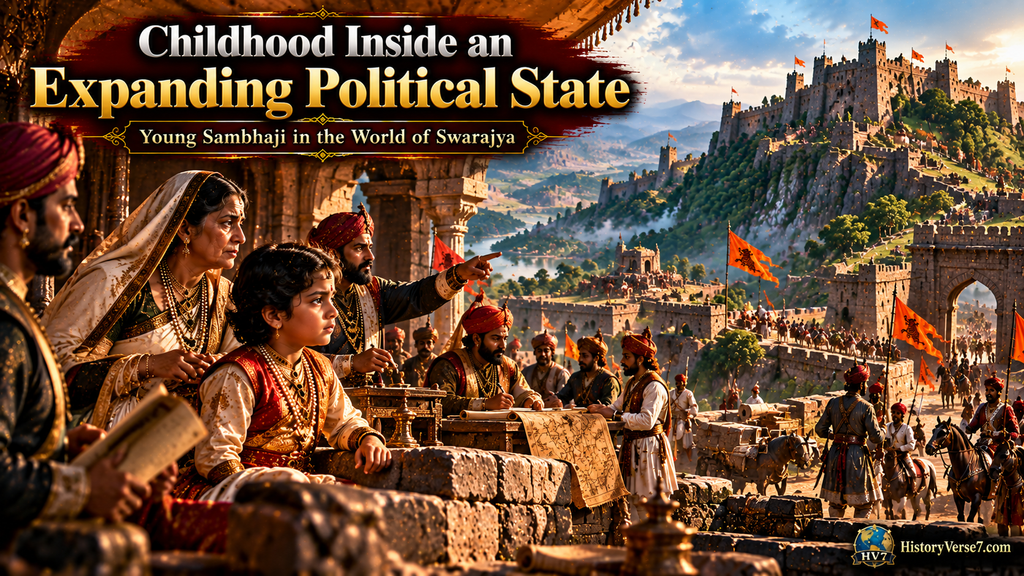
This kind of environment functioned, whether by deliberate design or simply by circumstance, as an informal apprenticeship in rule. A royal heir in this period learned statecraft largely by being present around it: watching how forts were administered, how commanders were addressed and rewarded, how disputes were settled, how negotiations with rival powers were conducted. Direct documentary evidence of Sambhaji Maharaj’s specific day-to-day exposure to these processes during his earliest years is limited, and later biographical accounts sometimes fill this gap with more confident detail than the sources can support. What can be said responsibly is that the general shape of his childhood inside a royal household actively engaged in war, administration, and diplomacy is well established, even where the specific texture of his personal experience within it is not.
His relationship with his father during these very early years is documented only in the most general terms: Shivaji Maharaj was, through the 1660s, deeply occupied with the campaigns and crises covered in Chapter One of this series the conflict with Bijapur, the raid on Shaista Khan, the Surat raid, the Treaty of Purandar and a young son’s day-to-day life would necessarily have unfolded largely apart from his father’s most demanding political and military commitments, under Jijabai’s household authority, even as Sambhaji Maharaj remained, by virtue of his birth, at the center of his father’s dynastic planning.
The Education of Sambhaji Maharaj
Sambhaji Maharaj’s education is one of the more genuinely interesting, and genuinely contested, aspects of his early life, and it deserves careful treatment rather than the confident claim, repeated in many popular accounts, that he was simply a “great scholar.”
What is reasonably well supported is that Sambhaji Maharaj received a formal education appropriate to a Maratha royal heir, including training in Marathi, and that he developed real proficiency in Sanskrit, a language his grandfather Shahaji and, differently, his father’s court had also valued for its connection to classical statecraft literature and religious learning. Some accounts describe Persian instruction as well, consistent with the practical necessity, for any Deccan ruler of this period, of being able to engage with Mughal and Bijapuri administrative and diplomatic correspondence, though the depth and formality of this Persian training is less firmly documented than his Sanskrit education.
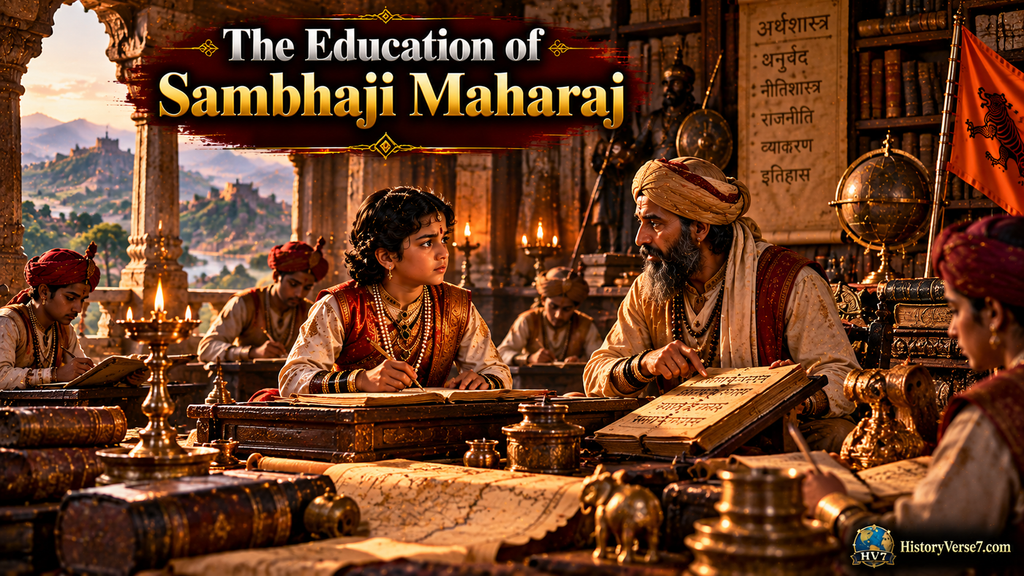
The more difficult question concerns the literary works traditionally attributed to him, most prominently the Sanskrit text Budhbhushanam, a work on politics, statecraft, and conduct, along with several Hindi-language works including titles such as Nayikabhed, Satsatak, and Nakhshikha, dealing with poetic and aesthetic themes. These attributions are widespread in popular biography, and it would be dishonest to dismiss them outright; there is a real manuscript tradition connecting these works to Sambhaji Maharaj’s name, and the broad idea that he received an education sophisticated enough to produce such writing is entirely consistent with what we know of his upbringing. At the same time, responsible scholarship treats the question of authorship, precise dating, and the reliability of the manuscript tradition behind these attributions as genuinely open in places, the kind of question where later tradition, honoring Sambhaji Maharaj as a scholar-king, may have solidified attributions that were originally less certain. Readers should understand the difference between two separate claims: that Sambhaji received a genuinely serious classical and literary education, which is well supported, and that he personally authored every specific text attributed to him in later tradition, which involves a layer of manuscript and attribution scholarship this chapter cannot resolve and should not pretend to resolve on the reader’s behalf.
Sambhaji Maharaj as a Political Heir
Sambhaji Maharaj’s emergence as an active, rather than merely nominal, political heir becomes more visible in the documentary record from the mid-1660s onward, closely tied to the diplomatic and military crises of that period covered more fully in the earlier chapters of this series.
The Treaty of Purandar in June 1665, which required Shivaji Maharaj to cede a substantial number of forts to Mughal control and accept a form of Mughal suzerainty, also drew Sambhaji Maharaj directly into Mughal-Maratha diplomacy at a young age; he was sent, still a child, into a relationship with Mughal authority that would recur, in different and more dramatic forms, throughout the rest of his youth. This was followed within a year by the Agra journey, discussed in the next section, which placed the young heir at the center of one of the most consequential episodes of his father’s career.
Through the later 1660s, as Shivaji Maharaj worked to rebuild Swarajya’s position, Sambhaji Maharaj began taking on responsibilities that went beyond ceremonial presence. From the early 1670s, sources describe him becoming involved in genuine administrative work, and by the time of the 1674 coronation, an English observer present at Raigad noted that the seventeen-year-old Sambhaji Maharaj was given the honor of a seat “on an ascent,” a detail from a contemporary European account that offers a rare, independently sourced glimpse of his formal status at court during this period, distinct from the more elaborate but less contemporaneous detail found in later Marathi retellings. Once his father became a crowned sovereign, Sambhaji Maharaj’s position as heir apparent carried a weight and formality it had not carried before, a shift discussed further below.
The Agra Episode and Sambhaji Maharaj
Sambhaji Maharaj accompanied his father to the Mughal court at Agra in 1666, at around nine years old, one part of the larger, dangerous diplomatic episode covered in full elsewhere in this series. This chapter will not retell the entire Agra story; what matters here is what the experience meant specifically for a young political heir rather than for his father’s reign as a whole.
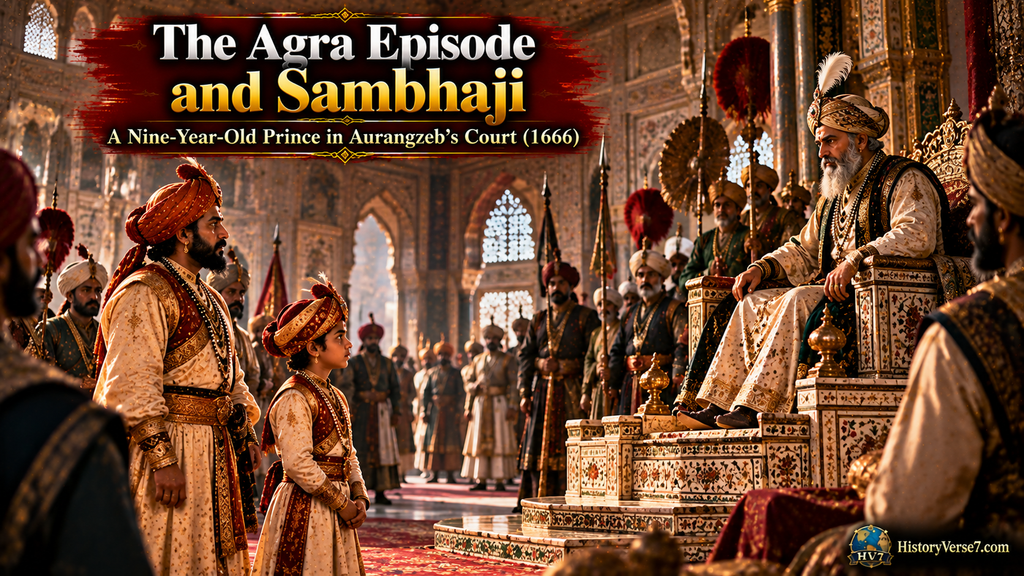
For Sambhaji Maharaj personally, Agra meant direct, early exposure to Mughal court protocol, to Aurangzeb’s court in its full imperial formality, and then to genuine danger: house arrest, an uncertain and extended period of confinement, and an escape achieved through deception and disguise rather than open confrontation, followed by a difficult journey back to the Deccan. A boy of nine experiencing this kind of sustained crisis, at the center of an international diplomatic confrontation between his father and the most powerful empire in the subcontinent, represents a formative political education of a very particular and unusually intense kind, even though the sources give us no reliable window into what the child himself understood or felt as these events unfolded. What can be responsibly said is that by the age of nine, Sambhaji Maharaj had already witnessed, at extremely close range, the real stakes and real dangers of Mughal-Maratha relations a lesson in the fragility of even carefully negotiated diplomatic arrangements that later events in his own life would echo more than once.
Sambhaji Maharaj and the Mughals
Sambhaji Maharaj’s relationship with Mughal political authority did not end with the Agra escape, and it is here that this chapter must resist the two easiest, and least accurate, narrative shortcuts: that Sambhaji Maharaj was simply loyal to his father throughout, or that his later dealings with the Mughals amount to straightforward betrayal.
In the years following Agra, a period of cautious accommodation developed between Shivaji Maharaj’s court and Mughal authority in the Deccan, mediated substantially through the Mughal prince Muazzam, who served as viceroy at Aurangabad. As part of this arrangement, Shivaji sent Sambhaji Maharaj to take service under Muazzam, with Diler Khan serving as Muazzam’s deputy; Sambhaji Maharaj visited the prince at Aurangabad in November 1667, was granted revenue rights connected to territory in Berar, and, alongside Maratha commanders including Prataprao Gujar, took part in operations conducted jointly with Mughal forces against Bijapur during this period of cooperation. This was not private or informal contact; it was a recognized, mansabdar-rank relationship with the Mughal administrative system, undertaken with his father’s knowledge and, evidently, his father’s direction.
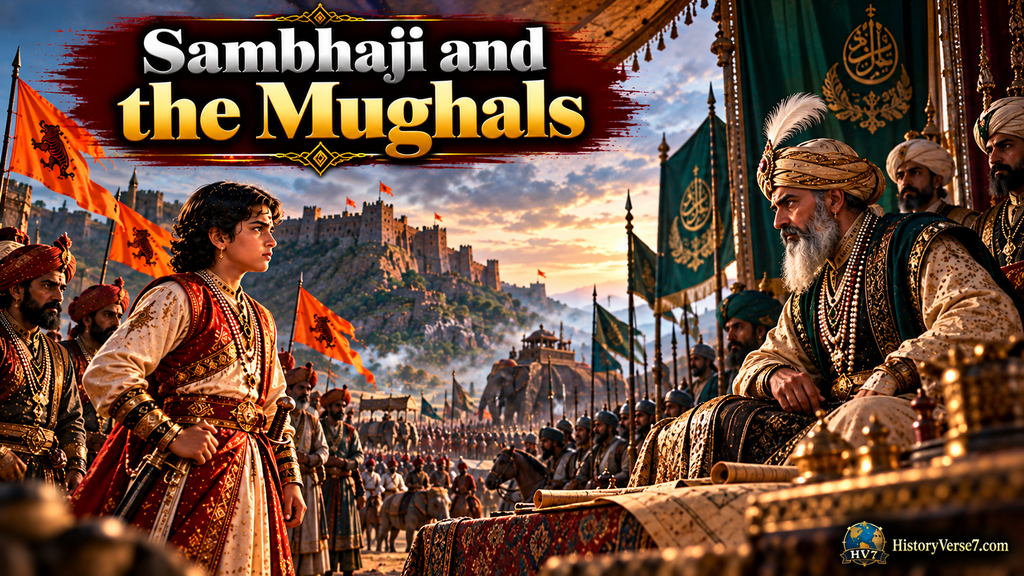
The relationship shifted again in the mid to late 1670s, and it is here that the record becomes both more dramatic and more genuinely contested. At some point, Shivaji Maharaj confined Sambhaji Maharaj at Panhala Fort. The reasons given for this confinement vary significantly depending on the source, and this chapter treats the variation itself as the important historical fact rather than settling on one explanation. Some accounts, generally later and less contemporaneous, attribute the confinement to personal misconduct on Sambhaji Maharaj’s part; other readings, taking into account the political tensions building around succession during this period, discussed further below, suggest that whatever the immediate pretext, the confinement should be understood at least partly within the context of a father managing a difficult, headstrong adult heir whose position and behavior had become a genuine source of concern at court. The evidence does not allow this chapter to declare with confidence which explanation, or what combination of explanations, is correct, and readers should be skeptical of any account, in either direction, that presents unqualified certainty here.
What followed the Panhala confinement is better documented. On 13 December 1678, Sambhaji Maharaj left Sajjangad, where he had been stationed, and traveled to Pedgaon to rejoin Diler Khan, now serving as the senior Mughal commander in the southern Deccan. The Mughals rewarded him with a substantially elevated rank, reportedly seven thousand zat, and the title of Raja from Aurangzeb himself. This was, by any reasonable historical standard, a genuine defection: Sambhaji Maharaj placed himself under Mughal command against his own father’s state, and in April 1679 he was present with Diler Khan’s forces during the siege and fall of Bhupalgad, an operation that ended with brutal treatment of the fort’s garrison and the civilian population that had sheltered inside it. Sambhaji Maharaj’s presence on the Mughal side during this specific, documented atrocity is one of the more genuinely difficult facts of his pre-accession life, and this chapter does not soften it.
The defection did not last. Within roughly a year, by some point in 1679 or 1680, Sambhaji Maharaj returned to the Maratha side. The surviving sources do not give a fully satisfying account of exactly why he chose to return, and this chapter will not invent one. What can be said is that the reconciliation, however it was achieved, was substantial enough that Sambhaji was again positioned as heir apparent by the time of his father’s death shortly afterward, suggesting that whatever the underlying causes of the defection and the return, both father and son treated the episode as something that could be, and needed to be, set aside for the sake of Swarajya’s continuity.
The Question of Sambhaji Maharaj’s Personality
Given a record of this genuinely mixed, capable administrator and diplomat in his teens, present at one of the more difficult atrocities of the Mughal-Maratha wars, confined by his own father under disputed circumstances, a defector who returned it should not be surprising that different kinds of sources portray Sambhaji Maharaj very differently, and this chapter treats that variation as historically informative rather than as a problem to be resolved into a single verdict.
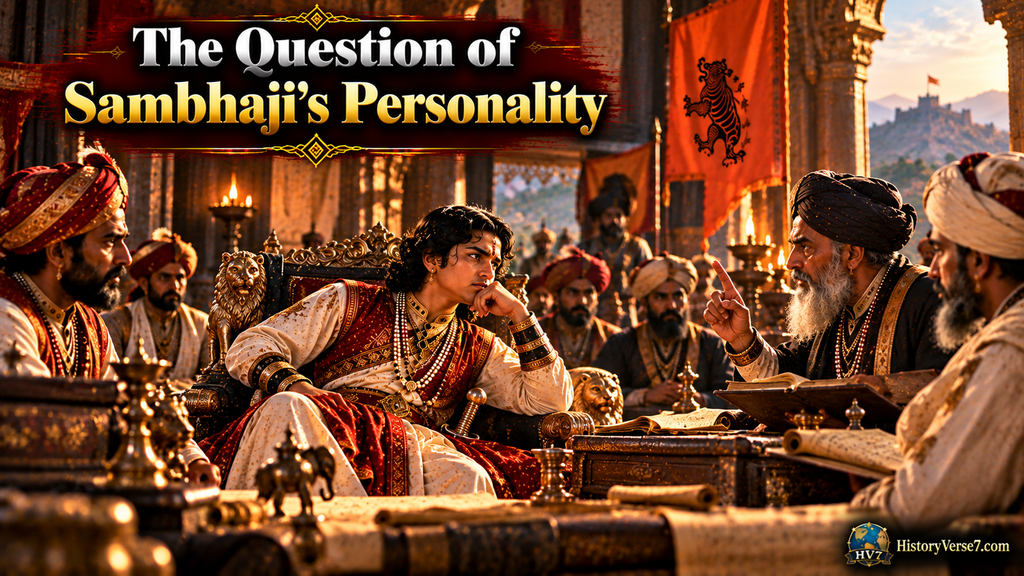
Later Marathi bakhars and devotional tradition, writing substantially after his death and shaped by the reverence that grew around his eventual execution, tend to emphasize the scholar-warrior image: precocious learning, filial loyalty, battlefield courage, and ultimately martyrdom. Mughal and Persian sources, by contrast, often frame him through the lens of a troublesome, occasionally useful, occasionally dangerous regional prince, more interested in his utility or threat to imperial interests than in any rounded portrait of his character. European traders and observers, where they mention him at all in this earlier period, tend to note his formal court status and political role rather than offering psychological assessment. Modern historians, working with all of these source types critically, have generally moved away from either the purely devotional or the purely dismissive reading, toward an account that takes the documented complexity the real education, the real military and diplomatic experience, the real defection, the real reconciliation as the most historically honest picture available, rather than resolving it in favor of whichever single narrative feels most satisfying.
This chapter will not attempt to diagnose Sambhaji Maharaj’s psychology or declare a final verdict on his character. The sources do not support that kind of confident conclusion, and a responsible historical account should say so plainly rather than papering over the gap with confident-sounding prose.
Shivaji Maharaj and Sambhaji Maharaj
The documented relationship between father and son across these years resists any simple description. There is clear evidence of trust: Sambhaji Maharaj was repeatedly given real responsibility, sent on missions involving genuine political and military stakes, and treated, at the 1674 coronation and afterward, with the formal honors due an heir apparent. There is equally clear evidence of tension: the Panhala confinement, whatever its precise cause, represents a father exercising direct disciplinary authority over an adult son in a way that suggests real friction, and the defection to the Mughals, whatever drove it, represents a rupture serious enough that Persian and Mughal sources treat it as a significant and genuine defection rather than some kind of coordinated ruse.
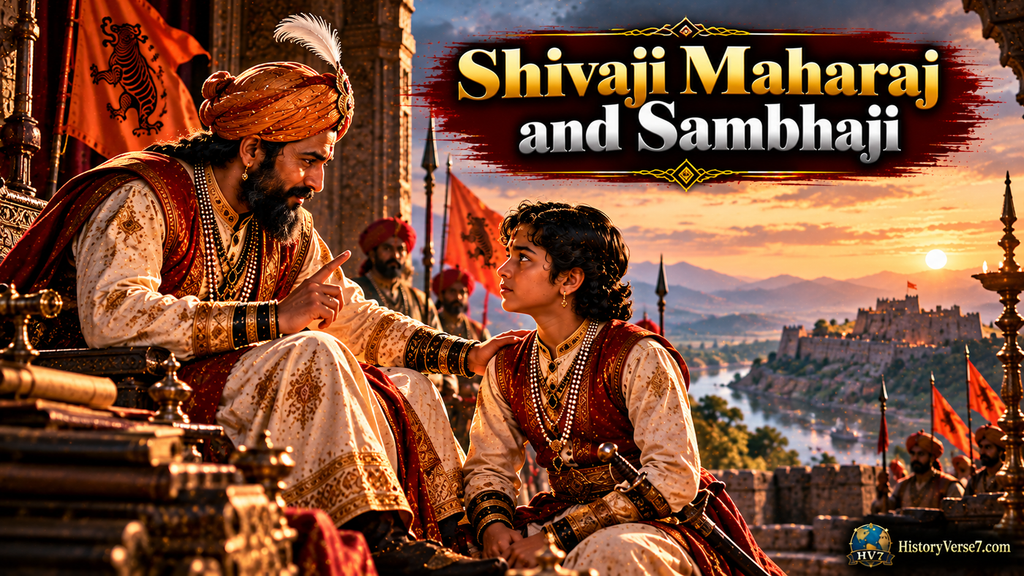
What this chapter will not do is invent a reconciliation scene, a private conversation, or a clear statement of either man’s motives at any of these junctures. The sources permit us to document what happened: missions undertaken, confinement imposed, defection carried out, return achieved, heir-apparent status restored without permitting us to know with confidence what either Shivaji Maharaj or Sambhaji Maharaj privately believed or felt about the other at any given moment. Historical honesty here means resisting the temptation to resolve genuine uncertainty into either a warm father-son bond periodically tested by outside pressure, or a fundamentally broken relationship papered over by political necessity. Both readings appear in different modern accounts; the evidence supports neither with full confidence.
Sambhaji Maharaj and the Royal Court
Court politics around Shivaji Maharaj’s later reign involved real, documented factional tension, and Sambhaji Maharaj’s position within it cannot be understood apart from the presence of Soyarabai, Shivaji Maharaj’s other prominent wife, and her son Rajaram, born considerably later than Sambhaji Maharaj and therefore, by the late 1670s, still a young child rather than a genuine rival claimant in terms of age or experience.
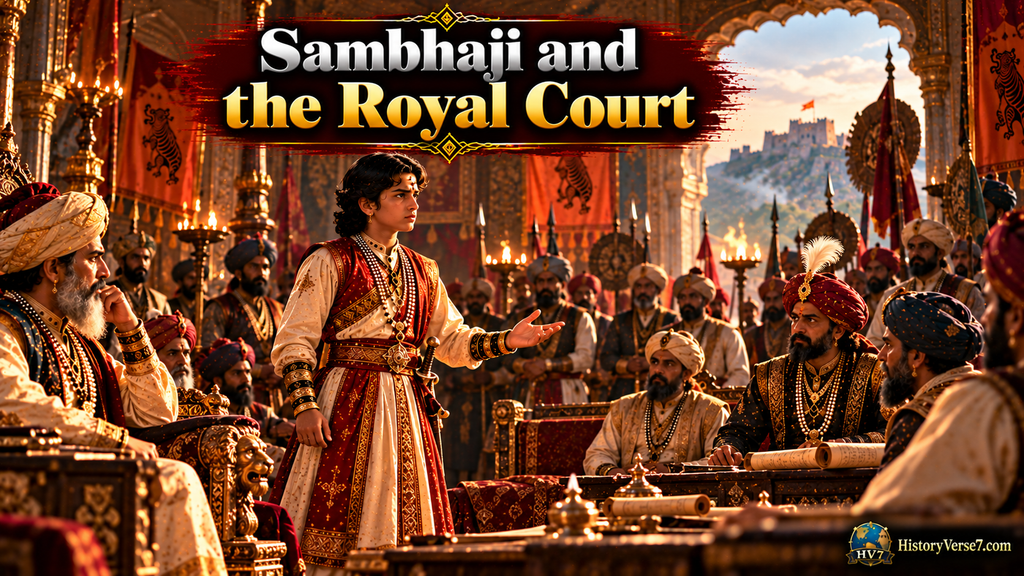
Soyarabai held real standing at court, and sources describing the period leading up to Shivaji Maharaj’s death document that she and a faction of ministers had an evident interest in Rajaram’s prospects, a dynamic that would become fully visible only after Shivaji Maharaj’s death, but that plausibly existed in some form before it. This chapter treats this carefully: the existence of a court faction with an interest in an alternative succession outcome is reasonably well documented; the specific motives, private conversations, and degree of active conspiracy involved before 1680 are considerably less certain, and later accounts, written with the benefit of knowing how the succession crisis actually unfolded, sometimes project more coordinated intent backward onto this earlier period than the contemporaneous evidence can support. Senior ministers and military commanders at court held their own positions and interests in this uncertain environment, and the general picture that emerges is one of a court with real, unresolved tension over the succession question well before Shivaji Maharaj’s death made that tension urgent, rather than a court united behind one clear, uncontested heir.
Rajyabhishek of Shivaji Maharaj and Sambhaji Maharaj’s Position
The 1674 coronation, covered in full detail in Chapter Two of the Shivaji Maharaj series on HistoryVerse7, carries specific significance for Sambhaji Maharaj that deserves attention here without repeating that full account.
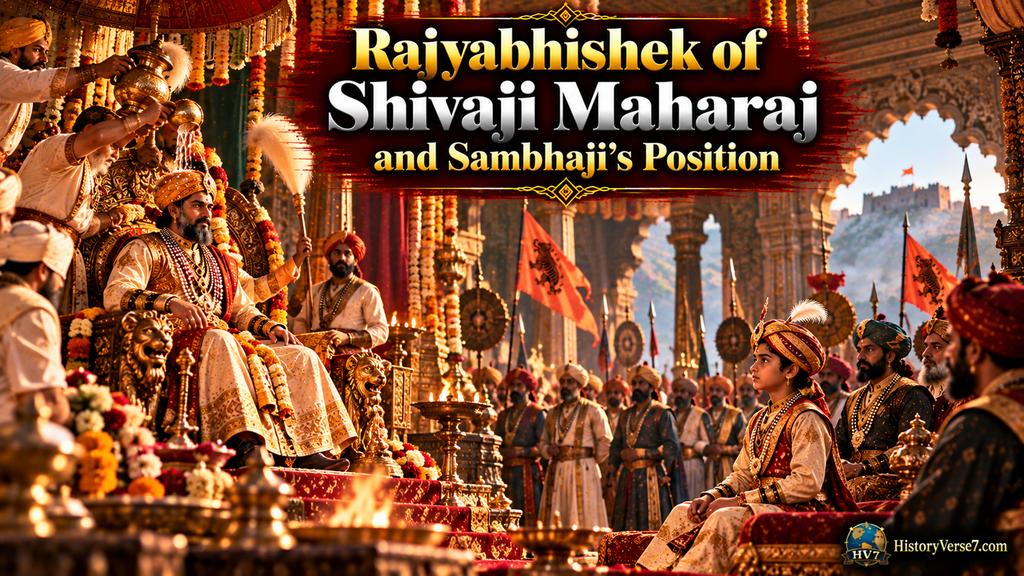
As Shivaji Maharaj’s eldest son, Sambhaji Maharaj’s position was transformed by his father’s coronation in a very concrete, legal sense: he went from being the son of a powerful but formally unrecognized regional ruler to being the heir apparent of a sovereign, ritually legitimated Chhatrapati, with all the questions of dynastic succession, legal inheritance, and formal court hierarchy that this new status implied. The English observer’s note of his seat “on an ascent” during the coronation ceremony is a small but genuinely useful piece of contemporary evidence of how his elevated status was formally displayed to observers present at Raigad. From this point forward, Sambhaji Maharaj was not simply a capable and experienced young nobleman within his father’s household; he was, in the formal political vocabulary the coronation had just established, next in line for the Chhatrapati’s throne, a status that raised the stakes of every subsequent tension between him and the rest of the court considerably higher than it would otherwise have been.
Sambhaji Maharaj’s Military Development
Sambhaji Maharaj’s military experience before 1680 should be understood as real but partial, documented in fragments across a career still substantially shaped by his father’s decisions rather than his own independent command.
His service alongside Mughal forces under Muazzam against Bijapur in the late 1660s gave him direct, if closely supervised, exposure to campaign conditions and coalition warfare. His presence with Diler Khan’s forces during the 1679 siege of Bhupalgad, discussed above, represents his most extensively documented direct military experience before his accession, notable precisely because it occurred on the opposing side from his father’s own army. Beyond these specific, well-documented episodes, later tradition attributes broader military experience and responsibility to Sambhaji Maharaj during the 1670s, and while this is entirely plausible given his status as heir apparent and his demonstrated involvement in administrative work from the early 1670s onward, the specific campaigns and command responsibilities often listed in popular biographies are not uniformly traceable to strong contemporary documentation, and this chapter is cautious about treating every such attribution as equally certain.
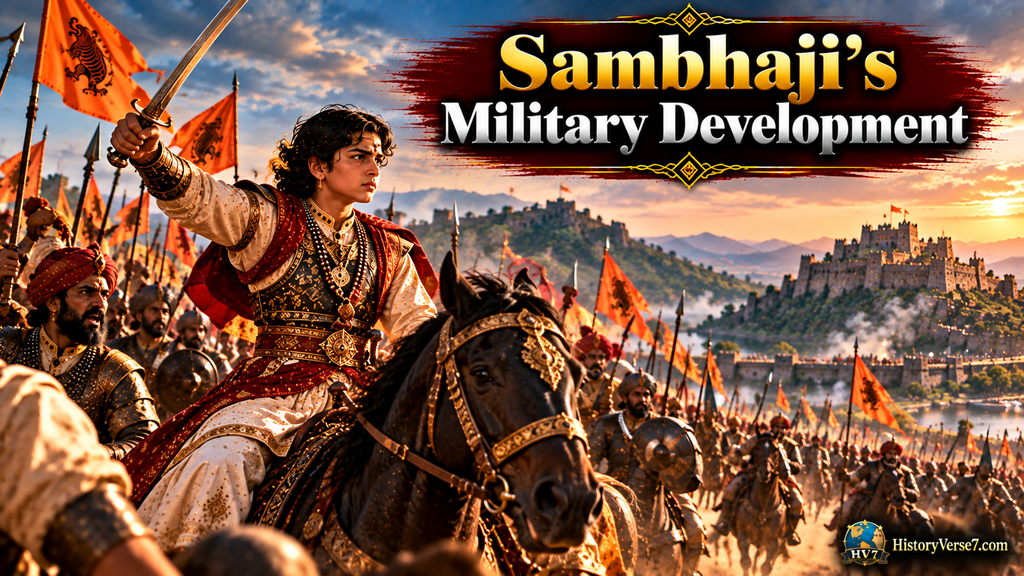
What can be said with confidence is that by 1680, Sambhaji Maharaj had seen war from more than one side of the Mughal-Maratha conflict, had operated within a formal Mughal command structure as well as within his father’s, and had therefore acquired a genuinely unusual, dual perspective on the military and political dynamics that would define his own reign an experience none of his father’s other potential successors could claim.
The Succession Question Before 1680
By the final years of Shivaji Maharaj’s reign, the succession question was not a purely theoretical concern awaiting his eventual death; it was an active undercurrent in court politics, shaped by Sambhaji’s formal status as heir apparent since 1674, the documented tension between father and son reflected in the Panhala confinement and the Mughal defection, and Soyarabai’s evident interest in her own son Rajaram’s future position, even though Rajaram remained a young child through most of this period rather than a plausible immediate alternative.
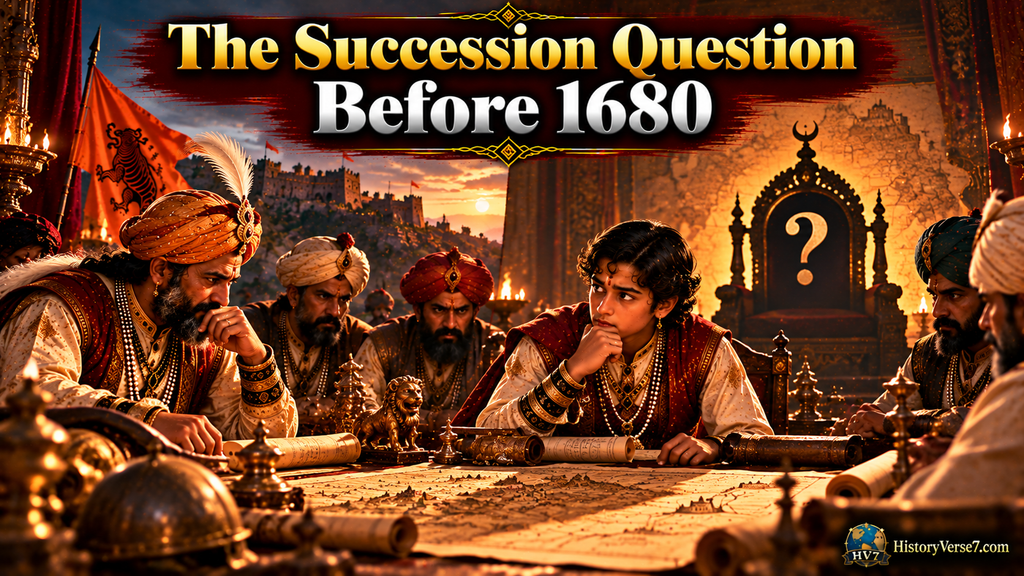
This chapter resists the popular framing, common in more devotional retellings, that casts this period as a clear conflict between a loyal, rightful heir and a scheming stepmother’s faction, just as it resists the opposite oversimplification that would cast Sambhaji Maharaj as simply the wronged victim of court intrigue. The evidence supports a genuinely unsettled situation: a formally designated heir whose own conduct had, at least twice, given his father and the court real cause for concern, set against a court faction with an understandable, if politically consequential, interest in an alternative arrangement. Neither side’s full motives are transparent to us, and any account that presents this period as a settled morality tale, with clear heroes and clear villains, is imposing a clarity the sources do not actually provide.
The Death of Shivaji Maharaj
Shivaji Maharaj died at Raigad on 3 April 1680, following a period of illness whose precise medical nature remains uncertain in the surviving record, a subject covered in fuller detail in the earlier chapters of this series. What matters specifically for Sambhaji Maharaj’s story is the immediate political situation this death created: an heir apparent who was not present at Raigad at the moment of his father’s death, positioned instead, by most accounts, at some distance, and a court where the underlying succession tensions described above now had to be resolved immediately rather than remaining a background concern.
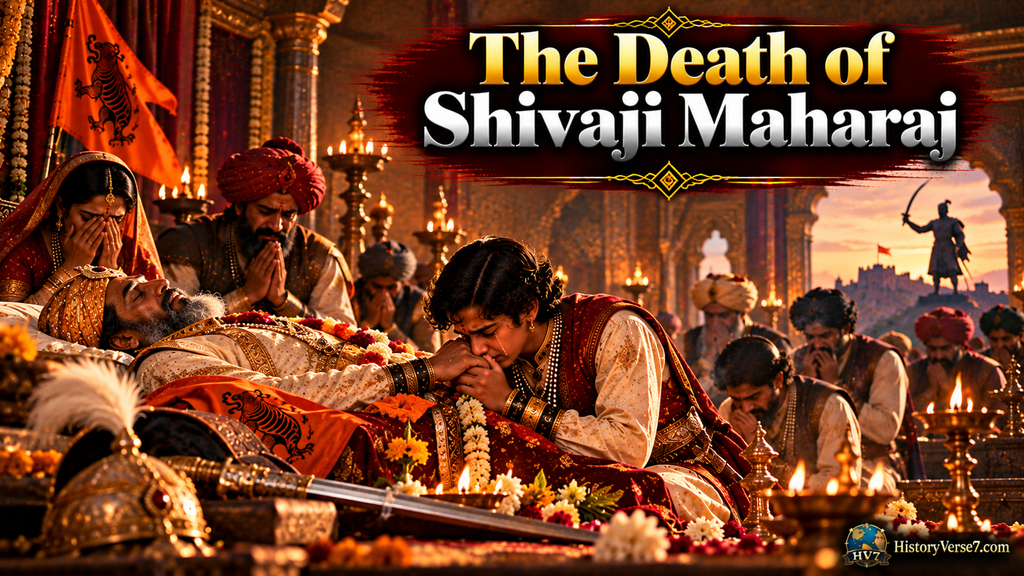
Communication in this period moved only as fast as messengers could travel, and the days immediately following Shivaji Maharaj’s death were, by any reasonable reading of the available evidence, a period of real uncertainty rather than an orderly, prearranged transition. This chapter does not repeat unverified claims about secret, long-planned plots on either side; what the evidence supports is a genuinely fluid and contested situation in which physical control of key forts and the speed of political action would ultimately determine the outcome far more than any formal, uncontested claim to the throne.
Sambhaji Maharaj’s Accession
In the immediate aftermath of Shivaji Maharaj’s death, a faction at court connected to Soyarabai moved to have the young Rajaram installed on the throne rather than Sambhaji Maharaj. Sambhaji Maharaj, learning of this, acted decisively and quickly: he moved to secure control of Panhala and then Raigad itself, asserting his position as heir apparent through direct political and military action rather than waiting for the matter to be settled through negotiation.
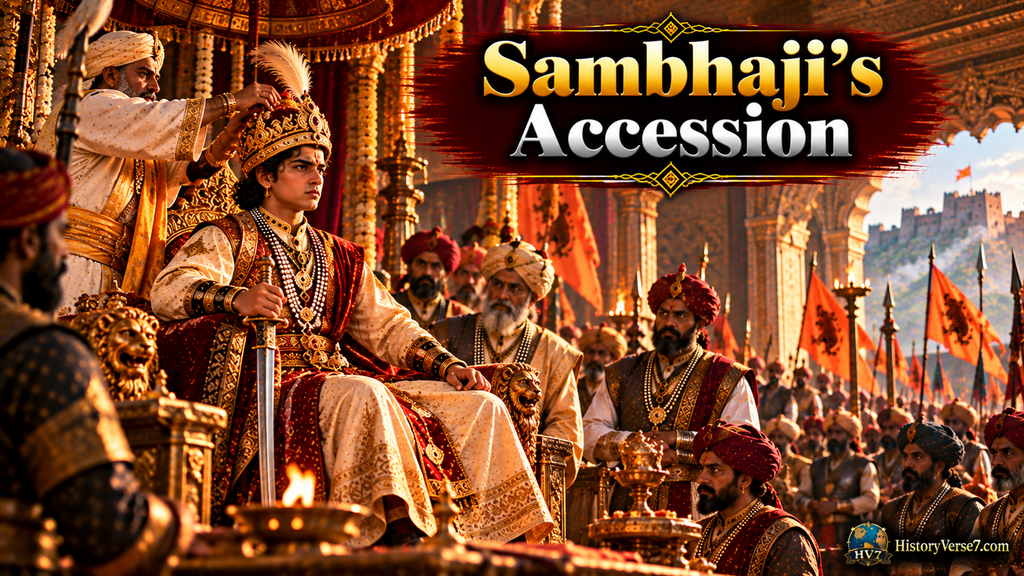
What followed was not immediately clean. Sources describe Sambhaji Maharaj’s position as genuinely contested for a period, with tension and suspicion extending into his own court and household, and later action taken against senior ministers associated with the faction that had favored Rajaram, a serious and, by some accounts, harsh consolidation of power rather than a magnanimous, uncontested assumption of the throne. This chapter treats the harsher elements of this consolidation as a documented part of Sambhaji Maharaj’s accession rather than an inconvenient detail to be minimized; readers should understand that his path to the throne involved real conflict with figures inside his own father’s court, not merely a formality following an uncontested hereditary claim.
The formal chronology of his elevation to Chhatrapati unfolded across roughly seven months rather than in a single moment: a first, more symbolic assumption of authority in the summer of 1680, followed by a fuller, formal coronation ceremony at Raigad in January 1681, mirroring, in its two-stage structure, the pattern of his own father’s 1674 coronation and its follow-up ceremony later that year.
Who Was Sambhaji Maharaj When He Became Chhatrapati?
Bringing together the evidence surveyed across this chapter, a few things can be said with reasonable confidence about the man who inherited Shivaji Maharaj’s throne in 1680 and 1681.
He had received a genuinely serious classical education, with well-documented proficiency in Sanskrit and Marathi, though the precise extent of his personal literary authorship remains a matter of ongoing scholarly discussion rather than settled fact. He had direct, personal experience of Mughal court culture and Mughal military command from an unusually young age, first as a child present at the Agra crisis, later as a young mansabdar serving under a Mughal prince, and later still as a defector fighting alongside Mughal forces against his own father’s army an unusually varied and, in places, genuinely uncomfortable education in the practical realities of Mughal-Maratha relations. He had been formally elevated to the status of heir apparent by his father’s 1674 coronation and had, by most accounts, taken on real administrative responsibility from the early 1670s onward. He had also experienced real friction with his father, serious enough to result in confinement and, later, outright defection, followed by a reconciliation whose precise terms remain unclear. And he had secured his own throne not through uncontested inheritance but through decisive, and in places harsh, political and military action against a rival faction within his own family’s court.
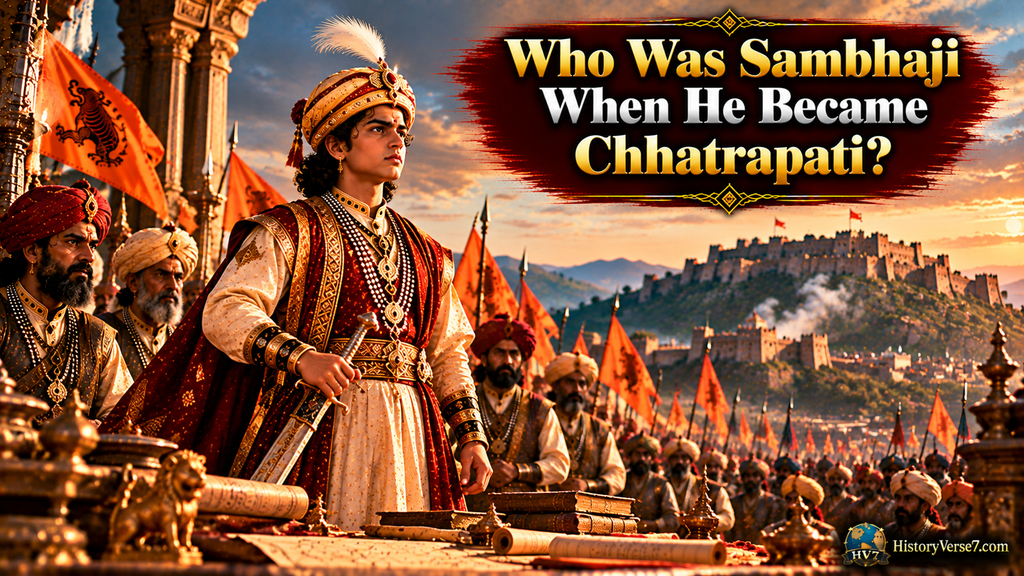
This chapter will not rank him against his father, and it will not declare him either a wronged hero or a troubled failure waiting to happen. What the evidence supports is a more genuinely complicated picture: a capable, well-educated, militarily and diplomatically experienced heir whose path to the throne had been neither smooth nor simple, and whose formative years had already exposed him, more directly than almost anyone else in his father’s court, to both the promise and the danger of the Mughal Empire he would spend the rest of his life fighting.
Ending: A Bridge to Chapter Two
Sambhaji Maharaj did not arrive in 1680 as a finished ruler waiting to be crowned. The Chhatrapati who inherited Shivaji Maharaj’s state had been shaped by a childhood inside an expanding and warring kingdom, by the early loss of his mother, by a classical education whose full literary legacy remains genuinely debated, by a diplomatic crisis at Agra experienced at the age of nine, by real administrative and military responsibility taken on in his teens, by confinement at his own father’s order, by a year spent fighting under a Mughal commander against his own family’s forces, and by a contested, sometimes violent, struggle to secure the throne itself once his father was gone.
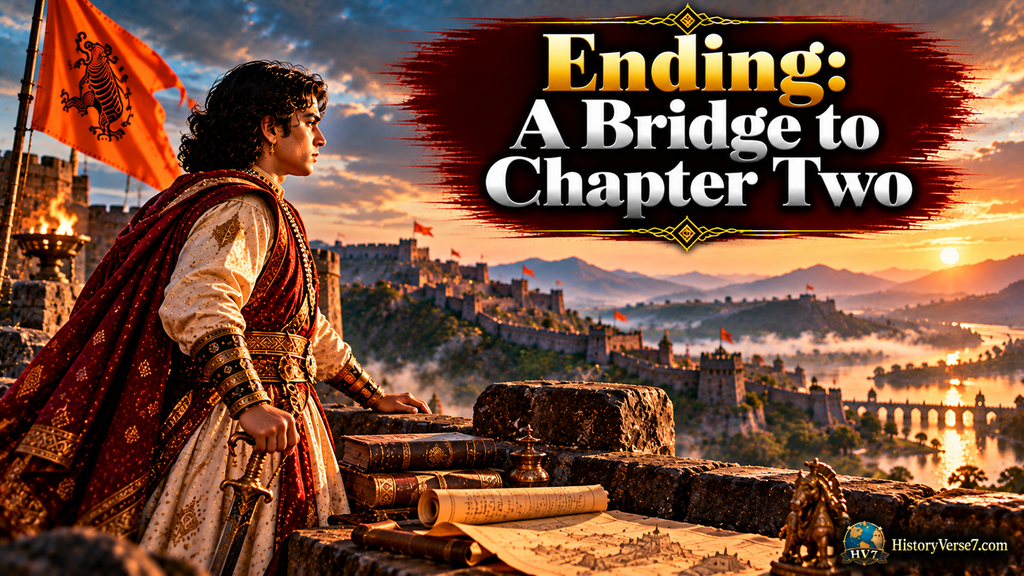
None of this explains everything about the reign that followed. But it makes clear that the man who became Chhatrapati in 1680 and 1681 was not a symbol waiting to happen. He was a specific, complicated political figure, formed by fifteen years of war, diplomacy, education, and family conflict, and it is that figure, rather than the legend that would later be built around his death, who now had to decide what kind of Chhatrapati he intended to be, in a Deccan where the full weight of the Mughal Empire, under Aurangzeb’s own direct and personal attention, was about to descend on Swarajya as it never had during his father’s lifetime.
That is where Chapter Two begins: Sambhaji Maharaj, the Chhatrapati who fought an empire.
Lesser-Known Facts
- Sambhaji was the only son born to Saibai, following three daughters, Sakhubai, Ranubai, and Ambikabai, making him her sole surviving male heir from birth.
- After Saibai’s death, Sambhaji’s upbringing under Jijabai repeated a pattern already established a generation earlier, when Jijabai had herself raised the young Shivaji Maharaj substantially without his father Shahaji’s regular presence.
- Sambhaji was sent into Mughal-linked diplomatic arrangements as part of the Treaty of Purandar at around age eight, meaning his direct personal exposure to Mughal political structures began even before the more famous Agra crisis of 1666.
- An English East India Company observer present at Raigad in 1674 recorded Sambhaji’s seated position of honor during his father’s coronation, one of the few genuinely independent contemporary European references to his formal status at court.
- Sambhaji’s period of service under Prince Muazzam in the late 1660s involved a formal grant of revenue rights in Berar, meaning he briefly held a recognized Mughal administrative stake in territory well outside his father’s core Maratha lands.
- The commander Prataprao Gujar, later famous for his death in the 1674 charge at Nesari, served alongside Sambhaji during the earlier period of Mughal-Maratha cooperation against Bijapur in the late 1660s.
- Sambhaji’s defection to the Mughals in December 1678 earned him one of the highest Mughal ranks granted to any Maratha figure of the period, seven thousand zat, along with the title of Raja directly from Aurangzeb.
- During the 1679 siege of Bhupalgad, Sambhaji was present on the same side as the Mughal forces responsible for treating the fort’s garrison and sheltering civilian population with significant cruelty, a documented fact that complicates any simple heroic narrative of his pre-accession years.
- The precise circumstances of Sambhaji’s return from Mughal service to his father’s side in 1679 or 1680 are not clearly explained in any surviving source, leaving a genuine gap in the historical record at a pivotal moment.
- Sambhaji’s coronation as Chhatrapati unfolded in two distinct stages, a more symbolic assumption of authority in mid-1680 followed by a formal ceremony at Raigad in January 1681, mirroring the two-stage structure of his own father’s 1674 coronation.
- The Sanskrit work Budhbhushanam, traditionally attributed to Sambhaji, deals explicitly with themes of statecraft and political conduct, a thematic fit with his documented administrative and political education, even where the certainty of direct authorship remains debated.
- Sambhaji’s rise to the throne involved direct action against ministers connected to the court faction that had favored his half-brother Rajaram, meaning his accession involved real internal conflict within his own father’s former court rather than a purely external military challenge.
- Sambhaji’s half-brother Rajaram, whose faction briefly attempted to claim the throne in 1680, was considerably younger than Sambhaji and would not become Chhatrapati in his own right until several years later, following Sambhaji’s own death in 1689, a subject belonging to Chapter Two.
- Persian chronicle sources and later Marathi historical tradition, despite their very different political perspectives, broadly agree on the basic chronology of Sambhaji’s 1678 to 1679 Mughal service, even as they differ sharply in how they interpret and frame it.
- The gap between well-documented facts, such as Sambhaji’s Mughal service and defection, and more uncertain traditional claims, such as the full authorship of his literary works, illustrates a broader pattern in Maratha historical sources: political and military events tend to be better and more independently documented than personal, educational, or literary details of the same individuals.
Author Perspective — HistoryVerse7
It would be easy to write about Sambhaji Maharaj’s early life as either a preview of martyrdom or a cautionary tale about a troubled prince. Neither framing does justice to what the evidence actually shows.
What strikes me most, working through this material, is how genuinely mixed the record is, and how consistently later tradition has tried to smooth that mixture into something simpler. A child who lost his mother at two and was raised largely by his grandmother. A political heir sent into Mughal service more than once, for reasons that were sometimes cooperative and, at least once, involved outright defection against his own father. A student of Sanskrit whose specific literary legacy remains genuinely uncertain. A crown prince confined by his own father under disputed circumstances, who nonetheless secured the throne through decisive, at times harsh, political action once the opportunity came.
None of this is a contradiction that needs resolving into a single tidy character sketch. It is, instead, exactly the kind of formation that produces a genuinely capable but genuinely complicated ruler, someone who understood Mughal power from the inside in a way his father never had the opportunity to, and who arrived at the throne already familiar with both the promise and the real danger of that relationship. Understanding this formation does not tell us how to judge the reign that followed. But it makes clear that whatever judgment we eventually reach about Sambhaji Maharaj as Chhatrapati, it should be a judgment about a specific, historically documented person, not about a legend assembled after the fact from his final, dramatic years.
Written & Researched by Abhishek Chavan — HistoryVerse7| © 2026 HistoryVerse7 | Article: Sambhaji Maharaj (Chapter – 1)
Primary Sources
| Source Type | Approx. Date | Language | Author / Attribution | Usefulness and Limitations |
| Marathi administrative correspondence and court records | Contemporary to near-contemporary | Marathi | Various officials and scribes of the Maratha administration | Useful for administrative appointments, land grants, and formal court proceedings; limited for personal or psychological detail; survival and cataloguing is uneven, so absence of a document is not proof an event did not happen. |
| Persian chronicles of the Mughal court | Contemporary to near-contemporary | Persian | Various Mughal court historians writing under or shortly after Aurangzeb’s reign | Valuable for Mughal-side detail on Sambhaji’s service under Muazzam, his defection, and his elevated Mughal rank; written from an imperial administrative perspective and prone to the conventional framing of regional princes as either useful subordinates or troublesome rebels. |
| English East India Company records and observer accounts | Contemporary | English | Company factors and envoys present in western India, including at Shivaji Maharaj’s court | Genuinely independent, contemporary evidence, such as the account of Sambhaji’s seated position of honor at the 1674 coronation; limited in scope, generally focused on matters of direct commercial or diplomatic interest to the Company rather than comprehensive court reporting. |
| Portuguese and Dutch trading records | Contemporary | Portuguese and Dutch | Company officials and factors along the western coast | Useful for corroborating major political and military events with an outside, commercially motivated perspective; coverage of Sambhaji specifically before 1680 is thinner than coverage of his father. |
| Later Marathi bakhars | Composed substantially after the events described, often decades later | Marathi | Various court chroniclers and later compilers | Valuable as a record of how Sambhaji was remembered and interpreted by later Maratha tradition, and occasionally preserving genuine detail not found elsewhere; require careful source criticism, since they were often composed with devotional or dynastic motives and can present later elaboration as settled fact. |
| Sanskrit and Hindi literary manuscripts attributed to Sambhaji | Composed date disputed; manuscript tradition later | Sanskrit and Hindi | Attribution to Sambhaji Maharaj, contested in places by modern scholarship | Important for assessing his education and literary reputation; genuine questions remain about precise authorship, dating, and the reliability of the manuscript transmission, discussed in the education section of this chapter. |
| Modern academic scholarship | Twentieth and twenty-first century | English and Marathi | Recognized historians of Maratha and Mughal-Deccan history | Provides critical synthesis and cross-checking of the above source types; this chapter draws on the general shape of this scholarship rather than any single author’s specific interpretive framework, while flagging points of genuine ongoing debate. |
FAQ — Sambhaji Maharaj
Who was Sambhaji Maharaj?
Sambhaji Maharaj was the eldest son of Chhatrapati Shivaji Maharaj and his first wife Saibai, who became the second Chhatrapati of the Maratha state in 1680 to 1681 after a contested succession.
When and where was Sambhaji Maharaj born?
He was born on 14 May 1657 at Purandar Fort, near present-day Pune.
What happened to Sambhaji’s mother?
His mother, Saibai, died on 5 September 1659 at Rajgad Fort, when Sambhaji was two years old, after which he was raised substantially by his grandmother, Jijabai.
What education did Sambhaji Maharaj receive?
He received a serious classical education with well-documented training in Sanskrit and Marathi; several Sanskrit and Hindi literary works are traditionally attributed to him, though the precise extent of his personal authorship remains debated among scholars.
What was Sambhaji’s role during Shivaji Maharaj’s visit to Agra?
He accompanied his father to Agra in 1666 at around age nine, experienced house arrest under Mughal custody, and took part in the escape and return journey to the Deccan.
The Making of a Warrior Prince
Sambhaji Maharaj’s journey to the throne was not a simple inheritance. His childhood, education, military exposure, diplomatic experiences, relationship with Shivaji Maharaj and the political tensions within the royal court all shaped the ruler he would eventually become.
Chapter 1 has followed that formation through historical evidence, scholarship, official heritage sources and the surviving historical record, while keeping established evidence separate from later tradition.
Chapter 2 arrives in 4 days. The story moves from the making of the prince to the difficult reality of the throne — succession, political conflict, Mughal pressure, diplomacy, warfare and Sambhaji Maharaj’s struggle to defend the Maratha state.
History is strongest when evidence is allowed to speak for itself. HistoryVerse7 continues to examine Maratha history through documented records, academic scholarship, regional heritage and careful historical comparison.
Save this chapter and return in 4 days for Chapter 2.
Share this content: