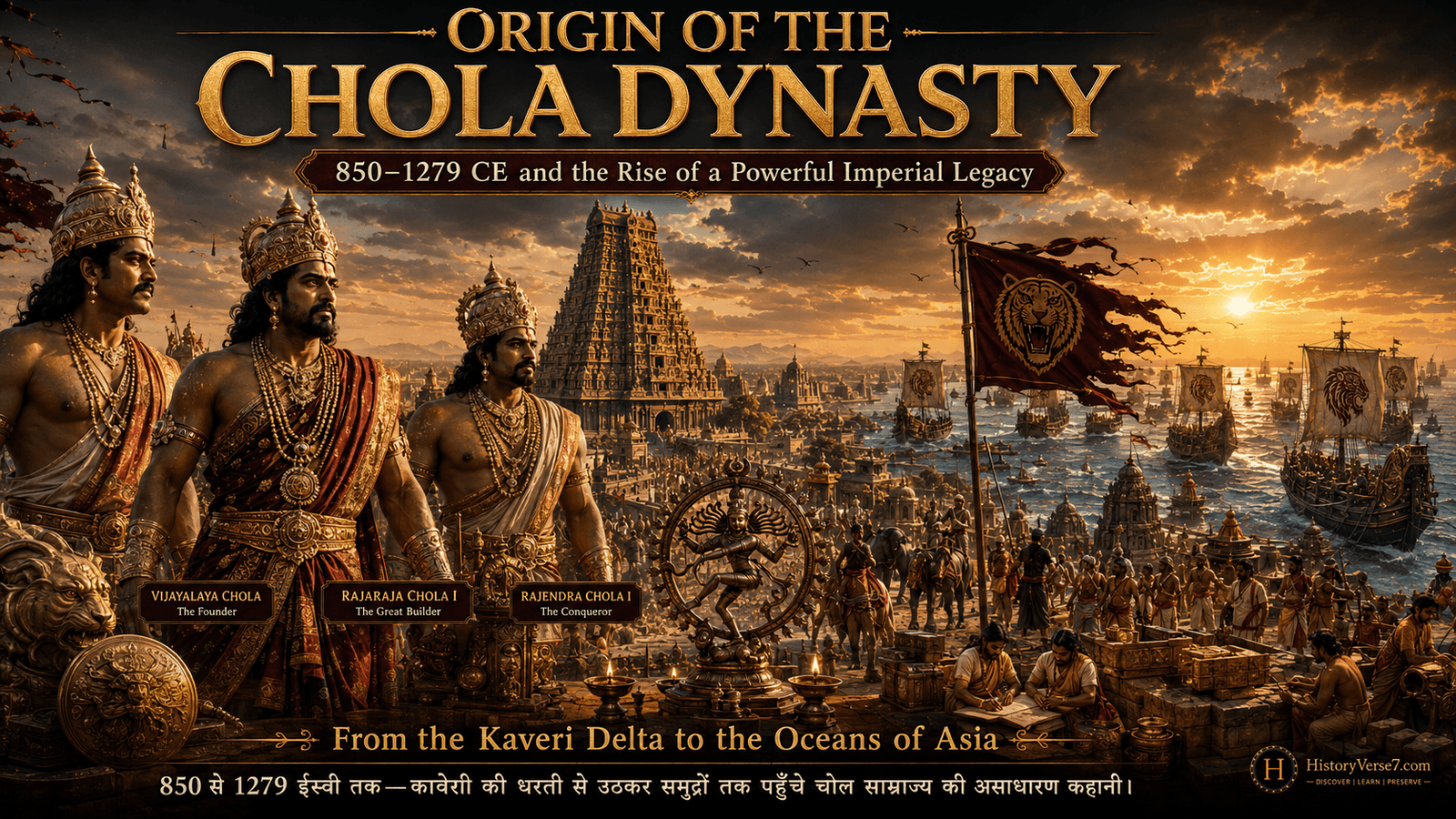
Origin of the Chola Dynasty: 850–1279 CE and the Rise of a Powerful Imperial Legacy
🏛️ Origin of the Chola Dynasty — The Fascinating Story Behind the Rise of One of South India’s Most Enduring Royal Houses Before the Cholas became one of South India’s most powerful imperial dynasties, there was a much older story— a story shaped by ancient Tamil traditions, Sangam literature, regional kingdoms, inscriptions, archaeology, and centuries…
Introduction: Why the Origin of the Chola Dynasty Matters
HistoryVerse7 | Cluster Article | International Edition
The question of where the Chola dynasty came from has occupied scholars for well over a century and remains, in important respects, unanswered. This is not for lack of effort. Generations of epigraphers, archaeologists, literary historians, and numismatists have brought their disciplines to bear on the problem, producing a substantial body of scholarship. What they have found is both illuminating and humbling: the Cholas are simultaneously one of the best-attested and most historically elusive of all ancient South Indian dynasties.
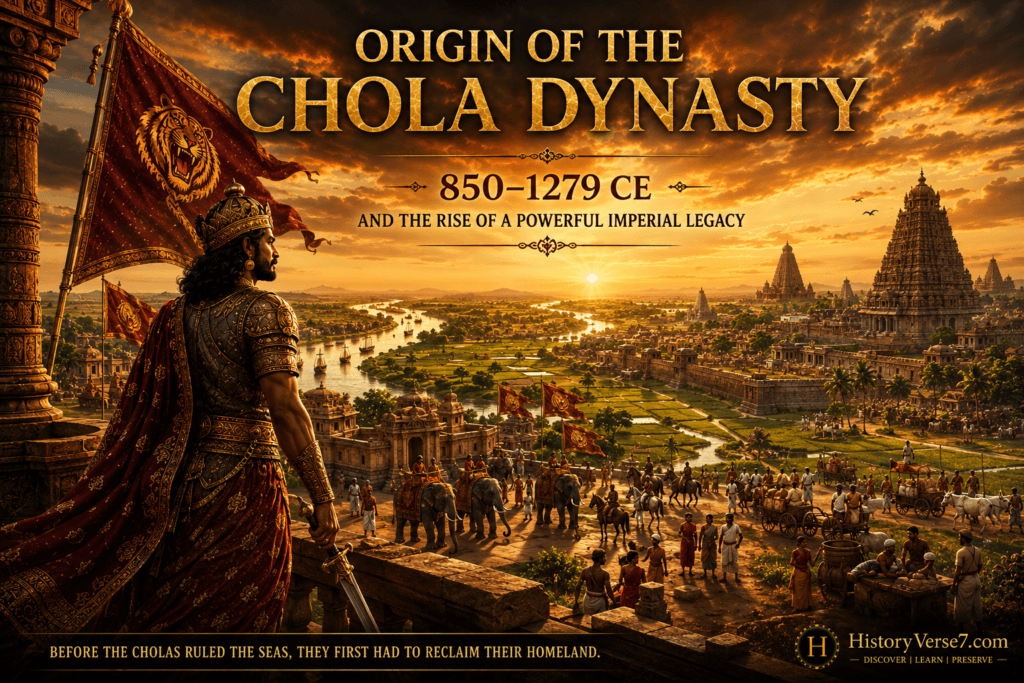
They are well-attested because the Tamil literary tradition of the Sangam age dated by most scholars to roughly the 3rd century BCE through the 3rd century CE mentions Chola kings by name, describes their capitals, praises their conquests, and mourns their deaths with a vividness that brings them startlingly to life. They are historically elusive because the gap between these early literary references and the rise of the Imperial Cholas in the 9th century CE is approximately five hundred years during which the dynasty barely appears in any historical source.
This article traces the full arc of Chola origins from the prehistoric Tamil-speaking communities of South India, through the Sangam age kings who first bore the Chola name, across the long historical shadow of the intervening centuries, to the moment when the dynasty reemerged, transformed but recognizably continuous, to build one of the great empires of the medieval world. Throughout, it distinguishes carefully between what the evidence actually shows and what later tradition has added.
Origin of the Chola Dynasty
South India Before the Cholas: Setting the Stage
The Political Landscape of Ancient Tamil Nadu
To understand the emergence of the Cholas, one must first understand the world into which they emerged. The Indian subcontinent’s southern peninsula defined by the Vindhya and Satpura mountain ranges to the north, the Western Ghats to the west, and the Eastern Ghats running along the eastern coast was, in the first millennium BCE, home to a distinct cultural and linguistic zone that modern scholars call the Dravidian world.
The Tamil-speaking communities of the far south inhabited a landscape of extraordinary geographical diversity: the lush coastal plains of the Coromandel coast watered by rivers like the Kaveri, Palar, and Vaigai; the elevated Deccan plateau of central Tamil Nadu; the dense forests of the Eastern Ghats; and the arid Tirunelveli plains of the deep south. These different ecological zones supported different modes of livelihood wet rice cultivation in the deltas, dry-land farming and pastoralism in the interior, fishing and maritime trade along the coast and different social organizations.
Ancient Tamil poetic tradition organized these ecological zones into five tinais (landscapes), each associated with a specific mood, flora, fauna, and human activity. This classification system one of the most sophisticated literary-geographical frameworks in the ancient world reflects the intimate relationship between Tamil communities and their physical environment that was the bedrock of early South Indian civilization.
The Three Great Tamil Confederacies
By the time of the Sangam literary corpus, three major political entities had established themselves as the dominant powers of Tamil South India: the Cheras, who controlled the southwestern coastal region corresponding roughly to modern Kerala; the Pandyas, whose capital at Madurai governed the southern interior and the rich pearl-fishing waters of the Gulf of Mannar; and the Cholas, whose heartland was the fertile Kaveri delta in the northeast of the Tamil region.
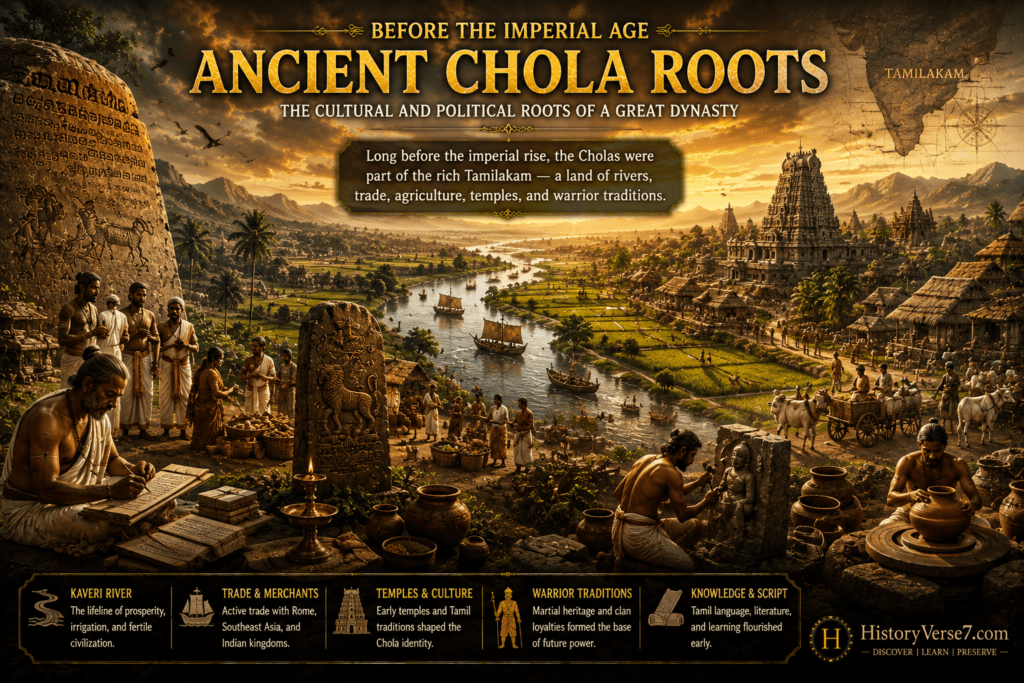
These three the muvendar, or ‘three crowned kings’ of Tamil tradition were not unified states in the modern sense. They were confederacies of chiefs whose loyalty to the central ruler was conditional, negotiated, and frequently contested. Territory expanded and contracted with military fortune. Minor chiefs shifted allegiance. The boundaries between the three confederacies were not fixed lines on a map but zones of competition and transition.
What is striking about this tripartite political structure is its apparent antiquity and stability. The same three names Chera, Pandya, Chola appear in the Sangam poems, in Ashokan edicts of the 3rd century BCE, in early Roman geographical accounts, and in Chinese records of the early centuries CE. Whatever their internal organization, these three confederacies were the recognized political framework of ancient Tamil South India for more than five centuries.
Ashokan Rock Edict II and XIII, dating to around 257 BCE, explicitly name the ‘Choda’ (Chola), ‘Panda’ (Pandya), and ‘Keralaputra’ (Chera) among the kingdoms bordering Ashoka’s Maurya Empire to the south. This is the earliest unambiguous external reference to the Cholas in the historical record and it demonstrates that by the mid-3rd century BCE, the Chola political identity was sufficiently established and well-known to be recorded in an imperial edict carved in stone.
The Sangam Age and the Early Cholas
What Is the Sangam Literature?
The Sangam literary corpus is one of the oldest surviving bodies of secular poetry in any Indian language and one of the great literary achievements of the ancient world. The word ‘Sangam’ refers to an academy specifically, the legendary academies of Tamil poets said to have convened under royal patronage in Madurai during a remote mythological past. Modern scholars use ‘Sangam literature’ to refer to a collection of approximately 2,381 poems in eight anthologies (ettuthokai) and ten idylls (pattupattu), supplemented by two major epics and several grammatical treatises.
Dating the Sangam corpus with precision is one of the most contested problems in Indian literary history. Traditional Tamil scholarship dates the academies to a period of extraordinary antiquity sometimes extending back tens of thousands of years a claim modern historians regard as legendary rather than historical. Most contemporary scholars, working from linguistic analysis, references to datable external events, and the evidence of associated archaeological finds, place the core of the Sangam corpus between approximately the 3rd century BCE and the 3rd century CE, with some later additions extending into the 5th or 6th century.
The Sangam poems are not primarily historical documents — they are literary works concerned with love, war, nature, and the human condition. But they are richly embedded in a specific historical world. They name kings, describe battles, specify geographical locations, and record the material culture of their time with a concreteness that makes them invaluable historical sources — provided they are read with appropriate critical awareness of their literary conventions and purposes.
The Cholas in Sangam Literature: A Portrait of Early Kingship
The Chola kings who appear in Sangam poetry are vivid, specific, and humanly compelling. The most celebrated is Karikala Chola ‘Karikala’ meaning ‘one with a charred leg,’ a name explained in tradition by a childhood accident. Whatever the etymology, Karikala is the dominant Chola figure of the Sangam age, celebrated in multiple poems and in the later epic Pattinappalai.
The poems describe Karikala as a mighty warrior who defeated the combined forces of the Cheras and Pandyas at the Battle of Venni a victory so complete that he established Chola supremacy over all three confederacies simultaneously. He is credited with forcing defeated kings to labor on the construction of embankments along the Kaveri River an act of both practical hydraulic engineering and pointed political humiliation. The Kaveri embankment tradition has been connected by later tradition to the famous Grand Anicut (Kallanai), still standing today, though direct archaeological confirmation of Karikala’s role in its construction has not been established.
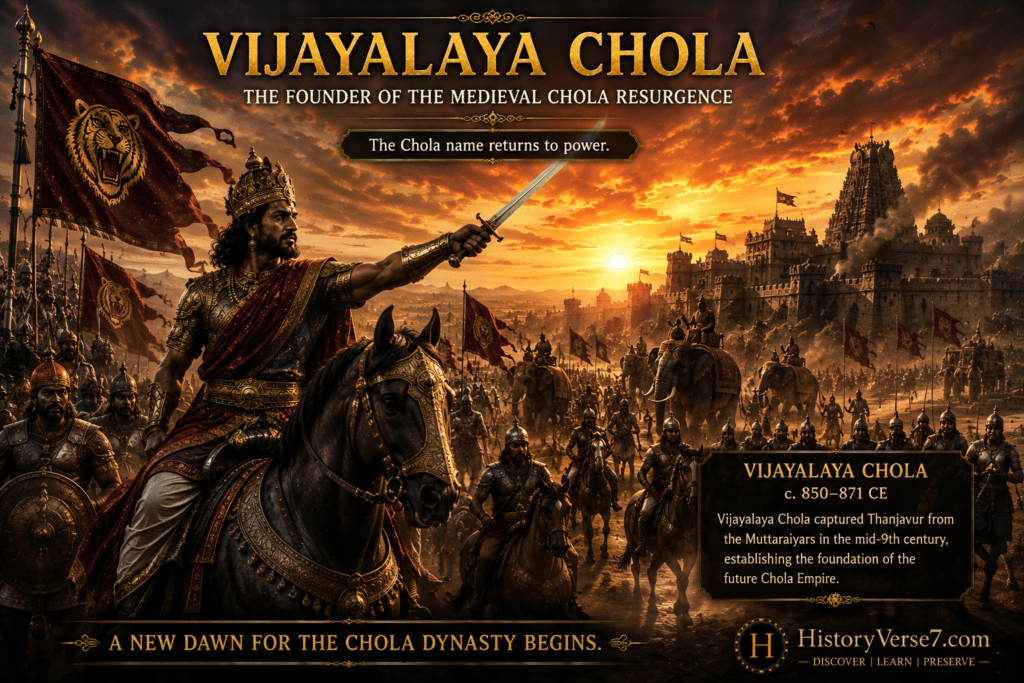
Karikala’s capital appears to have been Kaveripattinam (also known as Puhar), a great port city at the mouth of the Kaveri. The Sangam poem Pattinappalai (‘Song of the City’) describes Kaveripattinam with remarkable specificity: its crowded harbor where ships from foreign lands unloaded their cargoes, its workshops producing luxury goods, its temples and pleasure gardens, the sounds and smells of a prosperous international trading city. This is not generic poetic description it is a portrait of a specific place at a specific moment in history.
Archaeological excavations at the site of ancient Kaveripattinam, begun in the 1960s and continuing subsequently under the Archaeological Survey of India, have confirmed the existence of a major settlement at this location in the early centuries CE. Finds include Roman amphora sherds, rouletted ware pottery associated with Roman trade connections, evidence of bead manufacturing, and the remains of what appears to have been a significant urban settlement. The archaeology broadly corroborates the literary picture of Kaveripattinam as an important commercial center.
Other Sangam Chola Kings
Karikala is the most celebrated Sangam Chola, but he is not the only one. The poems mention several other Chola kings, though their chronological relationship to each other and to Karikala is often unclear. Kocengannan (‘Red-Eyed Chola’), celebrated in the Purananuru anthology, is remembered as a great temple builder one of the 63 Shaivite saints (Nayanmars) of later Tamil tradition identifies him as having built 70 Shiva temples and a magnificent temple at Chidambaram. Perunarkilli, Nalankilli, Ilankilli, and Kopperuncholan are among the other Chola names that appear in Sangam poetry.
Kopperuncholan is particularly interesting because the poems associated with him describe his death apparently by self-starvation (vattakkiruttal) in preparation for a glorious afterlife in terms that suggest a sophisticated ideology of heroic kingship that would have profound long-term significance for Tamil political culture. The willingness of a king to choose death in preference to political humiliation and the community’s veneration of this choice speaks to a set of values about honor, sovereignty, and sacrifice that runs through Tamil culture across centuries.
The Historical Significance of Sangam Chola Evidence
What does the Sangam evidence actually establish about Chola origins? Several things with reasonable confidence. First, the Chola political identity a dynasty ruling the Kaveri delta with Kaveripattinam as a major center was established and well-known by at least the 3rd century BCE (the date of the Ashokan edicts) and probably earlier. Second, by the early centuries CE, Chola kings were significant regional powers who participated in the broader Indian Ocean trading world and maintained a sophisticated royal court that patronized poets and artists. Third, the Kaveri River and its delta were the core of Chola territorial identity from the earliest attested period.
What the Sangam evidence does not establish and what scholars must be careful not to assume is a continuous, unified dynastic succession from the Sangam kings to the Imperial Cholas of the 9th century. The Sangam poems name individuals and describe events, but they do not provide the systematic genealogical information that would allow historians to construct a reliable king-list. The connection between the ancient Karikala and the medieval Vijayalaya is assumed by later Chola inscriptions but cannot be independently verified.
Legends About the Origin of the Cholas
Traditional Accounts: Solar Lineage and Mythic Ancestors
Like most ancient dynasties, the Cholas surrounded their origins with mythology that served political and ideological purposes. The most common traditional account derives the Chola lineage from Sibi, a legendary king of the Solar dynasty (Suryavamsha) celebrated in Sanskrit epic literature for his extraordinary generosity and self-sacrifice. Medieval Chola copper-plate inscriptions routinely open with genealogical verses tracing the dynasty’s ancestry to this Puranic hero.
The choice of Sibi as mythological ancestor was not arbitrary. Sibi’s story in which he offers flesh from his own body to save a dove from a hawk embodies values of royal generosity and sacrifice that medieval Chola kings wished to claim as their inheritance. By connecting themselves to this Solar lineage, the Cholas also positioned themselves within the broader Kshatriya (warrior-ruler) tradition of the Sanskrit Puranas, giving their Tamil kingship a pan-Indian legitimacy that transcended regional identity.
Other traditional accounts connect early Chola kings to the sage Agastya the mythological Brahmin hero who is credited with bringing Vedic civilization to South India or to a king named Manu, the primordial lawgiver of Hindu tradition. These connections to Brahminical learning and to the foundational figures of Sanskrit civilization served the same function as the Solar lineage claim: establishing the Cholas as legitimate heirs to a universal civilization, not merely a regional Tamil power.
The Meaning of ‘Chola’: Linguistic and Legendary Explanations
The word ‘Chola’ itself has attracted multiple traditional explanations. One common account derives it from the Sanskrit word ‘kola’ meaning black, supposedly referring to the dark complexion of the dynasty’s founder. Another connects it to the Tamil word ‘chozham,’ whose exact meaning is disputed. Yet another tradition links it to the name of a specific ancestral hero who founded the line.
Modern linguistic scholars approach these folk etymologies skeptically. K.A. Nilakanta Sastri noted that the origin of the word ‘Chola’ remains uncertain and that the traditional explanations are almost certainly retroactive invented to explain a name whose original meaning had been forgotten. The name may be a tribal or territorial designation of great antiquity, predating the organized literacy that would have preserved its original meaning.
Myths vs. Evidence: Separating Legend from History
The critical scholarly task is to distinguish between what the traditional accounts assert and what historical evidence can corroborate. Several points of necessary skepticism deserve emphasis.
The claim of Solar dynasty descent is a literary and ideological construction, not a historical genealogy. Similar Solar lineage claims appear in the inscriptions of the Pandyas, the Pallavas, and numerous other South Indian dynasties it was a standard trope of medieval Sanskrit political poetry, not a verifiable historical statement. No historian treats it as evidence of actual descent from the Suryavamsha of Puranic mythology.
The specific genealogies offered in medieval Chola copper-plate inscriptions which typically list a series of royal ancestors stretching back into the mythological past cannot be taken at face value as historical records. These inscriptions were composed by court poets whose job was to glorify the reigning king, not to write objective genealogical history. The further back the claimed lineage extends, the less historical value it carries.
This does not mean the traditional accounts are worthless. They preserve genuine cultural memory the association of the Cholas with the Kaveri delta, the celebration of specific heroic ancestors, the claims of military achievement that may reflect real historical realities even when the specific details are mythologized. Reading traditional accounts critically, extracting the kernel of historical plausibility from the shell of literary elaboration, is a core skill of South Indian historical scholarship.
Archaeological Evidence: What the Ground Reveals
Inscriptions and Their Testimony
The most directly historical evidence for the early Cholas comes from inscriptions texts carved in stone or engraved on copper plates that preserve records of royal grants, religious donations, and political assertions. The earliest inscriptions associated with the Chola tradition are the Ashokan edicts already mentioned, which establish the Chola name in the epigraphic record by the 3rd century BCE.
Tamil Brahmi inscriptions short texts in an early form of the Tamil script derived from the Brahmi writing system begin appearing in cave sites and rock faces in Tamil Nadu from approximately the 3rd century BCE onward. These inscriptions, many associated with Jain monks and merchants, occasionally mention donations by individuals with titles that may connect them to early political hierarchies, but direct references to Chola rulers in this early inscriptional corpus are rare and their interpretation is disputed.
The Anbil copper plates of Sundara Chola (10th century CE) and other later medieval inscriptions contain elaborate genealogies of the Chola dynasty but these were composed nearly a millennium after the events they purport to describe and cannot be treated as reliable historical sources for the Sangam period. They are evidence of how the 10th-century Chola court understood (or wished to present) its own past, not a window onto actual early Chola history.
One inscription of particular significance is the Kalugumalai inscription in the Tenkasi region, which mentions a local chieftain in terms that some scholars have connected to early Chola political organization though its interpretation remains contested. The South Indian Inscriptions series, published by the Archaeological Survey of India, remains the primary scholarly repository for this epigraphic material.
Numismatic Evidence: What Coins Tell Us
Coins are among the most reliable archaeological evidence for ancient political entities because they were produced in quantity, circulated widely, and survive in the archaeological record in relatively large numbers. Coins associated with early Chola rulers have been found in Tamil Nadu, though their dating and attribution are subjects of ongoing scholarly debate.
The most commonly discussed early Chola coins bear the tiger emblem the Chola dynastic symbol along with a fish and sometimes a bow, symbols associated with the Pandya and Chera dynasties respectively. These bi- or tri-symbol coins have been interpreted as evidence of confederation coinage perhaps issued to celebrate a political alliance or to circulate across the territories of all three Tamil confederacies. If this interpretation is correct, they would be evidence of a sophisticated monetary and political relationship among the three muvendar kingdoms.
Coins bearing only the tiger symbol, plausibly attributable to the Cholas alone, have been found in excavations at Kaveripattinam and at other sites in the Kaveri delta region. Their precise dating crucial for understanding the timeline of Chola political development depends on the stratigraphic context of their discovery and on comparisons with other datable coin types, a technical analysis that continues to refine our understanding.
Ancient Settlements and Archaeological Sites
Beyond the specific sites associated with literary and epigraphic evidence, the broader archaeological record of Tamil Nadu sheds light on the social and economic conditions that enabled the emergence of the Chola polity. Iron technology spread through South India by the late first millennium BCE, enabling more efficient agriculture and more devastating warfare a double edge that simultaneously expanded the food surplus available to support larger populations and more complex political organizations, and increased the destructive potential of inter-polity conflict.
Megalithic burial traditions large stone burial monuments of various types are widely distributed across Tamil Nadu and adjacent regions, dating from roughly 1000 BCE onward. These megaliths are associated with a pastoral and semi-agricultural society whose material culture includes iron tools and weapons, black-and-red ware pottery, and evidence of long-distance exchange in prestige goods. The society that produced these burials was the direct predecessor of the Sangam-age communities in which the Chola political identity took shape.
Excavations at Arikamedu, near Pondicherry, have revealed a major Roman-period trading settlement on the Coromandel coast, active from approximately the 1st century BCE to the 2nd century CE, with large quantities of Roman amphora sherds, Italian terra sigillata pottery, glass, and other Mediterranean imports. Arikamedu was probably not a Chola site specifically, but it demonstrates the intensity of the Roman-South Indian commercial relationship that the Sangam poems describe and that the Cholas participated in.
Foreign Accounts: How the Ancient World Saw the Cholas
Greek and Roman Sources
Among the most valuable external sources for early South Indian history are the geographical and commercial texts produced in the Greco-Roman world. The Periplus of the Erythraean Sea a Greek navigational handbook composed probably in the 1st century CE by an anonymous Egyptian-Greek merchant describes the ports and trade goods of the Indian coasts with practical specificity. It mentions several South Indian ports involved in the pepper, pearls, and textiles trade with Rome, and its geographical descriptions correspond recognizably to the coastal geography of Tamil Nadu and Kerala.
Ptolemy’s Geography (2nd century CE) provides a more systematic geographical account of South India, naming towns, rivers, and political entities with varying degrees of accuracy. Ptolemy mentions a ‘Kingdom of the Chola’ and a capital that corresponds to Kaveripattinam, providing external corroboration for the Sangam literary picture of Chola political geography.
The Tabula Peutingeriana a medieval copy of an ancient Roman road map shows a ‘Temple of Augustus’ at the mouth of the Ganges and other South Asian geographical features, reflecting the reach of Roman geographical knowledge. While it does not specifically name the Cholas, it is part of the broader Roman awareness of South Asian political geography that included knowledge of the Tamil kingdoms.
Roman coins have been found in considerable quantities across Tamil Nadu hundreds of gold aureus and silver denarius coins from various Roman emperors, particularly Augustus, Tiberius, and Nero, as well as later emperors. These coins are direct evidence of the commercial relationship between Rome and Tamil South India that the Sangam poems describe. Their distribution across the Tamil region, including the Kaveri delta, demonstrates that Chola territory was directly integrated into the Roman-Indian Ocean trading network.
Chinese References
Chinese historical annals of the Han Dynasty (206 BCE – 220 CE) contain references to diplomatic missions from South Indian kingdoms, though the identification of specific Chinese place-names with Tamil polities is often uncertain. The Hou Han Shu (History of the Later Han) mentions a kingdom called ‘Huangzhi’ that sent an embassy to the Han court some scholars have identified this with Kaveripattinam or another major South Indian port, though the identification is debated.
Chinese Buddhist pilgrims traveling to India including Faxian (early 5th century CE) and Xuanzang (7th century CE) left accounts of their journeys that include descriptions of South Indian kingdoms. These accounts, while primarily interested in Buddhist sites, provide valuable incidental information about the political geography of South India in the post-Sangam period. Neither Faxian nor Xuanzang mentions a strong Chola polity in their time, consistent with the historical evidence that the dynasty was in relative eclipse between the 4th and 9th centuries CE.
What Modern Historians Believe: The Scholarly Consensus and Its Limits
Contemporary historical scholarship on Chola origins reflects a careful balance between two extremes the uncritical acceptance of traditional accounts that characterized earlier nationalist historiography, and an overly skeptical dismissal of all pre-medieval Chola evidence that would leave the imperial dynasty’s origins entirely unexplained.
K.A. Nilakanta Sastri, whose ‘The Colas’ (1935, revised 1955) remains the foundational study of Chola history, accepted the broad historicity of the Sangam Chola kings while being appropriately cautious about specific genealogical claims. He argued for a continuous Chola dynastic tradition from the Sangam period to the medieval empire, with the 4th–9th century gap explained by political subordination rather than dynastic extinction.
Subsequent scholars have refined and challenged Nilakanta Sastri’s framework in various ways. Noboru Karashima, whose prosopographical studies of Chola inscriptions revolutionized our understanding of the medieval empire’s social and economic history, was more cautious about the Sangam-medieval connection, emphasizing the enormous gap in evidence and the danger of assuming continuity that cannot be demonstrated. His approach rigorously evidence-based, deeply skeptical of claims that outrun the sources has been enormously influential in shaping contemporary South Indian historiography.
Upinder Singh’s synthesis ‘A History of Ancient and Early Medieval India’ (2008) represents the current scholarly mainstream: acknowledging the reality and historical significance of the Sangam Cholas, noting the genuine uncertainty about the 4th–9th century period, and treating the imperial Chola dynasty as a revival or renaissance of an ancient tradition rather than either a simple continuation or a completely new beginning.
The honest scholarly position is this: the Chola name and political identity are among the oldest documented in South Asian history, attested with confidence by the 3rd century BCE. The Sangam-age Cholas were real political entities whose kings are remembered in some of the oldest Tamil poetry. The connection between these early Cholas and the imperial dynasty of the 9th century onward is claimed by the medieval Cholas themselves in their inscriptions, is plausible given the continuity of Chola territorial identity in the Kaveri delta, but cannot be independently verified for the intervening centuries.
The Transition to the Medieval Cholas: The Lost Centuries and the Revival
Between approximately the 4th and 9th centuries CE, the historical record of the Cholas falls largely silent. This silence is itself historically significant and requires explanation.
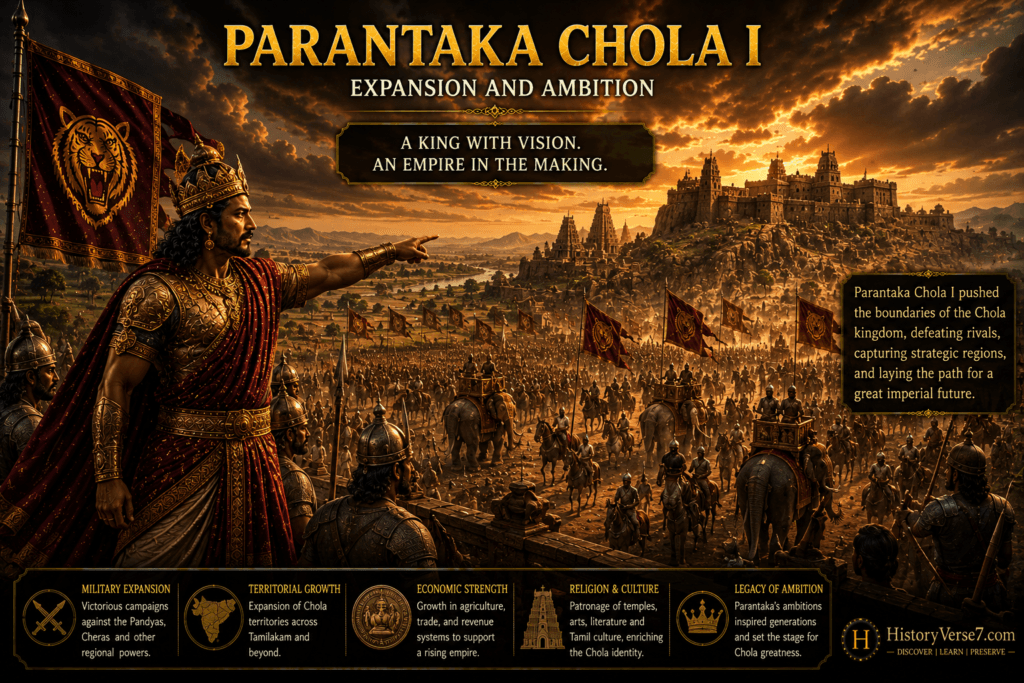
The most likely explanation is political: the Cholas were subordinated to, or eclipsed by, more powerful neighbors. The Pallavas of Kanchipuram rose to dominance in Tamil Nadu from approximately the 3rd century CE onward, and at their height in the 7th and 8th centuries under kings like Mahendravarman I and Narasimhavarman I, they were the paramount power in the Tamil region. The Pandyas also experienced periods of significant power during this interval. The Cholas, if they survived as a political entity at all, would have done so as subordinate chiefs too minor to attract the attention of the major Sanskrit-language inscriptions that are our primary source for this period.
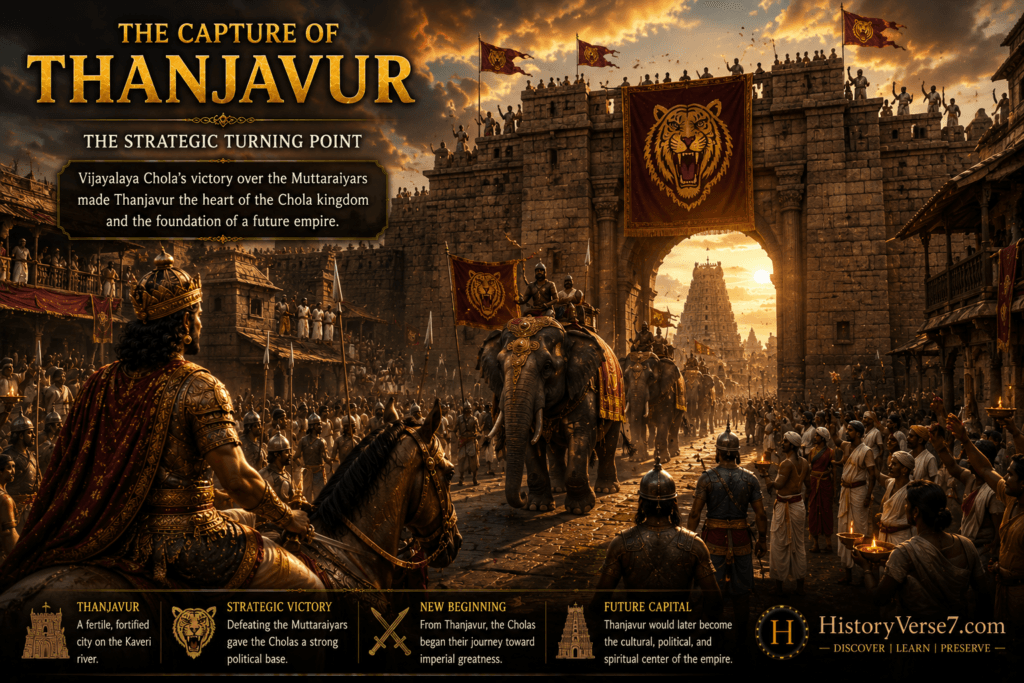
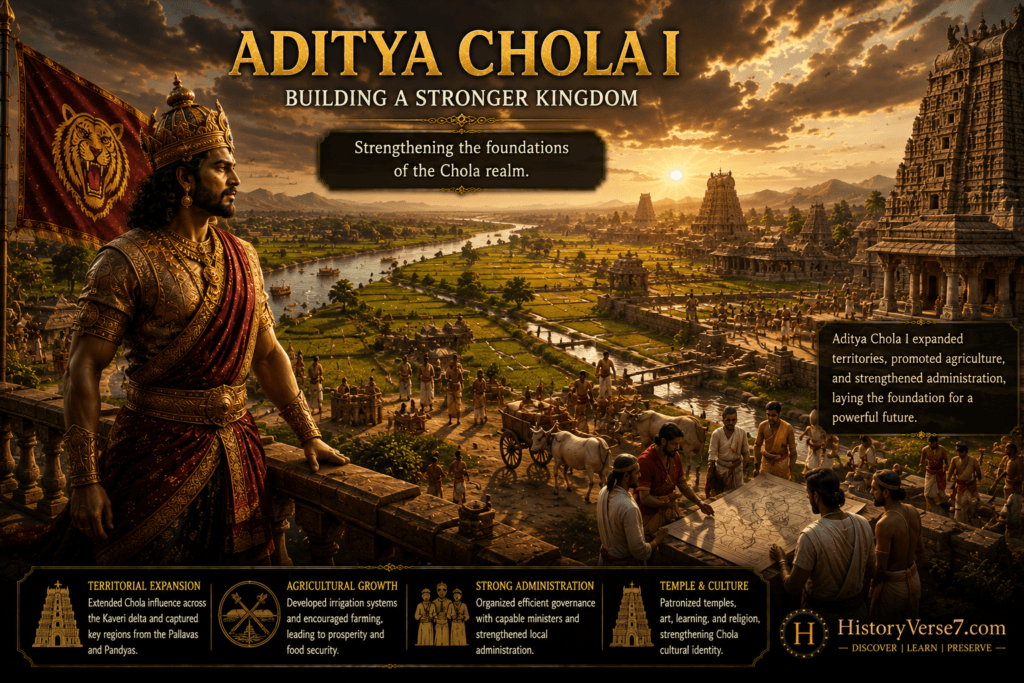
The Mutharaiyar chiefs a lineage that controlled Thanjavur and the central Kaveri delta in the 8th and 9th centuries may have been the immediate predecessors of the imperial Cholas in control of the Chola heartland. When Vijayalaya Chola seized Thanjavur from the Mutharaiyar around 848 CE, he may have been a Pallava subordinate chief asserting independence in the context of Pallava decline, rather than the direct heir of an unbroken Chola dynastic tradition.
The imperial Cholas’ own account of their origins, as preserved in their copper-plate genealogies, asserts direct continuity with the Sangam kings Karikala appears in medieval Chola genealogies as a remote ancestor. This assertion was politically valuable: it connected the new dynasty to an ancient and glorious tradition, giving its relatively recent rise to power the legitimacy of deep historical roots. Whether it reflects a genuine genealogical memory or a politically motivated construction is impossible to determine with confidence.
What can be said with confidence is that the imperial Cholas consciously identified with and drew upon the Chola tradition its territorial base in the Kaveri delta, its tiger emblem, its association with the great port of Kaveripattinam, its memory of heroic kings like Karikala. Whether or not there was a continuous biological descent from the Sangam kings to Vijayalaya, there was certainly a continuous cultural and territorial identity that the imperial dynasty claimed and built upon.
Historical Debate: The Unresolved Questions
Several major questions about Chola origins remain actively debated among scholars, and intellectual honesty requires acknowledging them rather than papering over the disagreements with false certainty.
The Sangam Dating Problem: The dating of the Sangam literary corpus is fundamental to understanding the historical context of the early Cholas, and it remains genuinely uncertain. While most scholars accept a broad date range of 3rd century BCE to 3rd century CE for the core corpus, some argue for later dates and others for earlier. The internal chronology of the corpus which poems are earliest, which kings are contemporary, how the various anthologies relate to each other is itself a matter of scholarly debate that directly affects how we reconstruct early Chola history.
The Karikala Question: Karikala is the most celebrated Sangam Chola king, but the historicity of many specific events associated with him the Battle of Venni, the forced labor on the Kaveri embankments, the construction of the Kallanai is difficult to verify independently. Some historians treat him as a historical figure whose deeds have been substantially embellished in literary tradition; others are more skeptical about whether he can be distinguished from a legendary archetype of the heroic king.
The Continuity Problem: The relationship between the Sangam Cholas and the imperial Cholas is the central unresolved question in Chola historiography. The medieval dynasty’s own claims of continuity are politically motivated and cannot be taken as straightforward historical evidence. But absence of evidence is not evidence of absence the fact that we lack documentation of the Cholas in the 4th–9th century interval does not mean they ceased to exist, only that they left no record that has survived. The balance of scholarly opinion leans toward accepting some form of continuity while acknowledging that it cannot be demonstrated rigorously.
The Ethnic and Linguistic Question: Were the Cholas a specifically Tamil-speaking ethnolinguistic community from the beginning, or did ‘Chola’ originally designate a political rather than ethnic identity? The Sangam poems are in Tamil, and the Chola kings appear as patrons of Tamil literature but the question of whether ‘Chola’ was always a Tamil identity or whether it might originally have been a broader political designation that was later Tamilized is one that specialists in ancient South Asian linguistics continue to debate.
Author Commentary
There is something both frustrating and deeply exciting about studying the origins of the Chola dynasty. Frustrating, because the evidence stubbornly refuses to resolve the most interesting questions we cannot confirm Karikala’s battles, cannot trace the genealogy from Sangam king to medieval emperor, cannot recover the 500-year gap in the dynastic record. And deeply exciting, for exactly the same reason: the Cholas are a reminder that history is not a completed puzzle whose pieces we merely need to arrange, but an ongoing inquiry whose answers we must continually revise as new evidence and new methods emerge.
What I find most compelling about the Chola origins question is what it reveals about the relationship between political identity and territorial rootedness. Whatever the gaps in the dynastic succession, the Kaveri delta remained ‘Chola country’ across the centuries a territorial identity so deeply embedded in the landscape, in the irrigation systems built upon it, in the communities living within it, that no political interruption could erase it. When Vijayalaya Chola seized Thanjavur in the 9th century, he was claiming a name that carried with it the weight of a thousand years of association with a specific piece of land and a specific way of life. That is not nothing. That is, in many respects, everything.
The lesson for students of history is methodological as much as substantive. The Chola origins case shows how much can be learned by using all available evidence literary, epigraphic, numismatic, archaeological, comparative while remaining rigorously honest about what each type of evidence can and cannot tell us. Legends are not history, but they are not worthless either. Inscriptions are primary sources, but they are also political documents. Archaeology provides ground truth, but its interpretation requires specialized knowledge and careful argument. Good history uses everything; it trusts nothing uncritically.
15 Lesser-Known Facts About the Origin of the Chola Dynasty
- Modern genetic and linguistic studies of South Indian populations broadly support the antiquity of Tamil-speaking communities in the Kaveri region, providing biological corroboration for the long historical rootedness of the cultural tradition in which the Chola identity developed.
- The Ashokan edicts of 257 BCE — carved in stone by the Maurya emperor Ashoka — contain the earliest external historical reference to the Cholas, naming them as a southern kingdom beyond Ashoka’s empire.
- The word ‘Chola’ appears in at least 8 different spellings in ancient sources: Chola, Choda, Cola, Coda, Sola, Soola, Cholan, and variations — reflecting the phonological differences between Greek, Latin, Sanskrit, Tamil, and Chinese transcription systems.
- Kaveripattinam, the ancient Chola capital, is now largely submerged under the Bay of Bengal due to coastal erosion and sea-level changes — a lost city that archaeology has only partially recovered.
- Roman gold coins — aureus and denarius — have been found in dozens of sites across Tamil Nadu, including the Kaveri delta, demonstrating that the early Chola heartland was directly integrated into the Roman-Indian Ocean trading network.
- The tiger emblem of the Cholas — their dynastic symbol — appears consistently from the earliest coins and medieval bronzes, representing one of the longest continuously used royal symbols in South Asian history.
- Karikala Chola — the most celebrated Sangam-age king — has never been definitively dated. Scholarly estimates for his reign range across a span of several centuries, from approximately 100 BCE to 200 CE.
- The Pattinappalai, a Sangam poem describing the Chola capital Kaveripattinam, is one of the earliest urban descriptions in Tamil literature — a vivid portrait of a cosmopolitan trading city that matches the archaeological evidence from the site.
- The three Tamil confederacies — Chola, Pandya, Chera — are so consistently mentioned together in ancient sources that some historians believe their tripartite relationship was itself a formal political institution, not merely a geographical coincidence.
- There is a gap of approximately 500 years — from roughly the 4th to the 9th century CE — during which the Chola dynasty appears in almost no surviving historical source. This is one of the most puzzling silences in South Asian historiography.
- The Anbil copper plates, issued by the 10th-century Chola king Sundara Chola, contain one of the most detailed medieval genealogies of the Chola dynasty — but historians treat it as political mythology rather than reliable history for the ancient period.
- Megalithic burial sites in the Kaveri delta region — large stone tombs dating from approximately 1000 BCE — provide the earliest archaeological evidence for the complex social organization that eventually produced the Chola political tradition.
- The Grand Anicut (Kallanai) dam across the Kaveri — attributed by tradition to the Sangam-age king Karikala — is considered by hydraulic engineers to be one of the oldest functional water-regulation structures in the world, though direct archaeological confirmation of its earliest phases is elusive.
- Foreign accounts of the early Cholas include references in the Periplus of the Erythraean Sea (1st century CE), Ptolemy’s Geography (2nd century CE), and possibly early Chinese Han Dynasty annals — making them one of the best-documented ancient South Indian polities in non-Indian sources.
- The Sangam poem corpus, which contains most of our knowledge of the early Cholas, was not ‘discovered’ by modern scholars but was preserved continuously in Tamil literary tradition — though the texts were critically edited and published for the first time only in the late 19th and early 20th centuries.
Conclusion: A Name Older Than Empire
The origin of the Chola dynasty is a story that begins not with a single founder or a decisive moment of political creation, but with a process slow, complex, and still imperfectly understood by which a Tamil-speaking community in the Kaveri delta developed, over many centuries, the political, economic, and cultural institutions that eventually produced one of the great empires of world history.
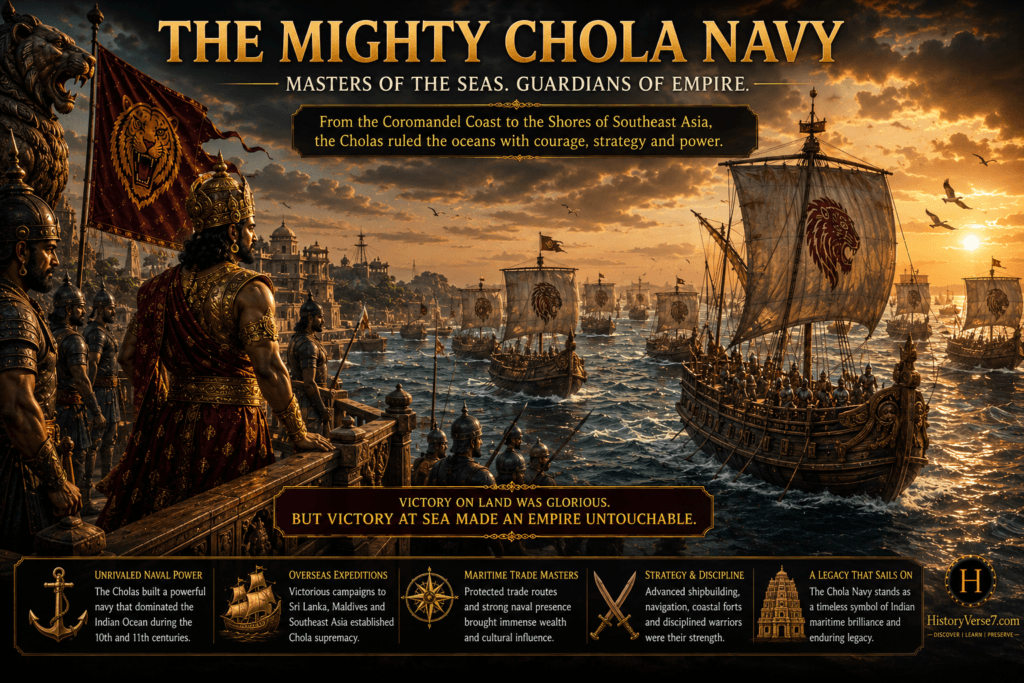
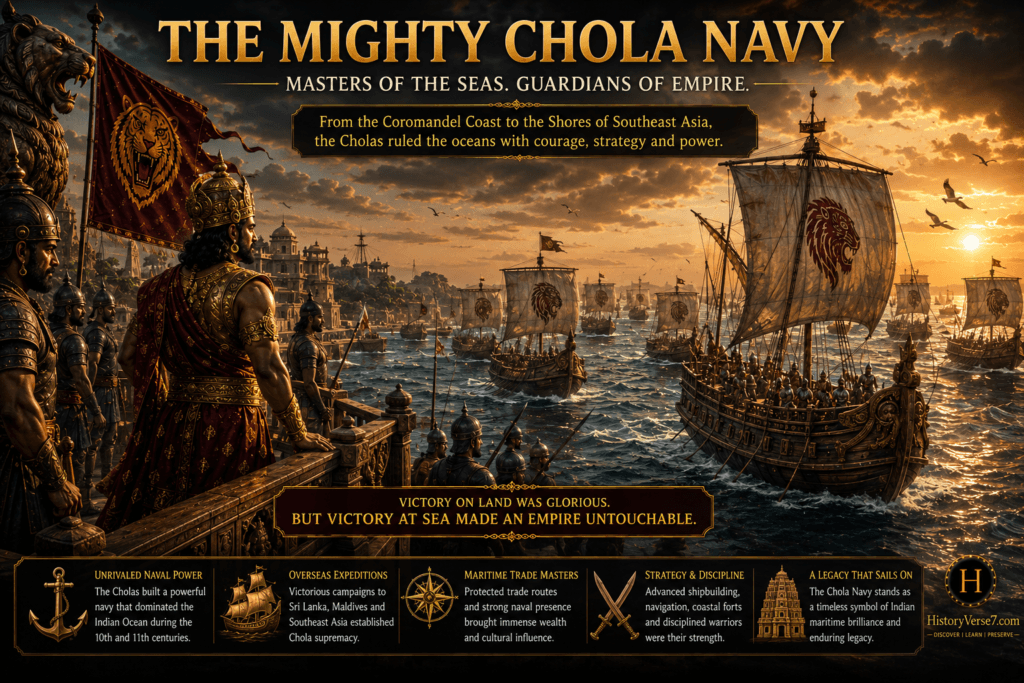
The name Chola is ancient among the oldest political names in South Asian history, carried in Ashokan stone, in Tamil verse, in Greek navigational handbooks, in Roman coins pulled from South Indian soil. The tiger emblem that flew over Chola warships in the 11th century CE was already symbolically significant when Sangam poets composed their verses in the early centuries of the common era. The Kaveri River that irrigated the rice fields sustaining the imperial Chola economy had been channeled and managed by generations of Tamil farmers before Rajaraja I ever sat on the Thanjavur throne.
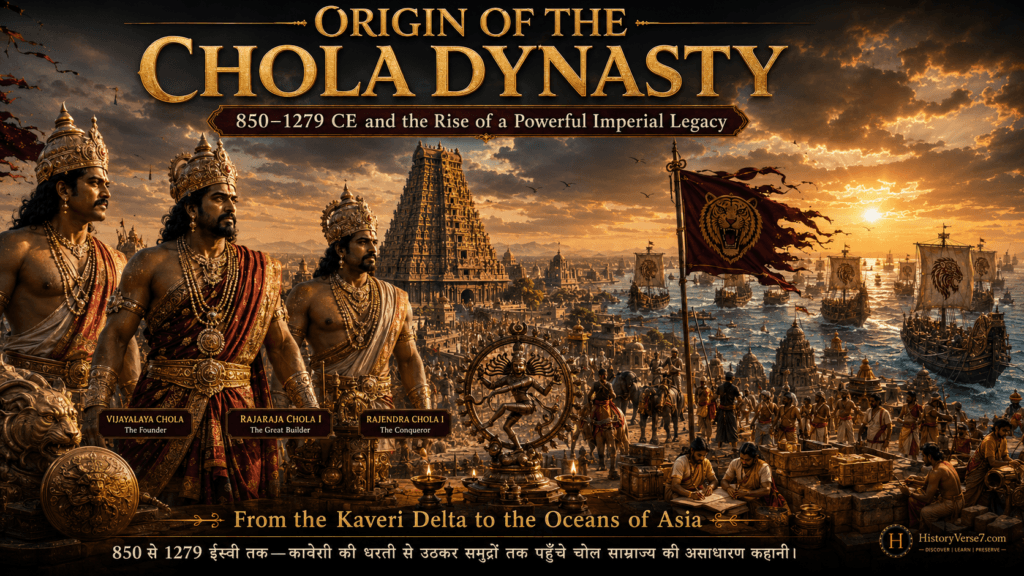
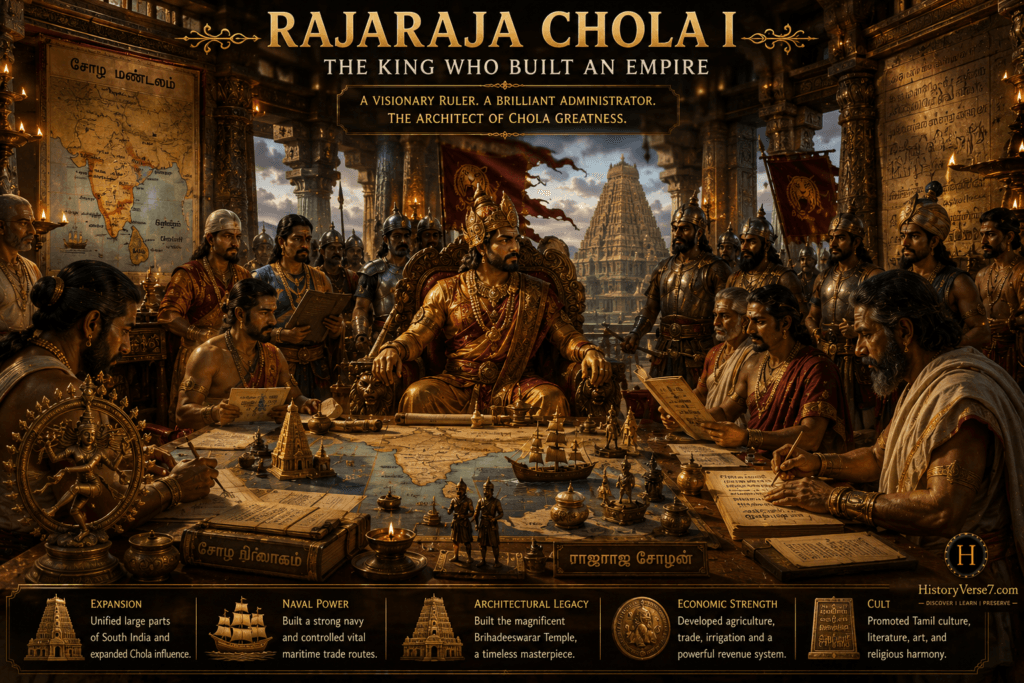
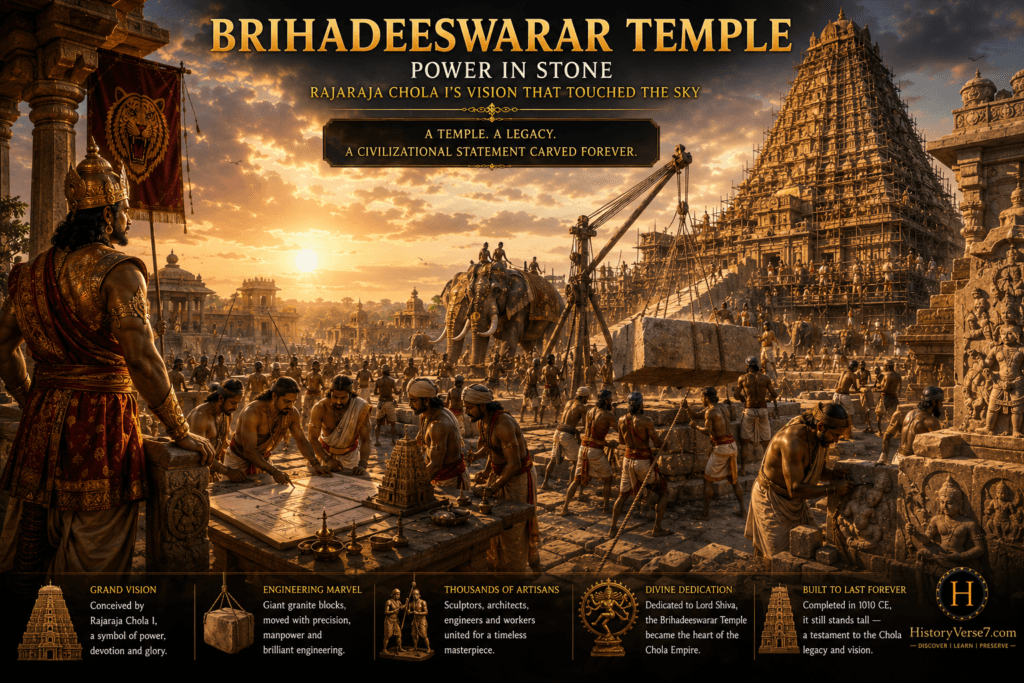
This depth of rootedness is, ultimately, the most important fact about Chola origins. Empires are not built in a generation they are built on foundations that take centuries to lay. The administrative sophistication of the Imperial Chola state, the commercial networks of the Tamil merchant guilds, the artistic traditions that produced the Brihadeeswara Temple and the Nataraja bronzes all of these drew on a deep well of accumulated cultural, economic, and institutional development that the Sangam age had begun to fill.
The five-century gap in the dynastic record remains mysterious and probably always will be. But the cultural continuity the enduring identity of the Kaveri delta as Chola country, the persistence of the tiger symbol, the maintenance of Tamil literary and religious traditions is real, and it is what enabled the remarkable revival of the 9th century. Vijayalaya Chola did not create a dynasty from nothing; he reclaimed an inheritance that had been waiting, in the landscape and the memory of the people, for someone with the ambition and the ability to assert it.
The Chola story begins, in the truest sense, not in 848 CE but in the deep time of Tamil civilization in the megaliths and the monsoon-fed rice fields and the fishing boats that have worked the Coromandel coast long before any king gave them his name.
References and Further Reading
- Champakalakshmi, R. — Trade, Ideology and Urbanization: South India 300 BC to AD 1300. Oxford University Press, 1996.
- Nilakanta Sastri, K.A. — The Colas (2 vols). University of Madras, 1935 (revised 1955). [Primary scholarly authority on Chola history]
- Nilakanta Sastri, K.A. — A History of South India. Oxford University Press, 1955.
- Stein, Burton — Peasant State and Society in Medieval South India. Oxford University Press, 1980.
- Karashima, Noboru — A Concise History of South India: Issues and Interpretations. Oxford University Press, 2014.
- Singh, Upinder — A History of Ancient and Early Medieval India. Pearson Education, 2008.
- Ramanujan, A.K. (trans.) — Poems of Love and War: From the Eight Anthologies and the Ten Long Poems of Classical Tamil. Columbia University Press, 1985.
- Archaeological Survey of India — South Indian Inscriptions (multiple volumes). Government of India.
- Archaeological Survey of India — Annual Reports and Excavation Reports on Tamil Nadu sites.
- Casson, Lionel (ed. and trans.) — The Periplus Maris Erythraei. Princeton University Press, 1989.
- Epigraphia Indica — Multiple volumes. Archaeological Survey of India.
Written & Researched by Abhishek Chavan — HistoryVerse7| © 2026 HistoryVerse7 | Cluster Article
FAQ — Origin of the Chola Dynasty
Q1: Who founded the Chola dynasty?
No single founder can be definitively identified. The Chola political identity appears in the historical record by the 3rd century BCE (Ashokan edicts) without a named founder. The earliest named Chola kings appear in Sangam poetry, with Karikala being the most celebrated. The Imperial Chola dynasty that built the medieval empire was founded by Vijayalaya Chola, who captured Thanjavur around 848 CE.
Q2: Are the Sangam Cholas and the Imperial Cholas the same dynasty?
This is the central unresolved question in Chola historiography. The medieval Chola inscriptions claim descent from the Sangam kings, and the same territorial identity (Kaveri delta) connects both periods. However, there is a five-century gap in the evidence (c. 4th–9th century CE) during which the dynasty barely appears in any historical source. Most historians accept a probable connection while acknowledging it cannot be rigorously demonstrated.
Q3: What is the earliest historical evidence for the Cholas?
The earliest external evidence is the Ashokan rock edicts of approximately 257 BCE, which name the ‘Choda’ (Chola) as a kingdom south of the Maurya Empire’s borders. The richest early evidence comes from the Sangam literary corpus (c. 3rd century BCE–3rd century CE), which describes Chola kings, their capital Kaveripattinam, and their military achievements. Archaeological evidence from Kaveripattinam itself confirms a major settlement there from the early centuries CE.
Q4: Why did the Cholas disappear from history between the 4th and 9th centuries?
The most likely explanation is political subordination. The Pallava dynasty of Kanchipuram dominated Tamil Nadu from approximately the 3rd to 9th centuries CE, and the Cholas probably survived as subordinate chiefs rather than independent kings during this period. Subordinate chiefs rarely generated the inscriptions and literary records that would preserve their history. When the Pallavas weakened in the 9th century, the Cholas reemerged as an independent power.
Q5: What is the significance of the tiger symbol for the Cholas?
The tiger was the Chola dynastic emblem, appearing on their coins, their seals, their battle standards, and their temple carvings. It represented royal power, ferocity, and sovereignty. The consistency of this symbol across the enormous time span from early Chola coins to medieval imperial bronzes is one of the strongest arguments for cultural (if not necessarily genealogical) continuity between the ancient and medieval Chola traditions.
Share this content: