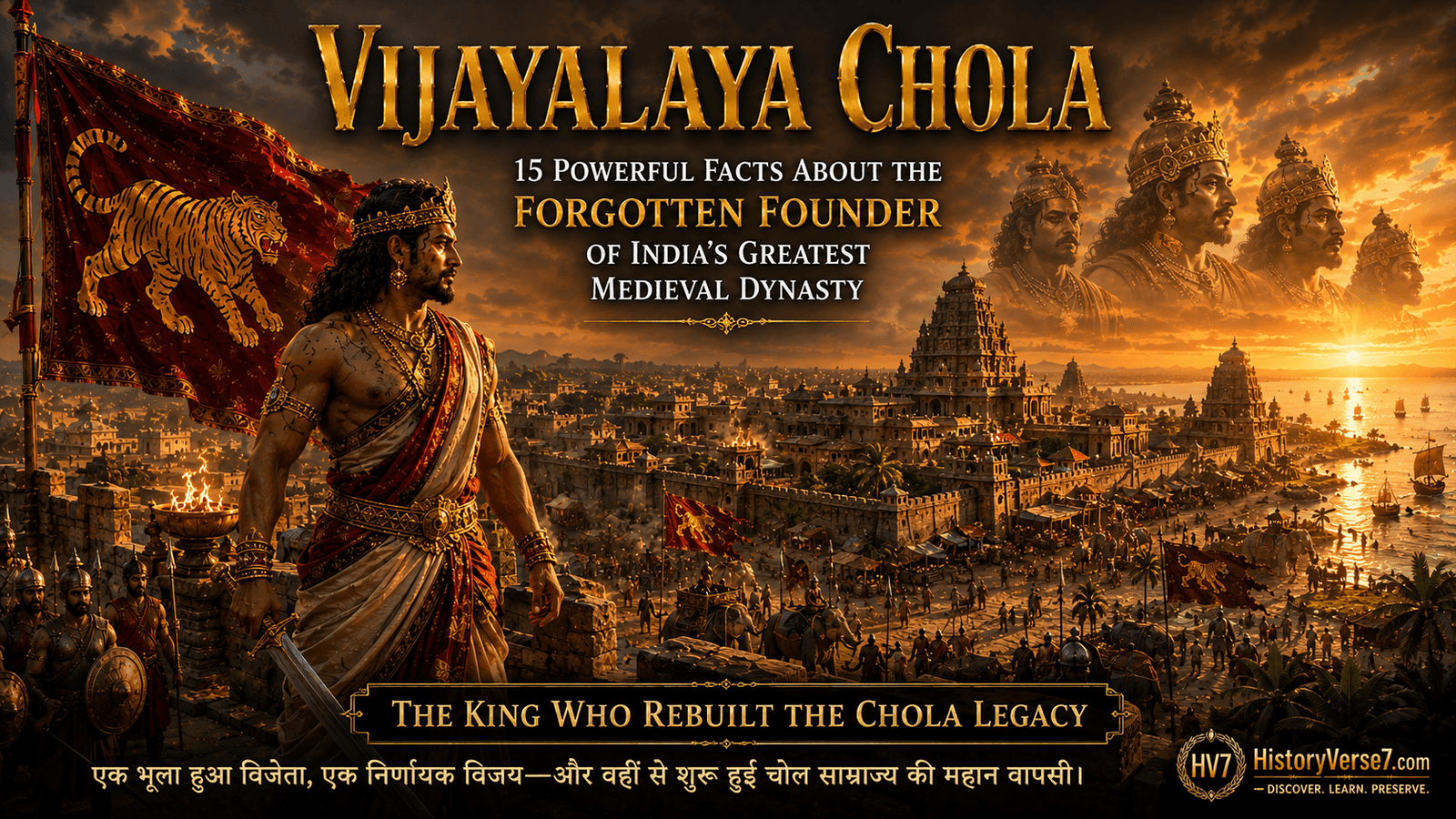
Vijayalaya Chola: 15 Powerful Facts About the Forgotten Founder of India’s Greatest Medieval Dynasty
⚔️ Vijayalaya Chola — The Forgotten Ruler Who Rebuilt Chola Power and Laid the Foundations of the Chola Empire Before the Cholas became one of medieval South India’s greatest imperial powers, there was a period when their political influence had faded considerably. The rise of Vijayalaya Chola changed that trajectory. Emerging in the politically fragmented…
Vijayalaya Chola
Vijayalaya Chola: The Forgotten Founder Who Laid the Foundations of the Chola Empire
HistoryVerse7.com | Cluster Article–Vijayalaya Chola | International English Edition
The Kaveri delta in the mid-9th century CE was a landscape of anxious political calculation. The Pallava dynasty of Kanchipuram, once the unchallenged paramount power of Tamil Nadu, was struggling to hold together an empire fraying at its edges. The Pandyas, pressing hard from the south, had inflicted damaging defeats on Pallava armies and were extending their influence northward into territories that had long acknowledged Pallava overlordship. Into this competitive, unstable political environment stepped a relatively obscure Chola chief, a man whose name, Vijayalaya, would eventually be remembered as the first chapter of one of medieval Asia’s most extraordinary imperial stories.
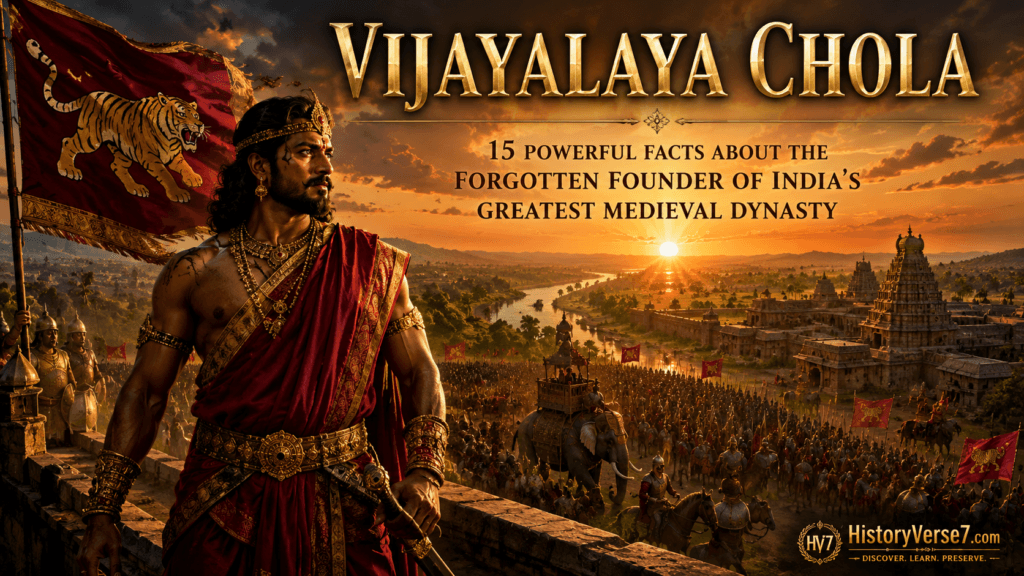
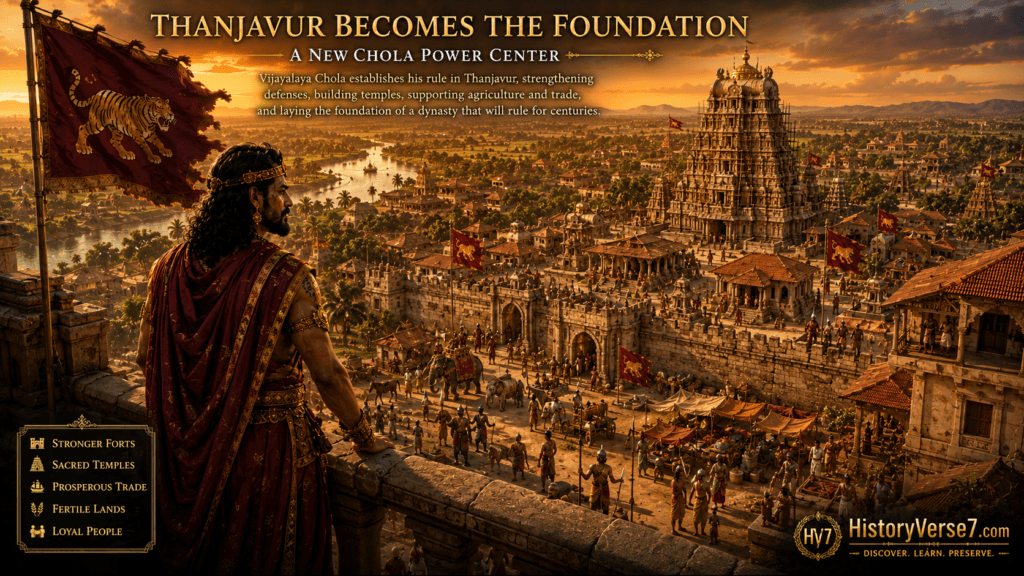
His moment came, according to the traditional account, when the Muttaraiyars, a chieftain lineage that had controlled Thanjavur and the rich agricultural heartland of the Kaveri delta for at least a century, were drawn into conflict with the Pandyas. The exact circumstances are debated among historians, and the surviving evidence is frustratingly sparse. But what is not in doubt is the result: somewhere around 848 CE, Vijayalaya seized Thanjavur, built a temple, and established a Chola presence in the Kaveri delta that would never again be dislodged.
His successors would go on to build the Brihadeeswara Temple, launch naval expeditions to Southeast Asia, receive ambassadors from Song Dynasty China, and create bronze sculptures that art historians rank among the finest ever produced. None of that was visible from where Vijayalaya stood. But the question worth asking is how a man in his position a subordinate chief in the shadow of a declining Pallava order, recognized the political opportunity before him, moved decisively to claim it, and laid a foundation solid enough to support everything that came after.
Who Was Vijayalaya Chola?
Vijayalaya Chola is conventionally recognized as the founder of the Imperial Chola dynasty, the line of kings that would rule Tamil Nadu and, at its height, project power from the Gangetic plains to the coasts of Southeast Asia. He is generally dated to approximately the mid-9th century CE, with his reign estimated to have run from around 848 to 871 CE, though these dates are derived from later inscriptions and should be treated as approximations rather than certainties.
The historical record for Vijayalaya is thin by any standard. Unlike his great-grandson Rajaraja I or his great-great-grandson Rajendra I, whose reigns are documented in thousands of stone inscriptions recording their military campaigns, religious endowments, administrative decisions, and personal titles, Vijayalaya left relatively few direct traces in the epigraphic record. Much of what historians know about him comes from genealogical references in later Chola inscriptions, composed decades or centuries after his death, in which his capture of Thanjavur is celebrated as the foundational act of the imperial dynasty.
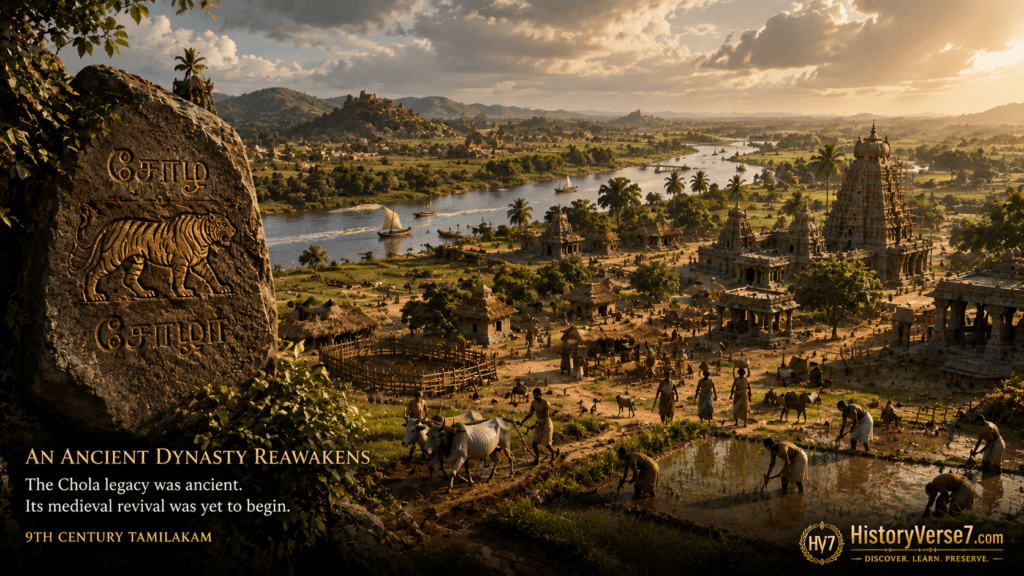
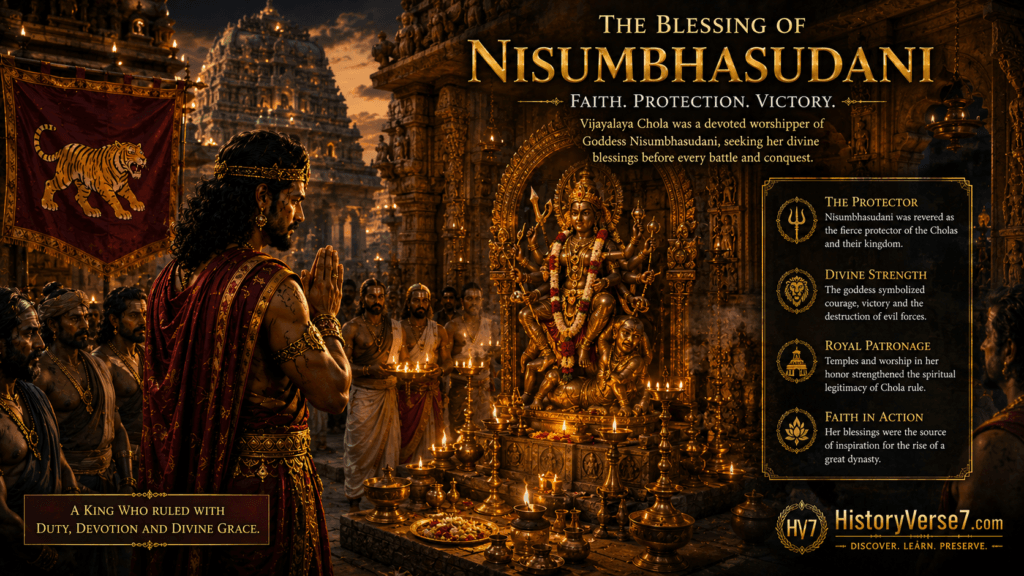
What those later inscriptions consistently assert is his Chola lineage, his connection, however attenuated or contested, to the ancient Chola tradition of the Kaveri delta and his seizure of Thanjavur from the Muttaraiyar chiefs. They also associate him with the foundation of a temple to the goddess Nishumbhasudani, a Durga-form deity, at Thanjavur, one of the very few specific acts of his reign that can be connected to surviving physical evidence. Beyond these essentials, the historical portrait of Vijayalaya is painted largely in inference and probability rather than direct documentation.
K.A. Nilakanta Sastri, whose ‘The Colas’ remains the fundamental scholarly study of the dynasty, treated Vijayalaya as the true founder of the Imperial Chola line while acknowledging the considerable uncertainty surrounding his reign. Noboru Karashima and other more recent scholars have been similarly cautious, emphasizing the evidentiary limitations while accepting the broad outlines of the traditional narrative. The honest scholarly position is that Vijayalaya is a real historical figure whose foundational importance is not in doubt, but whose specific biography, motivations, and strategies cannot be reconstructed in detail from the available evidence.
South India Before Vijayalaya Chola
The Political Landscape of Tamilakam
The Tamil-speaking region of South India, historically called Tamilakam, roughly corresponding to modern Tamil Nadu and parts of Kerala, had, by the 9th century CE, experienced several centuries of political reorganization following the decline of the great Sangam-age confederacies. The three ancient muvendar, the Cholas, Pandyas, and Cheras, had all experienced periods of eclipse, revival, and partial eclipse again as new political forces entered the arena.
By the 8th and early 9th centuries, Tamilakam’s political geography was dominated by three major players whose relative strength was constantly shifting. The Pallavas of Kanchipuram were the established paramount power of the northern Tamil region, but their authority was increasingly contested. The Pandyas of Madurai had regained much of their ancient strength and were pressing aggressively northward. And scattered across the landscape were numerous smaller chieftain lineages: the Muttaraiyars, the Vaidumbas, the Banas, and others who exercised local power in the interstices between the larger kingdoms, shifting their allegiances as political winds changed.
The Pandyas, Pallavas, and Muttaraiyars
The Pallava dynasty had been the dominant political force in northern Tamil Nadu from approximately the 3rd century CE. At its height under kings like Mahendravarman I (r. c. 600–630 CE) and Narasimhavarman I (r. c. 630–668 CE), the Pallavas had created a sophisticated court culture, patronized Sanskrit and Tamil learning, and built the remarkable rock-cut temples at Mahabalipuram (Mamallapuram) that remain standing today. But by the 9th century, Pallava power had been significantly eroded by repeated warfare with the Chalukyas of the Deccan, by Pandya pressure from the south, and by the growing assertiveness of their own subordinate chiefs.
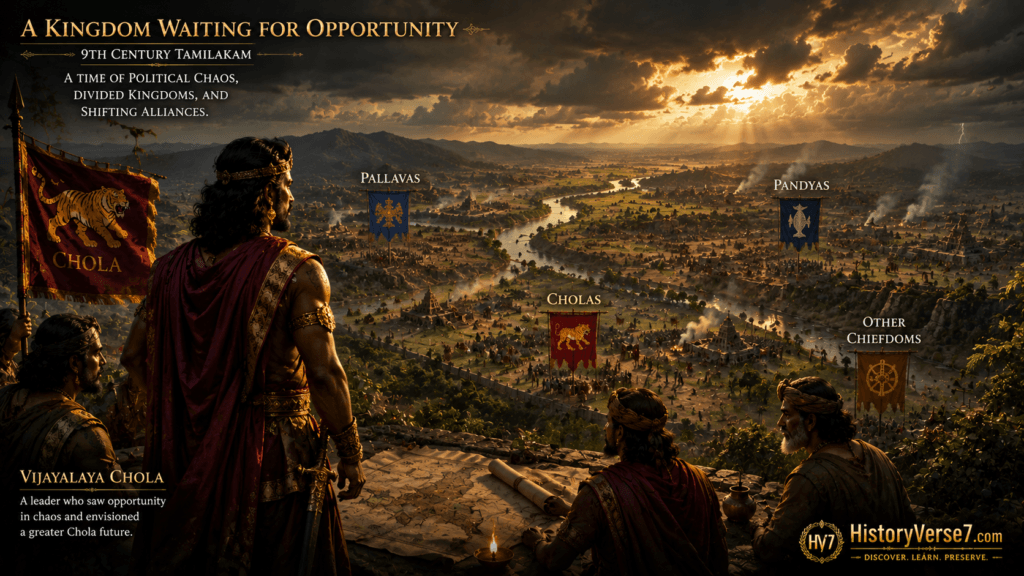
The Pandyas, ruling from Madurai, were in many respects the rising power of 9th-century South India. Their king Srimara Srivallabha (r. c. 815–862 CE) and his successors conducted aggressive military campaigns that repeatedly humiliated the Pallavas, sacked Kanchipuram on at least one recorded occasion, and pushed Pandya influence deep into territories that had previously acknowledged Pallava overlordship. It was this pressure, the distraction it caused the Pallavas, and the opportunities it created in the political space between the two larger powers that formed the immediate background to Vijayalaya’s rise.
The Muttaraiyars occupy a particular place in the story of Vijayalaya’s conquest. This lineage of chiefs had controlled Thanjavur and much of the central Kaveri delta since at least the 7th or 8th century CE. Their inscriptions, some of which survive, show them as significant regional powers who acknowledged Pallava overlordship while exercising effective local authority. They built temples, issued charters, and administered the extraordinarily productive agricultural economy of the Kaveri delta. When they were drawn into conflict with the Pandyas in the mid-9th century, they were not petty village headmen; they were a substantial political force whose temporary vulnerability created the opening that Vijayalaya exploited.
The Cholas Before Their Revival
Where did the Cholas stand in this landscape? The honest answer, as established in the article on Chola dynasty origins, is that we do not know with precision. The great Sangam-age Chola kings Karikala and his successors, who had once dominated the Tamil confederacies, appear to have been subordinated under Pallava overlordship from the 4th or 5th century onward, and the Chola name largely disappears from the major inscriptional record for several centuries. Whether a continuous Chola lineage survived these centuries as subordinate chiefs, or whether Vijayalaya’s claim to Chola identity was partly a political construction, is a question that historians continue to debate without a definitive resolution.
What is clear is that by the time of Vijayalaya, the Chola name still carried political weight in the Kaveri delta enough weight that a successful chief would want to claim it. The territorial connection to the Kaveri was ancient and deep. Claiming descent from the Sangam Chola kings was a way of asserting legitimate authority over the delta’s agricultural heartland, connecting the new dynasty to the most celebrated political tradition in Tamil history.
The Rise of Vijayalaya Chola
Vijayalaya’s Political Opportunity
The political logic of Vijayalaya’s rise is easier to reconstruct than its specific details. The mid-9th century Kaveri delta was governed by the Muttaraiyars, who were Pallava subordinates facing Pandya pressure. The Pallavas Vijayalaya’s own nominal overlords, according to most historical interpretations, were sufficiently weakened and distracted that they could not effectively protect their subordinates in the delta region. The Pandyas were strong but focused on their own expansionist agenda to the south and northwest. The regional balance of power was, in a word, unstable.
Vijayalaya appears to have been positioned either as a minor Chola chief or as someone claiming that identity somewhere in or near the Kaveri delta, possibly as a subordinate within the Pallava political system. The traditional account, repeated in later Chola inscriptions, presents him as seizing Thanjavur while the Muttaraiyars were engaged in conflict with the Pandyas. Whether this means a military campaign, an opportunistic occupation during a moment of Muttaraiyar vulnerability, or some combination of political maneuvering and force, the sources do not specify with any precision.
What is not in doubt is the timing and the result. The capture of Thanjavur transformed Vijayalaya from an obscure regional chief into the master of the Kaveri delta’s most strategically important city, a position that, properly consolidated, could serve as the foundation for far greater power.
The Struggle for the Kaveri Delta
The Kaveri delta is one of the most agriculturally productive landscapes in South Asia. The river, rising in the Coorg highlands and flowing eastward to the Bay of Bengal, deposits rich alluvial soil across a broad delta that has supported intensive rice cultivation for at least two millennia. Whoever controlled Thanjavur, the principal city of the delta, positioned at the junction of several important routes, controlled access to this agricultural surplus. That surplus, converted into revenue, could support armies, temples, courts, and the full apparatus of political authority.

The delta was not merely an agricultural prize. It was also a gateway to the Coromandel coast’s maritime trade. The ports of the eastern coast Nagapattinam, Kaveripattinam, and others connected the Kaveri delta economy to the wider Indian Ocean commercial world. A ruler who controlled the delta interior and maintained access to these coastal ports had both an agricultural and a commercial revenue base of considerable strength.
Vijayalaya clearly understood or, more likely, instinctively recognized that Thanjavur was the key to the delta, and the delta was the key to regional power in the Tamil country. His decision to seize and hold it, rather than simply raiding it for tribute, was the strategic choice that distinguished his action from those of countless other regional chiefs who rose and fell without leaving a lasting political legacy.
Building a New Chola Power Base
Once in control of Thanjavur, Vijayalaya faced the classic challenge of every newly installed ruler turning a military success into durable political authority. The tools available to a 9th-century South Indian ruler for this purpose were essentially three: military consolidation, religious patronage, and administrative organization. The evidence suggests Vijayalaya used at least the first two.
Military consolidation meant defending his new acquisition against the Muttaraiyars’ attempts at recovery and against any other regional power that might challenge his position. His son Aditya I, who succeeded him, continued the process of military expansion, defeating the last significant Pallava king, Aparajita, which effectively ended Pallava independence as a political reality. This suggests that Vijayalaya had already established a sufficiently strong military base for his successor to launch offensive operations against major powers.
The Capture of Thanjavur
Who Controlled Thanjavur Before Vijayalaya?
Thanjavur before Vijayalaya’s conquest was a Muttaraiyar stronghold. The Muttaraiyars, whose name appears variously in inscriptions as Muttarayar, Mutharaiyar, and similar spellings, were a Tamil chief lineage that had established themselves as significant power-holders in the Kaveri delta by at least the 7th century CE. They are documented in inscriptions as feudatories of the Pallavas, which means they acknowledged Pallava overlordship while exercising effective autonomous authority in their own territory.
Their inscriptions, found at several sites in the Kaveri delta region, show them as active builders of temples and patrons of Shaivite religious culture activities that were the standard markers of legitimate political authority in medieval South India. They were not a powerful empire, but they were a well-established regional presence with strong local roots. Displacing them required a significant military and political effort.
The Muttaraiyars and the Kaveri Delta
The specific event that created Vijayalaya’s opportunity, the Muttaraiyar conflict with the Pandyas, is referred to in later Chola tradition but is not documented in detail in any contemporary source. The traditional account, repeated in later Chola inscriptions, says that Vijayalaya took advantage of the Muttaraiyars being occupied with the Pandyas. Exactly what this means in military terms whether the Muttaraiyar forces were away from Thanjavur, whether they had suffered a defeat that left them unable to defend the city, or whether there was some other specific circumstance is not specified.
What the Muttaraiyar inscriptions tell us is that after Vijayalaya’s conquest, the Muttaraiyar lineage does not simply disappear. Some members of the lineage appear in later records as subordinates within the developing Chola political system. This pattern in which a defeated regional lineage is incorporated into the new order as subordinate chiefs rather than destroyed was standard practice in medieval South Indian politics and reflects the practical wisdom of a new ruler who needed local expertise and cooperation to actually govern the territory he had seized.
Vijayalaya’s Conquest of Thanjavur
The approximate date conventionally assigned to Vijayalaya’s capture of Thanjavur is around 848 CE, though some scholars have suggested slightly different dates and the precision of this figure should not be overstated. It is derived from working backward through later Chola genealogies and regnal years, a method that produces useful estimates but cannot yield exact dates for events this far removed from the surviving inscriptional record.
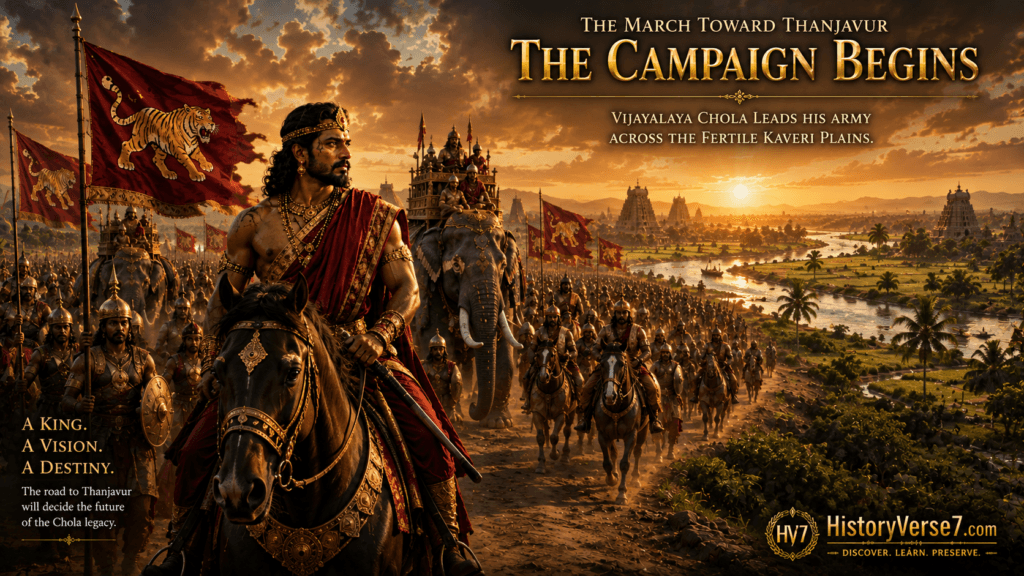
The traditional account does not describe the conquest in military detail; there are no accounts of sieges, battles, troop movements, or specific engagements that historians can analyze. What we are told, essentially, is that Vijayalaya took Thanjavur and made it the base of a restored Chola power. The mechanics of how he did so, the forces he commanded, the resistance he encountered, and the specific sequence of events are not recoverable from the available sources.
This is frustrating for anyone hoping to write a dramatic account of the conquest. But it is also, in a strange way, historically instructive. The Chola literary and inscriptional tradition, which would eventually become remarkably detailed about later kings, chose to preserve the fact of Vijayalaya’s conquest rather than its specific details. The foundation myth of the imperial dynasty was about the political act of claiming a historically significant territory by a ruler claiming the Chola lineage rather than about battlefield heroics.
Why Thanjavur Mattered
Thanjavur’s importance in 9th-century South India cannot be overstated. It was not simply a city; it was the political key to the Kaveri delta, and the Kaveri delta was the agricultural heart of the Tamil country. The city sat at a strategic junction that gave its ruler access to the main routes running north-south along the Coromandel coast and east-west across the Tamil peninsula.
Control of Thanjavur meant control of the irrigation system of the Kaveri delta, the network of channels, tanks, and weirs that distributed river water across the agricultural landscape and made the delta’s extraordinary rice yields possible. This irrigation system required continuous maintenance and administrative management that only a centralized authority could effectively provide. The ruler of Thanjavur was therefore not just a political overlord but an economic necessity, the organizer of the water management system on which the entire agricultural economy depended.
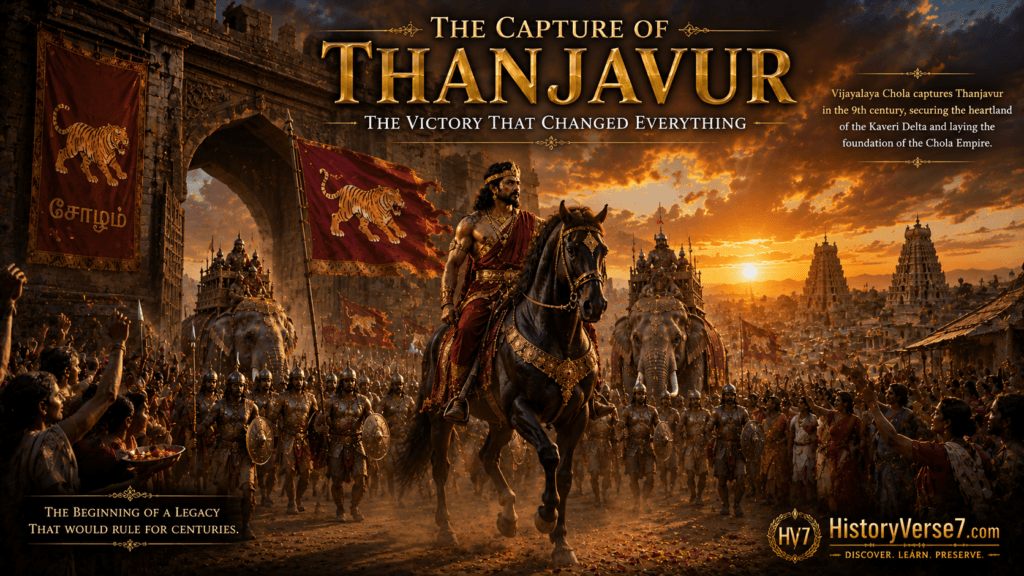
The city also carried significant symbolic weight. It was associated with the ancient Chola tradition; the Kaveri delta had been Chola country since the Sangam age, and any ruler who could credibly claim both the territory and the lineage was positioning himself as the legitimate heir to that ancient tradition. For Vijayalaya, who claimed Chola descent, Thanjavur was not merely a strategic prize; it was, in a sense, a homecoming.
Historical Evidence for the Conquest
The primary evidence for Vijayalaya’s conquest of Thanjavur comes from later Chola inscription texts composed during the reigns of his successors, particularly the great inscriptions of the Rajaraja I and Rajendra I periods. These inscriptions, when establishing the dynastic genealogy of the ruling king, consistently identify Vijayalaya as the founder of the imperial line and describe his seizure of Thanjavur as the foundational act.
The Anbil copper plates of Sundara Chola (10th century CE) and the Tiruvalangadu copper plates of Rajendra I (early 11th century CE) are among the most important genealogical inscriptions that mention Vijayalaya. These texts describe him in laudatory terms appropriate to royal genealogical literature, language that should be interpreted as political eulogy rather than objective biography, but they consistently affirm the core facts of his Chola lineage and his establishment at Thanjavur.
No contemporary inscription of Vijayalaya himself has been definitively identified and authenticated by scholars. This absence is itself significant it suggests that his reign was not yet generating the substantial inscriptional record that became characteristic of the later imperial Chola period. The administrative and documentary apparatus that would eventually produce thousands of inscriptions under Rajaraja I was still being built during Vijayalaya’s time.
Vijayalaya and the Pallavas
The relationship between Vijayalaya and the Pallava dynasty is one of the more nuanced aspects of his political situation, and it resists the simple characterization of straight forward rebellion or loyal service. Most historians interpret Vijayalaya as having been, at least initially, a subordinate within the Pallava political system a Chola chief who owed nominal allegiance to Kanchipuram while exercising effective local authority.
This interpretation is consistent with what we know about the structure of Pallava paramountcy. The Pallavas governed their extensive territories through a network of subordinate chiefs who acknowledged Pallava overlordship, participated in Pallava military campaigns when called upon, and maintained local order in exchange for recognition of their territorial authority. The Muttaraiyars had operated within this system; it would be natural for Vijayalaya to do the same.
The question of whether Vijayalaya’s seizure of Thanjavur constituted a rebellion against Pallava authority or an opportunistic action that the Pallavas were too weak to prevent or even one that served Pallava interests by removing Pandya influence from the delta is not clearly answered by the available evidence. K.A. Nilakanta Sastri suggested that Vijayalaya may have acted in concert with or at least with the acquiescence of the Pallavas, using the Pandya threat to justify the displacement of the Muttaraiyars. This is plausible but not demonstrable from the sources.
What is clear is that Vijayalaya’s son Aditya I eventually moved decisively against the Pallavas themselves, defeating and apparently killing the Pallava king Aparajita in battle around 893 CE. This transition from Pallava subordinate to Pallava destroyer within a single generation speaks to how rapidly the Chola political position strengthened following the capture of Thanjavur.
Vijayalaya and the Pandyas
The Pandya relationship is equally complex and even less well-documented for Vijayalaya’s specific reign. The Pandyas had been the indirect cause of his opportunity their conflict with the Muttaraiyars was what created the opening for his conquest but they were also a potential threat to his newly established power in the delta.
Pandya military strength in the mid-9th century was formidable. Their campaigns against the Pallavas had demonstrated that they could project power deep into northern Tamil Nadu, and a Pandya king who chose to focus on the Kaveri delta would have been a serious challenge to Vijayalaya’s consolidation. The fact that Vijayalaya was able to establish himself at Thanjavur and begin building Chola power without being immediately displaced by a Pandya counter-campaign suggests either that the Pandyas were occupied elsewhere, that they did not perceive Vijayalaya as an immediate threat, or that some accommodation was reached.
The Chola-Pandya relationship would become one of the defining tensions of South Indian politics for the next several centuries alternating between intense military conflict and occasional pragmatic accommodation. That long rivalry began with Vijayalaya’s establishment in the Kaveri delta, which placed a new power between the Pandya heartland in the south and the old Pallava territories in the north.
Vijayalaya’s Military and Political Strategy
Reconstructing Vijayalaya’s strategy requires inference from result rather than direct evidence of process we know what he achieved, but the deliberate calculations and decisions that led to those achievements are not recorded. With that caveat clearly stated, several strategic insights can reasonably be attributed to his actions.
The first is opportunism in the best sense the recognition and exploitation of a specific political moment when competing larger powers created a gap that a smaller but agile actor could fill. The Pallava-Pandya conflict was not a circumstance of Vijayalaya’s creation; it was a structural feature of the political landscape he inhabited. His achievement was recognizing that it created a specific opportunity the vulnerability of the Muttaraiyars in the Kaveri delta and acting on that recognition before the moment passed.
The second is territorial consolidation rather than territorial overreach. Vijayalaya appears to have focused on securing and holding Thanjavur and the Kaveri delta rather than immediately launching campaigns of wide expansion. This restraint if that is what it was gave the new Chola establishment time to develop roots before it was tested against major powers. His son Aditya I’s more aggressive campaigns became possible precisely because Vijayalaya had already created a stable base.
The third is the political use of religious patronage. The construction of the Nishumbhasudani temple at Thanjavur one of the few specific acts of Vijayalaya’s reign that can be connected to surviving evidence was not merely an act of personal piety. It was a political statement the new ruler of Thanjavur was claiming the role of temple patron and protector of the sacred landscape that medieval South Indian political culture expected of legitimate rulers. By building a temple, Vijayalaya was saying, in the most public and durable medium available to him, that his authority was legitimate and lasting.
Vijayalaya’s Temple and Religious Patronage
The temple associated with Vijayalaya’s founding of Chola power at Thanjavur dedicated to the goddess Nishumbhasudani is one of the most concrete connections between the historical figure and a specific physical act. Later Chola inscriptions describe Vijayalaya as having built or established this temple in the context of his conquest and settlement of Thanjavur.
The goddess Nishumbhasudani is a form of Durga the fierce manifestation of the divine feminine who destroys evil demons (Nishumbha being one such demon in Sanskrit epic tradition). The choice of this deity for Vijayalaya’s foundation temple is significant. Durga was a warrior goddess her patronage was appropriate for a military conqueror establishing his authority in newly seized territory. The dedication of a temple to her in Thanjavur was simultaneously a religious act and a political proclamation: the new ruler had the favor of the warrior goddess, and his conquest was divinely sanctioned.
The temple’s precise location and current status are matters of some historical uncertainty. The site has been associated with the Thanjavur area, but the original Vijayalaya-period structure has not been definitively identified and authenticated by modern archaeologists. This is not unusual for 9th-century CE structures in South India many early medieval temples have been rebuilt, expanded, or replaced in subsequent centuries, leaving uncertain physical traces of their original form.
What is clear from later Chola practice the extraordinarily elaborate temple patronage of Rajaraja I and his successors is that Vijayalaya established a template that his dynasty would follow and amplify for the next two centuries. The identification of Chola royal authority with temple patronage, which is one of the most distinctive features of the imperial Chola political system, began with Vijayalaya’s foundation at Thanjavur.
Vijayalaya’s Administration and Consolidation of Power
The administrative history of Vijayalaya’s reign is largely inferential. The sophisticated Chola administrative apparatus the elaborate hierarchy of territorial units, the village assemblies, the systematic land surveys was a product of development over many generations and reached its most documented form under Rajaraja I and Rajendra I. Projecting that mature system back onto Vijayalaya’s reign would be anachronistic.
What can be said with reasonable confidence is that any ruler in Vijayalaya’s position would have needed to address certain basic administrative questions immediately how to collect revenue from the newly controlled agricultural lands, how to maintain order and adjudicate disputes among the delta’s communities, how to manage the Kaveri irrigation system on which the agricultural economy depended, and how to establish working relationships with the local power-holders including, quite possibly, surviving Muttaraiyar chiefs whose cooperation was essential for effective governance.
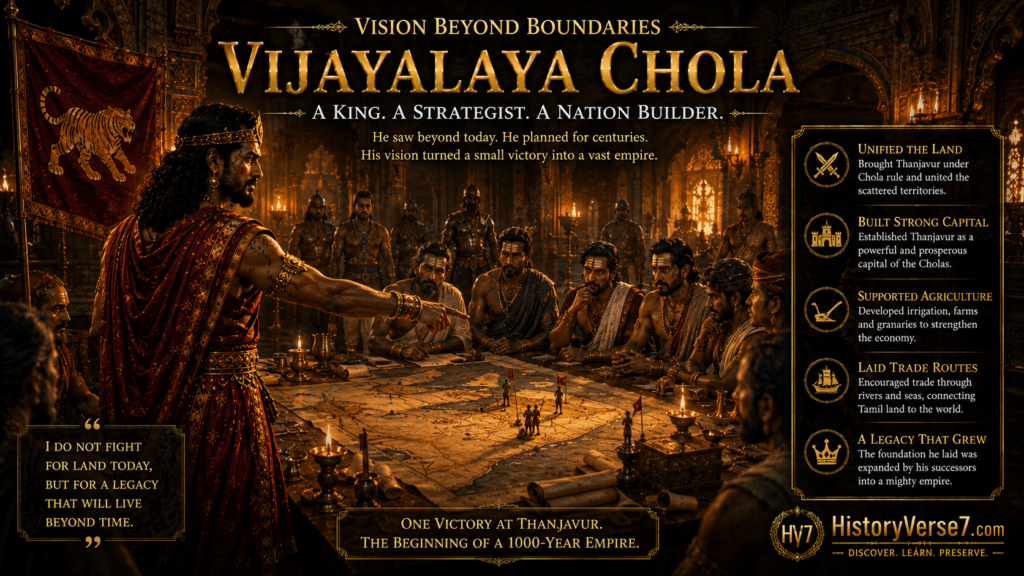
The incorporation of subordinate regional lineages into the new Chola political system evident in the later historical record probably began under Vijayalaya, as a pragmatic response to the practical challenge of governing a complex landscape with limited administrative personnel. The genius of medieval South Indian political administration was precisely this flexibility the ability to incorporate existing power structures into a new hierarchical framework rather than attempting to replace them wholesale.
The Historical Debate Around Vijayalaya Chola
Several questions about Vijayalaya remain genuinely contested among historians, reflecting the fundamental problem of reconstructing early medieval South Indian history from a limited and predominantly later documentary record.
The dating question is perhaps the most straightforward. The conventional date of c. 848 CE for the capture of Thanjavur is a scholarly estimate derived from regnal chronologies worked backward from better-documented later reigns. Different scholars working with the same sources have produced dates ranging from the 840s to the 860s. The uncertainty is real and matters for understanding the precise political context of Vijayalaya’s action but it does not affect the broader historical significance of the event.
The lineage question is more fundamental. Vijayalaya’s connection to the Sangam Chola tradition the claim that he was a genuine descendant of the ancient Chola kings is asserted by later inscriptions but cannot be independently verified. Scholars like Noboru Karashima have been cautious about accepting this claim at face value, noting that claiming prestigious dynastic lineages was a standard practice of medieval South Indian rulers and that the five-century gap in the Chola historical record makes the genealogical connection essentially unverifiable. Others, following Nilakanta Sastri, accept the likelihood of some genuine Chola lineage connection while acknowledging the uncertainty.
The relationship with the Pallavas is a third area of debate. Was Vijayalaya a Pallava subordinate acting within the Pallava system, an independent actor exploiting Pallava weakness, or something more complex? The sources do not resolve this cleanly, and different interpretations of the fragmentary evidence lead to different pictures of the political dynamics of his rise.
Author’s Perspective
The difficulty with writing about Vijayalaya Chola is not that there is too little to say it is that too much of what can be said has to be framed as inference rather than fact. The documentary record for his reign is thin in ways that become genuinely frustrating when you are trying to understand a historical figure whose importance is not in doubt. We can place him in his political landscape with reasonable confidence. We can explain why what he did mattered. We cannot, with honesty, put specific words in his mouth, describe the scene at Thanjavur when his forces arrived, or trace the specific calculations that led him to his decisive action.
What I find most historically interesting about Vijayalaya is not the conquest itself but its aftermath specifically, the question of how a newly established ruling house creates legitimacy. The Nishumbhasudani temple is, from this perspective, as important as any military campaign. Medieval South Indian rulers lived in a political culture in which the relationship between rulers and the divine enacted through temple patronage, religious endowment, and ritual participation was not merely symbolic. It was constitutive of political authority. By building a temple at Thanjavur, Vijayalaya was not decorating his conquest; he was completing it.
There is also something historically instructive about the gap between Vijayalaya’s fame and his importance. History tends to remember those who create visible monuments great temples, great campaigns, great literary achievements. The work of establishing political foundations, creating the conditions for institutional development, building the revenue base that makes later magnificence possible this work is less photogenic, less dramatic, and therefore less remembered. The Chola Empire is one of the most celebrated civilizations of medieval Asia. Vijayalaya built the house in which that civilization lived. That deserves more recognition than it typically receives.
15 Lesser-Known Facts About Vijayalaya Chola
- Vijayalaya’s historical importance was explicitly acknowledged in the elaborate genealogical preambles that later Chola kings attached to their major inscriptions a convention that placed the reigning king in a dynastic chain beginning with Vijayalaya’s foundational act. He was, in this sense, the reference point from which later Chola authority derived its historical justification.
- Vijayalaya’s conventional regnal dates (c. 848–871 CE) are estimates derived from working backward through later Chola genealogies, not from contemporary records. The actual dates may differ by a decade in either direction.
- No inscription definitively contemporary with Vijayalaya’s own reign has been identified and authenticated by scholars. His historical record rests almost entirely on later genealogical texts.
- The Muttaraiyars whom Vijayalaya displaced did not disappear from South Indian history members of the lineage appear in later records as subordinate chiefs within the developing Chola political system.
- Vijayalaya’s decision to build a temple to Nishumbhasudani (a form of Durga) at Thanjavur followed a standard medieval South Indian political practice of founding temples as acts of territorial legitimation.
- The name ‘Vijayalaya’ combines ‘vijaya’ (victory) and ‘alaya’ (abode or dwelling) essentially meaning ‘abode of victory’ though whether this was a birth name, a throne name, or a name acquired after his conquest is not specified in the sources.
- Later Chola inscriptions describe Vijayalaya as having been afflicted with a disease that was cured through devotion to the goddess Durga a tradition that may explain the dedication of his founding temple to a Durga-form deity, though this story cannot be verified historically.
- The Tiruvalangadu copper plates of Rajendra I composed about 160 years after Vijayalaya’s death provide one of the most detailed genealogical accounts of his reign, despite (or perhaps because of) that temporal distance.
- Vijayalaya’s conquest of Thanjavur is sometimes compared in structure, if not in scale, to the later Vijayanagara Empire’s founding both involved a small ruling house seizing a strategic base and using it to build a much larger power over subsequent generations.
- The political instability that enabled Vijayalaya’s rise the Pallava-Pandya conflict was itself the product of processes set in motion decades earlier by the Rashtrakuta expansion into South India, which had weakened both the Pallava and Pandya political systems.
- Aditya I, Vijayalaya’s son and successor, is credited in some later sources with having composed Tamil poetry praising Shiva a detail that, if accurate, suggests the developing Chola court was already cultivating the Tamil literary and devotional culture that would become central to imperial Chola identity.
- The Kaveri delta’s extraordinary agricultural productivity which Vijayalaya’s capture of Thanjavur gave him control over was the product of centuries of irrigation development, some of which dated back to the Sangam period and possibly earlier.
- Vijayalaya is sometimes described in popular Tamil historical literature as having been lame a physical disability that is part of the traditional biographical narrative. This detail appears in later literary traditions but is not confirmed in contemporary inscriptional sources.
- The name ‘Thanjavur’ itself (also spelled Tanjore) appears in a form recognizable to modern readers in inscriptions from at least the Muttaraiyar period, suggesting that the city had already achieved sufficient political importance to acquire a stable proper name before Vijayalaya’s conquest.
- The Chola tiger emblem the dynasty’s traditional symbol, visible on coins from the ancient period and on medieval bronzes was presumably claimed by Vijayalaya as part of his assertion of Chola lineage. How continuously the symbol had been used between the Sangam age and his time is unknown.
Conclusion: The Foundation Before the Empire
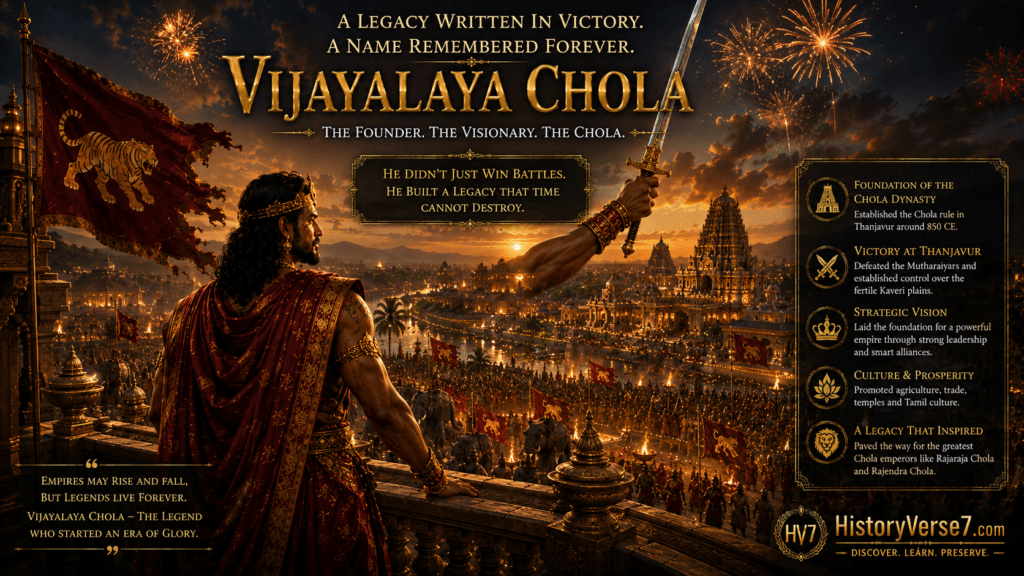
Vijayalaya Chola did not build a great temple. He did not march to the Ganges. He did not launch warships into the Bay of Bengal. What he did seizing Thanjavur from the Muttaraiyars around 848 CE and transforming a fading dynastic name into a living political reality may seem modest compared to the achievements of his descendants. But it was the act without which none of those achievements would have been possible.
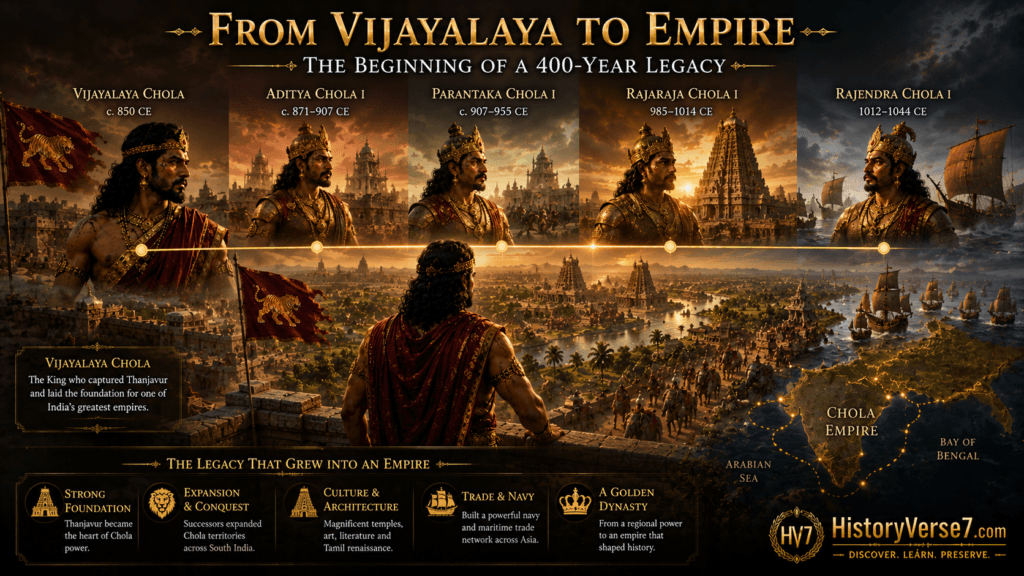
The Kaveri delta that Vijayalaya secured was the agricultural engine that powered all subsequent Chola development. The political tradition he claimed the ancient Chola association with the river and its delta gave his dynasty a legitimating foundation that connected it to one of the oldest and most celebrated political identities in Tamil history. The template of royal authority he established ruler as military protector, temple patron, and legitimate heir to a venerable tradition was the model that Aditya I, Parantaka I, and ultimately Rajaraja I would refine and amplify into one of medieval Asia’s most sophisticated political systems.
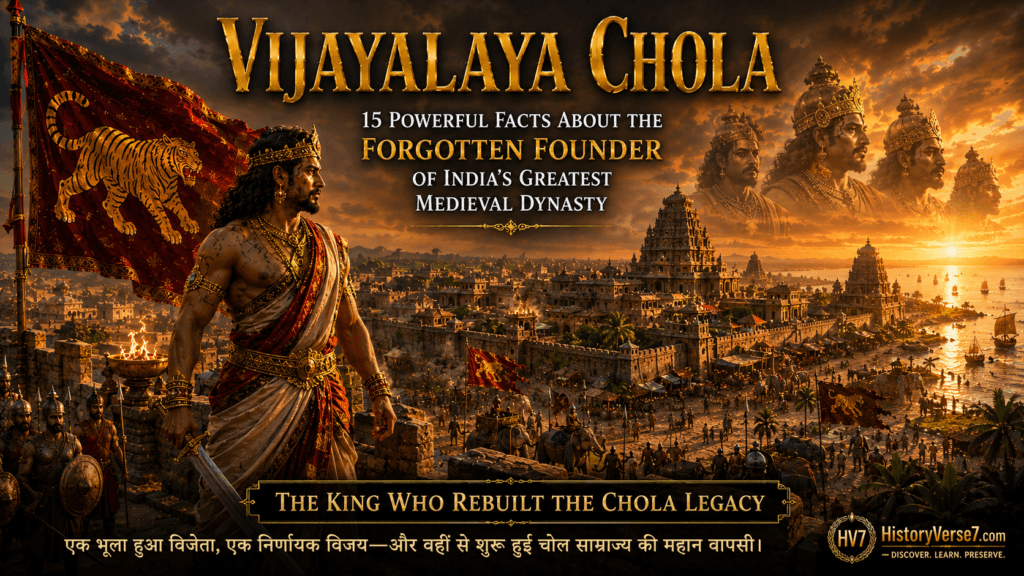
History tends to remember those who build the visible monuments the temples, the victories, the dramatic expeditions. It is worth remembering, occasionally, those who prepared the ground. The Brihadeeswara Temple stands because someone, more than a century before it was built, decided that Thanjavur was worth taking and holding. That person was Vijayalaya Chola. His story begins the greatest chapter of medieval South Indian civilization, even if the most celebrated pages of that chapter were written by others.
Written & Researched by Abhishek Chavan — HistoryVerse7| © 2026 HistoryVerse7 | Cluster Article — Vijayalaya Chola
References and Further Reading
Historical research based on inscriptions, archaeological evidence, academic scholarship and established historical sources including K.A. Nilakanta Sastri, Noboru Karashima, Burton Stein, Upinder Singh, and the Archaeological Survey of India South Indian Inscriptions series.
- Anbil Copper Plates of Sundara Chola South Indian Inscriptions series. Archaeological Survey of India.
- Nilakanta Sastri, K.A. The Colas (2 vols). University of Madras, 1935 (revised 1955). [Primary authority on Chola history]
- Nilakanta Sastri, K.A. A History of South India. Oxford University Press, 1955.
- Karashima, Noboru A Concise History of South India: Issues and Interpretations. Oxford University Press, 2014.
- Stein, Burton Peasant State and Society in Medieval South India. Oxford University Press, 1980.
- Singh, Upinder A History of Ancient and Early Medieval India. Pearson Education, 2008.
- Champakalakshmi, R. Trade, Ideology and Urbanization: South India 300 BC to AD 1300. Oxford University Press, 1996.
- Archaeological Survey of India South Indian Inscriptions series, particularly volumes covering Thanjavur district inscriptions.
- Tiruvalangadu Copper Plates of Rajendra I Epigraphia Indica Vol. III. Archaeological Survey of India.
FAQ — Vijayalaya Chola
Q1: Who was Vijayalaya Chola?
Vijayalaya Chola was a Tamil ruler who, around 848 CE, captured Thanjavur from the Muttaraiyar chiefs and established the Imperial Chola dynasty the line of kings that would eventually build one of medieval Asia’s most powerful empires. He is conventionally regarded as the founder of the Imperial Chola period, though the exact details of his biography and reign are poorly documented.
Q2: Was Vijayalaya Chola the founder of the Chola Empire?
He is recognized as the founder of the Imperial Chola dynasty the specific line of rulers that eventually produced Rajaraja Chola I, Rajendra Chola I, and the other great medieval Chola emperors. The broader Chola name and political tradition were much older, going back to the Sangam age (c. 3rd century BCE–3rd century CE). Vijayalaya re-established Chola political power in the Kaveri delta after several centuries during which the dynasty had been eclipsed.
Q3: When did Vijayalaya Chola rule?
The conventional scholarly dates for his reign are approximately 848–871 CE, though these are estimates derived from later genealogical texts and regnal chronologies rather than contemporary records. The actual dates may vary somewhat from these estimates.
Q4: How did Vijayalaya capture Thanjavur?
The sources say that Vijayalaya seized Thanjavur from the Muttaraiyar chiefs while they were engaged in conflict with the Pandyas. The specific military or political means by which he accomplished this are not described in any surviving source. Historians accept the fact of the conquest while acknowledging that its details cannot be recovered.
Q5: Who ruled Thanjavur before Vijayalaya?
The Muttaraiyars a Tamil chief lineage that had controlled the Kaveri delta since at least the 7th or 8th century CE. They were subordinates of the Pallava dynasty of Kanchipuram. After Vijayalaya’s conquest, some Muttaraiyar chiefs appear in later records as subordinates within the developing Chola political system.
Share this content: