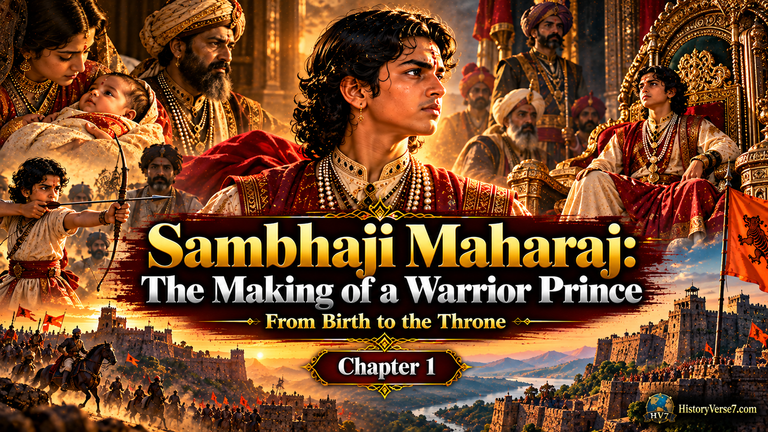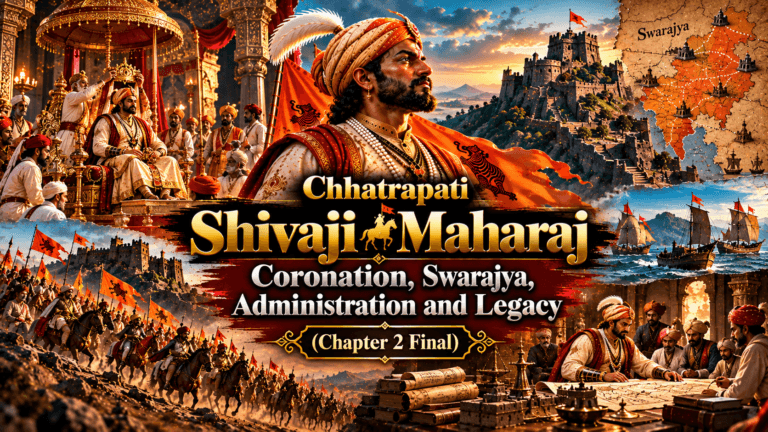
Sambhaji Maharaj: The Chhatrapati Who Fought an Empire (Final Chapter – 2)
HISTORYVERSE7 • MARATHA HISTORY • CHAPTER 2 Sambhaji Maharaj: The Chhatrapati Who Fought an Empire When Sambhaji Maharaj became Chhatrapati, he inherited a state facing powerful rivals, contested political relationships and the growing pressure of Mughal expansion. His reign was shaped by warfare, diplomacy, coastal conflict, internal political tensions and the difficult task of preserving…
Sambhaji Maharaj: The Chhatrapati Who Fought an Empire
When Sambhaji Maharaj became Chhatrapati, he inherited a state facing powerful rivals, contested political relationships and the growing pressure of Mughal expansion. His reign was shaped by warfare, diplomacy, coastal conflict, internal political tensions and the difficult task of preserving the state established by Shivaji Maharaj.
This HistoryVerse7 investigation examines Sambhaji Maharaj’s reign through military campaigns, political decisions, historical records and competing accounts. It considers both his achievements and limitations without reducing his life to either a perfect-hero narrative or a predetermined verdict of failure.
HistoryVerse7 Research Standard: Academic interpretations, contemporary accounts, official heritage information and later traditions are not interchangeable. Disputed claims are identified as disputed, and uncertainty is acknowledged where the surviving evidence does not provide a firm answer.
Table of Contents
Detailed Timeline
| Date | Event | Significance |
| 1680 (20 July) | Sambhaji’s symbolic assumption of authority | Initial, less formal assertion of his position as ruler following the succession crisis described in Chapter One. |
| 1681 (16 January) | Formal coronation of Sambhaji Maharaj at Raigad | Completes his elevation to Chhatrapati. |
| 1681 | Sacking of Burhanpur | Major early raid demonstrating Sambhaji’s independent military capability and provoking direct Mughal attention. |
| 1681 | Rebellion of Prince Muhammad Akbar | Aurangzeb’s son rebels and finds shelter connected to Sambhaji’s court, deepening the emperor’s personal commitment to the Deccan campaign. |
| 1682 | Aurangzeb commits to sustained Deccan campaign; siege of Ramsej begins | Marks the beginning of the emperor’s direct, personal, and prolonged presence in the region. |
| 1683 to 1684 | Konkan coastal campaign against Portuguese Goa and Siddi Janjira | Sambhaji directs a two-front coastal offensive; real pressure applied to both, neither fully subdued. |
| 1686 | Fall of Bijapur to Mughal forces | Removes one of the two remaining independent Deccan sultanates. |
| 1687 | Fall of Golconda to Mughal forces | Removes the second remaining independent Deccan sultanate, fundamentally reshaping the regional balance of power. |
| 1687 (December) | Battle of Wai | Maratha forces under Hambirrao Mohite defeat Mughal forces; Mohite is killed in the fighting. |
| 1688 | Continued siege of Ramsej and mounting Mughal pressure | Mughal resources increasingly concentrated against the Marathas following the fall of Bijapur and Golconda. |
| 1689 (January) | Sambhaji travels through the Konkan, including matters connected to the Shirke family | His final movements before capture. |
| 1689 (1 February) | Capture of Sambhaji at Sangameshwar | Mughal forces under Sheikh Nizam (later Muqarrab Khan) ambush and capture Sambhaji and Kavi Kalash. |
| 1689 (11 March) | Execution of Sambhaji and Kavi Kalash at Tulapur | Follows severe mistreatment in Mughal custody; carried out on Aurangzeb’s order. |
| 1689 (later in the year) | Fall of Raigad; capture of Yesubai and Shahu | Mughal forces take the Maratha capital; Sambhaji’s wife and young son taken into Mughal custody. |
| 1689 onward | Rajaram assumes leadership of continued Maratha resistance | Eventually establishes a base at Jinji in the south, continuing the war against the Mughals. |
| 1700 | Death of Rajaram; Tarabai continues Maratha resistance | Marks the transition of Maratha leadership to Tarabai on behalf of her young son. |
A State Surrounded by Enemies
HistoryVerse7.com | Article: Sambhaji Maharaj (Chapter 2) | International English Edition
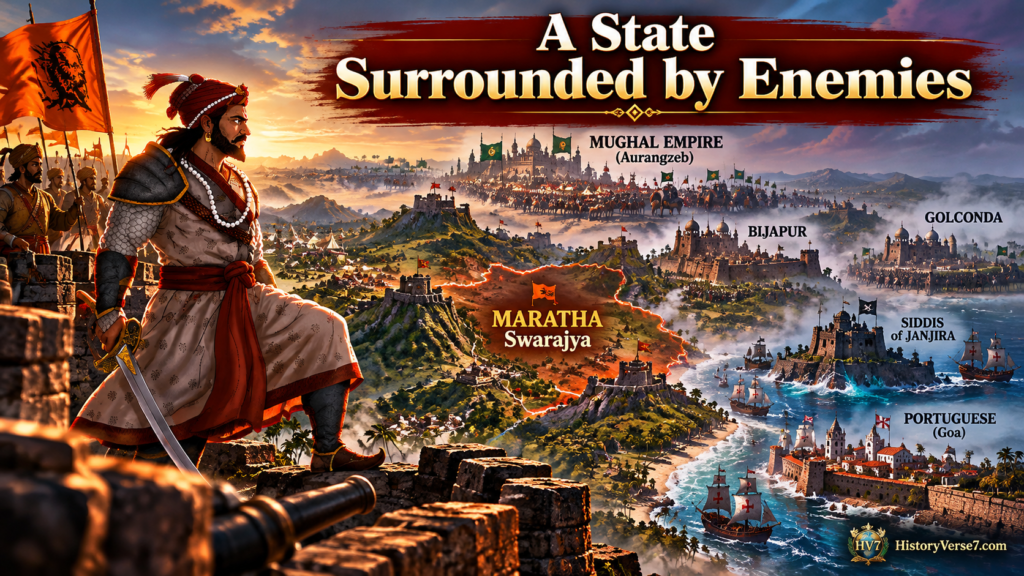
Sambhaji Maharaj did not inherit a peaceful kingdom. He inherited a compact, still-developing Maratha state, hemmed in by a weakened but still dangerous Bijapur, an ambitious Golconda, a hostile Siddi power controlling the fortress of Janjira just off the Konkan coast, a Portuguese Estado da Índia guarding its own commercial and territorial interests around Goa, and, above all, the Mughal Empire under Aurangzeb, an emperor who had, by the time Sambhaji took the throne, already decided that the unfinished business of the Deccan required his direct, personal attention.
Chapter One of this series covered how Sambhaji became this ruler: his birth, his education, his complicated relationship with his father, his time in Mughal service, and his contested rise to the throne in 1680 and 1681. This chapter does not repeat that story. It begins where Chapter One ended, with the question this chapter exists to answer: how did Sambhaji attempt to preserve and expand the state his father had built, in a Deccan that was about to become the site of the largest and most prolonged war the region had ever seen?
The State Sambhaji Maharaj Inherited
By 1681, the Maratha state was not a small or fragile project. It controlled a substantial and largely continuous territory stretching from the Sahyadri uplands through the Konkan coast, anchored by a genuinely extensive fort network that included Raigad as the capital, along with Rajgad, Pratapgad, Panhala, Sindhudurg, and dozens of smaller strongholds, each combining military, administrative, and storage functions in the way earlier chapters of the wider HistoryVerse7 Shivaji Maharaj series have already described.
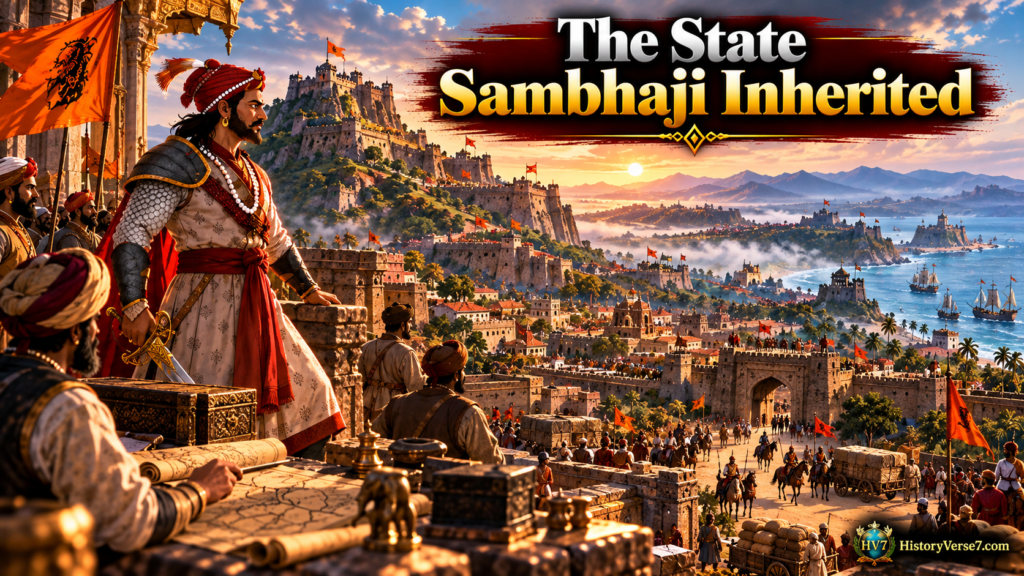
It should not, however, be mistaken for a centralized modern state. Administrative authority ran through a still-developing structure built around the Ashtapradhan council of ministers, fort-based local officials, and revenue arrangements that varied meaningfully in how consistently they operated across different regions, more consolidated in the Sahyadri core, less consistently integrated in the more recently acquired southern territories from Shivaji Maharaj’s Karnataka campaign. The military combined disciplined infantry, cavalry, and a genuinely capable regional navy operating along the Konkan coast, resources that had proven effective against Bijapur and in earlier, smaller-scale confrontations with Mughal forces, but that had never yet been tested against a sustained, full-scale Mughal invasion led by the emperor in person.
Diplomatically, the state Sambhaji inherited had real but fragile relationships: a wary, opportunistic connection to a declining Bijapur, some prior contact with Golconda, ongoing hostility with the Siddis of Janjira over control of the same stretch of coastline, and a complicated, oscillating history with Mughal power itself, ranging from open war to periods of formal cooperation, as Chapter One documented in detail through Sambhaji’s own earlier service under Mughal command. And internally, as Chapter One also established, Sambhaji’s own accession had involved real conflict with a court faction that had favored his half-brother Rajaram, leaving unresolved tension inside his own household and administration even as external pressure began to mount.
Accession and Consolidation
Sambhaji Maharaj’s formal coronation in January 1681 did not instantly resolve the internal tensions surrounding his accession. Sources describe continued distrust between Sambhaji and figures connected to the faction that had supported Rajaram’s claim, and action taken against ministers associated with that faction in the months following his seizure of Raigad and Panhala, discussed in Chapter One.
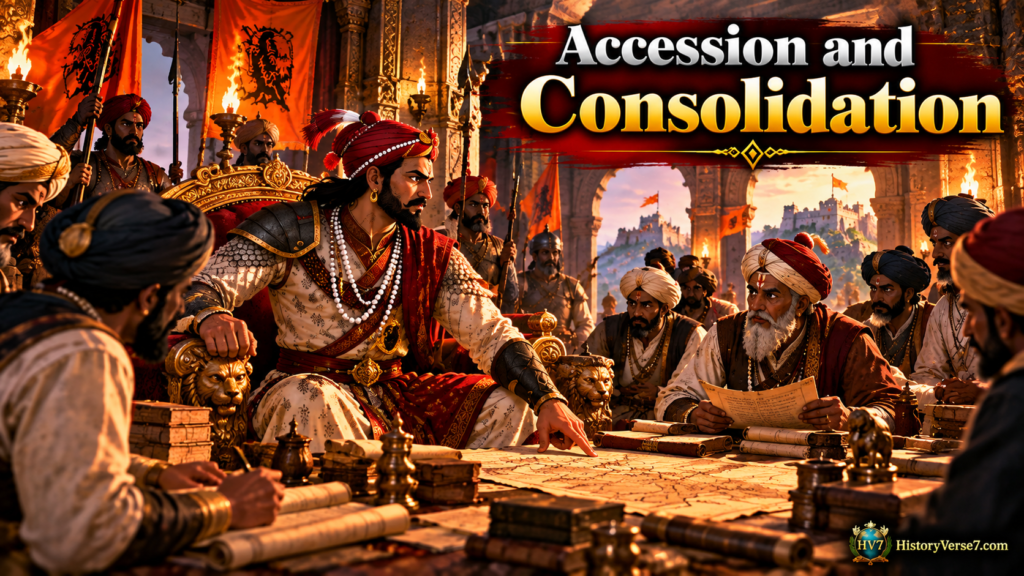
This chapter treats the severity and precise scope of this consolidation with the same caution Chapter One applied: sources vary in how much detail they provide, and later accounts, whether sympathetic or hostile to Sambhaji, sometimes present the process with more narrative clarity and moral certainty than the underlying evidence supports. What can be said with reasonable confidence is that Sambhaji spent the opening months of his reign securing his own political position at home, a task that inevitably competed for attention and resources with the external threats that were, at the very same time, beginning to gather along Swarajya’s borders.
Sambhaji Maharaj and Aurangzeb
Understanding the war that would consume nearly all of Sambhaji Maharaj’s reign requires understanding why Aurangzeb, who had ruled the Mughal Empire from the north for over two decades by 1680, decided that the Deccan now demanded his direct, personal, and prolonged presence an extraordinary commitment for any Mughal emperor, and one that would keep Aurangzeb south of the Narmada for the rest of his life.
Several converging factors are usually identified by historians, and this chapter presents them as converging rather than singular. Bijapur and Golconda, the two remaining independent Deccan sultanates, represented unfinished imperial business that Aurangzeb had long intended to resolve. The Maratha state, meanwhile, had grown considerably more capable and confident since the years of Shivaji Maharaj’s earlier campaigns, and its continued defiance, punctuated by events discussed below, represented both a genuine strategic threat to Mughal authority in the peninsula and a standing challenge to imperial prestige. A further, more immediate trigger arrived in 1681, when Aurangzeb’s own son, Prince Muhammad Akbar, rebelled against his father and fled south, finding at least temporary shelter and support connected to Sambhaji’s court an episode that transformed a regional strategic problem into something approaching a direct personal and dynastic affront to the emperor himself.
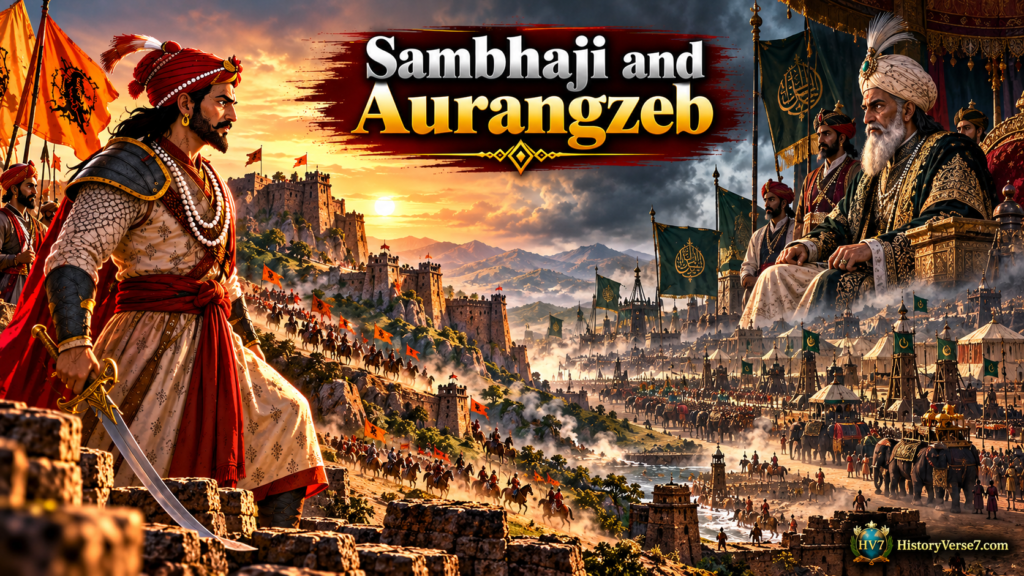
Sambhaji Maharaj’s own strategic objectives, by contrast, were considerably narrower and more defensive in character: preserve the fort network his father had built, protect the core Sahyadri and Konkan territory, extract whatever advantage could be found from Mughal-Bijapur-Golconda rivalries while they lasted, and survive. This chapter resists the framing, common in more devotional retellings, of a grand ideological confrontation between a righteous defender and an evil aggressor. What the evidence supports is a more conventional, if enormously consequential, clash of strategic interests: an expanding empire determined to eliminate a persistent regional threat, and a regional power fighting, with real skill and real desperation, to avoid being eliminated.
The Mughal-Maratha War: Major Campaigns
The conflict that dominated Sambhaji Maharaj’s reign was not a single war fought on a single front, but a sustained, multi-year, multi-theatre struggle involving sieges, raids, naval operations, and shifting local alliances across an enormous and difficult terrain. This section covers its major documented episodes; readers should understand that troop figures given in contemporary chronicles, whether Mughal or Marathi, reflect the conventions and possible exaggerations of period military reporting rather than verified modern-style statistics, and this chapter identifies such figures as source claims rather than fact wherever they appear.
The sacking of Burhanpur, in early 1681, stands among the most significant early episodes of the reign. Burhanpur was a major Mughal commercial and administrative center in the northern Deccan, and a Maratha raid struck it directly, inflicting serious damage and extracting considerable wealth. Politically, the raid served a double purpose: it demonstrated that Sambhaji Maharaj’s forces retained the same capacity for deep, disruptive strikes into Mughal territory that had characterized his father’s most famous raids, and it helped provoke the very Mughal response Aurangzeb’s decision to commit fully to a southern campaign that would define the rest of the reign. Persian chronicle sources record the raid’s scale and impact from the Mughal side; Marathi sources treat it as a significant early demonstration of Sambhaji Maharaj’s own military capability, distinct from anything directly inherited from his father’s reputation.
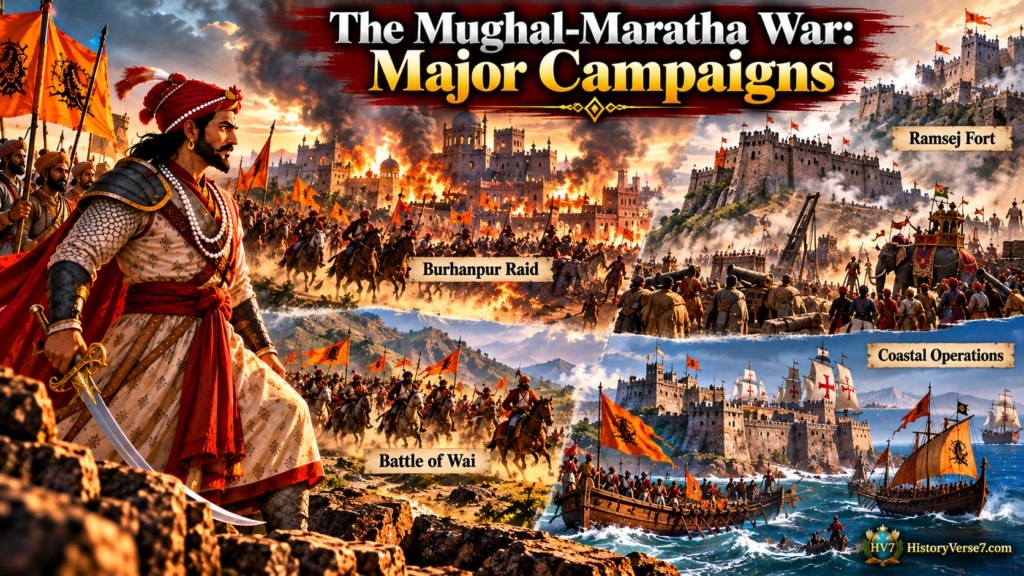
The siege of Ramsej, beginning in 1682 and continuing for roughly six years, represents one of the most remarkable single episodes of sustained Maratha resistance during the entire war. Ramsej was a comparatively modest hill fort near Nashik, and its prolonged defense against repeated Mughal assaults, despite the fort’s limited size and garrison, became a demonstration of how effectively fort-based defense, when combined with difficult terrain and determined local resistance, could frustrate even a well-resourced Mughal siege effort. Multiple Mughal commanders were rotated through the siege over its long duration without achieving a decisive result, and the episode is frequently cited by historians studying Maratha fort warfare as evidence of the defensive strength the fort network Shivaji Maharaj had built could still provide, even under Sambhaji Maharaj’s considerably more difficult strategic circumstances.
The Konkan campaign of 1683 to 1684 saw Sambhaji Maharaj direct Maratha forces against both the Siddis of Janjira and Portuguese territory around Goa simultaneously, a genuinely ambitious two-front coastal offensive discussed in more detail in the dedicated sections below. And the Battle of Wai, in December 1687, brought a major Maratha victory against Mughal forces under the command of the senapati Hambirrao Mohite, a victory achieved at severe cost: Hambirrao Mohite himself was killed in the fighting, depriving Sambhaji of one of his most senior and experienced military commanders at a critical juncture, only about a year before Sambhaji’s own capture.
Across these and numerous smaller, less individually documented engagements, the general pattern that emerges is one of a Maratha military machine still genuinely capable of inflicting serious damage and sustaining prolonged resistance, operating against an opponent with vastly superior long-term resources and an emperor personally committed to seeing the campaign through to its conclusion regardless of cost or duration.
Sambhaji Maharaj’s Military Strategy
The military approach that sustained this resistance drew directly on the fort-centered, mobility-focused method established under Shivaji Maharaj and discussed at length in earlier chapters of this series, adapted to the considerably more demanding circumstances of a full Mughal imperial invasion rather than the more limited campaigns of the preceding decades.
Fort warfare remained central: a besieging Mughal army, however large, faced enormous logistical and time costs reducing any well-defended hill fort, as the six-year Ramsej siege demonstrated in the most extreme terms. Mobility and raiding, the same Ganimi Kava approach discussed in the Shivaji Maharaj series, continued to allow Maratha forces to strike Mughal supply lines, isolated detachments, and vulnerable targets like Burhanpur while avoiding prolonged, confrontation with the main Mughal army wherever possible. Geography remained a genuine ally, with the broken terrain of the Sahyadris and the Konkan continuing to frustrate large-scale Mughal maneuver in ways that the more open terrain further north or on the Deccan plateau did not.
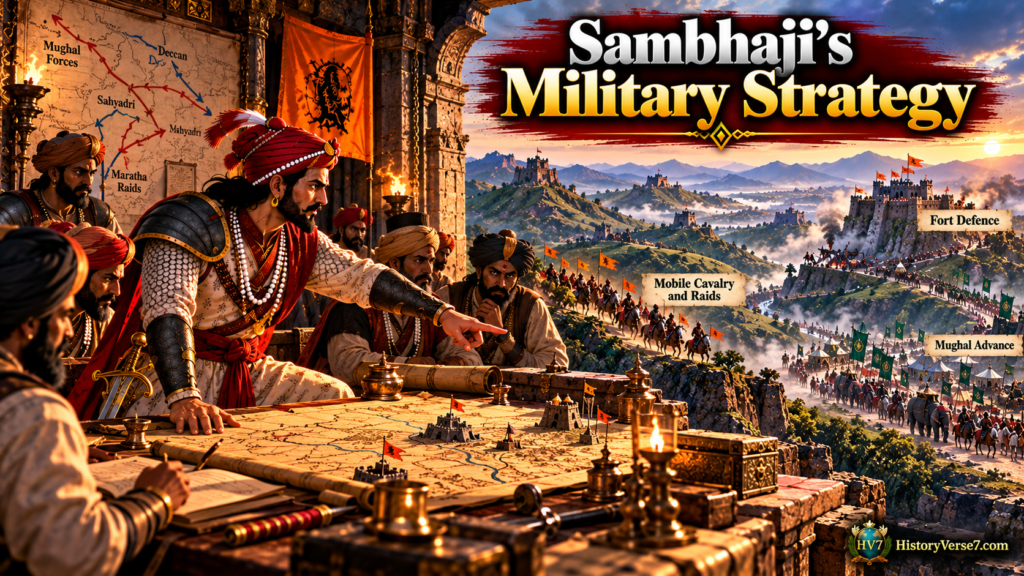
What changed under Sambhaji Maharaj, out of necessity, was the addition of a genuine coastal and naval dimension to the overall strategy, discussed further below, and a decentralization of operational command that modern historians generally attribute to the war’s sheer scale: no single commander, however capable, could personally direct every front of a conflict spanning the Sahyadris, the Konkan coast, and, at various points, more distant southern territory, and regional commanders operated with considerable independent initiative, a pattern documented in figures like Santaji Ghorpade, whose most famous exploits, discussed further in the legacy section of this chapter, would come slightly after Sambhaji Maharaj’s own death but whose military career began under his direct command. Where this chapter distinguishes documented fact from modern interpretation, it is worth noting that historians’ characterization of this decentralization as a deliberate strategic choice, as opposed to simply an unavoidable consequence of the war’s scale, remains an area of reasonable but not fully settled scholarly judgment.
Sambhaji Maharaj and the Portuguese
The Estado da Índia, based at Goa, represented a genuinely different kind of adversary from the Mughals or Bijapur: a smaller regional power, but one backed by considerable naval capability, established fortifications, and a long-standing commercial and territorial position along the western coast that Portuguese authorities had no intention of surrendering without resistance.
Tension between Sambhaji Maharaj’s state and Goa centered on territorial disputes along the Konkan coast, competing claims over coastal trade and customs revenue, and, at various points, direct Portuguese cooperation with or tacit support for Mughal interests, which Sambhaji’s court understandably viewed as a hostile act given the broader war underway. The 1683 campaign saw Maratha forces move directly against Portuguese-held territory, placing real pressure on Goa itself before Sambhaji’s attention was drawn elsewhere by the broader demands of the Mughal war.
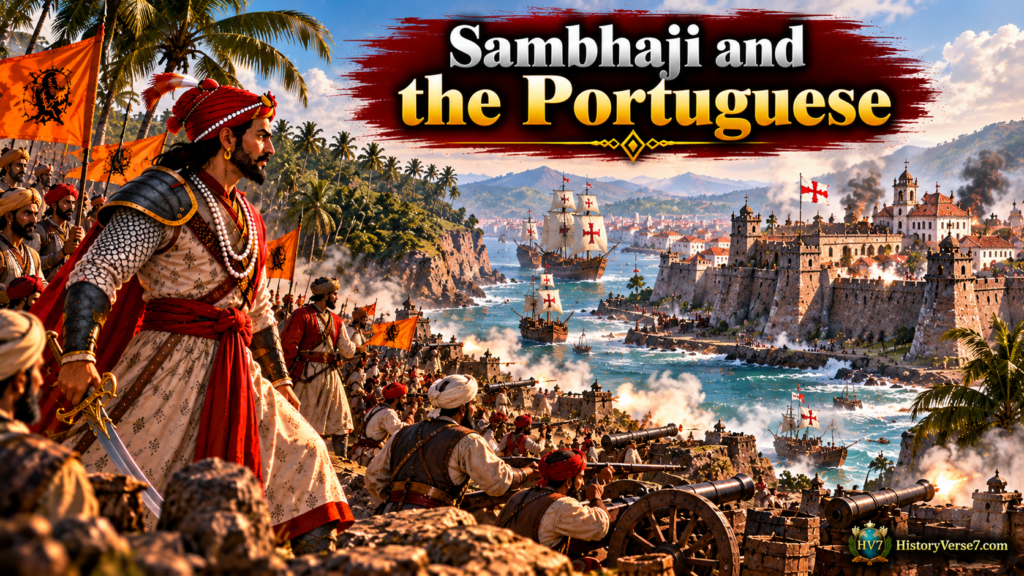
Portuguese records from this period, preserved in Estado da Índia archives and correspondence, provide a genuinely independent, contemporary perspective on these events, documenting real alarm at Goa and serious consideration of the territorial and commercial threat Sambhaji’s campaign represented. This chapter resists treating the Portuguese simply as villains or simply as victims in this conflict; their resistance to Maratha pressure reflected entirely rational defense of established commercial and territorial interests, just as Sambhaji Maharaj’s campaign against them reflected a rational Maratha interest in securing the Konkan coast and its trade against a well-armed regional rival, at a moment when the state could not afford unresolved hostile powers on multiple fronts simultaneously.
Sambhaji Maharaj and the Siddis of Janjira
The Siddis of Janjira, a maritime power controlling a formidable, well-defended island fortress just off the Konkan coast, had remained a persistent thorn in Maratha coastal ambitions since Shivaji Maharaj’s own reign, discussed in earlier chapters of this series, and this hostility continued essentially unresolved under Sambhaji Maharaj.
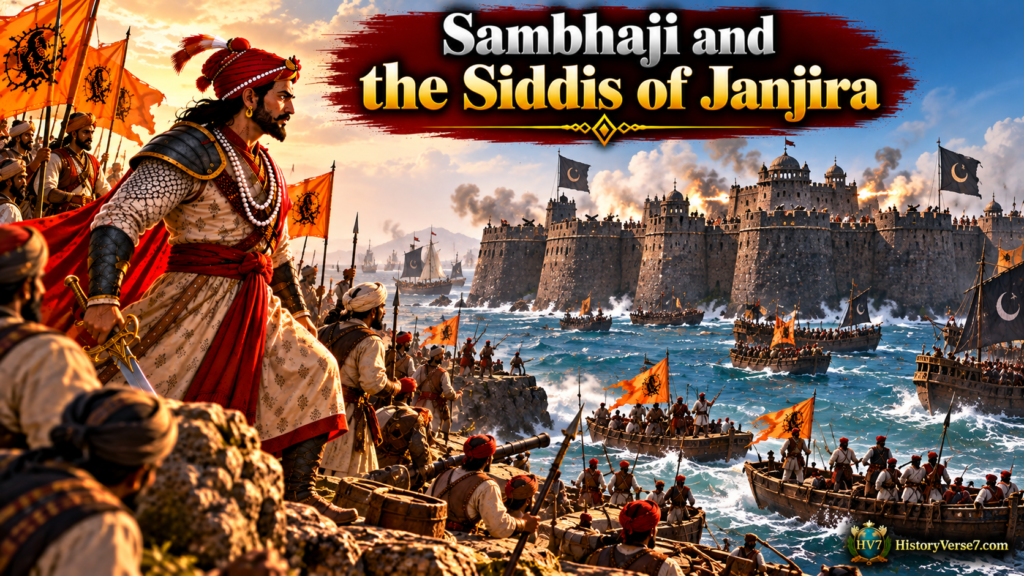
Sambhaji Maharaj directed military attention against Janjira as part of the same 1683 to 1684 Konkan campaign that targeted Portuguese Goa, reflecting a broader strategic logic of trying to secure the full length of the Konkan coastline against every rival power holding a foothold on it. Janjira’s natural defenses, an island fortress with strong walls and difficult approach by sea, proved as resistant to Maratha attack as they had to earlier Mughal and Bijapuri assaults across the preceding decades, and this chapter is careful not to exaggerate what Sambhaji Maharaj actually achieved here: despite real military pressure and, at points, genuine tactical success against Siddi forces on the mainland and in coastal waters, Janjira itself was never captured during Sambhaji Maharaj’s reign, and Siddi power along this stretch of coast remained a persistent, unresolved limitation on full Maratha control of the Konkan throughout the period this chapter covers.
Sambhaji and the Deccan Sultanates
Bijapur and Golconda, the two remaining independent Deccan sultanates, occupied an increasingly precarious position throughout Sambhaji Maharaj’s reign, caught between their own long-standing rivalry with the Marathas and the far greater, existential threat that Aurangzeb’s southern campaign now posed to their own independent existence.
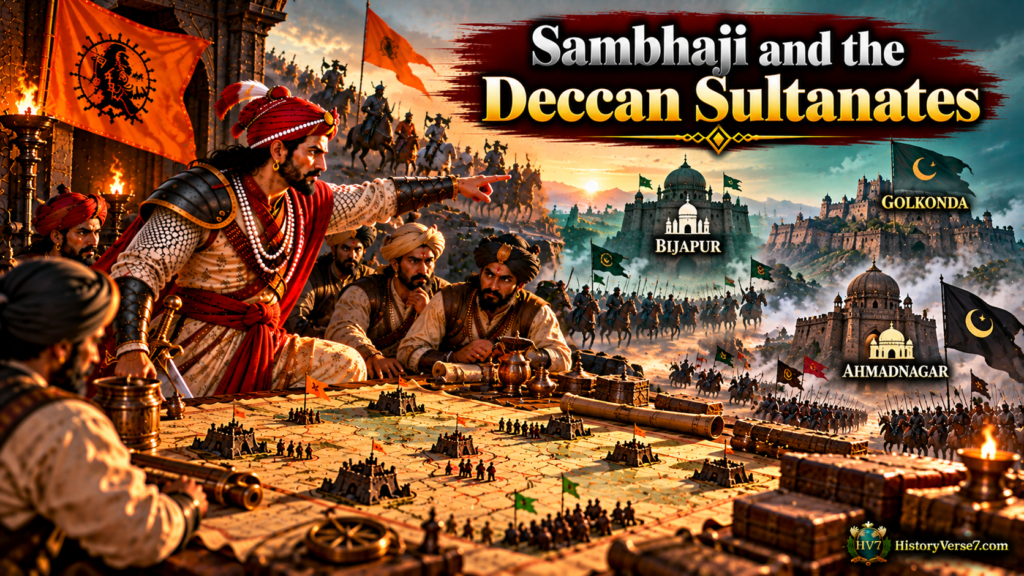
Sambhaji Maharaj’s relationship with both sultanates during this period was genuinely calculated rather than fixed: earlier hostility gave way, at points, to a recognition of shared interest against Mughal expansion, though this chapter is cautious about overstating the degree of formal coordination this produced, since the surviving evidence for sustained, close Maratha-Bijapur-Golconda military cooperation during this specific period is considerably thinner than the evidence for each power’s individual resistance to Mughal pressure. What changed the strategic environment decisively was the sequential Mughal conquest of both sultanates: Bijapur fell to Aurangzeb’s forces in 1686, and Golconda followed in 1687, within a year of each other and well within Sambhaji Maharaj’s own reign. Their fall removed two long-standing regional powers from the board entirely, absorbed their territory and resources directly into the Mughal war effort against the Marathas, and left Sambhaji’s state facing the full, undivided weight of Mughal military power without either of the traditional regional counterweights that had helped constrain Mughal ambition in the Deccan for generations.
The Maratha State Under Sambhaji Maharaj
Administering a state fighting for its survival on multiple fronts placed enormous strain on the institutions Sambhaji Maharaj had inherited from his father, and this section focuses narrowly on how those institutions functioned under his specific reign rather than repeating the fuller account of Maratha administrative structure covered elsewhere in the wider HistoryVerse7 cluster.
Revenue collection and fort administration continued to operate through the general structure established under Shivaji Maharaj, but wartime conditions, including sustained Mughal pressure on core territory and the disruption of agricultural and commercial activity that inevitably accompanies prolonged campaigning, placed real strain on the state’s resource base throughout the reign. The Ashtapradhan council continued to function, with ministers including figures who had served under Shivaji Maharaj continuing into Sambhaji Maharaj’s reign alongside newer appointees, though the war’s demands meant that military command and administrative authority were, at points, more closely fused in practice than the more formally differentiated system of the earlier, less pressured years of Swarajya’s development. Correspondence and communication between the fort network and the central court continued to function as the primary mechanism of coordination across the state’s territory, a system placed under genuine strain by the sheer geographic scope of a war now extending across the Sahyadris, the full Konkan coast, and, intermittently, more distant southern holdings.
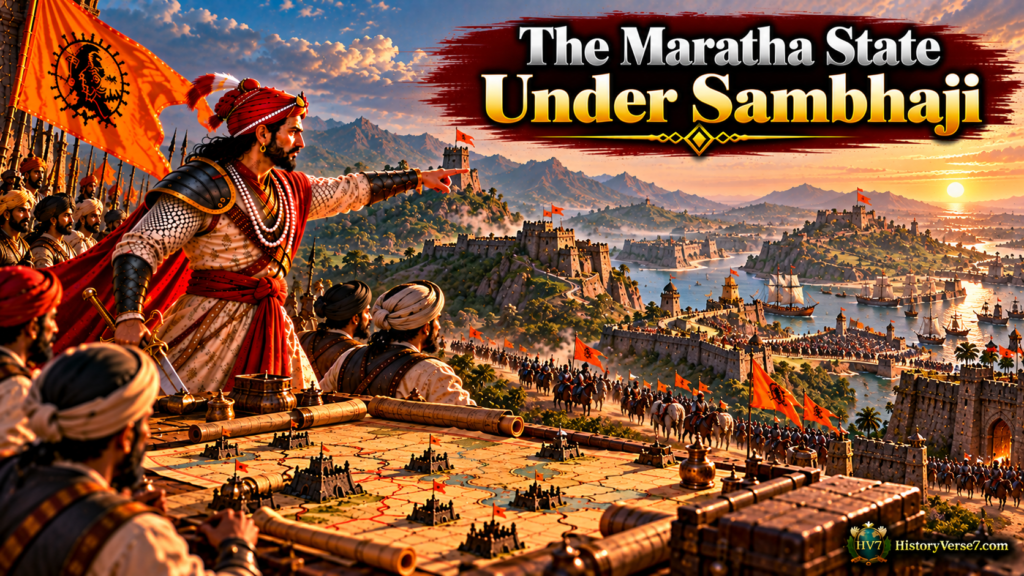
What is most notable about Maratha administration under Sambhaji Maharaj, considered as a whole, is less any dramatic institutional innovation and more its basic continuity and resilience under conditions his father’s system had never been directly tested against: full-scale, sustained, multi-front war against the resources of the entire Mughal Empire.
Sambhaji Maharaj as a Scholar and Writer
Chapter One of this series introduced the genuine but contested question of Sambhaji Maharaj’s literary output, and this chapter returns to it briefly in the specific context of his reign, without repeating that earlier discussion in full.
The Sanskrit text Budhbhushanam remains the work most consistently associated with his name, dealing with themes of statecraft, political conduct, and governance, a thematic fit with the practical demands of the reign he was actually living through. As established in Chapter One, this chapter maintains the same careful position: a genuine manuscript tradition connects this and several Hindi-language literary works to Sambhaji Maharaj, and his broader classical education is well documented independently, but the precise question of direct personal authorship, as opposed to patronage or later attribution reflecting his general scholarly reputation, remains a matter of real and ongoing scholarly discussion rather than settled fact. This chapter does not exaggerate his literary achievement into unqualified certainty, nor does it dismiss the tradition outright; the honest position, as in Chapter One, is that a genuinely educated ruler produced or patronized genuine scholarly work, with the precise boundaries of his personal authorship remaining an open question.
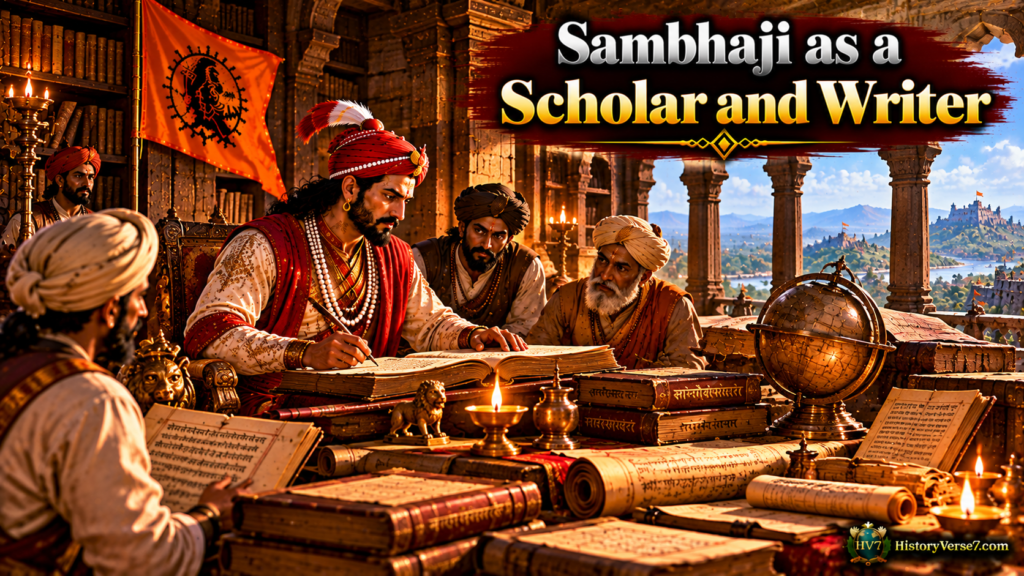
Court culture under Sambhaji Maharaj, to the extent it can be reconstructed from the fragmentary evidence available, continued to reflect the same combination of Sanskrit learning, Marathi administrative practice, and religious patronage that had characterized his father’s court, adapted to the more constrained and militarily focused circumstances of a reign spent almost entirely at war.
Religion and Sambhaji Maharaj
This section requires the same careful, evidence-driven treatment that the wider HistoryVerse7 Shivaji Maharaj series has applied to the same subject in earlier chapters, resisting both anachronistic modern political categories and unsupported claims of either universal tolerance or universal persecution.
As a Hindu ruler continuing the sovereign, ritually legitimated kingship his father had established through the 1674 coronation, Sambhaji’s court maintained patronage of Hindu religious institutions, including temples and religious endowments within Maratha territory, consistent with the expectations of a Deccan Hindu sovereign of this period and continuous with his father’s own established practice. At the same time, and consistent with the broader Deccan political reality already documented in earlier chapters of this series, Maratha administration and military under Sambhaji Maharaj continued to include Muslim officials and soldiers, reflecting the same practical, cross-communal character that had defined Swarajya’s functioning since its earliest years under Shivaji Maharaj.
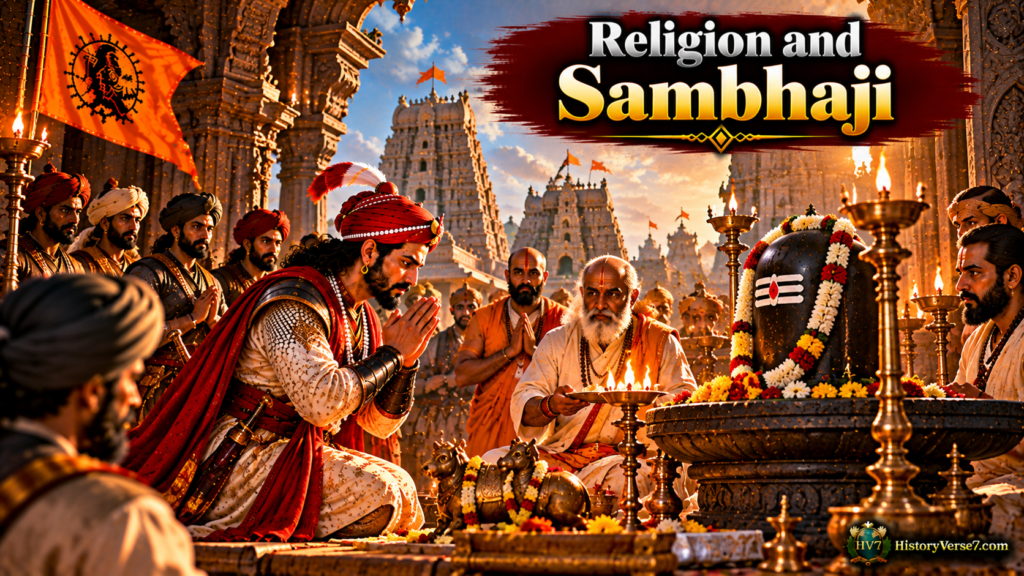
The war against Aurangzeb itself should not be read as a straightforwardly religious conflict, even though religious language and framing appear at points in the sources connected to specific episodes, including, as discussed below, the circumstances surrounding Sambhaji Maharaj’s own execution. The conflict was, at its core, a struggle over territory, sovereignty, and the survival of a regional state against an expanding empire, fought between political and military actors on both sides who were themselves religiously mixed in their own personnel and alliances, including Sambhaji Maharaj’s own continued reliance on Muslim officials and, at points, cooperation with the Muslim-ruled sultanates of Bijapur and Golconda against the Mughals. This chapter presents documented cases where they exist rather than asserting a general theory of religious policy in either direction, and it treats the religious symbolism that does appear in specific, well-documented moments, again including the execution, as significant historical evidence in its own right rather than as proof of a broader, generalized religious character to the war as a whole.
Women and the Royal Family
Yesubai, Sambhaji Maharaj’s wife, from the Shirke family of the Konkan, held the formal position of Chief Queen Consort throughout his reign, from his 1680 coronation until he died in 1689, and the documented record places her at the center of the Maratha royal household during this entire period, including, as the aftermath section of this chapter will discuss, direct and severe personal consequences once Sambhaji was captured.
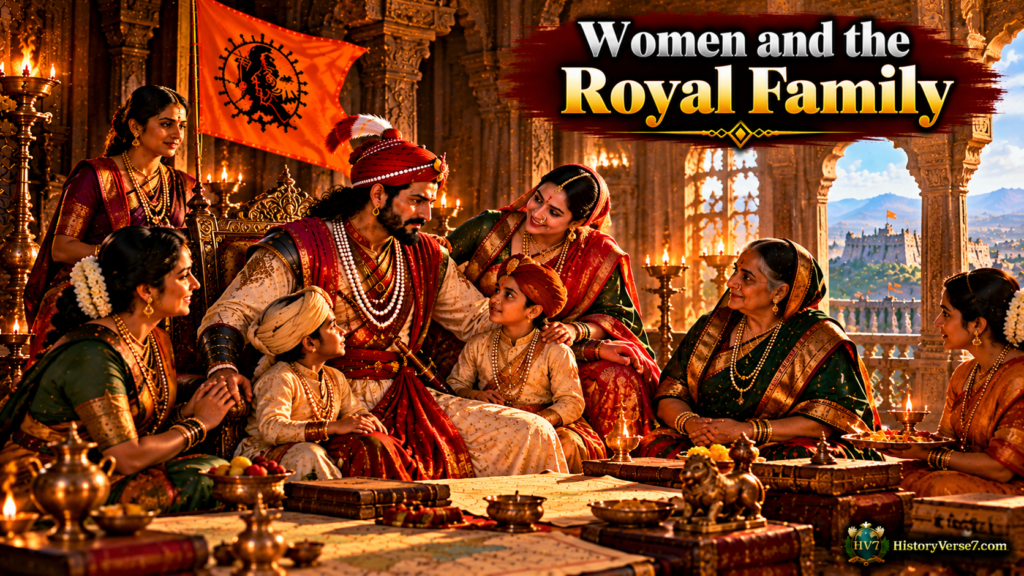
Rajaram, Sambhaji Maharaj’s younger half-brother and the son of Soyarabai, remained a politically significant figure throughout the reign despite the earlier succession conflict discussed in Chapter One, precisely because he represented the only other direct male heir within the ruling house and would, as this chapter’s later sections describe, become central to Maratha political survival immediately after Sambhaji Maharaj’s death. This chapter resists speculating about the private emotional dynamics between Sambhaji Maharaj and Rajaram during this period, since the surviving sources document political positions and later actions far more reliably than personal feeling, and any confident account of what either man privately believed about the other would be invention rather than history.
Sambhaji Maharaj’s Reputation in the Sources
Few figures in Maratha history are portrayed as differently across different source traditions as Sambhaji Maharaj, and this variation is itself an important historical fact rather than a problem to be resolved into a single, authoritative characterization.
Persian and Mughal chronicle sources, including the Maasir-i-Alamgiri and related court histories composed during or shortly after Aurangzeb’s reign, generally present Sambhaji through the lens of a persistent and dangerous regional rebel, someone whose defiance and eventual capture and execution the Mughal court treated as a significant imperial achievement, framed accordingly in the celebratory, victory-oriented conventions typical of Mughal court chronicle writing. Marathi bakhars, composed substantially later and shaped by the reverence that grew around Sambhaji Maharaj’s eventual martyrdom, tend to emphasize his courage, his scholarly credentials, and his defiance of Aurangzeb’s demands at the moment of his death, sometimes adding narrative and emotional detail well beyond what earlier, more contemporary sources can support. Portuguese and other European accounts, where they address him directly, tend to focus on his role in specific episodes of direct interest to their own commercial and territorial concerns, particularly the Goa campaign, offering useful but narrowly focused corroboration rather than a comprehensive portrait.

Later colonial-era historians, writing under British administration, frequently absorbed and repeated, sometimes uncritically, the more negative characterizations found in Persian sources or in earlier colonial scholarship shaped by its own political interests, while nationalist and post-independence Indian historiography, particularly from the twentieth century onward, generally worked to recover and re-center Sambhaji Maharaj’s military resistance and his death as an act of significant political and religious defiance, a reading that has become dominant in popular Indian memory of him today. Modern academic scholarship, drawing critically on all of these traditions, has generally moved toward the more genuinely mixed picture this chapter has tried to present throughout: a capable but imperfect ruler, operating under conditions of enormous and sustained external pressure, whose specific documented actions support neither the uncomplicated hero of popular memory nor the uncomplicated villain of some earlier colonial and Mughal-sourced accounts.
The Controversies Around Sambhaji Maharaj
Several specific claims about Sambhaji Maharaj’s reign recur often enough in popular retelling to warrant direct, source-by-source examination here, applying the same evidentiary discipline this entire two-chapter series has tried to maintain throughout.
The claim that Sambhaji Maharaj was a reckless or incompetent ruler whose personal failings brought about the Maratha state’s near-collapse is a characterization found substantially in later colonial-era historiography and in some Persian source traditions, but it sits uneasily against the documented military record of his reign: the Burhanpur raid, the six-year defense of Ramsej, the Battle of Wai, and the general survival of the Maratha state through eight years of direct war against the full resources of the Mughal Empire under Aurangzeb’s personal command. This chapter does not adopt the opposite, uncritical heroic framing either; what the evidence supports is a ruler operating with real skill under conditions no Maratha leader before him had faced, while also managing, not always successfully, real internal political tension and resource constraints documented elsewhere in this chapter.
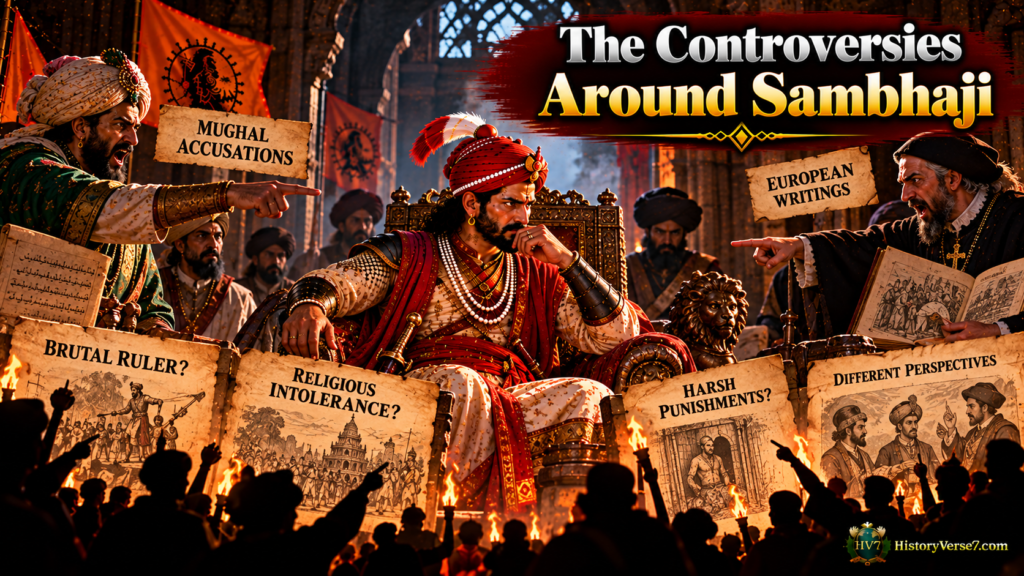
The claim, discussed already in Chapter One and worth restating briefly here in the context of his reign, that Sambhaji’s earlier Mughal service and defection reflect a consistent pattern of disloyalty or instability, does not sit easily against the documented consistency of his conduct once he became Chhatrapati: from 1681 onward, the sources show no comparable episode of Sambhaji again shifting allegiance toward Mughal service, and his entire reign, until his capture, was conducted as sustained, direct resistance to Aurangzeb.
The question of Ganoji Shirke’s role in Sambhaji Maharaj’s eventual capture, discussed fully in the next section, deserves particular caution here: while widely repeated in popular accounts as an act of clear, deliberate betrayal by a relative within the Shirke family connected to Yesubai, the strength of direct, reliable primary source evidence for the precise mechanics and motivation of this betrayal is genuinely limited, resting substantially on a single Marathi bakhar tradition rather than a wide, independently corroborating body of contemporary documentation. This chapter treats the broader fact of Sambhaji Maharaj’s capture through local intelligence and Mughal coordination as well established, while treating the specific, often dramatically elaborated details of Ganoji Shirke’s personal betrayal as resting on a narrower evidentiary base than popular retelling generally acknowledges.
Sambhaji Maharaj’s Capture
In early 1689, Sambhaji Maharaj, accompanied by his close adviser and minister Kavi Kalash, was traveling with a limited retinue from Sangameshwar toward Vishalgad and ultimately Raigad, having recently dealt with a local family dispute connected to the Shirke family in the Konkan region. The Mughal commander at Kolhapur, Sheikh Nizam, a former Golconda officer later honored by Aurangzeb with the title Muqarrab Khan, had been specifically positioned and instructed to watch for exactly this kind of opportunity, and received intelligence regarding Sambhaji Maharaj’s planned halt at Sangameshwar.
On 1 February 1689, Mughal forces under Sheikh Nizam’s command fell upon Sambhaji Maharaj’s party at Sangameshwar. A skirmish followed in which several of Sambhaji Maharaj’s men were killed defending him, and the greater part of his small escort was unable to prevent his capture; Kavi Kalash was captured alongside him. Sources describe Sambhaji Maharaj as having had the opportunity to escape earlier, had he acted on warning of the approaching Mughal force with sufficient urgency, though this chapter treats such retrospective claims about missed warnings with appropriate caution, since they are easier to assert confidently after the fact than to establish as certain in the moment itself.
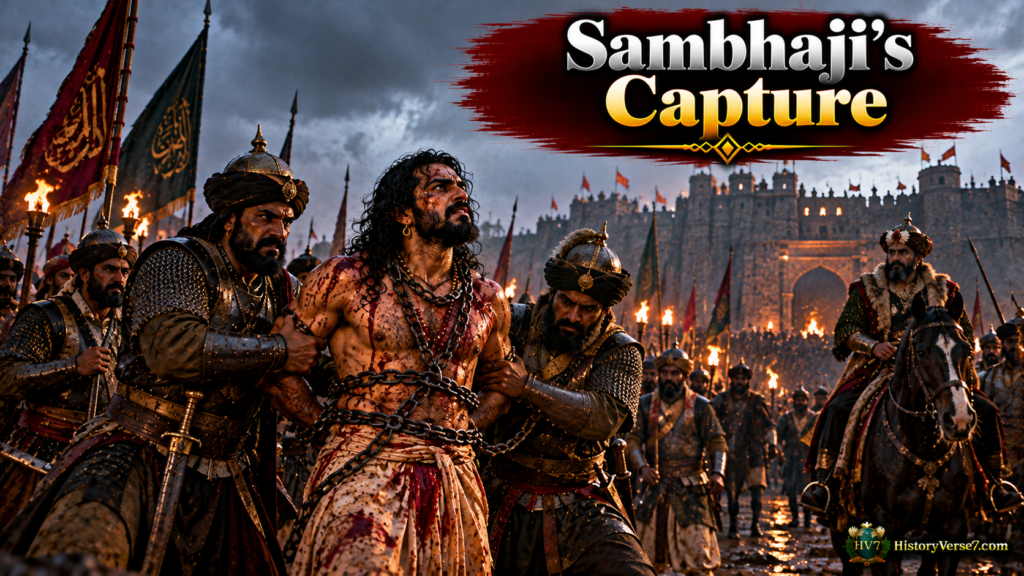
The question of local betrayal connected to this capture, discussed above, deserves restating plainly here: the broader claim that local intelligence, including information connected to the Shirke family, contributed to the Mughal forces’ ability to locate and intercept Sambhaji Maharaj’s party is reasonably well supported by the general pattern of events; the specific, dramatic account of Ganoji Shirke personally leading Mughal forces to the ambush rests on thinner and less independently corroborated evidence than its wide popular repetition would suggest, and this chapter presents it as probable rather than definitively established.
Sambhaji Maharaj, Kavi Kalash, and roughly two dozen additional officers were taken into Mughal custody and transported first toward Akluj and then to Aurangzeb’s own camp, where the emperor had, by this stage of the war, established a semi-permanent presence in the Deccan reflecting his complete personal commitment to seeing the conflict through.
Sambhaji Maharaj’s Execution
What followed Sambhaji Maharaj’s capture is documented across Persian court sources, including near-contemporary Mughal chronicle accounts, alongside later Marathi tradition that adds considerably more narrative and emotional detail than the earlier sources provide, and this chapter is deliberately careful to distinguish between the two.
According to the more contemporary Persian accounts, Sambhaji Maharaj and Kavi Kalash were brought before Aurangzeb and, in some accounts, subjected to public humiliation before the assembled Mughal camp. Sources describe an offer, or a demand, that Sambhaji Maharaj could secure his life by converting to Islam, surrendering Maratha forts, and revealing the identity of Mughal officers who had been secretly cooperating with Maratha forces during the war. According to the available sources, Sambhaji Maharaj refused these terms, and, in the account given in Mughal chronicle tradition, responded to Aurangzeb and the Mughal court with defiance and insult severe enough that religious authorities at court, the ulema, pronounced a sentence of death.
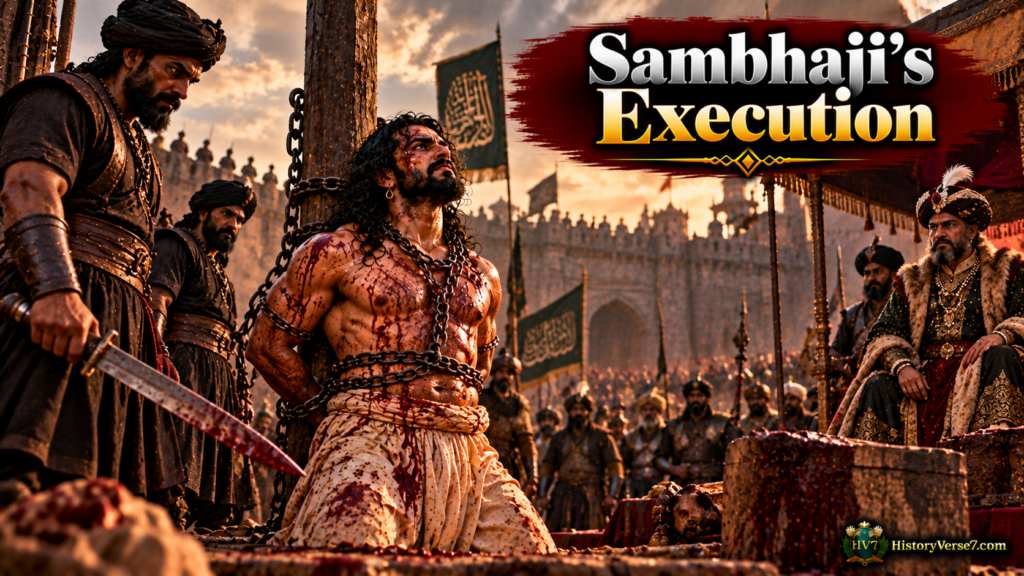
Sambhaji Maharaj and Kavi Kalash were executed on 11 March 1689 at Tulapur, near the confluence of the Bhima and Indrayani rivers, not far from Pune. Persian sources confirm that the execution followed a period of severe mistreatment, and this chapter states that fact plainly without reproducing the more graphic and specific details of mutilation and torture that appear prominently in later Marathi bakhar tradition, since the precision and completeness of those specific details rest substantially on sources composed well after the event, shaped by the devotional and commemorative purposes such accounts typically served, rather than on strictly contemporary, independently verifiable documentation. What can be responsibly stated is that near-contemporary Mughal sources themselves describe brutal treatment prior to execution, that this treatment was severe by any standard, and that the precise, itemized details found in later retellings should be understood as a later tradition layered onto a documented, genuinely brutal core event rather than as independently verified fact in every specific detail.
Local tradition holds that villagers in the area near Tulapur recovered and cremated Sambhaji Maharaj’s remains following the execution, a detail consistent with the broader historical picture of local Maratha sympathy persisting even under direct Mughal military control of the immediate area, though, as with much surrounding this event, the precise details of this local action rest more on tradition than on independently verified contemporary documentation.
Yesubai and the Aftermath
Sambhaji Maharaj’s death did not end Maratha resistance, and this chapter is careful to state that plainly rather than allowing his execution to read as the natural conclusion of the wider war. The most immediate and severe personal consequence fell on his own family: Yesubai and Sambhaji Maharaj’s young son, Shahu, were captured by Mughal forces shortly afterward, when the fort of Raigad itself fell to a Mughal siege later in 1689, and both were taken into Mughal captivity, where they would remain, held under conditions of formal but restrictive confinement, for close to two decades, according to Persian court records describing arrangements made for their maintenance within the Mughal camp and, later, court structure.
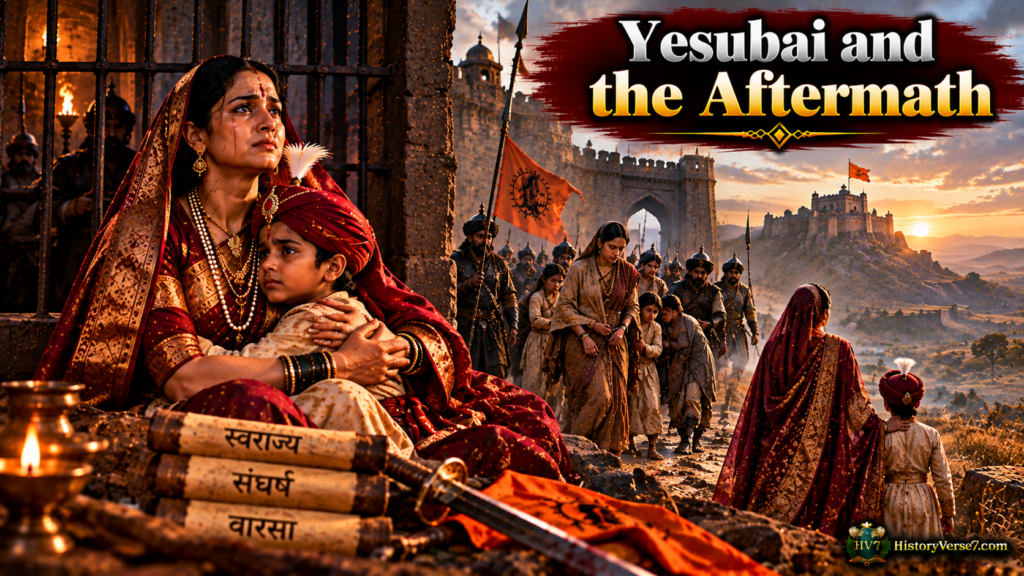
Political leadership of Maratha resistance passed to Rajaram, Sambhaji Maharaj’s half-brother, who, facing the same Mughal pressure that had cost his brother his life, eventually made his way south to the fortress of Jinji in the Tamil country, discussed briefly in the earlier Shivaji Maharaj chapters of this series in connection with its more limited role under Shivaji’s own southern campaign. Under Rajaram, and after he died in 1700 under the continued direction of his widow Tarabai on behalf of her young son, Maratha resistance not only survived Sambhaji Maharaj’s death but continued to inflict serious, sustained costs on Mughal forces for years afterward, a war of attrition that historians generally credit with substantially draining Mughal military and financial resources over the following decades, contributing to broader difficulties for the empire that would become fully apparent only after Aurangzeb’s own death in 1707. This chapter does not claim that Sambhaji Maharaj’s death somehow caused this later Maratha resilience; it explains, instead, that the institutions, the fort network, and the tradition of decentralized regional command that Sambhaji Maharaj’s own reign had relied on and helped sustain provided the foundation on which Rajaram and Tarabai’s continued resistance was built.
Did Sambhaji Maharaj Fail or Succeed?
This chapter resists offering a simple verdict, because the honest historical record does not support one, and instead presents the evidence across several distinct, measurable dimensions so that readers can form their own reasoned assessment.
On territorial survival, the Maratha state did not collapse during Sambhaji Maharaj’s reign, despite facing the full, sustained weight of Mughal military power for the better part of a decade; its core Sahyadri and Konkan territory remained substantially intact at the time of his capture, even as specific forts changed hands over the course of the fighting. On military resistance, the documented record, from Burhanpur to Ramsej to Wai, shows a state genuinely capable of inflicting serious damage on and denying decisive victory to an opponent with overwhelmingly superior long-term resources. On fort network integrity, the system inherited from Shivaji Maharaj proved its worth repeatedly, most dramatically at Ramsej, though it did not prove invulnerable, as the fall of Raigad itself shortly after Sambhaji Maharaj’s capture would demonstrate. On administrative continuity, the state’s core institutions continued functioning under sustained wartime pressure throughout the reign, a genuine achievement given the circumstances, even as that same pressure clearly strained the system’s capacity in ways this chapter has documented.
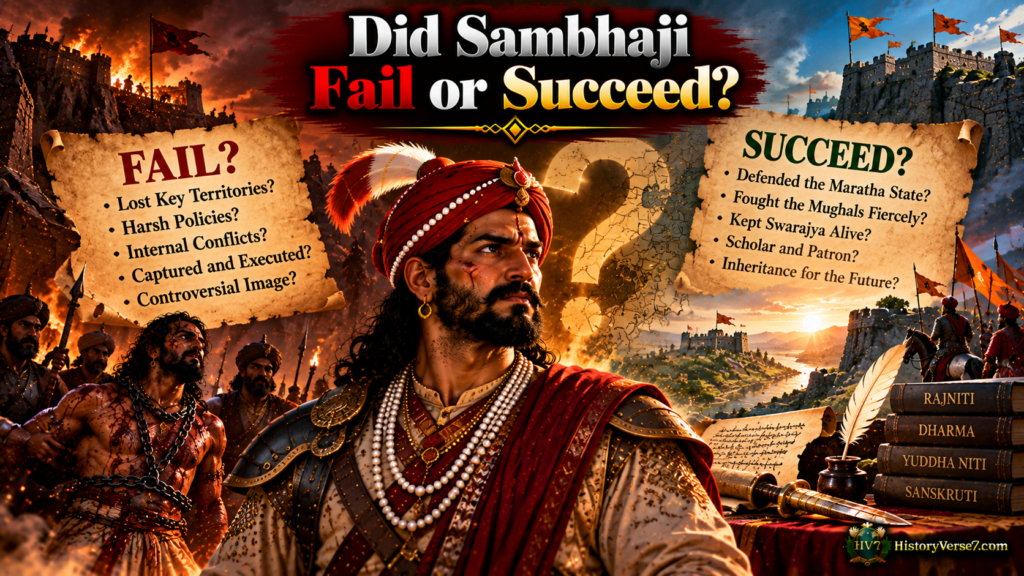
On diplomatic outcomes, the picture is considerably more mixed: relations with the Siddis and Portuguese remained essentially unresolved and hostile throughout, and the fall of both Bijapur and Golconda during Sambhaji Maharaj’s own reign removed potential regional counterweights to Mughal power in a way that left his state strategically more isolated by the end of his reign than at its beginning, a genuine and significant limitation rather than a success by any measure. And on the most immediate personal and dynastic dimension, Sambhaji Maharaj’s own capture and execution, followed by the imprisonment of his wife and young son, represents an unambiguous personal catastrophe, whatever its longer-term political consequences for Maratha resistance under his successors.
What Sambhaji Maharaj Actually Achieved
Setting aside both celebratory and dismissive framings, several specific, documented achievements can be attributed to Sambhaji Maharaj’s reign with reasonable confidence. He sustained the Maratha state’s core territorial integrity through nearly eight years of direct war against the full resources of the Mughal Empire, a genuinely difficult strategic achievement regardless of the war’s eventual longer-term course. He directed a genuinely ambitious coastal strategy, pressing simultaneously against both Portuguese Goa and Siddi Janjira, extending Maratha strategic ambition along the Konkan coast even where it did not achieve complete success. He maintained, under conditions of sustained external pressure his father’s reign had never faced in comparable intensity, the basic administrative and military institutions of the state he inherited, providing continuity that his successors would draw on directly after his death.
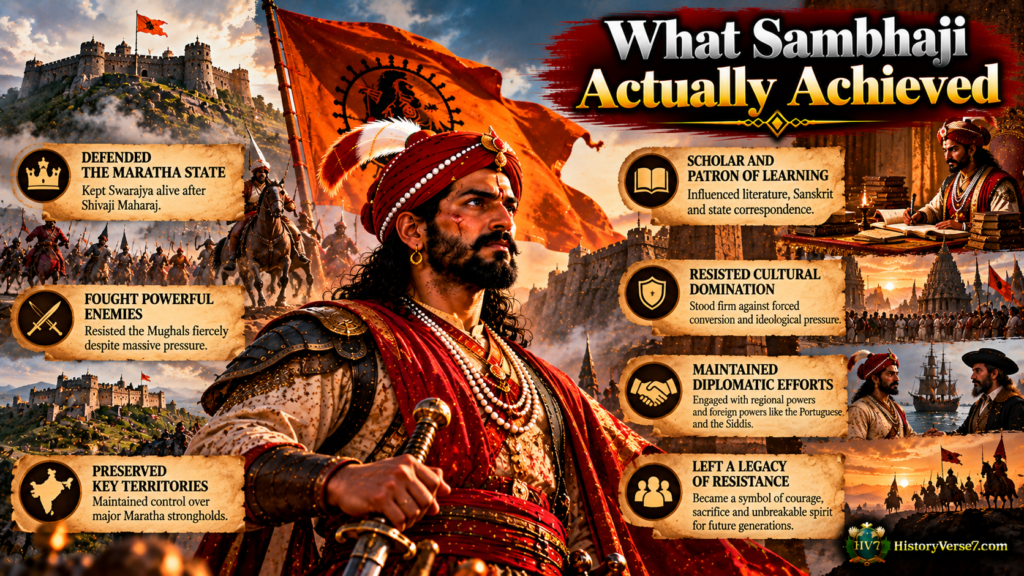
These achievements should be understood as short-term outcomes of the reign itself, distinct from the longer-term consequence, largely unintended and only fully realized under his successors, that the war he fought and the institutions he preserved helped establish the pattern of prolonged, decentralized, attritional resistance that would eventually contribute to exhausting Mughal resources over the following decades, well beyond anything Sambhaji himself could have foreseen or specifically intended during his own reign.
What Were the Limitations?
An honest assessment requires equally direct treatment of what did not go well, without resorting to insulting language or unsupported psychological speculation about Sambhaji Maharaj’s own character or decision-making.
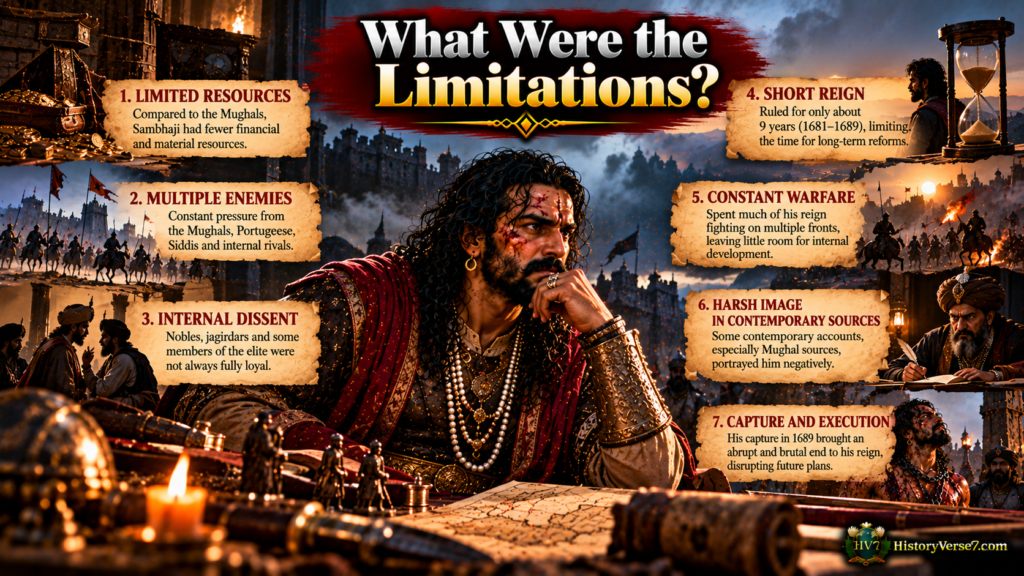
Internal political conflict, evident from the earliest days of his accession as documented in Chapter One and continuing, to some degree, throughout his reign, represented a real and persistent drain on the state’s unity at precisely the moment it could least afford internal division. Resource limitations, an inevitable consequence of a comparatively compact regional state facing the sustained military and financial resources of the entire Mughal Empire, placed real strain on the war effort throughout the reign, reflected in the loss of specific forts and territory over its course even as the core state survived. Multiple-front warfare, spanning the Mughals, the Siddis, and the Portuguese simultaneously at various points, spread Maratha military resources thin in ways that likely limited the decisiveness achievable on any single front, including the ultimately unresolved campaigns against Janjira and Goa. Diplomatic isolation deepened over the course of the reign as Bijapur and Golconda fell, removing potential regional partners and leaving the Maratha state facing Mughal power essentially alone by the reign’s final years. And the military setback at Sangameshwar itself, whatever the precise role of local betrayal in enabling it, represents a genuine operational and security failure at the most consequential possible moment, one whose personal and political consequences for the Maratha state were severe and immediate.
The Last Years of Sambhaji Maharaj’s Reign
The years following the Battle of Wai in December 1687 mark a period of increasing strain rather than a sudden collapse, and this chapter traces this final phase in more granular detail than a single summarizing paragraph would allow.

Hambirrao Mohite’s death at Wai, even amid a genuine Maratha victory, deprived Sambhaji Maharaj of one of his most senior and experienced field commanders at a moment when continuity of capable military leadership mattered enormously. Through 1688, with Bijapur and Golconda both now fully absorbed into Mughal control, Aurangzeb was able to direct an increasing proportion of the empire’s Deccan resources specifically against the remaining Maratha resistance, intensifying pressure across multiple fronts simultaneously. Sambhaji’s own movements during this period, including the family dispute connected to the Shirke family that drew him to the Konkan region in the weeks before his capture, reflect a ruler still actively managing both the external war and unresolved internal political and family tensions right up to the final weeks of his freedom. The sequence of events at Vishalgad and then Sangameshwar in January and early February 1689, discussed in detail above, brought this final period to its abrupt and decisive end, transforming what had been a difficult but sustained war of resistance into an immediate, acute crisis for the entire Maratha state within the span of a few weeks.
Sambhaji Maharaj’s Historical Legacy
Sambhaji Maharaj’s legacy developed along two distinct but related tracks after 1689, and this chapter treats them separately rather than collapsing them into a single narrative of inevitable triumph.
The immediate political track saw Maratha resistance continue and, in important respects, intensify under Rajaram and then Tarabai, using the institutional and military foundation Sambhaji’s own reign had helped preserve, discussed above. This chapter is explicit in stating what this does and does not mean: later Maratha success against the Mughals, and the eventual dramatic eighteenth-century expansion of Maratha power under subsequent Peshwa leadership, represents a longer, larger, and considerably later historical development that cannot be attributed solely, or even primarily, to Sambhaji Maharaj’s own reign or decisions, even as the continuity of the state and its institutions through his reign formed an essential link in that longer chain.
The second track, memory and historiography, has proven, if anything, even more consequential to how Sambhaji Maharaj is understood today than the immediate political outcomes of his own reign. Marathi historical tradition, particularly from the colonial and post-independence periods onward, increasingly centered his execution as an act of significant religious and political defiance, a framing reflected in his popular title Dharmaveer, and in the modern commemorations, public monuments, and continued cultural prominence he holds in Maharashtra today. This chapter, consistent with its approach throughout, treats this development in memory as a genuine and historically significant phenomenon in its own right, worth understanding and explaining, while maintaining a clear distinction between the documented events of his actual reign, discussed throughout this chapter, and the later cultural and political meanings that have been built upon and around those events in the more than three centuries since his death.
Author Perspective — HistoryVerse7
What should we remember when we remember Sambhaji Maharaj? Not, I think, either of the two versions that dominate popular memory: the flawless martyr-king of devotional retelling, or the reckless failure sometimes found in older, colonial-shaped historiography. Both versions flatten a reign that the actual evidence shows to have been genuinely difficult, genuinely mixed, and genuinely consequential.
What the documented record supports is a ruler who inherited an unfinished, still-developing state and then spent nearly the whole of his reign defending it against the full weight of the largest empire on the subcontinent, commanded in person by an emperor who would not leave the Deccan again for the rest of his own life. Sambhaji Maharaj did not win that war. He also did not lose it outright, in the sense that matters most: the state survived his own death, and the institutions and fort network he had defended, inherited and passed on in turn, gave his successors the foundation to keep fighting for another two decades until Mughal power in the Deccan was genuinely, lastingly exhausted.
His execution deserves to be remembered honestly, on the evidence that actually survives, rather than through the specific dramatic details later tradition added to it. And his reign deserves to be remembered as more than a prelude to that execution: eight years of sustained, difficult, genuinely consequential rule, conducted under conditions no Maratha ruler before him had faced, by a man whose formation, as Chapter One of this series described, had already exposed him, more directly than almost anyone else in his father’s court, to both the promise and the danger of the empire he ultimately died opposing.
Conclusion
Sambhaji Maharaj’s story should not be reduced to either a perfect hero or a failed ruler. The historical record does not support either simplification, and this two-chapter series has tried, throughout, to resist the pull toward whichever version feels more satisfying to tell.
What the evidence does support is this: a man shaped by early loss, a serious classical education, direct and repeated experience of Mughal power from multiple sides, and a contested rise to the throne, who then spent nearly eight years defending the state he inherited against the full, personally directed weight of the Mughal Empire. He won real victories and suffered real setbacks. He pursued an ambitious coastal strategy that succeeded only partially. He maintained his state’s core institutions under conditions of sustained pressure his father’s reign had never faced in comparable intensity. He was captured through a combination of misfortune and, probably, local betrayal whose exact mechanics remain genuinely uncertain, and he died refusing the terms offered for his life, an act of defiance that near-contemporary sources on both sides confirm even where they differ on its finer details.
None of this resolves into a single verdict, and it should not be made to. Sambhaji Maharaj ruled during one of the most difficult phases of the entire Mughal-Maratha conflict, and understanding his life, from the childhood covered in Chapter One through the reign covered in this chapter, requires exactly what this two-part series has tried to provide throughout: a willingness to examine the evidence from multiple sides, and an honesty about where that evidence runs out.
Written & Researched by Abhishek Chavan — HistoryVerse7| © 2026 HistoryVerse7 | Article: Sambhaji Maharaj (Chapter – 2)
FAQ — Sambhaji Maharaj (Chapter – 2)
How did Sambhaji Maharaj become Chhatrapati?
He secured the throne after a contested succession following his father’s death in April 1680, with a symbolic assumption of authority in July 1680 followed by a formal coronation at Raigad in January 1681, as covered fully in Chapter One of this series.
Why did Aurangzeb come to the Deccan?
Several converging factors are usually identified: unfinished business with Bijapur and Golconda, growing concern over Maratha strength, and the more immediate trigger of his own son Prince Muhammad Akbar’s 1681 rebellion, which found shelter connected to Sambhaji’s court.
What were Sambhaji’s major military achievements?
The 1681 sacking of Burhanpur, the roughly six-year defense of Ramsej Fort, and the December 1687 victory at the Battle of Wai stand among the most significant documented military successes of his reign.
Did Sambhaji Maharaj capture Janjira from the Siddis?
No. Despite sustained military pressure, Janjira remained under Siddi control throughout his reign.
Was Sambhaji Maharaj a successful or unsuccessful ruler?
The evidence supports a genuinely mixed assessment: real military and administrative achievement under extraordinarily difficult conditions, alongside real limitations, setbacks, and an ultimately fatal capture, rather than a simple verdict in either direction.
Sambhaji Maharaj: A Reign That Demands Historical Understanding
Sambhaji Maharaj’s reign unfolded under extraordinary pressure. The conflict with Aurangzeb, the struggle to maintain the Maratha state, competing political interests and the circumstances surrounding his capture and execution all shaped how his reign was experienced and remembered.
His historical significance cannot be measured by a single battle, a single source or a simple verdict of success or failure. Understanding Sambhaji Maharaj requires examining the evidence, the political choices available to him and the wider consequences of the Deccan war.
Begin with his formative years and political journey, then return to this chapter to follow his reign, the Mughal conflict and his legacy.
Read Chapter 1 — The Making of a Warrior PrinceHistory is not strengthened by removing its difficult questions. It is strengthened by examining evidence, acknowledging uncertainty and understanding people within the political world they inhabited.
Thank you for reading the HistoryVerse7 Sambhaji Maharaj series. Continue exploring the history of the Marathas through our related articles and the historical sources linked above.
Share this content: