
Chola Army: 15 Powerful Facts About Its Military Strength
Share this content: HISTORYVERSE7 • MILITARY HISTORY RESEARCH Chola Army: Understanding Military Power Through Historical Evidence The military strength of Chola Empire cannot be understood through famous campaigns alone. Inscriptions, historical scholarship and archaeological records help us examine military units, royal authority, warfare, logistics and the relationship between land forces and maritime power. The following…
Share this content:
Chola Army: Understanding Military Power Through Historical Evidence
The military strength of Chola Empire cannot be understood through famous campaigns alone. Inscriptions, historical scholarship and archaeological records help us examine military units, royal authority, warfare, logistics and the relationship between land forces and maritime power. The following academic and institutional resources offer useful starting points for exploring this history.
1. Archaeological Survey of India — South-Indian Inscriptions
A major epigraphic collection containing Tamil inscriptions that help reconstruct Chola political, religious and military history. The records must be interpreted in their original context.
Read the digitised inscription volume →2. INFLIBNET — The Cholas
An academic overview of Chola political history and campaigns, useful for understanding the wider context of imperial military expansion.
Read the academic chapter →3. Cambridge University Press — A Note on the Navy of the Chola State
Y. Subbarayalu examines the evidence and limitations surrounding the Chola navy. Particularly useful when distinguishing naval activity from the organisation of land forces.
Read the Cambridge research chapter →4. ISEAS–Yusof Ishak Institute, National University of Singapore
This scholarly publication examines the Chola expeditions in Southeast Asia, their historical context and the relationship between maritime activity and regional politics.
Explore the NUS research publication →5. Cambridge University Press — Rajendra Chola I’s Naval Expedition
Vijay Sakhuja and Sangeeta Sakhuja examine the 1025 expedition to Southeast Asia and its maritime context. This is a focused study of naval history, not a general account of the entire Chola army.
Read the Cambridge chapter →HistoryVerse7 research principle: Military history must be reconstructed carefully. Royal victory claims, inscriptions and later historical interpretations are not interchangeable. This article distinguishes documented evidence from reasonable interpretation and acknowledges where the surviving record is incomplete.
Table of Contents
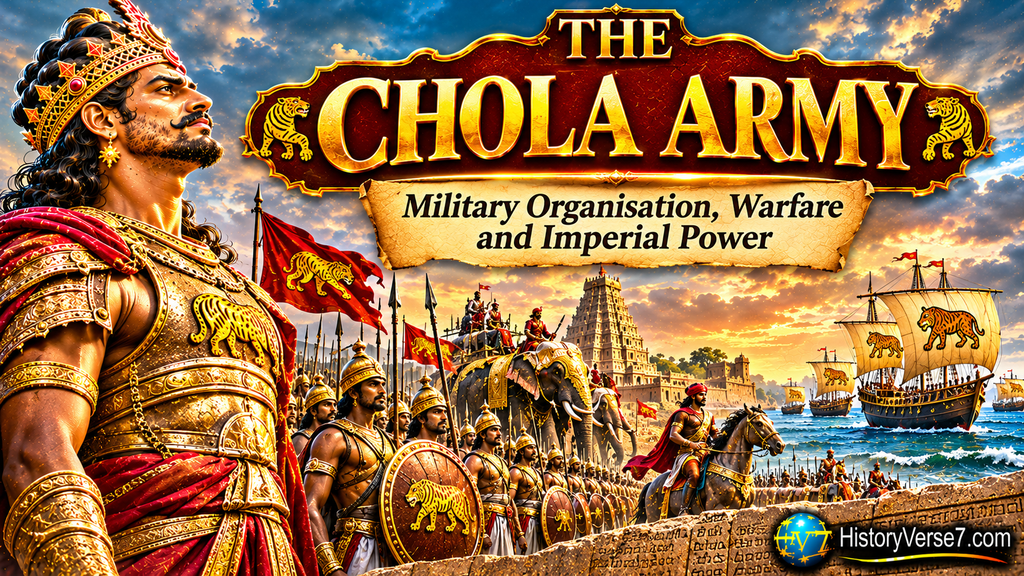
Chola Army: Military Organisation, Warfare and Imperial Power
HistoryVerse7.com |Cluster Article: Chola Army| International English Edition
Two documents from the early eleventh century show why the Chola army is easy to admire and hard to study. In the Rajarajesvara temple at Thanjavur, inscriptions list dozens of named military bodies, among them elephant troops, archers, horsemen and guards, and record what they gave to the temple and borrowed from it. In the same years, at Hottur in the Deccan, the Western Chalukya king Satyasraya had an inscription cut that claims a Chola force of nine hundred thousand men. The first is a catalogue made by people who worked with these units. The second is a number put out by an enemy who wanted his own escape to look impressive.
Together they set the terms for this article. The Cholas left an unusually rich record of their military world, and almost all of it was written to praise, to endow or to commemorate, not to describe how an army actually worked. The task is to read that record for what it can bear: how the army was named and organised, how it was paid for, where it fought, and where it failed.
The central question is how the Cholas organised and used military power to build, defend and extend a large imperial system, and what the strengths and limits of that system were. “Army” here means the land forces. The navy, which mattered enormously to Chola reach, is treated only where it touches the army, and a separate article is planned for it.
The Rise of Chola Military Power
The Chola army was not one institution that stayed the same for four centuries. It changed with the kings who led it and the enemies they faced.
The older editors of the Tanjore inscriptions, Venkayya and Hultzsch, summarise the early line this way. Vijayalaya, the founder of the Thanjavur family, made Thanjavur the capital. His son Aditya I conquered the Pallavas. Parantaka I spent much of his reign fighting the Pandyas and kept them under control. Towards the end of his reign, the Rashtrakutas under Krishna III invaded the Tamil country, killed the Chola prince Rajaditya and took Tondai-nadu, which they are said to have held for about a quarter of a century. Aditya Karikala is credited with winning it back. This is early twentieth-century scholarship, and later work has refined it, but it gives the pattern: a regional power that grew by absorbing neighbours and was nearly overturned by a stronger northern one.
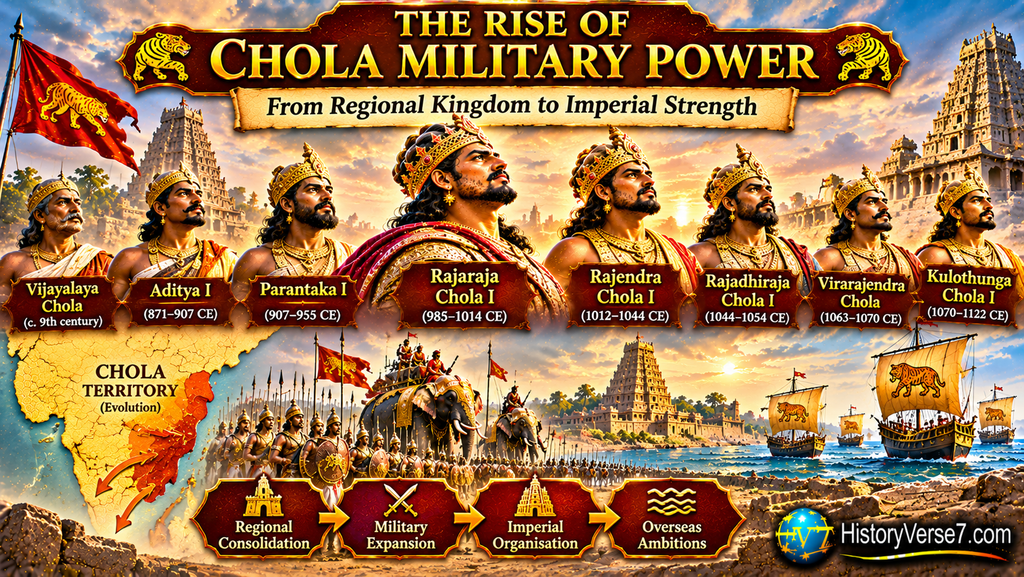
A striking feature is how little of this early military history was written on stone. The editors note that Parantaka I’s many stone inscriptions mention only the conquest of Madurai, and suggest that even this would probably be missing had he not borne the same name as his grandfather and needed a distinguishing epithet. Rajaraja I, on the editors’ reading, was the first southern king to open his inscriptions with an account of his conquests. That means our best evidence for the army begins with Rajaraja, and what is said about earlier armies rests on thinner material.
From Rajaraja onward the picture sharpens, with different emphases under each ruler:
- Rajaraja I (985 to 1014) left the first detailed regimental lists and the first campaign narratives in stone.
- Rajendra I inherited the army that, in the editors’ words, was called “the great warlike army” during his reign, and used it on the Ganges expedition, in Kalinga and in Sri Lanka.
- Rajadhiraja I spent his reign against the Western Chalukyas and died commanding at Koppam.
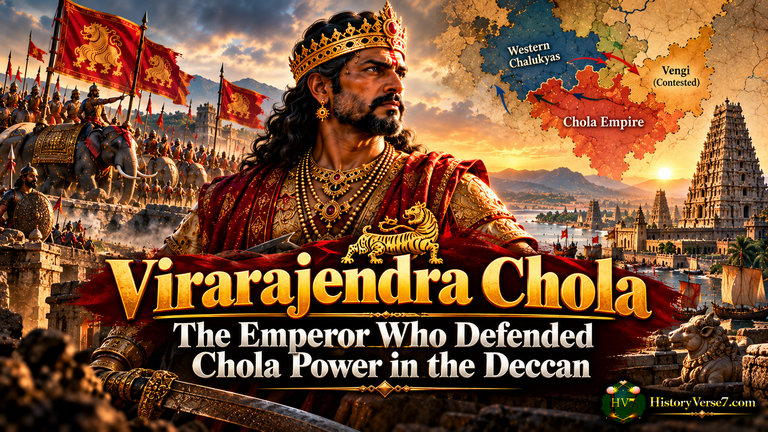
- Virarajendra held the Tungabhadra frontier and fought at Kudalasangamam.
- Kulothunga I relied on his sons and on garrisons in the Pandya country, and lost Sri Lanka and, late in his reign, the Gangavadi country.
These were different kinds of military problems. Treating the whole dynasty as a single war machine hides that.
Organisation of the Chola Army
The best evidence for organisation is the list of military bodies in the Tanjore inscriptions of Rajaraja I. The editors of South Indian Inscriptions, Volume II, count thirty-one, and they call them “regiments.” That word is theirs, not necessarily the inscriptions’, and it should not be taken to mean units of fixed size or modern structure.
The names are informative. In most of them the first part is a title or surname of the king or of his son. The editors suggest, as a conjecture, that such royal names were attached to a unit after it had distinguished itself in some engagement. They also observe that elephant troops, cavalry and foot soldiers all appear among the bodies. Beyond that, the lists do not tell us how many men each contained, who commanded them, or how they were grouped on campaign.
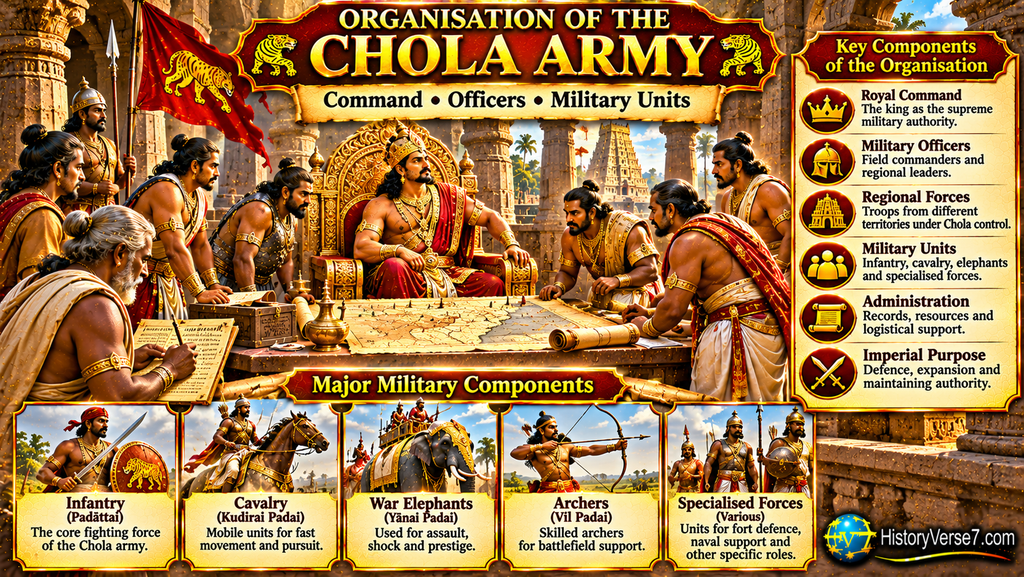
Command is glimpsed through individuals. Two generals are named in Rajaraja’s Tanjore records: Kuravan Ulagalandan, who also bore the title Rajaraja Maharajan, and Krishnan Raman, who bore the title Mummadi-Sora-Brahmamarayan. The second was a Brahmin who served as chief secretary and also as a military officer, and who built at least two of the temple’s enclosing verandahs. The editors also suggest that Kuravan Ulagalandan’s title, “one who measured the earth,” may have been given for his part in the revenue survey. The same records show officers bearing the title Muvendavelan, but the holders the editors name include a secretariat official, a magistrate and a temple manager, which warns against treating such titles as purely military ranks.
Officers of the rank called Perundaram appear in one pair of inscriptions vowing to give lamps to the temple if they returned from war without disgrace at the king’s hands. The editors read this as a sign of the discipline the king enforced. It is a single reading of a few records, but it hints at a court that held its commanders accountable. The editors add that the prominence given to the army in Rajaraja’s inscriptions shows how he treated his soldiers, which is again an inference.
What cannot be responsibly drawn from this is a modern command chart with ranks, divisions, and chains of reporting. The sources give names, titles, and troop numbers, not a described hierarchy.
Recruitment, Soldiers and Military Service
On recruitment, the sources are thin, and several popular claims go beyond them.
The editors observe that Rajaraja I launched no campaign until his eighth year, around 994, and infer that he was probably spending the time recruiting an efficient army. That is a reasonable inference from a gap in the record, not a documented recruitment drive.
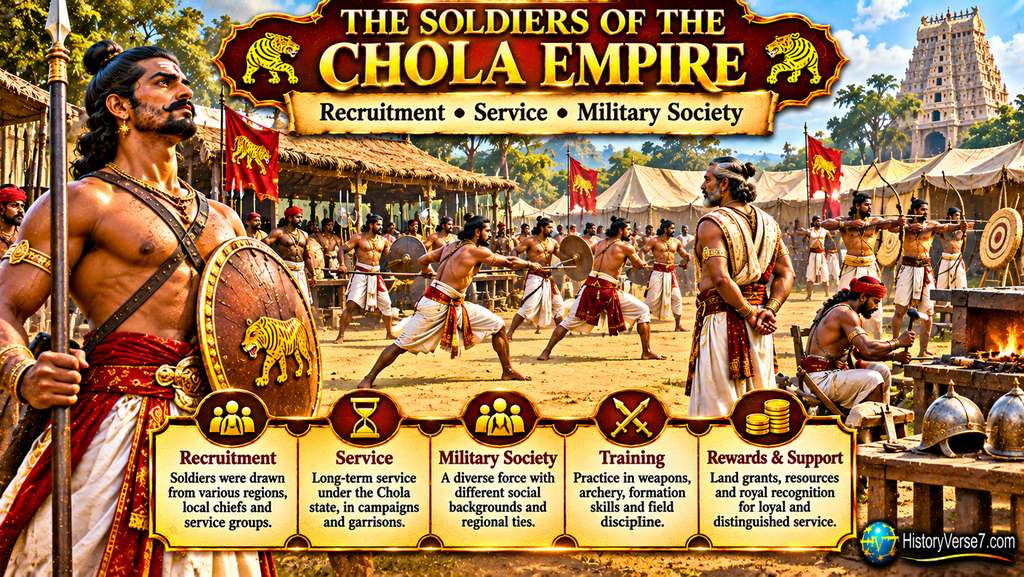
The most debated group is the Velaikkarar. Thirteen of the listed bodies carry the name Valangai-Velaikkarar, and the editors admit the origin of the term is obscure and may or may not relate to the right-hand and left-hand caste divisions of the Tamil country. In Sri Lankan sources, the Velakkara appear as troops in the service of Sinhalese kings. The editors, citing the Mahavamsa, say they figure in the history of the island under Vijayabahu I, were sent against the Chola country, refused to go, and rebelled. A Ceylon inscription of Vijayabahu’s time gives particulars of the community, and the Polonnaruwa Velaikkara inscription is usually described as recording their pledge to protect the Tooth Relic. Wijesinha, quoted in the editors’ commentary, called them mercenaries employed by the Sinhalese. The editors offered a conjecture that in the Chola country they were perhaps not mercenaries but regular soldiers or volunteers who enlisted when an occasion (velai) arose, and that they later migrated to Sri Lanka and became mercenaries. Burton Stein, as summarised in secondary accounts, is reported to have suggested they were drawn from the civilian population in wartime. These are interpretations, not settled history.
Two other points should be noted. Eighteen of the musicians at the Rajarajesvara temple are said to have belonged originally to the listed bodies, which suggests that soldiers and temples were bound together in ways beyond fighting. And nothing in the sources consulted supports a universal system of compulsory service. This article does not claim one.
The Different Branches of the Chola Army
The unit names point to the branches the army had, with one warning: the glosses below are standard Tamil word meanings and the editors’ observations about types, not detailed descriptions of how each branch fought.
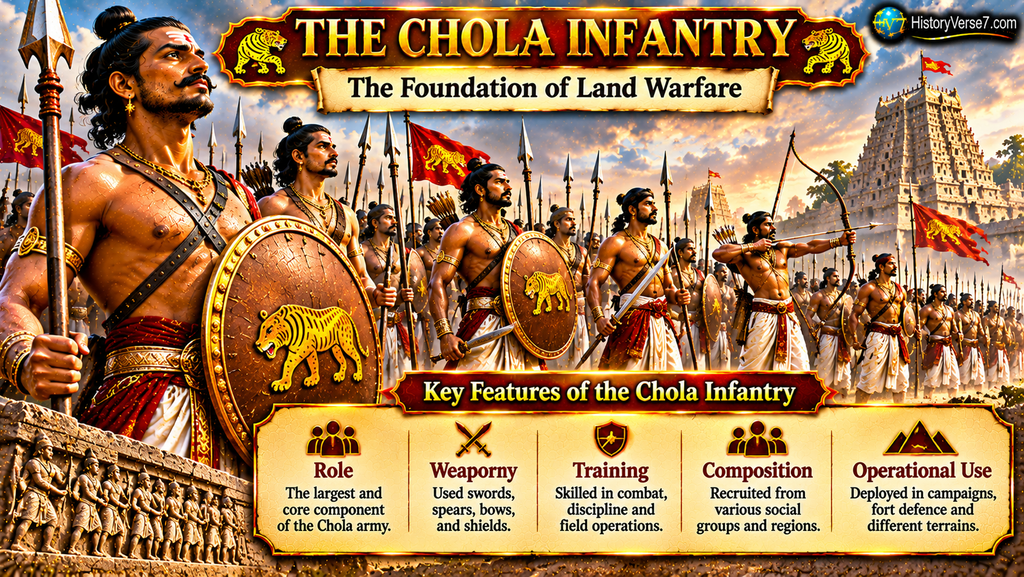
- Infantry and archers. The name Pandita-Sora-terinda-villigal contains villigal, from vil, “bow,” and is generally read as archers. A Tanjore street is recorded as Villigal-teru, “the archers’ street.” The editors confirm foot soldiers among the bodies.
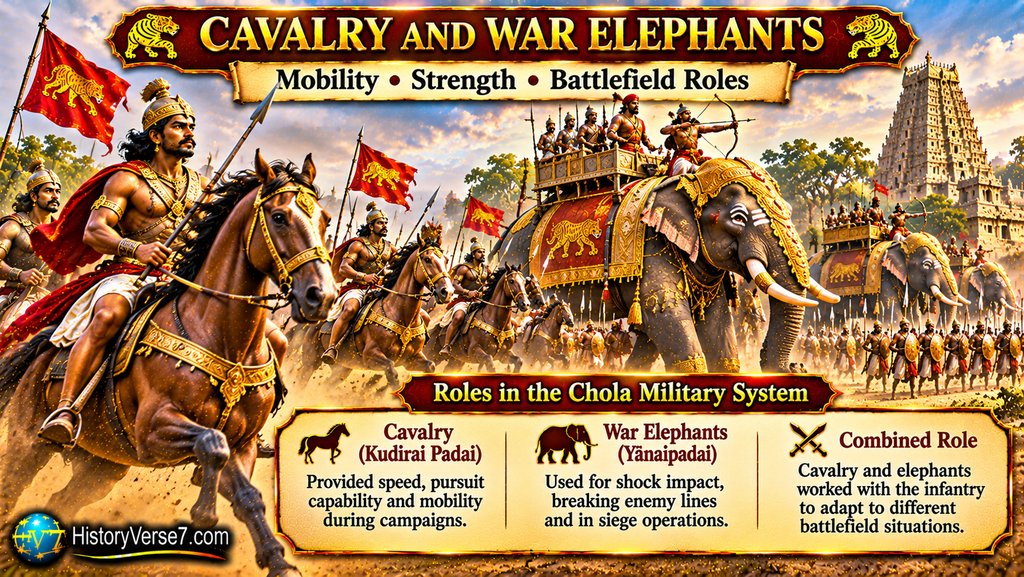
- Elephants. Perundanattu Anaiyatkal and Mummadi-Sora-terinda-Anaippagar include the word for elephant, and a street named for elephant-men (Anai-atkal-teru) is recorded in the capital. Elephants were a command platform as well as a weapon: Rajadhiraja I died directing the battle of Koppam from his war elephant.
- Cavalry. Nigarili-Sora-terinda-Udanilai-Kudiraichchevagar includes kudirai, “horse,” and the editors list cavalry among the bodies.
- Bodyguards and household troops. Names such as Vira-Sora-Anukkar, Keralantaka-vasal-tirumeykappar and Parivarameykappargal point to guards and attendants. Their exact functions are not described.
- Garrisons. Later, Kulothunga I’s reign saw military stations set up in the Pandya country, according to S. R. Balasubrahmanyam’s study of the later Chola temples.
There is no evidence in the sources consulted for war chariots in this period, and none are claimed. Nor are numbers given for any branch.
Weapons, Armour and Military Equipment
This is the area where the sources consulted say least, and it is better to say so than to fill the gap.
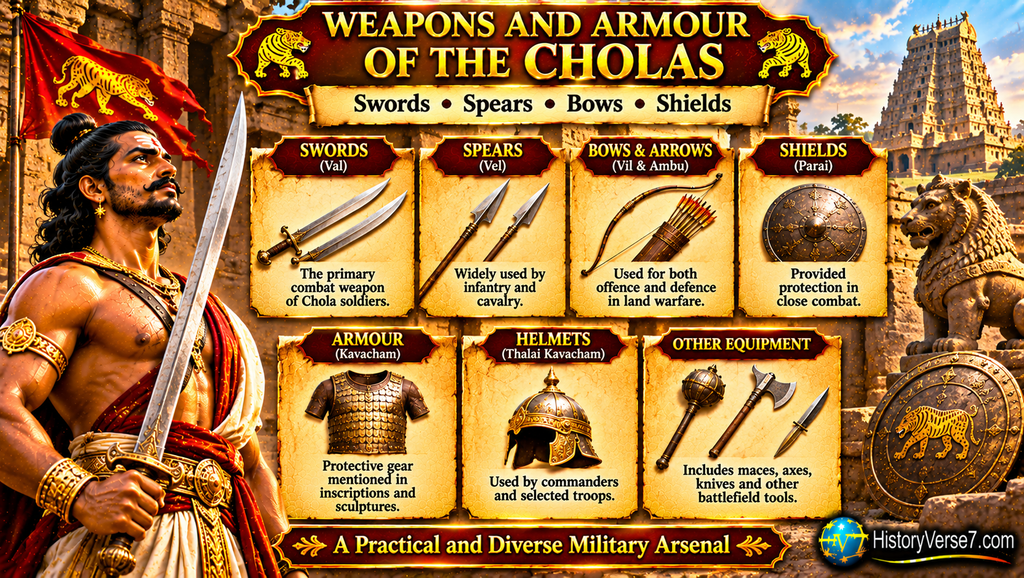
The inscriptions name bodies of troops, not their equipment. Temple records catalogue ornaments in great detail but, in the material examined here, do not itemise weapons. The one direct indication is linguistic: the term for the archers’ unit, villigal, implies the bow. Elephants are indicated by unit names and by Rajadhiraja’s death on one. Beyond that, swords, spears, shields and body armour would be expected in any medieval South Asian army, but this article does not assert specific types, forms or materials for the Cholas without evidence. That evidence would come from sculpture, hero-stones and archaeological finds, which were not examined for this piece. A hero-stone found in 2009 at Chengam is said, in a press report summarised in a secondary account, to mention the Kandalur fighting, but that is a newspaper report and not a source on weapons.
Readers should be wary of any account that lists Chola weapons in detail without citing the sculpture or find on which it rests.
Military Regiments and Their Inscriptions
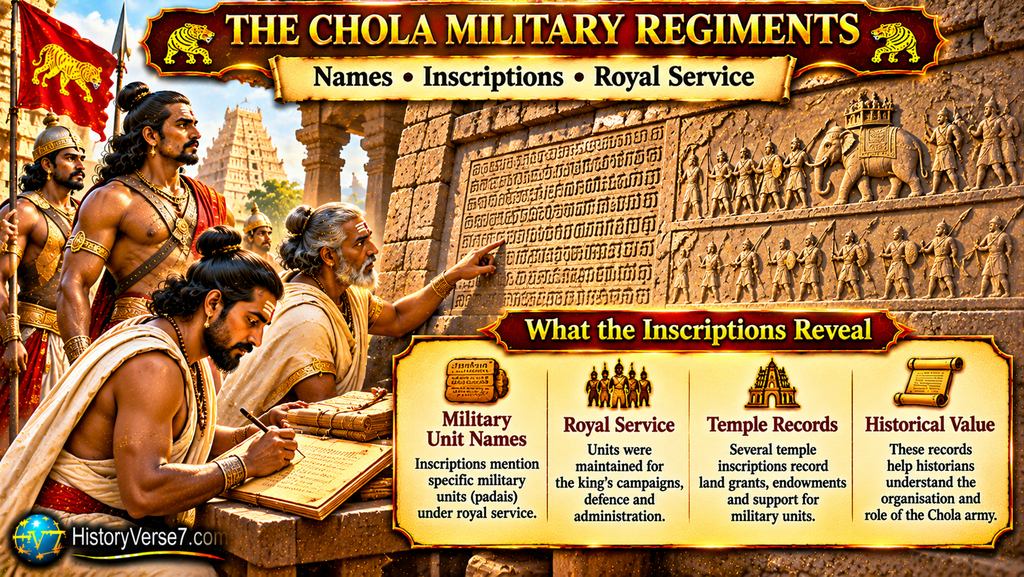
Regimental names survive because soldiers appear in temple records, and the pattern shows how the evidence works. The following names are taken from the Tanjore list in South Indian Inscriptions, Volume II, in the editors’ spellings, where “Sora” corresponds to “Chola”:
- Perundanattu Anaiyatkal, elephant-related troops.
- Pandita-Sora-terinda-villigal, a body of archers.
- Nigarili-Sora-terinda-Udanilai-Kudiraichchevagar, a cavalry body.
- Mummadi-Sora-terinda-Anaippagar, an elephant-related body.
- Vira-Sora-Anukkar, attendants or guards.
- Perundanattu-Valangai-Velaikkarappadaigal and Sirudanattu-Valangai-Velaikkarappadaigal, two groups of the Valangai-Velaikkarar.
- Rajaraja-terinda-Valangai-Velaikkarar and a dozen similar bodies named for royal titles.
- Keralantaka-vasal-tirumeykappar, a guard body.
The reason such names appear is mundane: temple accounts recorded who gave and who received. According to the editors, some of these bodies were entrusted with the management of minor shrines and had to supply what they needed, while others borrowed money from the temple at interest and agreed to repay it in cash. Eighteen musicians came from them, twelve from the Velaikkarar alone, each paid seventy-five kalam of paddy for temple service.
What these records do not show is that every named body had the same size, rank or function, or that the list is complete. The editors themselves note that two bodies may have existed on the “left hand” without being recorded. The record reveals a military establishment tied closely to the temple and the court. It does not give a roster.
Military Administration, Pay and Logistics
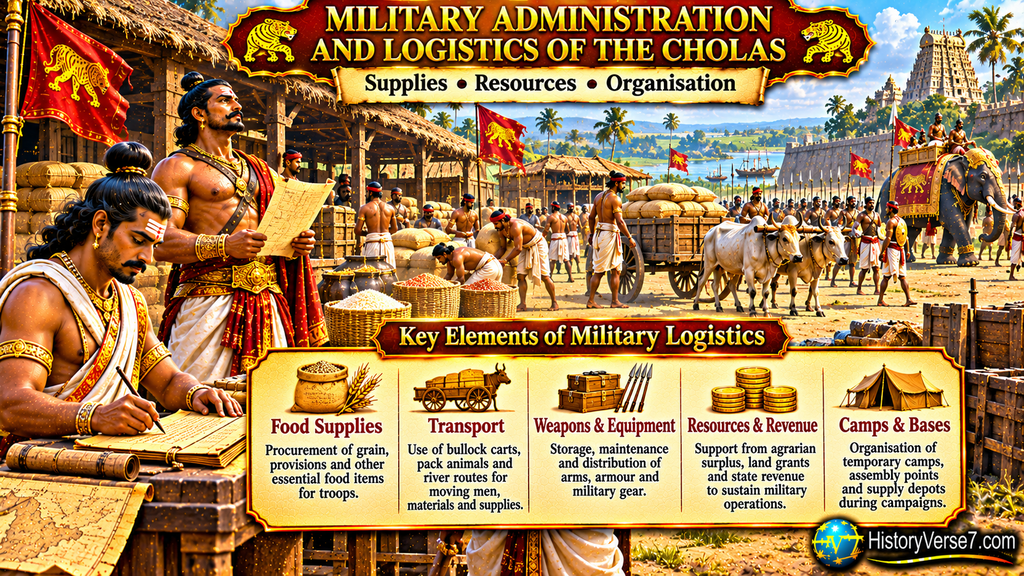
How the army was paid and fed has to be assembled from indirect evidence, and the honest summary is that direct accounts of soldiers’ pay are scarce in the sources examined.
What is documented is the state’s capacity to assess and collect revenue. The editors describe a revenue survey and settlement in Rajaraja’s reign, which they place around his seventeenth year, so exact that land as small as a fraction of a veli, given as 1/52,428,800,000, was measured and assessed. An order dated in his twenty-fourth year declared that the land of landholders who had failed to pay village taxes for three years would pass to the village and could be sold, to the exclusion of the defaulters. Such measures show a government that could extract resources systematically. They do not prove what share went to the army.
Other pieces point to the infrastructure. The capital contained quarters tied to the military: a record of Thanjavur’s streets lists the archers’ street, the elephant-men’s street and a settlement called Sivadasansolai alias Rajaraja-Brahmamaharajan-padaividu, where padai-vidu is usually read as a military camp or barracks. The editors also suggest, as a possibility, that a royal palace recorded at Tiruvalam may be the village of Vallam near Thanjavur, which a district gazetteer describes as a fortress of considerable strength. In Sri Lanka, the Mahavamsa, as paraphrased by the editors, tells of a Sinhalese king unable to maintain his army, with Kerala soldiers in his service demanding their wages, which shows that the payment of soldiers was a real problem in the region even if it is not a Chola account.
Under Kulothunga I, a land survey in his sixteenth year, around 1086, and the garrisons in the Pandya country both tie revenue to military capacity. The link between the two is an inference, not a recorded budget, and no statistics on military expenditure are given here.
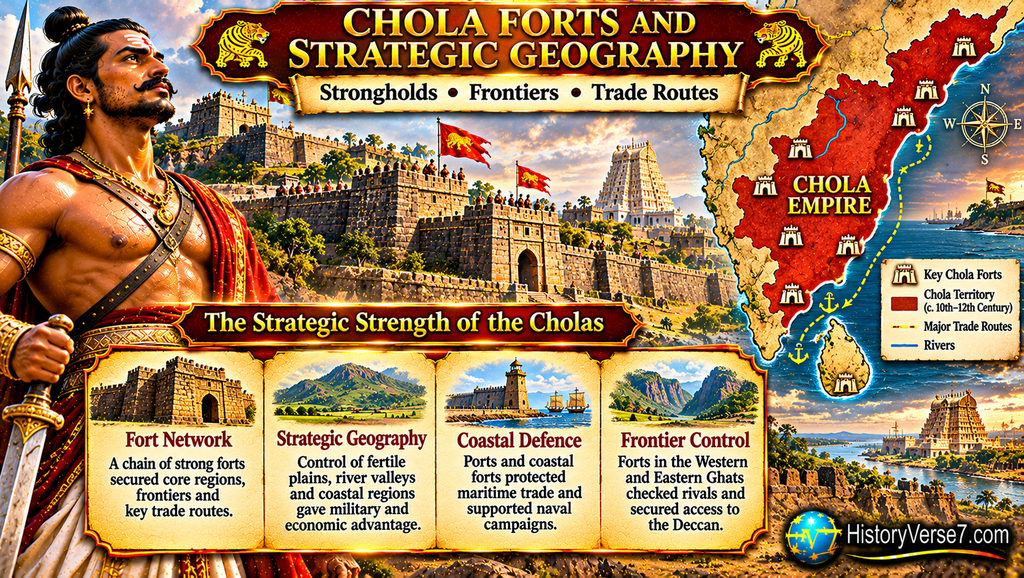
Chola Forts, Defence and Strategic Geography
Geography shaped where the Cholas fought, and the sources support a few firm points.
The northern frontier was the Tungabhadra and Krishna country, where Rajaraja’s conquest of Gangapadi and Nurambapadi on the Mysore plateau brought the Cholas into direct contact with the Western Chalukyas, according to the editors. Control of that borderland, and of Vengi on the east coast, drove the long rivalry described below. In the south and west, the Pandya stronghold of Udagai is described as an important fortress that Rajaraja’s forces stormed, and Kandalur on the Kerala coast was the object of one of his earliest campaigns. Hill forts could mark the limits of a campaign: a general of Rajendra I set up a pillar of victory on the Mahendragiri hill in Kalinga.
Coasts and ports mattered too. Rajaraja’s forces took the port of Virinam, according to the Tiruvalangadu plates cited by the editors, and the campaign against the “twelve thousand islands” in his last year, which the editors could not identify, shows that Chola military reach already extended over water.
Beyond these points, the sources consulted do not allow a detailed reconstruction of roads, supply routes, or river crossings, and none is invented here.
Chola Warfare and Battlefield Strategy
The inscriptions say that battles happened. They rarely say how.
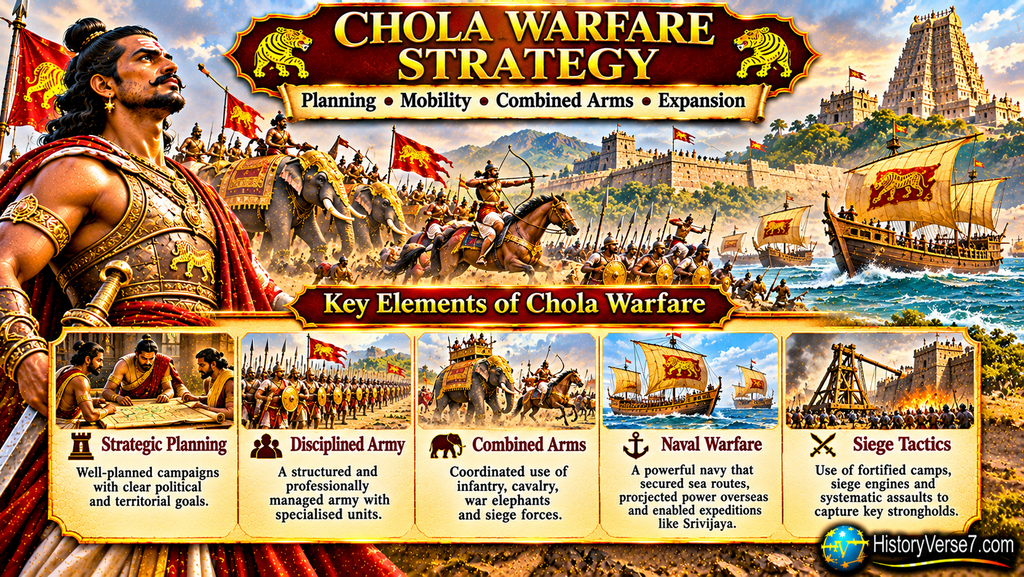
Several patterns can nonetheless be drawn. The Cholas fought on more than one front at once, which implies delegation: Rajaraja appears to have sent his son Rajendra to Kalinga, according to the editors, and Rajendra fought Satyasraya as a prince before becoming king. Kings and princes sometimes commanded in person; Rajadhiraja I died on his elephant at Koppam. Siege and fort assault appear in claims such as the storming of Udagai. Beyond that, descriptions of formations and manoeuvres are not in the sources examined.
The limits of reconstruction are shown by the Kandalur episode. Rajaraja’s inscriptions from his fourth year carry the phrase Kandalur-salai-kalamarutta. Nilakanta Sastri read it as destroying or overcoming the fleet in the roadstead of Kandalur. Other historians read it very differently: as ending a Brahmin feeding house, or, in the reading of M. G. S. Narayanan and Kesavan Veluthat, as destroying a Brahmin ghatika that served as a military training centre. If the second reading is right, the famous “naval” victory was not naval at all. Even the location of Kandalur is not settled: the editors of South Indian Inscriptions thought it perhaps lay near Virinam, and later writers have proposed other sites. A single phrase has therefore been taken to describe a fleet action, a religious institution and a military school.
This article accordingly offers no battle scenes. What can be said is that the Chola army fought as a set of detachments under royal and princely command, that it used elephants, cavalry and infantry, and that its sources celebrate outcomes and do not narrate tactics.
Major Chola Military Campaigns
A chronological overview shows both the range and the limits of Chola arms. Dates are those given in the sources consulted and are approximate unless stated.
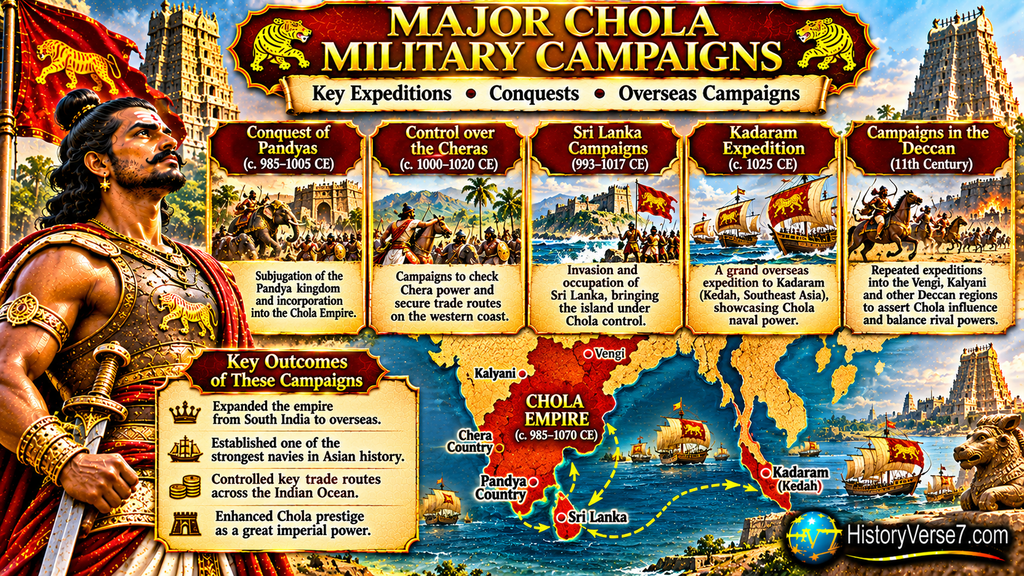
The Pandyas and Cheras. Parantaka I’s wars against the Pandyas are the background to the dynasty’s rise. Under Rajaraja I, the early campaigns combined the Pandya and Chera theatres: the Tiruvalangadu plates describe the seizing of the Pandya king Amarabhujanga and the capture of the port of Virinam, while the Tanjore inscriptions refer to the conquest of the Chera king and the Pandyas in Malai-nadu. The editors suggest the Cheras and Pandyas were allied. Rajaraja took the title Mummudi-Chola, “the Chola of three crowns,” in connection with these successes. Later reigns repeated the pattern, which means these regions needed repeated enforcement, not a single conquest.
The Western Chalukyas. The rivalry began in Rajaraja’s reign with a war against Satyasraya in about his twenty-first or twenty-second year, around 1005 to 1006. The Cholas claimed victory. Satyasraya’s Hottur inscription of 1007 to 1008 claims the Chola force numbered nine hundred thousand, that it ravaged the country, and that he put the Chola to flight. Both sides claimed success, and the number is an enemy’s boast. The rivalry continued under Rajendra I, Rajadhiraja I, Virarajendra and Kulothunga I, with outcomes that varied and no decisive resolution.
Vengi and Kalinga. Rajaraja conquered Vengi-nadu before his fourteenth year, around 998 to 999, and the editors surmise that he then placed Saktivarman on the Vengi throne after an interregnum. The Tiruvalangadu plates and the Mahendragiri inscriptions place Chola armies in Kalinga under Rajaraja and Rajendra I. Under Kulothunga I, the Kalinga wars were celebrated in the poem Kalingattuparani, but no lasting Chola administration there is shown in the sources consulted.
Beyond the peninsula. Rajendra I’s expedition to the Ganges, around 1019 to 1021, passed through Kalinga and Bengal and defeated the Pala king Mahipala I, but, as the Rajendra Chola I article on HistoryVerse7 explains, it produced no lasting territorial administration.
Setbacks. The Chola record includes losses as well. A Chalukya prince is reported to have reached the vicinity of the Chola capital around 1066 under Virarajendra, though the date and scale are uncertain. Chola rule in Sri Lanka ended during Kulothunga I’s reign. The Gangavadi country was lost to the Hoysalas around 1115 to 1116.
Rajaraja Chola I and the Expansion of Military Power
Rajaraja’s reign is the best-documented period of Chola military history, largely because he decided to record it. The editors say that no earlier southern king left such a record, and that his successors followed his example.
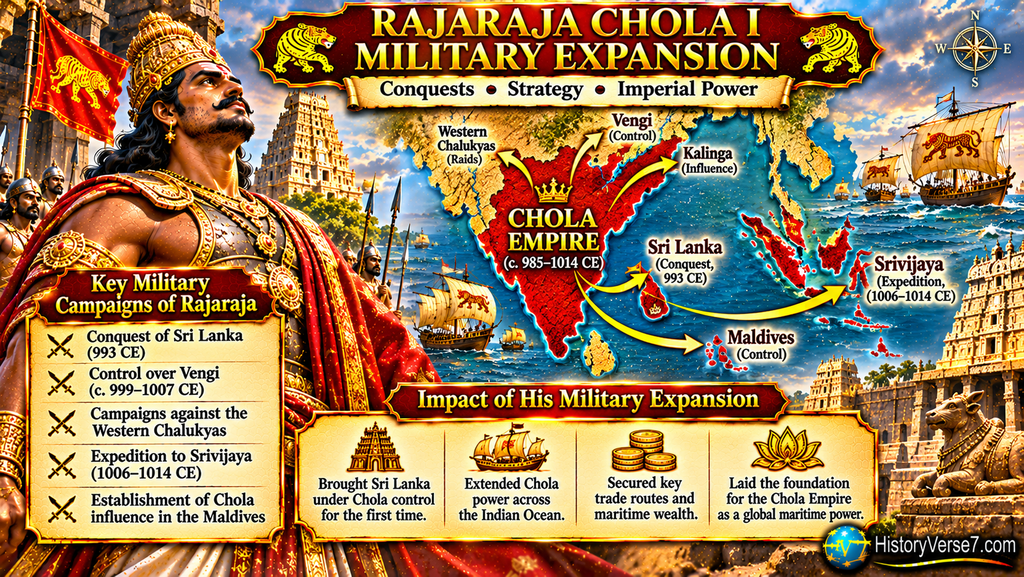
The sequence of his campaigns, as the editors reconstruct it, begins in his eighth year with Kandalur and the Pandya and Chera wars, goes on to Vengai-nadu, Gangapadi, Nurambapadi and Tadigaipadi before his fourteenth year, includes the conquest of Kudamalai-nadu, identified with Coorg, and ends in his twenty-ninth year with the expedition against the twelve thousand islands. The editors note a gap in the record between his eighteenth and twenty-first years, and say the years from the twenty-third to the twenty-ninth were not marked by military exploits, which they associate with the building of the Rajarajesvara temple and with administrative work.
Two cautions apply. The record distinguishes land campaigns from the naval and coastal operations only loosely, and as the Kandalur case shows, the nature of some operations is disputed. And the institutions attributed to him- regimental lists, the survey, the temple endowments- are documented in his records, but it does not follow that he invented them or that every development was his personal initiative.
Rajendra Chola I and the Chola Military at Its Maritime Height
Rajendra I took over the army that, in the editors’ words, was called “the great warlike army” in his reign, and used it over an unprecedented range: against Kalinga, against Satyasraya as a prince, in the Sri Lankan campaigns of about 1017 to 1018 that ended with the capture of the Sinhalese king Mahinda V, on the Ganges expedition, and in the 1025 expedition to Kadaram and Srivijaya.
The relationship between land forces and shipping is the important point. The expeditions to Sri Lanka and Kadaram required the army to cross water, which implies a close working relationship with maritime forces. But the sources consulted give no size or composition for any expeditionary force, and this article gives none. The 1025 expedition, as the earlier article in this cluster explains, was a major military operation that did not produce lasting rule in Southeast Asia. Historians such as Hermann Kulke discuss it in terms of trade, prestige, and plunder, and no single motive has been established.
The Chola Army and the Sri Lankan Campaigns
Sri Lanka shows both the reach and the limits of the Chola army. The editors cite a Tamil inscription at Padaviya dated in Rajaraja’s twenty-seventh year, about 1011 to 1012, and villages in Ceylon that were granted to the Tanjore temple and had to remit their assessment there, as evidence that Rajaraja’s subjugation of the island was substantial. The editors note that the Mahavamsa’s chronology of the period is off by about twenty-three years and that Rajaraja’s invasion of Ceylon must have fallen between 1001 and 1004, so Sinhalese and Chola dates have to be reconciled with care. They also record that Ceylon came to be called Mummadisora-mandalam.
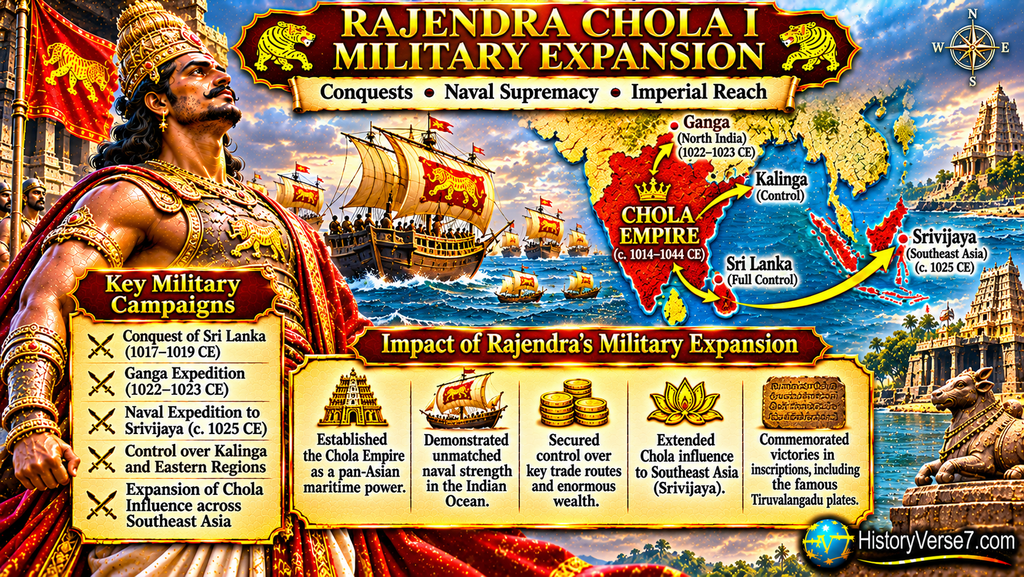
Rajendra I’s forces captured Mahinda V, who died in captivity around 1029, according to the Sinhalese tradition summarised in secondary accounts. Resistance began almost at once, and one account has Sinhalese generals forcing the Chola forces back to Polonnaruwa after six months of fighting. Later, according to a secondary summary, Chola inscriptions claim that the Sinhalese king Vikramabahu lost his life in a war with Rajadhiraja I, while the Mahavamsa says he died of disease; the two accounts do not agree.
The final stage was a long Sinhalese campaign under Vijayabahu I, described in one summary as seventeen years, which ended Chola rule on the island in Kulothunga I’s reign. Dates for the end of Chola rule range from about 1070 to 1075 in the sources consulted. The Velakkara troops, according to the Mahavamsa as the editors summarise it, refused to march against the Chola country and rebelled against Vijayabahu I, and they are also associated with a Polonnaruwa inscription recording a pledge to guard the Tooth Relic, which shows how mixed the loyalties of professional troops could be.
The picture is of military occupation, partial administration, and resistance, not a single conquest or a permanent integration. Spencer’s article on Chola policy in Ceylon, which this piece did not consult, is a standard reference for the debate.
The Chola Army and the Western Chalukya Rivalry
The Chalukya war lasted from about 1005 to the end of the Chola imperial period, and it shows the limits of Chola influence in the Deccan more clearly than any other.
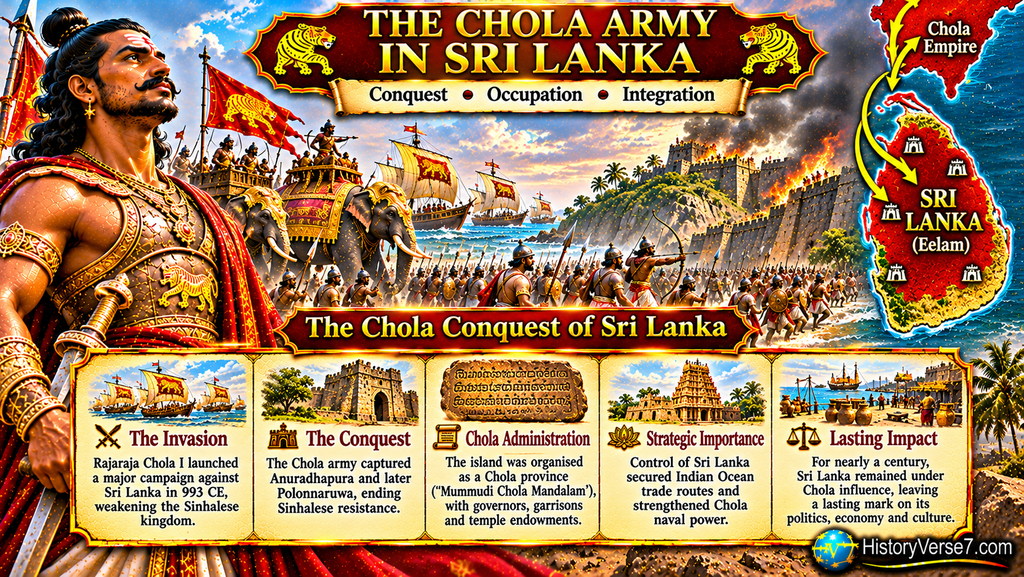
The Cholas won battles: Maski under Rajendra I, a claimed victory at Kudalasangamam under Virarajendra, and the Nangili war under Kulothunga I. They also lost their emperor at Koppam under Rajadhiraja I in 1052 or 1054, and the Chalukyas never collapsed. The Tungabhadra remained the working frontier, and neither side could hold the other’s core. What Chola armies could do was project force across the Krishna and Tungabhadra country, install friendly rulers in Vengi and, for a time, hold the Gangapadi region. What they could not do was destroy the Western Chalukyas or hold the borderland without constant effort.
For readers who want the full sequence, the article on Rajadhiraja Chola I and the one on Virarajendra Chola cover the Koppam and Kudalasangamam episodes in detail.
The Chola Army and the Indian Ocean World
The army’s connection to the Indian Ocean was through campaigns that needed shipping and ports, and through the protection of trade. The Kadaram expedition of 1025 and the Sri Lankan operations are the clearest examples. Later, under Kulothunga I, a Chola embassy to China is recorded in 1077, and ambassadors of the king of Kadaram sought a charter for a Buddhist monastery at Nagapattinam around 1090.
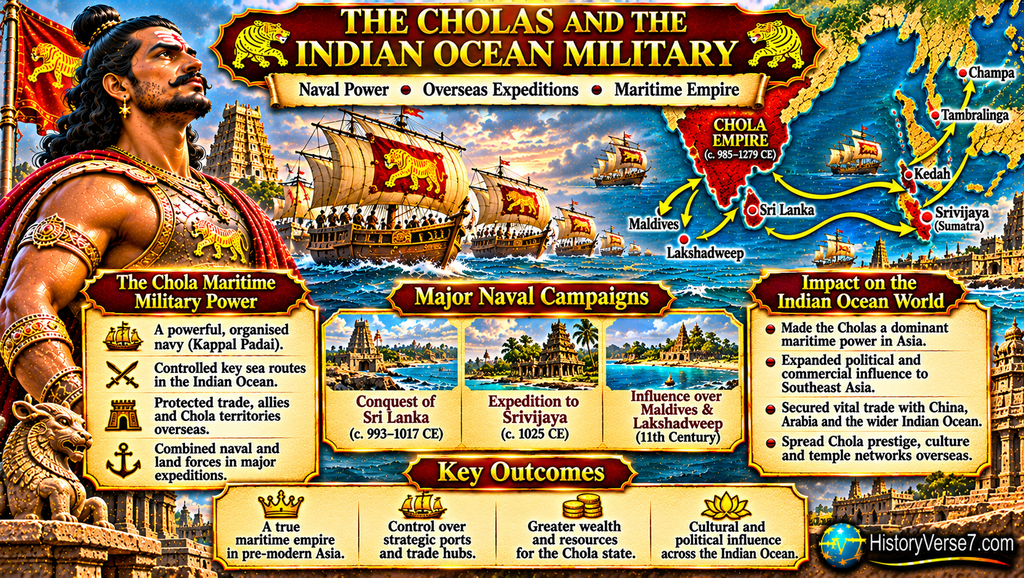
It is safer to say that military power and commerce were linked than to say how. The sources do not show the army guarding trade routes as a regular function, and this article does not claim that it did. Historians, including Kulke, discuss the Chola naval expeditions in terms of trade access, prestige, and plunder, and the debate has not been settled.
The Relationship Between the Chola Army and the Chola Navy
The army and the navy had different tasks. The army fought on land, held forts and garrisons, and moved by road and river. The navy, to the extent the sources describe it, handled coasts, ports and crossings. They worked together on expeditions to Sri Lanka and Kadaram, where troops had to be carried and supplied across water.
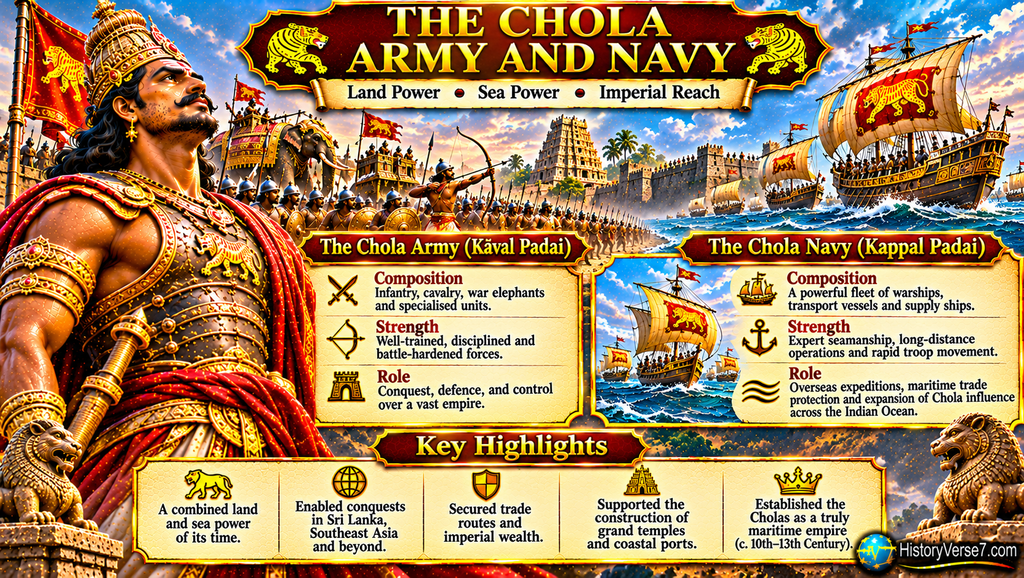
The evidence for this cooperation is mostly indirect, and the sources do not separate the two services cleanly. The Kandalur case again shows why: a phrase that one historian reads as the destruction of a fleet is read by others as an attack on a land institution. A separate HistoryVerse7 article on the Chola navy is planned, and it will treat naval organisation and maritime warfare in detail. This section only marks the boundary.
The Decline of Chola Military Power
The decline was gradual and had several causes, and it cannot be reduced to a single battle or ruler.
Under Kulothunga I, the Cholas lost Sri Lanka and, near the end of his reign, the Gangavadi country to the Hoysalas. In the twelfth century, the Chola kings faced a more crowded political field. The Pandyas revived under Maravarman Sundara Pandya I, who, according to standard summaries, invaded the Chola country soon after taking the throne in 1216, sacked Thanjavur and Uraiyur, and forced the Chola court out of its capital. The Chola kingdom was restored, in those summaries, only after Hoysala pressure on the Pandya king and on condition that the Cholas accept his overlordship.
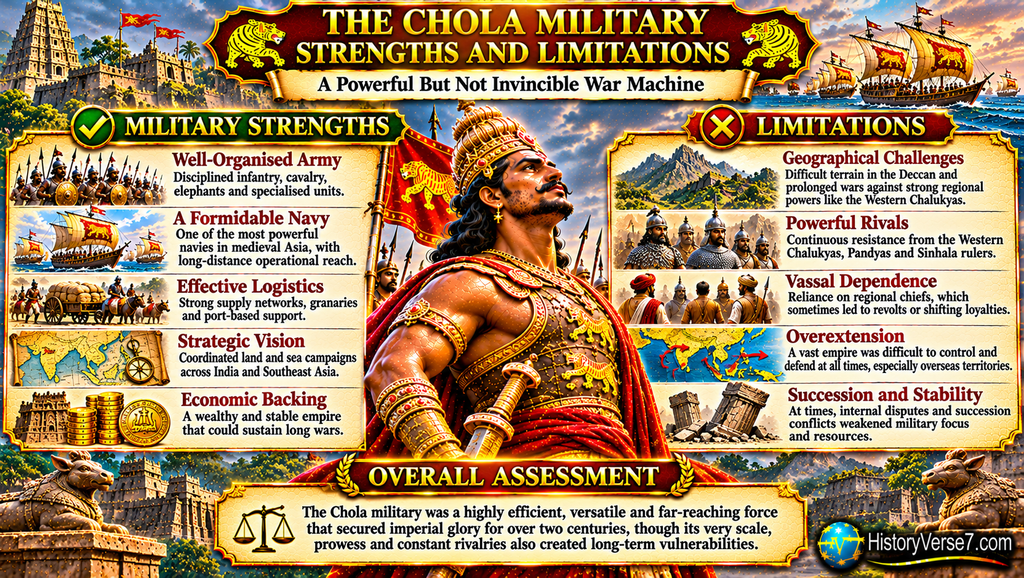
Rajaraja III’s reign was one of continuous trouble. The Kadava chief Kopperunjinga defeated and imprisoned him around 1231 to 1232, and the Hoysalas intervened to free him. His brother Rajendra III took control of the administration, and the inscriptions suggest a civil war between them. Rajendra III fought the Hoysalas and the Pandyas, but Jatavarman Sundara Pandya I, who took the throne in 1251, subdued him and made him acknowledge Pandya overlordship.
The usual date for the end of Chola rule is about 1279, when Rajendra III was defeated. Sources differ on the details. Some attribute the final blow to Jatavarman Sundara Pandya I during his reign of about 1251 to 1272, others to Maravarman Kulasekara Pandya I in 1279, and one popular summary dates the sack of Gangaikonda Cholapuram to 1264. These disagreements, and the quality of some of the summaries, mean the final decades need careful sourcing. What is clear is that the Chola state had become dependent on allies, lost its army’s earlier reach, and could not withstand a revived Pandya power.
15 Lesser-Known Facts About the Chola Army
- Rajaraja I is described by the editors of South Indian Inscriptions as the first southern king known to open his inscriptions with a record of his conquests.
- Parantaka I’s many stone inscriptions mention only his conquest of Madurai, so the stone record of his wars is thin.
- The Tanjore inscriptions name thirty-one military bodies, according to the editors’ list.
- Thirteen of the listed bodies belong to the Valangai-Velaikkarar, and the meaning of Valangai in this context is, in the editors’ words, obscure.
- Most of the unit names begin with a title of the king or his son, which the editors suggest may mark distinction in earlier fighting.
- Eighteen of the Rajarajesvara temple’s musicians came from the military bodies, twelve of them from the Velaikkarar.
- Each of those twelve received seventy-five kalam of paddy for temple service.
- Some military bodies borrowed money from the temple at interest, according to the editors.
- A Brahmin named Krishnan Raman served as a military officer and as chief secretary, and built parts of the temple’s enclosure.
- Thanjavur had a street named for archers and another for elephant-men, and a settlement whose name ends in padai-vidu.
- The Hottur inscription of Satyasraya claims a Chola force of nine hundred thousand, an enemy’s claim that cannot be verified.
- A single phrase about Kandalur has been read as a naval victory, as the end of a feeding house and as the destruction of a military school.
- Rajaraja’s survey measured land to a fraction of a veli given as 1/52,428,800,000.
- Velakkara troops in Sri Lanka are reported to have refused to march against the Cholas and to have revolted against Vijayabahu I.
- Rajadhiraja I is the one Chola emperor in this cluster known to have died commanding on his elephant in battle.
Author
While writing about the Chola army, I kept feeling that an army cannot be understood only through its victories. The Thanjavur inscriptions give us the names of military bodies, but most of them appear in connection with gifts and loans to the temple, not as descriptions of war. In other words, we see the soldiers more as donors and debtors than on the battlefield.
That is why I have put the emphasis on organisation, revenue, forts and the names of the units. Royal inscriptions exaggerate victory, and an enemy’s record does the same. The claim of nine hundred thousand soldiers in the Hottur inscription is an example, and it cannot be taken as evidence.
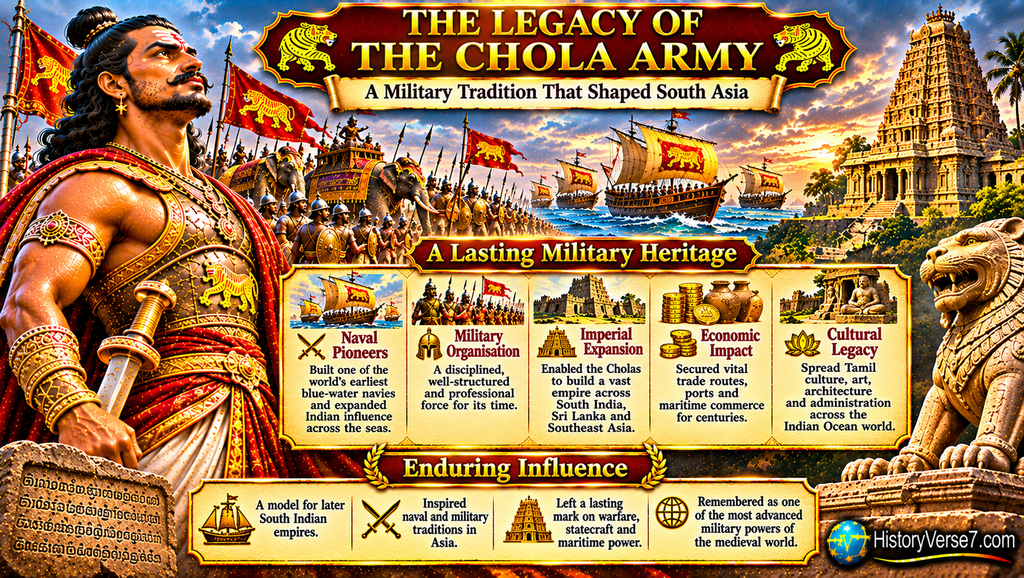
In popular stories, the Chola army often looks invincible, but the records also point to the loss of Sri Lanka, the unfinished struggle with the Chalukyas, and, in the end, the rise of the Pandyas. I have tried to say only what the evidence supports, and where historians disagree, to state that disagreement plainly. To read more research-based articles on Chola history, keep visiting HistoryVerse7.com.
One flag: “most of them appear in connection with gifts and loans” is a generalisation. The Thanjavur records show regiments giving to and borrowing from the temple, but I did not count every mention. If you want to be stricter, you could change it to “many of them.”
Conclusion: The Military Foundations of Chola Imperial Power
How did the Cholas organise and use military power? The evidence shows a state that combined a revenue system of unusual precision, a court and temple network that bound soldiers to the crown, and a set of named military bodies drawn from elephants, cavalry, archers and guards. It used them through kings, princes and generals across several fronts, and under its strongest rulers it reached the Ganges and the Malay Peninsula.
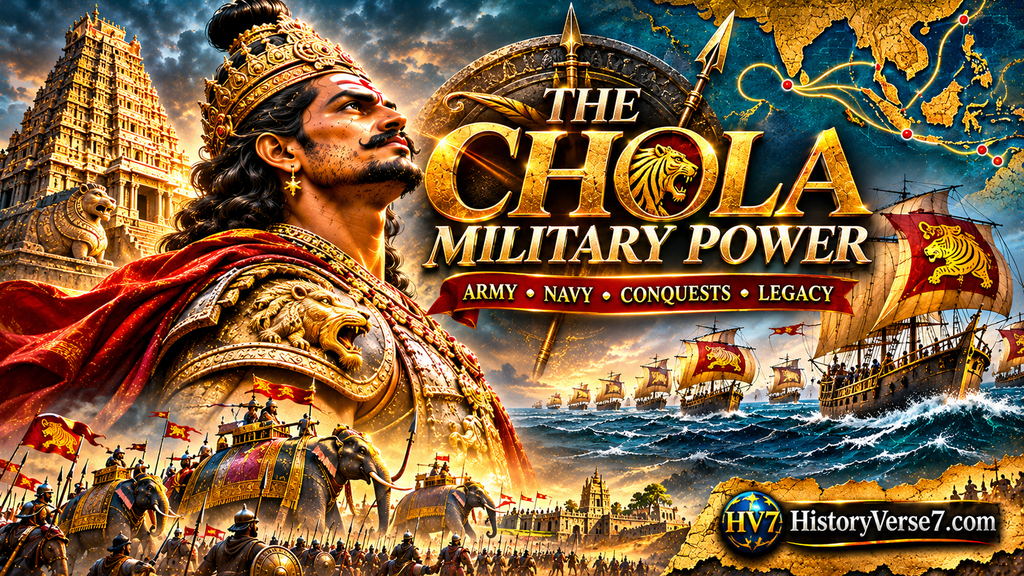
The same evidence marks the limits. The sources celebrate outcomes and conceal logistics. Distant conquests did not become provinces. The Chalukya war was never won. And in the end the system failed in the thirteenth century when allies, revenue and leadership did not hold against a revived Pandya state.
What the Chola army shows, more than any single victory, is how a medieval Indian state turned administration into military power, and how hard that power was to keep. To follow the story further, the HistoryVerse7 articles on Rajaraja Chola I, Rajendra Chola I, Rajadhiraja Chola I, Virarajendra Chola, and Kulothunga Chola I cover the rulers behind these armies.
Written & Researched by Abhishek Chavan — HistoryVerse7| © 2026 HistoryVerse7 | Cluster Article: Chola army
FAQ — Chola army
What was the Chola Army?
The Chola Army was the land force of the Chola state, which ruled much of South India from about the ninth to the thirteenth century. It is known from inscriptions naming military bodies such as archers, cavalry, elephant troops and guards, and from records of campaigns. Its structure changed over time, and the sources give few details about size or tactics.
How did the Cholas recruit and maintain soldiers?
The sources are thin. The editors suggest Rajaraja I spent his first years recruiting, and a precise land survey supported revenue. Soldiers were linked to temples through gifts and loans. No evidence in the sources consulted supports compulsory service, and direct records of soldiers’ pay are scarce.
What were the major battles fought by the Cholas?
Documented engagements include the Kandalur episode under Rajaraja I, Maski under Rajendra I, Koppam in 1052 or 1054, Kudalasangamam under Virarajendra, and the Nangili war under Kulothunga I. Many are known mainly from royal claims, with dates and outcomes disputed, so each should be treated as a claim to be checked.
How did the Cholas maintain control over Sri Lanka?
The Cholas subdued much of the island under Rajaraja I and Rajendra I and administered parts of it, but resistance never stopped. Chola rule ended during Kulothunga I’s reign after a rising led by Vijayabahu I, with dates between about 1070 and 1075. It was occupation with partial administration, not permanent integration.
Why did Chola military power decline?
Several factors combined: the loss of Sri Lanka and the Gangavadi country, a more crowded field of regional powers, the Pandya revival in the thirteenth century, conflict with the Hoysalas and Kadavas, and growing dependence on allies. The conventional end date is about 1279. No single battle or ruler explains it, and sources differ on the final blows.
Explore the History of Chola Empire
The Chola military was part of a wider imperial system shaped by kingship, regional politics, administration, trade and maritime activity. Continue exploring the rulers and events that shaped this remarkable period of South Indian history.
Chola Empire — English Articles
Discover more: All English Chola articles →
चोल इतिहास — हिंदी लेख
Academic and Historical Research
The history of an empire is not defined by victories alone. It is also shaped by the institutions, people, resources and political decisions that made those victories possible.
Keep Exploring. Keep Questioning. Keep Discovering.
HISTORYVERSE7.COM