Rajadhiraja Chola I: 15 Powerful Facts About the Warrior King
HISTORYVERSE7 • CHOLA EMPIRE • GREAT KINGS Rajadhiraja Chola I: The Warrior King Who Died on the Battlefield Rajadhiraja Chola I was more than an emperor remembered for dying in battle. Prepared for power during the reign of his father, Rajendra Chola I, he served as crown prince and co-ruler before taking the throne. His…
Rajadhiraja Chola I: The Warrior King Who Died on the Battlefield
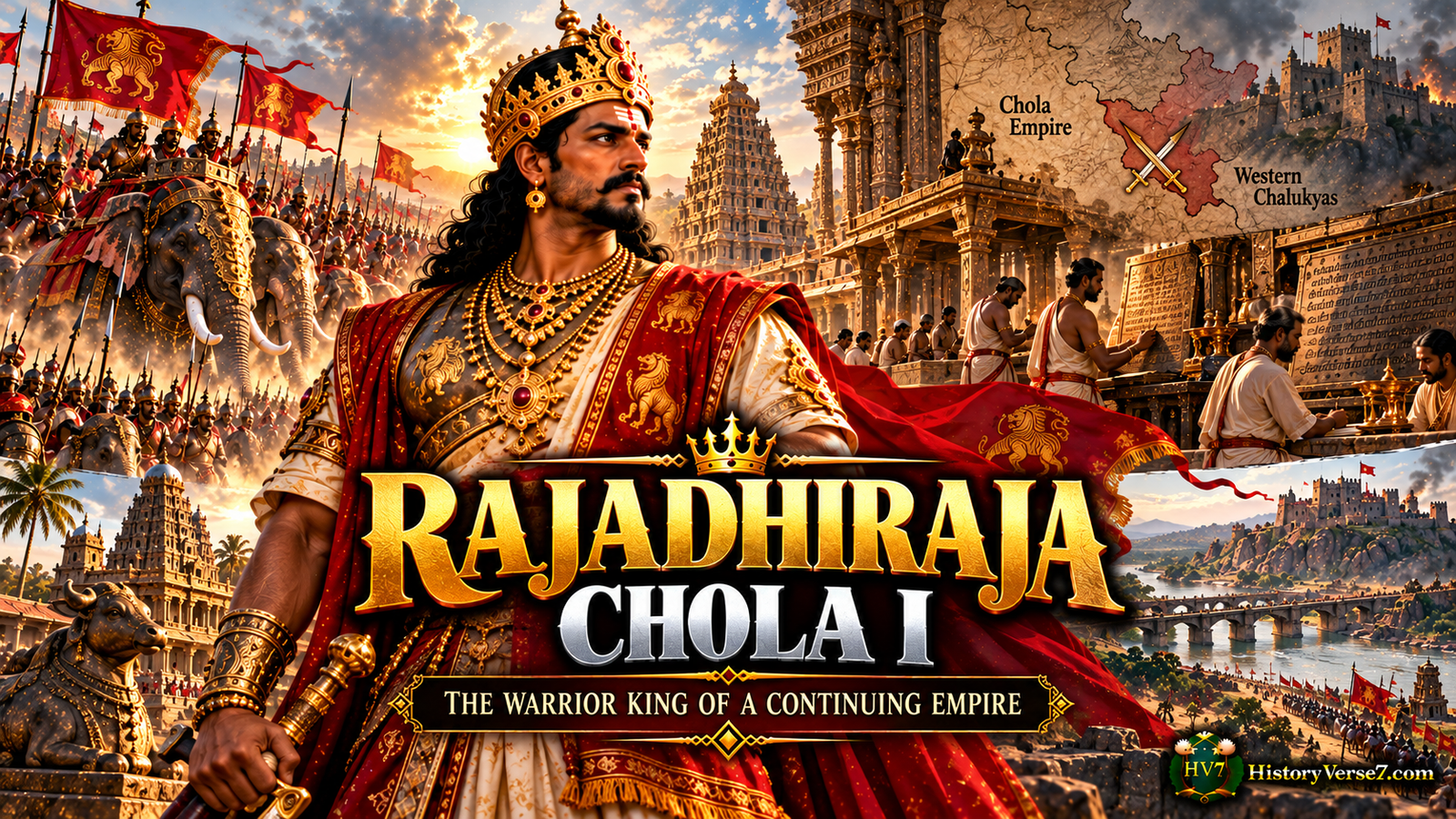
Rajadhiraja Chola I was more than an emperor remembered for dying in battle. Prepared for power during the reign of his father, Rajendra Chola I, he served as crown prince and co-ruler before taking the throne. His reign was shaped by campaigns in the south and a prolonged struggle with the Western Chalukyas.
This HistoryVerse7 feature examines his political preparation, military leadership, imperial administration and the Battle of Koppam, where his death became a defining moment in Chola history. Inscriptions and historical scholarship are essential to understanding both his achievements and the limits of what can be established about his reign.
HistoryVerse7 Research Principle: Royal inscriptions preserve important historical evidence, but their claims must be read critically. Contemporary records, later traditions and modern historical interpretations should be distinguished wherever the evidence allows.
A King Who Died Leading His Own Army
HistoryVerse7.com |Cluster Article: Rajadhiraja Chola I| International English Edition
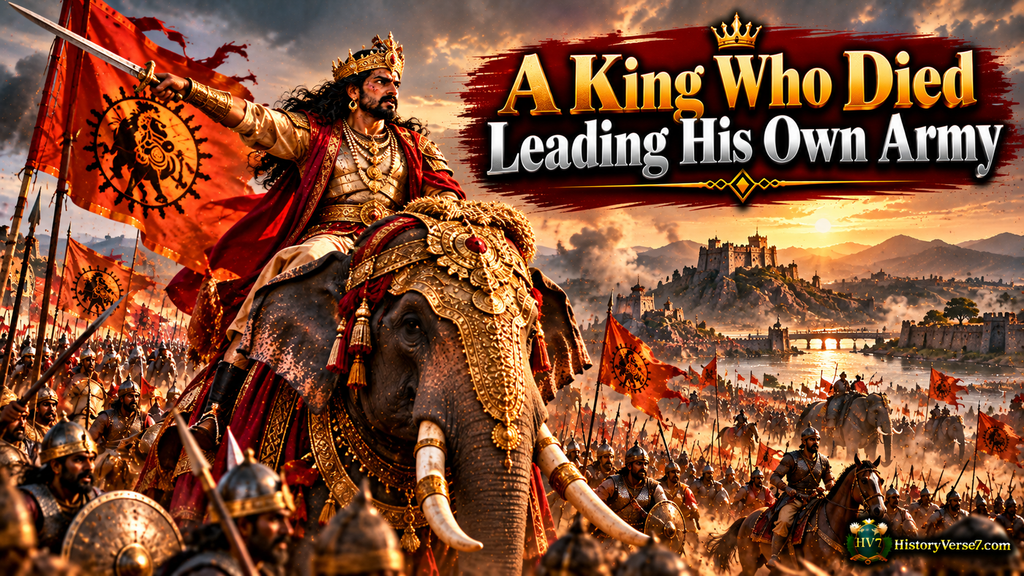
Most Chola emperors ruled from Thanjavur or Gangaikonda Cholapuram, directing campaigns through trusted commanders while remaining, for the most part, safely removed from the actual fighting. Rajadhiraja Chola I did not rule that way. In the early 1050s, somewhere on the banks of the Tungabhadra near a place the inscriptions call Koppam, a Chalukya arrow found him while he was still seated on his war elephant, directing a battle his own army was, by most accounts, already winning. He died there, on campaign, commanding in person, and the Cholas remembered him afterward by a title that says more about him than any formal epithet could: Yanai-mel-thunjina Devar, “the king who died seated upon the elephant.”
That single fact tends to dominate how Rajadhiraja is remembered, when he is remembered at all. It shouldn’t. The more interesting question isn’t how he died, but why a Chola emperor, inheriting one of the wealthiest and most sophisticated states in the medieval world, chose to spend so much of his reign doing something most of his predecessors delegated. The answer to that question starts well before he became emperor at all during the long reign of his father, Rajendra Chola I.
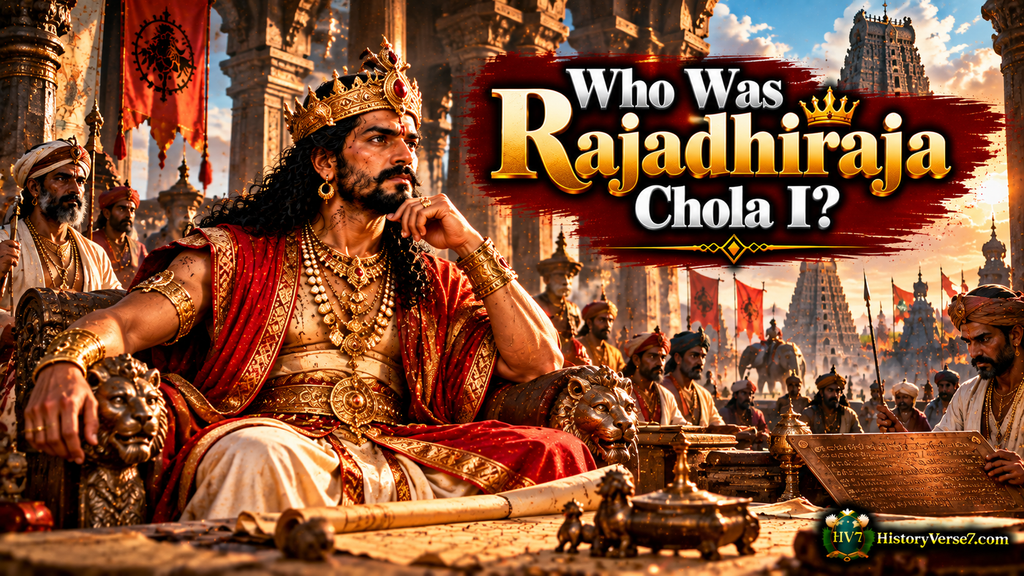
Who Was Rajadhiraja Chola I?
Rajadhiraja was the eldest son of Rajendra Chola I, born, according to tradition, under the name Ilaval Sundaran around 994 CE at Thanjavur, the old Chola capital his great-grandfather’s generation had built into an imperial seat. His mother’s identity is not established with the same confidence as his father’s, and this article does not claim more certainty here than the inscriptional record actually allows. What is firmly documented is his position: eldest son of the reigning emperor, and, from a comparatively early point in his father’s reign, the designated heir to the Chola throne.
Rajendra Chola I’s own reign, covered in detail elsewhere on HistoryVerse7, was defined by extraordinary military and symbolic ambition the conquest of northern Sri Lanka, the famous expedition to the Ganges that earned Rajendra his own title of Gangaikonda Chola, and the 1025 naval campaign against Srivijaya. Rajadhiraja grew up inside this expanding, increasingly confident imperial project, not as a passive observer of it but, as the next section explains, as an active participant from a young age.
The Chola Empire Before Rajadhiraja
By the time Rajadhiraja began taking on real responsibility, the empire his father had built stretched across the Tamil heartland, into substantial portions of Sri Lanka, and through the Pandya and Chera countries of the far south, all drawn, in varying degrees of direct administration and tributary relationship, into the Chola political order. Chola influence extended into the eastern Deccan through the allied Eastern Chalukya kingdom of Vengi, secured by Rajendra’s own diplomatic marriage strategy, and Chola naval power had demonstrated, through the Srivijaya campaign, a reach extending well beyond South Asia’s shores.
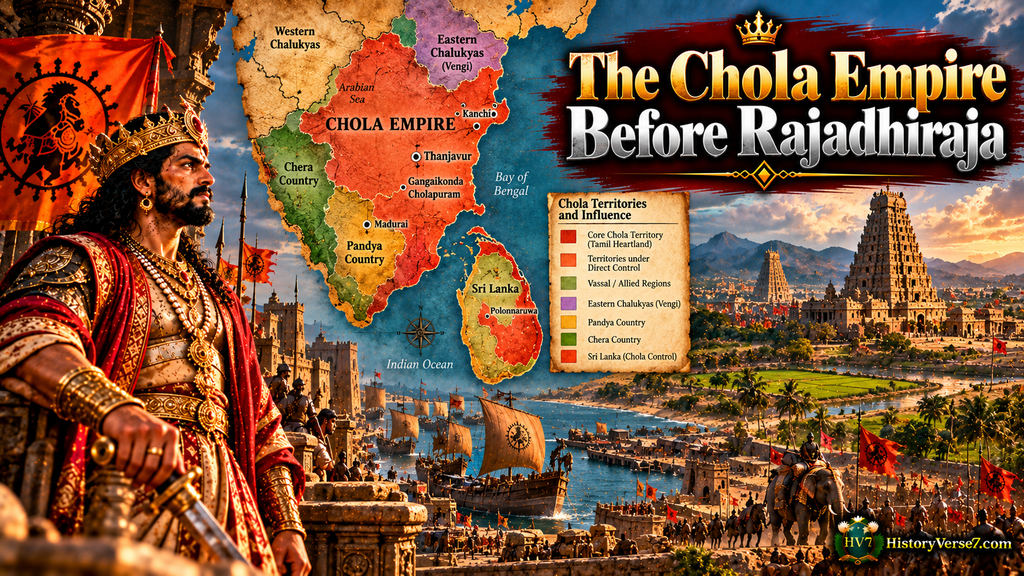
What this empire did not have, by the final years of Rajendra’s reign, was a resolved relationship with the Western Chalukyas, the rival Deccan power whose territory bordered Chola influence along the Tungabhadra and Krishna river region, and whose own ambitions in Vengi repeatedly collided with Chola interests. This unresolved rivalry, discussed at length below, is the single most important inheritance Rajadhiraja received not a settled empire at peace with its neighbors, but a wealthy, expanding state with one serious, unfinished conflict still very much alive on its northern frontier.
Rajadhiraja as Crown Prince
The Chola dynasty, across the reigns of Rajaraja I, Rajendra I, and now into Rajadhiraja’s own generation, had developed a consistent and evidently deliberate method of preparing heirs: rather than keeping a crown prince at court until the throne became vacant, the reigning emperor sent his designated heir into real campaigns, gave him real administrative responsibility, and, at a certain point, formally associated him with the throne itself through a ceremony of co-regency.
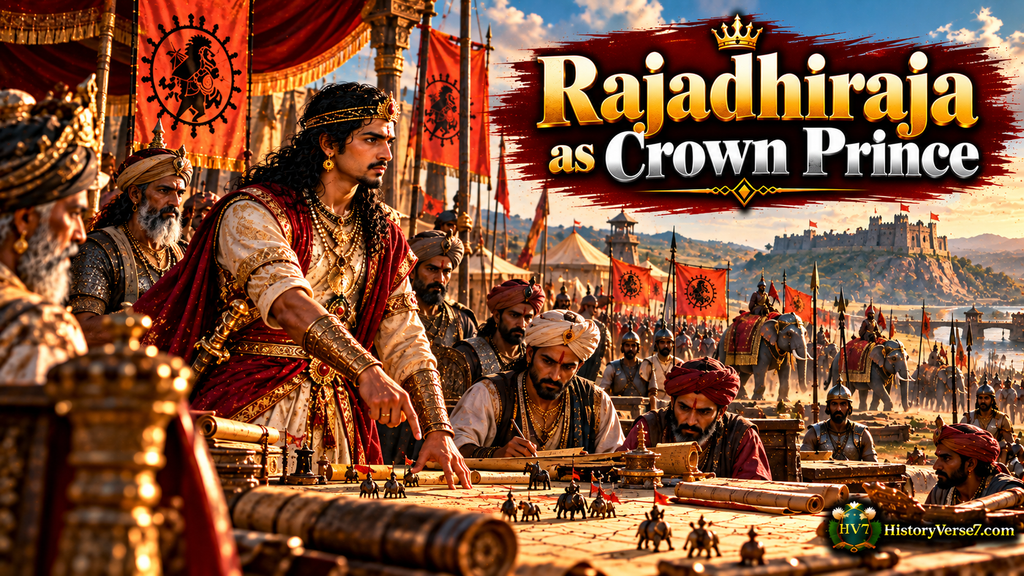
Rajadhiraja followed this same path. Inscriptions from Rajendra’s later reign describe him commanding military operations on his father’s behalf, and he was, at various points, entrusted with direct responsibility for specific regions and campaigns rather than being kept close to the capital in a purely ceremonial role. This mattered enormously for what came after. When Rajadhiraja eventually became sole emperor, he was not an untested prince suddenly thrust into command; he had already spent years, likely decades, actively running campaigns and administering territory under his father’s ultimate authority.
The Chola Co-Regent System
Rajadhiraja’s formal association with the throne during his father’s lifetime is documented in inscriptions, which indicate a period of shared authority beginning around 1018, while Rajendra I continued to reign as the senior emperor until his own death in 1044. This arrangement mirrors the pattern Rajendra himself had experienced under Rajaraja I a generation earlier, discussed in the Rajendra Chola I article on HistoryVerse7, and it appears to have been a deliberate dynastic strategy rather than a one-time arrangement.
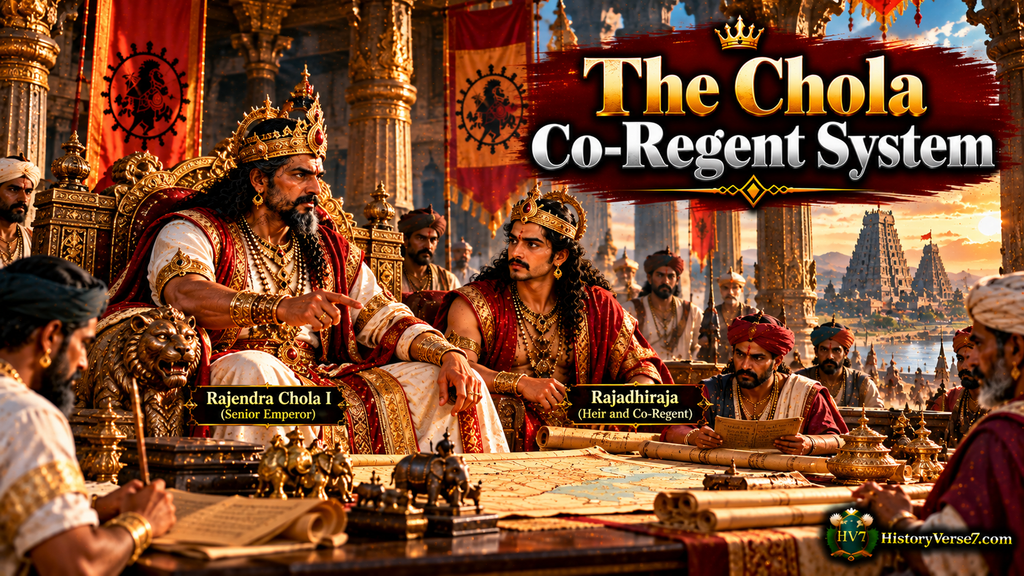
It would be a mistake, however, to read this co-regency through a modern lens of equal joint rule. Rajendra I remained the senior, reigning emperor throughout this period, and Rajadhiraja’s authority, however real in practical military and administrative terms, operated within and under his father’s continuing sovereignty. What inscriptions can tell us is that Rajadhiraja held genuine command responsibility and was formally recognized as heir well before 1044; what they cannot tell us, with the same confidence, is the precise day-to-day balance of decision-making power between father and son during this roughly twenty-six-year period. Historians generally treat the co-regency as evidence of careful, intentional succession planning rather than as proof of a fully defined, dual-monarch system of government.
Rajadhiraja’s Early Military Campaigns
Well before his father’s death, Rajadhiraja was already a battle-tested commander, and the documented record of this earlier period deserves attention in its own right rather than being treated as a brief prelude to his reign as emperor.
He is credited with continuing Chola military pressure against the Western Chalukyas during his father’s reign, part of the long, multi-generational contest over the Deccan borderlands that Rajendra I himself had fought at the Battle of Maski. He also held direct responsibility over Chola interests in Sri Lanka during this period; later inscriptions describe his younger brother Virarajendra serving as Chola viceroy of the island, appointed by Rajadhiraja himself, indicating that by this point Rajadhiraja held enough independent authority to make senior appointments of his own within the wider Chola administrative structure, not merely to lead individual campaigns assigned to him.
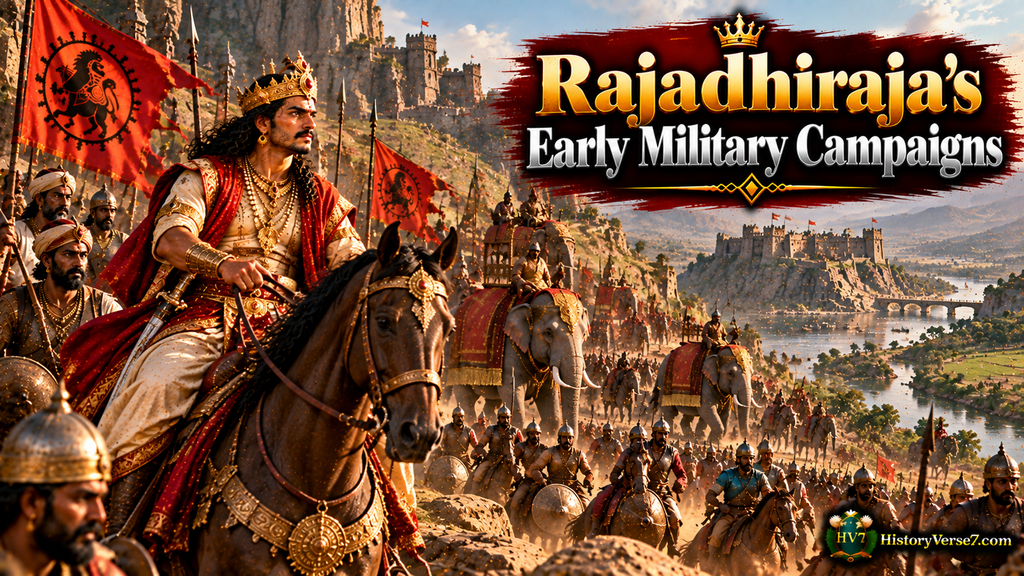
The precise chronology and sequence of his campaigns during this earlier period is not fully settled in the sources, and this article is careful not to overstate the certainty available here: inscriptions tend to record outcomes and claims of victory in the conventional celebratory language typical of Chola royal epigraphy, rather than providing a complete, independently verifiable campaign-by-campaign narrative. What can be said with confidence is that by the time he became sole emperor in 1044, Rajadhiraja had extensive, documented military experience across more than one frontier of the empire.
Rajadhiraja and Sri Lanka
Chola involvement in Sri Lanka did not end with the conquests completed under Rajaraja I and Rajendra I; it continued, in a more contested and evolving form, into Rajadhiraja’s own period of authority. His appointment of his brother Virarajendra as viceroy of the island indicates that the Cholas maintained a formal administrative structure there well into this period, treating Sri Lanka as territory requiring active, ongoing governance rather than a settled possession that could simply be left alone.
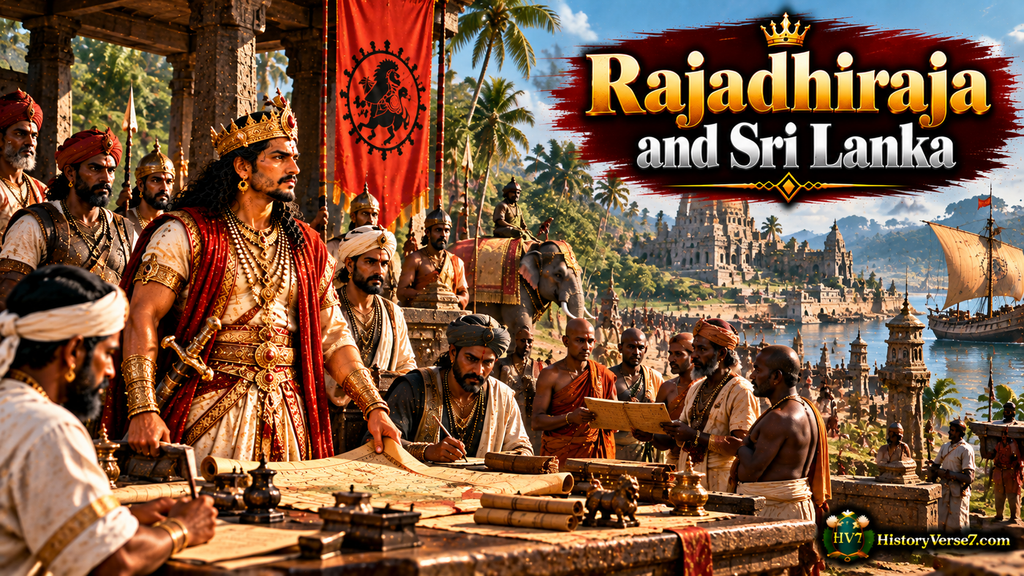
This article is careful not to suggest that Chola authority over Sri Lanka during this period was uniform or uncontested throughout the island. The evidence supports strong Chola control in the north and center, continuing the pattern already established under earlier reigns, alongside the kind of local resistance and periodic instability that had characterized Chola rule on the island since its initial conquest. Rajadhiraja’s reign should be understood as a period of continued Chola presence and active administration in Sri Lanka, not as a moment of dramatic new conquest or, conversely, of Chola withdrawal.
The Pandya and Chera Countries
To the south, Chola overlordship of the Pandya and Chera territories, substantially established under Rajaraja I and Rajendra I, continued to require active maintenance rather than simply persisting on its own. Inscriptions from this period describe continued Chola administrative presence and, at points, the suppression of local resistance in these southern territories, consistent with the broader pattern of Chola rule here: formal overlordship combined with real, periodic local assertion of independence that required military and political attention to contain.
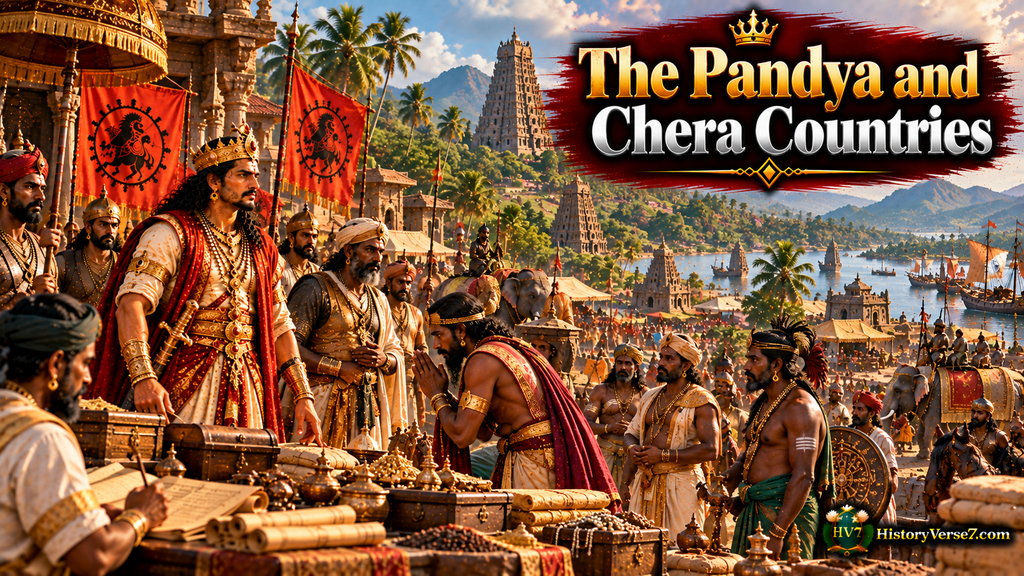
This article resists describing Chola control of the Pandya and Chera countries as a single, completed conquest that simply held steady throughout Rajadhiraja’s reign. The more accurate picture, consistent with how Chola control of these southern territories functioned under his father and grandfather as well, is one of a layered, actively managed overlordship: real authority, real integration into Chola administrative and religious patronage networks, and real, recurring need for assertive action to maintain that authority against local pushback.
The Western Chalukyas: The Great Rivalry
No relationship shaped Rajadhiraja’s reign more than the long contest with the Western Chalukyas, and understanding why requires looking past any single battle to the underlying structure of Deccan politics in this period.
The Western Chalukya kingdom, centered further north and west on the Deccan plateau, and the Chola Empire, based in the Tamil south, met along a contested borderland roughly defined by the Krishna and Tungabhadra rivers. Neither side could fully absorb the other’s core territory, but both had powerful reasons to contest the space between them, and both had an enormous stake in Vengi, the Eastern Chalukya kingdom that sat strategically between them and that each power wanted as an ally rather than a rival. Rajadhiraja’s own father had fought Western Chalukya forces at Maski decades earlier; by the time Rajadhiraja became the primary Chola commander against the Chalukyas, and then emperor in his own right, this rivalry had already become one of the defining, structural features of Deccan politics, not a new conflict he initiated.
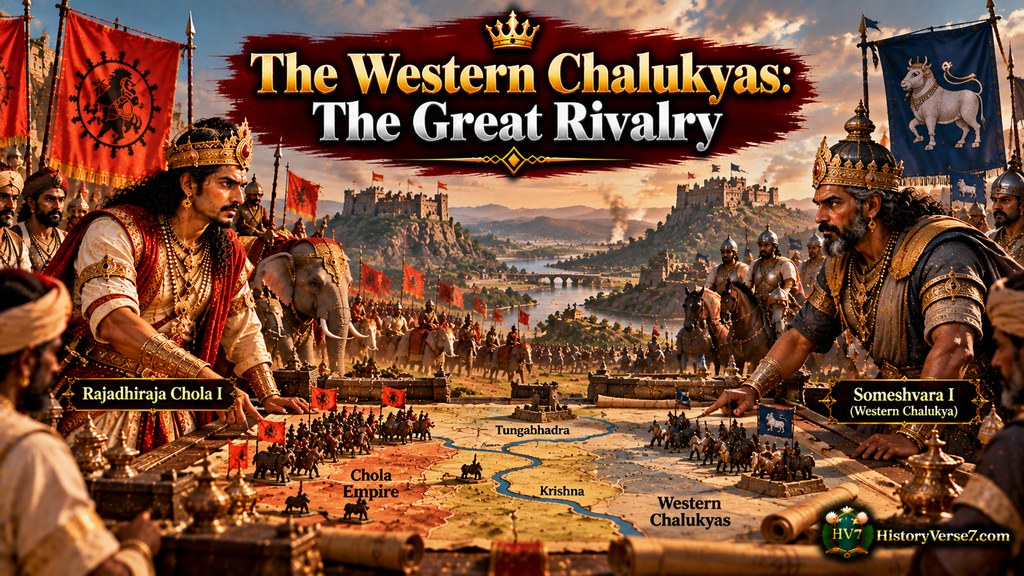
The Western Chalukya ruler most directly associated with Rajadhiraja’s reign was Someshvara I, also known by the titles Ahavamalla and Trilokamalla, who came to the Chalukya throne around 1042, succeeding his father Jayasimha II. According to the historian Suryanath Kamath, Someshvara I moved to interfere in Vengi affairs soon after his own coronation, a direct challenge to the Chola-aligned settlement in that kingdom, and was defeated by Rajadhiraja at Amaravathi. Other scholarly accounts, including that of K. A. Nilakanta Sastri, describe a major Chola victory at Dannada, identified with the ancient city of Dhanyakataka on the Krishna River, forcing a Western Chalukya retreat and resulting in the destruction of the Chalukya fort at Kollipakki. These accounts do not perfectly agree on sequence and detail, a reminder that reconstructing the exact order of battles in this long rivalry from royal inscriptions on both sides is genuinely difficult, and this article presents the general shape of sustained, recurring conflict rather than claiming false precision about every individual engagement.
Why Did the Cholas and Western Chalukyas Keep Fighting?
The persistence of this rivalry across multiple Chola and Chalukya reigns reflects more than simple hostility between two royal houses. Vengi sat at the heart of it: whichever power could install and maintain a friendly ruler there gained a strategic foothold in the eastern Deccan and denied that same advantage to its rival, and both the Cholas and the Chalukyas treated the Vengi succession as a matter requiring direct, repeated military intervention across successive generations.
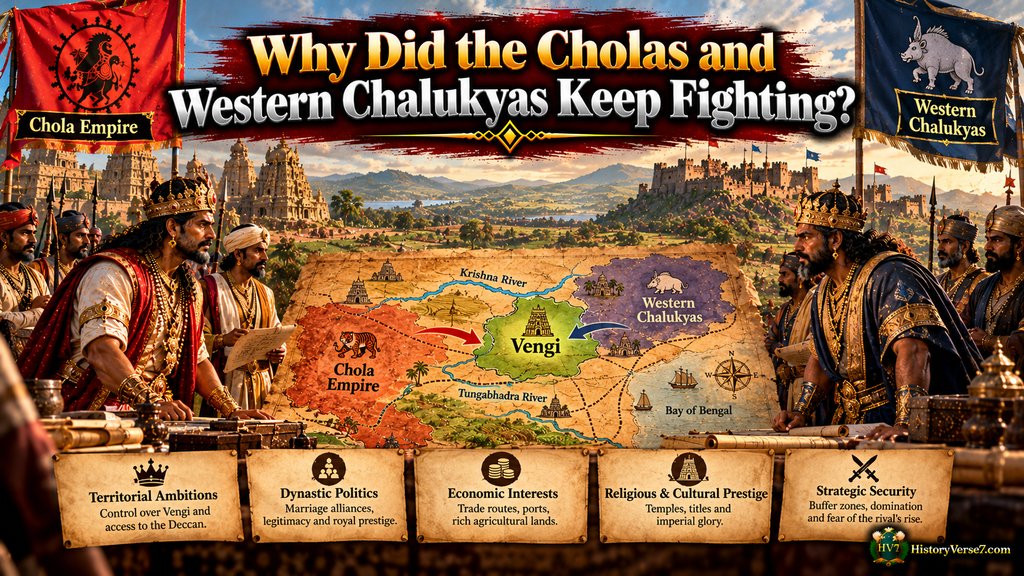
Beyond Vengi specifically, control of the Krishna-Tungabhadra borderland carried real strategic and economic weight, governing access to trade routes and agriculturally valuable territory that neither side wanted to concede by default. Prestige mattered as well, in a political culture where royal inscriptions recorded military success in the language of universal, almost cosmic kingship; a Chola emperor who failed to answer Chalukya aggression, or a Chalukya king who failed to answer Chola incursion, risked a real loss of standing among his own nobility and rival courts. Modern historians generally treat this combination of territorial, economic, dynastic, and prestige-driven motivations as mutually reinforcing rather than attempting to isolate one single, decisive cause for a rivalry that persisted, with interruptions, across nearly a century of South Indian history.
Rajadhiraja as a Military Commander
What distinguished Rajadhiraja from several of his predecessors was not any single tactical innovation but the sheer consistency of his personal battlefield involvement. From his time as crown prince through his final campaign, the inscriptional record repeatedly places him in direct command of active operations rather than directing war from the capital through subordinate generals.
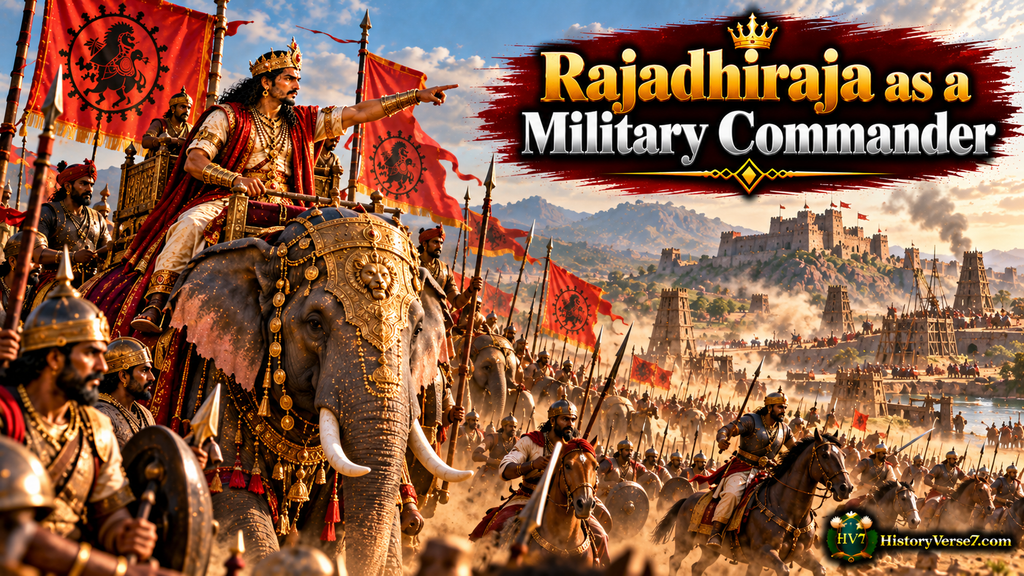
His campaigns against the Chalukyas involved significant use of cavalry and, where sources allow it to be inferred, elephant corps consistent with established Chola military practice, operating across considerable distances into contested Deccan territory. His first major recorded success against Someshvara I, at a battle identified as Pundur, reportedly forced the Chalukya ruler’s sons, Vikramaditya VI and Vijayaditya, to flee the field, and resulted in Someshvara I himself being driven back to territories further north in the Nolambavadi region for a period. This article treats such accounts, drawn substantially from Chola inscriptional sources, with appropriate caution regarding precise detail, while accepting the broader, repeatedly corroborated pattern of sustained Chola military pressure against the Chalukyas across this period as well established.
What can be said with particular confidence, because it is corroborated by the circumstances of his own death, is that Rajadhiraja led from the front in the most literal sense available to a medieval monarch: present on the battlefield, visible to his own troops and the enemy alike, directing operations from his position on a war elephant rather than from a command tent at a safe remove.
Rajadhiraja Becomes Emperor
When Rajendra Chola I died in 1044, Rajadhiraja’s transition to sole emperor appears to have been straightforward, consistent with the pattern of careful succession planning that had characterized Chola dynastic practice across three successive generations by this point. He was, by any reasonable measure, an unusually experienced ruler at the moment of his formal accession: roughly fifty years old, with decades of documented military command and, through appointments like his brother’s Sri Lankan viceroyalty, demonstrated administrative authority already behind him.
This matters for understanding the reign that followed. Rajadhiraja did not need to spend his early years as emperor establishing his authority or learning the business of rule; he stepped into the role already fully formed as a commander and administrator, free to continue the campaigns and priorities that had already defined his adult life for decades.
The Emperor at War
Rajadhiraja’s reign as sole emperor, from 1044 until his death roughly eight years later, was dominated by the continuation of the same Western Chalukya conflict he had already spent years fighting as crown prince, alongside the ongoing work of maintaining Chola authority in Sri Lanka and the southern Pandya and Chera territories discussed above.
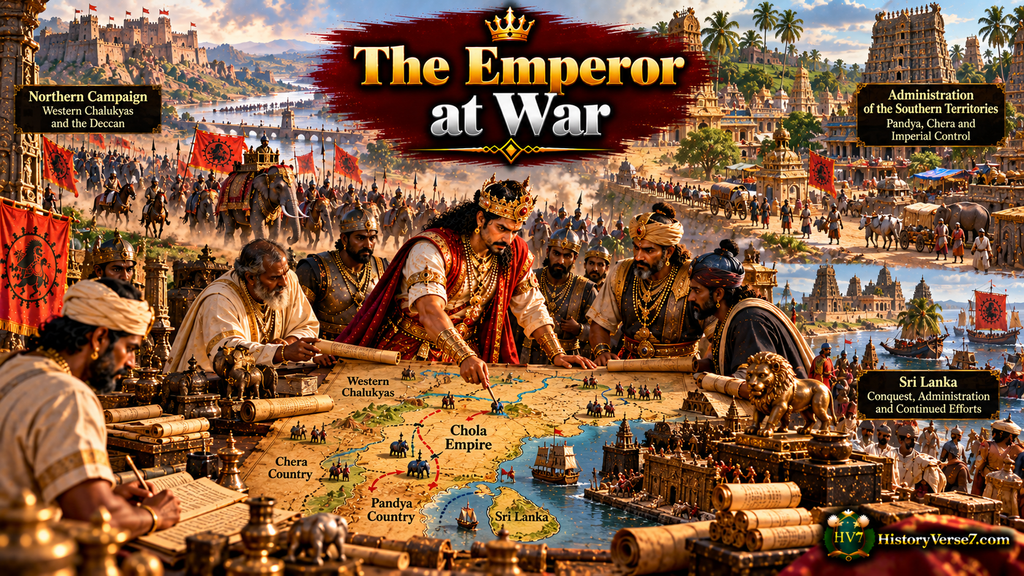
This combination, sustained major warfare on the northern frontier alongside continuous administrative attention to the south and to Sri Lanka, illustrates something important about how a medieval empire of this scale actually functioned. Rajadhiraja could not have personally overseen every aspect of this immense, multi-front responsibility alone, and the empire’s continued functioning during these years depended on the administrative structures his father and grandfather had built, discussed further in the administration section below, operating effectively even while the emperor himself spent extended periods away from the capital on campaign.
The Road to Koppam
By the early 1050s, the long Chola-Chalukya rivalry had reached a particularly active phase. Someshvara I, having been checked at Amaravathi and, by Sastri’s account, at Dannada as well, remained determined to reassert Chalukya influence in the contested borderlands and in Vengi. Rajadhiraja, for his part, was unwilling to cede the ground his earlier campaigns had won.
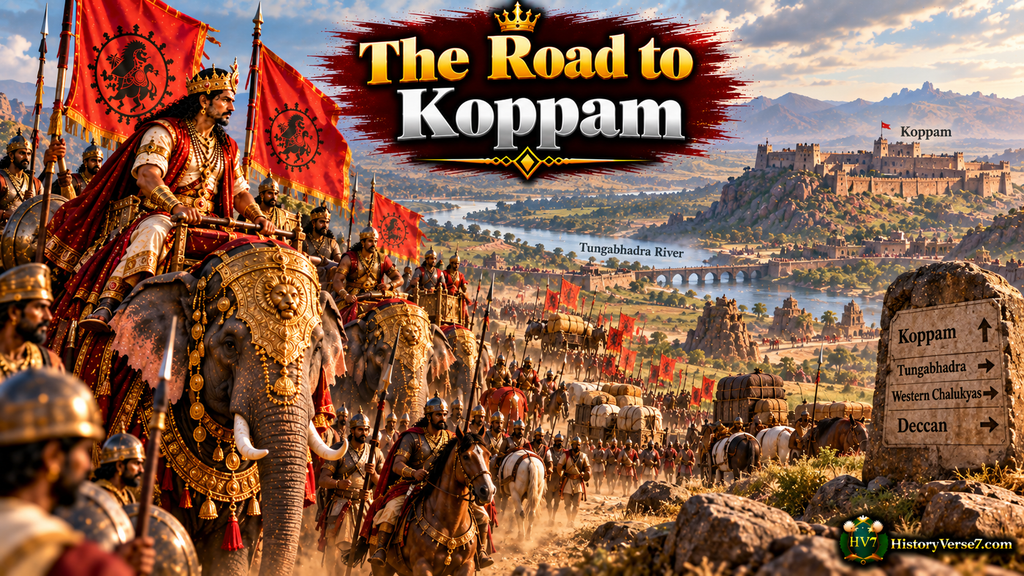
Sources describe Rajadhiraja leading a major northward expedition, plundering the Chalukya province of Ratta-mandalam and, on this same campaign, burning the city of Kampili, deep within territory the Western Chalukyas considered their own. This was not a defensive action; it was a deliberate, large-scale offensive strike into the heart of contested Deccan territory, the kind of operation that made a major confrontation with Someshvara I’s own forces essentially unavoidable. Someshvara I responded by moving to meet the Chola army directly, and the two forces came together at a site the inscriptions name Koppam, generally identified with modern Koppal in Karnataka, on the banks of the Tungabhadra River.
The Battle of Koppam
The date of the battle is not settled with complete certainty in modern scholarship. Most sources place it in 1054, based on an inscription of that year along with the Manimangalam record of Rajadhiraja’s successor dated 1055; the historian Sen has argued for an earlier date of 1052. This article presents both dates rather than asserting false precision on a point where serious historians genuinely disagree.
What the sources describe, combining the Chola inscriptional account with the more fragmentary external evidence, is a pitched battle in which Chola forces appear to have held a real tactical advantage. According to the account preserved in Chola records, the battle was going in the Cholas’ favor when Chalukya archers succeeded in mortally wounding Rajadhiraja, who was directing the engagement from his position on his war elephant. Chola sources go on to claim that the elephants, horses, and camels of the Chalukya forces, along with substantial battlefield spoils and even members of Someshvara I’s own household, fell into Chola hands in the fighting that followed his death claims that should be read, as with all Chola victory inscriptions, as the conventional language of a triumphant royal record rather than independently verified battlefield statistics.
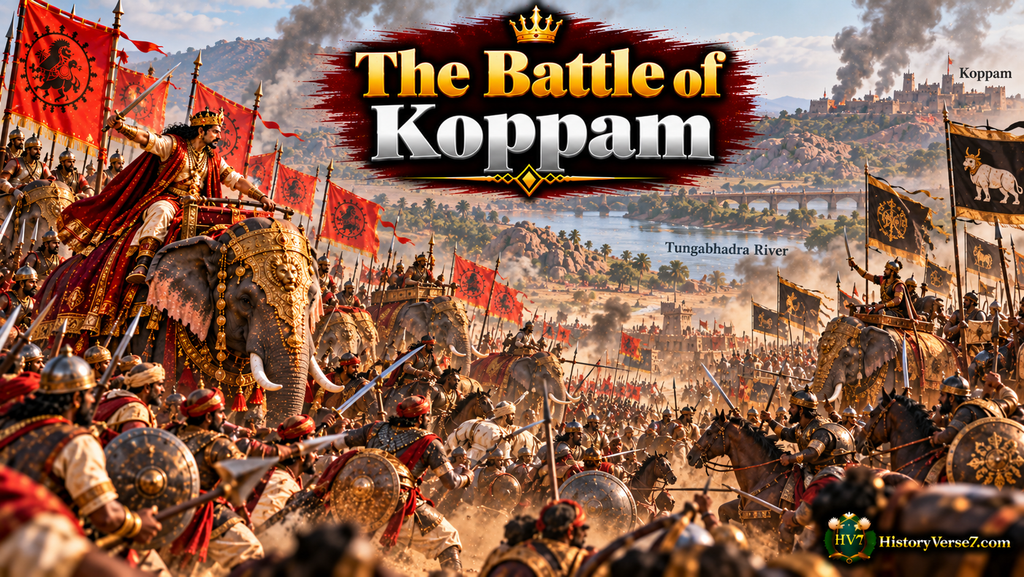
This is the central interpretive challenge of Koppam: the fullest surviving account comes from the Chola side, composed to commemorate a Chola emperor’s death and his dynasty’s continued triumph despite that loss, and it should be read with the same critical awareness this article has applied to Chola inscriptions throughout. What is corroborated, and treated with greater confidence by modern historians, is the basic, consequential fact at the center of the whole episode: Rajadhiraja died on the battlefield at Koppam, in the middle of an active engagement against Someshvara I’s forces, a fact confirmed not only by later Chola inscriptions but by the Western Chalukya side’s own acknowledgment, through Someshvara I’s recorded grief over the death of his brother Jayasimha in the same engagement, that a major, costly battle had indeed taken place there.
How Did Rajadhiraja Die?
Rajadhiraja died in the middle of battle, struck by Chalukya arrows while directing his forces from atop his war elephant. This article will not embellish that fact with invented final words or a dramatized death scene; the sources do not provide them, and inventing such detail would betray the evidentiary standard this entire two-article Chola cluster has tried to maintain.
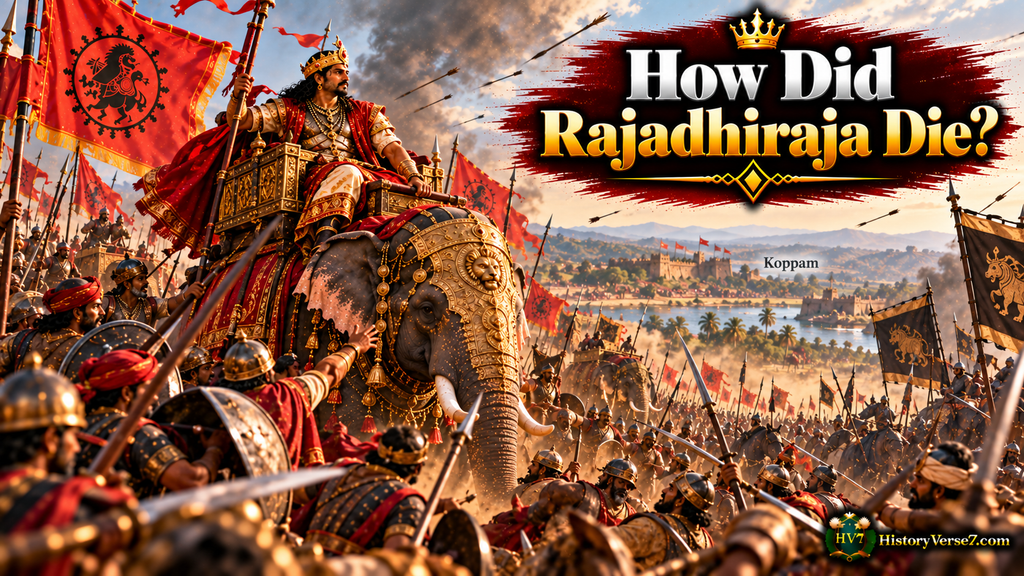
What makes his death genuinely unusual, and worth pausing on, is the fact of an emperor dying in active combat at all. Most Chola rulers, including his own father and grandfather, directed the empire’s wars primarily through senior commanders while remaining, themselves, at a far greater remove from direct battlefield danger. Rajadhiraja’s death at Koppam was not an isolated accident of bad fortune striking a ruler who happened to be nearby; it was the culmination of a lifelong pattern, documented from his earliest campaigns as crown prince onward, of leading from the front in the most direct, physically exposed sense available to a medieval monarch. His death reveals something genuine about Chola kingship in this period: that for at least one emperor, personal battlefield command was not a ceremonial gesture but the literal, sustained practice of rule.
What Happened After His Death?
The Chola response to losing an emperor mid-battle is itself one of the most historically interesting aspects of the entire episode, and it reveals something important about how deeply institutionalized Chola military command had become by this period. According to later Chola inscriptions, Rajadhiraja’s younger brother, who would become Rajendra Chola II, recognized that the Chola army risked falling into disarray at the moment its emperor fell, and responded immediately: he declared himself the next Chola monarch on the battlefield itself and ordered the army to continue fighting without pause.
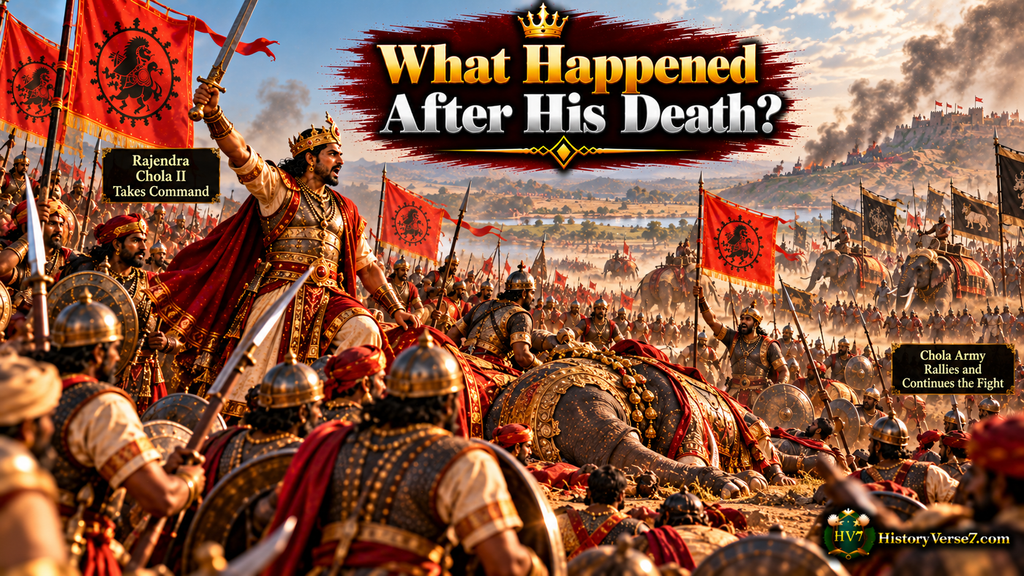
This is a remarkable claim, and this article treats it as exactly that: a claim, preserved specifically in Rajendra II’s own later inscriptions, composed to establish the legitimacy and decisiveness of his own accession under crisis conditions. Independent corroboration of the precise battlefield sequence is limited, but the broader outcome is well documented and consistent across sources: the Chola army did not collapse or retreat in the wake of Rajadhiraja’s death, Rajendra II emerged as his successor without the kind of succession crisis that might be expected after an emperor’s sudden death in the field, and Chola tradition holds that he went on to erect a victory pillar at Kolhapur before withdrawing his forces back toward Chola territory, a symbolic assertion that the campaign, despite its devastating personal cost, ended in Chola strategic advantage rather than Chalukya triumph.
Administration and Governance
It would be a mistake to let the drama of Koppam obscure the fact that Rajadhiraja governed a sophisticated imperial state for the better part of three decades, first as active crown prince and co-regent, then as sole emperor. The administrative structure he operated within was substantially the one his father and grandfather had built: provincial governance organized around established Chola administrative divisions, revenue assessment and collection continuing along established lines, and temple institutions functioning as key local administrative and economic anchors alongside royally appointed officials.
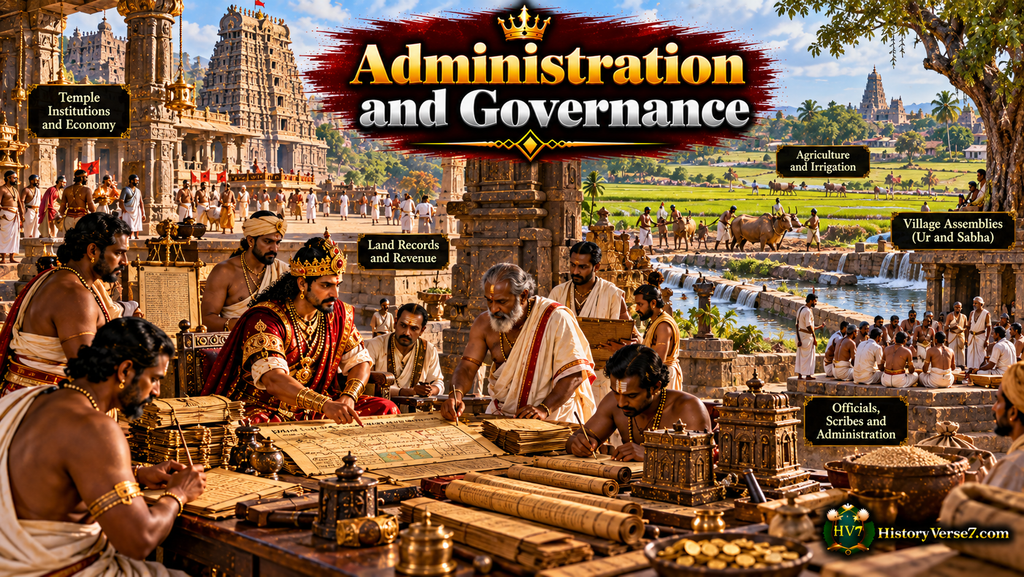
The evidence from Rajadhiraja’s own reign points toward continuity rather than dramatic reform. This should not be read as a criticism or as evidence of administrative neglect; a sophisticated system functioning as intended, requiring maintenance and attention rather than wholesale reinvention, is itself a sign of institutional strength, and it freed Rajadhiraja, as it had freed his father before him, to commit the kind of sustained personal attention to military affairs that defined his reign without the empire’s core governance collapsing in his absence.
Temple Patronage and Imperial Ideology
Like his father and grandfather, Rajadhiraja continued the Chola dynasty’s close association with Shaiva religious patronage, and inscriptions from his reign record temple donations and grants consistent with established royal practice. These should not be understood as expressions of personal piety alone, though piety was certainly part of the picture; temple patronage served, as it had for generations of Chola rulers, as a form of political communication, asserting royal legitimacy and generosity to a wide public audience while simultaneously functioning as genuine economic and administrative institutions, anchoring local land management, labor organization, and redistribution of agricultural surplus within their surrounding communities.
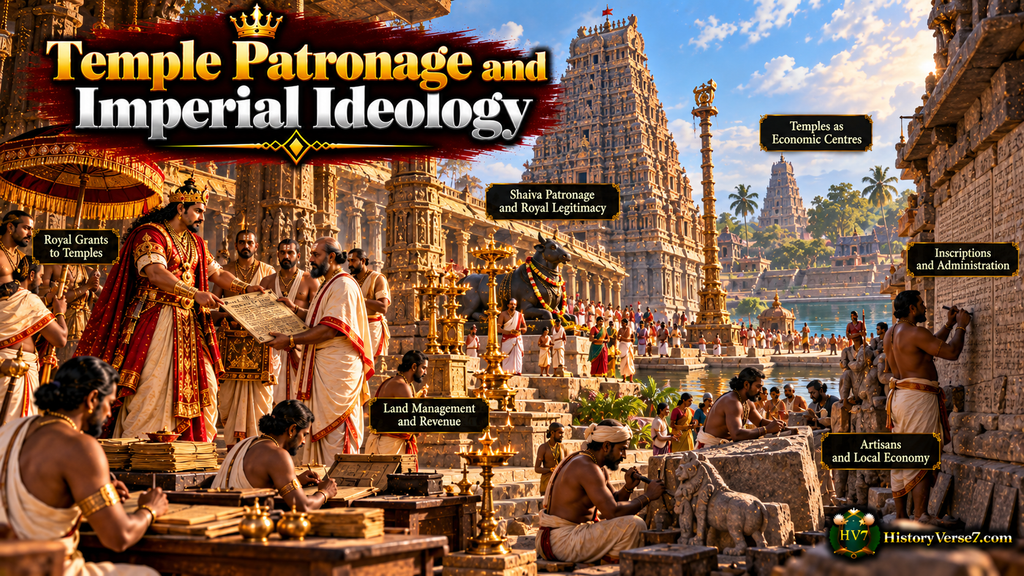
Rajadhiraja’s own royal titles and inscriptional self-presentation drew on the same vocabulary of universal, triumphant kingship his father had used, now reinforced by his own extensive, genuinely documented record of personal military leadership. This connection between inscriptional claim and lived reality is worth noting: unlike some royal inscriptions whose claims of conquest rest on thinner independent corroboration, Rajadhiraja’s reputation as an active, battlefield-present commander is corroborated by the circumstances of his own death in a way that gives his military titles unusual credibility among the broader corpus of Chola royal inscriptions.
What Do Rajadhiraja’s Inscriptions Tell Us?
Reading Rajadhiraja’s inscriptions critically means separating several distinct kinds of information they contain. His royal titles and genealogical claims, tracing his descent from Rajendra I, Rajaraja I, and the earlier Chola line, are generally treated as reliable, since dynastic genealogy served practical legal and administrative purposes that gave rulers little incentive to fabricate it. His military claims, particularly surrounding specific battles against the Chalukyas, follow the conventional celebratory idiom of Chola royal epigraphy, recording victories, captured spoils, and humbled enemies in language designed to project triumph rather than to provide a neutral battlefield report, and this article has treated such claims throughout with the corresponding caution.
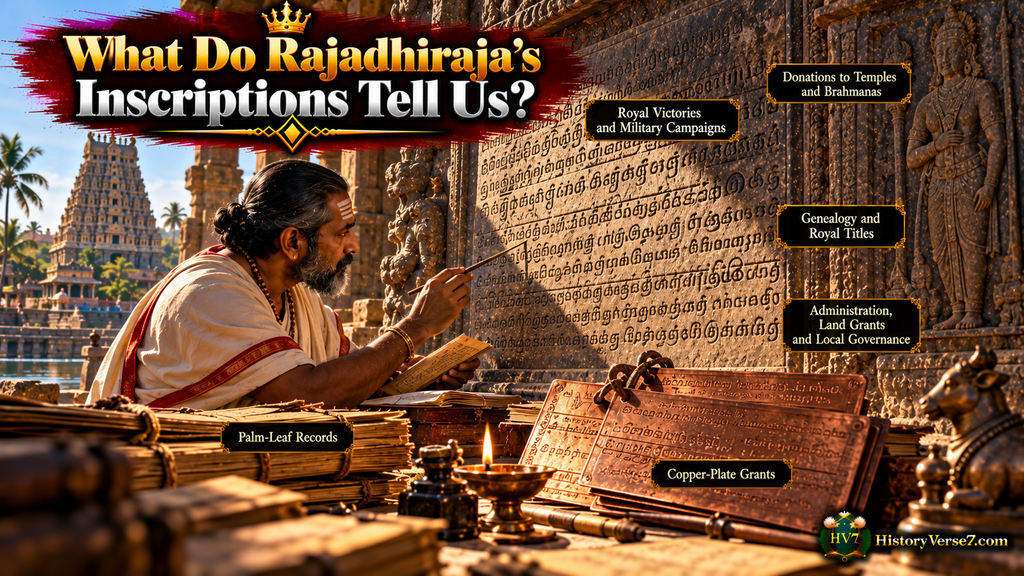
His temple donation records, by contrast, tend to be among the more reliably informative portions of his inscriptional corpus, since they record specific, practical transactions, land grants, endowments, and administrative arrangements, that served ongoing legal and institutional functions rather than purely rhetorical ones. Reading a Chola inscription well means holding these different categories of claim to different evidentiary standards simultaneously, rather than treating an entire inscription as uniformly reliable or uniformly suspect.
Rajadhiraja: Warrior or Emperor?
It is tempting, given how he died, to remember Rajadhiraja simply as a warrior who happened to also hold the Chola throne. This article resists that reduction. The documented record shows a ruler who spent decades in active military command, yes, but also one who held real administrative authority as crown prince, who made senior appointments like his brother’s Sri Lankan viceroyalty, who maintained continuity in a sophisticated imperial administrative system through nearly thirty years of combined co-regency and sole rule, and whose temple patronage and inscriptional self-presentation engaged fully with the political and religious ideology expected of a Chola emperor.
The fairest assessment is that Rajadhiraja was, consistently and by deliberate dynastic design, both: a prince trained from an early age to combine battlefield command with administrative responsibility, and an emperor who continued to exercise both functions personally rather than delegating the military half of that equation to subordinates once he reached the throne. His death at Koppam was not a departure from how he had always ruled; it was the final, costliest instance of exactly that pattern.
His Strengths and Limitations
Rajadhiraja’s documented strengths are genuinely substantial: extensive military experience accumulated over decades, a demonstrated willingness and capacity to lead from the front, evident administrative competence reflected in his authority to make senior appointments and maintain a functioning empire through extended military campaigns, and the dynastic legitimacy that came from the Chola tradition of carefully prepared, experienced succession.
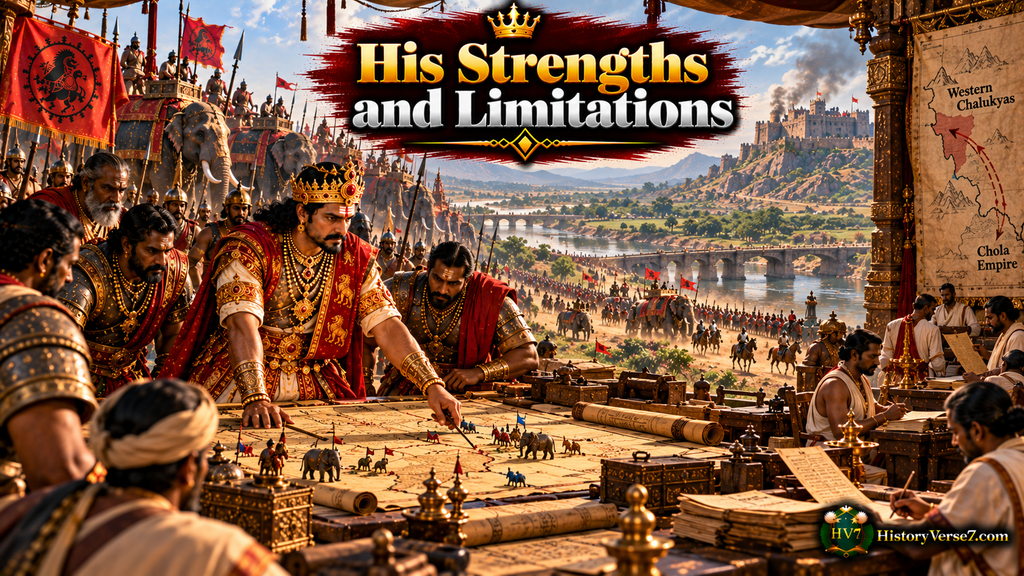
His limitations deserve equally direct treatment. The Western Chalukya conflict that consumed so much of his reign was never resolved during his lifetime, continuing instead under his successors for decades afterward, a persistent structural problem that no single Chola emperor of this period managed to settle permanently. The pressure of maintaining Chola authority across Sri Lanka, the southern Pandya and Chera territories, and the northern Deccan frontier simultaneously placed real and continuous strain on the empire’s military and administrative resources throughout his reign. And his personal style of command, however effective in sustaining Chola military pressure against the Chalukyas, carried an obvious and ultimately realized risk: an emperor who insists on commanding in person, battle after battle, across decades, eventually faces the real possibility of dying exactly as Rajadhiraja did.
Was Rajadhiraja a Successful King?
The honest answer resists a simple yes or no, and this article presents the relevant evidence across several distinct dimensions rather than forcing a single verdict.
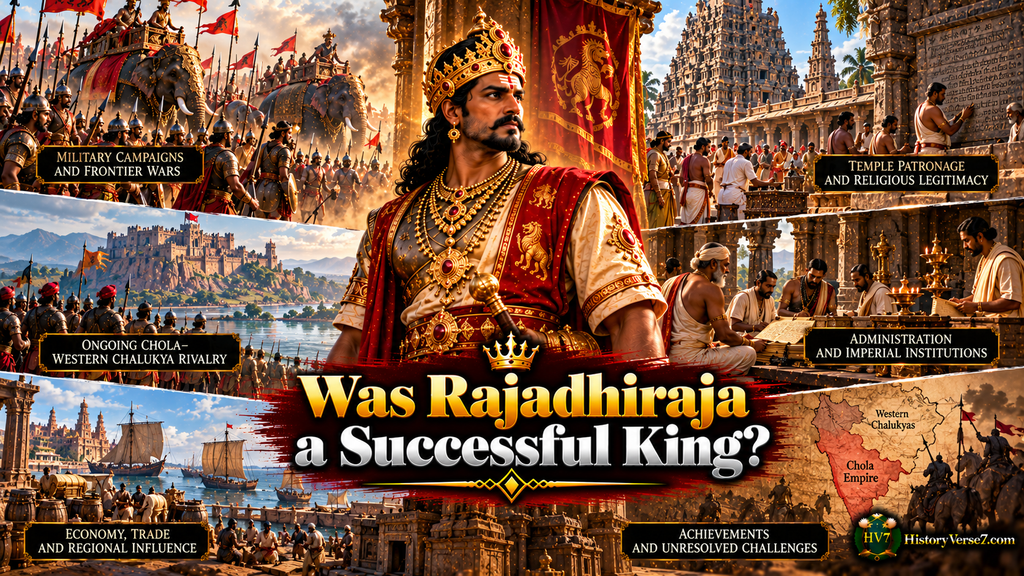
Militarily, his record shows sustained, real success against the Western Chalukyas across decades, including documented victories at Pundur, Amaravathi, and Dannada, even though the underlying conflict remained unresolved at his death. Politically and dynastically, his reign preserved and extended the careful succession planning his father and grandfather had established, and the smooth transition to Rajendra II even amid the crisis of his own battlefield death stands as genuine evidence of institutional strength rather than fragility. Administratively, the empire’s core governance structures continued functioning effectively throughout his reign, a real achievement given how much of his personal attention was necessarily directed toward sustained military campaigning. Territorially, Chola authority in Sri Lanka and the southern Pandya and Chera countries was maintained, if not dramatically expanded, throughout his reign. And in the one measure that matters most starkly, his own survival, his reign ended in his death on an active battlefield, a genuinely significant limitation whatever the broader strategic outcome of the campaign that killed him.
Lesser-Known Facts
- Rajadhiraja’s personal name, according to tradition, was Ilaval Sundaran, a detail that rarely appears outside specialist scholarship compared to his far more commonly used imperial title.
- He was formally associated with the Chola throne as co-regent around 1018, meaning he held a recognized position of authority for roughly thirty-four years in total, combining his time as crown prince and his eight years as sole emperor.
- His brother Virarajendra served as Chola viceroy of Sri Lanka during the early part of Rajadhiraja’s period of authority, an appointment that shows Rajadhiraja exercising senior administrative power, including the authority to appoint governors, well before his formal accession as sole emperor.
- Virarajendra, the same brother appointed to govern Sri Lanka, would himself later become Chola emperor, continuing the Chola-Chalukya conflict his brother had died fighting.
- Rajadhiraja’s posthumous title, Yanai-mel-thunjina Devar, meaning “the king who died seated upon the elephant,” is one of the more unusual and specific posthumous epithets in the entire Chola dynastic record.
- The main contemporary sources for the Battle of Koppam are an inscription dated to 1054 and the Manimangalam inscription of his successor Rajendra II, dated 1055, meaning the fullest account of his death was composed within roughly a year of the event by his own dynasty.
- Modern historians disagree on the precise date of the Battle of Koppam, with most sources favoring 1054 and the historian Sen arguing for 1052, a genuine point of ongoing scholarly disagreement rather than settled fact.
- The Chalukya king Someshvara I lost his own brother, Jayasimha, in the same battle that killed Rajadhiraja, meaning Koppam inflicted serious losses on the royal houses of both empires simultaneously.
- According to Chola tradition, Rajendra II crowned himself emperor on the battlefield at Koppam itself, immediately after his brother’s death, in order to prevent the Chola army from falling into disarray during active combat.
- Chola sources claim that Rajendra II erected a victory pillar at Kolhapur following the battle, asserting a continued claim of strategic advantage despite the loss of the reigning emperor during the engagement.
- Rajadhiraja’s early victory over Someshvara I at Pundur reportedly forced two of the Chalukya king’s sons, the future ruler Vikramaditya VI and his brother Vijayaditya, to flee the battlefield.
- Different modern historians, drawing on different inscriptional evidence, describe Rajadhiraja’s campaigns against Someshvara I somewhat differently, with Kamath emphasizing a victory at Amaravathi and Sastri emphasizing a victory at Dannada on the Krishna River, a reminder of how reconstructing exact campaign sequences from royal inscriptions remains genuinely difficult.
- The site of Koppam has been identified by modern scholars with Koppal in present-day Karnataka, located on the Tungabhadra River.
- Someshvara I would go on to fight Rajadhiraja’s successors for over a decade after Koppam, eventually dying by ritual drowning in the Tungabhadra River in 1068, illustrating how the underlying Chola-Chalukya rivalry long outlasted the battle that killed Rajadhiraja.
- Rajadhiraja’s reign as sole emperor, at roughly eight years, was considerably shorter than either his grandfather Rajaraja I’s twenty-nine-year reign or his father Rajendra I’s thirty-year reign, a factor that plausibly contributes to his comparatively lower profile in popular memory of the dynasty.
Historical Assessment
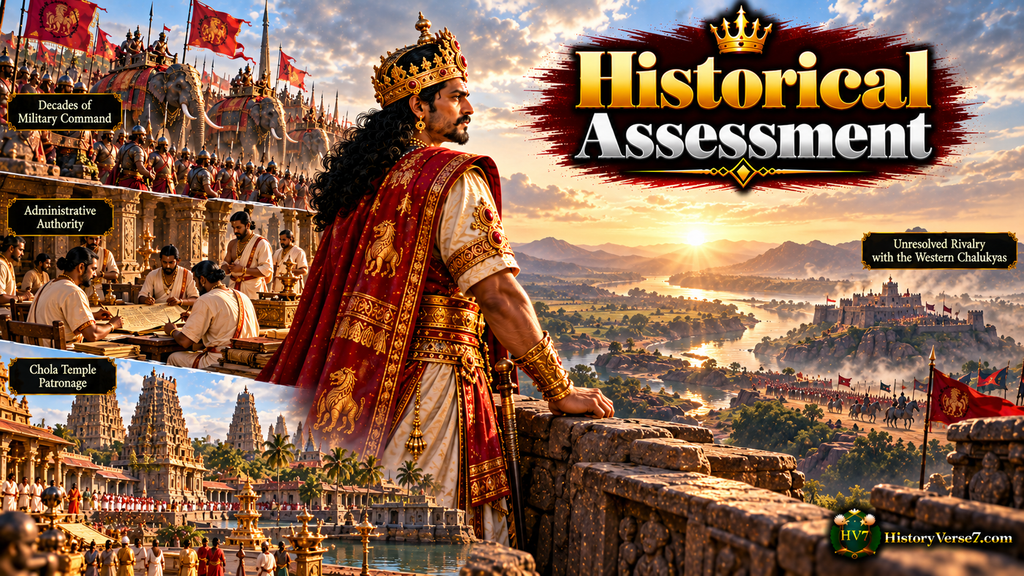
Who was Rajadhiraja Chola I? A Chola emperor whose adult life, from his earliest documented campaigns as crown prince through his death as reigning sovereign, was defined by sustained, personal military command, combined with genuine administrative authority exercised across a roughly thirty-four-year span of co-regency and sole rule.
What made him different from Rajaraja and Rajendra was not the scale of his ambition, which matched theirs, but its character. His grandfather and father each achieved singular, transformative projects the Thanjavur temple, the Ganges expedition, the Srivijaya campaign that reshaped the Chola Empire’s identity in dramatic, relatively concentrated episodes. Rajadhiraja’s reign, by contrast, was defined by the sustained management of an ongoing, structural conflict he had inherited and would, in turn, pass on unresolved to his own successors.
Why was he so deeply involved in warfare personally, rather than delegating it as some predecessors had? The evidence does not allow a definitive answer to this question of personal motivation, and this article will not invent one. What the evidence does show is a consistent pattern, beginning in his years as crown prince and continuing without apparent change once he became emperor, of direct, personal battlefield command, a pattern so sustained across decades that it appears to reflect a genuine and deliberate approach to kingship rather than a passing phase or an isolated decision.
What does his battlefield death reveal about Chola kingship? That for at least one Chola emperor, the ideology of universal, martial sovereignty proclaimed in royal inscriptions was not purely rhetorical. Rajadhiraja’s death demonstrates that the risks of personal command were real and that at least one Chola ruler was willing to bear them consistently, to the end of his life.
What did his reign accomplish, and what remained unresolved? He maintained and extended Chola military pressure against the Western Chalukyas across decades, preserved Chola authority in Sri Lanka and the southern Pandya and Chera territories, and ensured, through his own earlier investment in dynastic succession planning, that his death in battle did not produce a succession crisis for the empire as a whole. What he did not accomplish, and what no single reign of this long conflict managed to accomplish, was a lasting resolution to the Chola-Western Chalukya rivalry itself, a structural feature of Deccan politics that would continue to shape, and cost, the Chola Empire for decades after his own death at Koppam.
Conclusion
Rajadhiraja Chola I’s significance does not lie simply in the fact that he died in battle. He was trained from an early age to combine battlefield command with administrative responsibility, governed alongside his father for more than two decades before becoming emperor in his own right, inherited one of medieval India’s most powerful and sophisticated states, and continued, without apparent interruption, to personally lead its armies for the whole of his reign.
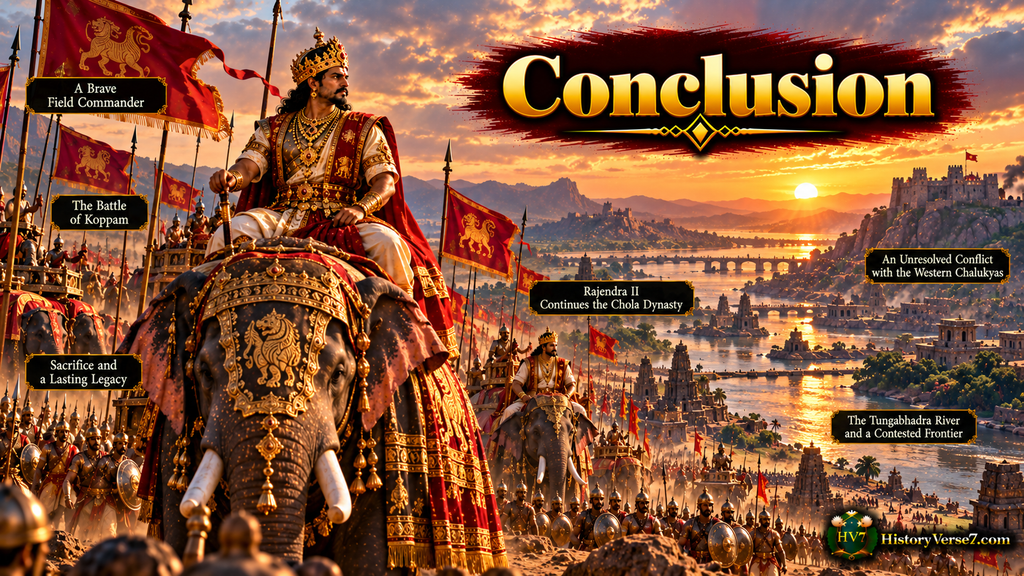
His death at Koppam, whatever uncertainty surrounds its exact date and precise tactical detail, therefore represents something more revealing than the death of a king struck down by misfortune. It is the final, costliest expression of a pattern of rule that had defined his entire adult life: an emperor who understood personal, visible command as central to how a Chola sovereign exercised power, and who continued to exercise it that way until the moment it killed him. The empire he left behind did not collapse. It mourned him, crowned his brother on the same battlefield, and kept fighting the same unresolved war for decades more a continuity that says as much about the institution he helped sustain as his death says about the man himself.
Written & Researched by Abhishek Chavan — HistoryVerse7| © 2026 HistoryVerse7 | Cluster Article: Rajadhiraja Chola I
Scholarly works to cite
- K. A. Nilakanta Sastri, The Cholas (University of Madras) and A History of South India (Oxford University Press). Both are the standard references, and Sastri is the source for the Dannada account.
- Suryanath U. Kamath, A Concise History of Karnataka. Kamath is the source for the Amaravathi account.
- S. N. Sen, Ancient Indian History and Civilization. Sen is the historian who argues for 1052 as the Koppam date.
- Upinder Singh, A History of Ancient and Early Medieval India (Pearson, 2008).
- Noboru Karashima (ed.), A Concise History of South India: Issues and Interpretations (Oxford University Press, 2014).
- Y. Subbarayalu, South India under the Cholas (Oxford University Press, 2012).
- R. Champakalakshmi, Trade, Ideology and Urbanization: South India 300 BC to AD 1300 (Oxford University Press, 1996).
Primary sources
- The Manimangalam inscription of Rajendra II (1055) is the key source for Koppam and the battlefield accession.
- The 1054 inscription that dates the battle.
- Rajadhiraja’s own inscriptions in South Indian Inscriptions (SII), Epigraphia Indica, and the Archaeological Survey’s Annual Reports on Epigraphy.
Rajadhiraja Chola I: The Emperor Behind the Battlefield Legend
Rajadhiraja’s significance lies not simply in his death at Koppam. He was prepared to rule, governed alongside Rajendra Chola I and continued to lead Chola campaigns after becoming emperor. His reign reveals how military leadership, imperial authority and dynastic succession were connected in the medieval Chola state.
The surviving inscriptions preserve important evidence, but royal victories and territorial claims still require critical examination. Studying Rajadhiraja through both the historical record and its limitations gives us a more complete understanding of his reign.
The next planned articles in this HistoryVerse7 cluster explore Virarajendra Chola and Kulothunga Chola I, continuing the story of Chola power, political change and imperial succession.
Thank you for reading HistoryVerse7. Explore the related articles and historical resources to follow the Chola Empire beyond the reign of Rajadhiraja Chola I.
History is best understood through evidence, context and critical inquiry.
Share this content: