
Sundara Chola and the Chola Succession Crisis: 10 Historical Truths About the King History Almost Forgot
Sundara Chola: The King Who Ruled a Powerful but Troubled Chola Kingdom The history of the Cholas is often dominated by the spectacular achievements of Rajaraja Chola I and Rajendra Chola I. But before the great imperial age emerged, the Chola kingdom passed through a difficult period in which military strength, regional rivalry, and dynastic…
Sundara Chola
Sundara Chola: The King Who Ruled a Powerful but Troubled Chola Kingdom
HistoryVerse7.com | Cluster Article: Sundara Chola| International English Edition
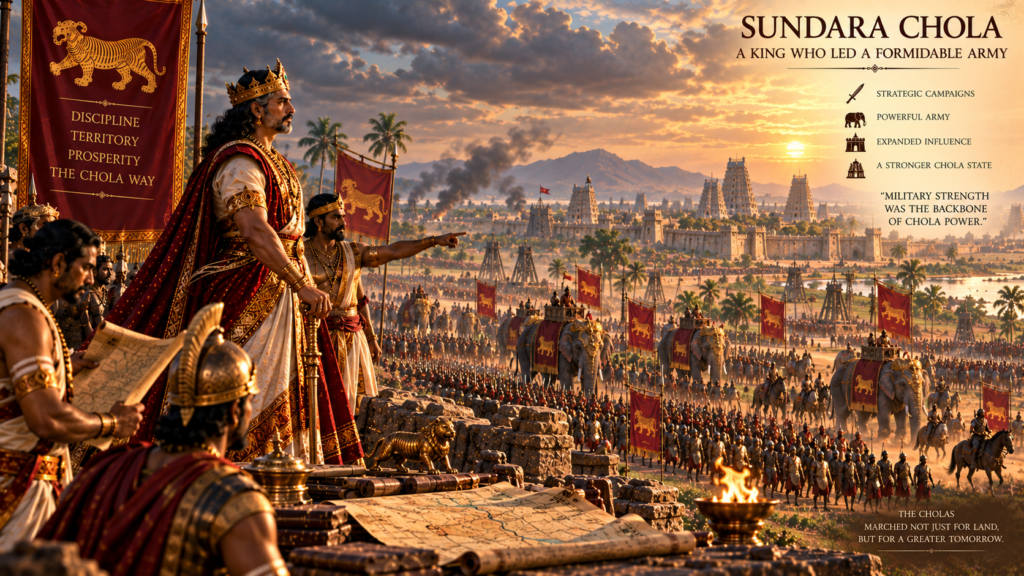
The Chola kingdom that Sundara Chola inherited around 956 CE was both stronger and more complicated than any kingdom his ancestors had ruled. Vijayalaya had seized Thanjavur from the Muttaraiyars and set the dynasty in motion. Aditya I had dismantled Pallava independence and absorbed the northern Tamil country. Parantaka I had spent nearly five decades transforming that foundation into the most extensive Chola territorial domain yet achieved, before the catastrophic defeat at Takkolam and the death of his heir-apparent Rajaditya left the dynasty navigating its most difficult period of adjustment since its founding.

By the time Sundara Chola came to the throne, the Chola state had survived all of that. It had also survived the brief reigns of Gandaraditya and Arinjaya two of Parantaka I’s sons who had held the throne without dramatically reshaping its position. The political institution was intact. The Kaveri delta heartland was secure. But the outer reaches of Chola authority were contested, the Pandya kingdom remained a persistent challenge in the south, and the dynastic politics within the Chola royal family were becoming increasingly complex with each passing generation.
What made Sundara Chola’s reign particularly consequential was not the empire he built the full imperial transformation would come under his son Rajaraja I but the political, military, and dynastic work he did in conditions of genuine uncertainty. His reign was powerful in some respects and troubled in others, and understanding both dimensions is essential for understanding how the Chola dynasty reached the imperial height it achieved under the rulers who followed him.
Who Was Sundara Chola?
Sundara Chola whose personal name was Parantaka is also known in the historical literature as Parantaka II, a designation that distinguishes him from his famous grandfather Parantaka I while acknowledging his shared royal name. The dual identification as ‘Sundara Chola’ (Beautiful Chola) and ‘Parantaka II’ appears in both inscriptions and modern scholarly literature, and both usages are historically legitimate. In this article, ‘Sundara Chola’ is used as the primary designation to avoid confusion with his grandfather.
He was the son of Arinjaya Chola himself one of the sons of Parantaka I who had briefly occupied the Chola throne making him a grandson of the long-reigning Parantaka I. His mother was Kalyani, a princess from the Western Ganga dynasty of Mysore, giving him a genealogical connection to one of the significant regional powers of 10th-century peninsular India. This Ganga connection was not merely a biographical detail it reflected the network of dynastic relationships through which the Chola royal family managed its political relationships with neighboring powers.

His reign is conventionally dated to approximately 956–969 CE, though these dates are derived from later inscriptional genealogies and carry the usual caveats about precision. He was the father of three significant historical figures: Aditya Karikala, who served as crown prince and military commander before dying under circumstances that remain historically uncertain; Arulmozhivarman, who would become the celebrated Rajaraja Chola I; and a daughter, Kundavai, who became an important figure in the political and religious life of the later Chola court.
K.A. Nilakanta Sastri’s treatment of Sundara Chola in ‘The Colas’ gives him substantial attention his reign generated a richer inscriptional record than those of his two immediate predecessors, and the political events associated with his family produced material that would be significant for subsequent Chola history. Recent scholarship, including the prosopographical work of Noboru Karashima, has refined the administrative picture of his reign through systematic analysis of the land grant records.
The Chola Kingdom Before Sundara Chola
The Legacy of Vijayalaya Chola
The Chola dynasty’s imperial story began with Vijayalaya’s capture of Thanjavur around 848 CE. This act seizing the political key to the Kaveri delta from the Muttaraiyar chiefs created the territorial and agricultural foundation on which all subsequent Chola development rested. The Kaveri delta’s extraordinary rice productivity, managed through a combination of royal irrigation investment and systematic land revenue administration, provided the economic base for everything that followed.
The Expansion Under Aditya I
Aditya I’s defeat of Aparajita Pallava around 890 CE removed the primary obstacle to northward Chola expansion and absorbed Tondaimandalam the ancient Pallava heartland into the Chola sphere. The Chola kingdom that had been a delta chieftaincy under Vijayalaya became a major regional power under Aditya I.
Parantaka I and the High Point of Early Chola Expansion
Parantaka I’s nearly fifty-year reign pushed Chola ambitions to their furthest extent southward to Madurai, across the Palk Strait toward Sri Lanka before the Battle of Takkolam around 949 CE contracted northern positions and killed heir-apparent Rajaditya. The multi-king succession that followed Parantaka I’s death around 955 CE involved Gandaraditya and Arinjaya both sons of Parantaka I reigning briefly before Sundara Chola, the son of Arinjaya, came to the throne.
The Battle of Takkolam and Its Consequences
The defeat at Takkolam by the Rashtrakuta king Krishna III was not merely a military setback it disrupted the dynastic succession, contracted Chola territorial reach in the north, and demonstrated that the Chola military had genuine limits against a determined and capable adversary. The recovery from Takkolam politically, militarily, and administratively was the central challenge facing the Chola dynasty in the decades between Parantaka I’s death and Sundara Chola’s accession. The brief reigns of Gandaraditya and Arinjaya were part of this recovery process. Sundara Chola inherited its results.
How Sundara Chola Became King
The Succession After Parantaka I
The succession from Parantaka I to his sons Gandaraditya and Arinjaya, and then to Arinjaya’s son Sundara Chola, followed a pattern of lateral and descending succession that had characterized the Chola dynasty since its founding. None of the transitions in this sequence appears to have been dramatically contested, though the brevity of Gandaraditya’s and Arinjaya’s reigns suggests that the dynasty was navigating a period of internal adjustment rather than stable long-term governance.
The Political Position of Sundara Chola
When Sundara Chola became king around 956 CE, he was the grandson rather than son of the most recent long-reigning Chola ruler. His father Arinjaya’s brief reign had been a transitional episode; his uncle Gandaraditya’s reign before that similarly. Establishing his own authority building the networks of loyalty, administrative relationships, and military capacity that would allow him to govern effectively was the primary challenge of his early reign.
Establishing His Authority
The inscriptional record from Sundara Chola’s reign shows a king actively engaged in the standard mechanisms of Chola royal authority issuing land grants, supporting temple institutions, maintaining administrative relationships with local power-holders across the Chola territories. The geographical distribution of his inscriptions, which extends across the Kaveri delta heartland and into the northern territories, suggests a reign with a functioning administrative reach, even if the outer fringes of Chola authority remained contested.

The Political Situation During Sundara Chola’s Reign
The South India of the mid-to-late 10th century was still a competitive political environment, though the specific configurations of power had shifted considerably from the landscape of Parantaka I’s peak years. The Rashtrakutas whose king Krishna III had inflicted the Takkolam defeat were now themselves facing internal pressures that would eventually contribute to their own decline in the 970s. This Rashtrakuta weakening created an opportunity for the Chola kingdom to reassert northward positions, and Sundara Chola’s reign is associated with some of this reassertion.
The Pandya kingdom to the south remained a persistent factor not eliminated by Parantaka I’s famous Madurai campaign, not decisively subdued by any subsequent Chola military action, and capable of reasserting itself in southern Tamilakam whenever Chola military attention was focused elsewhere. Managing this persistent Pandya challenge was a continuous administrative and military preoccupation of Sundara Chola’s reign.

The Gangas of Mysore with whom the Chola royal family had dynastic connections through Sundara Chola’s mother occupied a significant position between the Chola and Rashtrakuta spheres. Their relationship with the Chola kingdom during Sundara Chola’s reign was a factor in the broader political balance of the peninsula, though the specifics of Chola-Ganga relations during this period are not always well documented in the surviving inscriptional record.
Sri Lanka the island across the Palk Strait that had been a focus of Chola military activity since Parantaka I’s reign continued to represent both an opportunity and a challenge for Chola southward ambitions. The island’s political instability and its role as a refuge for Pandya political actors made it a recurring element in the strategic calculations of the Chola court.
Sundara Chola and the Pandyas
The Continuing Chola-Pandya Conflict
The Chola-Pandya relationship during Sundara Chola’s reign continued the pattern of competitive pressure that had characterized the relationship since Parantaka I’s famous capture of Madurai. The Pandya kingdom had never been permanently subdued by Parantaka I’s campaign it had been temporarily weakened, not destroyed and its periodic reassertion was a feature of South Indian political life that every Chola ruler had to manage.
The Struggle for Madurai
The inscriptional record associated with Sundara Chola’s reign contains references to military activity in the Pandya territories, and later Chola genealogical tradition credits his reign with continued Chola pressure on Pandya positions. The specific details of Chola-Pandya military engagement during his reign are less well documented than for Parantaka I’s famous Madurai campaign, and historians exercise appropriate caution about reconstructing specific military events from the available evidence.
The Chola Campaigns in the South
Military activity in the south during Sundara Chola’s reign was associated with his crown prince Aditya Karikala as much as with the king himself a delegation of military command to the heir-apparent that was consistent with Chola royal practice in the preceding period. The specific campaigns associated with Aditya Karikala’s military career, including his role in southern operations and Sri Lankan-adjacent activities, will be discussed more fully in the section on Aditya Karikala below.
Historical Evidence for Sundara Chola’s Victories
Royal titles preserved in Sundara Chola’s inscriptions include epithets associated with southern military activities epithets that claim martial achievements in the direction of the Pandya territories and beyond. These inscriptional claims follow the standard conventions of medieval South Indian royal titulature, and historians treat them as evidence of military activity and aspiration while exercising caution about specific claims that cannot be independently corroborated.
Sundara Chola and Sri Lanka
Why Sri Lanka Mattered to the Cholas
Sri Lanka’s strategic importance for the Chola kingdom was multiple and had been recognized since at least the reign of Parantaka I. The island’s northern ports were closely integrated with the commercial economy of the Coromandel coast. Its role as a potential refuge for Pandya political actors kings and princes who might use the island as a base for recovering their position in southern Tamilakam gave it direct security relevance for the Chola state. And the pearl fisheries of the Palk Strait, shared between the island and the adjacent Tamil coast, were commercially valuable.
The Chola Military Intervention
Chola military engagement with Sri Lanka during Sundara Chola’s reign is attested by both Tamil inscriptions and Sri Lankan chronicle sources the Culavamsa in particular providing a perspective on Chola activity in the island that is not always available from the inscriptional record alone. The nature of this engagement whether it constituted a systematic military campaign, a series of expeditions with limited objectives, or something more complex is a question that the sources do not fully resolve.
Aditya Karikala and the Southern Campaigns
Aditya Karikala’s role in military activities directed toward the south including activities related to Sri Lanka is one of the more significant and less fully documented aspects of this period in Chola history. Some historians have associated him with Chola military activities in the island during the period of Sundara Chola’s reign, based on later Chola tradition and Sri Lankan chronicle references. The evidence for this association is suggestive rather than conclusive, and confident reconstruction of specific campaigns is not possible from the available sources.

What the Sources Actually Establish
The honest summary of what the historical sources establish about Chola involvement with Sri Lanka during Sundara Chola’s reign is this: there was military and political engagement; Aditya Karikala was likely involved in some of this engagement; and the specific nature, extent, and results of that engagement cannot be reconstructed with confidence from the surviving evidence. The full-scale Chola conquest and administration of Sri Lanka associated with Rajaraja I belongs to the next generation projecting it backward onto Sundara Chola’s reign would misrepresent the historical record.
Aditya Karikala and the Chola Royal Family
Aditya Karikala Sundara Chola’s eldest son and the designated heir to the Chola throne was one of the most prominent figures of the mid-to-late 10th century Chola court, and his death before his father created the succession complications that would eventually produce Uttama Chola’s unusual accession. Understanding Aditya Karikala’s position is essential for understanding the political dynamics of Sundara Chola’s reign.
His role as crown prince involved active military command a pattern consistent with Chola royal practice from the time of Rajaditya Chola (Parantaka I’s son who died at Takkolam). Crown princes who commanded armies demonstrated military capability while their fathers governed, developing the personal networks and military reputations that would serve them when they eventually became king. Aditya Karikala’s military activities in the south, including possible Sri Lankan-related campaigns, were part of this traditional crown-princely role.

The inscriptional record preserves some evidence of Aditya Karikala’s activities, though less than for the major Chola kings who generated large bodies of royal inscriptions. His royal titles and epithets suggest martial achievement and royal aspiration consistent with his position as heir-apparent. The Tamil literary tradition preserves his name in ways that suggest he was remembered as a significant and capable figure.
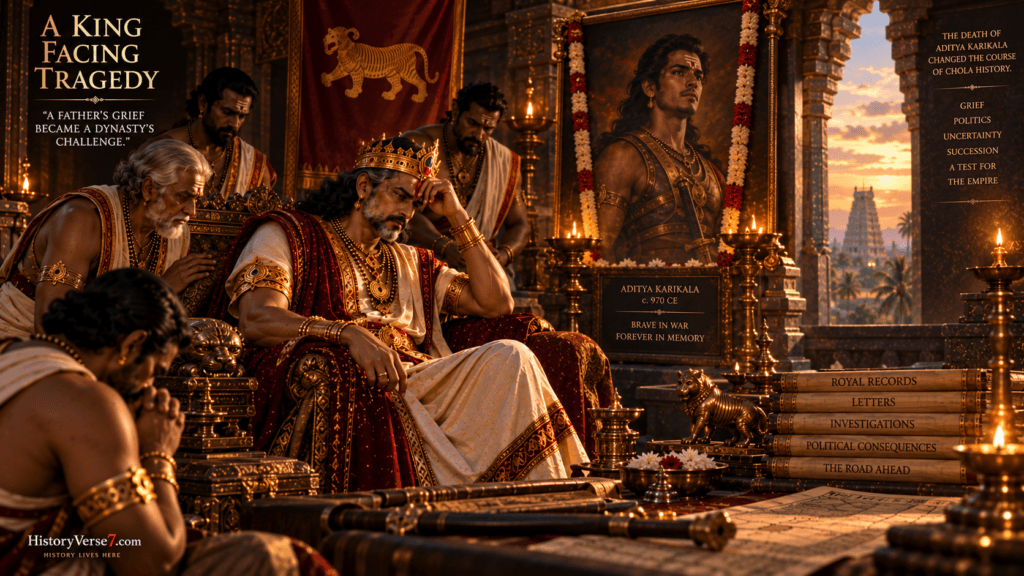
His death which occurred before Sundara Chola’s own death, thereby disrupting what would otherwise have been a straightforward succession is one of the most consequential and least well-documented events of this period in Chola history. The circumstances of his death are the subject of later traditions that include suggestions of political violence, but these traditions cannot be confirmed by contemporary inscriptional evidence. The available evidence establishes that he died before his father; it does not establish how or why.
Arulmozhivarman: The Future Rajaraja Chola
Sundara Chola’s younger son, Arulmozhivarman the prince who would eventually become Rajaraja Chola I occupied a position of increasing political significance as Aditya Karikala’s death removed the designated heir and created a succession question that would not be straightforwardly resolved during Sundara Chola’s lifetime.
The young Arulmozhivarman’s activities during his father’s reign are not extensively documented in contemporary sources, but later Chola tradition and in particular the elaborate genealogical inscriptions of Rajaraja I’s own reign presents him as a prince of exceptional ability whose future greatness was evident from his early years. This retrospective framing serves the political purpose of Rajaraja I’s inscriptional tradition and should be read with that purpose in mind.

What can be said with confidence is that Arulmozhivarman was a member of the Chola royal family who was positioned, after Aditya Karikala’s death, as a potential future king a position that would require navigating the succession question that Uttama Chola’s intervening reign created. His eventual accession as Rajaraja I, the extraordinary imperial achievements of his reign, and the systematic inscription programme he undertook to document his dynasty’s history all of these are products of the later period and belong to a separate article.
Sundara Chola’s daughter Kundavai who would become an important religious and political figure in the Chola court under her brother Rajaraja I was also a member of this royal family, and her later prominence is another reminder of how consequential Sundara Chola’s family would prove to be for the subsequent history of the dynasty.
Sundara Chola and Uttama Chola
The relationship between Sundara Chola and Uttama Chola requires careful explanation because later popular tradition has sometimes presented it in ways that the historical evidence does not straightforwardly support.
Uttama Chola also known as Madhurantaka was the son of Gandaraditya, who was one of Parantaka I’s sons and therefore Sundara Chola’s uncle. This made Uttama Chola Sundara Chola’s first cousin. The two men were thus contemporaries within the Chola royal family, rather than belonging to successive generations, and the succession from Sundara Chola to Uttama Chola after Sundara Chola’s death represented a lateral move within the royal family rather than a direct father-to-son succession.
The political relationship between Sundara Chola and Uttama Chola during Sundara Chola’s lifetime is not well documented in the inscriptional record. Whether Uttama Chola held significant administrative or military positions during his cousin’s reign, or whether he was a relatively peripheral figure who only became politically central at the moment of the succession, is not established by the available evidence.
The subsequent succession from Uttama Chola to Arulmozhivarman (Rajaraja I) which returned the throne to the direct descendants of Sundara Chola is sometimes framed in later tradition in ways that imply tension between the two branches of the royal family. These traditions should be treated cautiously; the smooth transition to Rajaraja I after Uttama Chola’s death suggests that whatever complexity existed in the succession was managed within the framework of Chola dynastic practice rather than through open conflict.
The Death of Aditya Karikala and the Succession Question
The death of Aditya Karikala before his father Sundara Chola is among the most historically significant and least well-documented events of this period in Chola dynastic history. Its consequences were substantial: it removed the designated successor to the Chola throne, opened a succession question that would be resolved through Uttama Chola’s accession rather than through the direct Sundara Chola male line, and eventually led to a political situation in which Arulmozhivarman the younger son became king only after the intervening reign of his cousin Uttama Chola.
The circumstances of Aditya Karikala’s death have been the subject of considerable historical and popular discussion. Later Tamil literary and traditional sources contain suggestions that his death was not natural that it involved political violence in some form. These suggestions are not confirmed by contemporary inscriptions, and historians treat them with appropriate caution. The death of a crown prince before his father was not unprecedented in medieval South Indian dynastic history, and natural causes cannot be excluded simply because later tradition prefers a more dramatic narrative.

What the inscriptional evidence does establish is the fact of his death, the chronological sequence in which it occurred (before Sundara Chola), and the political consequences that followed from it. Beyond these basics, the evidence does not reliably establish the specific circumstances, and responsible historical analysis requires acknowledging that uncertainty rather than filling it with dramatic but unsupported narrative.
The succession question created by Aditya Karikala’s death was not resolved during Sundara Chola’s lifetime in the way that would have been most straightforward by designating Arulmozhivarman as the new heir-apparent and ensuring a direct succession. Why this did not happen is itself a question the sources do not clearly answer. Arulmozhivarman may have been too young for immediate designation; there may have been political factors within the royal family that made a direct designation complicated; or the succession may have been left deliberately open. The result, in any case, was the succession of Uttama Chola after Sundara Chola’s death, followed eventually by Rajaraja I’s accession.
Administration Under Sundara Chola
The administrative record of Sundara Chola’s reign is richer than for his two immediate predecessors, reflecting both the approximately thirteen years of his reign and the more developed administrative apparatus of the Chola state by the mid-to-late 10th century. Land grants in Sundara Chola’s name have been identified in the inscriptional corpus, documenting the routine business of Chola governance transferring revenue rights to temples and Brahmin recipients, organizing the agricultural land management of the Kaveri delta, maintaining the network of local institutional relationships that the Chola administrative system depended upon.
The geographical distribution of these land grants provides evidence about the extent of effective Chola administrative authority during his reign. Grants concentrated in the Kaveri delta and Tondaimandalam reflect the areas of most secure Chola administration; the pattern of grants in the southern territories and the outer fringes of Chola territory provides evidence about the reach of royal authority in less secure regions.

Local institutions the village assemblies (sabhas), the merchant communities, the temple managing bodies continued to function within the administrative framework developed over the preceding century. The relationship between the Chola royal administration and these local institutions was collaborative rather than directly directive, with the central administration working through rather than around the established patterns of local governance. Noboru Karashima’s prosopographical analysis of Chola inscriptions has provided detailed evidence about the officials and administrators who served in Sundara Chola’s administration, tracing career patterns that illuminate the functioning of the Chola bureaucratic system during this period.
Religion and Temple Patronage Under Sundara Chola
Temple patronage under Sundara Chola followed the established patterns of Chola royal religious practice Shaivite in its primary orientation, expressed through land grants supporting priestly services and ritual activities at major temples across the Chola territories. The Chidambaram Nataraja temple which Parantaka I had patronized with spectacular generosity through the golden sheathing of its towers continued to receive royal attention during Sundara Chola’s reign, maintaining the connection between the Chola royal house and this most important of Tamil Shaivite sacred centers.

The political function of temple patronage during Sundara Chola’s reign was the same as for his predecessors demonstrating the legitimate authority of the Chola king as the protector and sustainer of Tamil Shaivite religious life, creating communities of economic beneficiaries whose livelihoods depended on continued royal patronage, and physically inscribing royal authority into the sacred landscape of the Chola territories through the public act of temple endowment.
Sundara Chola’s daughter Kundavai whose later prominence in the religious life of the Chola court under her brother Rajaraja I is well documented may have begun developing the religious interests and networks that would characterize her later career during her father’s reign, though the specific evidence for her activities during Sundara Chola’s period is limited.
Sundara Chola’s Health and Later Years
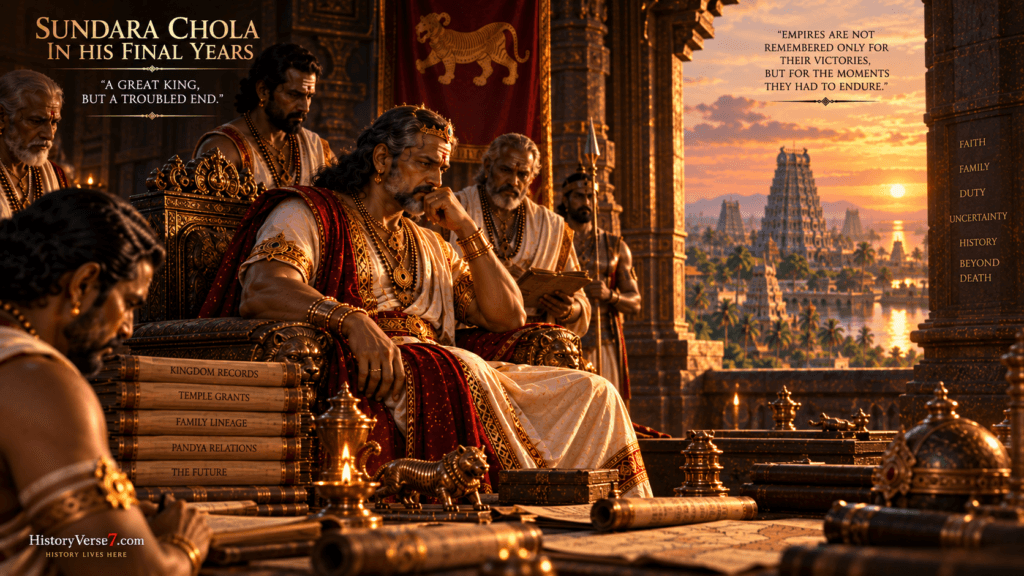
Later traditions including Tamil literary accounts associated with his reign describe Sundara Chola as having experienced significant health difficulties in the later years of his reign. These accounts speak of physical infirmity that limited his activity and may have affected his capacity for direct governance. Whether these accounts reflect historical reality or are later literary elaborations of a king remembered as ruling during difficult political circumstances cannot be established with confidence from the contemporary inscriptional record.
If the accounts of ill health have any historical basis, the political significance would be considerable: a king whose physical capacity was diminished would depend more heavily on family members and trusted officials for the practical exercise of royal authority. Aditya Karikala’s military role would have been even more significant in such circumstances, and the shock of his death even more politically disruptive. But this remains inference from traditions that cannot be independently verified.

The inscriptional record does not preserve evidence that directly speaks to the king’s personal health. Administrative documents land grants, temple endowments, revenue records continued to be issued in his name through his reign, suggesting a functioning royal administration even if the king’s personal engagement in governance may have varied.
Sundara Chola’s Major Achievements
An honest assessment of Sundara Chola’s achievements requires distinguishing between what the evidence establishes and what later tradition asserts, and between achievements that had genuine long-term significance and those that were important in the short term but less durable.
Military continuity was his most visible achievement. The Chola kingdom’s territorial domain was maintained and, in some respects, consolidated during his reign. Chola military pressure on the Pandya kingdom continued. Some reassertion of northern positions, following the Rashtrakuta setback of Takkolam, appears to be associated with his reign a recovery that was important for the Chola kingdom’s long-term strategic position even if it did not produce the kind of dramatic victories that generated memorable inscriptional records.

Administrative development continued during his reign, building on the patterns established by his predecessors and creating the more detailed and systematic land revenue records that historians have used to reconstruct the economic history of the Chola heartland. The officials and administrative networks that served Sundara Chola would carry forward their experience and expertise into subsequent reigns, providing institutional continuity that was valuable precisely because it was invisible.
His dynastic legacy the family he created, the sons he raised, the daughter whose later prominence would shape Chola court culture proved to be, from a long-term perspective, among the most consequential aspects of his reign. Rajaraja Chola I, one of the most celebrated rulers in South Asian history, was Sundara Chola’s son. That fact alone gives Sundara Chola’s reign a historical significance that transcends what his own inscriptions record.
The Challenges and Limitations of His Reign
The challenges of Sundara Chola’s reign were substantial, and acknowledging them is as important as acknowledging his achievements.
Pandya resistance remained persistent and was never definitively resolved during his reign. The southern frontier continued to require military attention and administrative management without the kind of comprehensive strategic resolution that would have allowed the Chola state to redirect resources toward other objectives. This persistent southern instability was a structural feature of the Chola strategic situation rather than a specific failure of Sundara Chola’s governance, but it remained a limitation on what could be achieved during his reign.
The death of Aditya Karikala was the most serious challenge of his reign a dynastic disruption that created succession uncertainty with significant political consequences. Whether this disruption reflects a failure of Sundara Chola’s dynastic management or simply the unpredictable workings of mortality cannot be determined from the available evidence, but its consequences were real regardless of cause.

The succession to Uttama Chola rather than to Arulmozhivarman directly was a political complication that created a period of dynastic uncertainty and potential instability. That the dynasty navigated this complication without catastrophic fragmentation is evidence of the robustness of Chola political institutions; that the complication arose at all reflects the vulnerabilities inherent in dynastic succession systems.
Sundara Chola Timeline
| Date / Period | Event | Historical Significance |
| c. 949 CE | Battle of Takkolam; Rajaditya killed; Parantaka I’s northern position contracted | Background to Sundara Chola’s political inheritance |
| c. 955 CE | Death of Parantaka I; Gandaraditya succeeds | Beginning of post-Parantaka I dynastic adjustment |
| c. 956 CE (approximately) | Death of Arinjaya; Sundara Chola (Parantaka II) becomes king | Sundara Chola’s accession; begins approximately 13-year reign |
| c. 956–969 CE | Sundara Chola’s reign | Military continuity; administrative development; dynastic complexity |
| c. 956–969 CE | Military activities in Pandya territories and Sri Lanka region | Continuing Chola pressure southward; Aditya Karikala’s military role |
| Before c. 969 CE | Death of Aditya Karikala (crown prince) | Succession disruption; circumstances historically uncertain |
| c. 969 CE | Death of Sundara Chola | Succession passes to Uttama Chola (cousin) rather than to sons |
| c. 969–985 CE | Reign of Uttama Chola | Transitional reign; Arulmozhivarman matures politically |
| c. 985 CE | Arulmozhivarman becomes Rajaraja Chola I | Imperial Chola phase begins; Sundara Chola’s son becomes the dynasty’s greatest ruler |
Sundara Chola: Historical Evidence vs. Later Tradition
| Claim | Historical Evidence | Scholarly Assessment |
| Sundara Chola ruled c. 956–969 CE | Later Chola genealogical chronologies | Approximate dates accepted; precision limited |
| He was the son of Arinjaya Chola and grandson of Parantaka I | Consistent across inscriptional genealogies | Well-established dynastic position |
| Aditya Karikala died before Sundara Chola | Established by inscriptional chronology | Fact of death established; circumstances uncertain |
| Aditya Karikala was assassinated for political reasons | Later literary and traditional sources only | Unconfirmed by contemporary evidence; possibility acknowledged |
| Sundara Chola suffered ill health in later years | Later Tamil literary tradition | Not confirmed by contemporary inscriptions; uncertain |
| Military campaigns in Pandya territory and Sri Lanka region | Inscriptional titles and later tradition | Military activity accepted; specific events not fully documented |
| Arulmozhivarman was active militarily during this period | Later Chola tradition and Sri Lankan sources | Possible; not confirmed by contemporary Tamil inscriptions |
10 Lesser-Known Facts About Sundara Chola
- The political significance of Sundara Chola’s reign is, in an important sense, inseparable from the significance of his family — the sons and daughter whose later activities shaped the imperial Chola state in ways that his own inscriptions could not have anticipated.
- Sundara Chola is also known as Parantaka II — a designation that distinguishes him from his famous grandfather Parantaka I while acknowledging the shared royal name. Both designations appear in historical literature.
- His mother was a princess from the Western Ganga dynasty of Mysore — giving him a genealogical connection to one of the significant regional powers of 10th-century peninsular India.
- His daughter Kundavai became one of the most prominent women of the later Chola court, playing significant religious and political roles during her brother Rajaraja I’s reign.
- The title ‘Sundara’ — meaning Beautiful — is somewhat unusual in Chola royal nomenclature, which more typically emphasized martial achievement rather than aesthetic qualities.
- He was the father of Rajaraja Chola I — one of the most celebrated rulers in South Asian history — a paternal relationship that gives his reign historical significance regardless of his own documented achievements.
- His reign saw the gradual weakening of the Rashtrakuta dynasty — the power that had inflicted the Takkolam defeat on Parantaka I — which created an opportunity for Chola northward reassertion that was exploited during his reign and more fully under his successors.
- The prosopographical database of Chola inscriptions developed by Noboru Karashima and colleagues has documented officials and administrators active during Sundara Chola’s reign, providing evidence of administrative continuity across the succession from Parantaka I through to Rajaraja I.
- Sri Lankan chronicle sources — particularly the Culavamsa — contain references to Chola activity in the island during the period of Sundara Chola’s reign, providing a non-Tamil perspective on events that is not always available from the inscriptional record alone.
- The succession from Sundara Chola to Uttama Chola — a lateral move to a cousin — had precedent in Chola dynastic practice; similar lateral successions had occurred after Parantaka I’s death when Gandaraditya and Arinjaya held the throne before Sundara Chola’s own accession.
Author Perspective
Sundara Chola’s reign illustrates a specific and recurring challenge in dynastic history: ruling effectively during a period when the political conditions that will define your reign’s historical reputation have not yet fully developed. The imperial Chola state that historians study in such detail with its systematic land surveys, its magnificent temple construction programme, its naval expeditions across the Bay of Bengal was the product of Rajaraja I’s reign and those that followed. But the conditions that made Rajaraja I’s achievements possible were created partly by Sundara Chola’s management of the dynastic and political situation he inherited.

The death of Aditya Karikala is the episode that most forcefully raises the question of historical contingency. Had Aditya Karikala survived his father, the Chola succession would have passed directly from Sundara Chola to a prince with established military credentials and a clear dynastic claim. The subsequent period of succession complexity Uttama Chola’s reign, and the eventual return of the throne to Sundara Chola’s line through Rajaraja I would not have occurred. Whether the outcome would have been better, worse, or simply different for the Chola dynasty is a question that the evidence cannot answer.
What can be said is that the dynastic succession system of the Chola kingdom flexible enough to accommodate lateral succession when direct succession was unavailable, robust enough to maintain political coherence through a period of succession complexity proved adequate to the challenge. Sundara Chola’s reign was part of the process through which this system was tested. That it passed the test is a historical fact worth appreciating, even if the testing itself is less dramatic than what came after.
Conclusion: The King Between Two Ages
Sundara Chola ruled at a moment when the Chola kingdom was powerful enough to matter in South Indian politics but not yet powerful enough or perhaps not yet ready to launch the systematic imperial expansion that would define the dynasty’s greatest period. His reign was marked by genuine military and administrative activity, by the continuation of the institutional development that his predecessors had begun, and by the complex dynastic politics of a royal family navigating succession questions without clear precedent.
The death of Aditya Karikala was the defining event of his reign the event that most clearly distinguished his political situation from what it might otherwise have been and that set in motion the succession complications of the following two decades. Whether that death reflects accident, illness, or something more deliberately political, the sources do not establish. What it established in political terms was a period of dynastic uncertainty that the Chola institutional system ultimately managed without catastrophic fragmentation.

Sundara Chola’s historical reputation is inevitably shaped by the son who followed him the son whose achievements were spectacular enough to dominate historical memory of the entire Chola dynasty. That is a familiar dynamic in dynastic history, and it does not accurately represent the historical importance of his reign. He ruled during a difficult transition, maintained a complex kingdom, and transmitted it imperfectly but adequately to a sequence of successors who eventually brought the dynasty to its greatest achievements.
The question worth asking about Sundara Chola is not whether he matched Rajaraja I’s imperial achievement. The more illuminating question is whether the Chola kingdom, under his management, remained capable of producing such achievement. The evidence suggests it did. That is a form of historical contribution that the inscriptional record cannot fully capture but that the subsequent history of the Chola dynasty makes impossible to ignore.
Written & Researched by Abhishek Chavan — HistoryVerse7| © 2026 HistoryVerse7 | Cluster Article: Sundara Chola
References and Further Reading
Historical research based on inscriptions, archaeological evidence, academic scholarship and established historical sources including K.A. Nilakanta Sastri, Noboru Karashima, Burton Stein, Upinder Singh, and the Archaeological Survey of India South Indian Inscriptions series.
- Epigraphia Indica — Multiple volumes. Archaeological Survey of India.
- Nilakanta Sastri, K.A. — The Colas (2 vols). University of Madras, 1935 (revised 1955).
- Nilakanta Sastri, K.A. — A History of South India. Oxford University Press, 1955.
- Karashima, Noboru — A Concise History of South India. Oxford University Press, 2014.
- Stein, Burton — Peasant State and Society in Medieval South India. Oxford University Press, 1980.
- Singh, Upinder — A History of Ancient and Early Medieval India. Pearson Education, 2008.
- Champakalakshmi, R. — Trade, Ideology and Urbanization: South India 300 BC to AD 1300. Oxford University Press, 1996.
- Culavamsa (Sri Lankan chronicle) — for references to Chola activity in Sri Lanka during this period.
- Archaeological Survey of India — South Indian Inscriptions series. asi.nic.in
FAQ —– Sundara Chola
Q1: Who was Sundara Chola?
Sundara Chola, also known as Parantaka II, was a Chola king who ruled approximately from 956 to 969 CE. He was the son of Arinjaya Chola and grandson of Parantaka I. He is historically significant as the father of Rajaraja Chola I and as the king who ruled the Chola kingdom during a period of political complexity that preceded the imperial Chola expansion.
Q2: What was his original name and why is he called Parantaka II?
His royal name was Parantaka the same name as his famous grandfather Parantaka I. The designation ‘II’ distinguishes him from his grandfather. The alternate name ‘Sundara Chola’ meaning Beautiful Chola appears in inscriptions and is the designation used in this article to avoid confusion.
Q3: Who was his father?
Arinjaya Chola one of the sons of Parantaka I who briefly held the Chola throne before Sundara Chola’s accession. Sundara Chola was also the grandson of Parantaka I and great-great-grandson (in dynastic terms) of Vijayalaya Chola, the dynasty’s founder.
Q4: What was Sundara Chola’s relationship with Uttama Chola?
Uttama Chola was Sundara Chola’s first cousin both were grandsons of Parantaka I, Sundara Chola through Arinjaya and Uttama Chola through Gandaraditya. After Sundara Chola’s death, Uttama Chola succeeded him as king rather than either of Sundara Chola’s surviving sons, a lateral succession that reflected the complex dynastic politics of the moment.
Q5: How should his reign be understood in the larger development of the Chola Empire?
Sundara Chola’s reign occupies a transitional position between the post-Takkolam recovery of the mid-10th century and the imperial expansion associated with Rajaraja I. His most historically significant contribution may have been the family he created including the son who became Rajaraja I and the daughter Kundavai who shaped later Chola court culture rather than the specific military or administrative achievements of his own reign.
Share this content: