Rajaraja Chola I: 10 Remarkable Facts About the Emperor Who Transformed History
HISTORYVERSE7 • CHOLA EMPIRE RESEARCH SERIES Before Rajaraja Built an Empire, the Cholas Had Already Been Building Power Rajaraja Chola I did not inherit a kingdom without a history. Generations of Chola rulers had already fought for the Kaveri heartland, expanded into neighbouring regions, faced major defeats and developed the political institutions that later supported…
Before Rajaraja Built an Empire, the Cholas Had Already Been Building Power
Rajaraja Chola I did not inherit a kingdom without a history. Generations of Chola rulers had already fought for the Kaveri heartland, expanded into neighbouring regions, faced major defeats and developed the political institutions that later supported imperial expansion.
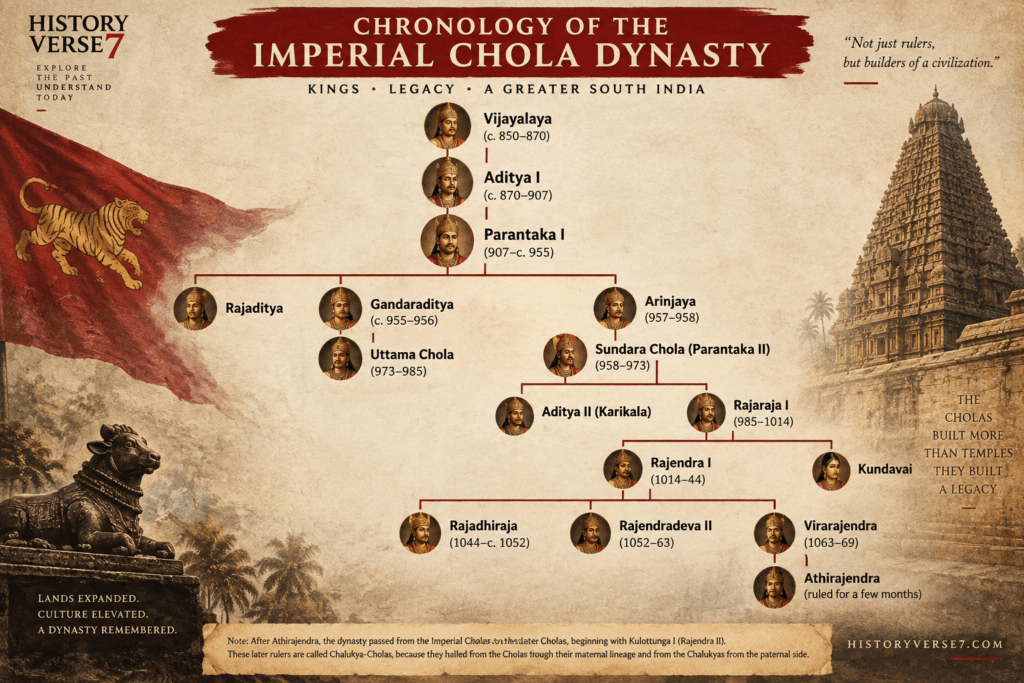
To understand Rajaraja properly, it helps to follow the dynasty before him — from the revival under Vijayalaya to the expansion of Aditya I and Parantaka I, and the difficult succession politics of the later tenth century.
Discover the Origin of the Chola Dynasty →
Read the Story of Vijayalaya Chola →
Understand Aditya I Chola’s Expansion →
Explore Parantaka I and the Takkolam Crisis →
UNESCO — Great Living Chola Temples Research →
Archaeological Survey of India →
DHARMA — South Indian Inscriptions →
The Metropolitan Museum of Art — Chola Art →
Table of Contents: Rajaraja Chola I
Rajaraja Chola I: The King Who Built One of South India’s Greatest Empires
HistoryVerse7.com |Cluster Article: Rajaraja Chola I| International English Edition
Let’s start with a question that doesn’t get asked enough. By the time Rajaraja Chola I came to the throne around 985 CE, the Chola dynasty had already been a significant South Indian power for over a century. Vijayalaya had seized Thanjavur. Aditya I had ended Pallava independence. Parantaka I had pushed Chola forces to Madurai and briefly into Sri Lanka. And yet despite all of that there was no Chola empire in the sense that historians use the word. There was a powerful kingdom. There was a formidable military tradition. There was a revenue base rooted in the extraordinarily productive Kaveri delta.
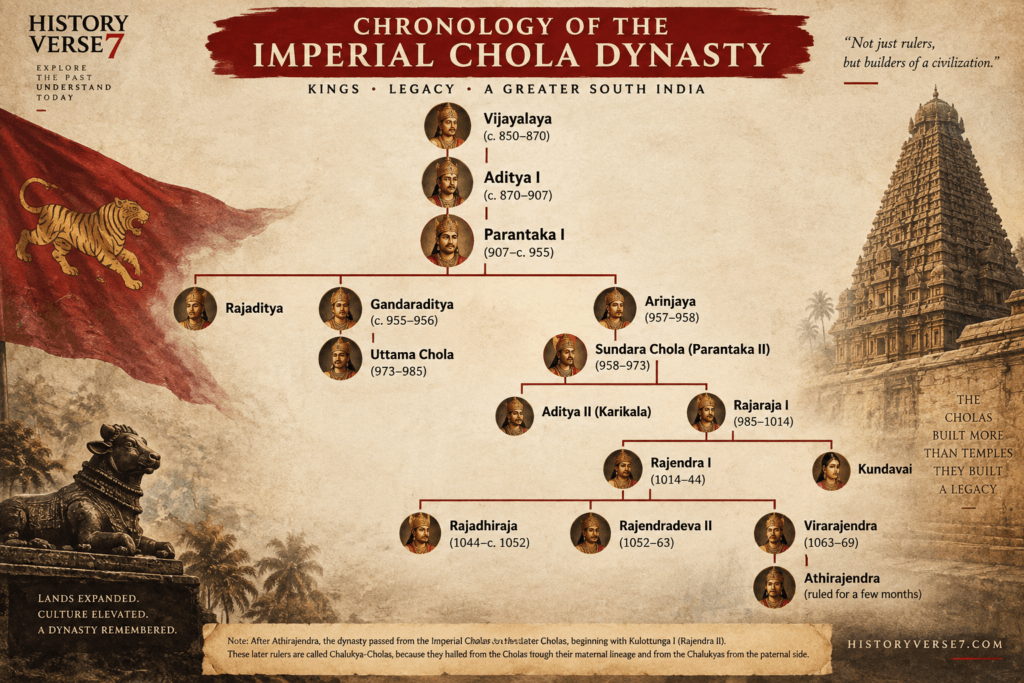
But empire requires more than military victories. It requires administration detailed enough to collect taxes from territories hundreds of miles from the capital. It requires maritime power capable of crossing open ocean. It requires a bureaucratic apparatus that can function across languages, geographies, and local power structures simultaneously. It requires the kind of institutional infrastructure that outlasts any individual campaign.
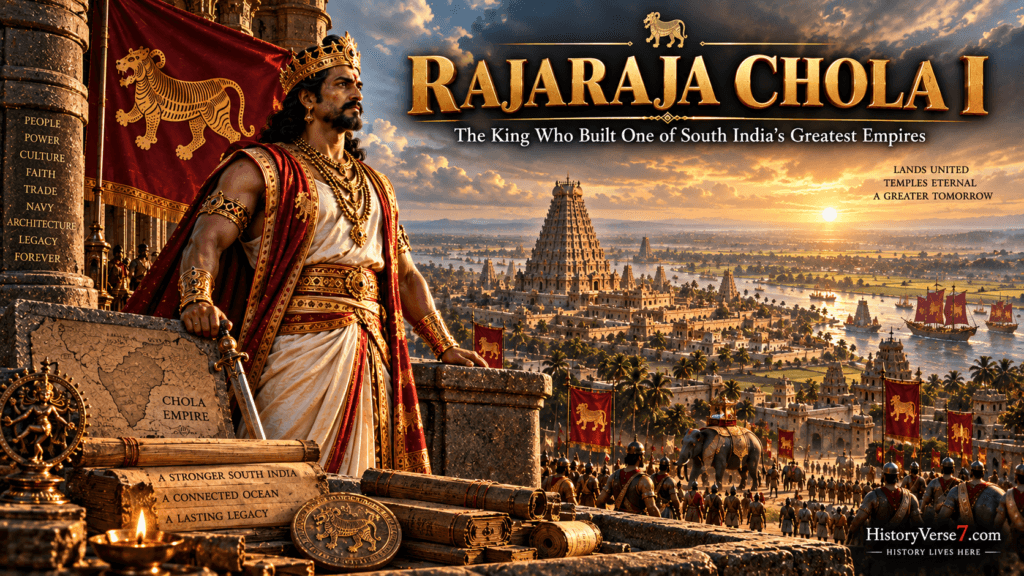
Rajaraja Chola I built that. Not overnight, and not without setbacks. But over thirty years of careful, persistent, and often brilliant statecraft, he transformed what he inherited into something that historians would eventually classify as one of the great medieval Asian empires. The Brihadeeswara Temple still standing after a thousand years, still functioning as a place of worship is the most visible symbol of what his reign produced. But the temple is almost the least interesting part of the story.
Rajaraja Chola I Timeline
| Date / Period | Event | Historical Significance |
| c. 940s–950s CE | Birth of Arulmozhivarman (Rajaraja I) | Future emperor born to Sundara Chola |
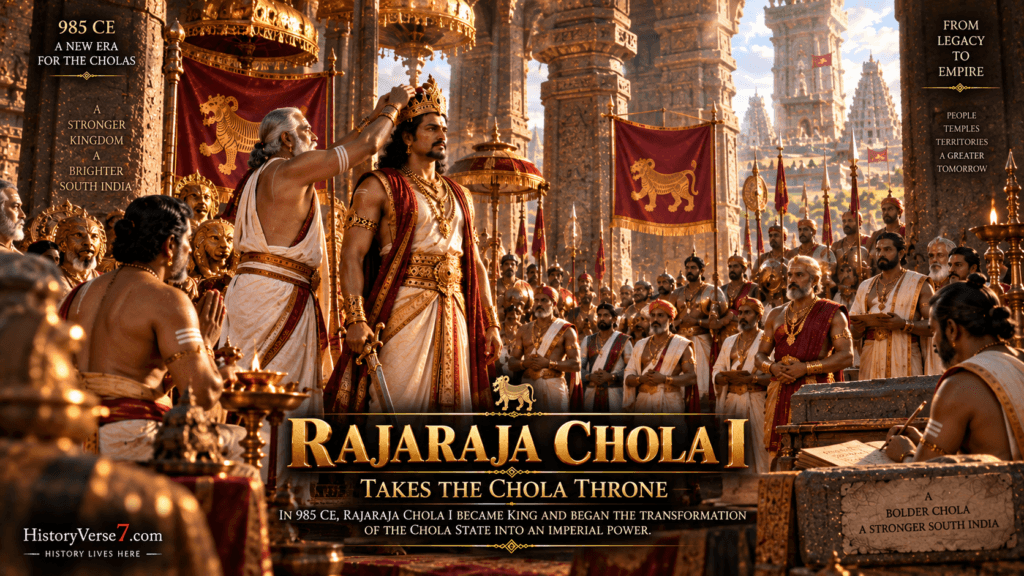
| c. 985 CE | Arulmozhivarman becomes Rajaraja Chola I | Imperial Chola phase begins |
| c. 985–995 CE | Early reign; consolidation and military preparation | Administrative and military foundation laid |
| c. 994–997 CE | Campaigns against Pandyas; capture of Pandya territories | Southern Tamilakam incorporated; ‘Maduraikonda’ tradition continued |
| c. 994–1007 CE | Campaigns against Cheras; western coast and Lakshadweep | Maritime dimension of Chola expansion established |
| c. 995–1001 CE | Sri Lanka invasion; capture of northern Sri Lanka | Chola becomes maritime empire; Sri Lankan capital displaced |
| c. 1001 CE | Anuradhapura occupied; Polonnaruwa established as Chola capital | Ancient Sri Lankan capital abandoned; Chola administration begins |
| c. 994–1014 CE | Campaigns against Western Chalukyas; Vengi alliance | Deccan frontier managed; Eastern Chalukya alignment secured |
| c. 1000–1010 CE | Land survey; administrative reorganization | Fiscal infrastructure for empire created; institutional peak |
| c. 1010 CE | Brihadeeswara Temple consecrated at Thanjavur | Greatest architectural monument of Chola civilization |
| c. 1010 CE onward | Rajendra increasingly prominent; military commands | Succession preparation; institutional continuity ensured |
| c. 1014 CE | Death of Rajaraja Chola I; succession of Rajendra I | Empire transmitted intact; Rajendra expands further still |
Who Was Rajaraja Chola I?
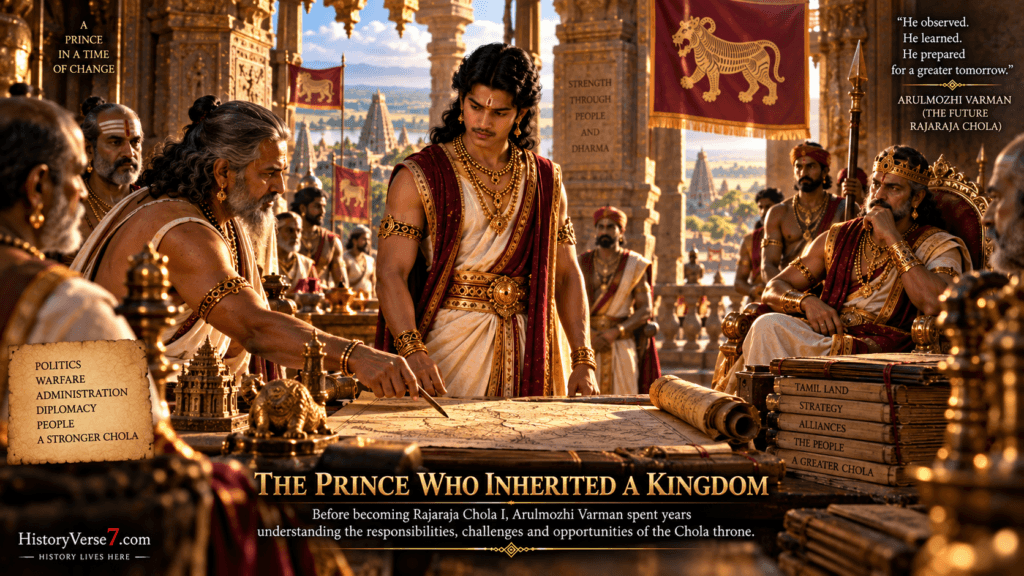
Rajaraja Chola I was born Arulmozhivarman a Tamil name meaning ‘he whose word is grace’ the younger son of Sundara Chola (Parantaka II) and a princess named Vanavan Mahadevi. His birth date is not precisely established by contemporary sources, but most historians place it somewhere in the 940s or 950s CE. He grew up in the Chola royal household during a period of dynastic complexity that included the death of his elder brother Aditya Karikala before their father and the subsequent reign of their cousin Uttama Chola, who held the throne from approximately 969 to 985 CE before the throne passed to Arulmozhivarman.
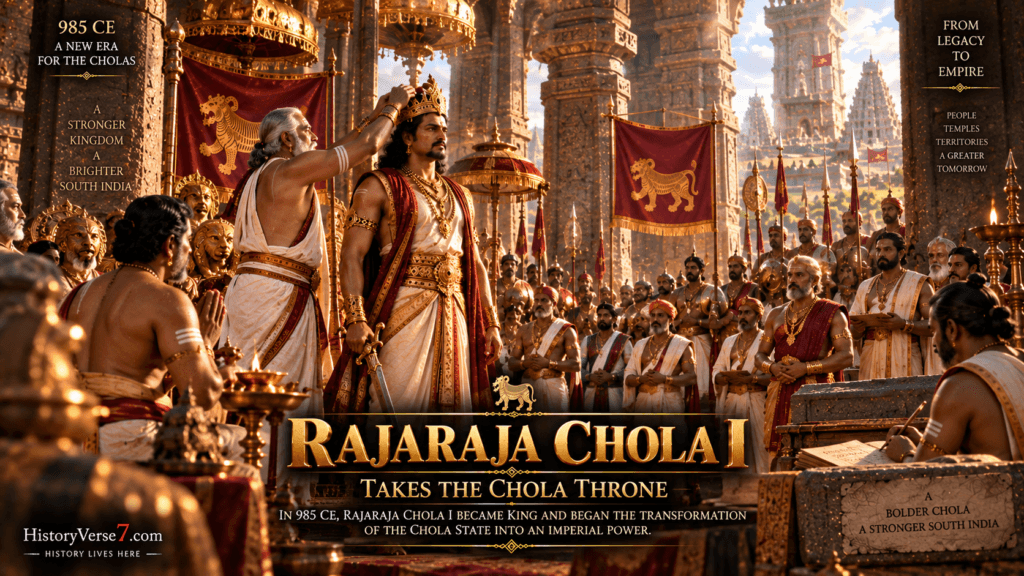
The throne name he adopted on accession, Rajaraja, meaning ‘King of Kings’, was itself a political statement. It announced ambitions that his predecessors, for all their achievements, had not quite claimed so explicitly. The name was not unusual in South Asian royal tradition, but it carried weight. It positioned the new king as paramount among rulers rather than merely first among equals in the Tamil political landscape.
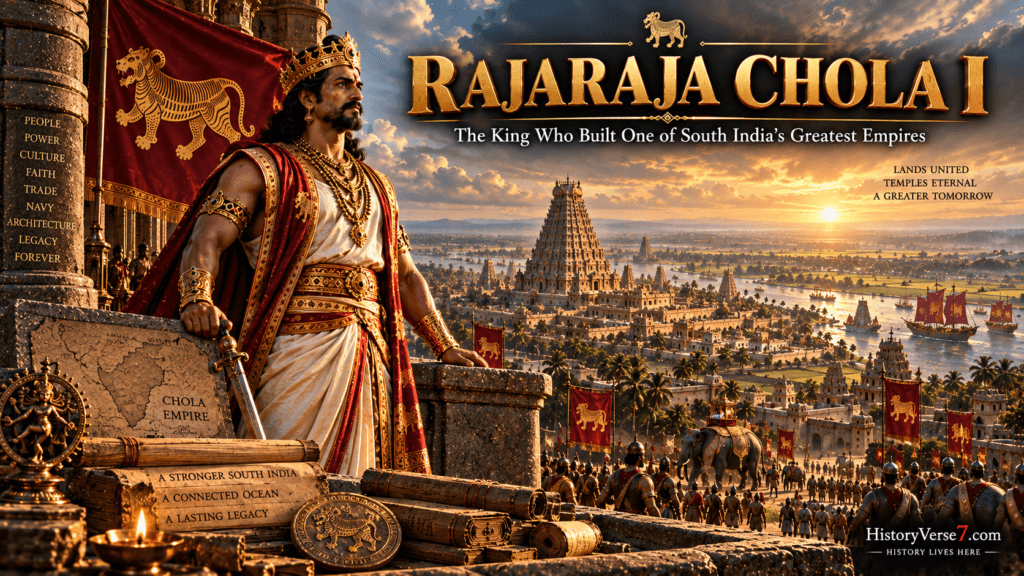
His sister Kundavai, who would become one of the most influential royal women of the Chola period, was an active presence in the political and religious life of the court throughout his reign. Inscriptions from his reign document her own patronage of temples and her connections with the leading religious institutions of the Tamil country, providing some of the richest evidence available for the roles that elite Chola women could play in public life.
Rajaraja’s son Rajendra, the future Rajendra Chola I, who would extend the dynasty’s reach to Southeast Asia and to the Ganges was involved in military and administrative affairs from relatively early in his father’s reign, gaining the experience and the political networks that would define his own subsequent rule. Father and son appear to have worked in close coordination, with Rajendra taking on increasingly significant military responsibilities as Rajaraja’s reign progressed.
The Chola Kingdom Before Rajaraja
Vijayalaya’s Revival
The imperial Chola story started with Vijayalaya Chola’s seizure of Thanjavur from the Muttaraiyar chiefs around 848 CE. The act was relatively modest in scale capturing one city and its surrounding delta territory but its long-term consequences were extraordinary. Thanjavur controlled the Kaveri delta’s agricultural heartland, the most productive rice-growing landscape in South Asia, and whoever held it had the revenue base to build something much larger.
Aditya I’s Expansion
Vijayalaya’s son Aditya I took the obvious next step: he went north and removed the Pallavas from the political equation. The defeat and death of Aparajita Pallava around 890 CE ended Pallava independence and opened the entire northern Tamil country Tondaimandalam, including the ancient capital Kanchipuram to Chola authority. Within two generations, the Chola dynasty had gone from delta chieftaincy to dominant power in Tamil Nadu.
Parantaka I and the Takkolam Crisis
Parantaka I spent nearly fifty years pushing that dominance further south to Madurai, across the strait to Sri Lanka, in a reign of spectacular ambition that ended in the serious setback of Takkolam around 949 CE. The Rashtrakuta king Krishna III defeated the Chola forces, killed the heir-apparent Rajaditya, and contracted Chola northern positions. What followed was a period of dynastic adjustment the brief reigns of Gandaraditya and Arinjaya before Sundara Chola stabilized the situation.
Sundara Chola
Sundara Chola (Parantaka II) ruled approximately 956 to 969 CE. His reign saw some military recovery, continued administrative development, and the complex dynastic politics that included the death of crown prince Aditya Karikala and the eventual succession of his cousin Uttama Chola rather than his own son Arulmozhivarman. It was a period of real political difficulty navigated without catastrophic collapse.
Uttama Chola
Uttama Chola held the throne from approximately 969 to 985 CE a transitional reign whose historical significance lies primarily in what it maintained rather than what it created. The Chola administrative system continued functioning, the military remained intact, and when Arulmozhivarman eventually came to power as Rajaraja I, he inherited a kingdom in reasonable political health if not spectacular growth.
How Rajaraja Chola Became King
The Succession After Uttama Chola
Uttama Chola died around 985 CE without a direct male heir in the line that would succeed him, and the throne passed to Arulmozhivarman Sundara Chola’s surviving son, who now became Rajaraja Chola I. The transition appears to have been orderly. No contemporary source records a succession dispute, and the smooth transfer suggests that whatever dynastic complexities had characterized the period of Uttama Chola’s reign had been managed within the royal family framework.
Rajaraja’s Position Before Accession
During Uttama Chola’s sixteen-year reign, Arulmozhivarman had not been idle. Later Chola tradition and some Sri Lankan chronicle evidence associates him with military activities in the south and across the Palk Strait during this period. Whether these accounts reflect precisely what happened is debated, but the broader picture is plausible: the prince who would become one of history’s great administrators and military commanders was almost certainly developing his capabilities and building his political networks during these years of enforced waiting.
The Beginning of His Reign
The beginning of Rajaraja’s reign is not dramatically marked by any single founding act that later tradition elevated to mythological status. The early years appear to have been devoted to consolidation, political positioning, and the deliberate preparation of military campaigns whose scope suggests careful planning. By the early 990s CE, the campaigns had begun in earnest.
The Kingdom He Inherited
What exactly did he inherit? A kingdom with a secure agricultural heartland in the Kaveri delta, a functioning administrative apparatus capable of managing land revenue across a substantial territory, a military tradition with real capability, a religious infrastructure of endowed temples that also served as economic institutions, and a political position that was dominant in the Tamil country but still subject to challenge from the Pandyas in the south, the Western Chalukyas in the north, and from Sri Lanka across the strait. The ingredients for empire were present. The empire itself still needed to be built.
The Early Years of Rajaraja’s Reign
The first decade of Rajaraja’s reign roughly 985 to 995 CE is less well documented in the inscriptional record than the later imperial period, but it was clearly not a period of passivity. The Chola state was being prepared for the sustained military expansion that would define the middle and later years of his reign, and that preparation required administrative attention, military organization, and diplomatic groundwork.
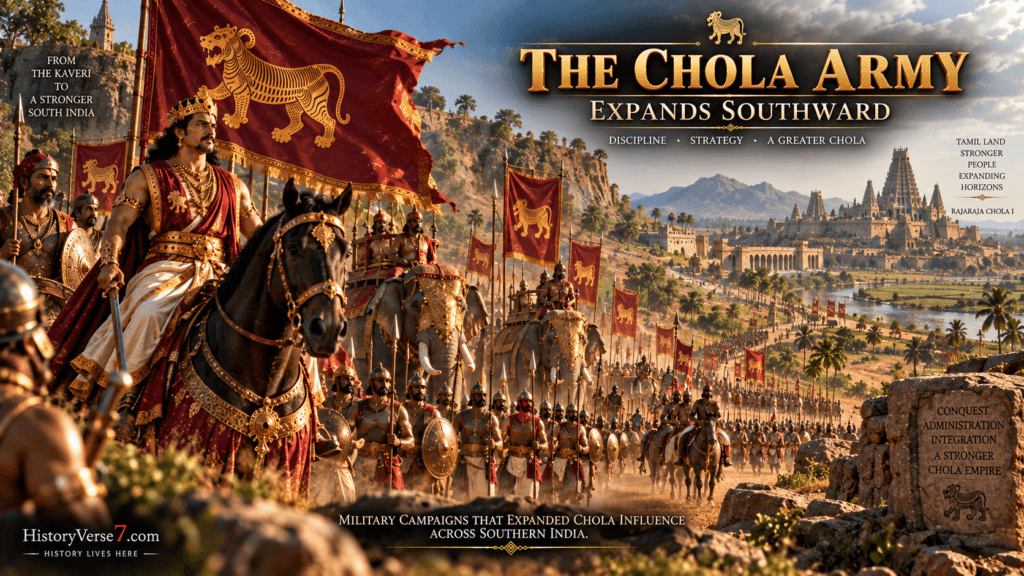
The Chola kingdom of 985 CE faced challenges in several directions simultaneously. To the south, the Pandya kingdom remained capable of resistance and had never fully accepted subordination to Chola authority. To the west, the Chera kings of the western coast controlled territory and trade routes that were strategically valuable. To the north, the Western Chalukyas of Kalyani were the dominant Deccan power, and the Chola-Chalukya frontier was a zone of persistent competition. Across the Palk Strait, Sri Lanka was politically turbulent, offering both a challenge and an opportunity.
Managing all of these simultaneously required sequencing and choosing which challenges to address first, which relationships to manage diplomatically while military attention was focused elsewhere, and how to allocate the state’s military and financial resources most effectively. The campaigns of Rajaraja’s middle reign show evidence of this kind of strategic thinking, though reconstructing the specific calculations is necessarily an inference from outcomes rather than direct evidence of planning.
Rajaraja Chola and the Pandyas
The Chola-Pandya Rivalry
The rivalry between the Chola and Pandya dynasties was by the late 10th century already more than a century old in its imperial-era form, rooted in the fundamental geographical competition between two powers with overlapping territorial ambitions in the Tamil south. Parantaka I had captured Madurai and earned the title ‘Maduraikonda,’ but that capture had not permanently ended Pandya political independence. The Pandyas had reasserted themselves repeatedly in the intervening decades.
Campaigns in Southern Tamilakam
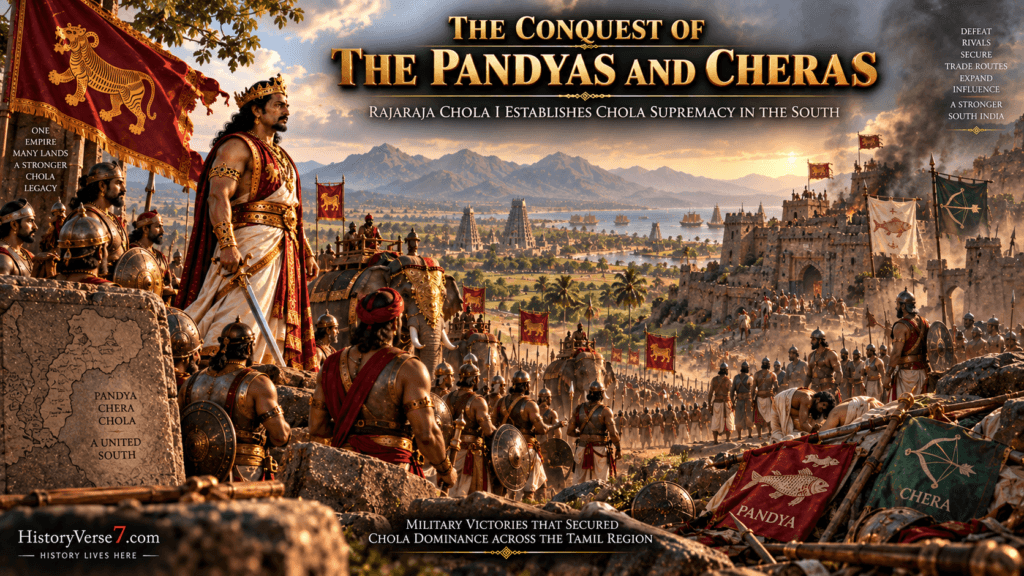
Rajaraja’s campaigns against the Pandyas in the 990s CE were more systematic and ultimately more decisive than those of his predecessors. The inscriptional record, particularly the Tiruvalangadu copper plates and the great Rajaraja inscription at the Brihadeeswara Temple, records his military achievements against Pandya forces in terms that suggest comprehensive rather than merely temporary Chola dominance. The Pandya king of this period, whose precise identity is subject to some scholarly debate, was driven from his kingdom, with later tradition associating his refuge with Sri Lanka and with connections to the Chola’s other enemies.
Political Importance of the Pandya Country
Why did the Pandya territories matter so much? The strategic logic was multiple. Southern Tamilakam was agriculturally productive in its own right. The Gulf of Mannar pearl fisheries were commercially valuable. The ports of the southern coast were important nodes in the Indian Ocean trading network. And Pandya political independence was, from the Chola perspective, a persistent structural challenge: a rival power base that could always potentially form the core of an anti-Chola coalition.
Consequences of Chola Expansion
The incorporation of the Pandya territories into the Chola administrative system during Rajaraja’s reign was not complete or uncomplicated. The Pandyas would reassert themselves in subsequent periods, and Chola southern authority required continuous military maintenance. But the pattern established by Rajaraja of treating the Pandya territories as Chola administrative zones rather than independent kingdoms shaped the political geography of the Tamil south for the next century.
Rajaraja Chola and the Cheras
The Chera kingdom of the western coast, controlling the narrow strip of land between the Western Ghats and the Arabian Sea that corresponds broadly to modern Kerala, was not a Chola rival in the same sense as the Pandyas. Its geography was different, its political tradition was different, and the specific character of Chola-Chera competition reflected the western coast’s particular strategic position.
The western coast mattered to the Chola state for several reasons. The passes through the Western Ghats connecting the Coromandel coast to the Malabar coast were strategically significant; controlling them affected the movement of goods and armies across the peninsula. The ports of the Malabar coast were nodes in the Arabian Sea trading network, connecting the peninsula’s commerce to the Persian Gulf and Red Sea. And the Chera king was, from time to time, a potential ally for the Chola’s other enemies.
Rajaraja’s campaigns against the Cheras, documented in his inscriptions, particularly in the great Thanjavur inscription, resulted in the defeat of Chera forces and the assertion of Chola authority over the western coastal territories. The specific military engagements are not described in detail that would allow confident reconstruction of specific battles, but the inscriptional claim of military achievement is broadly accepted by historians as reflecting real Chola expansion in this direction.
The maritime implications of Chola western coastal activity were significant. The Lakshadweep (Laccadive) Islands, which lay along the maritime route between the Coromandel and Malabar coasts and across the Arabian Sea, came under Chola influence during Rajaraja’s reign, suggesting that the western campaigns had an offshore dimension connected to the broader development of Chola maritime capacity.
Rajaraja Chola and Sri Lanka
Why Sri Lanka Became a Chola Target
Sri Lanka had been in Chola military sights since Parantaka I, and the political logic had not changed: the island was commercially important, strategically significant for controlling the Palk Strait sea lanes, a potential refuge for Chola enemies (particularly Pandya fugitives), and a source of valuable resources. What had changed by Rajaraja’s time was Chola military capacity; the state was now capable of sustained operations across open water in ways that earlier Chola armies had not been.
The political situation in Sri Lanka itself also created an opportunity. The island had experienced significant political turbulence in the decades before Rajaraja’s campaigns, with multiple competing claimants to the Sinhalese throne and the political fragmentation that created conditions in which external intervention could be decisive. The Culavamsa, the Sri Lankan chronicle that provides the island’s perspective on this period, records the Chola arrival in terms that emphasize the political chaos the invasion created and the specific ways in which Chola forces exploited existing political divisions.
The Chola Invasion
Rajaraja’s invasion of Sri Lanka, launched in the mid-990s CE, according to most chronological reconstructions, was a major military operation rather than a raiding expedition. Chola forces crossed the Palk Strait, defeated the Sinhalese king Mahinda V’s forces in engagements documented in both Tamil and Sri Lankan sources, and established Chola control over the northern and central parts of the island. The Sinhalese court retreated southward to Rohana, the island’s southern province, which was not initially conquered.
Northern Sri Lanka and Anuradhapura
The most significant consequence of the initial invasion was the fall of Anuradhapura, the ancient Sinhalese capital, one of the oldest continuously inhabited cities in South Asia and the religious center of Theravada Buddhism on the island. The Chola forces apparently plundered Anuradhapura. Sri Lankan sources describe the destruction or removal of sacred objects in an act that had profound religious and political implications for the island’s population. The ancient capital was subsequently abandoned, and Chola administration was established with Polonnaruwa as its center.
The choice of Polonnaruwa as the new administrative center reflected practical Chola interests: it was better positioned for communications and control of the island’s northern and central regions, but it also represented a dramatic break with the Sinhalese political tradition of Anuradhapura. For Chola administrative purposes, the new center was more functional; for Sinhalese political identity, the loss of the ancient capital was a profound disruption.
The Limits of Early Chola Control
The Chola conquest under Rajaraja did not extend to the entire island. The southern province of Rohana remained under Sinhalese control, with Mahinda V maintaining a royal court there. The island was effectively divided: Chola administration in the north and center, and Sinhalese resistance in the south a partition that would create persistent challenges for Chola governance and that would eventually lead to Sinhalese recovery of the island under Vijayabahu I in the early 12th century.
Historical Evidence from Sri Lankan Sources
The Culavamsa provides detailed accounts of the Chola invasion that are invaluable for historians precisely because they present a perspective absent from Chola inscriptional sources. Tamil inscriptions celebrate the conquest; the Sri Lankan chronicle records its human and political consequences from the other side. Using both sets of sources together critically and carefully, recognizing the political purposes of each gives historians a more complete picture of what the Sri Lanka campaign meant in practice than either source alone provides.
Rajaraja Chola and the Western Chalukyas
The Western Chalukyas of Kalyani, who controlled the Deccan and were the dominant power north of the Chola kingdom, represented a different kind of challenge from the Pandyas or the Cheras. They were a continental power rather than a regional one, capable of mobilizing military forces on a scale that matched or exceeded the Chola state’s capacity. The Chola-Chalukya relationship during Rajaraja’s reign was one of persistent competition along a contested frontier rather than the decisive campaigns that characterized Chola southern expansion.
Rajaraja’s inscriptions record military activity in the direction of the Chalukya territories specifically, campaigns in the Deccan regions bordering the Chola northern frontier. The Vengi region (roughly corresponding to the northern Andhra coast) was a zone of particular Chola-Chalukya competition, where the two powers fought for influence over the Eastern Chalukya kingdom that controlled this strategically important coastal corridor.
The Eastern Chalukyas of Vengi, a separate dynasty from the Western Chalukyas, despite the shared name, were drawn into alignment with the Cholas through a marriage alliance that had significant long-term consequences: Rajaraja’s daughter Kundavai (a different Kundavai from his sister) married a Vengi Chalukya prince. This alliance helped secure the Chola northern coastal flank and gave the Chola state a foothold in Deccan politics that would become increasingly important under Rajendra I.
The Expansion of the Chola Empire
By approximately 1010 CE, the midpoint of Rajaraja’s reign, the Chola state controlled a larger and more diverse territory than at any previous point in its history. Understanding the geographical scope of this expansion requires looking at several distinct zones, each with its own strategic logic and administrative challenges.
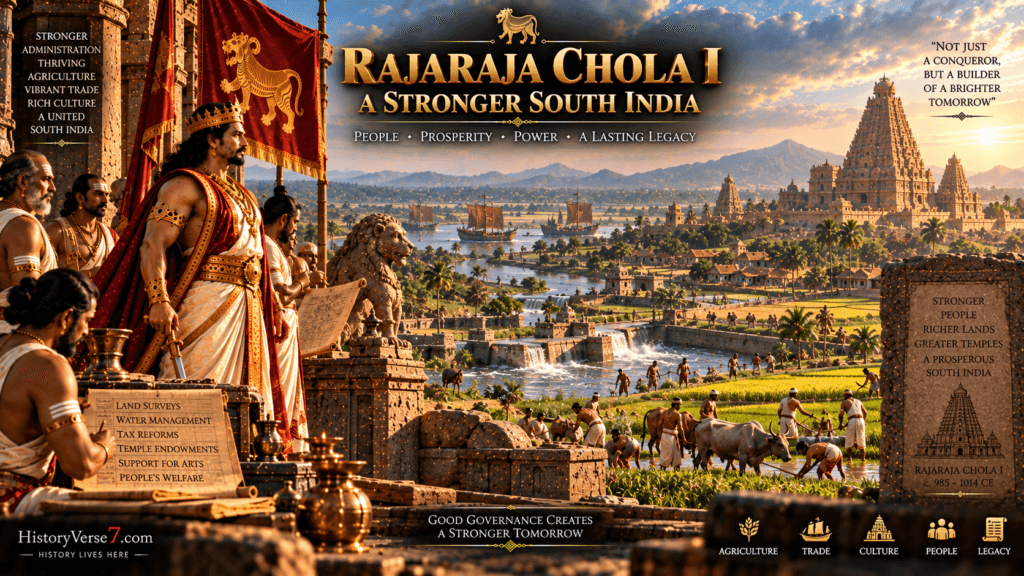
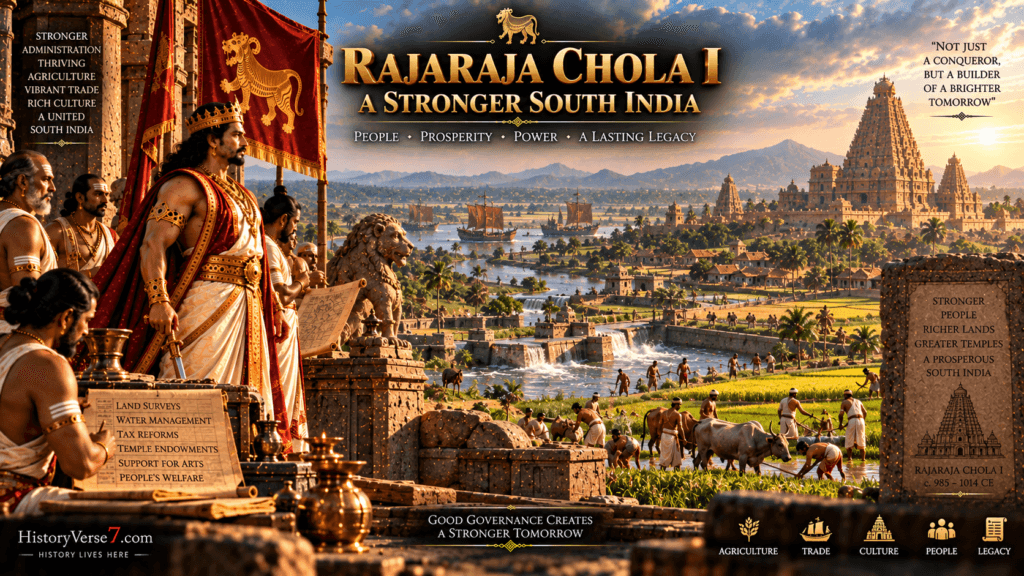
The Kaveri delta remained the heartland, the agricultural engine that powered everything else. The irrigation systems of the delta, the systematic land revenue administration developed over the preceding century, and the dense network of endowed temples that served as local economic institutions all continued to function as the economic foundation of the imperial enterprise.
The Tamil regions beyond the delta Tondaimandalam in the north and the Pandya country in the south were incorporated zones whose loyalty to the Chola state was maintained through a combination of military presence, administrative management, and the strategic use of temple patronage to build local institutional ties.
Sri Lanka represented the most dramatic territorial extension: an island across open water, requiring maritime logistics rather than overland supply lines, with a population that did not share the Tamil language or Shaivite religious tradition of the Chola heartland. Administering Sri Lanka required different tools from those used in Tamil Nadu.
The western coast and the Lakshadweep Islands represented a maritime dimension of Chola expansion whose full implications would only become visible under Rajendra I. Rajaraja was establishing the maritime infrastructure the coastal bases, the naval forces, the administrative mechanisms for overseas territory that made Rajendra’s more spectacular sea campaigns possible.
Rajaraja Chola’s Military System
The military that enabled Rajaraja’s expansion was not created from scratch during his reign. It was the product of more than a century of Chola military development, building on foundations established by Vijayalaya and systematically developed by each succeeding generation. What Rajaraja did was to scale it, organize it more systematically, and extend it into the maritime domain in ways his predecessors had not.
The Chola army of Rajaraja’s period combined several elements. Professional royal forces, the standing army directly loyal to and paid by the king, formed the core. Feudatory contingents contributed by subordinate chiefs supplemented these forces for major campaigns. Specialist units including elephant corps, cavalry, and infantry with various weapons and tactical roles added capability for different kinds of warfare.
The Brihadeeswara Temple inscription, one of the richest documentary sources for Rajaraja’s reign, records the military titles and achievements claimed by the king in ways that illuminate the specific campaigns and the sequence of conquests. While the inscriptional language is eulogistic rather than descriptive, it preserves a chronological framework of military activity that historians have used to reconstruct the sequence of Rajaraja’s campaigns.
What the inscriptions cannot tell us directly, and where speculation must be resisted, are the specific tactical decisions, the numbers of soldiers involved, the details of individual engagements, or the private planning that preceded campaigns. Medieval South Indian inscriptions record results, not processes, and the confidence with which some popular accounts reconstruct specific battles and troop movements exceeds what the evidence actually supports.
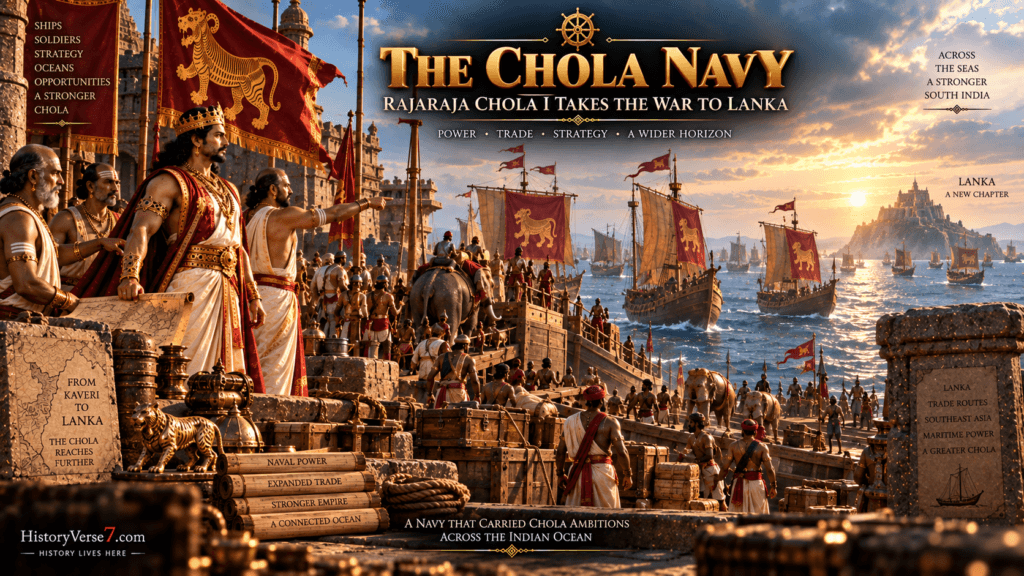
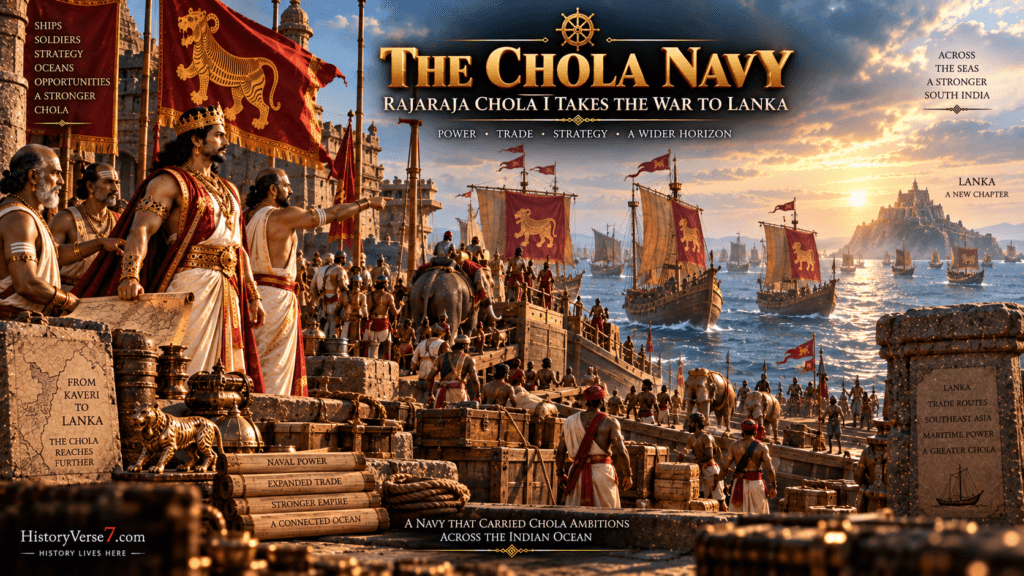
The Chola Navy Under Rajaraja
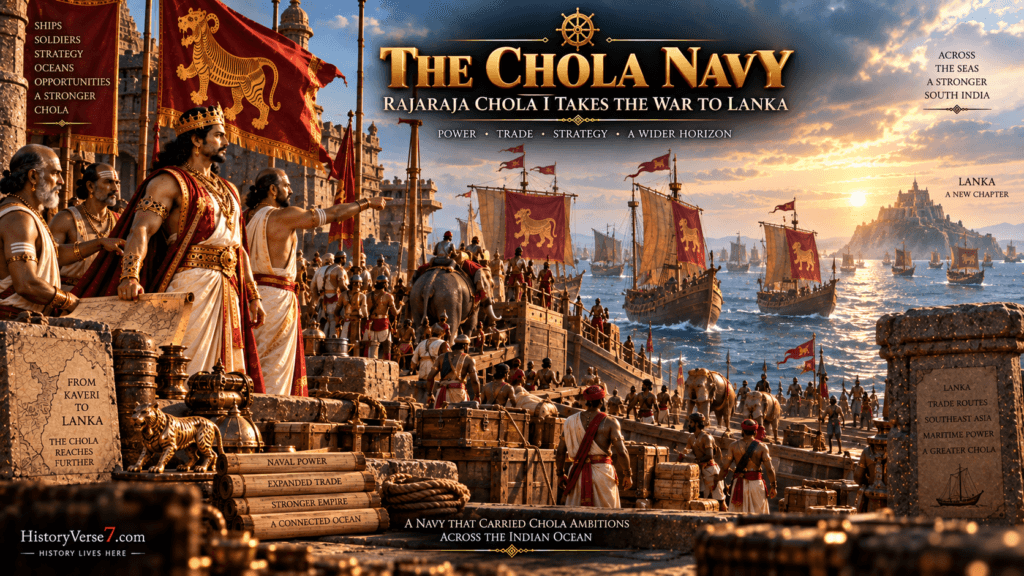
The Sri Lanka campaign made one thing absolutely clear: the Chola state under Rajaraja was not simply a land power with occasional maritime ambitions. It was developing into a genuine naval power, an entity capable of projecting military force across open water, supplying and reinforcing distant coastal positions, and protecting the sea lanes that connected the Chola territories with the wider Indian Ocean commercial world.
The detailed history of Chola naval development is the subject of a separate cluster article. What needs to be noted here is that Rajaraja’s reign was the period during which this naval capacity became fully operational rather than merely aspirational. The Sri Lanka crossing required not just warships but transport vessels, logistics, communication systems, and the navigational knowledge to operate reliably across the Palk Strait and around the island’s coasts.
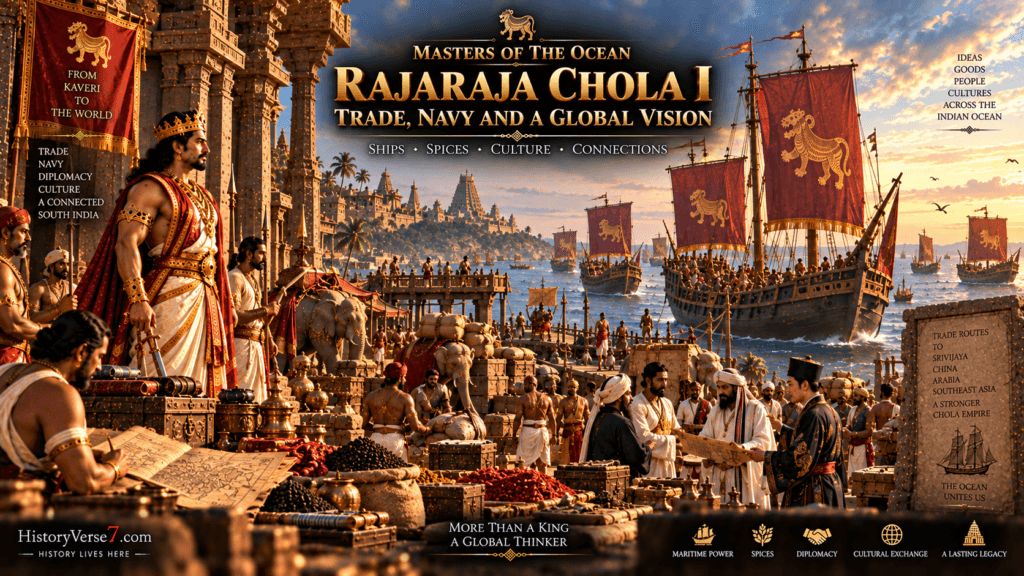
The Coromandel coast ports, Nagapattinam in particular, served as naval bases for these operations. Nagapattinam’s importance as a commercial and religious center (it hosted significant Buddhist and Tamil Shaivite institutions) complemented its military function: the commercial infrastructure of the port supported the logistics of naval operations, while the religious institutions provided networks of local knowledge and loyalty.
The Maldives Islands mentioned in Rajaraja’s inscriptions as a zone of Chola maritime activity extended the reach of Chola naval operations into the Indian Ocean beyond the Palk Strait and the Lakshadweep. Whether Chola presence in the Maldives constituted anything like administration or merely the assertion of maritime dominance is debated, but the geographical reach it represents is significant.
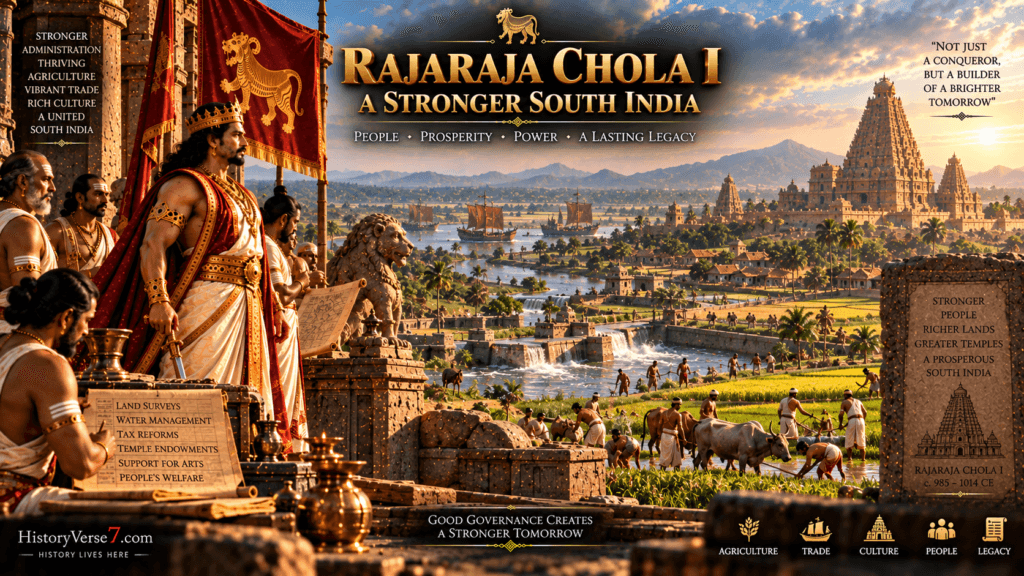
Rajaraja Chola’s Administrative Reforms
This is where Rajaraja’s reign becomes most interesting to historians who care about how states actually function rather than just about military victories. The administrative development of the Chola state under his reign was systematic, extensive, and, unusually for a medieval South Asian polity exceptionally well-documented in the inscriptional record.
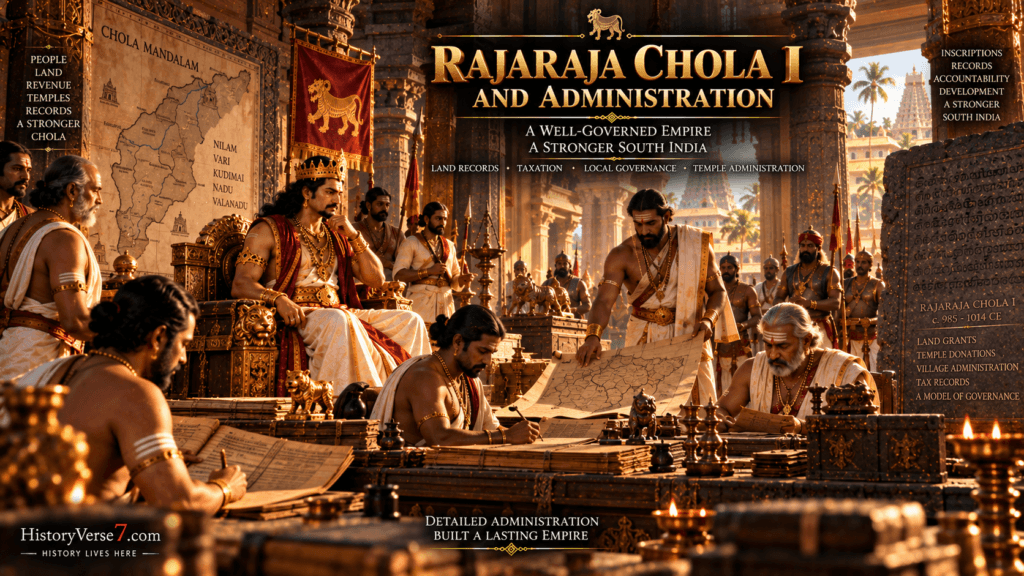
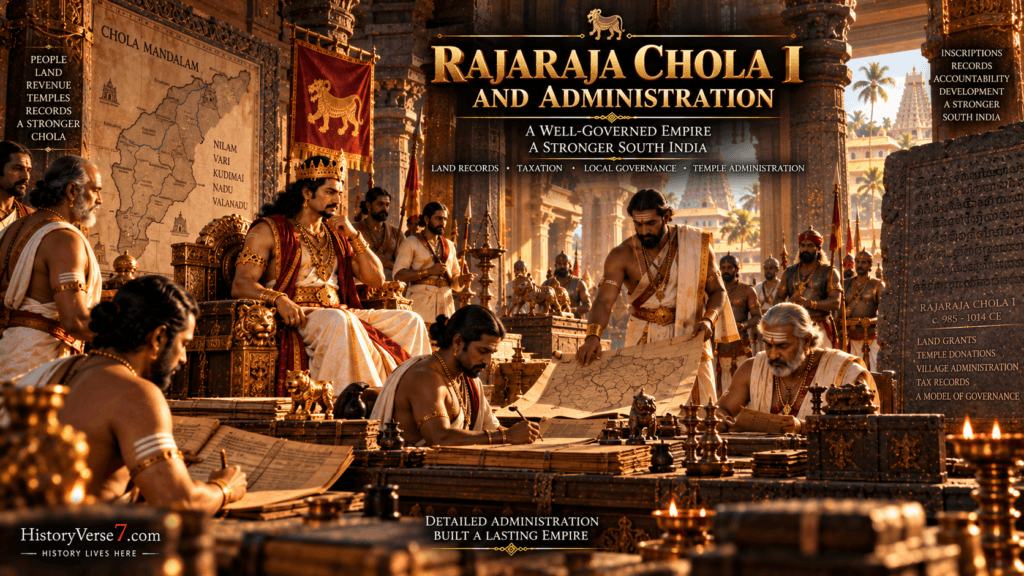
The starting point is the land survey: the systematic measurement, classification, and registration of agricultural land across the Chola territories. Rajaraja undertook a comprehensive survey of land in the Chola heartland that created a documentary record of extraordinary detail. Villages were measured. Field types were classified. Revenue obligations were assessed and recorded. The resulting administrative record allowed the state to track land ownership, manage revenue collection, and document the grants through which revenue rights were transferred to temples and other recipients with a precision unusual for any pre-modern state.
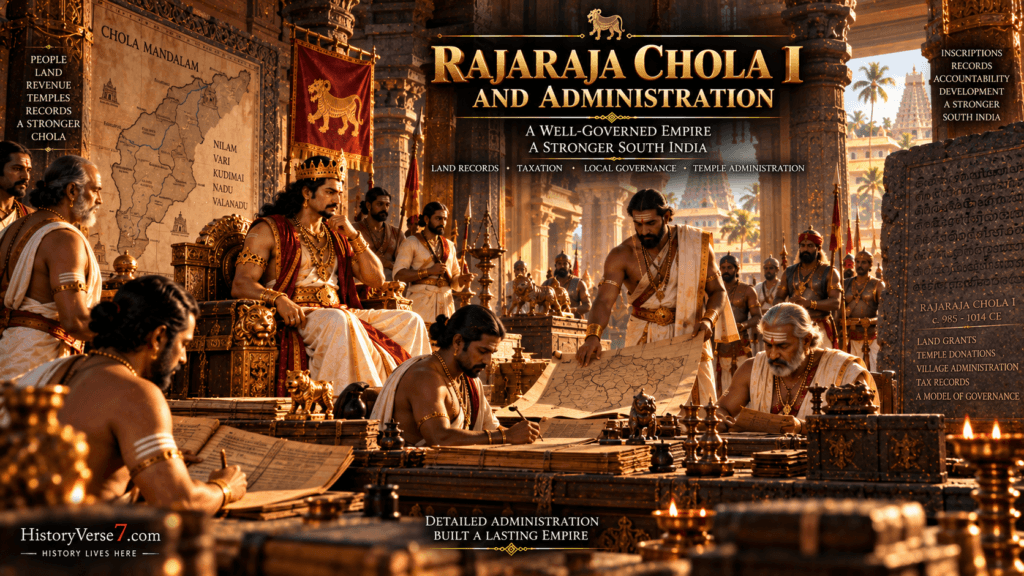
This wasn’t simply bureaucratic tidiness. The land survey served the state’s most fundamental fiscal interest ensuring that the agricultural surplus of the Kaveri delta and surrounding territories was systematically converted into royal revenue. Without that revenue, nothing else in Rajaraja’s programme the military campaigns, the temple construction, the institutional development would have been financially possible.
The relationship between revenue administration and temple endowment deserves particular attention. When Rajaraja endowed the Brihadeeswara Temple with land grants and the scale of those grants was enormous he was not simply expressing personal piety. He was transferring revenue rights to an institution that would then manage those resources within a framework supervised by the royal administration. The temple economy was not separate from the state economy; it was a specific organizational form within the broader fiscal system.
The Land Survey and Revenue System
The land survey associated with Rajaraja’s reign conducted sometime in the first decade of his rule, according to the inscriptional evidence, was one of the most significant administrative acts of the entire Chola imperial period. Understanding what it was and what it achieved requires stepping back from the dramatic military narrative and paying attention to the unglamorous but essential work of fiscal administration.
Medieval South Indian land surveys were not simple censuses. They were complex administrative exercises involving the physical measurement of individual fields, the classification of land by type and productivity (different rates applied to irrigated wet land, rain-fed dry land, garden land, and so forth), the identification of existing ownership and cultivation rights, and the calculation of revenue obligations. The results were recorded in registers often inscribed in stone, giving them a permanence that paper or palm-leaf records could not guarantee, and used as the basis for both taxation and for the documentation of grants that transferred revenue rights from cultivating landowners to temples or Brahmin recipients.
The Uthiramerur inscriptions, from the late 9th and early 10th century, already show the sophistication of Chola land administration before Rajaraja’s reign. What Rajaraja’s survey added was scale and systematicity, extending the detailed administrative record across a larger territory, standardizing the classification systems, and creating a comprehensive fiscal infrastructure for the empire.
Rajaraja Chola and the Local Administration
One of the most celebrated features of the Chola administrative system is its system of local self-government the village assemblies (sabhas or urs), the merchant assemblies (nagarams), and the various specialized bodies that managed particular aspects of local life. These institutions were not created by Rajaraja; they had deep roots in Tamil social organization that predated the Chola dynasty. What Rajaraja’s reign contributed was the systematic integration of these local institutions into the imperial administrative framework.
The relationship worked something like this: the central administration established the fiscal framework the revenue rates, the land survey records, the grant documents but left the actual management of local affairs to existing institutions. The sabha managed the village’s collective interests, settled local disputes, maintained irrigation, and administered the endowments that supported local temples. The nagaram represented merchant community interests. The temple managing bodies oversaw the enormous economic activities of the major endowed temples.
Royal administration reached into these local institutions not by replacing them but by working through them, requiring that certain decisions be confirmed at the local assembly level, ensuring that revenue collection operated through established local channels, and using temple institutions as administrative nodes for activities ranging from record-keeping to the distribution of charitable resources.
The result was a state that was simultaneously highly organized at the imperial level and relatively autonomous at the local level a combination that was both practically effective and politically stable. Local communities retained meaningful control over their own affairs within the framework the central administration established, which gave them reasons to support rather than resist that framework.
Rajaraja Chola and the Economy
The economic history of Rajaraja’s reign is inseparable from its agricultural and administrative history, but it is not reducible to them. The Chola state under Rajaraja was embedded in the Indian Ocean commercial world connected to trade networks extending from the Persian Gulf to the South China Sea in ways that went well beyond the internal management of agricultural revenue.
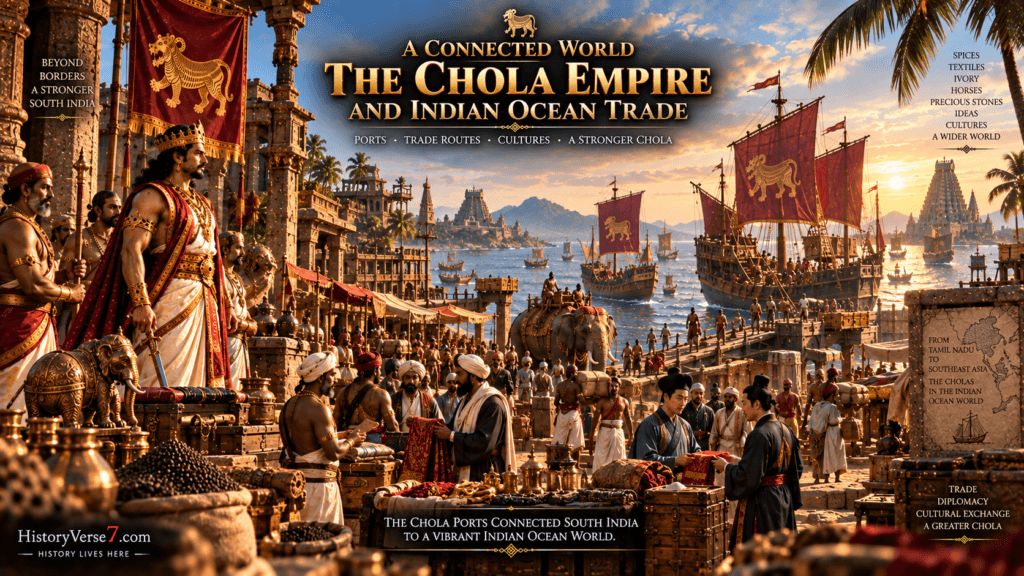
The Tamil merchant guilds, particularly the Ayyavole (or Ainurruvar, the organization of ‘500’), whose inscriptions have been found across South and Southeast Asia, operated under conditions that the Chola state both shaped and depended upon. The security of the sea lanes, the management of the Coromandel coast ports, the political stability of the territories through which overland trade routes passed all of these were conditions that the Chola state provided and that merchant communities required for their commercial operations.
Trade generated revenue for the state through port duties and commercial taxes, supplementing the agricultural revenue base. But the relationship between the Chola state and the merchant communities was not simply extractive. The maritime campaigns which secured sea lanes and demonstrated Chola naval power were also commercial investments, making it safer and easier for Tamil merchants to operate across the Indian Ocean.
The temple economy deserves specific attention here. Major endowed temples held significant landholdings, employed hundreds of staff, provided banking functions (lending money at interest to cultivators and merchants), managed charitable grain distributions, and served as centers of artistic production. These were not side effects of religious devotion; they were economically significant institutions embedded in the broader economic life of their regions.
Brihadeeswara Temple: Rajaraja’s Greatest Monument
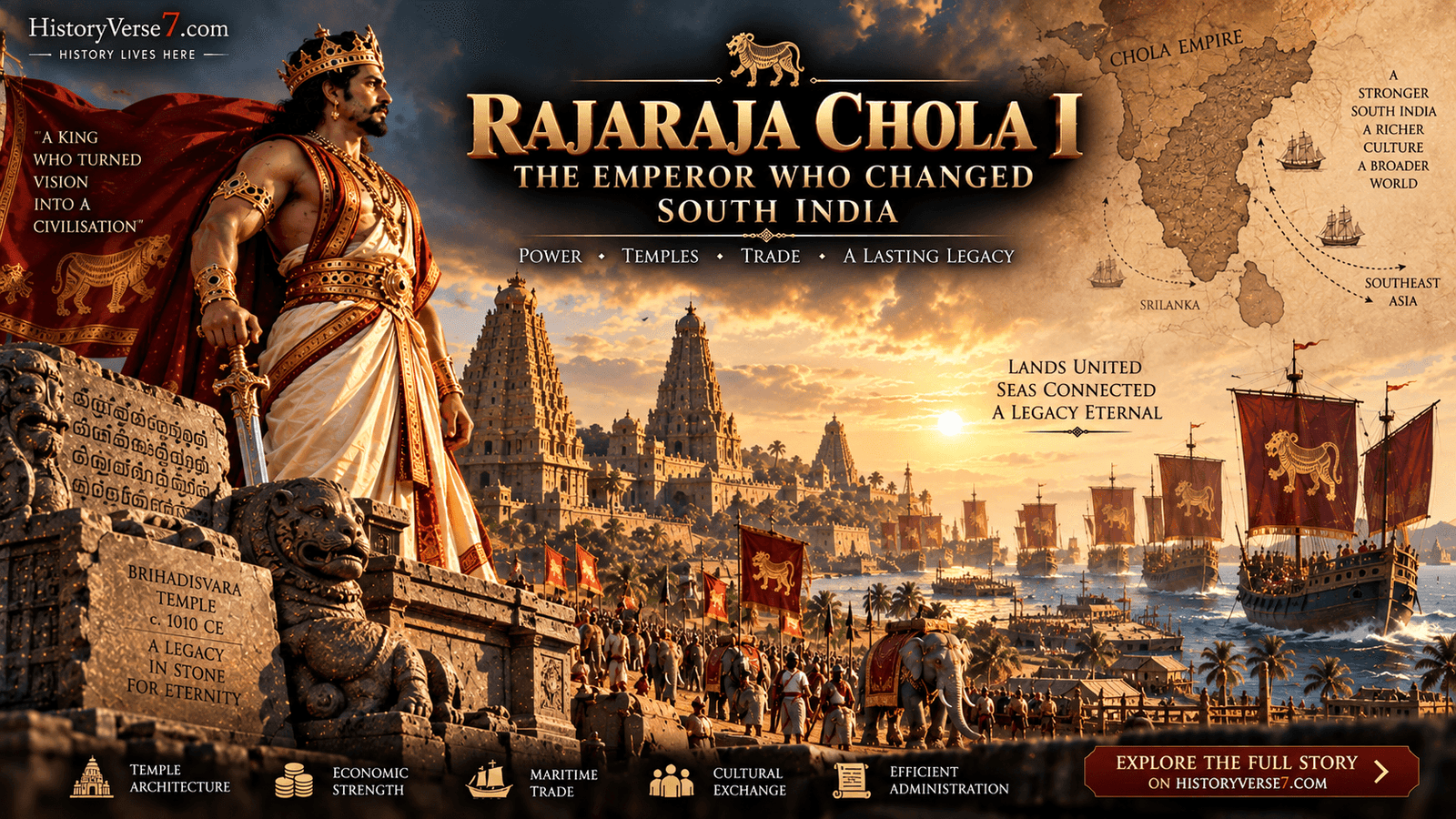
The Brihadeeswara Temple at Thanjavur, consecrated around 1010 CE, now a UNESCO World Heritage Site, still an active place of worship after a thousand years is the most visible surviving evidence of what Rajaraja’s reign produced. It deserves extended discussion, though the full history of the temple has its own cluster article.
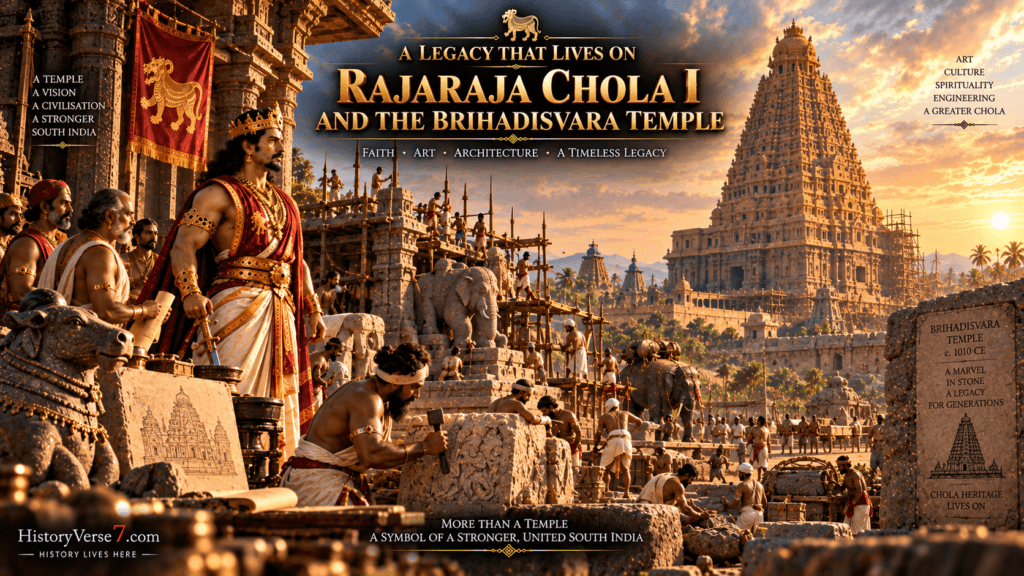
The numbers are striking. The central tower (vimana) rises to approximately 66 meters among the tallest temple towers in India at the time of construction. The capstone alone has been estimated at around 80 tonnes, raised to the top by a construction ramp that may have extended several kilometers. The outer walls carry some of the finest stone sculpture produced in South India during the medieval period figures of Shiva in various manifestations, scenes from Tamil Shaivite mythology, portraits of royal donors, images of dance and music that document the performing arts of the Chola court.
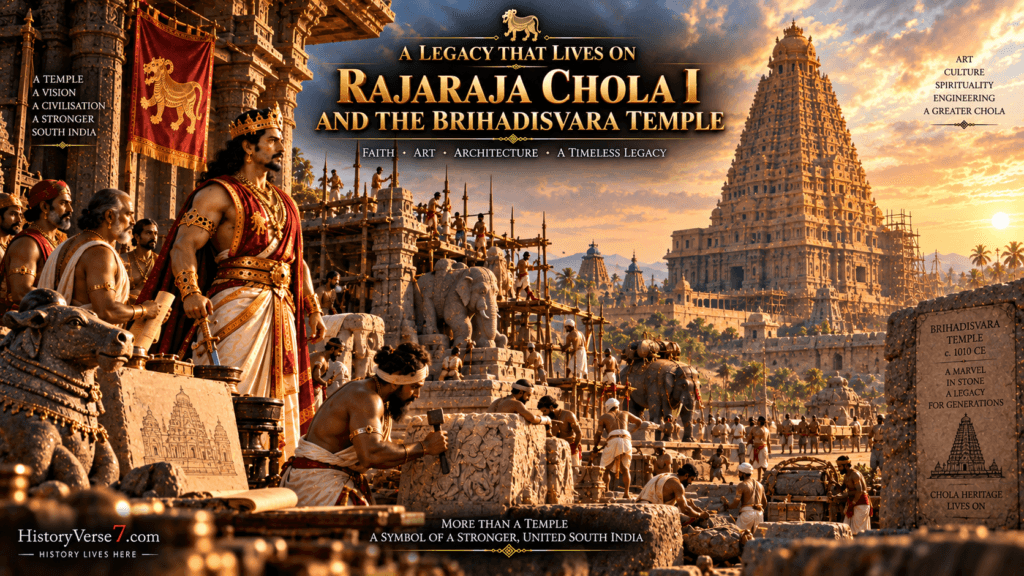
The temple complex was not just a building. It was an institution. The Brihadeeswara inscription records endowments supporting over 400 professional staff priests, musicians, dancers, accountants, gardeners, guards, and specialists of various kinds. The land grants associated with the temple gave it control over revenue from hundreds of villages across the Chola territories, making it one of the largest landholders in 11th-century South India. This was not a building that stood empty between ceremonies; it was a functioning economic and social institution that employed substantial numbers of people and managed significant resources.
The engineering achievement deserves recognition alongside the artistic one. The construction of a building of this scale in the early 11th century required sophisticated project management coordinating thousands of workers, managing supply chains for stone and other materials, developing engineering solutions for problems that had no established precedent, and maintaining quality control over an extended construction period. The people who designed and built the Brihadeeswara Temple were not just religious artists; they were some of the most capable technical minds of their era.
The political symbolism was equally deliberate. The temple was dedicated to Shiva, confirming Rajaraja’s Shaivite religious identity. It was built at Thanjavur the Chola capital, the political heart of the empire making it a monument to dynastic power as much as personal piety. It was named ‘Rajarajesvaram’ the temple of the Lord of Rajaraja establishing an explicit connection between the king and the divine patron of the institution. Every element of the temple’s design, endowment, and administration communicated the same message: the Chola empire was legitimate, powerful, divinely favored, and intended to endure.
Rajaraja Chola and Religion
Rajaraja’s personal religious identity was Shaivite a devotee of Shiva, expressed through his titles, his temple patronage, and the religious programs he supported. The Brihadeeswara Temple is a Shaiva institution. The royal epithets invoke Shiva’s favor. The Tamil Shaivite devotional tradition the Tevaram hymns of the Nayanmars received royal patronage during his reign, with the compilation and formalization of these texts as a canonical religious corpus attributed to the Chola court’s cultural activity.
The relationship between Rajaraja’s Shaivism and other religious traditions in his kingdom requires careful treatment. The Chola territories contained significant populations of Vaishnavas, Jains, and Buddhists alongside the Shaivite majority. The evidence from inscriptions suggests that Rajaraja’s religious patronage focused heavily on Shaiva institutions without systematic persecution of other traditions, though asserting ‘complete religious tolerance’ on the basis of absence of evidence would overstate what the sources can establish.
Sri Lanka presented a specific religious challenge. The island’s population was overwhelmingly Buddhist Theravada Buddhism, at that. The Chola conquest created situations of religious tension, and Sri Lankan chronicle sources record incidents involving Buddhist sacred sites that suggest Chola forces were not consistently respectful of Buddhist religious property. Managing the religious sensitivities of a conquered Buddhist population while maintaining Shaivite royal identity created a kind of cognitive dissonance that the inscriptional record, understandably, does not discuss.
Women During Rajaraja’s Reign
The inscriptional evidence from Rajaraja’s reign is unusually rich in its documentation of women’s activities not as a deliberate social policy, but because the temple donation system that generated so many inscriptions was one in which women participated actively.
Rajaraja’s sister Kundavai who bore the title ‘Pirattiyar’ (princess/queen) is documented in multiple inscriptions as an independent donor to temples and religious institutions. Her donations were substantial, made in her own name, and demonstrate a degree of economic autonomy and social prominence that is striking for the medieval period. The fact that her activities were considered worth inscribing permanently in stone reflects both her actual importance in the Chola court and the cultural framework that recognized and valued royal women’s public roles in religious patronage.
Beyond the royal family, inscriptions record donations by elite women from merchant and landowning families endowments of lamps, donations of land, gifts of gold and jewels to temple treasuries. These documents are significant evidence for women’s access to property and their capacity for independent economic action in 11th-century South Indian society, though they must be read carefully to avoid over-generalizing from the experience of a socially privileged minority to claims about women’s status generally.
How Rajaraja Prepared the Chola Empire for Rajendra
The question of institutional continuity how a state survives the transition from one strong leader to the next without losing the capabilities that leader had built is one of the fundamental challenges of political organization in any era. Rajaraja managed this challenge more successfully than most.
The land survey and administrative records he created were not dependent on his personal knowledge or relationships for their functioning. They were institutional documents that the administration could use after his death with the same effectiveness as during his lifetime. The endowed temples he created were self-managing institutions their governance structures were specified in their founding documents, their revenue sources were legally established in permanent records, and their operations continued regardless of who sat on the Chola throne.
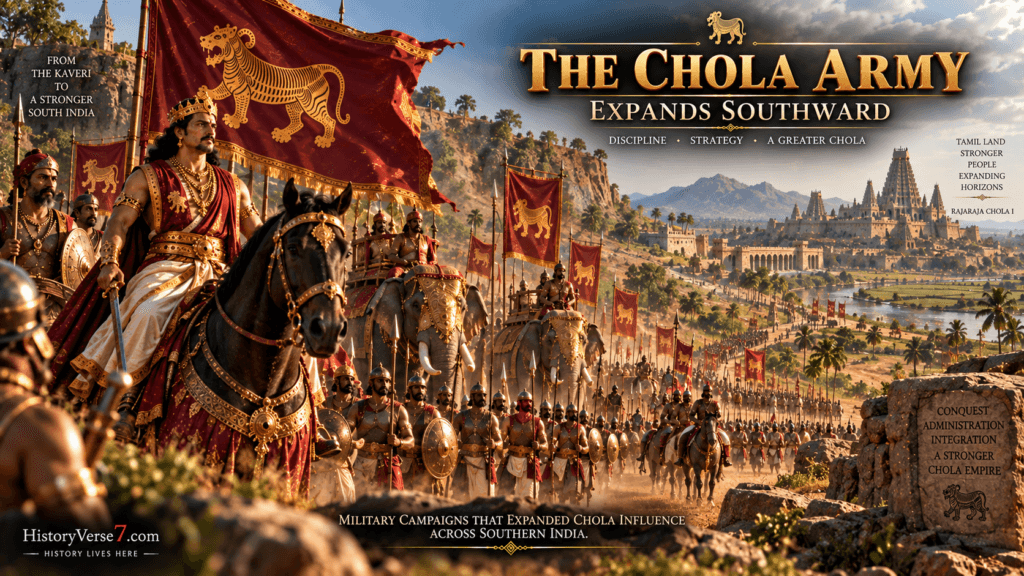
The military system the professional forces, the logistics infrastructure, the naval capacity was an institutional asset rather than a personal one. Rajaraja had built and organized it; Rajendra inherited it and deployed it for his own campaigns without needing to rebuild from scratch.
The political relationships with feudatory chiefs, with subordinate regional powers, with the merchant communities whose commercial networks the Chola state both depended on and protected were managed through institutional frameworks that survived the royal transition. The feudatory system, the formal hierarchy of political relationships that defined who owed what to the Chola throne, was documented and enforceable in ways that didn’t require Rajaraja’s personal presence to function.
The Final Years of Rajaraja Chola
The last decade of Rajaraja’s reign roughly 1004 to 1014 CE saw the continuation of military and administrative activity rather than any dramatic final chapter. Campaigns in the Deccan, continuing management of Sri Lanka, and the elaboration of the administrative system that his surveys had established all continued. The Brihadeeswara Temple was consecrated around 1010 CE, one of the signal moments of his reign’s cultural production.
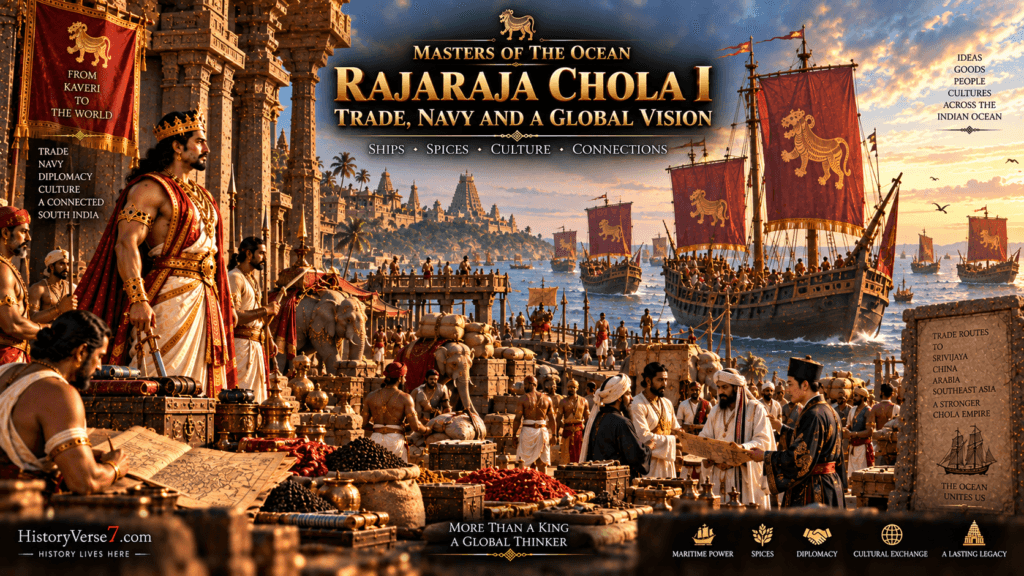
Rajendra’s role became increasingly prominent during this period. His military commands, his administrative experience, and his formal designation as heir all suggest a deliberate process of preparation and handover that was well-advanced before Rajaraja’s death. The empire that Rajendra inherited was not a system created by one man’s genius and dependent on his continued presence; it was an institutional structure capable of functioning and developing under capable leadership.
The Death of Rajaraja Chola
Rajaraja Chola I died around 1014 CE, after approximately thirty years on the throne. The circumstances of his death are not described in surviving sources. He was succeeded by Rajendra Chola I in what appears to have been an orderly transition no succession dispute is documented, and the institutional continuity of the Chola state was maintained without interruption.
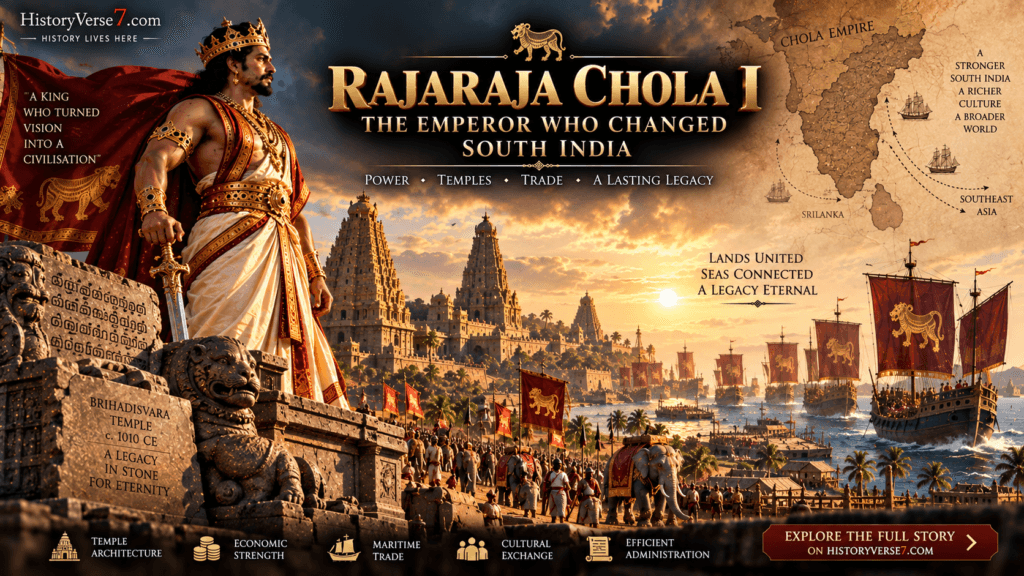
The empire he left behind was larger, more systematically administered, and more institutionally coherent than anything the Chola dynasty had previously managed. The Brihadeeswara Temple stood newly consecrated. The land survey records provided the administrative foundation for continued revenue management. The military was capable and organized. The maritime infrastructure was developed. Rajendra would build on all of this spectacularly but what he built on was real.
The Limits of Rajaraja’s Empire
Honesty about historical achievement requires acknowledging what didn’t work as well as what did. The Chola empire under Rajaraja had real limits, and understanding them is as important as understanding the achievements.
Sri Lanka was never fully controlled. Chola administration in the north and center of the island coexisted with continued Sinhalese resistance in the south throughout Rajaraja’s reign. The political instability this created required continuing military attention and administrative resources that were not available for other purposes.
The Deccan frontier was contested rather than controlled. The Western Chalukyas were too powerful and too distant for the Chola state to incorporate into its administrative system; the best that could be achieved was a favorable balance of power along a frontier zone, which required continuous military maintenance.
The administrative reach of the Chola state, sophisticated as it was, was not uniform across the empire’s full territorial extent. The Kaveri delta was tightly administered; the outer territories were less so. The difference between territories that the Chola king ‘controlled’ in the sense of collecting regular revenue and those he simply ‘dominated’ in the sense of being able to send armies there was significant, even if the inscriptional record tends to elide the distinction.
Was Rajaraja Chola Really the Greatest Chola King?
The question comes up because of how dramatically his reign stands out in the Chola dynasty’s long history. But ‘greatest’ is a complicated word for historians, and the honest answer involves some qualification.
Rajaraja was the most effective empire-builder in the Chola dynasty’s history. His combination of military expansion, administrative development, and institutional creation produced a state that was qualitatively different more capable, more extensive, more sophisticated than what existed before him. On those criteria, the case for his preeminence is strong.
Rajendra I, his son and successor, extended Chola power further still to the Ganges, to Southeast Asia, to Song Dynasty China through diplomatic exchanges. If ‘greatest’ is measured purely by territorial reach, Rajendra has a claim. But the analytical framework is important: Rajendra could achieve what he achieved because Rajaraja had built the institutional foundation from which such achievements were possible. The father’s administrative work made the son’s military adventures viable.
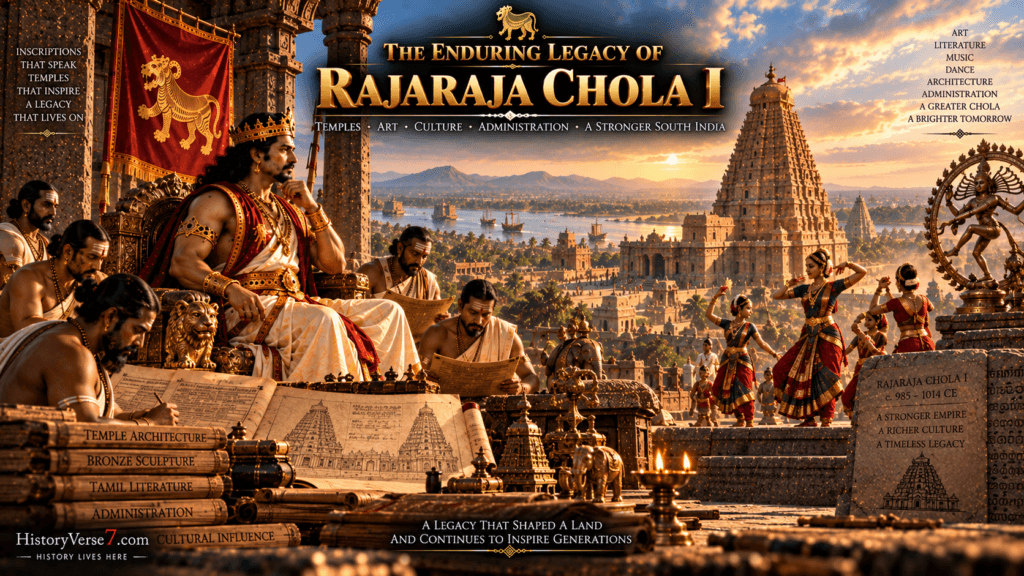
In terms of lasting cultural impact, Rajaraja’s Brihadeeswara Temple is the most enduring single monument of the Chola civilization still standing, still functioning, visited by millions of people each year. In terms of administrative development, his land survey represents a high point of medieval Indian state organization. On these criteria, his claim to preeminence within the dynasty is difficult to challenge.
Rajaraja Chola’s Empire at Its Height
| Region | Chola Objective | Result / Historical Evidence |
| Kaveri Delta (heartland) | Revenue base; administrative core | Tightly controlled; systematic land survey documented |
| Tondaimandalam (north Tamil Nadu) | Territorial continuity from Aditya I’s expansion | Incorporated; Kanchipuram within Chola sphere |
| Pandya country (south Tamil Nadu) | Eliminate major rival; southern trade routes | Pandya king driven out; Chola administration established |
| Chera territories (western coast/Kerala) | Control of sea lanes and passes; maritime access | Chera forces defeated; Lakshadweep brought under influence |
| Northern/Central Sri Lanka | Control of Palk Strait; eliminate Pandya refuge | Conquered; Polonnaruwa as Chola administrative capital |
| Southern Sri Lanka (Rohana) | Complete island control | Not achieved; Sinhalese resistance maintained |
| Maldive Islands | Maritime presence; Indian Ocean strategy | Asserted in inscriptions; administration limited |
| Deccan frontier (Vengi) | Secure northern flank; alliance with Eastern Chalukyas | Marriage alliance; contested frontier managed |
| Western Chalukya frontier | Prevent Chalukya expansion into Tamil territories | Ongoing competition; no permanent territorial gains |
10 Lesser-Known Facts About Rajaraja Chola
- Rajaraja’s reign lasted approximately thirty years a duration that, combined with his administrative capability, gave him the time to build institutions that were genuinely self-sustaining rather than dependent on his personal authority for their functioning.
- Rajaraja’s birth name Arulmozhivarman meaning ‘he whose word is grace’ in Tamil is rarely mentioned in popular accounts, which tend to use only his throne name. The shift from personal name to imperial title itself reflects the transformation of his political identity.
- His sister Kundavai, whose inscriptions document her as an independent donor to temples, is one of the most prominently documented royal women in South Indian epigraphic history her activities provide some of the richest evidence available for elite women’s roles in Chola court culture.
- The Brihadeeswara Temple inscription one of the longest and most detailed inscriptions of the medieval South Indian world occupies over one hundred feet of wall space and documents the temple’s staffing, endowments, and governance arrangements in a level of detail that is unmatched for any contemporary building.
- The temple’s consecration around 1010 CE when the building was complete and its institutional endowments formally established is documented so precisely in the inscriptional record that it is one of the better-dated events in the entire medieval South Indian chronology.
- Rajaraja’s campaign against the western coast brought the Lakshadweep (Laccadive) Islands within the Chola sphere a geographical extension that is remarkable given those islands’ distance from the Coromandel coast and their strategic importance for Indian Ocean navigation.
- The Chola conquest of northern Sri Lanka displaced the ancient capital Anuradhapura — one of the oldest continuously inhabited cities in Asia, founded centuries before the common era — and established Polonnaruwa as the new administrative center, a shift that permanently affected the island’s historical geography.
- The land survey associated with Rajaraja’s reign created administrative records that are still being analyzed by historians today, providing some of the most detailed evidence available for the agricultural economy of medieval South India.
- Rajaraja formally designated Rajendra as ‘Yuvaraja’ (crown prince) during his own lifetime, providing an institutional framework for the succession that helped ensure it was smooth when Rajaraja died.
- The temple’s Nataraja (Dancing Shiva) tradition — the formalization of Chola bronze sculpture as a canonical art form — received significant development during Rajaraja’s reign, though the great tradition predated him.
Author Perspective
What strikes me most about Rajaraja’s reign, reading through the inscriptions and thinking about what it meant to build an administration capable of managing territory from the Deccan frontier to the Maldives, is how much of his achievement was invisible. The Brihadeeswara Temple is the part of his reign that most people know about, and it is genuinely extraordinary. But the land surveys, the revenue records, the temple endowment documentation, the local governance frameworks these are the foundations on which the temple and everything else rested.
Medieval history has a tendency to record victories and monuments while ignoring the organizational work that made both possible. The Chola administrative system under Rajaraja was a genuine achievement of human institutional creativity a set of mechanisms for managing complex social and economic relationships at scale, across diverse geographies and populations, without the communication or transportation technologies that modern states take for granted. Building that system required not just military success but careful, sustained, and genuinely innovative statecraft.
The other thing worth noting is how deliberately Rajaraja prepared for his own mortality. The institutional arrangements he created the systematic documentation of revenue and endowments, the formal designation and preparation of Rajendra as his successor, the organizational structures of the temples and local assemblies were designed to function without him. They worked. The Chola Empire didn’t collapse when Rajaraja died. It expanded further. That is not an accident. It is the product of administrative intelligence that deserves as much recognition as the Brihadeeswara Temple’s stone towers.
Conclusion: What Rajaraja Actually Built
The Brihadeeswara Temple will always be the image most people carry away from any encounter with Rajaraja Chola I. That is fair enough; the building is extraordinary, and a thousand years of survival and continued use is its own kind of argument for Rajaraja’s achievement.
But the temple is the most visible part of something larger. The administrative system that funded it, organized it, staffed it, and managed its endowments after Rajaraja’s death that system was at least as impressive as the building itself. The land surveys, the revenue records, the local governance frameworks, the temple institution documentation: these were the institutional architecture within which the physical architecture stood.
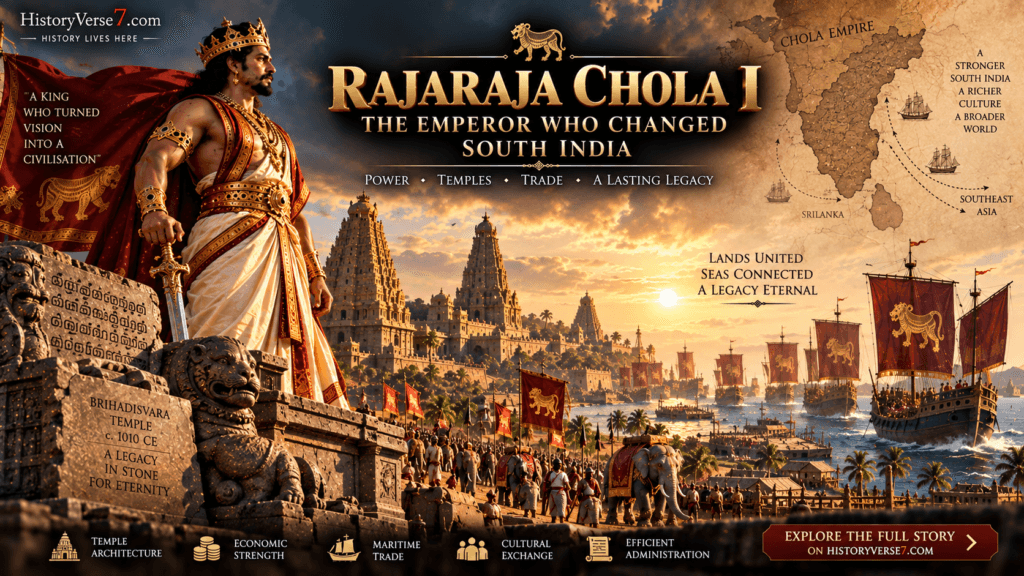
The military expansion into Sri Lanka, the Pandya country, the western coast, the Deccan frontier created the territorial scope of an empire. The administrative development created the institutional capacity to actually govern that empire. The two achievements were not separate; they were components of a single project, the construction of a political entity genuinely worthy of being called an imperial state.
Rajendra I would go further to the Ganges, to Southeast Asia, to China by diplomatic mission. But he went further on a foundation that Rajaraja had built. The institutions, the revenue systems, the naval capacity, the administrative networks these were Rajaraja’s inheritance to his son. Rajendra used them brilliantly. But what he used was real, carefully built, and deliberately designed to outlast its builder.
That, in the end, is the most impressive thing about Rajaraja Chola I. Not just what he built. But that it lasted.
Written & Researched by Abhishek Chavan — HistoryVerse7| © 2026 HistoryVerse7 | Cluster Article: Rajaraja Chola I
References and Further Reading
- UNESCO World Heritage documentation Brihadeeswara Temple, Great Living Chola Temples. whc.unesco.org
- Nilakanta Sastri, K.A. The Colas (2 vols). University of Madras, 1935 (revised 1955). [Primary scholarly authority]
- Nilakanta Sastri, K.A. A History of South India. Oxford University Press, 1955.
- Karashima, Noboru A Concise History of South India. Oxford University Press, 2014.
- Stein, Burton Peasant State and Society in Medieval South India. Oxford University Press, 1980.
- Singh, Upinder A History of Ancient and Early Medieval India. Pearson Education, 2008.
- Champakalakshmi, R. Trade, Ideology and Urbanization: South India 300 BC to AD 1300. Oxford University Press, 1996.
- Dehejia, Vidya Art of the Imperial Cholas. Columbia University Press, 1990.
- Culavamsa (Sri Lankan chronicle) for Sri Lankan perspectives on Chola activity.
- Archaeological Survey of India South Indian Inscriptions series, particularly volumes covering Thanjavur inscriptions. asi.nic.in
- Epigraphia Indica Multiple volumes. Archaeological Survey of India.
FAQ — Rajaraja Chola I
Q1: Who was Rajaraja Chola I?
Rajaraja Chola I born Arulmozhivarman was a Chola king who ruled approximately from 985 to 1014 CE. He transformed the Chola kingdom from a significant regional power into a genuine imperial state, expanding territory across southern India, into Sri Lanka, and along the western coast, while simultaneously developing one of the most sophisticated administrative systems in medieval South Asia. He built the Brihadeeswara Temple at Thanjavur, still standing after a thousand years.
Q2: Why was Rajaraja Chola so famous?
Three reasons primarily: the Brihadeeswara Temple, one of the world’s great architectural achievements; the territorial expansion that made the Chola state into a true empire; and the administrative development that created institutional systems sophisticated enough to manage that empire sustainably. His fame also reflects the richness of the inscriptional record from his reign, which has generated substantial scholarly attention.
Q3: Did Rajaraja have a navy?
Yes and a significant one. The Sri Lanka campaign required substantial maritime capacity, and the Chola navy under Rajaraja was capable of transporting and supplying armies across open water. The naval capacity he developed would be further deployed and expanded under Rajendra I. The detailed history of the Chola navy is covered in a separate cluster article.
Q4: Why did he build Brihadeeswara Temple?
The temple served multiple purposes simultaneously. It was an expression of personal Shaivite devotion. It was a political statement of imperial legitimacy and divine favor. It was an economic institution one of the largest landholders in 11th-century South India. And it was a cultural monument establishing Thanjavur as the cultural capital of the Tamil world. To ask why he built it is really to ask why any of these purposes mattered, and the answer is that they all did, simultaneously.
Q5: Why is Rajaraja important today?
The Brihadeeswara Temple at Thanjavur which he built is visited by millions of people annually and is one of the most important cultural sites in India. His administrative innovations influenced subsequent South Indian governance. The bronze sculpture tradition that flourished under his patronage including the iconic Nataraja is recognized as one of the world’s great artistic achievements. And his reign represents one of the most impressive examples in world history of the combination of military expansion, administrative development, and cultural patronage that characterizes the great empire-building periods of human history.
Rajaraja Chola Built the Foundation. The Story Continues.
Rajaraja Chola I transformed Chola power into one of medieval South India’s most formidable imperial systems. But his achievement becomes clearer when we follow the rulers, conflicts and political changes that came before him.
Continue exploring the HistoryVerse7 Chola Research Series in English and Hindi.
Ministry of Culture, Government of India →
Archaeological Survey of India →
Smithsonian National Museum of Asian Art — Chola Dynasty →
DHARMA — South Indian Inscriptions →
HistoryVerse7 • Chola Empire Research Series
Share this content: