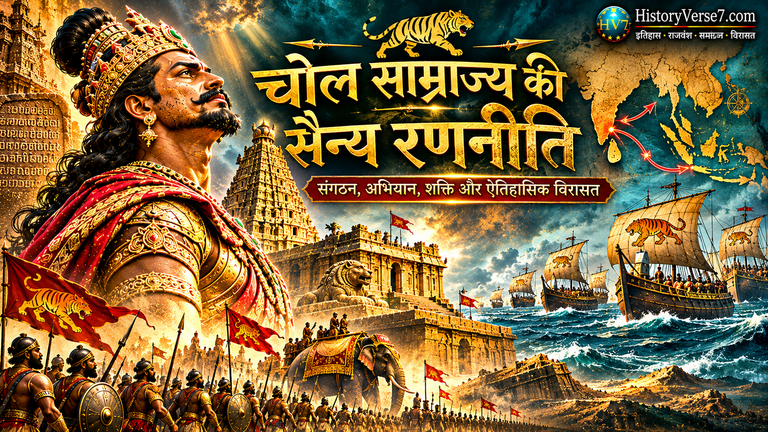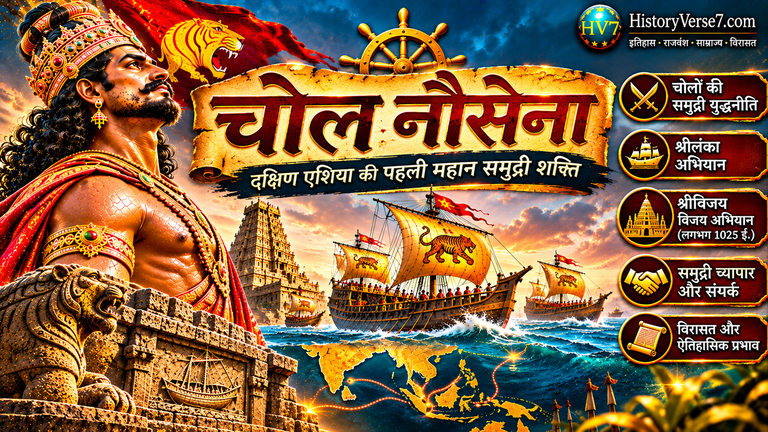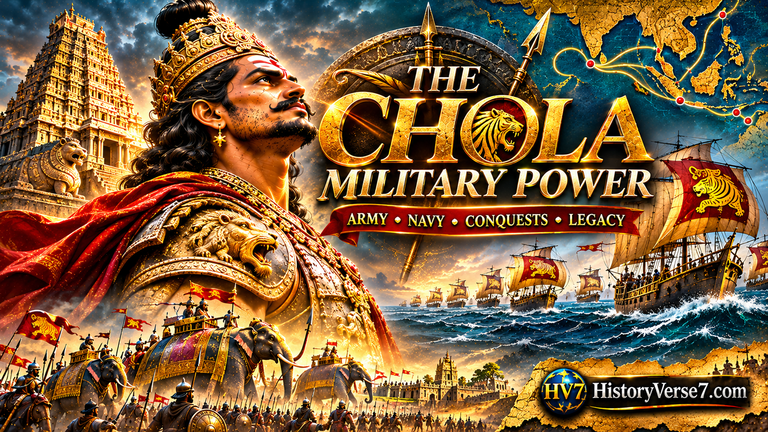

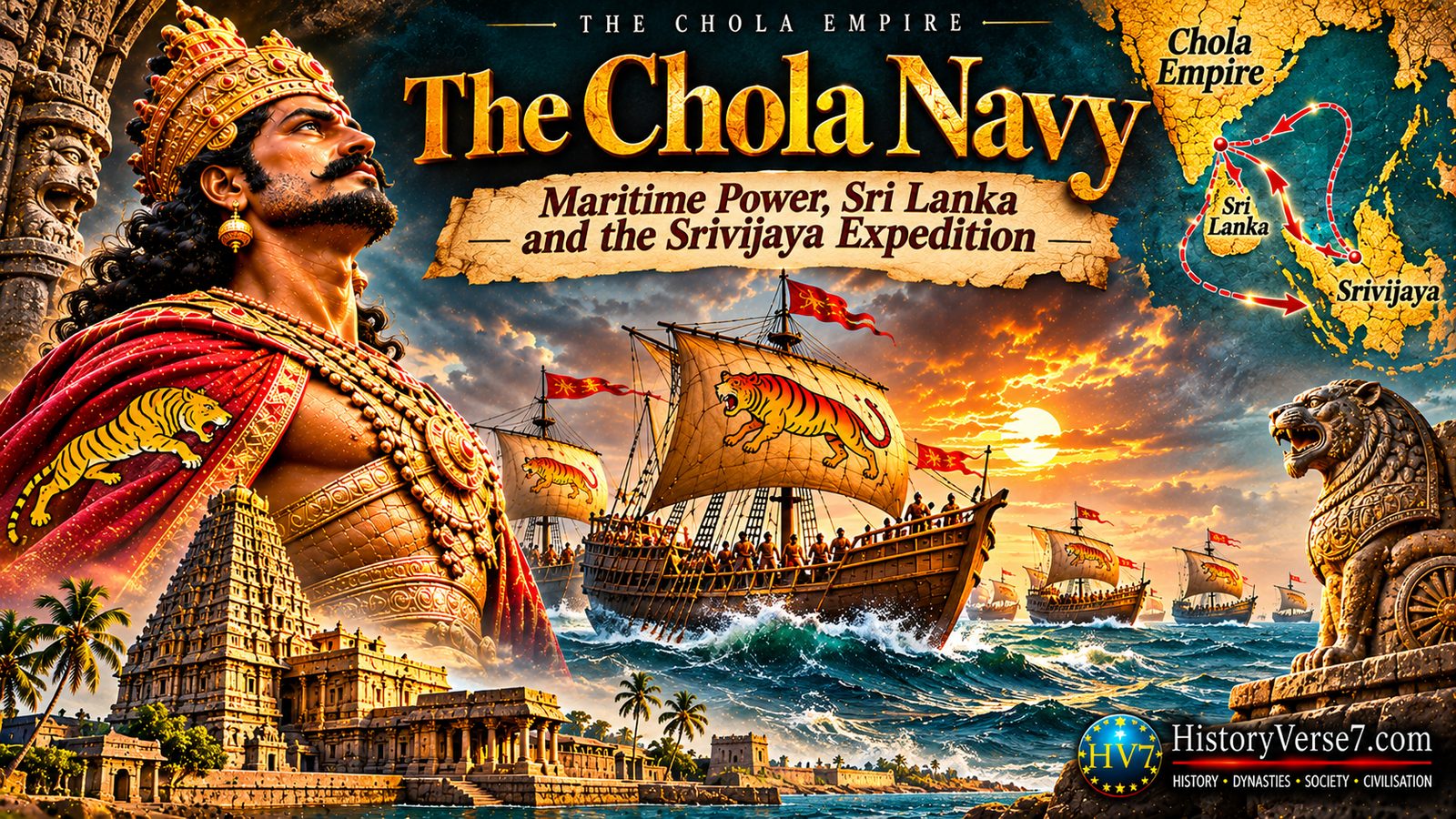
Chola Navy: 15 Powerful Facts About Its Maritime Power
Share this content: HISTORYVERSE7.COM | MARITIME HISTORY Chola Navy: Explore the Maritime Power of the Chola Empire Chola Navy was an important instrument of the Chola Empire’s maritime influence, overseas expeditions and connections across the Indian Ocean. From the reign of Rajaraja Chola I to the campaigns of Rajendra Chola I, the naval history of…
Share this content:
Chola Navy: Explore the Maritime Power of the Chola Empire
Chola Navy was an important instrument of the Chola Empire’s maritime influence, overseas expeditions and connections across the Indian Ocean. From the reign of Rajaraja Chola I to the campaigns of Rajendra Chola I, the naval history of the Cholas offers a fascinating insight into South India’s relationship with the wider maritime world.
Discover what historical inscriptions, academic research and surviving evidence reveal about Chola ships, naval warfare, overseas campaigns and maritime networks. Explore the evidence carefully, separating documented history from later interpretations.
EXPLORE HISTORICAL RESEARCH
South Indian Inscriptions Academic Research on the Chola Navy NUS Research PublicationDiscover the past through historical evidence with HistoryVerse7.com.
Table of Contents
The Chola Navy: Maritime Power, Ships and Overseas Expeditions
HistoryVerse7.com |Cluster Article: Chola Navy| International English Edition
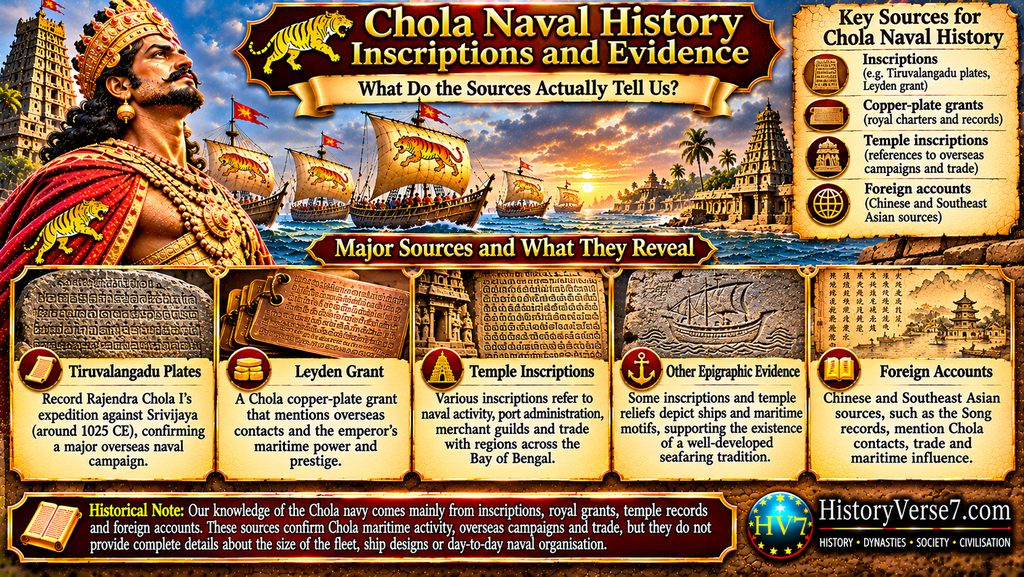
The most famous event in Chola maritime history is also the one that tells us the least about how the Chola navy worked. Around 1025, a Chola force crossed the Bay of Bengal and attacked a string of ports on the Malay Peninsula and in Sumatra. The expedition is recorded in the inscriptions of Rajendra Chola I, listed place by place. But the scholar Y. Subbarayalu, writing on the navy of the Chola state, concludes that there is practically little explicit information from any contemporary source on how the navy was organised, what its vessels were like, how many warriors took part, or which port towns served as bases.
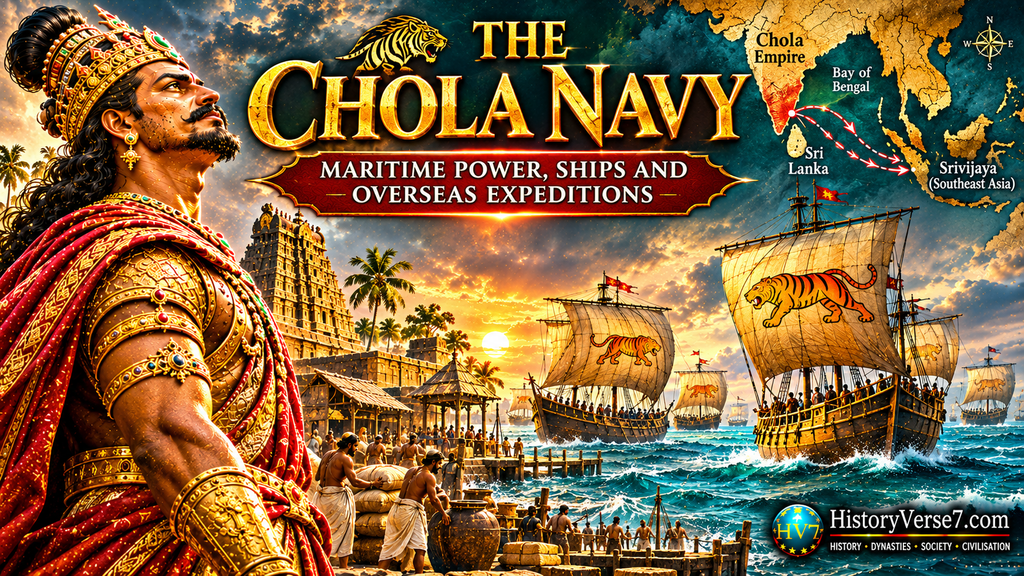
That admission is the right starting point. The Chola navy is not an institution we can describe the way we might describe a modern fleet. It is a set of voyages, mostly known from the praise-passages that open royal inscriptions, together with fragments of evidence about ports, trade and diplomacy. This article asks what those fragments can support. It looks at the Tamil coast and the seas around it, at the reigns in which maritime activity shows up, at the ports and the merchants who used them, and at what the great expeditions did and did not achieve.
The central question is how the Chola rulers developed and used maritime power to support trade, move military forces, influence the Indian Ocean and mount overseas expeditions, and what the evidence lets us say about it. The land forces are covered in the separate HistoryVerse7 article on the Chola Army; here they appear only where they depend on ships.
The Maritime Foundations of the Chola Empire
The Chola heartland lay in the Kaveri delta, close to the Coromandel Coast, the eastern shore of the Tamil country facing the Bay of Bengal. To the south-east, the Palk Strait and the Gulf of Mannar separate the Tamil coast from Sri Lanka. Subbarayalu puts the crossing at about 50 to 150 kilometres, short enough that an army could be carried across in boats. To the east and south-east, the Bay of Bengal leads to the Malay Peninsula and Sumatra, and beyond them to the South China Sea.
Geography made these waters useful, but it did not make them a Chola possession. A coast gives access; it does not by itself give control. The Chola state had to build ports, secure harbours, find ships and crews, and decide when to use them. Where the sources are silent, as they often are, this article does not assume that the Cholas patrolled or policed any particular stretch of water.
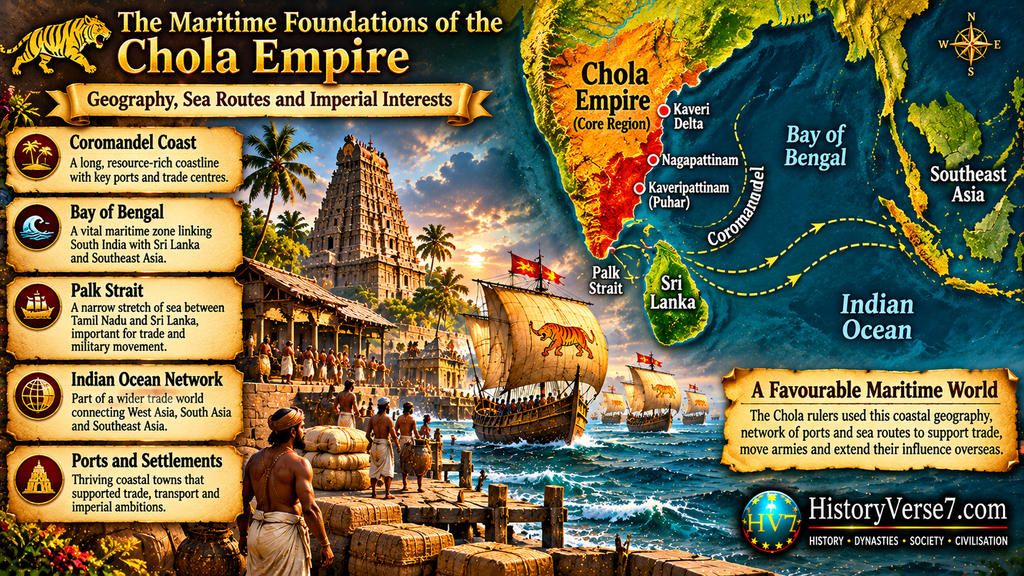
The wider setting was the Indian Ocean trading world. A summary in the ISEAS volume on the Chola naval expeditions notes that the Periplus of the Erythraean Sea, a Greek merchants’ handbook of the first century CE, mentions commerce from the Chola country, and Ptolemy is cited as well. Those are references to the Tamil coast long before the imperial Cholas of the ninth to thirteenth centuries, and they show how old the region’s seafaring connections were. They should not be read as evidence about the eleventh-century Chola state.
The Development of Chola Naval Power
Maritime activity is not equally visible in every reign, and the evidence does not support giving every Chola ruler the same naval capacity.
For the early rulers, Vijayalaya, Aditya I and Parantaka I, the sources consulted say almost nothing about naval power. The editors of South Indian Inscriptions, Volume II, note that even Parantaka I’s stone inscriptions record only the conquest of Madurai, which means that early campaigns, naval or otherwise, are poorly documented. This article does not credit these kings with a fleet.
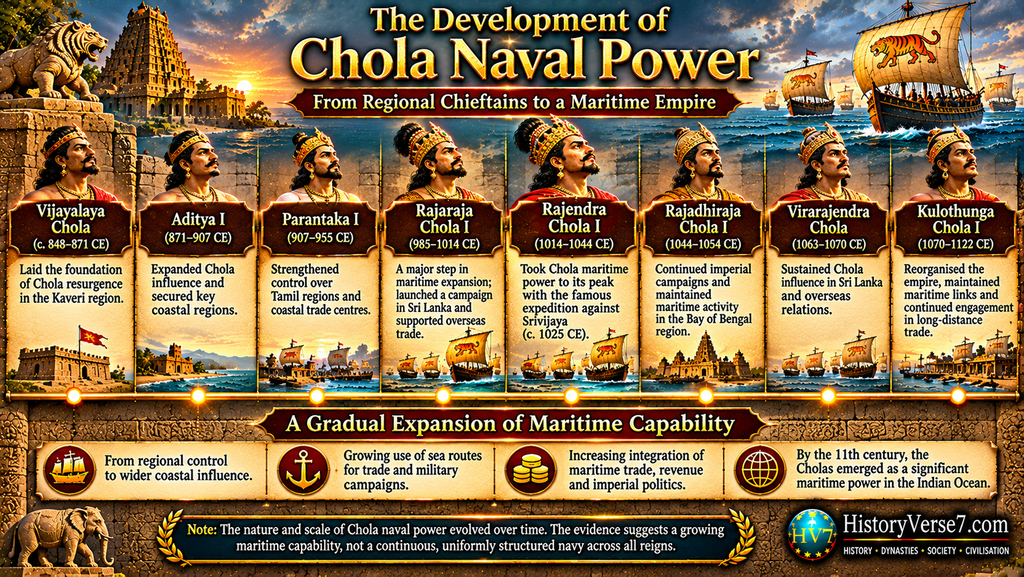
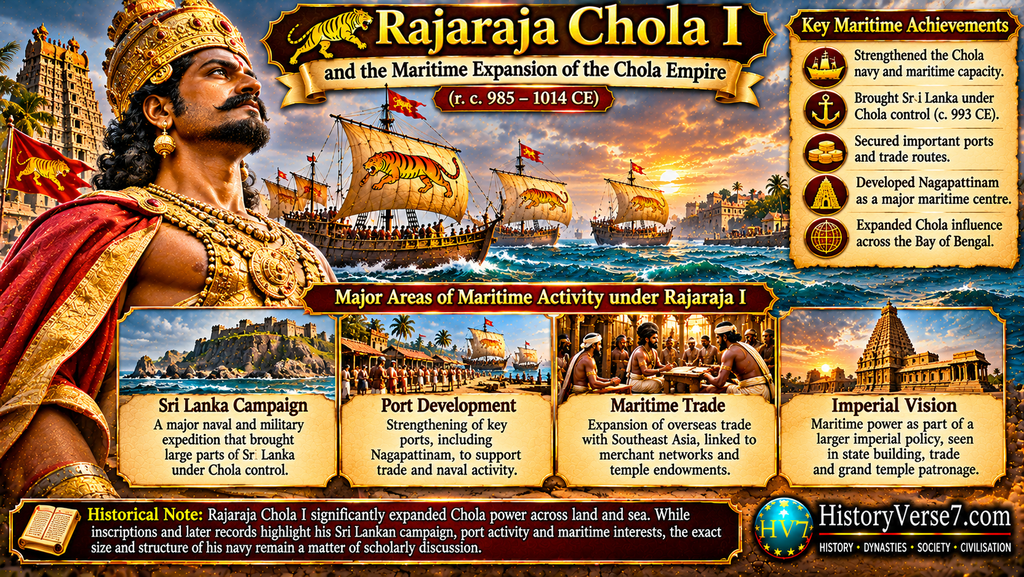
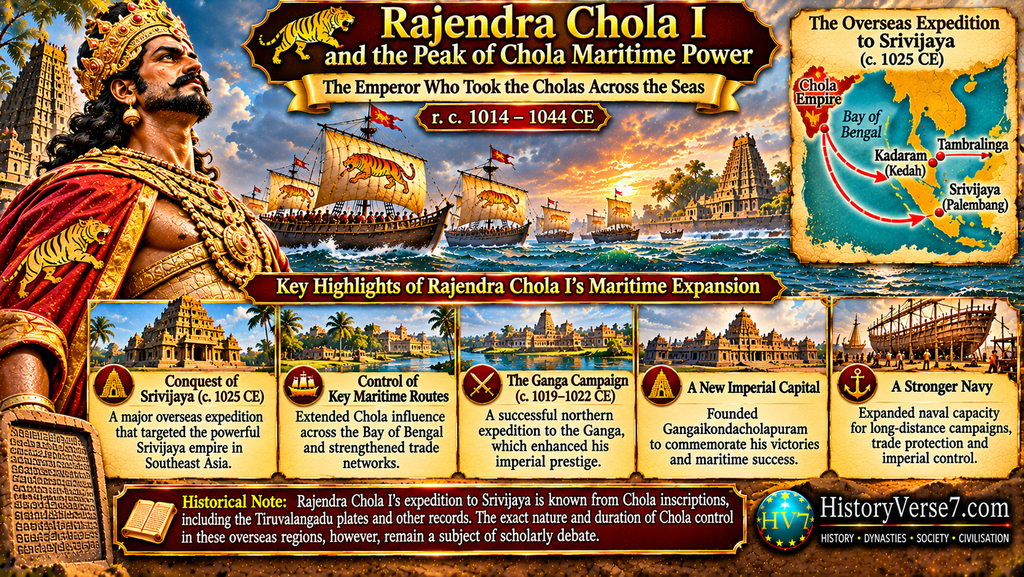
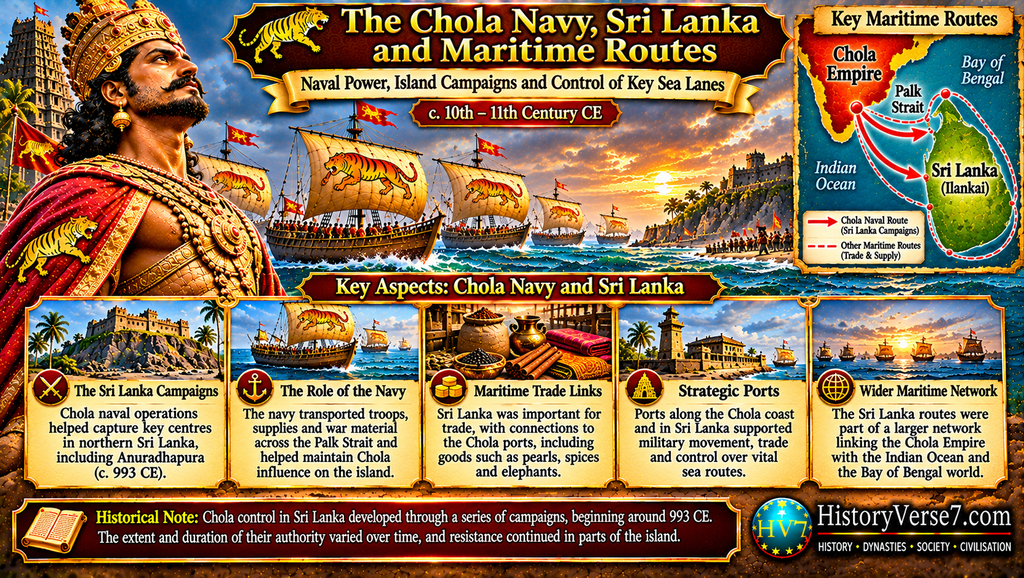
Rajaraja Chola I marks the point where maritime operations enter the record. His inscriptions mention an early campaign at Kandalur, the capture of the port of Virinam, an invasion of Sri Lanka, and a last expedition in his twenty-ninth year against a place called the “twelve thousand islands.” Rajendra Chola I carried this further: the Sri Lankan campaign of about 1017 to 1018, and the expedition of about 1025 across the Bay of Bengal. Subbarayalu’s view is that by the time of the Srivijaya expedition, the navy already had some experience of long-distance voyages.
After Rajendra I, the record shifts. The Western Chalukya war dominates the reigns of Rajadhiraja I and Virarajendra, and the maritime evidence is thin. Virarajendra’s inscriptions assert the conquest of Kadaram, the Chola name for the Kedah region of the Malay Peninsula, and the ISEAS volume introduces a later, smaller naval expedition, but the sources consulted here do not clarify the details. Under Kulothunga I there is evidence of maritime contact, not of naval campaigns: a Chola embassy to China in 1077 and ambassadors of the king of Kadaram seeking a charter around 1090, both reported by S. R. Balasubrahmanyam. A pattern emerges in which naval force was central under Rajaraja I and Rajendra I and more diplomatic and commercial afterward, though the sources do not let us state this as a settled conclusion.
Did the Cholas Have a Permanent Navy?
The phrase “Chola navy” is a convenient label, not a documented institution. It is worth asking what it would have to mean.
A permanent navy in the modern sense would involve standing fleets, dedicated officers, fixed bases, and a continuing budget. The sources consulted contain nothing that describes such a structure. What they show instead is that on particular occasions the Chola court assembled ships and crews, carried troops across water, and sent them to attack specific targets. Whether those ships and personnel were kept in being between campaigns, or collected from ports and merchants when needed, is not stated.
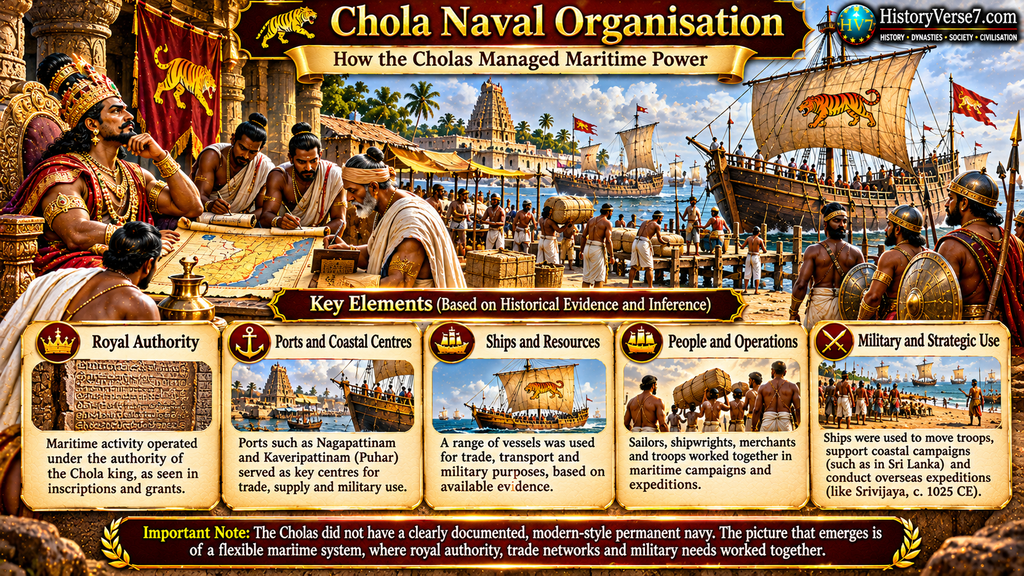
Several possibilities are consistent with the evidence. There may have been a core of royal ships and crews that existed permanently, supplemented by hired or requisitioned vessels when a large expedition was planned. There may have been little permanent naval establishment at all, with the state relying on the seafaring skills of coastal communities and the shipping of merchants. Or the answer may have varied from reign to reign. This article does not choose between them, and it does not supply a naval hierarchy of admirals, captains and squadrons. Subbarayalu’s point that the inscriptions are mostly records of gifts to temples, and so cannot tell us much about technology or organisation, explains why the question remains open.
Chola Ships and Maritime Technology
Ships are the weakest part of the evidence. Subbarayalu lists the nature of the vessels among the things for which there is practically no explicit contemporary information. A chapter in the ISEAS volume speaks of ships of various sizes in Chola-period shipping but, as far as the abstract shows, does not specify them, and no dimensions, designs, or classifications are given here.
A few distinctions can still be drawn. Vessels in the Chola world served different purposes: merchant ships carried goods, transport vessels carried troops and supplies, and coastal craft handled shorter voyages. A merchant vessel was not a warship, and a ship that carried soldiers across the Palk Strait was not necessarily built for fighting. The sources do not let us sort named vessels into these categories, and they do not reveal how long-distance sailing vessels were built, what materials were used, or how many men they carried.
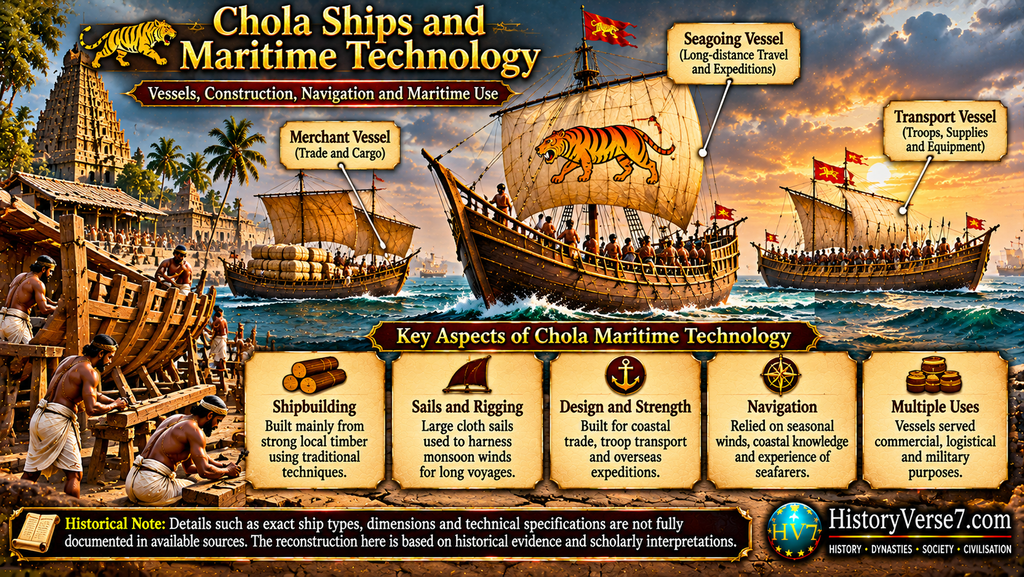
What is sometimes added in popular accounts, such as ship names, tonnages, and crew numbers, belongs to later reconstruction or to broader accounts of Indian Ocean shipping in other periods, and should be treated with caution. Knowledge of the sailing conditions of the Bay of Bengal, including the seasonal winds that governed when voyages could be made, comes from general accounts of the region rather than from any source consulted for this article. It is plausible that such conditions shaped Chola expeditions, but the Chola records do not say so.
Naval Organisation, Sailors and Maritime Personnel
For the people who sailed, the record is even thinner than for the ships.
The inscriptions praise kings and name places; they seldom name crews, officers or port officials. Subbarayalu notes that no contemporary source provides the numerical strength of the warriors involved in the expeditions. This article therefore gives no crew numbers, no ranks, and no recruitment system.
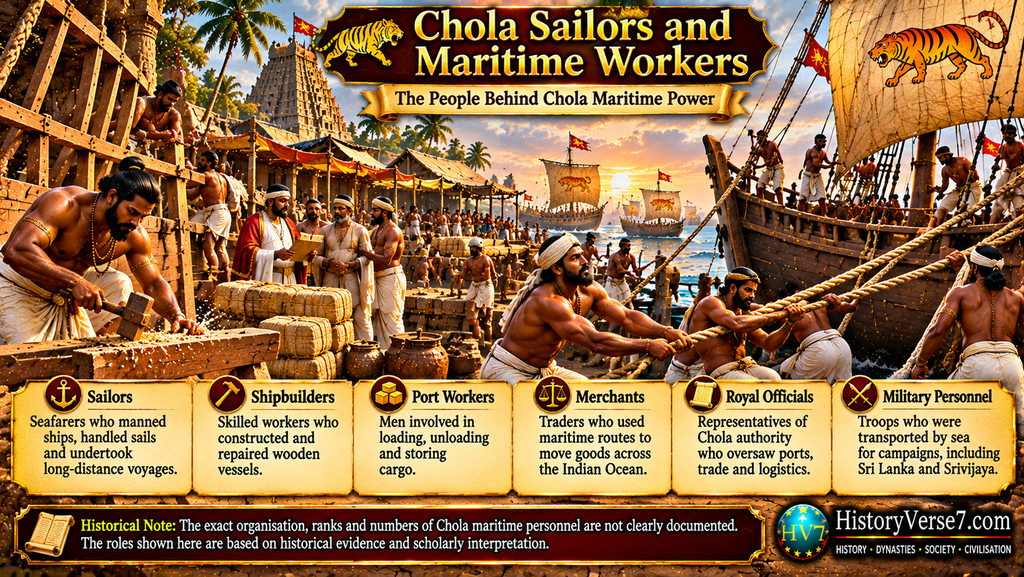
What can be said is limited to a few relationships. Military personnel were carried on sea expeditions, which means soldiers and sailors worked together, but the sources do not say who commanded at sea. Merchants and the state were linked, since ports needed merchants and merchants needed security, but the nature of that link is mostly inferred. And the line between commercial and military maritime activity is not clearly drawn in the evidence: the same coast, the same crews and perhaps the same ships could serve both purposes.
Ports and Maritime Centres of the Chola World
A few ports stand out in the evidence, though each needs careful dating.
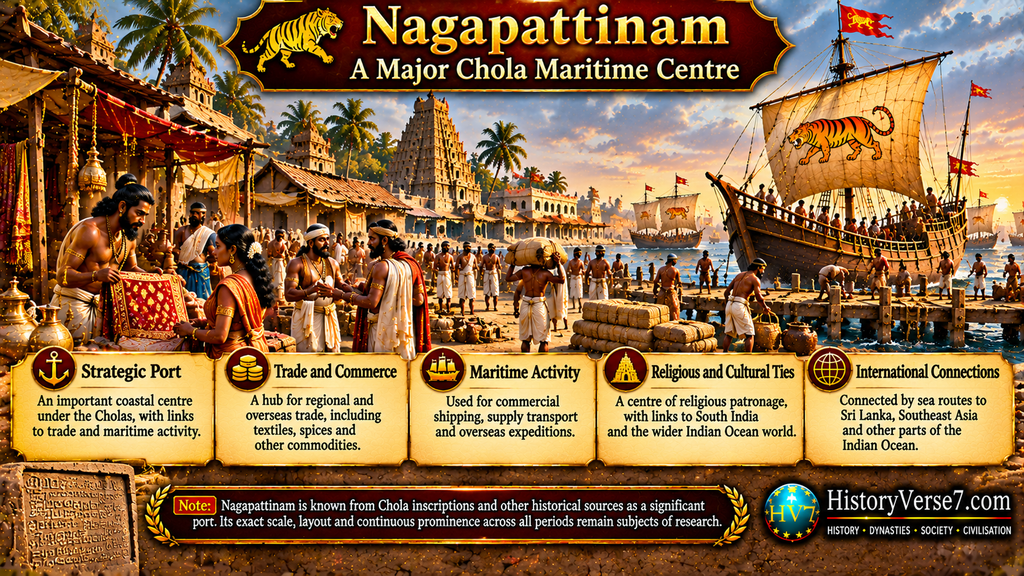
Nagapattinam on the Coromandel coast is the best documented port of the imperial period. According to the ISEAS volume’s chapter on the port, the earliest Chola inscription there is of Rajaraja I. The same chapter reports that the Buddhist Cudamani Vihara at Nagapattinam was built by a Sailendra king of Srivijaya, that a larger copper-plate grant, the larger Leiden grant of 1005, records Rajaraja’s gift of village revenue for its upkeep, and that Rajendra I also supported it. These details were seen only in summary form for this article and should be checked against the original. The chapter also argues that Nagapattinam’s rise as a medieval port was triggered by the loss of Kaveripattinam.
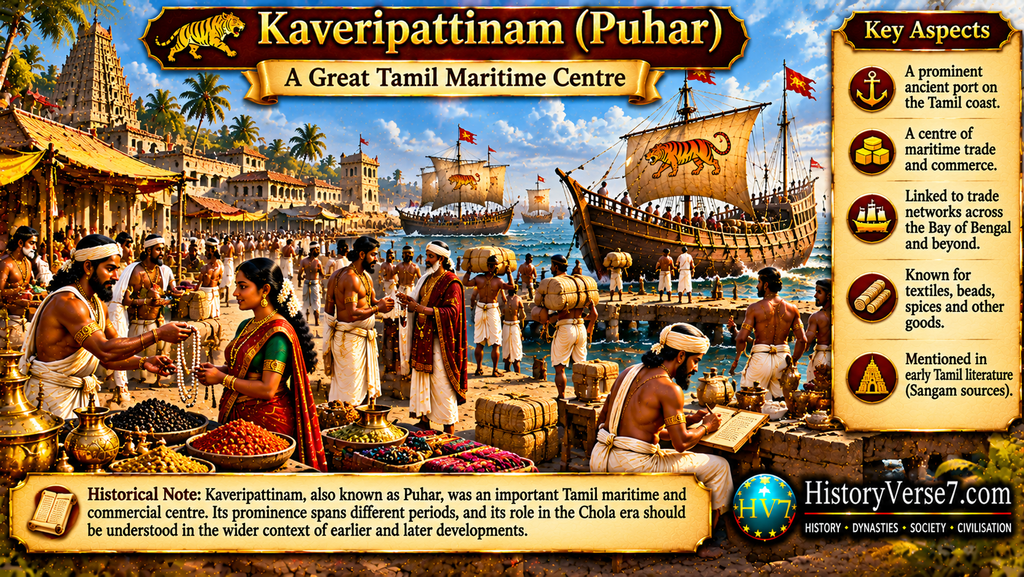
Kaveripattinam, also called Puhar, needs chronological caution. Early Tamil poetry, including the Pattinappalai, describes it as a great port with foreign merchants. But that picture belongs to the early centuries CE. The argument that Nagapattinam took over after Kaveripattinam declined suggests that the earlier port’s prosperity should not be assumed for the eleventh century.
Virinam appears in Rajaraja’s records as a port taken in his early campaigns, according to the editors of South Indian Inscriptions. Kandalur, the object of an early campaign, is not securely located; the editors thought it lay near Virinam, and later writers have proposed other sites.
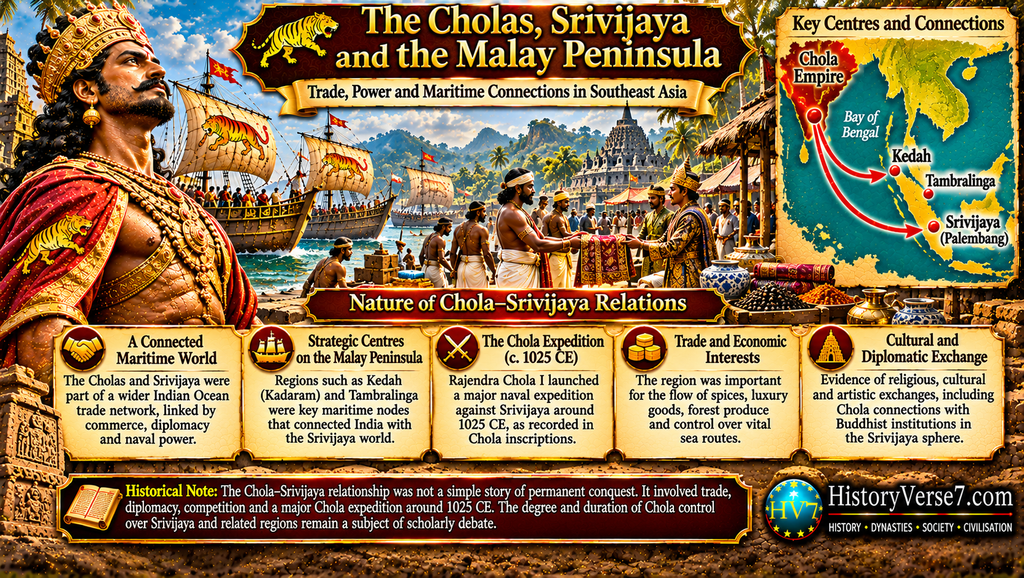
Across the sea, the targets of the 1025 expedition included Kadaram, in the Kedah region, and Srivijaya itself, centred on Sumatra, together with a dozen other port cities on the Malay Peninsula, in Sumatra and in the Nicobar Islands. Those were Srivijayan ports, not Chola ones. Earlier lists of ports in the literature should not be assumed to have stayed active throughout the Chola period.
The Chola Navy and Indian Ocean Trade
Maritime commerce and Chola power were connected, but the connection has to be stated carefully.
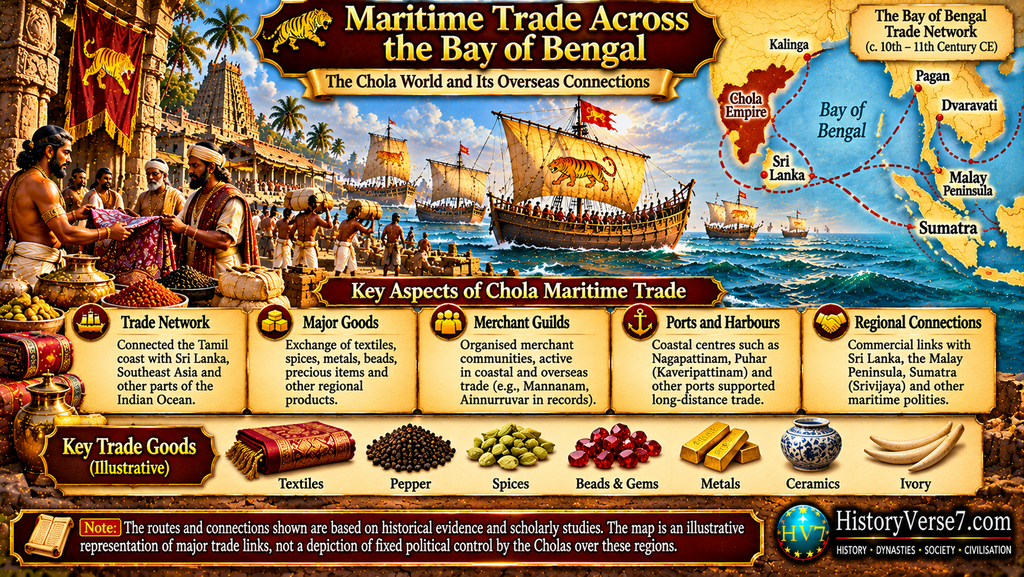
The ISEAS volume describes the early eleventh century as a time when the Cholas subdued the kingdoms of southern India, occupied Sri Lanka and the Maldives, and opened links with Song China, while Srivijaya held a key position in East-West maritime trade through its Sumatran and Malayan ports. Chinese texts in the volume’s appendix refer to the Chola kingdom by the name Zhu-nian. The volume also devotes chapters to South Indian merchant guilds and to a maritime guild called the Anjuvannam, though the details were not examined here. Other scholars have written about Chola-period merchant bodies such as the Ayyavole and the Manigramam, but this article did not consult sources on them and makes no claim about their size or power.
Trade is also visible through diplomacy and religious patronage. The Cudamani Vihara shows a Srivijayan king financing a monastery in a Chola port. A Chola embassy reached China in 1077, according to Balasubrahmanyam. Around 1090 ambassadors from the king of Kadaram asked for a charter exempting villages that supported a Buddhist monastery at Nagapattinam, which reads as a diplomatic arrangement, not an act of rule.
None of this supports the claim that the Cholas controlled the whole Indian Ocean trade. What it shows is a state with real commercial and diplomatic contacts across the Bay of Bengal, which at least once used force against a trading partner.
Rajaraja Chola I and the Expansion of Maritime Power
Rajaraja I’s reign is where the record begins. His inscriptions, as reconstructed by the editors of South Indian Inscriptions, Volume II, show a first recorded campaign in his eighth year, around 994, against the Cheras and Pandyas that included a fight at Kandalur, and the capture of the port of Virinam. In a later campaign, perhaps between 1001 and 1004, he invaded Sri Lanka. In his twenty-ninth year came the expedition against the “twelve thousand islands.”
The Kandalur phrase shows the difficulty of reading these records. Nilakanta Sastri understood it to mean the destruction of a fleet in the roadstead of Kandalur. Others have read it as the end of a Brahmin feeding house or, in the view of M. G. S. Narayanan and Kesavan Veluthat, the destruction of a Brahmin ghatika that served as a military training centre. If the second or third reading is right, Rajaraja’s most celebrated early “naval” success was not a sea action at all. The location of Kandalur is also disputed.
The twelve thousand islands are equally uncertain. The editors could not identify them. Subbarayalu cites Nilakanta Sastri and Indrapala for the identification with the Maldives, but it remains an identification and not a fact stated in the inscription. If correct, it implies a voyage of roughly 800 to 1,000 kilometres, much longer than the Palk Strait crossing. The publisher’s description of the ISEAS volume goes further and says the Cholas occupied the Maldives, but that claim should be set against the doubt about the identification and the lack of evidence for continuing administration.
What links all of this to land warfare is transport. Moving troops to Sri Lanka required boats, and the Sri Lankan campaign was therefore both a military and a maritime undertaking. The inscriptions record the result, not the mechanics.
Rajendra Chola I and the Srivijaya Expedition
The expedition of about 1025 is the best-known Chola naval operation and one of the most debated, and the evidence needs to be set out in layers.
Background. Srivijaya, based in Sumatra, held key ports on the Malay Peninsula and Sumatra and a central place in the maritime route between India and China. The ISEAS volume’s description speaks of friendly relations that the 1025 expeditions disrupted, and the Cudamani Vihara is one sign of earlier ties. The volume’s introduction calls the expedition a unique event in otherwise peaceful relations between India and Southeast Asia.
Chronology. Most accounts put it in or around 1025. Subbarayalu gives about 1026. The sources agree on the approximate date but not on the exact year.
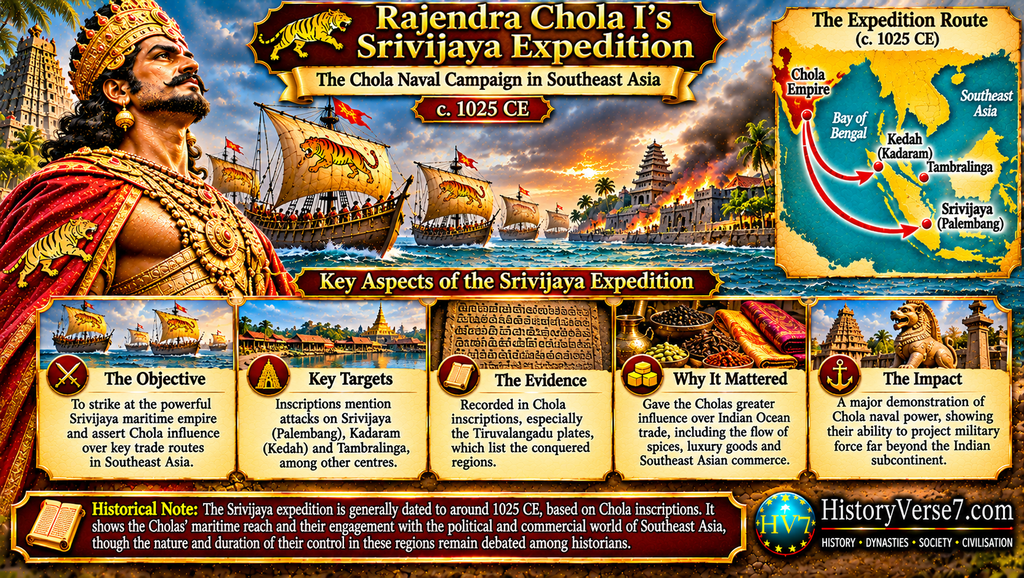
What the Chola record says. Rajendra’s inscription claims that he despatched many ships across the rolling sea and lists the places attacked. Kulke notes that the list names Srivijaya, Kadaram and twelve other port cities on the Malay Peninsula, in Sumatra and in the Nicobar Islands, fourteen in all according to the publisher’s description. Earlier research for this series records that the king of Srivijaya was captured. The list of places and the capture are the Chola court’s account.
Objectives. Historians disagree, and Kulke says the sources are silent about the exact causes. He discusses interpretations by Nilakanta Sastri and by George Spencer, who saw the expedition as the culmination of a “politics of plunder” the Cholas had practised in South India and Sri Lanka. Vijay and Sangeeta Sakhuja treat it as a display of long-range maritime capability resting on a large logistical effort. Tansen Sen has placed it in a Chola–Srivijaya–China triangle. No single explanation has been established.
Outcome. The expedition was a major naval raid that devastated several cities, in the Sakhujas’ description. Whether it brought tribute, a change of rulers or any lasting authority is not shown. Virarajendra’s inscriptions later assert a conquest of Kadaram, and the ISEAS introduction mentions a further, smaller expedition, which suggests that the first did not settle matters. Around 1090 Kadaram’s king sent ambassadors to the Chola court. The most defensible summary is a successful expedition and a military demonstration of reach, not a permanent occupation or administration of the Srivijaya realm. This article does not claim that Rajendra conquered or governed Southeast Asia, and the evidence for such rule is absent.
The Chola Navy and Sri Lanka
Sri Lanka was the nearest overseas theatre, and the sea made the difference between a campaign and an occupation.
The Palk Strait and Gulf of Mannar were short enough that troops could be ferried across, as Subbarayalu notes. The Chola operations on the island, from Rajaraja’s invasion of about 1001 to 1004 through Rajendra’s campaign of about 1017 to 1018 and beyond, relied on that crossing for troops and supplies. The editors of South Indian Inscriptions cite a Tamil inscription of Rajaraja’s twenty-seventh year at Padaviya and villages in Ceylon granted to the Tanjore temple, which show a Chola presence on the island, and they note that the island was called Mummadisora-mandalam in Chola records.
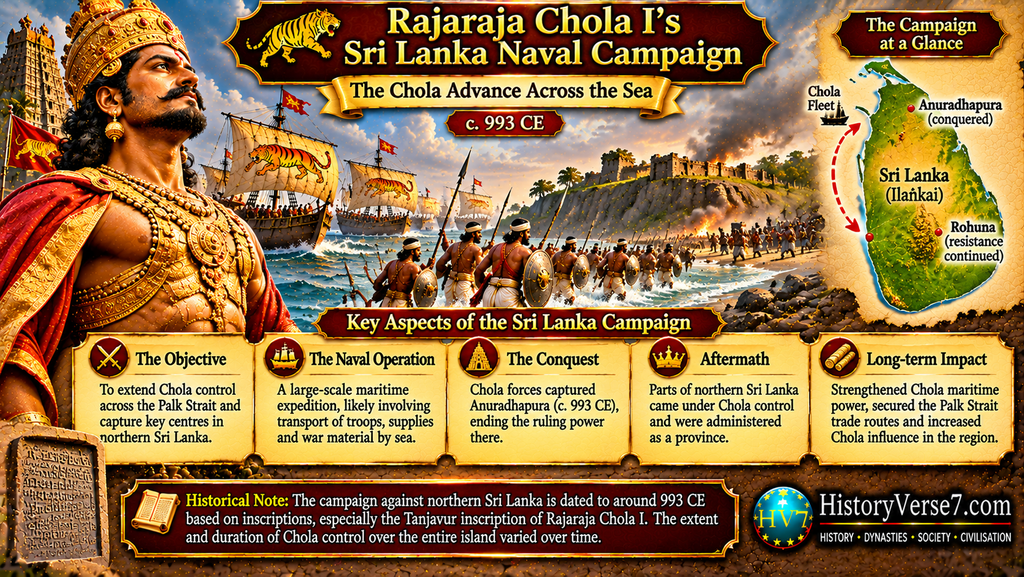
Naval access did not guarantee political control. The Sinhalese resisted from the start; one summary describes generals who forced Chola troops back to Polonnaruwa, and a long campaign under Vijayabahu I ended Chola rule on the island during Kulothunga I’s reign. Dates range from about 1070 to 1075. The ability to cross the strait was an advantage for the Cholas, but it also meant that reinforcements and supplies depended on keeping that route open and on the loyalty of those on the island. The Sri Lankan sources, particularly the Mahavamsa, tell the story from the other side and do not always agree with the Chola inscriptions. This article did not consult George Spencer’s study of the Cholas in Ceylon, which is the standard analysis.
Chola Navy and Southeast Asia
The relationship between the Cholas and Southeast Asia was mostly commercial, religious and diplomatic, with one episode of force.
The Cudamani Vihara in Nagapattinam, financed by a Srivijayan ruler, and a Chola embassy to China show that exchange ran in several directions. Srivijaya’s ports on the Malay Peninsula and Sumatra were the nodes the Chola expedition struck. After 1025, evidence of continued contact exists: Kadaram’s ambassadors around 1090, and Virarajendra’s claim to have conquered Kadaram. The ISEAS volume also includes chapters on Chola trade with Southeast and East Asia and on the fabric trade, but those were not examined here.
The limits of Chola military influence in the region are clear from what is missing. There is no evidence in the sources consulted for Chola governors, garrisons or provincial administration in Sumatra or the Malay Peninsula, and this article does not describe any Southeast Asian territory as a Chola possession. The Bay of Bengal was a space of connection and occasional conflict, not a Chola sea in any exclusive sense.
Naval Warfare and Maritime Strategy
What the sources show of naval warfare is mostly outcomes. They say that ships were sent, that places were attacked and that victories followed.
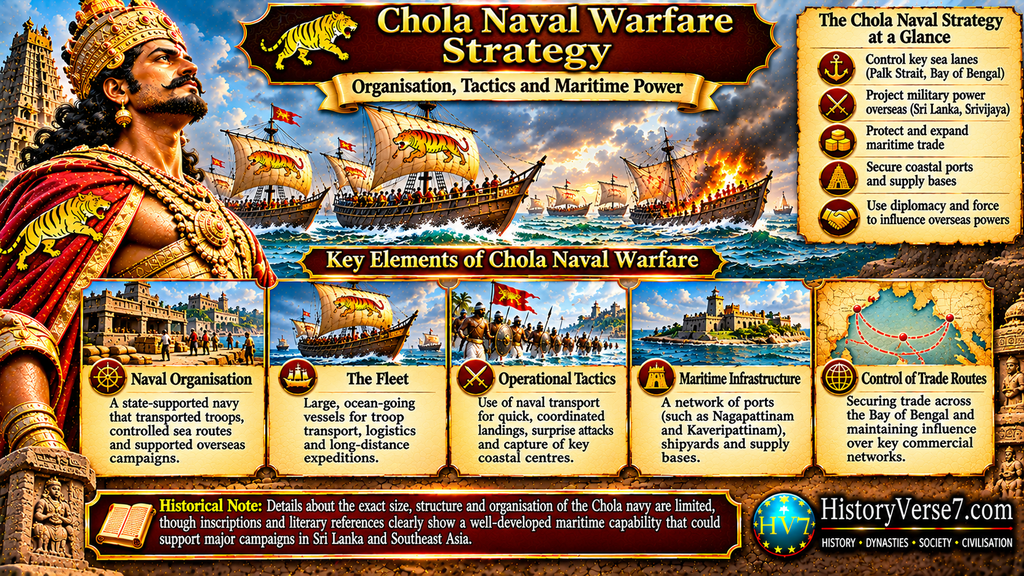
Three functions of sea power can be identified with reasonable confidence. The first is the transport of troops by sea, evident in the Sri Lankan campaigns and in the expedition across the Bay of Bengal. The second is the strike on coastal and port targets, as at Virinam and in Southeast Asia. The third is the logistics of supply: the Sakhujas see the 1025 raid as demonstrating the ability to sustain a large and complex naval operation over a long distance, though that is an interpretation of an event whose mechanics are unrecorded.
What cannot be claimed is detailed tactics. There is no reliable account of ship-to-ship fighting, fleet formations or amphibious assault procedures, and this article offers none. Even the one episode often cited as a naval battle, Kandalur, is disputed as to whether it was a naval engagement at all. The relationship between sea power and imperial strategy is better seen in the pattern of choices than in any described doctrine: the Cholas used the sea to reach Sri Lanka, to threaten a major trading rival, and to display power, and they did not attempt to hold distant ports.
The Chola Navy and the Chola Army
The two services had different jobs but depended on each other for expeditions across water.
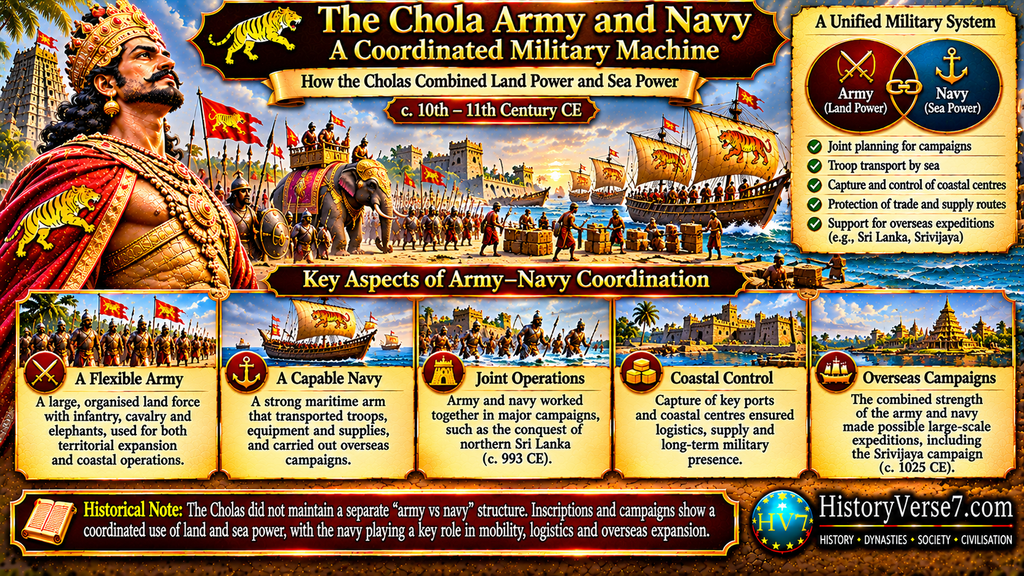
The army fought on land, held forts and garrisons, and moved by road and river. The navy, such as it was, carried that army across the Palk Strait and the Bay of Bengal and attacked coastal targets. Coastal bases connected the two, though the sources do not identify naval bases, as Subbarayalu stresses. Joint campaigns needed supply as well as transport: troops landed in Sri Lanka had to be fed and reinforced by sea.
The HistoryVerse7 article on the Chola Army treats regiments, officers, forts and land warfare, and it discusses the Kandalur reading debate from the army’s side. This article does not repeat that account. What the two together show is a state that could project force by land and by sea, but whose records describe the outcomes more reliably than the institutions behind them.
Why Did Chola Maritime Power Matter?
Maritime activity mattered to the Chola state in several overlapping ways, and none of them should be pushed too far.
Politically, the ability to cross the sea extended the reach of Chola kings to Sri Lanka and, briefly, across the Bay of Bengal, which added to their prestige. Militarily, ships gave mobility: armies could be moved to places that land routes could not reach. Commercially, ports connected the Tamil country with Srivijaya and China, and the Chola court cultivated those links through embassies and patronage. Diplomatically, the Cudamani Vihara and the later embassies show a state that used religion and commerce, not only force, in its dealings with partners overseas.
The sources do not support claims that every economic or cultural development in the Chola world was caused by naval expansion. The agricultural base in the Kaveri delta, the temple economy and the land revenue system were the foundations of the state, and the navy was one instrument among several. The relationship between ports and state power is real, but it is better understood as a mutual dependence than as a story of naval conquest leading to commercial wealth.
The Limits and Decline of Chola Maritime Power
Chola maritime power was never unlimited, and its later history is poorly documented.
The limits were clear within the heyday itself. The expedition across the Bay of Bengal did not lead to lasting rule. Sri Lanka, reached by a short crossing, was lost during Kulothunga I’s reign. The distances involved were great: the voyage to the Maldives, if that is what the twelve thousand islands were, was perhaps 800 to 1,000 kilometres, and the voyage to Srivijaya longer. Maintaining influence at such distances required resources and goodwill that the Chola state could not always supply.
After the early eleventh century, the evidence points to a shift from large naval expeditions to diplomacy and commerce, as the contacts of 1077 and about 1090 suggest. The wider decline of the Chola state in the twelfth and thirteenth centuries, discussed in the Chola Army article, involved the rise of other regional powers, among them the Hoysalas and a revived Pandya kingdom, and the sources consulted for this article do not document what happened to Chola maritime influence in those years. Changes in trade routes and the fortunes of ports such as Nagapattinam may have played a part, but without direct evidence, no single battle or ruler can be blamed, and this article does not attribute the decline of maritime influence to any one cause.
15 Lesser-Known Facts About the Chola Navy
- The crossing from the Tamil coast to Sri Lanka across the Palk Strait and Gulf of Mannar is only about 50 to 150 kilometres, according to Y. Subbarayalu.
- If the “twelve thousand islands” of Rajaraja I’s last expedition are the Maldives, as many scholars think, the voyage was about 800 to 1,000 kilometres.
- The editors of South Indian Inscriptions could not identify the twelve thousand islands.
- Subbarayalu notes that the evidence for Chola naval expeditions comes from brief references in the praise-passages of inscriptions.
- The same scholar finds practically no explicit contemporary information on the organisation of the navy, its vessels, the numbers involved or the ports used as naval bases.
- Rajendra I’s inscription lists, besides Srivijaya and Kadaram, a dozen other port cities on the Malay Peninsula, in Sumatra and in the Nicobar Islands, fourteen places in all according to the volume’s description.
- Chinese texts referred to the Chola kingdom as Zhu-nian, and the ISEAS volume includes them in an appendix.
- The Cudamani Vihara at Nagapattinam, a Buddhist monastery, was built by a Srivijayan Sailendra king, according to a chapter in that volume.
- The larger Leiden grant, dated 1005, records Rajaraja I’s gift of village revenue to that monastery, according to the same chapter.
- Three different explanations have been offered for Rajaraja I’s Kandalur phrase: a fleet, a feeding house and a military training centre.
- The first Chola inscription at Nagapattinam is that of Rajaraja I, according to the ISEAS volume’s chapter on the port.
- The smaller Leiden grant, of about 1090, records ambassadors from the king of Kadaram asking for a charter for the same monastery, as summarised by S. R. Balasubrahmanyam.
- A Chola embassy is recorded in Chinese sources in 1077, with seventy-two men, according to Balasubrahmanyam.
- Greek and Roman-era sources such as the Periplus mention commerce from the Chola country, centuries before the imperial Cholas.
- Ceylon was known in Chola records as Mummadisora-mandalam, according to the editors of South Indian Inscriptions.
Author’s Note
One of the greatest challenges in writing about the Chola Navy was the scarcity and scatter of available evidence. The Srivijaya expedition is widely discussed, but contemporary sources remain largely silent on questions such as what the ships looked like, how many there were, who their sailors were, and how the ports functioned as naval bases. Most of the surviving evidence comes from a few lines recorded in royal eulogies.
Therefore, I have tried to understand the Chola Navy not merely through its overseas campaigns, but also through the region’s geography, ports, trade networks and political strategy. Ports such as Nagapattinam, along with connections to China and Southeast Asia, demonstrate that the sea was not only a route for warfare but also a channel for diplomacy and commerce.
Popular accounts often claim that the Cholas ruled the entire Indian Ocean or exercised sovereignty over Southeast Asia. The available evidence does not support such sweeping conclusions. Instead, it points towards raids, maritime contacts and, at times, limited political influence. I have tried to ensure that where evidence is lacking, speculation is not presented as fact. For more research-based articles on Chola history, continue exploring HistoryVerse7.com.
Conclusion: The Maritime Legacy of the Chola Empire
How did the Cholas develop and use maritime power, and what can the evidence tell us? The answer has two halves that do not quite match.
The first half is substantial. Chola rulers, above all Rajaraja I and Rajendra I, used ships to carry armies to Sri Lanka and, once, across the Bay of Bengal to strike at the ports of a major trading rival. They cultivated ports such as Nagapattinam, exchanged embassies with China, and patronised a Buddhist monastery financed from Southeast Asia. Maritime reach added to their prestige and widened their political options.
The second half is the limit of what we know. The sources describe voyages in a few lines of praise, and they do not describe ships, crews, bases or tactics. The best modern scholars say so plainly. The expeditions did not create overseas provinces, and Sri Lanka, the nearest and best-documented case, was lost.
The Chola navy is therefore best understood as an episodic capability, built and used by particular kings for particular purposes, resting on a seafaring coast and a trading world that long predated and outlasted it. For the land forces behind these voyages, the HistoryVerse7 article on the Chola Army is the natural companion, and the articles on Rajaraja Chola I and Rajendra Chola I follow the kings who gave the Chola navy its place in history.
Written & Researched by Abhishek Chavan — HistoryVerse7| © 2026 HistoryVerse7 | Cluster Article: Chola Navy
FAQ — Chola Navy
What was the Chola Navy?
The Chola Navy is the modern label for the ships, crews and maritime capability the Chola kings used to carry troops, attack ports and keep commercial and diplomatic links across the seas. It is known mainly from praise-passages in royal inscriptions. Explicit information on its organisation, vessels and numbers is almost absent, so it is best seen as episodic.
Did the Cholas have a permanent navy?
The evidence does not say. The sources show fleets assembled for particular expeditions, but nothing consulted describes standing squadrons, fixed naval bases, ranks or a continuing naval budget. A permanent core supplemented by hired or requisitioned ships is possible, as is heavy reliance on coastal communities and merchants. Scholars stress how little explicit information survives.
Why is the Chola Navy historically significant?
It shows how an Indian state used ships to move armies, strike a trading rival and cultivate links with Srivijaya and China, extending its prestige across the Bay of Bengal. It is also a case study in the limits of evidence, since praise-passages record voyages but not ships, crews or bases.
Why did Chola maritime influence decline?
The sources consulted do not document the decline of Chola maritime influence directly. Sri Lanka was lost in Kulothunga I’s reign, though contacts with China and Kadaram continued around 1077 and 1090. The wider Chola decline involved regional rivals. Changes in trade routes and ports may have played a part, but no single battle or ruler can be blamed.
Did the Cholas control the entire Indian Ocean?
No. Chola ships reached Sri Lanka, possibly the Maldives, and Southeast Asian ports, but the evidence shows raids and contacts, not control of the ocean. Other powers and trading communities shared the seas. Claims of control over the whole Indian Ocean go well beyond what the sources support.
Continue Exploring the History of the Chola Empire
The maritime history of the Chola Empire is only one part of a much larger story. From Rajaraja Chola I’s campaigns and Rajendra Chola I’s overseas expedition to the political struggles of later emperors, the dynasty’s history reveals the relationship between military power, maritime commerce, administration and imperial ambition. Explore the following HistoryVerse7 articles to understand the rulers, institutions and historical events that shaped one of medieval South India’s most influential dynasties.
📚 Explore the Chola Empire — English Articles
Discover more historical features in our complete collection: Explore All English Chola Articles →
🔎 Further Reading — Academic Research and Historical Sources
For readers interested in examining the historical evidence independently, these academic publications and research collections offer further perspectives on Chola maritime history, overseas expeditions, inscriptions and Indian Ocean trade.
- DHARMA — South Indian Inscriptions
- Cambridge University Press — A Note on the Navy of the Chola State
- Cambridge University Press — Rajendra Chola and the Srivijaya-China Connection
- Cambridge University Press — Rajendra Chola I’s Naval Expedition
- National University of Singapore — Chola Naval Expeditions to Southeast Asia
- ISEAS Publishing — Nagapattinam to Suvarnadwipa
- INFLIBNET — The Cholas: Academic Historical Chapter
- UNESCO — Great Living Chola Temples
The history of the Chola Empire is not simply a record of kings, battles and distant conquests. It is a story of political ambition, maritime connections, commercial networks and the institutions that shaped medieval South India. Understanding this past requires curiosity, historical evidence and a willingness to question popular assumptions.
Keep Reading. Keep Questioning. Keep Exploring History.
HISTORYVERSE7.COM