Virarajendra Chola: The Emperor Who Defended Chola Power in the Deccan
HISTORYVERSE7 • HISTORICAL RESEARCH Virarajendra Chola: The Emperor Who Defended Chola Power in the Deccan During the eleventh century, one of the Chola Empire’s greatest challenges was maintaining its political and military influence across the Deccan. Rivalry with the Western Chalukyas, succession politics in Vengi, and shifting regional alliances shaped the reign of Virarajendra Chola….
HISTORYVERSE7 • HISTORICAL RESEARCH
Virarajendra Chola: The Emperor Who Defended Chola Power in the Deccan
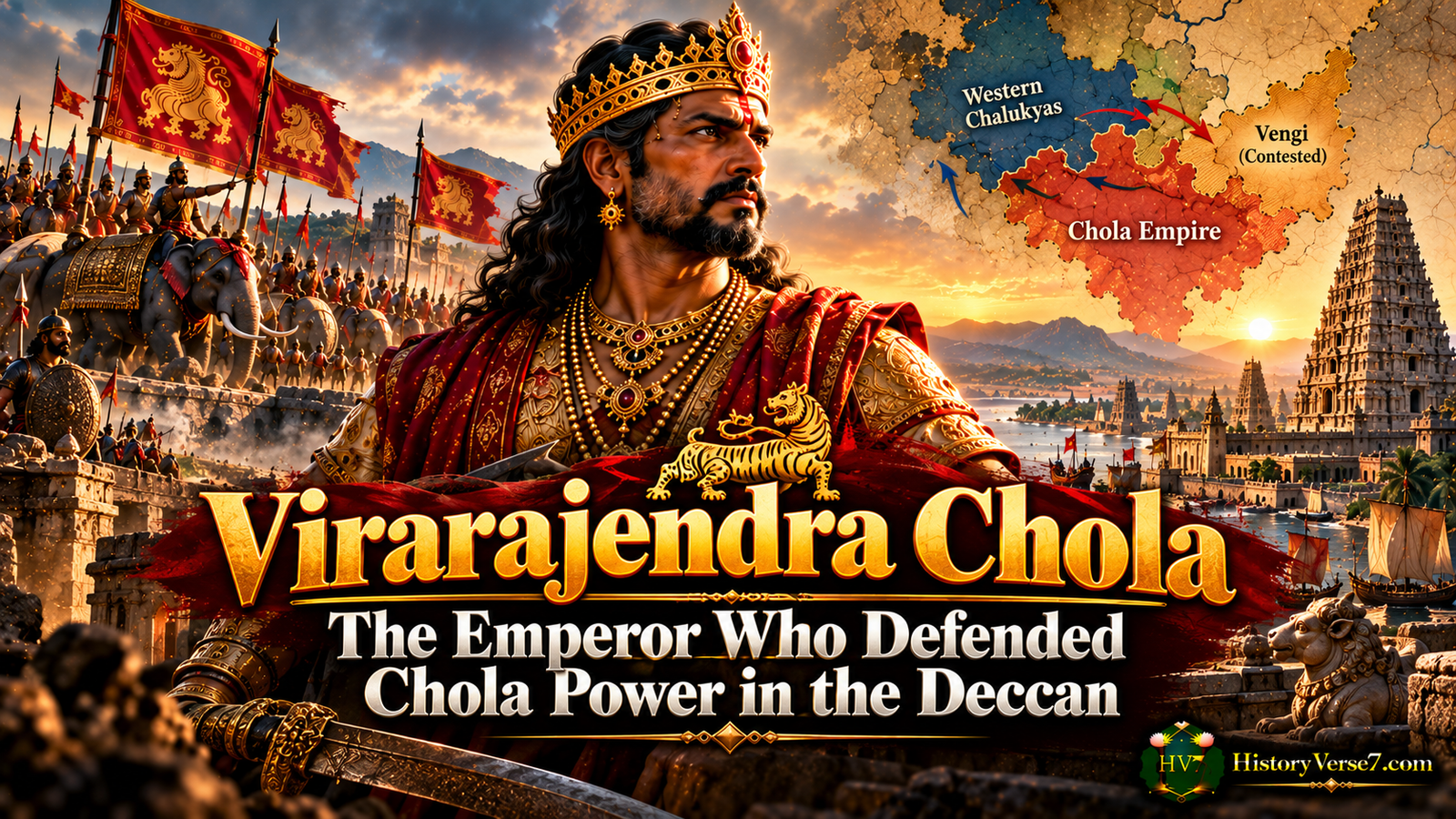
During the eleventh century, one of the Chola Empire’s greatest challenges was maintaining its political and military influence across the Deccan. Rivalry with the Western Chalukyas, succession politics in Vengi, and shifting regional alliances shaped the reign of Virarajendra Chola.
This HistoryVerse7 feature examines Virarajendra’s reign, military campaigns, diplomacy, administration, and inscriptions through the available historical evidence. Royal claims, corroborating evidence, and modern historical interpretations are distinguished wherever possible, offering a more balanced account than a simple narrative of victories.
Explore Historical Sources
DHARMA — An Inscription of Virarajendra Chola
Explore a digitised scholarly edition of an inscription from Virarajendra’s fifth regnal year, including information about a temple lamp endowment.
UNESCO — Great Living Chola Temples
Consult the official World Heritage record for the architectural and cultural legacy of the Chola period.
Ministry of Culture, Government of India — Great Living Chola Temples
Read government information about the historical and cultural significance of Chola temples.
Our research principle: Prioritise inscriptions and archaeological evidence, assess royal claims critically, and acknowledge uncertainty where the surviving sources are incomplete.
HISTORYVERSE7.COM • HISTORY, EVIDENCE & ANALYSIS
Table of Contents
A King in a Contested Deccan
HistoryVerse7.com |Cluster Article: Virarajendra Chola| International English Edition
When Virarajendra Chola took the throne in 1063, the empire he inherited was still rich, still militarily formidable, and still locked in a quarrel it had not managed to settle for the better part of half a century. The quarrel was with the Western Chalukyas, whose kingdom lay along the northern edge of Chola ambition, and whose rulers had spent decades refusing to accept a Chola-dominated Deccan. Virarajendra’s two elder brothers, Rajadhiraja I and Rajendra II, had each fought this war. One of them had died in it. The third brother did not get to choose a different inheritance.
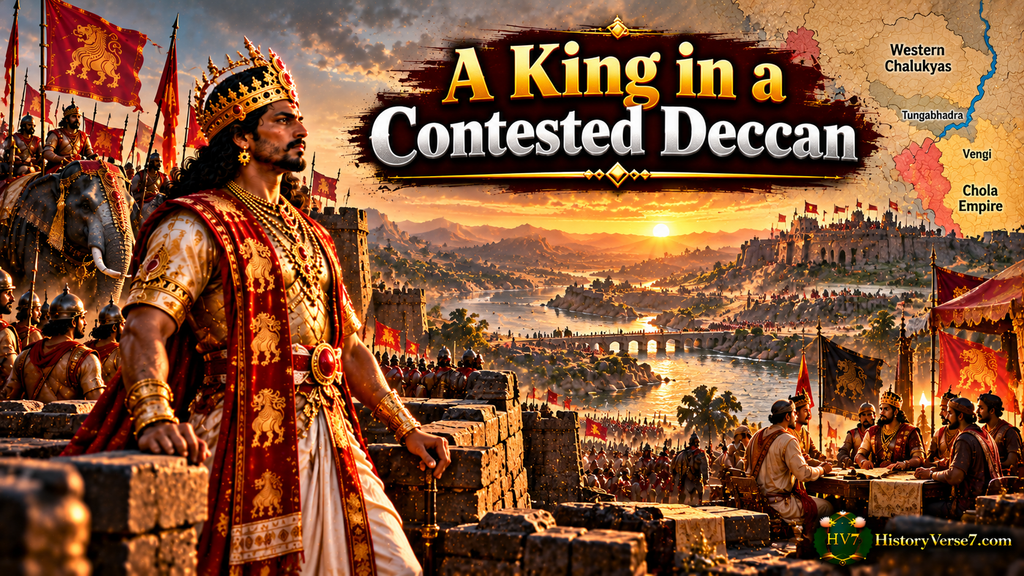
So the question that runs through his short reign is a practical one. How does a ruler hold together a large, prestigious empire when a determined neighbour keeps contesting its frontier, when an allied kingdom’s succession keeps reopening old disputes, and when every battlefield victory seems to need winning again a few years later? Virarajendra’s answer, as far as the evidence lets us reconstruct it, combined hard fighting with something less often remarked on: a willingness to do deals, including through marriage, with the very dynasty he spent years fighting.
This article follows that story using what survives, which is mostly his own inscriptions. They are valuable, and they are one-sided, and the difference matters throughout.
Who Was Virarajendra Chola?
Virarajendra was a son of Rajendra Chola I, which made him a younger brother of Rajadhiraja I and of Rajendra II. Modern summaries give his birth year as roughly 1002, but that figure is a reconstruction rather than something a contemporary record states, and it should be held loosely. He bore the dynastic regnal name Rajakesarivarman, in the alternating Rajakesari and Parakesari pattern that Chola kings followed, and he used the surname Vira-Chola, a name that also turns up in the literature composed under his patronage.
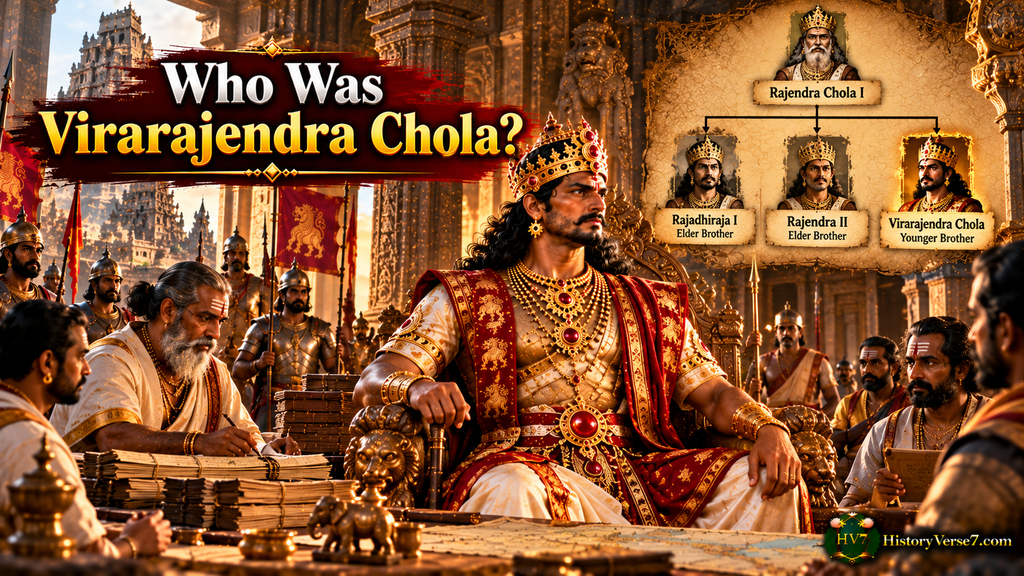
What is known of his life before 1063 comes from later descriptions of his career rather than from a detailed biography. Chola epigraphy and modern summaries place him in military service under his brothers, including a period as Chola viceroy in Sri Lanka appointed during Rajadhiraja’s reign, and note that he took part in fighting against the Western Chalukyas well before he became king. Beyond that, the sources go quiet. His mother is not securely identified in the material consulted for this article, and nothing reliable survives about his childhood, so none of it is invented here.
His queen is named in the Karuvur inscription edited in South Indian Inscriptions, Volume III, as Arumoli-Nangai. His son Athirajendra, whose brief rule comes at the end of this story, appears in the same epigraphic record as his successor.
The Chola Empire Before His Accession
Rajendra Chola I died in 1044 after a reign that had stretched Chola power to the Ganges and across the sea to Srivijaya. His eldest son Rajadhiraja then ruled for roughly eight years until he was killed at Koppam, in the great confrontation with Someshvara I of the Western Chalukyas covered in the previous article in this cluster. Rajendra II, who had taken command on that battlefield, ruled from 1052 until about 1063. Conflicts with the Western Chalukyas continued through his reign, and inscriptions credit him and his son Rajamahendra with further engagements, including one on the Tungabhadra at a place called Mudakkaru, which the historian S. N. Sen dates to about 1059.
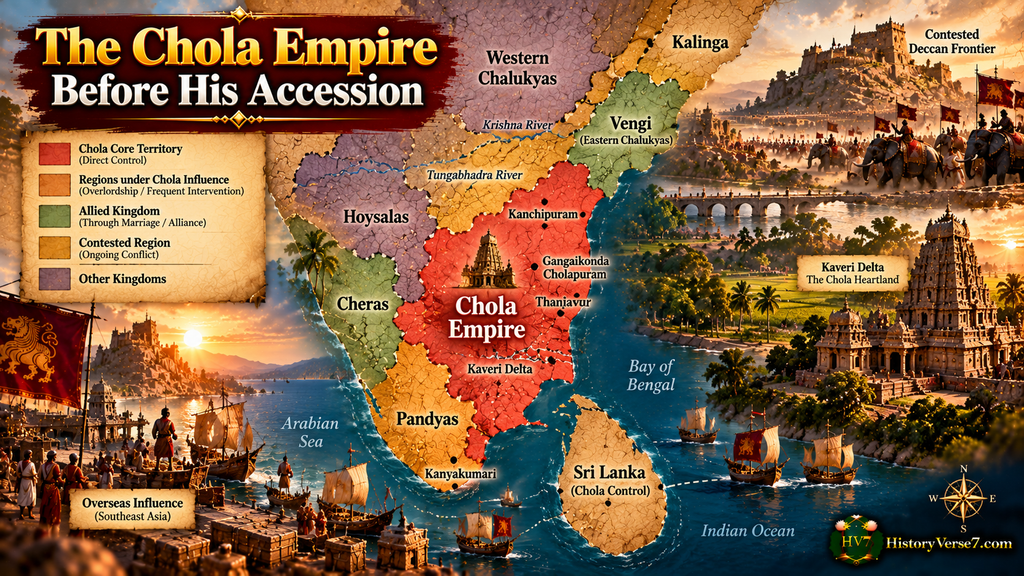
The strategic picture was by now familiar. The Tungabhadra and Krishna country was the contested borderland. The southern kingdoms, the Pandyas and Cheras, were under Chola overlordship that needed periodic reinforcement. And in the east lay Vengi, the Eastern Chalukya kingdom that both the Cholas and the Western Chalukyas wanted on their side. Vengi had been bound to the Chola house by marriage since Rajendra I gave his daughter Ammangadevi to the Vengi king Rajaraja Narendra. When Rajaraja Narendra died in 1061, the question of who should rule Vengi opened again, and Someshvara I moved quickly to back a rival candidate. That unresolved Vengi succession is the political backdrop to nearly everything Virarajendra did.
Accession and Imperial Continuity
Virarajendra became king around 1063, after the deaths of Rajendra II and of Rajendra II’s son Rajamahendra, who had been associated with the throne. The edited inscriptions in South Indian Inscriptions, Volume III, argued from the sequence of regnal names that Rajamahendra was Virarajendra’s immediate predecessor and that Athirajendra followed him. Later summaries compress this into the simpler statement that Virarajendra succeeded Rajendra II. Both versions point to the same practical conclusion: the line passed within the family from one of Rajendra I’s sons to another, with no sign in the surviving evidence of a contested seizure of power.
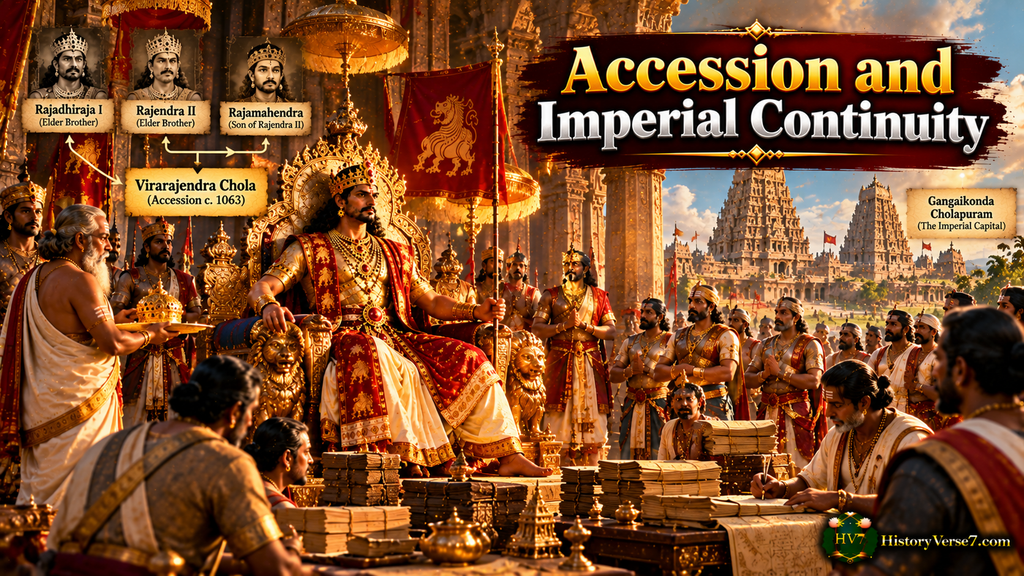
That absence of drama deserves to be stated plainly rather than filled in. Nothing in the records consulted suggests a succession conspiracy, a rival claimant in the Chola court, or a coup. What the evidence does show is a king in his sixties, already seasoned by years of campaigning, taking over an administrative machine that had been running for generations. The Karuvur inscription records him issuing a grant from his palace at Gangaikonda-Solapuram, the capital Rajendra I had founded, which is itself a small piece of evidence that the imperial court continued to function as before.
The Western Chalukyas: The Central Rivalry
The Western Chalukya kingdom, ruled in this period by Someshvara I from about 1042 until he died in 1068, was a Deccan power with its own imperial pretensions. It claimed the same borderlands the Cholas wanted, it cultivated its own candidates in Vengi, and it had demonstrated, at Koppam, that it could kill a Chola emperor and survive the consequences.
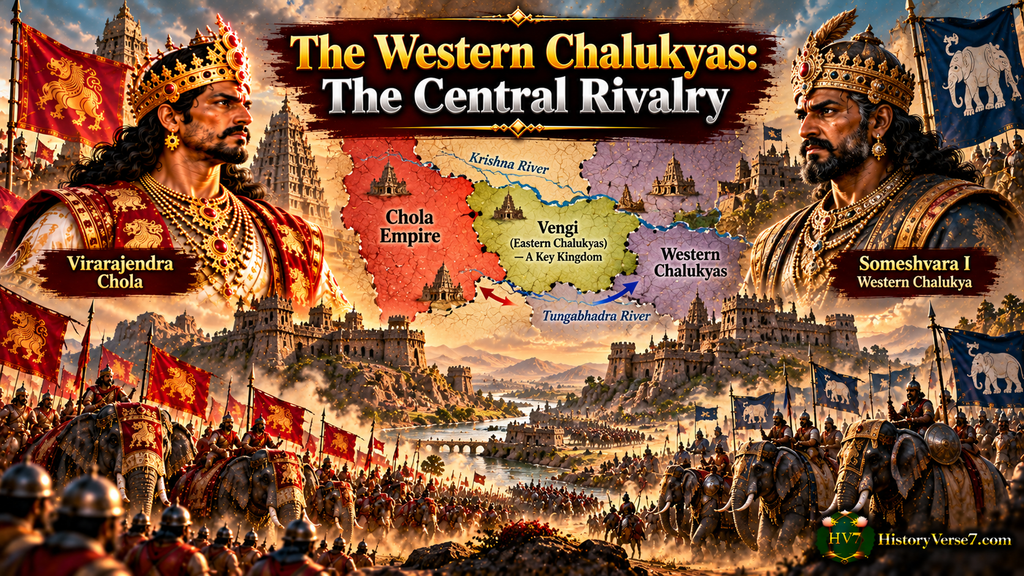
Why the rivalry persisted is worth separating from the question of who won individual battles. Vengi mattered because whoever controlled it flanked the other side. The Krishna and Tungabhadra corridor mattered because it governed movement between the Tamil country and the Deccan plateau. Prestige mattered because both courts defined kingship through victory, and a king who ignored a challenge risked appearing weak to his own nobles. Dynastic claims mattered because rival Eastern Chalukya princes could each be presented as the rightful ruler of Vengi. These pressures reinforced each other, which is why the conflict outlived individual kings. It would be a mistake to read it as personal hatred between Virarajendra and Someshvara. It was a structural contest that each ruler inherited and each tried to manage.
Virarajendra’s Military Campaigns
The campaigns attributed to Virarajendra come overwhelmingly from his own inscriptions, supplemented by the Western Chalukya side where it survives, and the picture they paint should be read accordingly.
Kudalasangamam. The most celebrated engagement is the battle of Kudalasangamam, the “meeting of the rivers,” identified with Koodli in the Shimoga district of Karnataka. Rajendra II had already fought there around 1062, according to Western Chalukya history. Under Virarajendra, accounts say Someshvara I issued a challenge to meet again at the same place. Virarajendra, according to the summary of these sources, waited a month for the Chalukya king to appear. When the Chalukya army did not come, he advanced and, in the Chola account, was victorious on every front, raising a victory pillar on the bank of the Tungabhadra. His own inscriptions, including those at Karur and Tindivanam, claim that Someshvara’s sons Vikramaditya VI and Jayasimha fled the field with their hair in disorder, and that he defeated the Chalukya armies five times in all. These are royal claims. They are consistent with a major Chola success at Kudalasangamam, but the “five times” is a boast, and no independent source confirms the count or the precise sequence.
The raid on the Chola capital. The Chalukya side was not passive. Around 1066, according to modern summaries, Vikramaditya VI led a force deep into the Chola country and reached the neighbourhood of Gangaikonda Cholapuram itself before being driven back. This matters because it cuts against the picture of a one-sided Chola dominance. A Chalukya prince reaching the imperial capital was a serious embarrassment, whatever the eventual outcome, and sources differ on the exact date and scale.
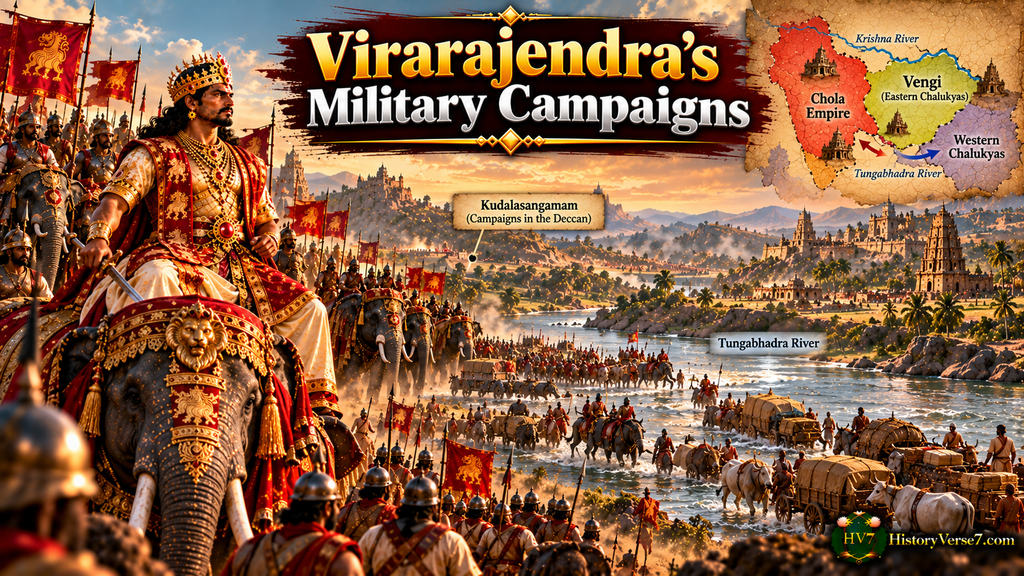
Vengi and the east. After the death of Rajaraja Narendra, Someshvara I had sent armies to impose his preferred candidate. One column under his general Chamundaraya and another under his sons moved into the Gangavadi region. Virarajendra’s response, in the Chola narrative, was a campaign across the eastern Deccan. The summaries credit victories at Vengi, at Bezwada (modern Vijayawada), in Kalinga, and at Chitrakuta in the Nagavamsi domains. Whether each of these was a battle, a raid, or a show of force is not something the inscriptions settle.
Elsewhere. The Karuvur inscription of his fourth year, followed by the Manimangalam inscription of his fifth year, claims the killing of the king of Pottappi, of a Kerala ruler named Varan, of the Pandya king, and of the younger brother of Jananatha of Dhara, among others. The Tindivanam and Perumber inscriptions assert the conquest of Kadaram. Each of these is a victory claim in the formulaic language of a royal record. Pottappi is a region of the Telugu country, Dhara is the Paramara capital in central India, and Kadaram, as discussed in the Rajendra Chola I article, is the Chola name for the Kedah region of the Malay Peninsula. The SII editor noted that Kadaram had earlier been wrongly identified with a place in the Madura district. How much of this was real military action, how much was commemoration of earlier or smaller operations, and how much was conventional royal rhetoric, the inscriptions cannot tell us.
Vengi and the Politics of Succession
Vengi is the key to understanding why Virarajendra’s reign looks the way it does. The kingdom’s Eastern Chalukya dynasty and the Chola house were intermarried, and the two courts treated each other as relatives as much as rivals. Kulottunga I, the man who would eventually take the Chola throne, was born as Rajendra Chalukya around 1025, the son of Rajaraja Narendra and Ammangadevi, and so a grandson of Rajendra I. He was both a Vengi prince and a Chola grandson, which is what made him such a loaded figure when the succession tangled.
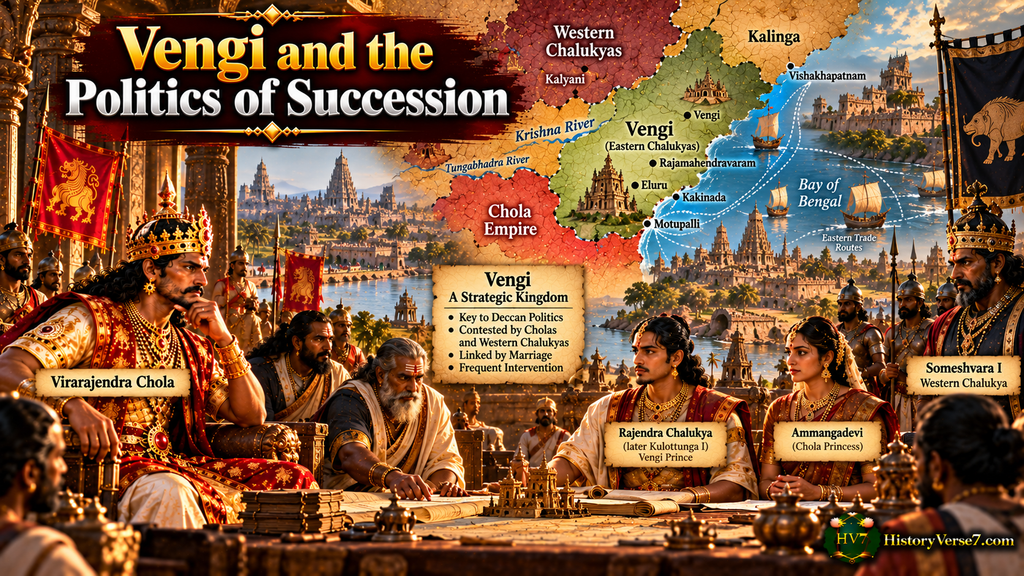
Someshvara I’s strategy was to back a different line, supporting Shaktivarman II, the son of Vijayaditya II, while the Cholas preferred Rajendra, the son of the dead king. It matters to be precise about what the Cholas controlled here. They did not administer Vengi directly the way they administered the Tamil heartland. They exerted influence through dynastic ties, military intervention, and alliances. The gap between that and annexation explains why the Vengi question kept returning. A Chola victory could install a friendly ruler, but could not make him permanently secure, and when the Chola army went home, the Western Chalukyas could come back.
The Southern Kingdoms
In the south, the picture is thinner. The Karuvur inscription’s list includes a Pandya king and a Kerala ruler, and a Kanyakumari inscription of Virarajendra, discussed below, shows his authority recorded at the far southern tip of the peninsula. These records fit the long-standing pattern of Chola overlordship that needed occasional enforcement rather than a single decisive conquest.
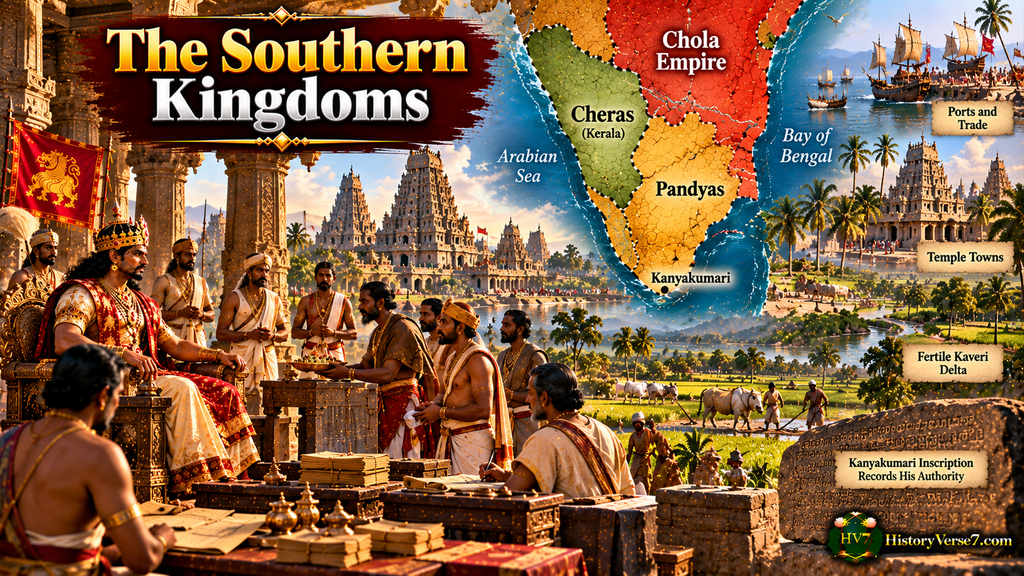
What the evidence does not support is any detailed narrative of southern campaigns in his reign. There is no account of a campaign, no route, no date, and no outcome beyond the bare claim. This article therefore does not build one. The honest summary is that southern rulers appear in his victory lists and that Chola authority in the south continued, with the precise nature of any resistance and any intervention unknown. Sri Lanka is a related and more pointed case: Chola power on the island broke down shortly after his death, when Vijayabahu’s successful rising, placed by modern scholarship around 1070 to 1072, ended Chola rule there. That falls just outside his reign, but it is a reminder that the southern and island frontiers had not been settled by any previous king’s victories.
Military Leadership and Strategy
The evidence does not allow a detailed reconstruction of Virarajendra’s tactics, and it is better to say so than to borrow detail from other reigns. What can be said is limited but real.
He fought in the Tungabhadra country, which means he operated at long range from the Chola heartland, across rivers and through hill country, with all the supply problems that implies. The Kudalasangamam account suggests a king willing to take the initiative, advancing after waiting a month rather than withdrawing, and to commemorate success with a victory pillar on the river, a conventional but meaningful marker of how far a campaign had reached. His campaigns in the east required movement across the Vengi and Kalinga country, again at great distance. Chola armies in this period, as in earlier ones, combined infantry, cavalry, and war elephants, and inscriptions of the time routinely mention captured horses and elephants, though the sources for his specific campaigns do not offer numbers, and none are given here.
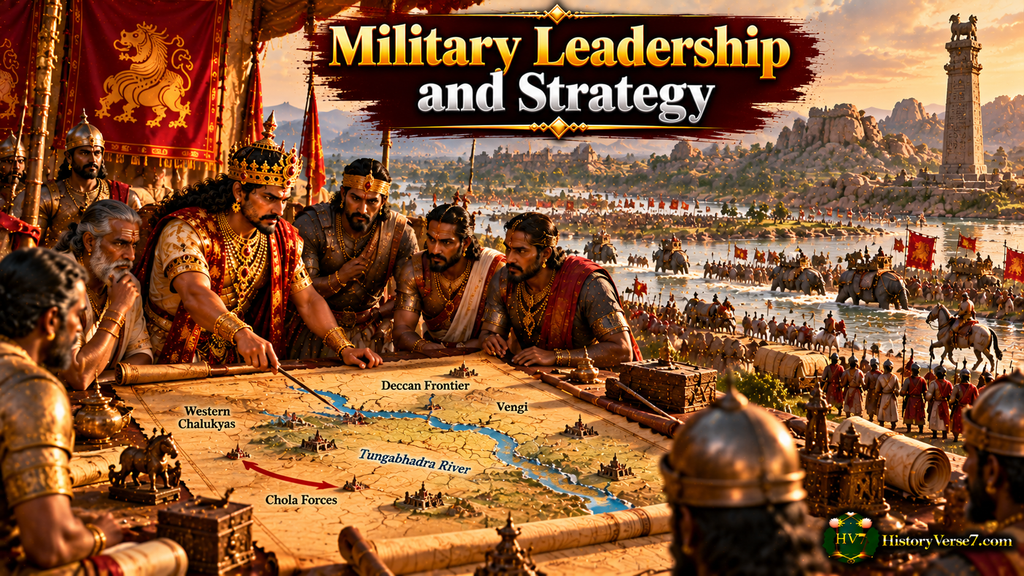
Equally important is what they show about the relationship between fighting and bargaining. The war was not run in isolation from politics. Virarajendra used both force and diplomacy in pursuit of the same objectives: a friendly Vengi, a secure Tungabhadra frontier, and a Western Chalukya court that could not threaten the Chola capital.
Diplomacy and Political Calculation
The most striking diplomatic fact of the reign is the marriage alliance with the family of his enemy. Vikramaditya VI, the Chalukya prince who had led the raid on the Chola capital, married one of Virarajendra’s daughters. Chola sources go further and say Virarajendra recognised Vikramaditya as the Western Chalukya king, a claim that has to be read against the political reality that Vikramaditya was then in conflict with his own brother Someshvara II over their father’s throne.
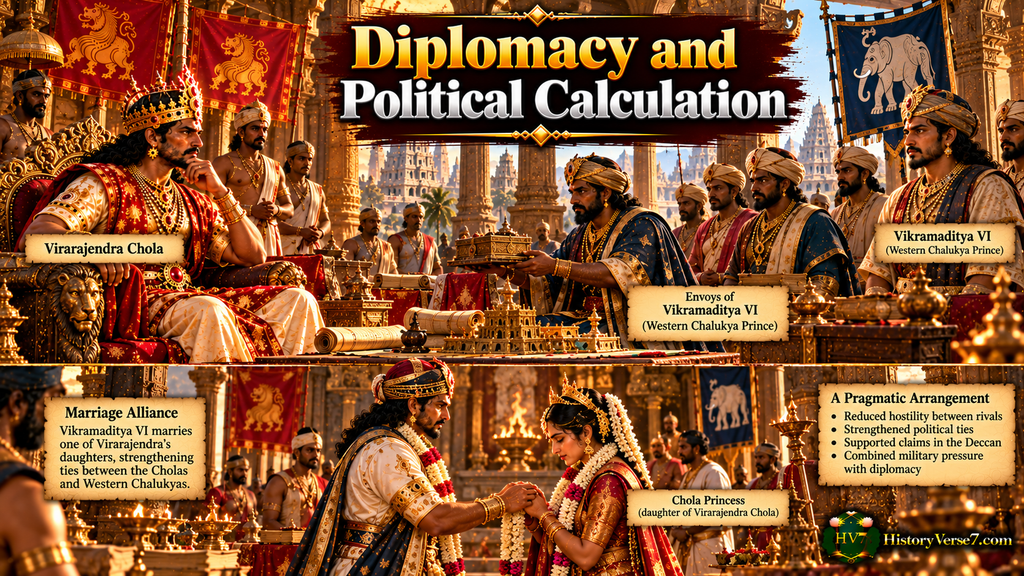
The sequence of events can be summarised cautiously. Someshvara I died by ritual drowning in the Tungabhadra on 29 March 1068. His sons then competed for the succession. The summaries suggest that Virarajendra backed Vikramaditya VI, in part by marriage, in part by political support, against Someshvara II, since a Western Chalukya ruler who owed something to the Cholas would be preferable to one who did not. Vikramaditya’s reign lasted until 1126 and was long and, by the account of historian Sen, largely peaceful and prosperous.
How far this was a deliberate grand strategy, as opposed to a series of opportunistic moves, is an interpretation and not a documented fact. No treaty text survives, and there are no records of the negotiations. What the marriage and the recognition show is a ruler pursuing the same objective, Chola security, by a route that did not depend on defeating the other side outright.
Administration Under Virarajendra
The administrative evidence points to continuity rather than reform. Nothing in the inscriptions examined suggests new institutions, new revenue systems, or a restructuring of provincial government under Virarajendra, and this article does not attribute any to him.
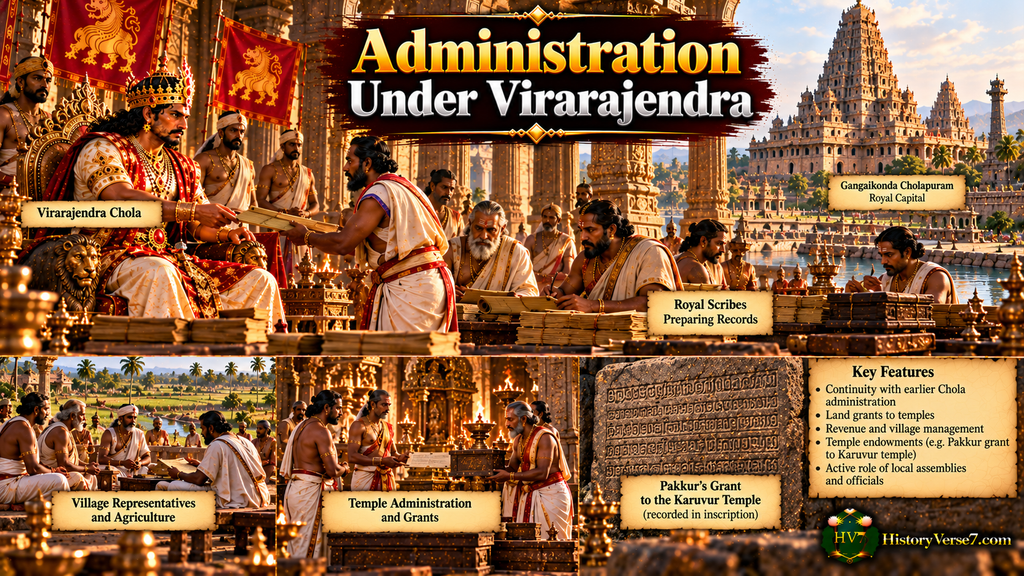
What the inscriptions do show is the machinery running. The Karuvur record documents a grant of the village of Pakkur to the temple at Karuvur. Pakkur, like Karuvur itself, belonged to Vengala-nadu, a district within the Adhirajaraja-mandalam, a named Chola administrative division. The grant was issued from the royal palace at Gangaikonda-Solapuram. Dated inscriptions across regnal years, from Achcharapakkam in the fifth year to Tindivanam in the sixth, show royal records being produced in different parts of the Tamil country throughout the reign, which is evidence of a functioning administrative reach.
The reasonable conclusion is that Virarajendra governed through the apparatus built under Rajaraja I and Rajendra I, and that the demands of near-constant war left little evidence of administrative innovation, whether or not he in fact attempted any.
Temples, Religion, and Royal Patronage
Like his predecessors, Virarajendra made grants to temples, and inscriptions at Karuvur, Tindivanam, Perumber, and elsewhere record this activity. As earlier articles in this cluster have noted, temples were religious, economic, and political institutions at once. They held land, employed people, and anchored local administration, so a royal grant was both an act of piety and a form of governance.
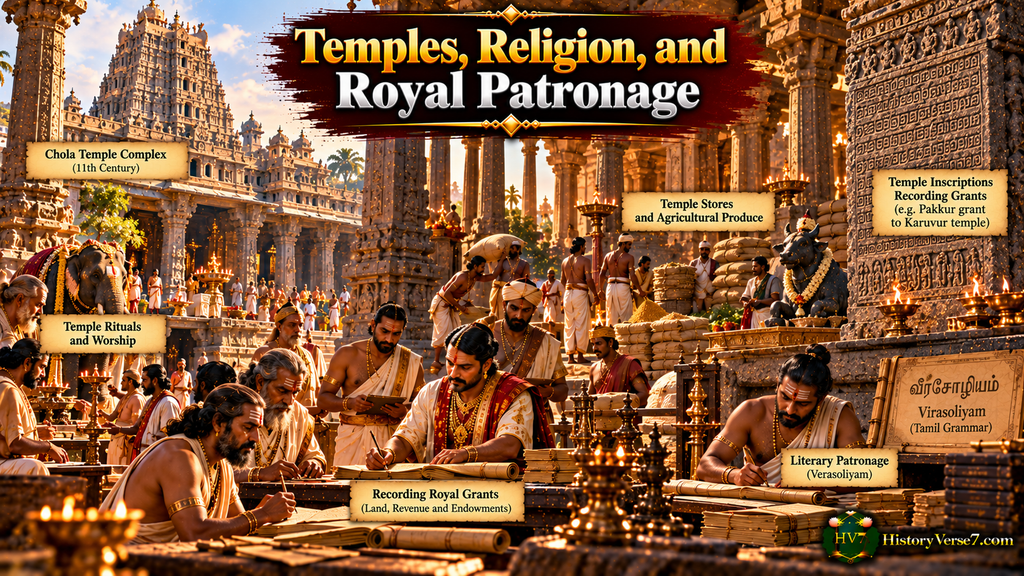
Beyond that, the evidence is thin. The available sources say nothing reliable about his personal beliefs, and it would be unjustified to draw conclusions about the religious policy of his government from a handful of grants. One thing that can be said is that his reign produced literature. A Tamil grammatical work, traditionally identified as the Virasoliyam, names Virarajendra as its author’s patron, and the SII editor argued from the commentary, which mentions the victory at Kudalasangamam and no later event, that the work was composed during his reign. The point is that his court supported scholarship as well as war.
What Do Virarajendra’s Inscriptions Reveal?
His inscriptions are the backbone of everything above, and they have to be read for what they are. They tell us his regnal name and surname, his genealogy, the places where his records were set up, the villages and temples that received grants, and the victories he chose to claim. They are the main reason we know about Kudalasangamam at all.
They also show what a king wanted remembered. The Kanyakumari inscription of Virarajendra is notable for being one of the few epigraphical records that gives a genealogical list of Chola kings, which suggests a conscious effort to place himself within the dynastic line. The Karuvur and Manimangalam records list the rulers he claims to have killed in a single sweep, a rhetorical device that compresses what may have been scattered or separate encounters into one grand statement.
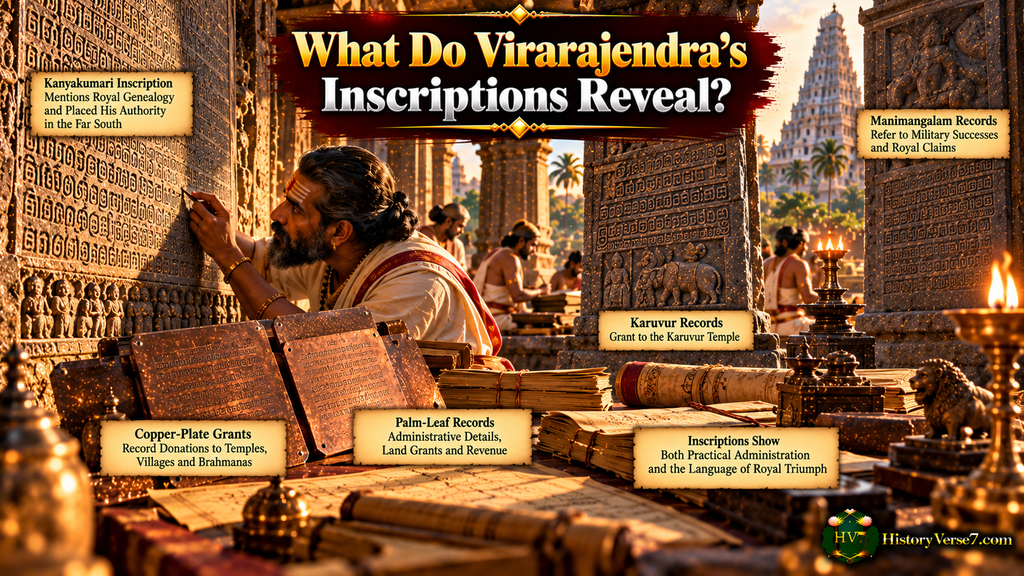
The limitations are straightforward. A royal inscription does not report a defeat. It does not distinguish between a decisive battle and a skirmish. It does not tell us whether a conquered territory was held or abandoned the next season. And it names Kadaram without telling us what, concretely, happened there. Read critically, his inscriptions are excellent evidence for what the Chola court claimed and for the routine business of administration, and much weaker evidence for the scale and permanence of what he achieved.
The Limits of Chola Power
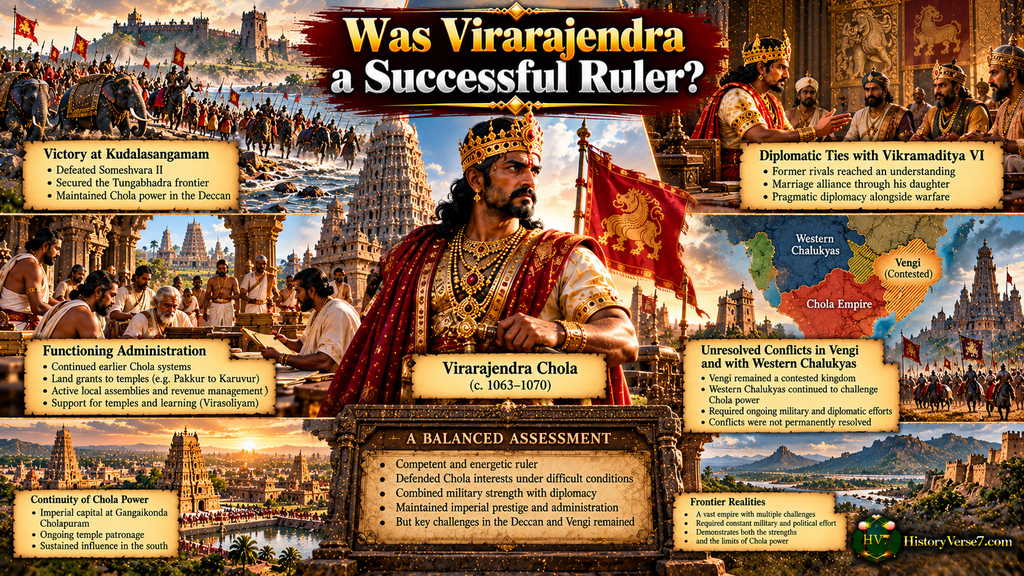
The reign’s own evidence argues against any simple story of Chola dominance. A Chalukya prince reached the vicinity of the capital. Vengi, despite repeated Chola intervention, remained a battleground rather than a settled province. The Western Chalukyas survived Kudalasangamam and went on to a long reign under Vikramaditya VI. Sri Lanka slipped away within a few years of his death. None of that means the Chola Empire was collapsing; there is no evidence for collapse in his reign. It means that a large premodern empire could win a battle without winning the war, and that influence over a neighbour is not the same as control.
The distinction matters most in the east. A king who could march to Vengi and install a friendly ruler had real reach, but he could not administer the place from Gangaikonda Cholapuram. Each intervention bought time rather than a permanent settlement, and that is the structural limit his reign illustrates.
Final Years and Succession
Virarajendra died in 1070 in the Chola capital, probably in the first half of the year. His son Athirajendra succeeded him, and some summaries associate him with the throne as early as 1067, though dates differ. The reign was brief, a matter of months, and Athirajendra died around June 1070. The circumstances are unclear. One tradition, reported by the historian Nilakanta Sastri, identifies Athirajendra with Krimikanta Chola, the king remembered in Vaishnava tradition as a persecutor of the philosopher Ramanuja, and says he died in a local uprising. That identification rests on later sources and is not secure. Vikramaditya VI, according to the summaries, was in the Chola capital around this time, helped quiet unrest, and returned home after about a month, apparently satisfied that order had been restored.
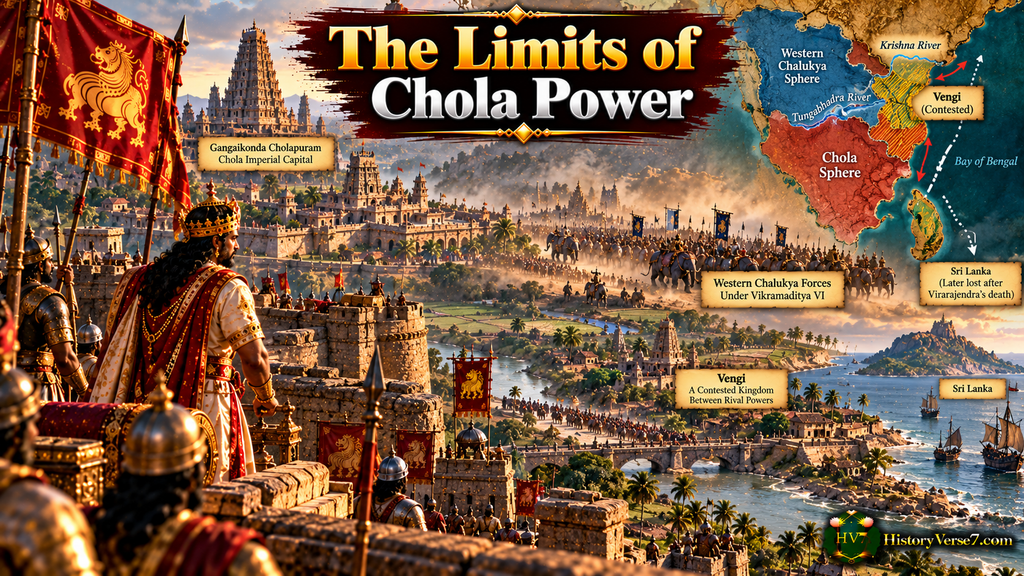
The throne then passed to Kulottunga I, who was crowned on 9 June 1070. The relationship is worth stating exactly. Kulottunga was not Virarajendra’s son. He was the son of Virarajendra’s sister Ammangadevi and the Vengi king Rajaraja Narendra, which made him Virarajendra’s nephew and a grandson of Rajendra I. His accession combined a Chola descent through his mother with an Eastern Chalukya identity through his father, and it brought a new line to the Chola throne. Whether Virarajendra’s own family had a weaker claim, whether the transition was smooth, and what exactly Vikramaditya VI wanted from it are questions on which the available sources are incomplete. This article treats the succession as a complicated dynastic handover, not as a seamless one, and does not reconstruct the political manoeuvres behind it.
Was Virarajendra a Successful Ruler?
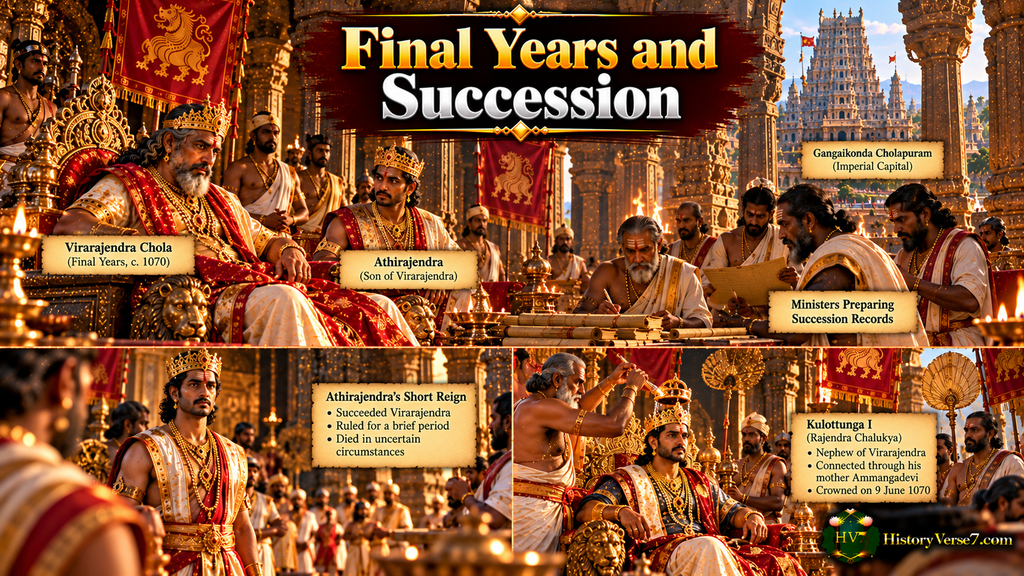
The answer depends on which measure is applied. Militarily, his own inscriptions claim a run of victories, and there is good reason to credit a real Chola success at Kudalasangamam. But the Chalukya raid on the capital shows the war was not one-sided. Diplomatically, the marriage alliance with Vikramaditya VI bought a durable peace with a Chalukya ruler who would reign for decades, which is arguably his most lasting achievement, though it is an interpretation rather than a documented policy. In Vengi, his campaigns did not produce permanent control, but they helped keep the Chola-connected line alive until Kulottunga’s accession. Administratively, he maintained a working empire without leaving evidence of reform. And in terms of imperial continuity, he handed the empire on intact, but to a short-lived son and then to a line from another dynasty. That is a mixed record. It is better described as competent defence of an empire in difficult conditions than as either triumph or failure.
Why Is Virarajendra Less Familiar Today?
Several reasons are plausible, though none can be proven. His reign was short, under a decade, compared with the three-decade reigns of Rajaraja I and Rajendra I. He has no signature monument comparable to the Brihadisvara temple or to Gangaikonda Cholapuram. His record is one of repeated border wars rather than one dramatic expedition to the Ganges or across the sea. Much of what survives about him is inscriptional rather than narrative, which makes for a less vivid story. And he sits at the end of a dynastic line, just before the accession of Kulottunga I, a figure whose own reign and reputation, helped by the later Tamil poem Kalingattuparani, drew much of the attention that popular memory gives to this period. He is an easy king to overlook, and a revealing one for exactly that reason.
Lesser-Known Facts
- Virarajendra’s regnal name was Rajakesarivarman, and he also used the surname Vira-Chola, which appears in the literature composed under his patronage.
- He was a son of Rajendra Chola I and the youngest of the three brothers who ruled after him, following Rajadhiraja I and Rajendra II.
- The 1002 birth year commonly given for him is a modern reconstruction, not a figure recorded in a contemporary source.
- The Karuvur inscription of his fourth year names his queen as Arumoli-Nangai and records a grant of the village of Pakkur, in Vengala-nadu, to the Karuvur temple.
- That same grant was issued from his palace at Gangaikonda-Solapuram, the capital founded by his father, which shows the imperial court still operating from there.
- The Karuvur and Manimangalam inscriptions claim he killed the king of Pottappi, a Kerala ruler named Varan, the Pandya king, and the younger brother of Jananatha of Dhara, among others.
- The Tindivanam and Perumber inscription asserts the conquest of Kadaram, and its editor in South Indian Inscriptions noted that Kadaram had earlier been wrongly identified with a place in the Madura district.
- Kudalasangamam, the best-known battle of his reign, is identified with Koodli in the Shimoga district of Karnataka, and Rajendra II had already fought there around 1062.
- His inscriptions at Karur and Tindivanam claim that Someshvara I’s sons Vikramaditya VI and Jayasimha fled the battlefield, and that he defeated the Chalukya armies five times.
- The Kanyakumari inscription of Virarajendra is one of the few epigraphical records that gives a genealogical list of Chola kings.
Historical Assessment
Who was Virarajendra Chola? A son of Rajendra I and the youngest of the three brothers to rule after him, he came to the throne around 1063 after years of military service, and ruled for under a decade.
What were the central challenges of his reign? The unresolved rivalry with the Western Chalukyas, the repeated reopening of the Vengi succession, and the work of keeping the empire’s southern and island frontiers quiet.
What did he achieve against the Western Chalukyas? His inscriptions claim a series of victories, centred on Kudalasangamam, and there is good reason to credit a real Chola success there. He also secured, by marriage and recognition, a working relationship with Vikramaditya VI, the Chalukya prince who would rule for half a century.
Why was Vengi so important? It flanked both empires, and each wanted a friendly ruler there. Because Chola influence rested on dynastic ties and military intervention rather than direct administration, the question kept returning.
What do his inscriptions reveal? The routine business of an imperial court, his genealogy and titles, and the victories he wanted remembered. They are weaker evidence for the scale and permanence of those victories.
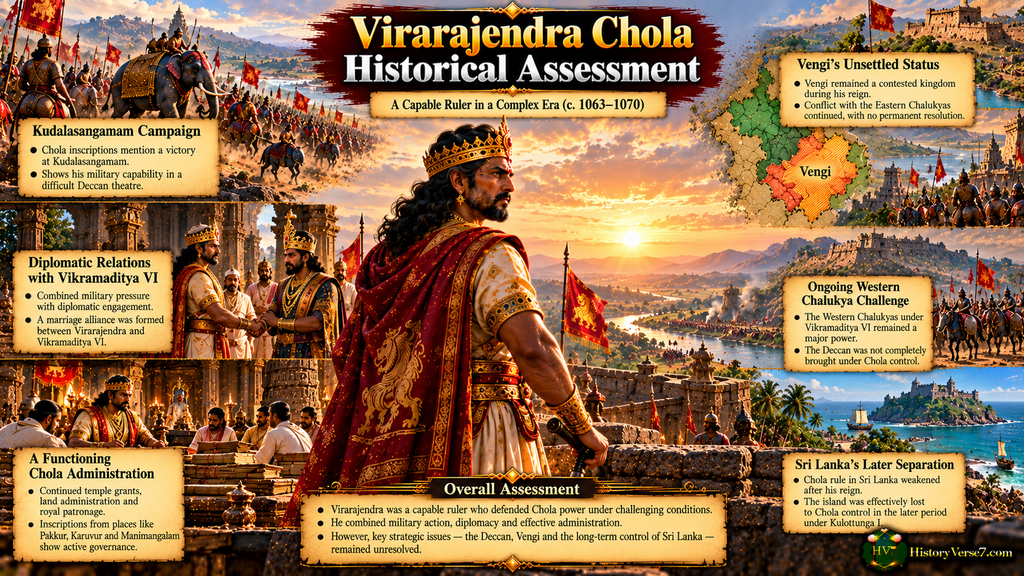
What were the limits of his power? A Chalukya prince reached the vicinity of the capital; Vengi was never settled, and Sri Lanka slipped away shortly after his death.
How did his reign influence later Chola history? He handed on an intact empire, but his own line ended within months, and the throne passed to Kulottunga I, who combined Chola and Eastern Chalukya descent and founded a new phase of Chola rule.
Written & Researched by Abhishek Chavan — HistoryVerse7| © 2026 HistoryVerse7 | Cluster Article: Virarajendra Chola
FAQ — Virarajendra Chola
Who was Virarajendra Chola?
Virarajendra Chola was an eleventh-century Chola emperor, a son of Rajendra Chola I and a younger brother of Rajadhiraja I and Rajendra II. He ruled from about 1063 until he died in 1070. His reign was dominated by the long conflict with the Western Chalukyas and the politics of Vengi.
When did Virarajendra Chola rule the Chola Empire?
He is generally dated to about 1063 to 1070. Some modern summaries give slightly different start dates for his rule or for his son’s co-regency, so the exact years should be treated as approximate. He died in early 1070, and the throne passed to his son Athirajendra.
Why was Vengi important to Virarajendra Chola?
Vengi, the Eastern Chalukya kingdom, lay between the Chola and Western Chalukya spheres, and whoever had a friendly ruler there gained a strategic advantage. It was also tied to the Chola house by marriage. The Cholas influenced it through alliance and intervention rather than direct administration.
What were Virarajendra Chola’s major military campaigns?
His best-known engagement is the battle of Kudalasangamam against the Western Chalukyas. His inscriptions also claim victories in Vengi and the eastern Deccan, and over rulers in Pottappi, Kerala, and the Pandya country. These are royal claims, and the details of most are not independently confirmed.
Did Virarajendra Chola defeat the Western Chalukyas?
His inscriptions say he did, repeatedly, and a real Chola success at Kudalasangamam is plausible. But the Western Chalukyas survived, a Chalukya prince reached the neighbourhood of the Chola capital, and the rivalry continued, so he won battles without ending the conflict.
HISTORYVERSE7 • CHOLA EMPIRE HISTORY SERIES
Continue Exploring the History of the Chola Empire
Virarajendra Chola’s reign offers an important perspective on the struggle to maintain Chola influence in the Deccan, the rivalry with the Western Chalukyas, and the political significance of Vengi. To understand his place in this wider history, it is also worth exploring the reigns of Rajaraja Chola I, Rajendra Chola I, and Rajadhiraja Chola I.
Continue your historical journey with HistoryVerse7’s Chola Empire collection. Explore our English articles or visit the Hindi collection for more coverage of Chola rulers, military campaigns, administration, and cultural heritage.
Explore the Chola Empire in English
Discover our English-language articles on Chola emperors, imperial expansion, military campaigns, political rivalries, administration, and cultural history.
Explore All English Chola Articles →
Related Articles
Explore Chola History in Hindi
Prefer reading in Hindi? Explore our Hindi-language collection covering Chola rulers, dynastic history, major conflicts, administration, and cultural heritage.
Further Reading and Historical Research
DHARMA — Inscription of Virarajendra Chola
Consult a digitised scholarly edition of an inscription associated with Virarajendra’s reign.
UNESCO — Great Living Chola Temples
Explore the official World Heritage record for major surviving Chola temples.
Government of India — Ministry of Culture
Read government material on the historical and cultural importance of the Great Living Chola Temples.
History is best understood by examining the evidence behind the story.
Thank you for reading HistoryVerse7. Continue exploring the past through carefully researched history, inscriptions, and evidence-based analysis.
HISTORYVERSE7.COM • HISTORY, EVIDENCE & ANALYSIS
Share this content: