
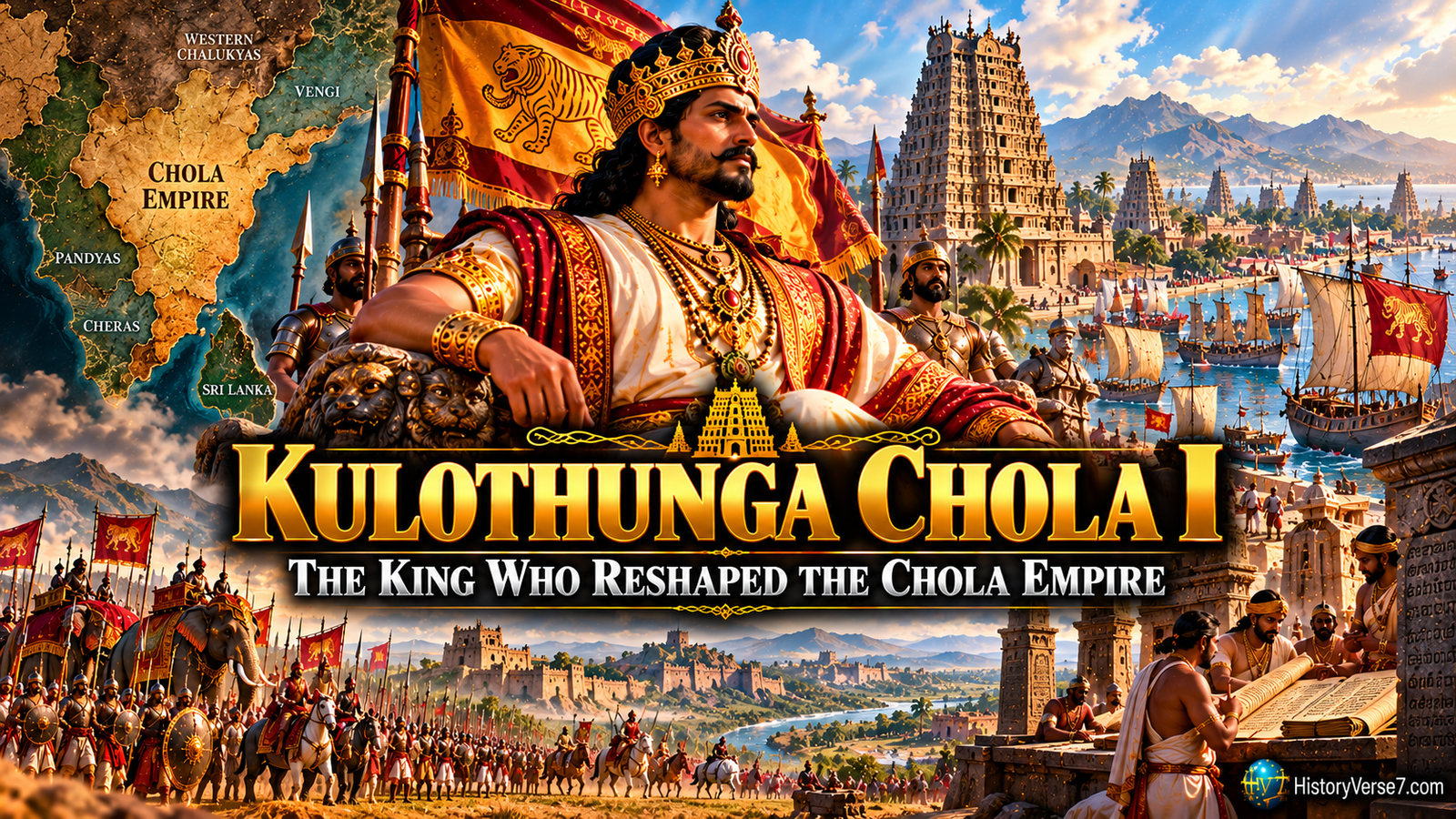
Kulothunga Chola 1: The King Who Reshaped the Chola Empire
Share this content: HISTORYVERSE7 • HISTORICAL RESEARCH Understanding Kulothunga Chola 1 Through Historical Evidence Kulothunga Chola I’s reign was shaped by dynastic succession, the politics of Vengi, regional rivalries and the changing priorities of the Chola Empire. Understanding this period requires more than royal victory accounts. Inscriptions, scholarly editions and historical research help us distinguish…
Share this content:
Understanding Kulothunga Chola 1 Through Historical Evidence
Kulothunga Chola I’s reign was shaped by dynastic succession, the politics of Vengi, regional rivalries and the changing priorities of the Chola Empire. Understanding this period requires more than royal victory accounts. Inscriptions, scholarly editions and historical research help us distinguish documented events from political claims and later interpretations.
Explore the historical sources:
- DHARMA — South-Indian Inscriptions, Volume III, Part II : Digitised editions of inscriptions relating to Kulottunga Chola I and other rulers.
- IGNCA — Inscriptions of Kulottunga-Chola I : An epigraphic study discussing the king’s inscriptions and historical records.
- INFLIBNET — The Cholas : An academic educational overview of the Chola dynasty.
Our approach: This HistoryVerse7 feature examines historical claims critically, considers the limitations of surviving evidence and avoids treating every reported victory as proof of permanent territorial control.
Timeline
| Date | Event | Note |
| c. 10 May 1011 | Vimaladitya comes to the Vengi throne | Kielhorn’s dating as cited in South Indian Inscriptions. He is Kulothunga’s grandfather and married Kundavai, a daughter of Rajaraja I. |
| c. 16 Aug 1022 | Rajaraja Narendra comes to the Vengi throne | Same source. He later married Ammangadevi, a daughter of Rajendra I, and became Kulothunga’s father. |
| 1044 | Death of Rajendra I | Rajadhiraja I becomes sole emperor. |
| c. 28 May 1052 | Rajendra II’s accession | Date used in the SII table of reigns. |
| 1052 or 1054 (disputed) | Battle of Koppam | Rajadhiraja I is killed; the date is disputed in scholarship. |
| 1061 | Death of Rajaraja Narendra | Vijayaditya VII holds Vengi; accounts of his patrons differ. |
| 1062 to 1063 | Virarajendra’s accession | SII table; his latest dated inscription is in his eighth year. |
| 1070 | Death of Virarajendra; brief reign of Athirajendra | Length of Athirajendra’s reign and manner of his death are uncertain. |
| c. 9 June 1070 | Kulothunga crowned | Approximate; a minority reading proposes a different order of events (needs verification). |
| c. 1070 to 1075 (sources differ) | Chola rule in Sri Lanka ends after Vijayabahu rises | Balasubrahmanyam places expulsion from Polonnaruva c. 1073 and the coronation c. 1075; other summaries give 1070. |
| c. 1075 to early 1080s (sources differ) | Nangili war with the Western Chalukyas | Chola accounts claim success; the Tungabhadra remains the working frontier. |
| c. 1076 to 1077 | Death of Vijayaditya VII; Kulothunga’s sons placed in Vengi | Order and dates of the viceroys vary between summaries. |
| 1077 | Embassy to China | Reported from Chinese records via Balasubrahmanyam; not checked in the original. |
| c. 1086 (16th year) | Second general land survey | Surveyor-general reported as Ulagalanda Perumal. |
| c. 1090 (20th year) | Smaller Leyden grant | Ambassadors of the king of Kadaram request a charter for a Buddhist monastery at Nagapattinam. |
| c. 1095 to 1096 | First Kalinga war | Balasubrahmanyam’s dating; no lasting administration shown in sources consulted. |
| c. 1110 (or before c. 1103) | Second Kalinga war, celebrated in the Kalingattuparani | Dating differs between summaries. |
| c. 1115 to 1116 | Hoysala ruler Vishnuvardhana takes Talakkadu and the Gangavadi country | Approximate; ends Chola presence in that region. |
| c. 1118 | Vikrama Chola recalled from Vengi and made heir | Per Balasubrahmanyam; Vengi left with weaker Chola presence. |
| c. 1118 to 1119 (49th year) | Latest year in the SII list of his inscriptions | Later discoveries extend the known span. |
| c. 1122 (or 1125) | End of the reign | Sources differ; the reign lasted at least about fifty-two years. |
Kulothunga Chola 1: The King Who Reshaped the Chola Empire
HistoryVerse7.com |Cluster Article: Kulothunga Chola 1| International English Edition
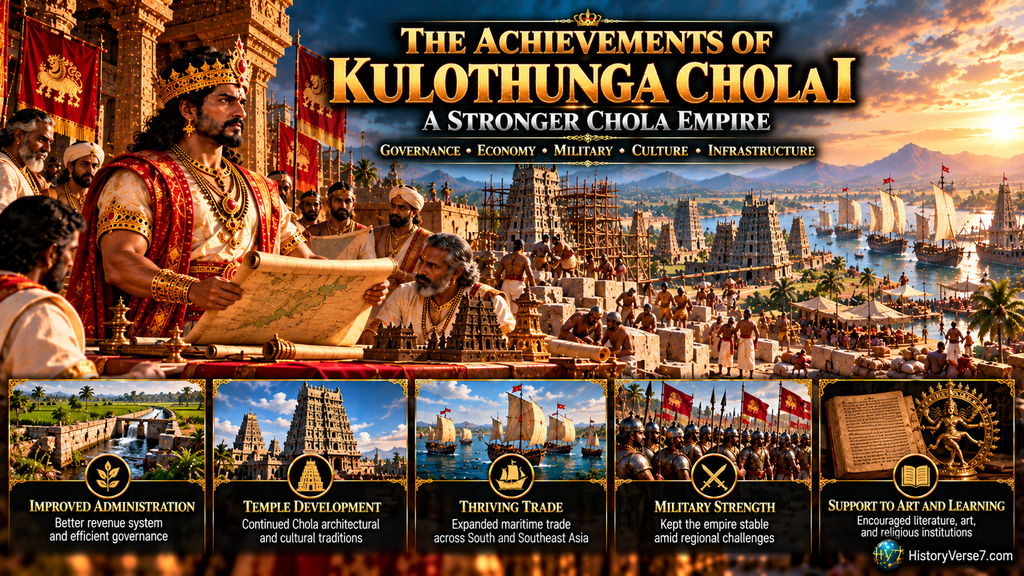
In the space of a few months in 1070 CE, the Chola throne passed from Virarajendra, a king who had spent his reign fighting the Western Chalukyas, to his son Athirajendra, who ruled for only a short time in circumstances the sources describe thinly, and then to a man who had grown up in a different royal house altogether. His father had been a king of Vengi, the Eastern Chalukya kingdom on the Andhra coast. His mother was a Chola princess. The inscriptions, using calculations by the epigraphist Franz Kielhorn as cited in South Indian Inscriptions, date the start of his reign to about 9 June 1070.
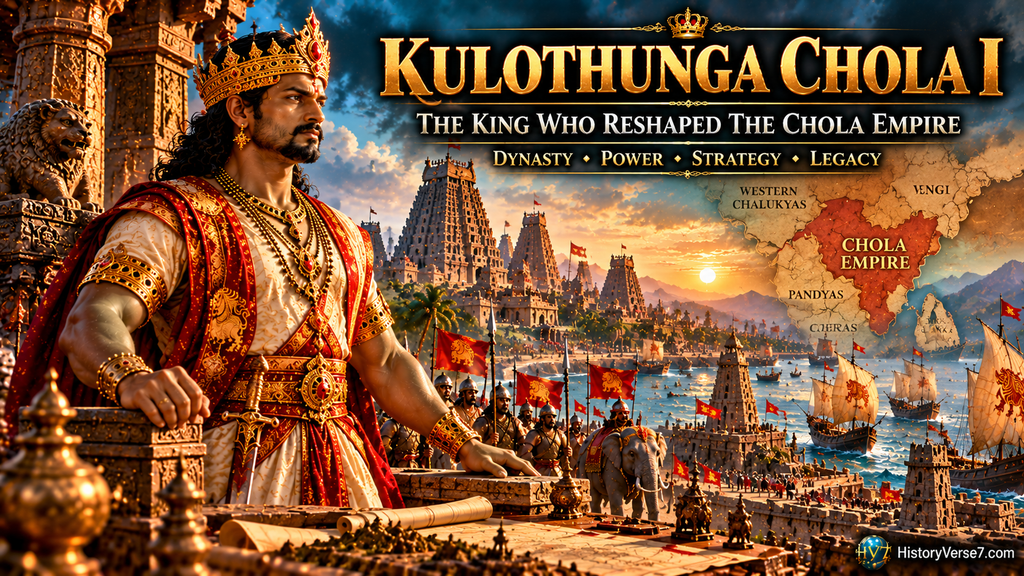
He would rule for more than fifty years, longer than any of the imperial Chola kings before him. That length alone should make us cautious about the easy label of a single “transformation.” A reign of five decades has phases, setbacks, and delegated work, and some of what is credited to the king belonged to his officials, his sons, and the machinery he inherited.
This article is built around one question: how did Kulothunga Chola I manage a dynastic transition that could have broken the empire, keep Chola power intact, and shift its priorities? The answer has to be assembled from his inscriptions, from a court poem written in his honour, from a rival’s chronicle, and from modern scholars who do not always agree. Where they differ, the differences are part of the story.
Who Was Kulothunga Chola 1?
He was born Rajendra, and in the sources that name him before his accession, he appears as an Eastern Chalukya prince. On taking the Chola throne, he used the regnal name Kulottunga, a Sanskrit-derived name usually glossed as “the lofty one of the lineage,” together with the traditional Chola dynastic name Rajakesarivarman. Modern writers often call him a “Chalukya-Chola” king, a label that appears in the editorial commentary of South Indian Inscriptions, Volume III, and that captures his double inheritance.
Two cautions about names. Three Chola kings bore the name Kulottunga, and this article concerns only the first. His grandson Kulottunga II ruled from about 1133, and Kulottunga III reigned much later, from the late twelfth century. The early editors of the inscriptions did not always keep the numbering straight, and the commentary in South Indian Inscriptions itself uses a different scheme, so older books can be confusing.
Historians consider his reign important for three reasons. It began a new line on the Chola throne through a prince of mixed Chola and Eastern Chalukya descent. It was unusually long, which means his inscriptions give an unusually continuous record. And it is the reign in which several long-running problems- Vengi, the Chalukya frontier, Sri Lanka- were either settled in ways that lasted or visibly slipped away.
The Chola and Eastern Chalukya Connection
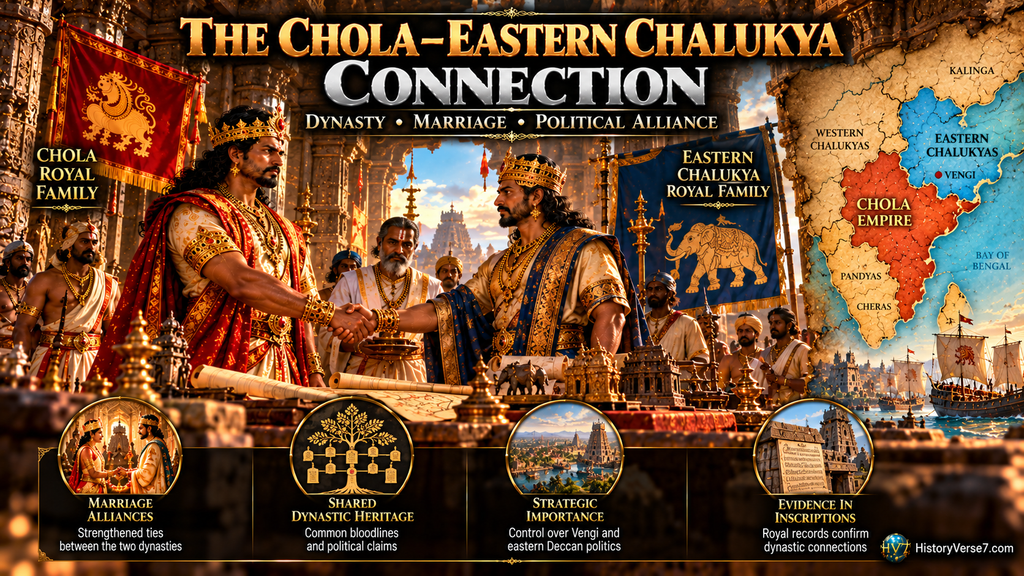
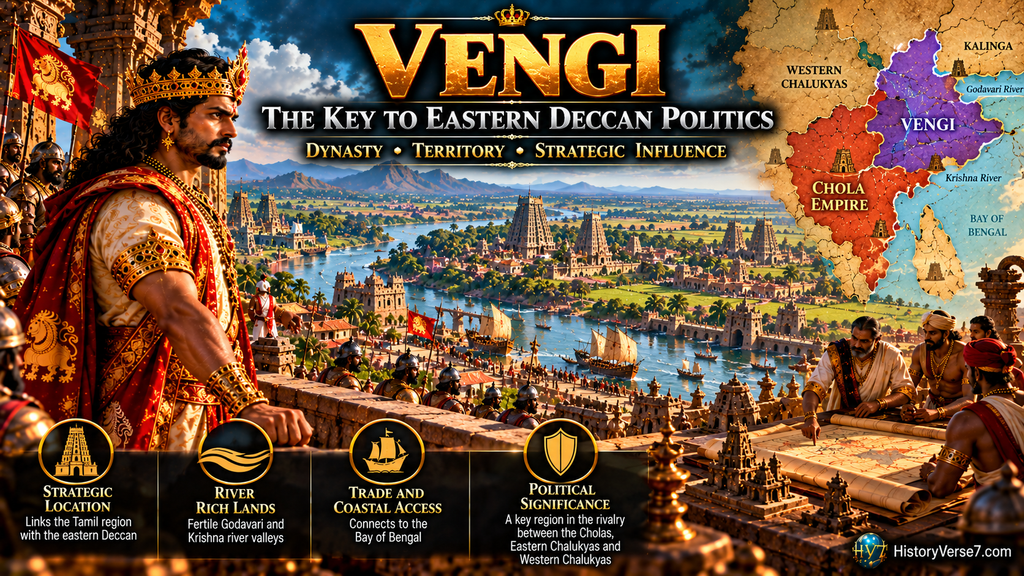
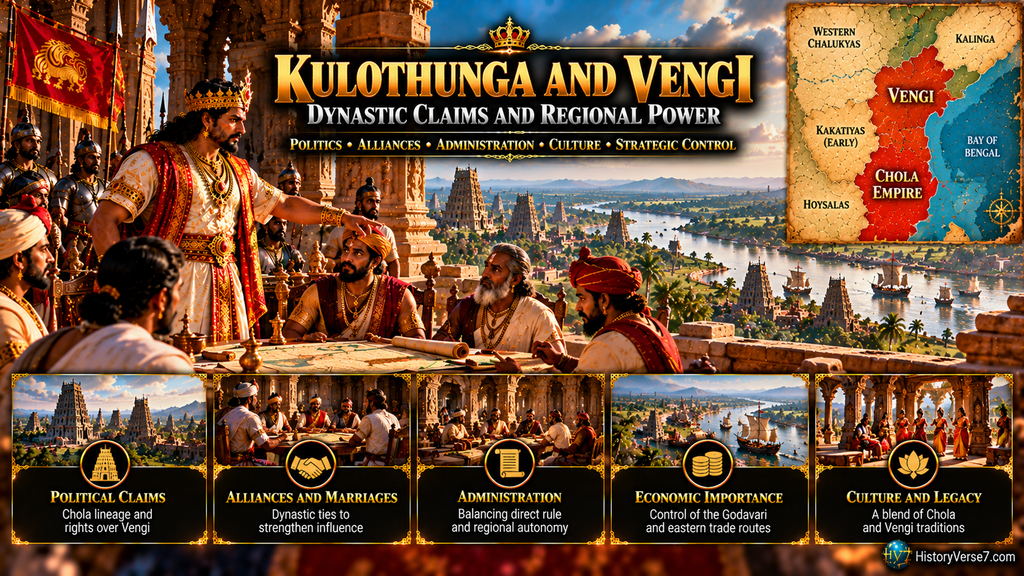
Vengi was the Eastern Chalukya kingdom, centred on the delta country between the Godavari and Krishna rivers in modern Andhra Pradesh. For the Cholas it was a buffer and a lever: a friendly ruler there protected the eastern flank of the Deccan, and the Western Chalukyas wanted the same thing for themselves.
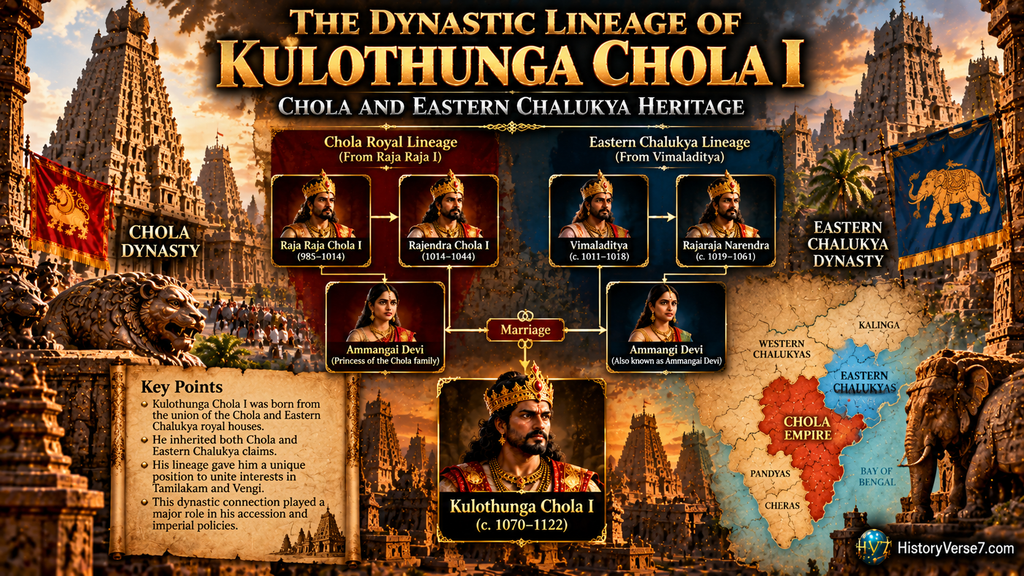
The two houses had been intermarrying for two generations before Kulottunga was born. The Chola commentary in South Indian Inscriptions, Volume III, sets out the relationships, drawing on the dates calculated by Kielhorn:
- Rajaraja I of the Chola house gave his daughter Kundavai in marriage to the Eastern Chalukya king Vimaladitya, who came to the Vengi throne on about 10 May 1011.
- Their son Rajaraja, usually called Rajaraja Narendra, became king of Vengi on about 16 August 1022. His mother was a Chola princess, and his mother’s brother was Rajendra Chola I.
- Rajaraja Narendra married Ammangadevi, a daughter of Rajendra I, who was therefore also his cousin.
- Their son, born Rajendra, became Kulothunga Chola I.
On both sides of his family there was a Chola daughter. The inscriptions play on this, describing him as belonging to the lunar race through his father’s line and the solar race through his mother’s. The Tamil poem Kalingattuparani, composed to celebrate a victory of his reign, is quoted in the commentary to South Indian Inscriptions for his ancestry, though its verses need careful reading. A younger sister of his, named Kundavai after her grandmother, is known from an inscription at Chidambaram.
What this does and does not establish needs saying plainly. It establishes that Kulottunga had a genuine Chola ancestry, one his supporters could use. It does not establish that his claim to the throne was uncontested. His connection ran through daughters of the Chola house, not through a son in the direct male line, and the next sections show that this mattered.
The Political World Before His Accession
By the 1060s, the Chola Empire had lost its first two great kings and one of its warrior kings. Rajendra I died in 1044. His eldest son Rajadhiraja I was killed at Koppam, in a battle dated to 1052 or 1054 depending on which historian is followed. Rajendra II then ruled from about 1052 for roughly a decade, and was followed by Virarajendra, whose reign is covered in the preceding article in this series.
The commentary in South Indian Inscriptions gives a table of accession dates for this stretch. Rajendra II is dated from about 28 May 1052. Virarajendra is dated from 1062 to 1063, with his latest inscription in his eighth year. Adhirajendra’s latest known date is his third year. Kulothunga is dated from about 9 June 1070. The editor noted that these reigns overlapped, as earlier Chola reigns had, because kings associated their sons with the throne before dying.
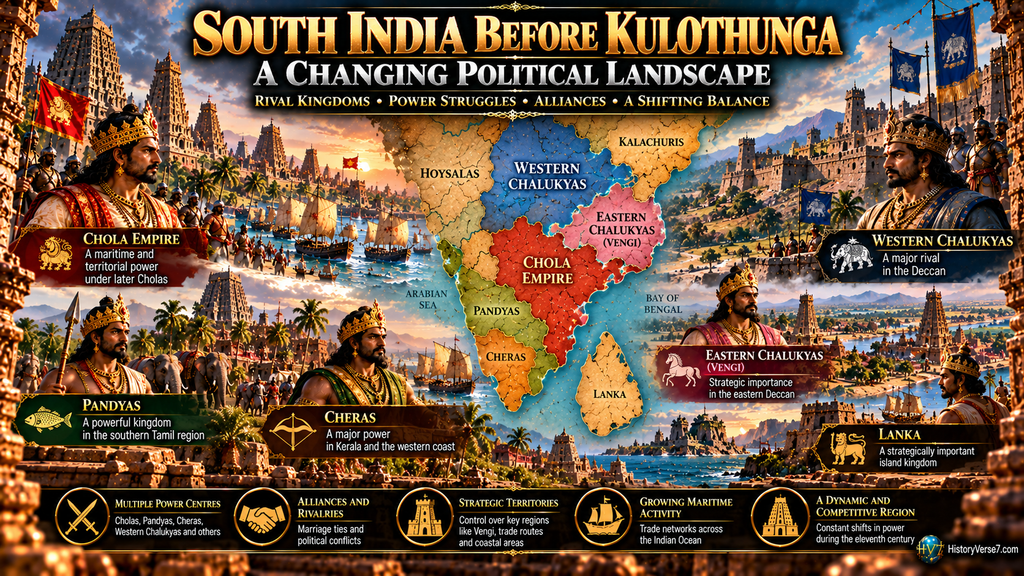
Outside the court, the Deccan was in flux. Someshvara I of the Western Chalukyas died in 1068, and his sons Someshvara II and Vikramaditya VI began a succession struggle. Vengi’s king Rajaraja Narendra had died in 1061, and the throne there passed to Vijayaditya VII, whose patrons and loyalties are described differently in different sources. Virarajendra’s inscriptions say he bestowed Vengi on Vijayaditya VII, while other accounts present Vijayaditya as a candidate supported by the Western Chalukyas.
What is securely established is the sequence of kings and the approximate dates. What is debated is nearly everything about the final months of the old line: how long Adhirajendra reigned, how he died, and what the Chola court looked like when Kulottunga arrived.
Kulothunga Chola 1’s Accession to the Throne
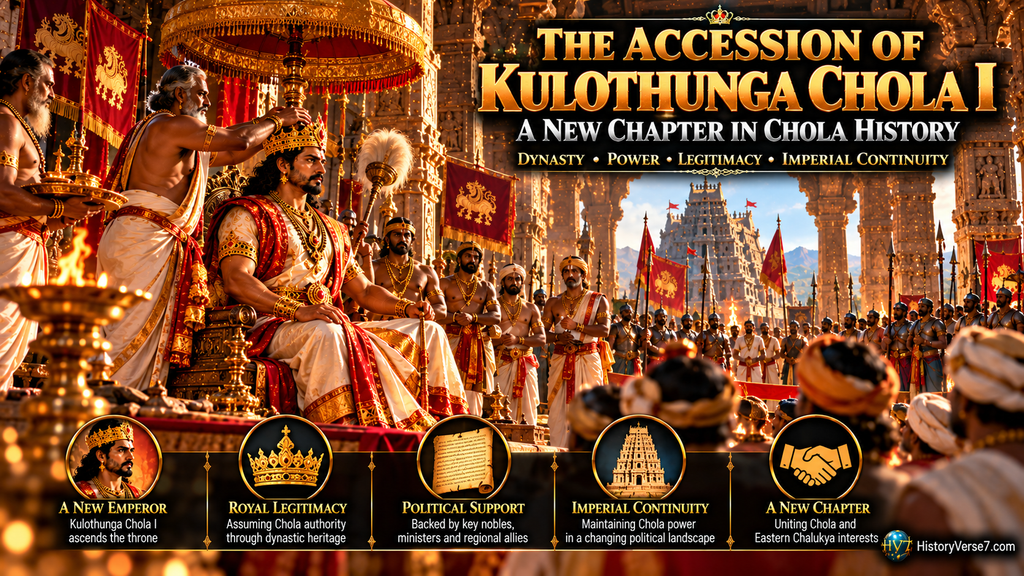
The core facts are these. Virarajendra died in 1070. His son Athirajendra, who may have been associated with the throne earlier, held power for a short time. Kulothunga was crowned around 9 June 1070, and his own inscriptions begin to appear from his second regnal year.
The harder questions are about legitimacy. The editor of South Indian Inscriptions, Eugen Hultzsch, writing more than a century ago, called Kulothunga a “usurper” and dismissed a story of his adoption into the Chola house as a political invention put about to give him standing. I have not been able to check the exact wording of that passage, so it should be read against the original. That is an early scholarly judgement, and it has been contested. Nilakanta Sastri and later historians, as summarised in secondary accounts, take a more cautious view: the surviving sources do not clearly describe Kulothunga killing his predecessor or fighting a war for the crown, and his claim as a grandson of Rajendra I was a real one. The Tamil court poem Kalingattuparani presents the accession as a rescue of a kingdom in disorder. A Western Chalukya source, the court poet Bilhana’s Vikramankadevacharita, tells the story from the other side and is hostile in tone.
Some details of his age at accession are also uncertain. Summaries often place his birth around 1025, which would make him in his mid-forties in 1070. A view traced to Sastri holds that he was a young man, in his teens or early twenties, when he arrived. These cannot both be right, and the choice changes how the accession reads. A prince in his forties walking into a crisis looks like a claimant with experience. A teenager looks like a figure around whom others, perhaps ministers and relatives, acted.
There is also a minority reading of the chronology. R. Sethuraman, as reported in S. R. Balasubrahmanyam’s study of the later Chola temples, has argued that the events of 1070 unfolded in a different order from the standard account, with Kulothunga first recognised as heir apparent before becoming king. This is not the mainstream view, but it shows how soft the dates around the transition are.
Consolidating Imperial Authority
How a new king establishes himself can often be read from where his early inscriptions turn up. The list compiled by Hultzsch shows records from Kulothunga’s second year at Tiruvorriyur, Tiruvalangadu and Kolar, from his third year at Somangalam, from his fourth year at Kavantandalam, and from his fifth and sixth years at Kanchipuram. The Kolar inscription is notable because Kolar lies in what is now Karnataka, which suggests that Chola authority, or at least Chola royal records, extended into the Gangapadi country very early in the reign. That is an inference from the find-spot, not a statement in the inscription.
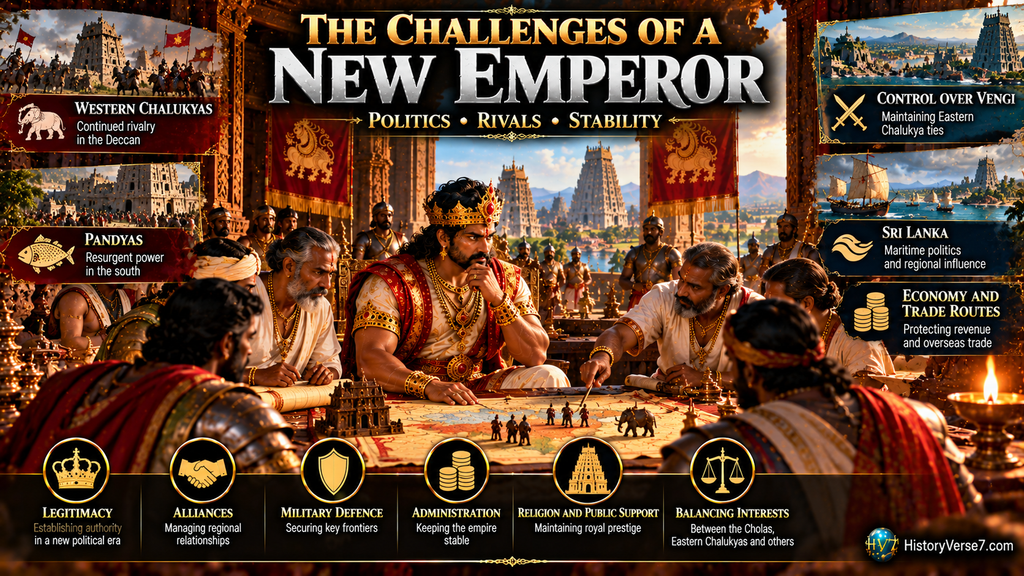
Several other developments are credited to the early and middle reign, with the attribution varying by source. Secondary accounts describe military cantonments established in the Pandya country, a more settled use of the king’s sons as viceroys in the east, and a thorough land survey. Each is discussed below. The point to hold on to here is that a king does not consolidate a state alone. The sons, generals, and officials who appear in the records were doing real work, and the surviving evidence cannot always separate their initiative from his.
Conflict with the Western Chalukyas
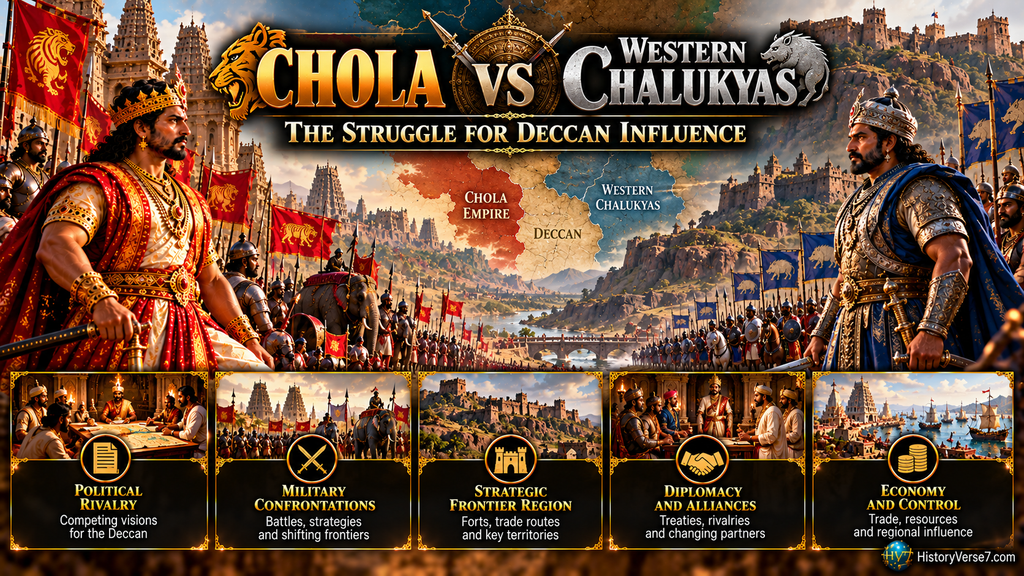
The Western Chalukyas were the defining opponent of the three kings before Kulothunga, and they remained one for him. The Chalukya king through most of his reign was Vikramaditya VI, who had fought the Cholas as a prince and had married a daughter of Virarajendra. That marriage had not given the Cholas a lasting ally, and by the mid-1070s the two were at odds.
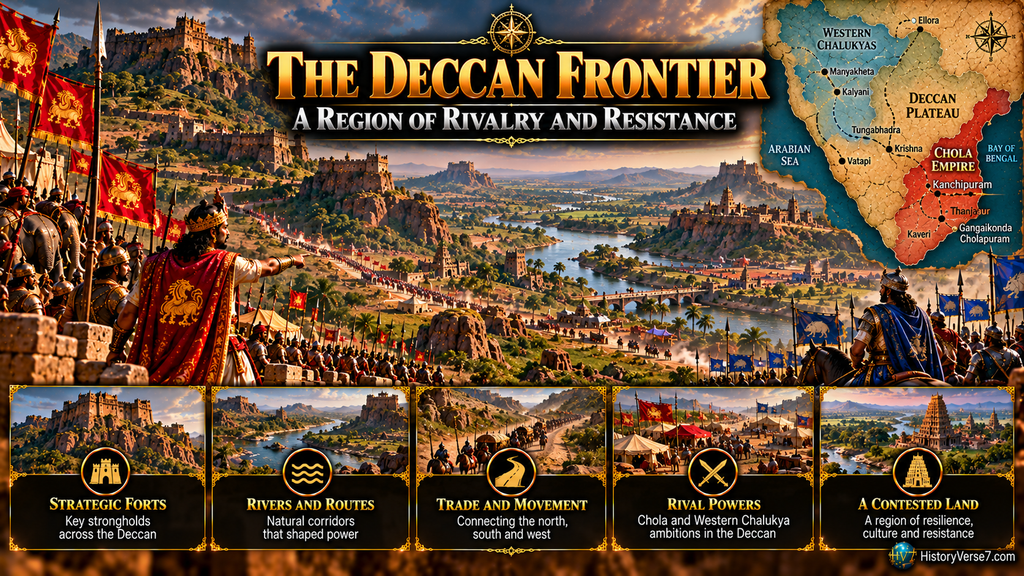
The best-known confrontation is the war around Nangili, in the borderland on the Gangapadi side. Chola accounts, as summarised in secondary works, describe Kulothunga’s forces driving the Chalukya king back as far as the Tungabhadra and taking control of territory in Gangavadi. Dates in modern summaries vary, from about 1075 to the early 1080s. Chalukya sources do not describe a defeat. The responsible reading is that the Tungabhadra remained the working boundary for a long time, with each side claiming success.
Vikramaditya VI reigned until 1126, a long and, by some accounts, stable reign. Late in Kulothunga’s life, the balance shifted. Around 1115 to 1116, according to Balasubrahmanyam and standard summaries, the Hoysala ruler Vishnuvardhana took Talakkadu and with it the Gangavadi country, which had been the Cholas’ foothold in the Karnataka region. A rising Hoysala power, itself nominally a Chalukya feudatory, was a new factor.
What can be said safely is that Kulothunga held the frontier for most of his reign, lost the Gangavadi country near its end, and never destroyed the Western Chalukya kingdom.
Vengi and the Eastern Deccan
Vengi mattered more to Kulothunga than to any earlier Chola king, because it was his father’s kingdom. His inscriptions at Draksharama, from his thirty-first and fortieth years, show that his records reached the Telugu country, and the Chellur and Pithapuram plates issued by his son Vira-Choda are among the main sources for the Eastern Chalukya side of his story.
After Rajaraja Narendra died in 1061, Vijayaditya VII held Vengi. When Vijayaditya died, around 1076 or 1077, Kulothunga placed his own sons in charge. According to Balasubrahmanyam, the sequence ran from Rajaraja Mummadi Chola to Vira Choda, then to Rajaraja Chodaganga, back to Vira Choda, and finally to Vikrama Chola, who governed until about 1118. Other summaries give the order and dates somewhat differently, and the sequence should be treated as approximate.
This was a different arrangement from earlier Chola dealings with Vengi. Previously the Cholas had supported friendly Eastern Chalukya kings. Now a son of the Chola king ruled as his viceroy. That is closer to direct control, but it is still not the same as the administration of the Tamil heartland. The viceroys ruled through local officials and Telugu-speaking elites, and the king’s authority there depended on personal and family ties.
The same logic applied to the Kalinga wars. The Tamil poem Kalingattuparani, by the poet Jayankondar, celebrates a Chola campaign in Kalinga led by a general named Karunakara Tondaiman. Balasubrahmanyam describes a first war around 1095 to 1096 and a second around 1110, while another summary dates the second war to before the king’s thirty-third year, which is about 1103. A passage in one of Kulothunga’s inscriptions at Alangudi, from his forty-fifth year, also describes a conquest of Kalinga. The poem is a victory celebration, and the inscription is a royal claim. Neither proves lasting administration, and the sources consulted for this article show no Chola administrative system in Kalinga afterwards.
Relations with the Pandyas, Cheras, and Sri Lanka
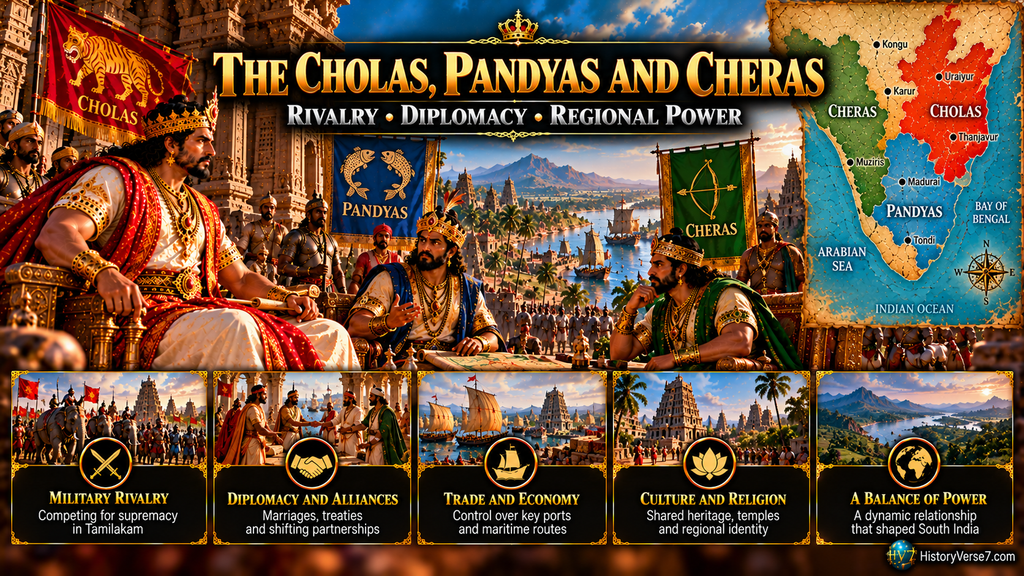
In the far south, the picture is of repeated pressure rather than a single conquest. The Pandya country had never been fully quiet under Chola overlordship. Balasubrahmanyam describes several Pandya chiefs, sometimes called “the five Pandyas,” in conflict with Kulothunga, and describes Chola military stations in the Pandya country. Inscriptions of a Pandya chief named Parakrama Pandya were dated in his own regnal years, which is a sign of how much local autonomy survived.
In the west, secondary accounts describe a campaign against the Cheras in the Kerala country, around the 1090s. The details are thin, and a single expedition may have been described in different ways.
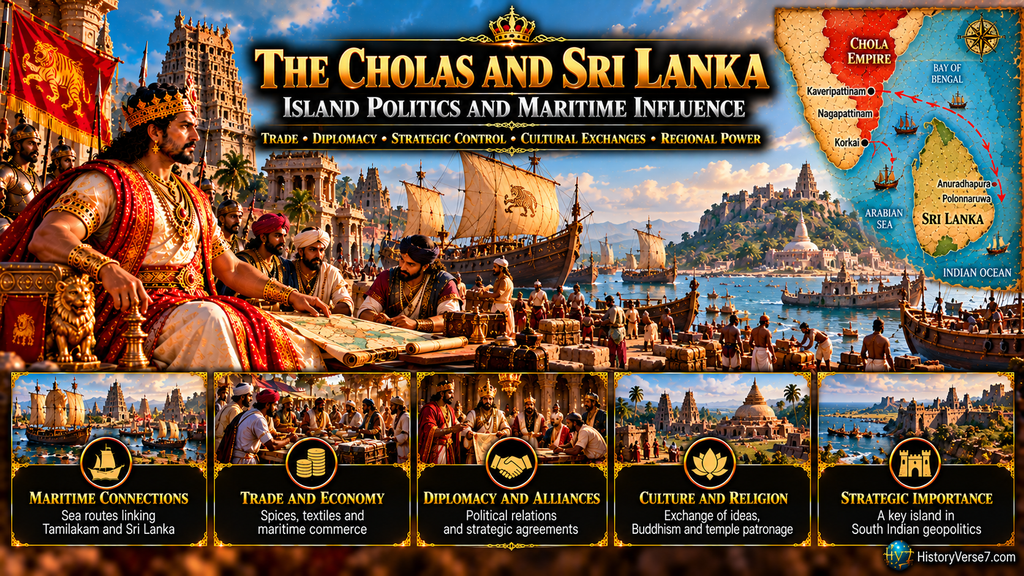
Sri Lanka is the clearest case of a gain that was lost. The island had been brought under Chola control by Rajaraja I and Rajendra I. In the early part of Kulothunga’s reign, a Sinhalese leader named Vijayabahu led a successful uprising. Balasubrahmanyam places the Cholas’ expulsion from Polonnaruva around 1073 and Vijayabahu’s coronation around 1075, while other summaries date the rising to 1070. The sources differ on the dates. What is not in doubt is the outcome: Chola rule on the island ended during Kulothunga’s reign, and his own inscriptions are silent about it. A royal record that omits a loss is a standard feature of this kind of evidence.
Marriage ties may have continued afterwards. Balasubrahmanyam reports that a daughter of Kulothunga named Suttamalli married a Sri Lankan prince, which, if correct, suggests that diplomacy went on after the war.
The Chola Military and Imperial Strategy
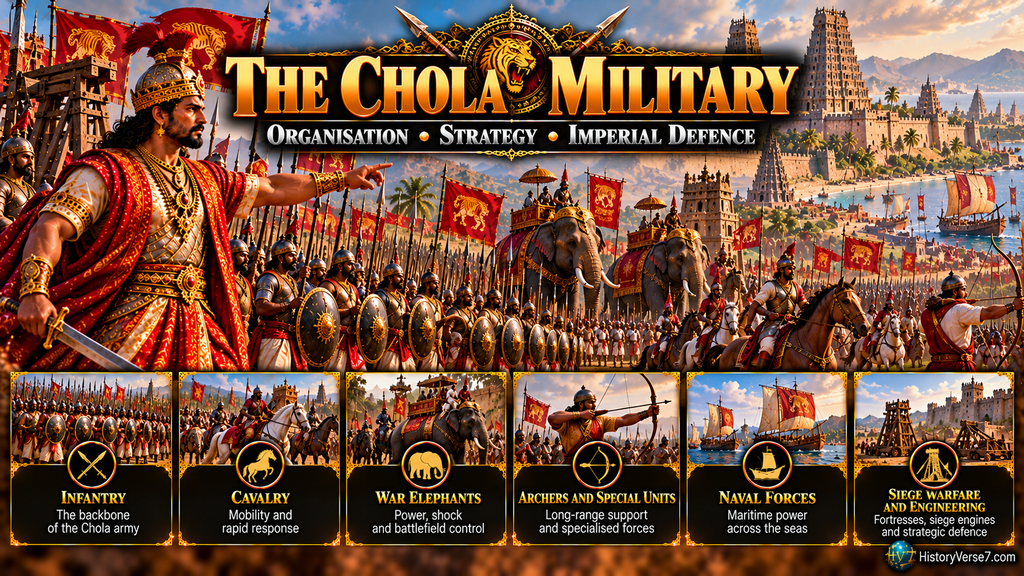
The inscriptions give little that can be used to reconstruct the army. They name commanders, record victories and mention captured territory, but they do not give regiment lists, formations or numbers, and none are offered here.
What the reign does show is a set of strategic priorities. The first was the western frontier on the Tungabhadra, where the Chalukya threat never went away. The second was the east, where Vengi and Kalinga drew sustained attention, with Kulothunga’s sons and generals doing much of the work. The third was the south, where the Pandya country needed garrisons rather than a single campaign. Sri Lanka, which had been a priority for earlier kings, quietly stopped being one once it was lost.
Behind this was the relationship between force and governance. In the Pandya country and in Vengi, military presence and the placing of kinsmen went together with the administrative arrangements described below. The Cholas were adjusting their method to the kind of territory they held. Where evidence for naval operations in this reign is thin, as it is, this article does not infer any.
Administration Under Kulothunga Chola 1
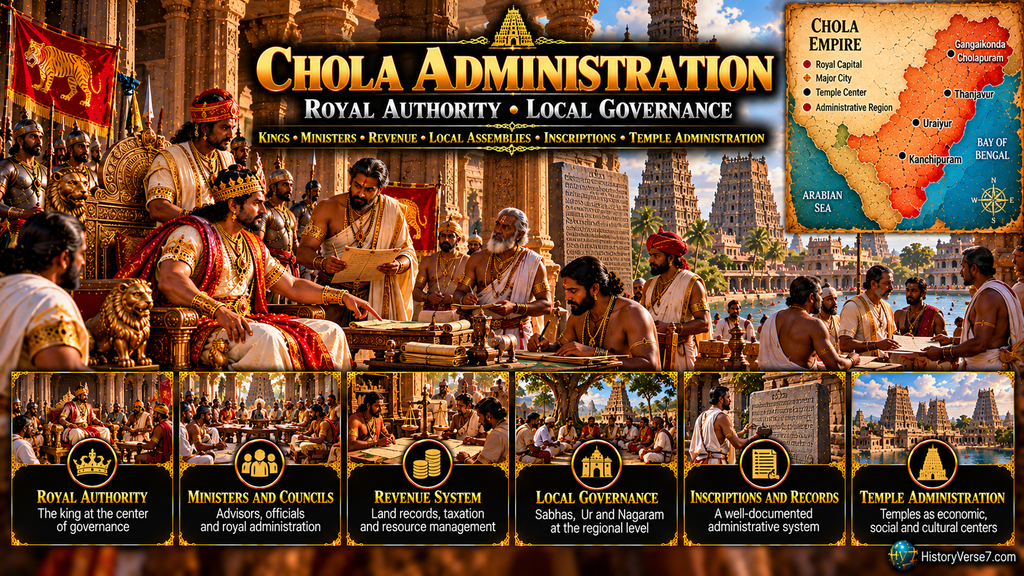
The administrative system of the Chola country was already mature. It had provinces, assessed land, temple-centred village institutions and a body of officials who appear in inscriptions across the period. Kulothunga inherited that machinery, and his inscriptions show it running. The task for a historian is to separate continuity from anything new.
The most clearly attributed development is the land survey. According to Balasubrahmanyam, a second general survey of land was carried out in the sixteenth year of the reign, around 1086, under a surveyor-general named Ulagalanda Perumal. Summaries commonly describe an earlier survey under Rajaraja I. A survey of this kind assessed land for revenue, which makes it central to how the state financed itself.
The second development is the use of royal sons as viceroys in Vengi, described above. The third is the placing of garrisons in the Pandya country. Beyond these, I could not find reliable evidence of other reforms attributed specifically to Kulothunga, and I do not invent any.
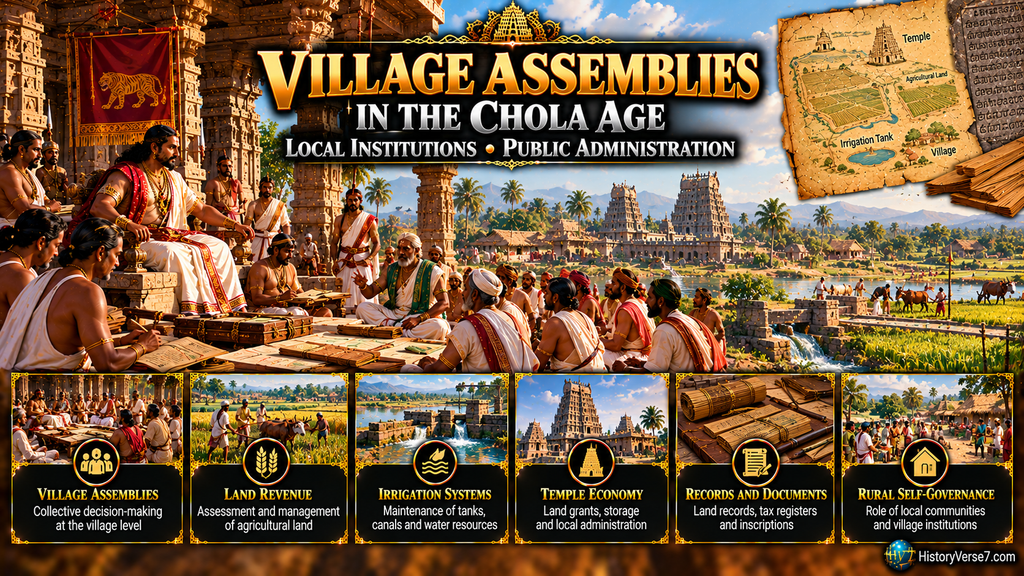
A word on local assemblies. Several of his inscriptions come from temples in villages whose assemblies were active in the Chola period, such as Uttaramallur and Manimangalam. The summaries I consulted do not say what those particular records preserve, so I do not claim any specific assembly decision for his reign.
“Sungam Tavirtta Cholan” and the Question of Taxation
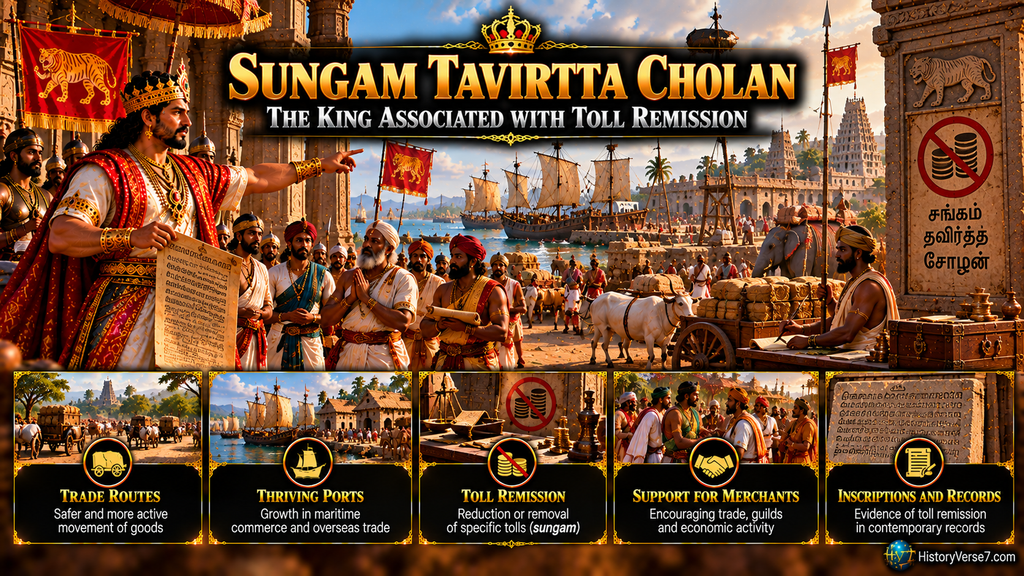
This is the epithet most often attached to Kulothunga in popular books. Sungam is the Tamil word for tolls or customs dues, and tavirtta means “removed” or “abolished.” The title, in its various spellings, means roughly “the Chola who abolished tolls.”
What the evidence establishes. The epithet is real and early. In South Indian Inscriptions, Volume III, Hultzsch quotes an inscription at Alangudi, dated in the sixth year of Rajaraja II, which, in his rendering, dates a record by the thirty-fifth year of Kulottunga as the king who ruled after abolishing tolls, and he notes that Kulottunga bore the surname Sungandavirtton, meaning “the abolisher of tolls.” So within a generation of the king’s reign, the title was in official use as part of how his regnal years were named.
What the evidence does not establish. It does not tell us which tolls were abolished, in which regions, for how long, or whether the measure was a general abolition, a series of local remissions, or a gesture celebrated in royal language. It does not say that other levies were touched. The same reign, as discussed above, is credited with a major survey of land to fix revenue, which points the other way: land revenue, the state’s main income, was being assessed more carefully, not abandoned.
A second piece of evidence cuts against a sweeping reading. The smaller Leyden grant, from the twentieth year of the reign, around 1090, exempts certain villages from a list of customary dues. Balasubrahmanyam’s summary lists them as including a levy transcribed as sungamera. Whether this term refers to tolls, and what exactly it covers, should be checked by an epigraphist. But a charter that exempts specific villages from named dues implies that such dues still existed, which makes a blanket and permanent abolition unlikely.
Possible significance. A reduction in tolls on goods moving between regions would have favoured merchants, and Kulothunga’s reign saw active contacts overseas, discussed below. But there is no quantitative evidence of what the policy did to trade, and the epithet is also a piece of royal self-presentation. This article therefore treats “Sungam Tavirtta Cholan” as evidence that toll relief was a prominent part of how the king wished to be seen, and as a reason to ask what it covered, not as proof that taxation was abolished.
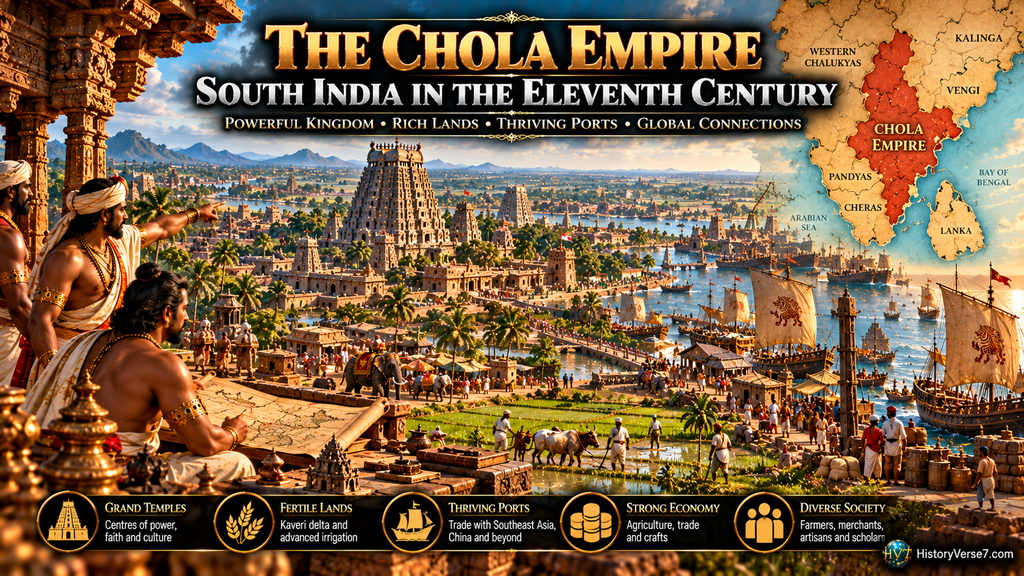
Agriculture, Trade, and the Chola Economy
The economy rested on agriculture. Revenue from assessed land, much of it in the fertile Kaveri delta and the surrounding districts, funded the army, the court and the temples, which were themselves major landholders and employers. The survey of around 1086 was an attempt to put this base on a firmer footing. The sources consulted for this article do not give specific irrigation projects for his reign, and I do not invent any.
Trade is better documented through contact than through figures. Chinese records report an embassy from the Chola country to China in 1077, described in Balasubrahmanyam’s study as a party of seventy-two men. The smaller Leyden grant of about 1090 records that ambassadors of the king of Kadaram, the Chola name for the Kedah region of the Malay Peninsula, asked for a charter exempting villages that supported the Chudamani Vihara, a Buddhist monastery at the port of Nagapattinam. Whether the Kadaram ruler should be called a subordinate or a counterpart is debated, and the grant, as summarised, reads more like diplomacy than rule.
These episodes sit within a wider story. Historians such as Hermann Kulke, in a chapter in Nagapattinam to Suvarnadwipa, discuss the earlier Chola naval expedition against Srivijaya and debate whether it was driven by trade, prestige, or plunder. Kulottunga’s reign shows that connections continued after that expedition, but the sources do not let us say that his tolls policy led to any particular commercial success. Revenue, trade, and political authority were linked, and none of them can be tied to one royal decision.
Temples, Religion, and Cultural Life
The temples are where much of the evidence is preserved. The list in South Indian Inscriptions shows his inscriptions at Chidambaram, Srirangam, Tiruvidaimarudur, the Jambukesvara temple, Tirukkalukkunram and many Kanchipuram sites, as well as at Draksharama and Simhachalam in the Telugu country. That pattern shows patronage and royal presence across both the Tamil and the Telugu regions. It does not by itself say what each inscription records.
The sources show a king who supported institutions of more than one religious tradition. A temple inscription at Chidambaram from his forty-fourth year, an inscription at Srirangam, and the Buddhist Chudamani Vihara charter all belong to his reign. That is what the documentary evidence supports. It would be a step too far to read it as a statement about his personal belief or a general policy of his government.
A later tradition in Sri Vaishnava hagiography tells of a persecuting Chola king named Krimikanta, who was hostile to the philosopher Ramanuja. Modern writers have identified this king with Kulothunga I in some accounts and with Adhirajendra in others. The identification is disputed; it rests on much later narrative, and this article does not treat it as established.
Literature of the reign includes the Kalingattuparani by Jayankondar, a court poem, and works later associated with the court. These are valuable for how the court wished to see itself. They are not neutral records.
Inscriptions and Historical Evidence
Kulottunga’s reign is among the best documented of the Chola period, because it lasted so long. The list compiled in South Indian Inscriptions gives records from his second year to his forty-ninth year, and later discoveries have extended the known span.
Several kinds of material can be distinguished. Tamil inscriptions often open with a historical introduction, a praise passage that recounts the king’s deeds. The list shows at least three families of such openings, one used in his second to fourth years, one from the fifth year onward, and one from the seventh year onward. As the introductions changed, the court’s picture of the reign changed with them, which is one reason historians read them in sequence. Other records have no historical introduction at all. There are Sanskrit and Telugu inscriptions in the Andhra country, copper-plate grants such as the Leyden grant, and plates issued by his son Vira-Choda.
These sources reveal the king’s titles, genealogy, grants and claimed victories, and the administrative business of temples and villages. They omit defeats, as the silence about Sri Lanka shows, and they describe events from the king’s point of view. The poem Kalingattuparani and the rival chronicle by Bilhana supply perspective the inscriptions cannot, one friendly and one hostile.
For all of these, the rule from earlier articles in this series applies: royal records are evidence of what a court claimed, and need to be checked against other evidence before they are treated as an account of what happened.
Was Kulothunga Chola I a Transformational Ruler?
The honest answer is that he was an effective consolidator who made some real changes, and that the word “transformational” claims more than the evidence allows.
On dynastic consolidation, he succeeded. A prince from outside the direct male line took a disordered throne and held it for over fifty years, founding a line that lasted. On imperial continuity, he mostly succeeded. He kept the Tungabhadra frontier through most of his reign and the Chola country intact, though he lost Sri Lanka at the start and the Gangavadi country at the end. On military and diplomatic strategy, he combined force with kinship, placing sons in Vengi and sending ambassadors overseas.
On administrative and economic policy, the evidence is real but narrower than reputation suggests. There is a land survey, a use of viceroys, garrisons in the south, and a toll-related epithet whose meaning is still being worked out. On regional authority, he governed the heartland directly and the peripheries by a mix of force, kin and local arrangement. The gap between his documented achievements and his later reputation is the same gap this article has tried to keep visible: later tradition remembered the epithet and the long reign, and sometimes forgot what the sources do not say.
He should be compared with his predecessors only in terms of the evidence. Rajaraja I and Rajendra I built and extended an empire. Kulothunga’s task was to hold what remained and keep a changed dynasty together. That is a less dramatic kind of success, and a real one.
Evidence and Fact-Checking Table
| Historical Claim | Source or Evidence | Source Type | What the Evidence Supports | Limitations or Uncertainty | Verification Status |
| Reign began about 9 June 1070 | Kielhorn’s calculations cited in SII Vol. III (Hultzsch) | Epigraphic dating in a modern edition | An approximate start date | Calculated, not stated; a minority reading proposes a different order of events | Verified against consulted SII page; minority reading needs verification |
| Parents were Rajaraja Narendra and Ammangadevi; grandparents Vimaladitya and Kundavai | SII Vol. III commentary | Primary edition with editor’s reading | Chola descent on both sides | Relies on the editor’s interpretation of inscriptions and the poem | Verified against consulted SII page |
| His accession was a usurpation | SII commentary (Hultzsch) versus later historians as summarised | Scholarly interpretation | That a legitimacy debate exists | Exact wording of both views not checked; Sastri not consulted directly | Needs verification |
| Born about 1025, or a teenager or young man in 1070 | Secondary summaries | Tertiary and secondary | That his age at accession is uncertain | No primary record of birth | Needs verification |
| War at Nangili and Tungabhadra frontier | Balasubrahmanyam; secondary summaries | Secondary | Chola claim of success; frontier held | Dates range from about 1075 to the early 1080s; Chalukya side silent | Partly verified |
| Sons governed Vengi as viceroys | Balasubrahmanyam; Chellur and Pithapuram plates (via SII list) | Secondary plus inscription find-spots | Viceroyalty system | Sequence and dates vary | Partly verified |
| Kalinga wars about 1095 to 1096 and about 1110 | Balasubrahmanyam; Kalingattuparani | Secondary; court poem | That campaigns took place | Dating differs; no lasting administration shown | Partly verified |
| End of Chola rule in Sri Lanka | Balasubrahmanyam; secondary summaries | Secondary | Loss during the reign | Dates differ between 1070 and 1075; Spencer not consulted | Partly verified |
| Second land survey about 1086 | Balasubrahmanyam | Secondary | A survey in the sixteenth year | Method and scope not examined | Verified against consulted chapter |
| Epithet Sungam Tavirtta Cholan in official use | Alangudi record of Rajaraja II, sixth year, in SII Vol. III | Primary edition with editor’s translation | Epithet used a generation after the reign | Scope of toll relief unknown; translation not independently checked | Verified against consulted SII page |
| Village dues still existed about 1090 | Smaller Leyden grant as summarised by Balasubrahmanyam | Secondary summary of a primary charter | Customary dues were exempted by charter | Meaning of the term transcribed as sungamera not checked | Needs verification |
| Embassy to China in 1077 | Balasubrahmanyam citing Chinese records | Secondary | Overseas contact | Chinese source not consulted | Partly verified |
| Ambassadors of Kadaram sought a charter about 1090 | Balasubrahmanyam on the Leyden grant | Secondary summary of a primary charter | Diplomatic contact; status of the ruler debated | Original text not read | Partly verified |
| Gangavadi lost to the Hoysalas about 1115 to 1116 | Balasubrahmanyam; secondary summaries | Secondary | A late-reign loss | Dates approximate | Partly verified |
| Vikrama Chola made heir about 1118; reign ends about 1122 or 1125 | Balasubrahmanyam; SII list (latest year 49) | Secondary plus inscription list | Succession and length of reign | End date disputed | Partly verified |
| Krimikanta Chola was Kulothunga or Adhirajendra | Later hagiography; modern summaries | Late tradition | That the identification is disputed | Much later than the events | Needs verification |
Conclusion: The Legacy of Kulothunga Chola I
How did Kulothunga manage a dynastic transition, maintain Chola imperial power, and reshape the empire’s priorities? The record supports a qualified answer. He took the throne when the old line had run out, held it for over half a century, and established a line that outlived him. He kept the core of the empire, accepted the loss of Sri Lanka, and spent much of his energy on the east and on the Tungabhadra frontier. He relied on his sons and officials as much as on himself, and he governed different regions by different methods.
Where his policies appear to have mattered most is in the use of kinship and viceroys, in the survey that put revenue on firmer ground, and in the toll-related epithet that signalled an interest in commerce. What remains uncertain is the scope of that epithet, the circumstances of his accession, and how much of the reign’s record reflects the king and how much his court.
To follow the wider story, the earlier articles on Rajaraja Chola I, Rajendra Chola I, Rajadhiraja Chola I and Virarajendra Chola trace the line that led to him, and the HistoryVerse7 Chola Empire section gives the full sequence.
Author
What struck me most while writing about Kulothunga I is that his rise to the throne is not simply the story of one king following another. He was the child of an Eastern Chalukya father from Vengi and a Chola princess, and by 1070 the direct male line of Rajendra I had come to an end. In such a period, holding the kingdom together, defending its borders, and keeping control by sending his sons to different regions was the real test of his rule.
In this article, I have leaned repeatedly on inscriptions, but their limits are also easy to see. Royal records list victories and are often silent about defeats. The loss of Sri Lanka is one example. I have also not read a title like “Sungam Tavirtta Cholan” as meaning that all taxes were removed. It speaks of tolls or transit duties, and even today its scope is not fully clear.
In history there is often a gap between popular belief and evidence. I have aimed to speak plainly where the evidence is clear, and, where historians disagree, to put that disagreement before the reader too. To read more research-based articles on Chola history, keep visiting HistoryVerse7.com.
One flag: the claim that “the direct male line of Rajendra I had come to an end” in 1070 is an interpretation. It rests on Athirajendra’s brief reign and the lack of any known male heir. If you want to be stricter, you could soften it to “the line of Rajendra I’s sons had run out.”
Written & Researched by Abhishek Chavan — HistoryVerse7| © 2026 HistoryVerse7 | Cluster Article: Kulothunga Chola 1
FAQ — Kulothunga Chola 1
Who was Kulothunga Chola 1?
Kulothunga Chola 1 was a Chola emperor who ruled from about 1070 for more than fifty years. Born Rajendra, he was the son of the Eastern Chalukya king Rajaraja Narendra and the Chola princess Ammangadevi. He began a new line on the Chola throne and is remembered by the epithet Sungam Tavirtta Cholan.
When did Kulothunga Chola 1 rule?
His reign is dated from about 9 June 1070, using calculations cited in South Indian Inscriptions. The end is less certain: many accounts give about 1122, while a study of later Chola temples uses 1125. Either way he ruled for at least about fifty years, longer than any earlier imperial Chola king.
What was his connection to the Eastern Chalukyas?
His father, Rajaraja Narendra, was an Eastern Chalukya king of Vengi, and his grandfather was Vimaladitya. But his paternal grandmother, Kundavai, was a daughter of Rajaraja I, and his mother, Ammangadevi, was a daughter of Rajendra I. He was therefore descended from the Chola house on both sides.
What were his most important achievements?
The best-documented are holding a new dynasty together after a disputed succession, keeping the Tungabhadra frontier for most of fifty years, carrying out a land survey, governing Vengi through his sons, and sustaining contacts with China and Kadaram. These achievements were set against real losses, notably Sri Lanka and the Gangavadi country.
Why is Kulothunga Chola 1 important in Chola history?
His reign began a new line of kings, lasted unusually long, and left an exceptionally continuous inscriptional record. It also shows an empire adjusting its priorities, with more attention to the Tungabhadra frontier, Vengi, and Kalinga than to overseas expeditions. How far that shift was deliberate policy is an interpretation, not a documented plan.
Explore More of the Chola Empire
Kulothunga Chola I’s reign becomes easier to understand when viewed within the longer history of the Chola dynasty. Explore the rulers, political transitions and imperial developments that shaped the kingdom before and during his reign.
Explore the Chola Empire
Browse More Chola History
Explore all English Chola articles | Explore Chola history in Hindi
Further Reading and Historical Research
For readers who want to examine the evidence behind Kulothunga Chola I’s reign, the following scholarly and institutional resources offer useful starting points.
History is not only about remembering kings and their victories. It is about examining evidence, understanding political change and discovering the complexity of the past.
Keep Exploring. Keep Questioning. Keep Discovering.
HISTORYVERSE7.COM