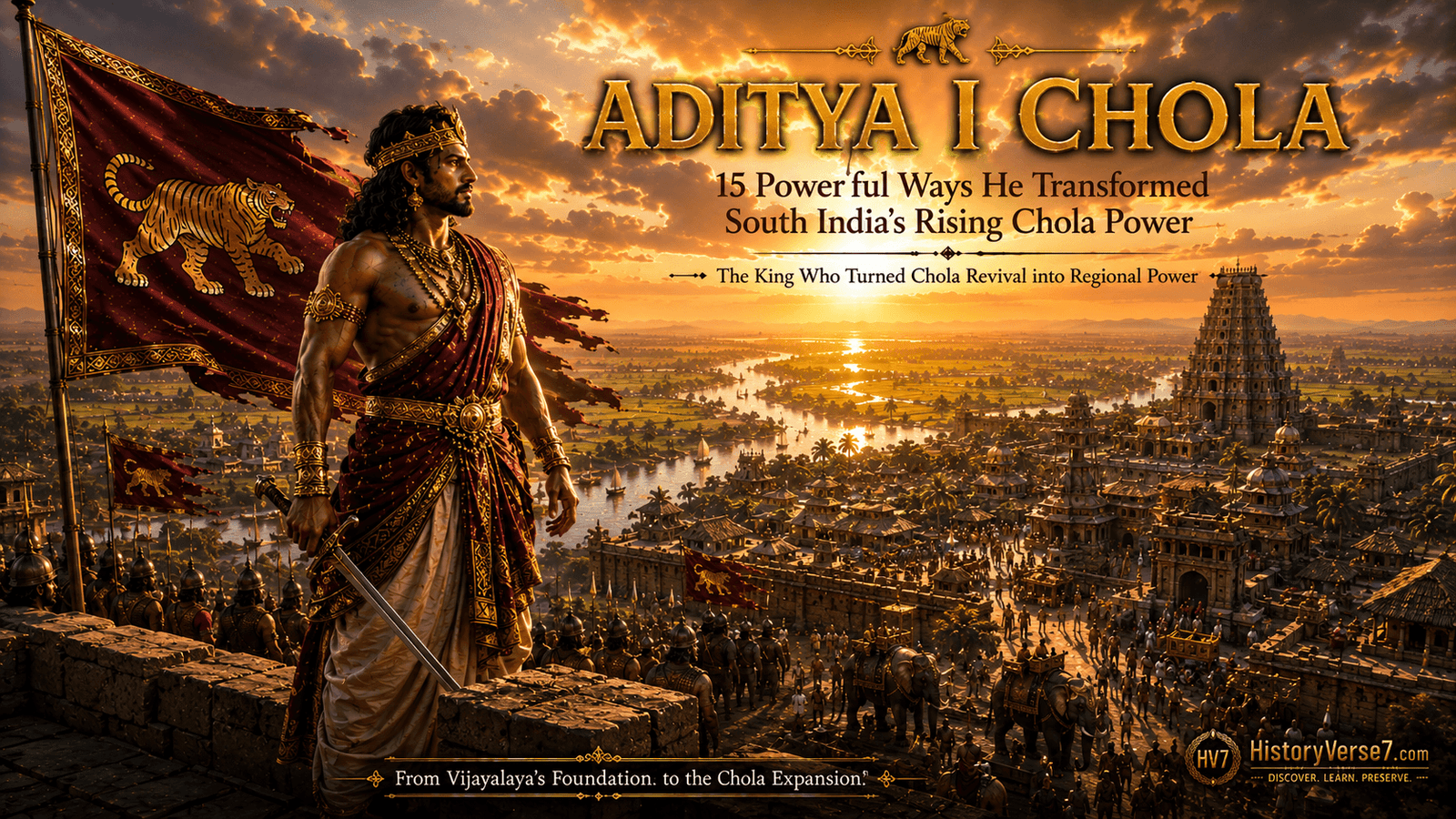
Aditya I Chola: 15 Powerful Ways He Transformed South India’s Rising Chola Power
⚔️ Aditya I Chola — The Powerful King Who Transformed Vijayalaya’s Revival into a Rising Chola Power The story of the Chola Empire did not begin with Rajaraja Chola. Long before the great imperial age, the dynasty had to rebuild its political strength in a fiercely contested landscape of ninth-century South India. Aditya I Chola…
Aditya I Chola
Aditya I Chola: The King Who Transformed Vijayalaya’s Chola Revival into a Rising South Indian Power
HistoryVerse7.com | Cluster Article: Aditya I Chola | International English Edition
When Vijayalaya Chola seized Thanjavur around 848 CE, he accomplished something genuinely significant: the reestablishment of Chola political authority in the Kaveri delta after nearly five centuries of obscurity. But Thanjavur, for all its agricultural wealth and symbolic importance, was still just one city. The Pallavas still held the northern Tamil country from their ancient capital at Kanchipuram. The Pandyas pressed from the south. A dozen smaller chiefs occupied the spaces between. The Chola revival was real, but fragile.
It fell to Vijayalaya’s son, Aditya I, to answer the question that every new dynasty eventually faces: could a political revival become something permanent? Could a single city become the base of a kingdom, and could a kingdom become the dominant power in a fiercely competitive landscape? By the time Aditya I died sometime around 907 CE, according to most scholarly estimates, those questions had been answered in ways that would shape South Indian history for the next three centuries.
His reign is not well known outside specialist circles. Aditya I lacks the architectural signature of Rajaraja Chola I; no great temple bears his name in the way that the Brihadeeswara defines his great-great-grandson’s legacy. He lacks the dramatic overseas campaigns of Rajendra Chola I. What he has instead is something perhaps more fundamental: the military and political record of a ruler who took a fragile inheritance and turned it into a considerably more formidable one. The Battle of Sripurambiyam, the defeat of the last significant Pallava king, and the northward expansion of Chola territory these were the achievements that made later Chola grandeur structurally possible.
Who Was Aditya I Chola?
Aditya I Chola was the son and successor of Vijayalaya Chola, the conventional founder of the Imperial Chola dynasty. He is generally dated to a reign of approximately 871–907 CE, though these dates are derived primarily from later genealogical inscriptions and from working backward through the regnal years of subsequent Chola kings. As with Vijayalaya, the exact chronology of his reign cannot be established with complete precision from contemporary sources.
His royal titles, as preserved in later Chola inscriptions, include ‘Kodandarama’, a name invoking the bow-wielding Rama of the Ramayana, and several epithets emphasizing military prowess and royal grandeur. One title particularly associated with him in the inscriptional tradition is connected to his defeat of the Pallava king, which later records commemorate as one of the defining moments of early Chola expansion.
K.A. Nilakanta Sastri, in ‘The Colas,’ gives Aditya I a prominent place in the story of Chola revival, identifying his reign as the period in which the Chola kingdom underwent its most significant territorial expansion since Vijayalaya’s initial seizure of Thanjavur. Noboru Karashima’s more cautious framework accepts the broad narrative while emphasizing the limitations of the available evidence, particularly the absence of inscriptions that are definitively contemporary with Aditya I’s own reign rather than composed by his successors.
What distinguishes Aditya I from his father, historically, is the scale of his military achievements. Vijayalaya established a base; Aditya used that base to transform the Chola kingdom’s position in South Indian politics. The defeat of the Pallava king Aparajita, in particular, represented a qualitative shift in Chola ambitions from a delta chieftaincy asserting regional independence to a power capable of defeating one of South India’s oldest and most prestigious dynasties.
South India on the Eve of Aditya I’s Reign
The Chola Kingdom After Vijayalaya
The Chola kingdom that Aditya I inherited was, by 871 CE, more than a generation old as an independent political entity but still fundamentally limited in its territorial reach. Vijayalaya had secured Thanjavur and the immediate Kaveri delta a valuable prize, certainly, but one whose full potential could only be realized through further expansion. The surrounding political landscape remained crowded with powers whose responses to Chola ambitions would determine the dynasty’s future.
The new Chola power had demonstrated that it could survive; it had not been immediately crushed by the Pallavas, the Pandyas, or the Muttaraiyars whom Vijayalaya had displaced. But survival and growth are different propositions. Aditya I inherited a kingdom with a strong territorial base and a demonstrated capacity for political initiative, but also with significant strategic vulnerabilities. To the north lay the Pallavas; to the south, the Pandyas; in every direction, smaller chieftains whose allegiances remained negotiable.
The Pallavas
The Pallava dynasty of Kanchipuram, which had dominated northern Tamil Nadu for centuries, built the great rock-cut temples at Mahabalipuram, and produced the refined court culture that had shaped Tamil civilization for generations, was, by the late 9th century, in serious decline. The combination of Rashtrakuta pressure from the north, Pandya aggression from the south, and the growing assertiveness of their own subordinate chiefs had significantly eroded the coherence of Pallava power.
The Pallava king of the late 9th century, Aparajita, whose name means ‘the unconquered,’ a title that history would render ironic, was still a significant figure, but ruling a kingdom under pressure from multiple directions simultaneously. The Pallavas retained the political prestige of their ancient lineage and the administrative infrastructure of a long-established state, but their military capacity to defend the full extent of their former territory was declining.
For Aditya I, the Pallava situation presented a strategic opportunity with considerable risks attached. The Pallavas were declining, but they were not yet insignificant. Moving against them prematurely, or without adequate preparation, could have been catastrophic for the still-developing Chola kingdom. The question was one of timing when the Pallava position had weakened sufficiently that a Chola military intervention could be decisive rather than simply provocative.
The Pandyas
The Pandya kingdom of Madurai remained a formidable power through the late 9th century. Under kings like Srimara Srivallabha and his successors, the Pandyas had conducted aggressive military campaigns against the Pallavas, demonstrating an offensive capability that made them dangerous neighbors for any South Indian power. Their relationship with the emerging Chola kingdom was complex, sometimes rivals, sometimes acting against common enemies.
The Pandya-Chola relationship in this period was less one of sustained military conflict than of competitive positioning, with both kingdoms pursuing their own expansion while watching each other’s moves carefully. The full Chola-Pandya antagonism that would characterize later Chola imperial history was still developing. Aditya I’s relationship with the Pandyas was primarily defined by the broader triangular competition between Pallavas, Pandyas, and Cholas that characterized South Indian politics in the late 9th century.
The Cheras
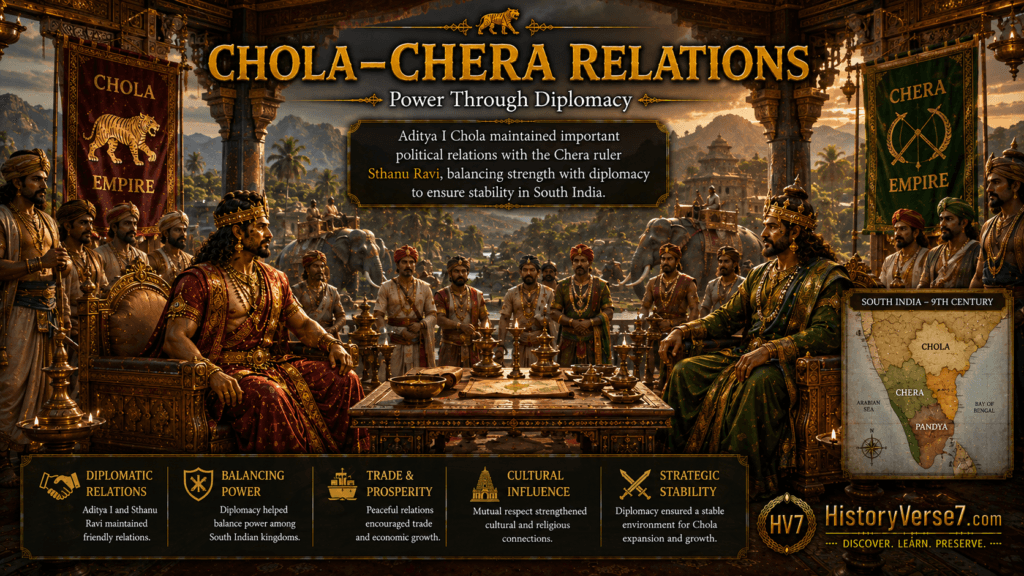
The Chera kingdom, the ancient Tamil confederacy of the western coastal region corresponding roughly to modern Kerala, had experienced its own cycles of rise and eclipse. By the late 9th century, the political entity that Sangam literature celebrated as one of the three great Tamil confederacies had been substantially reorganized, and the western coastal region was controlled by a successor political structure. Aditya I’s inscriptions contain references to campaigns in the direction of the western coast, though the extent and permanence of any Chola presence there is debated by scholars.
The Wider Political Balance
The late 9th century South Indian political landscape was, in essence, a system in transition. The old Pallava supremacy was ending; the new Chola supremacy had not yet begun. The Pandyas were strong but faced their own internal pressures. Dozens of smaller regional powers — the Gangas of Mysore, the Banas, the Vaidumbas, various feudatory chiefs — occupied the spaces between the major kingdoms, capable of tipping political balances through their allegiance choices. Aditya I operated in this unstable, opportunity-rich environment with evident strategic intelligence, exploiting the weakness of the Pallavas while managing his southern and western relationships sufficiently well to pursue northern expansion.
Aditya I and the Battle of Sripurambiyam
Why the Battle Took Place
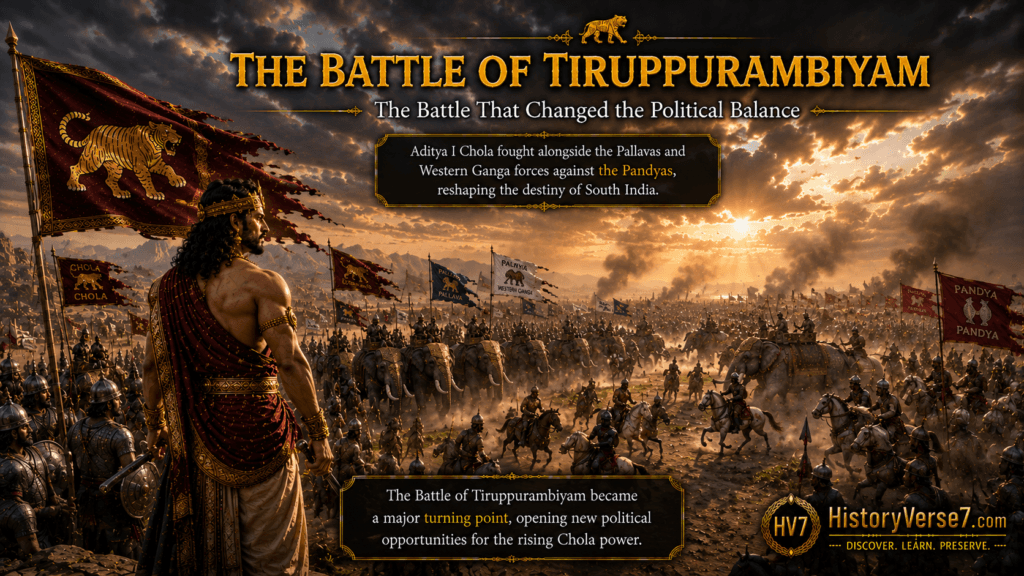
The Battle of Sripurambiyam, fought at a location in the northern Tamil country, generally identified with a site in the former Pallava-controlled territory, represents the most clearly documented military event of Aditya I’s reign. Understanding why it occurred requires understanding the political dynamics of the late 9th century in which Pallava, Pandya, and Chola interests were in complex collision.
By the late 9th century, the Pandya king Varaguna II was engaged in an aggressive northern campaign that directly threatened Pallava power. The Pallavas, under Aparajita, were thus under significant military pressure from the south when the Cholas, under Aditya I’s leadership, entered the equation. The triangular character of this conflict Pandyas pressing north against Pallavas, Cholas pressing north against both created the specific political configuration in which Sripurambiyam occurred.
The Chola decision to intervene was not, based on available evidence, a straightforward alliance with one party against another. The political dynamics were more complex, and historians have interpreted them in different ways. What seems clear from the inscriptional record is that Aditya I fought at Sripurambiyam in a way that resulted in the death of the Pallava king Aparajita, a consequence that transformed the political geography of northern Tamil Nadu.
The Major Political Powers Involved
The primary participants in the conflict were the Pallavas under Aparajita and the forces challenging them from multiple directions. The Pandya king Varaguna II had been pressing Pallava positions from the south. Aditya I and the Chola forces entered this struggle in ways that effectively sealed the Pallava fate.
The Ganga king Prithivipati I also appears in connection with this conflict in some sources, having been allied with the Pallavas. His defeat or retreat in connection with the Sripurambiyam engagement is mentioned in some later Chola inscriptions, though the specific sequence of events involving multiple parties is not easy to reconstruct with confidence from the surviving evidence.
Aditya I’s Role
Later Chola inscriptions, most importantly the Leyden Grant and the Tiruvalangadu copper plates, credit Aditya I with defeating and killing Aparajita Pallava. This is the core of his military reputation in the inscriptional tradition. The title ‘Kodandarama’ and epithets associated with bow-wielding martial prowess are connected in tradition with this defeat.
It is worth being precise about what the evidence actually establishes. The claim that Aditya I personally killed Aparajita is in later genealogical inscriptions, which are literary-political documents rather than battle chronicles. The broad fact of the Pallava king’s defeat and death in this period, and the Chola role in that outcome, is accepted by mainstream scholarship. The specific details of Aditya I’s personal conduct in the battle cannot be verified from contemporary sources.
What the Historical Evidence Actually Tells Us
The primary documentary evidence for Sripurambiyam comes from later Chola inscription texts composed during the reigns of Aditya I’s successors, sometimes considerably later. These inscriptions celebrate the battle as a foundational moment in Chola history, but they were composed to glorify the dynasty rather than to provide objective military historiography.
Contemporary epigraphic evidence from Aditya I’s own reign is extremely limited. This is a structural problem in early Chola historiography: the inscriptional record becomes substantially richer from the reign of Parantaka I onward, leaving the reigns of Vijayalaya and Aditya I documented primarily through what later kings chose to say about their predecessors. K.A. Nilakanta Sastri and subsequent scholars have worked carefully with these limitations, accepting the broad outlines of the Sripurambiyam narrative while being appropriately cautious about specifics that the sources cannot reliably establish.
Why the Battle Changed South Indian Politics
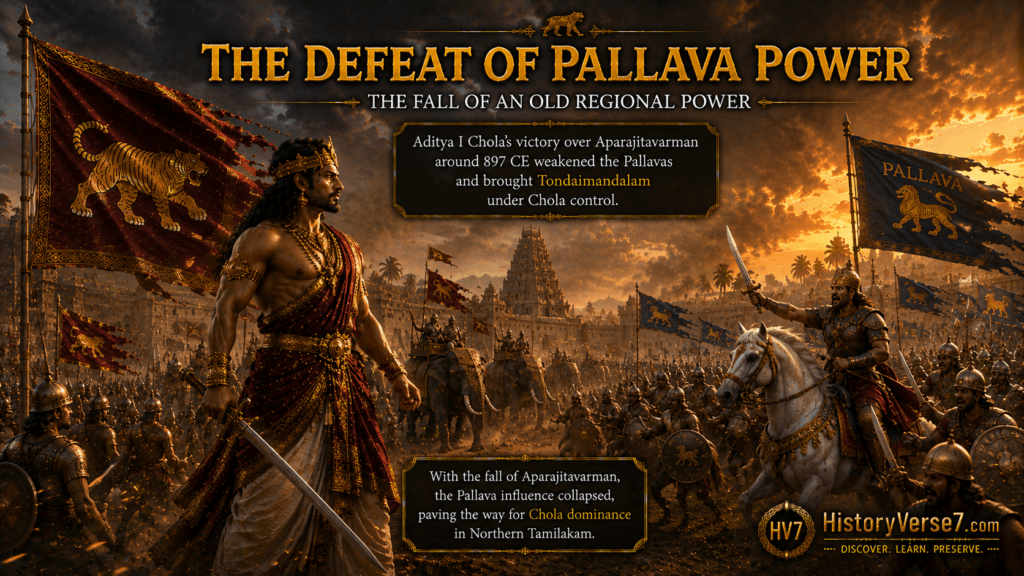
The death of Aparajita Pallava at or around the time of the Sripurambiyam engagement effectively ended the Pallava dynasty as a significant independent political force. This was not a gradual decline; Pallava inscriptions essentially ceased after this period, and no subsequent Pallava king exercised the kind of political authority that Aparajita’s predecessors had wielded. The political space that Pallava power had occupied in the northern Tamil country, the territories around Kanchipuram, and the routes connecting the Coromandel coast to the interior Deccan now became available for the Chola kingdom to claim.
The significance of Sripurambiyam, viewed structurally, is that it removed the primary obstacle to northward Chola expansion. As long as the Pallavas remained a coherent political force, the Chola kingdom was geographically contained in the Kaveri delta region. After Sripurambiyam, the entire northern Tamil country became, in principle, accessible to Chola authority. Whether that authority could be effectively exercised was a subsequent challenge, but the political barrier had been removed.
How Aditya I Became King
Succession After Vijayalaya
The succession from Vijayalaya to Aditya I appears to have been straightforward son succeeding his father in a dynasty where the principle of primogeniture was becoming established. Later Chola inscriptions consistently identify Aditya I as Vijayalaya’s son and direct successor, and there is no surviving evidence of succession disputes or rival claimants at this transition. This uncontested succession was itself significant: it suggested that Vijayalaya’s reign had been sufficiently successful to establish a degree of dynastic legitimacy that made the succession orderly.
Aditya’s Position Within the Chola Dynasty
Aditya I inherited a kingdom that was approximately twenty years old as an independent Chola entity, old enough to have established administrative routines, local loyalties, and a degree of institutional continuity, but young enough that the dynasty’s long-term viability was not yet settled. He was not inheriting a mature imperial state; he was inheriting the second generation of a dynastic project whose continuation depended on continued military and political success.
Establishing Political Legitimacy
One of the interesting aspects of Aditya I’s reign, from a political-history perspective, is the question of how a recently established dynasty builds legitimacy. The tools available in 9th-century South India for this purpose were essentially the same as those available to his father: military success, temple patronage, and the careful cultivation of relationships with local power-holders whose cooperation was necessary for effective governance.
The inscriptional tradition associates Aditya I with the construction of Shiva temples along the banks of the Kaveri, an act of religious patronage that simultaneously expressed personal piety and made a political statement about the Chola ruler’s role as protector and sustainer of the sacred landscape. This pattern of temple-building as political legitimation, which his father had begun, would be amplified and systematized by subsequent Chola rulers into one of the most distinctive features of the imperial Chola political system.
Aditya I and the Decline of Pallava Power
The Changing Chola-Pallava Relationship
The relationship between the early Cholas and the Pallavas was, for most of the reign of Vijayalaya, one of nominal subordination, the Cholas operating within or alongside the Pallava political system while building their own power base in the Kaveri delta. Under Aditya I, this relationship underwent a fundamental transformation from subordination to confrontation and ultimately to the elimination of Pallava independence.
This transformation was not necessarily the result of a planned long-term strategy; the sources do not allow us to reconstruct the specific decision-making process that led from Vijayalaya’s Pallava subordination to Aditya I’s defeat of Aparajita. What the evidence suggests is a process in which Chola power grew while Pallava power declined, creating conditions in which direct military conflict became both possible and, from the Chola perspective, highly attractive.
The Defeat of Aparajita Pallava
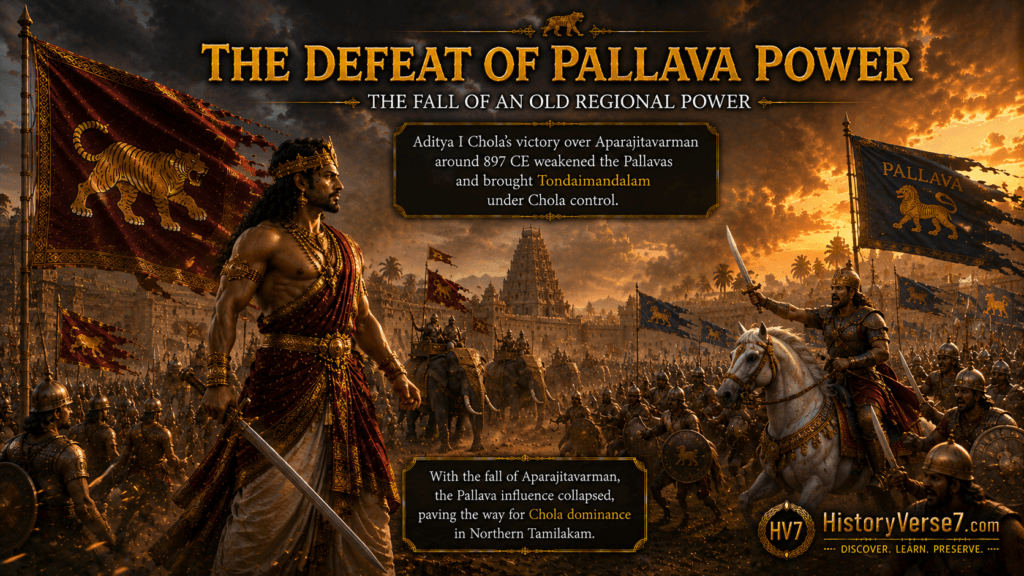
The defeat and death of Aparajita Pallava, the last Pallava king to exercise significant independent authority, is the central military achievement of Aditya I’s reign. The exact circumstances of Aparajita’s death are not precisely documented in contemporary sources. What the later inscriptional tradition consistently asserts is that Aditya I was responsible for this defeat, that it represented a decisive military victory, and that it opened the way for Chola expansion into territories previously controlled by the Pallavas.
Aparajita was not a negligible ruler; he had managed to maintain Pallava power in a difficult political environment for some years. His defeat required a Chola military force capable of meeting and overcoming a still-significant South Indian kingdom. That Aditya I was able to achieve this speaks to the degree to which his father’s consolidation of the Kaveri delta had produced a kingdom with real military capacity.
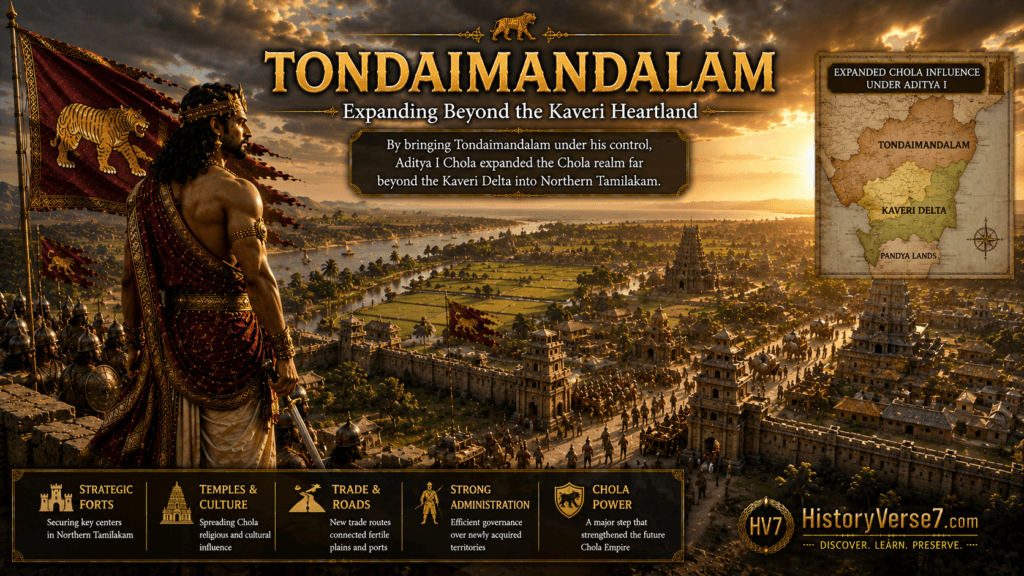
The Annexation of Tondaimandalam
The northern Tamil country, the region known as Tondaimandalam, centered on Kanchipuram and the surrounding territories, had been the heartland of Pallava power for centuries. Following Aparajita’s defeat, this region gradually came under Chola influence. The process by which this happened was almost certainly not a single dramatic annexation but a more gradual extension of Chola political authority as local chiefs and administrators accommodated themselves to the new political reality.
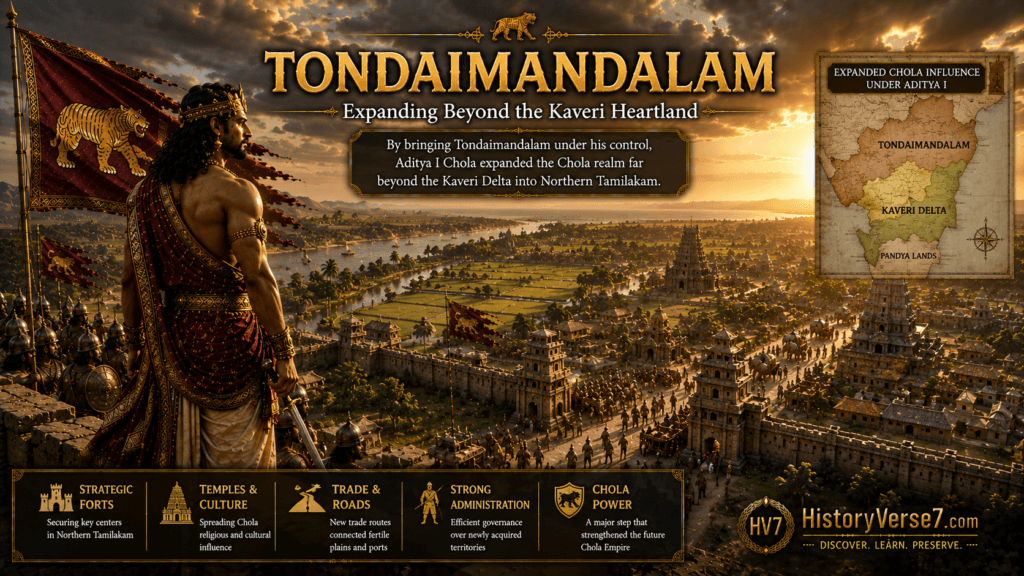
Tondaimandalam was strategically valuable for several reasons beyond its direct agricultural and commercial resources. It provided access to the northern Coromandel coast, to the routes leading toward the Deccan, and to Kanchipuram itself, one of the most important religious and cultural centers in all of South India. A Chola state that controlled both the Kaveri delta (its traditional heartland) and Tondaimandalam would be geographically positioned to dominate the entire eastern coast of the Tamil-speaking world.
Why the Pallava Defeat Mattered
The end of significant Pallava political independence mattered for reasons that went beyond the immediate military and territorial consequences. The Pallavas had been, for centuries, the paramount dynasty of the Tamil north, the patrons of Sanskrit and Tamil learning, the builders of Mahabalipuram, the dynasty that had defined the political culture of northern Tamil Nadu. Their disappearance as an independent force created a symbolic as well as a political vacancy.
The Chola dynasty, by defeating the Pallavas rather than simply coexisting with them, was positioning itself as the Pallavas’ successor, the new paramount power of Tamil Nadu, the dynasty that would inherit not just the Pallava territories but the Pallava role as the dominant political and cultural force of the region. This was an ambition that would take several more generations to fully realize, but Aditya I’s military actions made it a realistic possibility for the first time.
The Expansion of Chola Territory
Northern Expansion
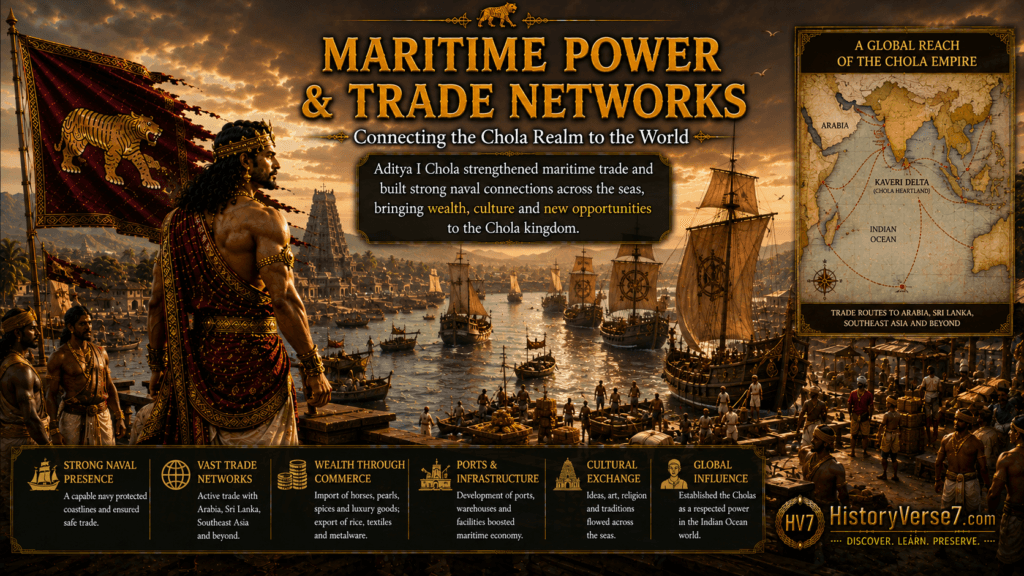
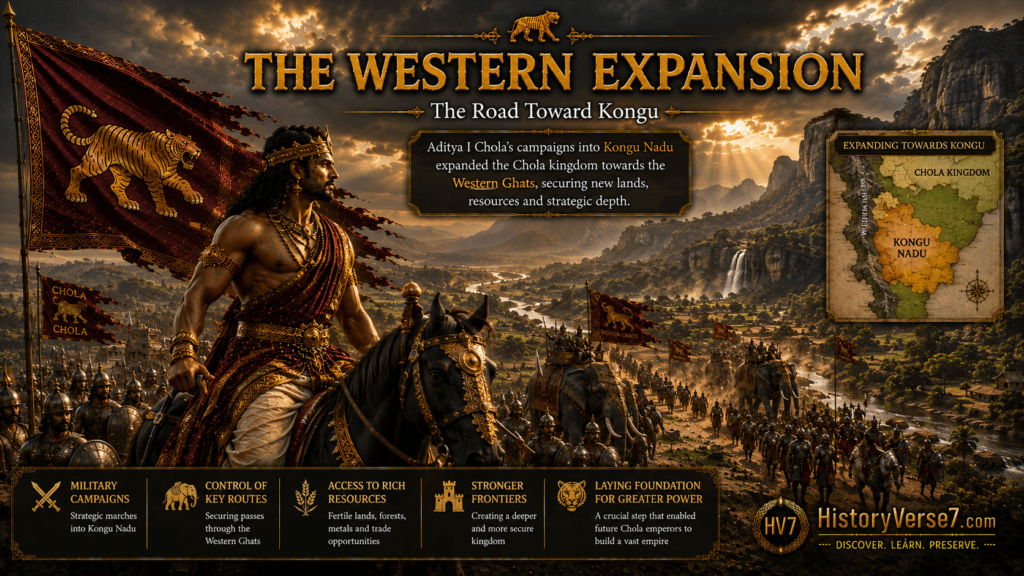
The most significant territorial expansion of Aditya I’s reign was northward, into the former Pallava territories. The incorporation of Tondaimandalam into the Chola political sphere represented a substantial increase in the kingdom’s size, resources, and strategic reach. Kanchipuram, the ancient Pallava capital and one of South India’s most important religious centers, came within the Chola sphere of influence, a development with both practical and symbolic significance.
The northern expansion also brought the Chola kingdom into direct relationship with the Ganga kingdom of Mysore, a significant power whose response to Chola expansion would shape the political geography of the region for generations. Aditya I’s management of this relationship, which involved both military confrontation and eventual accommodation, was a significant aspect of his political statecraft.
Southern and Western Dimensions
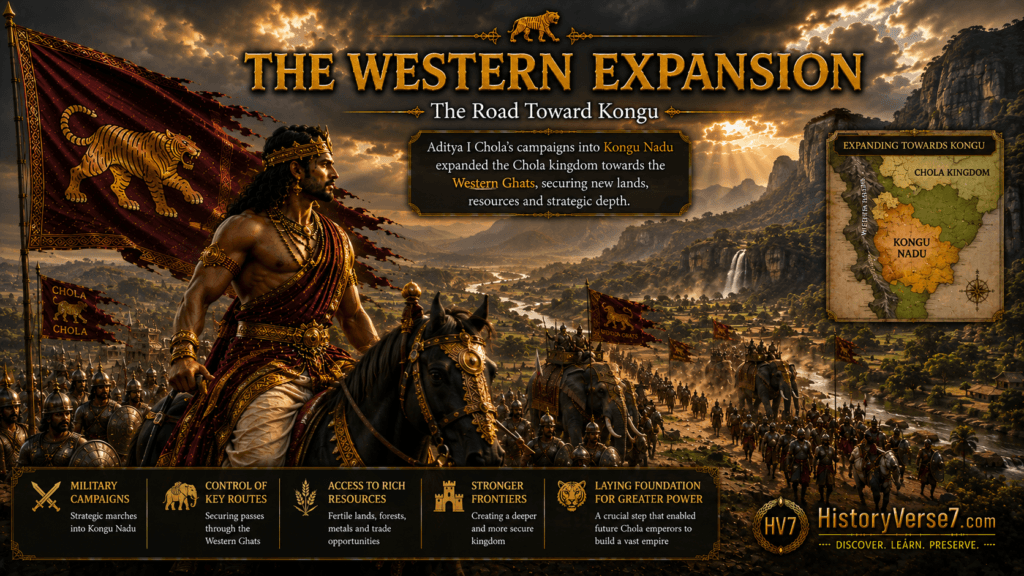
Aditya I’s inscriptions and the later tradition also suggest military activity in other directions, including campaigns toward the Pandya territories in the south and activity in the direction of the western coast (Chera territory). The extent and permanence of any Chola expansion in these directions during Aditya I’s reign is more difficult to establish from the available evidence than the northern expansion.
Some later inscriptions credit Aditya I with wide-ranging military activity, but historians exercise caution about accepting such claims at face value. Royal genealogical inscriptions in medieval South India routinely attributed comprehensive military achievements to earlier kings in ways that were as much literary convention as historical record. The northward expansion, anchored by the defeat of Aparajita, is the aspect of Aditya I’s territorial activity that can be established with the greatest confidence.
Control of the Kaveri Region
While the northern expansion was the most dramatic development of Aditya I’s reign, the consolidation of control over the Kaveri delta itself was equally important for the long-term development of Chola power. The delta was the economic foundation of everything; its agricultural surplus funded military campaigns, temple construction, and the administrative apparatus of the growing kingdom.
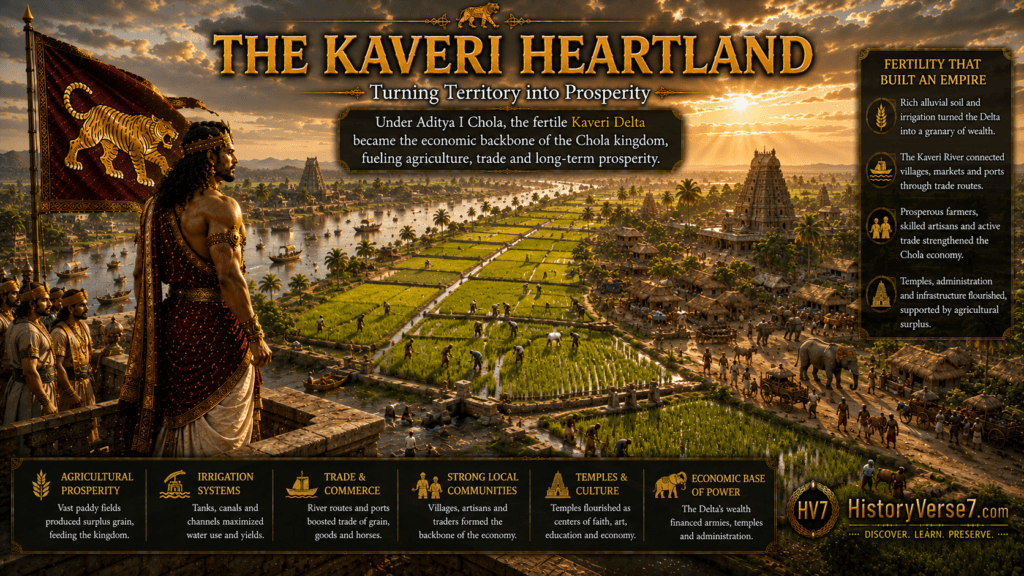
Aditya I’s reign appears to have been a period of continued development of the irrigation and agricultural management systems of the Kaveri delta, building on what Vijayalaya had begun. The specific details of this development are not well documented for his reign, but the general pattern of Chola investment in the delta’s agricultural infrastructure is established from the reign of Parantaka I onward, and the foundations of that investment were almost certainly being laid during Aditya I’s time.
Strategic Consolidation
Perhaps more important than any single territorial acquisition was the strategic consolidation that Aditya I achieved: the transformation of a collection of newly conquered or newly asserted territories into a kingdom with coherent administration, established revenue flows, and recognized political authority. This is the kind of achievement that leaves fewer traces in the historical record than dramatic military victories, but without which military victories become merely temporary and unstable gains.
Aditya I and the Pandyas
The Chola-Pandya relationship during Aditya I’s reign was defined by the broader political competition that characterized South Indian politics in the late 9th century. The Pandyas, under Varaguna II, had been aggressively pressing northward against Pallava positions, a campaign that indirectly contributed to the conditions that enabled the Battle of Sripurambiyam. The intersection of Pandya and Chola military activity in the northern Tamil country created situations of complex, sometimes overlapping, sometimes competing interests.
Later Chola inscriptions describe Aditya I as having defeated or subdued Pandya forces in certain contexts. How to evaluate these claims requires the same caution applied to other aspects of the inscriptional record: they represent later Chola perspectives on events, composed to establish dynastic legitimacy and military prestige, not neutral historiographical accounts. The Pandyas were not eliminated as a significant power during Aditya I’s reign; they remained a major force in South Indian politics for generations afterward. What Aditya I appears to have achieved in relation to the Pandyas was a degree of military parity and political deterrence rather than subordination.
The later, intense Chola-Pandya rivalry that would define much of the imperial Chola period was shaped in part by the precedents set during Aditya I’s reign, the establishment of a Chola kingdom strong enough to compete militarily with the Pandyas on roughly equal terms.
Aditya I and the Cheras
The western coast and the political entities of that region broadly grouped under the ‘Chera’ designation in Chola inscriptional tradition appear in the context of Aditya I’s reign in ways that are difficult to evaluate precisely. Some later Chola sources credit Aditya I with military campaigns in the direction of the western coast, suggesting at minimum an attempt to assert Chola influence in that direction.
The ‘Chera’ polity of the late 9th century was not the same political entity as the Sangam-age Chera confederacy. The western coastal region had been substantially reorganized politically, and what Chola inscriptions describe as the ‘Chera’ in this period likely refers to the political entities that controlled the Malabar coast and the passes connecting the eastern and western coasts of the peninsula.
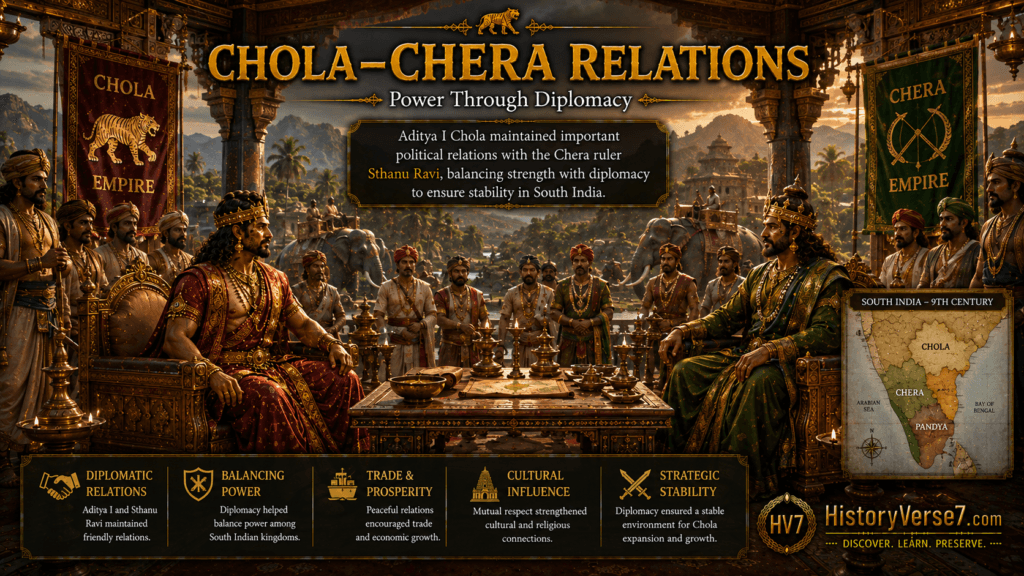
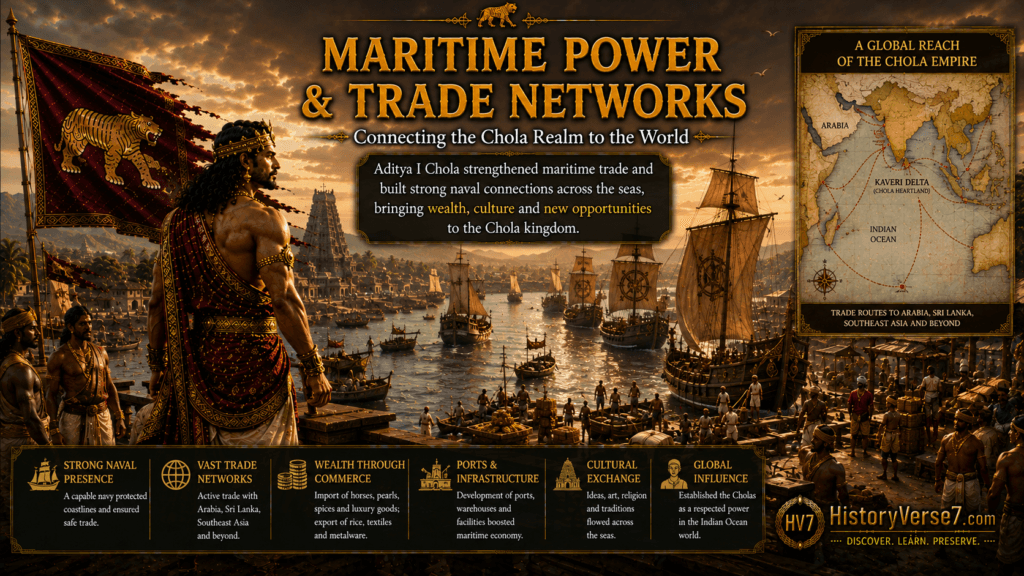
Whether Aditya I achieved any lasting Chola presence in western coastal territories is uncertain from the available evidence. Later Chola kings, particularly Rajaraja I and his successors, would assert significant authority over the western coastal region, and it is possible that Aditya I’s campaigns established precedents or tributary relationships that contributed to this later development. The inscriptional record, however, does not allow definitive conclusions about the extent or permanence of any western coastal activity during his reign.
Aditya I’s Military Leadership
Reconstructing Aditya I’s military leadership from the available evidence requires the careful distinction between what the sources directly state and what can be reasonably inferred from patterns of success and failure. Direct descriptions of his military methods, formations, or tactical decisions do not survive. What survives is the record of outcomes, and outcomes, even when documented in politically motivated inscriptions, provide meaningful evidence about the ruler who produced them.
The most significant inference that can reasonably be drawn about Aditya I’s military leadership is that he understood the importance of choosing the right moment for military action. The Sripurambiyam campaign was not launched against a Pallava kingdom at the height of its power it was launched when Pallava vulnerability, created by Pandya pressure from the south, created conditions in which Chola military action could be decisive. This suggests either strategic patience or political intelligence, and probably both.
The geographical scope of the military activity attributed to Aditya I, if the later inscriptional claims are even partially accurate, implies a Chola military capable of sustained campaigning in multiple directions. Building such a military required the development of organizational, logistical, and financial systems that could support armies in the field over extended periods. That Aditya I was able to build and maintain such a military is suggested by the scale of the achievements attributed to his reign.
The incorporation of defeated enemies into the Chola political system, the accommodation of regional chiefs as subordinate power-holders rather than their destruction, was likely a feature of Aditya I’s approach as it was of his father’s. This kind of political integration required military confidence sufficient to offer accommodation from a position of demonstrated strength, and organizational sophistication sufficient to manage the resulting network of subordinate relationships.
Administration Under Aditya I
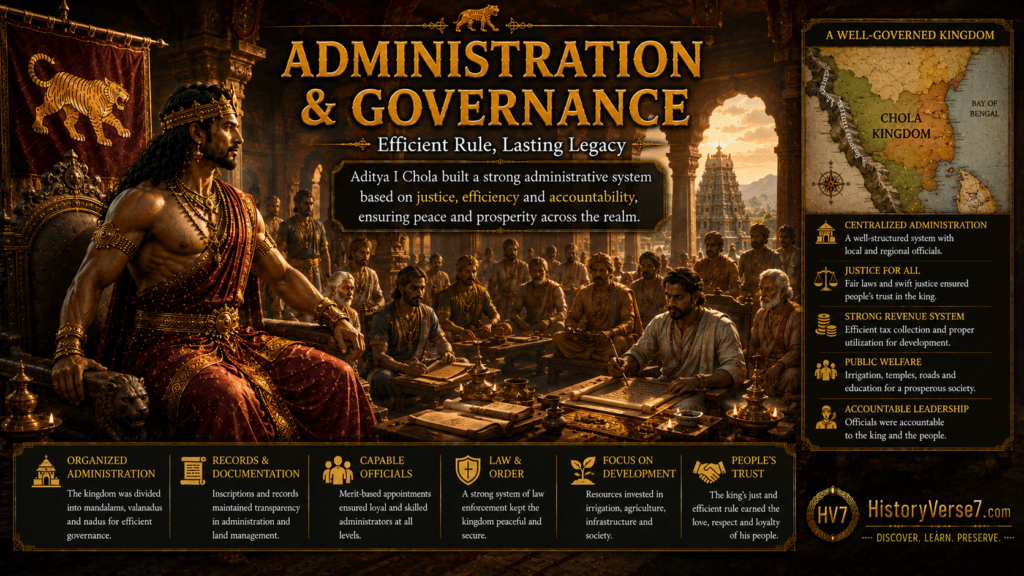
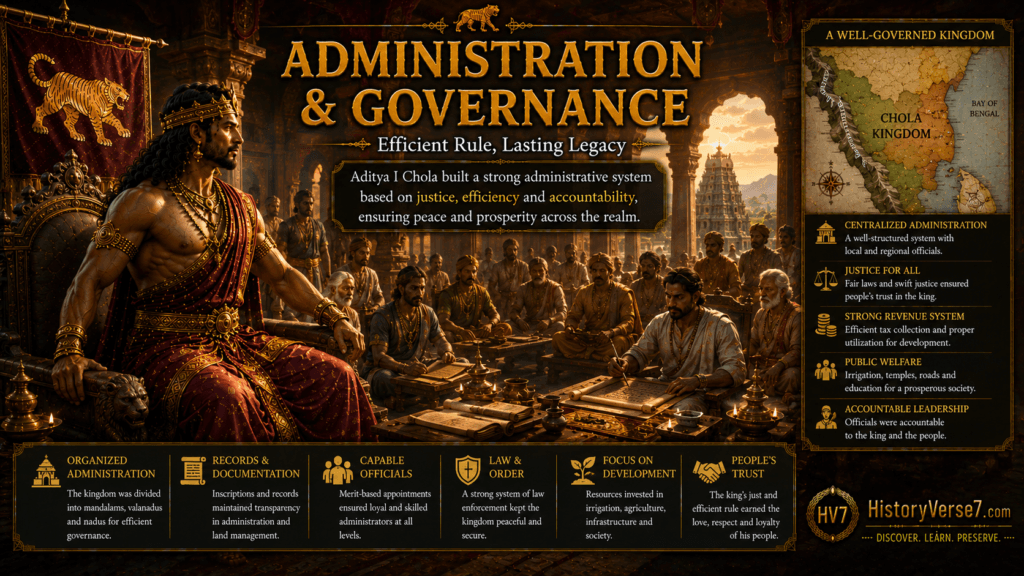
The administrative history of Aditya I’s reign is, like that of his father, only partially recoverable from the available evidence. The elaborate, well-documented Chola administrative apparatus with its systematic land surveys, its hierarchy of territorial units, and its carefully organized temple endowments is primarily known from the reign of Parantaka I and his successors. Projecting that later system back onto Aditya I’s reign with confidence would be anachronistic.
What can be said is that any ruler managing the kind of territorial expansion that Aditya I achieved would have had to address significant administrative challenges. Incorporating newly acquired territories, the former Pallava lands of Tondaimandalam, in particular, into a coherent political system required the extension of revenue-collection systems, the management of existing local power structures, and the establishment of mechanisms for resolving disputes and maintaining order over a larger and more diverse territory than the original Kaveri delta base.
Land grants to temples and Brahmin recipients, the primary administrative documentary record of the early medieval South Indian state, appear to have been issued during Aditya I’s reign, though the surviving examples are limited. These grants served multiple functions simultaneously: they transferred revenue rights in ways that created local stakeholders in the Chola system, they expressed royal piety and generosity in forms that enhanced political legitimacy, and they created written records of royal authority over specific territories.
The relationship between the Chola royal administration and existing local institutions the village assemblies, the merchant guilds, the temple managing bodies was almost certainly more accommodating than directive during this early period. The sophisticated Chola system of managed local autonomy that historians have analyzed in detail for the later imperial period was still being developed during Aditya I’s reign. Its foundations, however, were being laid.
Religion and Temple Patronage Under Aditya I
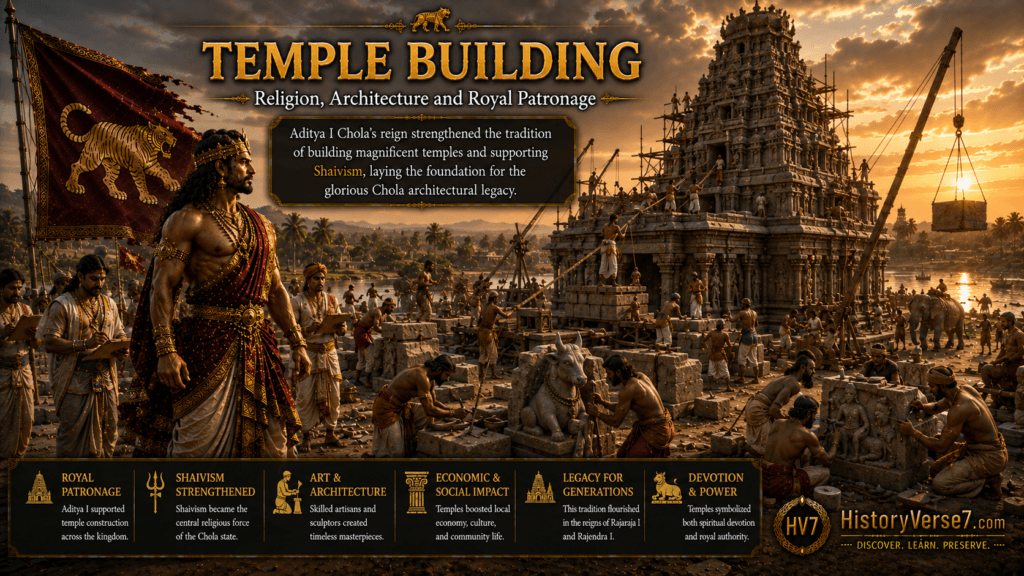
Aditya I’s religious patronage is associated in the later tradition primarily with Shaivism, the worship of Shiva, which was already the predominant religious orientation of the Chola dynasty under his father Vijayalaya. The construction of Shiva temples along the Kaveri River is specifically mentioned in some later inscriptions in connection with his reign, a form of religious patronage that simultaneously expressed piety and marked the Kaveri, the Chola heartland, as sacred territory under Chola protection.
Temple construction and endowment in medieval South India was never purely a religious act. It was a political statement, an economic instrument, and a social institution all at once. By building temples, a ruler was claiming the role of sacred landscape’s protector, a role with immediate political resonance in a society where the relationship between divine favor and royal legitimacy was deeply felt. By endowing temples with land grants, a ruler was creating economic institutions whose revenue streams were administratively embedded in the royal system and whose beneficiaries, priests, musicians, and artisans, became stakeholders in the continuation of royal patronage.
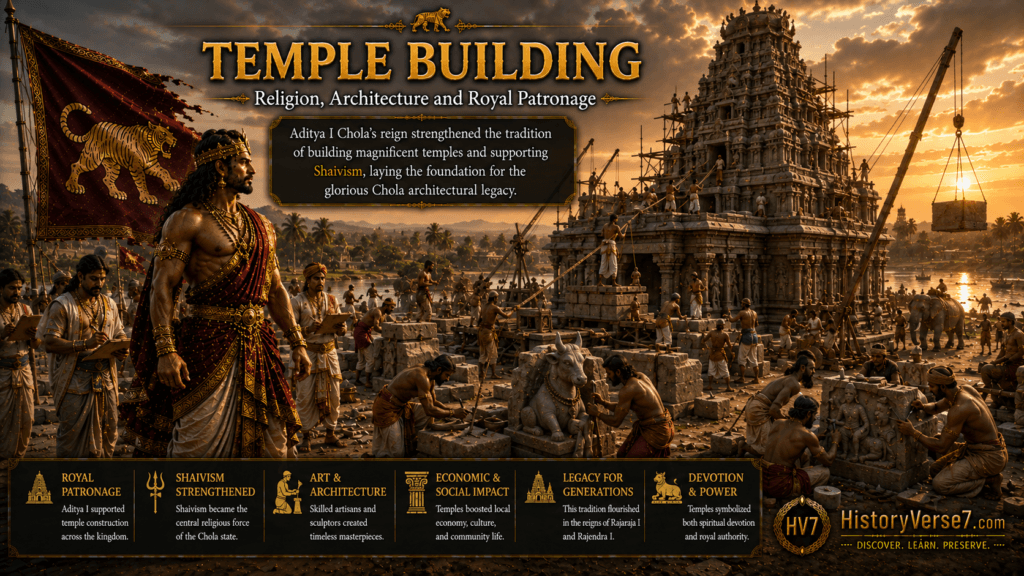
Aditya I appears to have continued and expanded the temple patronage tradition that Vijayalaya had begun with the Nishumbhasudani temple at Thanjavur. The geographical spread of temples associated with his reign along the Kaveri, and potentially in the newly acquired northern territories, suggests a deliberate policy of using religious architecture to mark and legitimize Chola authority over an expanding territorial domain.
The later Chola dynasty’s extraordinarily intense engagement with temple construction, culminating in the Brihadeeswara Temple of Rajaraja I and the Gangaikondacholapuram Temple of Rajendra I, had its roots in the practices established by the dynasty’s founders. Aditya I’s reign was a formative period for this tradition.
Aditya I’s Death and Succession
Aditya I died around 907 CE, according to the chronological estimates derived from later Chola genealogies and regnal sequences. The circumstances of his death are not described in any surviving source. He was succeeded by his son Parantaka I a succession that appears to have been orderly and uncontested, suggesting that the dynasty’s internal stability had been maintained throughout Aditya I’s reign.
The Chola kingdom that Parantaka I inherited was substantially more powerful and territorially extensive than the one Aditya I had received from Vijayalaya. The Kaveri delta remained the economic core, but the kingdom now extended northward through the former Pallava territories to the vicinity of Kanchipuram and beyond. The Pallava dynasty had been effectively removed from the equation as a significant independent political force. The military capacity of the Chola state had been demonstrated against a major South Indian kingdom and found more than adequate.
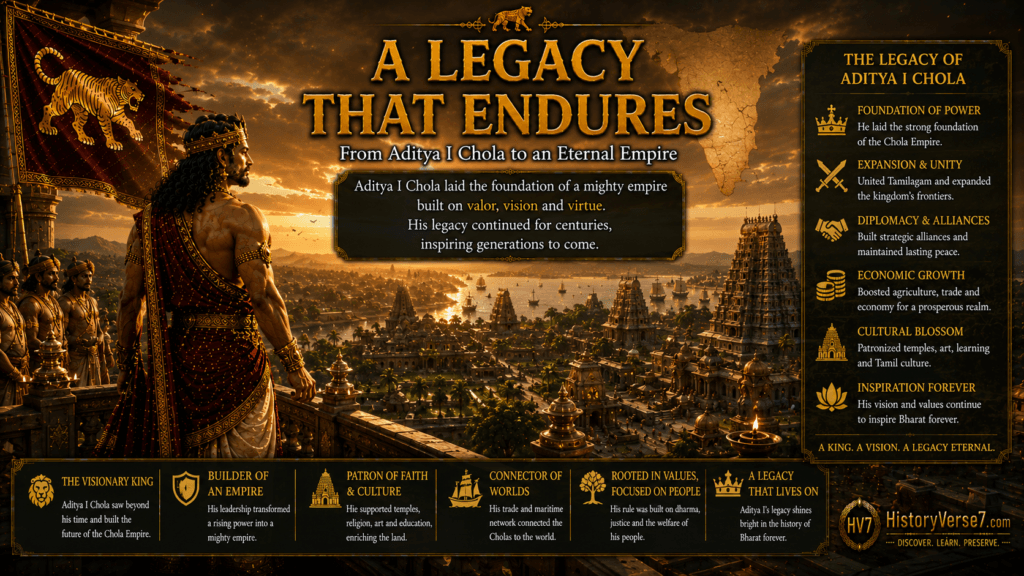
Parantaka I would go on to conduct aggressive campaigns against the Pandyas and briefly conquer Sri Lanka, thinking in fully imperial terms in ways that required the solid territorial and military base that Aditya I had created. The relationship between Aditya I’s reign and Parantaka I’s imperial ambitions is the same as the relationship between Vijayalaya’s reign and Aditya I’s military expansion: each generation built upon what the previous one had established, making possible achievements that would not have been conceivable from a lower foundation.
How Aditya I Changed the Future of the Chola Dynasty
The transition from Vijayalaya to Aditya I to Parantaka I represents one of the most consequential dynastic sequences in medieval South Asian history: three generations, each building decisively on the previous, transforming a regional chieftaincy into a major South Indian power and then into an empire with continental ambitions.
Vijayalaya created the base: the Kaveri delta, Thanjavur, the reestablished Chola name. Aditya I created the scale: the northward expansion, the defeat of the Pallavas, the emergence of the Chola kingdom as a power capable of competing with and defeating the region’s established dynasties. Parantaka I created the imperial vision: the campaigns against the Pandyas, the conquest of Sri Lanka, the administrative development that began transforming a kingdom into an empire.
Without Aditya I’s military achievements, particularly the removal of Pallava power from the northern Tamil country, Parantaka I’s imperial ambitions would have faced a fundamental geographical constraint. The Chola kingdom would have remained hemmed in the Kaveri delta, unable to access the resources and strategic position that the northern territories provided. It was Aditya I who opened the door that Parantaka I walked through and that Rajaraja I eventually transformed into the gateway of an empire.
Why Aditya I Is Often Overshadowed by Rajaraja Chola
The structural reason for Aditya I’s relative obscurity in popular historical memory is straightforward: he left no great monument. The Brihadeeswara Temple at Thanjavur, arguably the most magnificent structure produced by any Indian dynasty before or since, bears Rajaraja I’s name and defines his historical image in ways that no amount of scholarly explanation can entirely displace. Rajendra I has the dramatic narrative of the Southeast Asian expedition. Parantaka I has the Sri Lanka conquest.
What Aditya I has is the defeat of Aparajita Pallava and the northward expansion of Chola territory, achievements that are significant but less visually or narratively dramatic than temples and naval expeditions. This is a common pattern in dynastic history: the rulers who prepare the conditions for later magnificence tend to be less celebrated than those who produce the magnificence itself, even though the relationship of cause and effect runs precisely in the other direction. For historians of the Chola dynasty, Aditya I is not obscure. Nilakanta Sastri’s ‘The Colas’ gives him substantial attention. The scholarly literature on early Chola history consistently recognizes his reign as a critical phase in the dynasty’s development. The obscurity is a feature of popular rather than scholarly historical memory, and it reflects the general tendency of public history to prefer spectacular achievements over foundational ones.
Author’s Perspective
The history of the Chola dynasty provides an unusually clear example of what might be called the multi-generational logic of dynastic success. No single ruler, however talented, built the Chola Empire. It was built across generations, each of which was shaped by what the previous one had achieved and shaped in turn the possibilities available to the next.
Aditya I occupies a specific and crucial position in this logic. He was neither a founder nor an empire-builder in the conventional sense. He was a transformer, the ruler who took a specific kind of inheritance (a revived dynasty with a strong territorial base but limited reach) and produced a specific kind of outcome (a kingdom with demonstrated capacity to defeat major rivals and incorporate their territories). This transformation was not glamorous in the way that great temples or naval expeditions are glamorous. But it was the transformation on which everything else depended.
The Battle of Sripurambiyam deserves more attention in general historical consciousness than it typically receives. The defeat and death of Aparajita Pallava was not simply a military event; it was the moment when the Chola dynasty ceased to be one of several competing regional powers and became, for the first time, the dominant political force in the Tamil north. That shift in relative position created the structural conditions for the imperial Chola state. It was, in a meaningful sense, the point of no return for the Chola dynasty’s trajectory toward empire.
Students of political history will recognize in Aditya I a type that appears repeatedly in successful dynastic sequences: the consolidating second-generation ruler whose achievements are a prerequisite for third-generation greatness. These rulers rarely receive the recognition they deserve, because history tends to remember peaks rather than the slopes that make peaks possible. Aditya I was one such slope: steep, significant, and ultimately indispensable.
15 Lesser-Known Facts About Aditya I Chola
- Aditya I’s military campaigns required a logistical infrastructure — supply lines, provisioning systems, military organization — that had to be developed from the base that Vijayalaya had created. The administrative learning that went into sustaining multi-directional military campaigns during his reign contributed directly to the more sophisticated Chola administrative system that emerged under Parantaka I.
- Aditya I’s name itself — meaning ‘sun’ or ‘son of Aditi’ in Sanskrit — carried solar symbolism that connected the Chola dynasty to the prestigious Solar lineage (Suryavamsha) claimed in their genealogical inscriptions.
- The Battle of Sripurambiyam involved not just Cholas and Pallavas but also the Pandya king Varaguna II and the Ganga king Prithivipati I — making it a multi-power conflict that reshaped South Indian politics across multiple kingdoms simultaneously.
- No inscription definitely contemporary with Aditya I’s own reign has been identified; all primary documentary evidence for his achievements comes from later inscriptions composed by his successors.
- The defeat of Aparajita Pallava effectively ended a dynasty that had ruled northern Tamil Nadu for approximately six centuries, one of the longest-lasting continuous dynasties in South Indian history up to that point.
- Aditya I’s title ‘Kodandarama’ invoked the image of Rama armed with the Kodanda bow, a title that positioned him within the tradition of dharmic warrior kingship celebrated in Sanskrit epic literature.
- The Leyden Grant, a copper plate inscription of the Chola dynasty found in the Netherlands, is one of the important sources referencing Aditya I’s achievements in its genealogical preamble.
- Kanchipuram, the ancient Pallava capital that came within Chola influence following Aditya I’s northern expansion, was one of the most important religious centers in South India, home to major Shaivite and Vaishnavite temples that were significant targets of later Chola patronage.
- The Ganga kingdom of Mysore, whose king Prithivipati I was involved in the Sripurambiyam conflict on the Pallava side, subsequently developed a more accommodating relationship with the Chola kingdom, a political transition that was part of the broader restructuring of South Indian politics following the Pallava collapse.
- Aditya I’s construction of Shiva temples along the Kaveri, referenced in later inscriptional tradition, established a pattern of sacred geography marking the Kaveri as a Chola-protected divine landscape that his descendants would develop into an elaborate tradition of Kaveri-side religious patronage.
- The transition from Aditya I to Parantaka I appears to have been entirely smooth; no succession disputes or political crises are recorded for this period, suggesting that the Chola dynasty’s internal stability had been well established by the end of Aditya I’s reign.
- The political vacuum created by the collapse of Pallava power was filled not just by the Cholas but also by the emergence of other regional powers — the Rashtrakutas remained a significant force from the north, and the reconfiguration of South Indian politics following Sripurambiyam involved multiple actors beyond just the Chola-Pallava dyad.
- Aditya I’s reign spans roughly the same period as the reign of Alfred the Great in England (871–899 CE), a useful reminder that the Chola dynastic development was contemporary with other significant political reorganizations happening across the medieval world.
- The Tamil poetic tradition eventually celebrated Aditya I in ways that later influenced Tamil historical consciousness, though the specific poems associated with his reign are difficult to date and authenticate with precision.
- The Chola-Pallava transition was not necessarily experienced as a dramatic political rupture by all inhabitants of the affected territories; local institutions, temple organizations, and administrative practices showed considerable continuity across the change in paramount overlordship.
Conclusion: The Reign That Made Empire Possible
Vijayalaya Chola revived the Chola political tradition by seizing Thanjavur. Aditya I proved that revival could become something much larger. The difference between the two reigns is not merely territorial, though the territorial expansion was substantial, but structural. When Vijayalaya died, the Chola kingdom was a significant regional player in the Kaveri delta. When Aditya I died, it was the dominant power in the Tamil north, having eliminated the dynasty that had defined that region’s political culture for centuries.
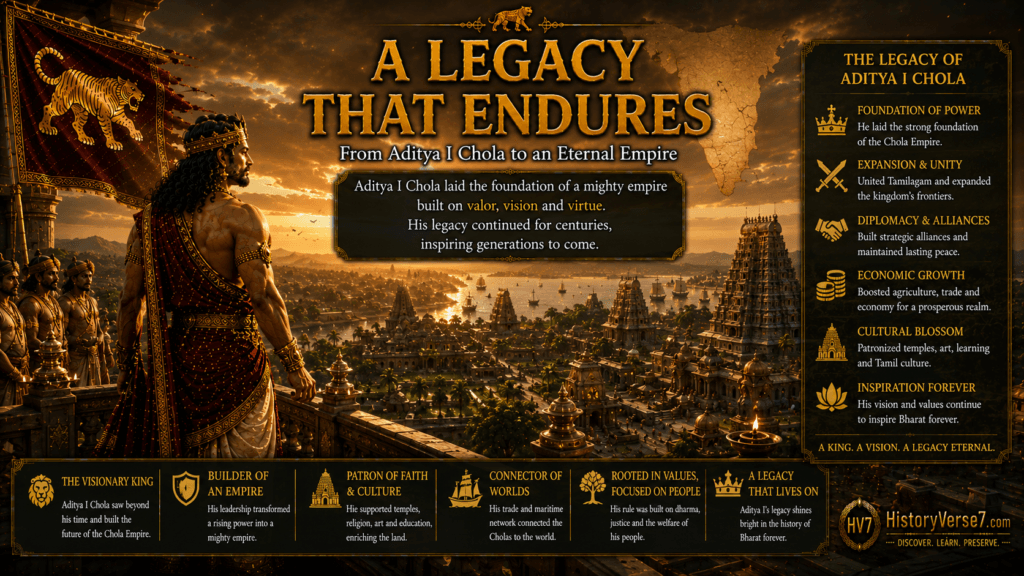
The Battle of Sripurambiyam sits at the center of this transformation. The defeat of Aparajita Pallava was not just a military victory; it was the event that restructured the political geography of South India, removing the primary obstacle to Chola expansion and creating the conditions in which the next two generations could pursue genuinely imperial ambitions. Parantaka I’s campaigns, Rajaraja I’s temple-building, Rajendra I’s naval expeditions all of these were built on the foundation that Aditya I created by winning and consolidating the gains from Sripurambiyam.
History tends to remember the visible peaks of achievement rather than the slopes that make peaks possible. The Brihadeeswara Temple defines Rajaraja I; the Southeast Asian expedition defines Rajendra I. Aditya I is defined by a battle whose name few people outside South Indian historical scholarship would recognize. That asymmetry between historical importance and popular memory is the particular injustice that this article has tried, in some small measure, to correct.
Written & Researched by Abhishek Chavan — HistoryVerse7| © 2026 HistoryVerse7 | Cluster Article — Aditya I Chola
References and Further Reading
Historical research based on inscriptions, archaeological evidence, academic scholarship, and established historical sources including K.A. Nilakanta Sastri, Noboru Karashima, Burton Stein, Upinder Singh, and the Archaeological Survey of India South Indian Inscriptions series.
- Archaeological Survey of India — Annual Reports and Epigraphy Reports. asi.nic.in
- Nilakanta Sastri, K.A. — The Colas (2 vols). University of Madras, 1935 (revised 1955). [Primary authority on Chola history]
- Nilakanta Sastri, K.A. — A History of South India. Oxford University Press, 1955.
- Karashima, Noboru — A Concise History of South India. Oxford University Press, 2014.
- Stein, Burton — Peasant State and Society in Medieval South India. Oxford University Press, 1980.
- Singh, Upinder — A History of Ancient and Early Medieval India. Pearson Education, 2008.
- Champakalakshmi, R. — Trade, Ideology and Urbanization: South India 300 BC to AD 1300. Oxford University Press, 1996.
- Tiruvalangadu Copper Plates of Rajendra I — Epigraphia Indica Vol. III. Archaeological Survey of India.
- The Leyden Grant — South Indian Inscriptions series. Archaeological Survey of India.
FAQ — Aditya I Chola
Q1: Who was Aditya I Chola?
Aditya I Chola was the son and successor of Vijayalaya Chola, and the second ruler of the Imperial Chola dynasty. He reigned approximately from 871 to 907 CE and transformed the Chola kingdom from a delta-based chieftaincy into a significant regional power through military campaigns that culminated in the defeat of the last major Pallava king.
Q2: Who was Aditya I’s father?
Vijayalaya Chola, the founder of the Imperial Chola dynasty, who had captured Thanjavur from the Muttaraiyar chiefs around 848 CE and established the Chola presence in the Kaveri delta that Aditya I inherited and expanded.
Q3: What was the Battle of Sripurambiyam?
The Battle of Sripurambiyam was a military engagement in the northern Tamil country, fought around 890 CE, in which Chola forces under Aditya I’s leadership defeated the Pallava king Aparajita — who was killed in or following the battle. The conflict also involved Pandya and Ganga forces, making it a complex multi-party engagement that effectively ended significant Pallava political independence.
Q4: When did Aditya I Chola rule?
Approximately 871 to 907 CE, based on estimates derived from later Chola genealogical inscriptions. These dates are broadly accepted by mainstream scholarship but cannot be established with complete precision from contemporary sources.
Q5: Who was the Pallava king defeated by Aditya I?
Aparajita Pallava the last Pallava king to exercise significant independent political authority. His death in or after the Battle of Sripurambiyam effectively ended the Pallava dynasty as a major South Indian power, after several centuries of dominance in northern Tamil Nadu.
Share this content: