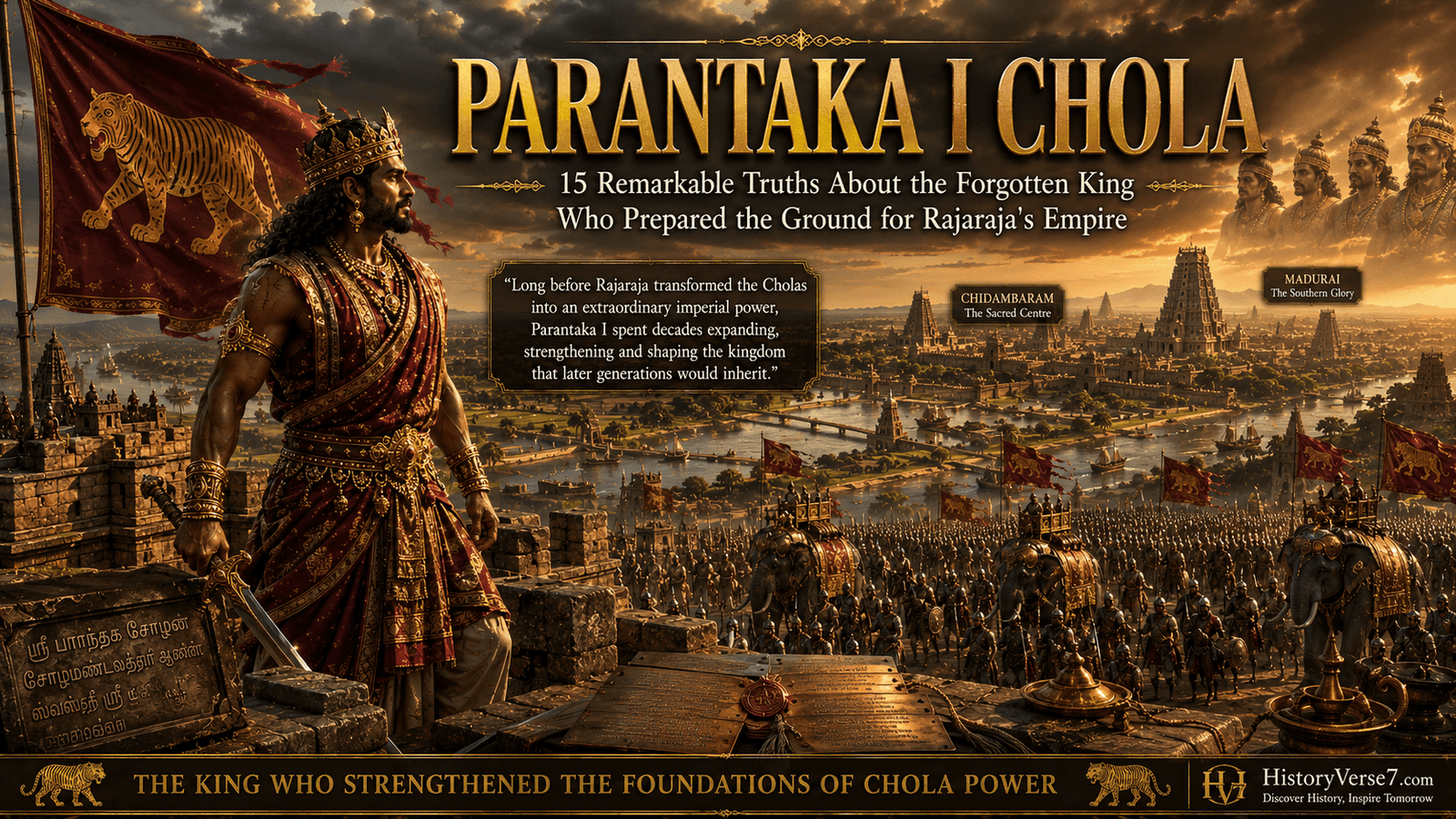
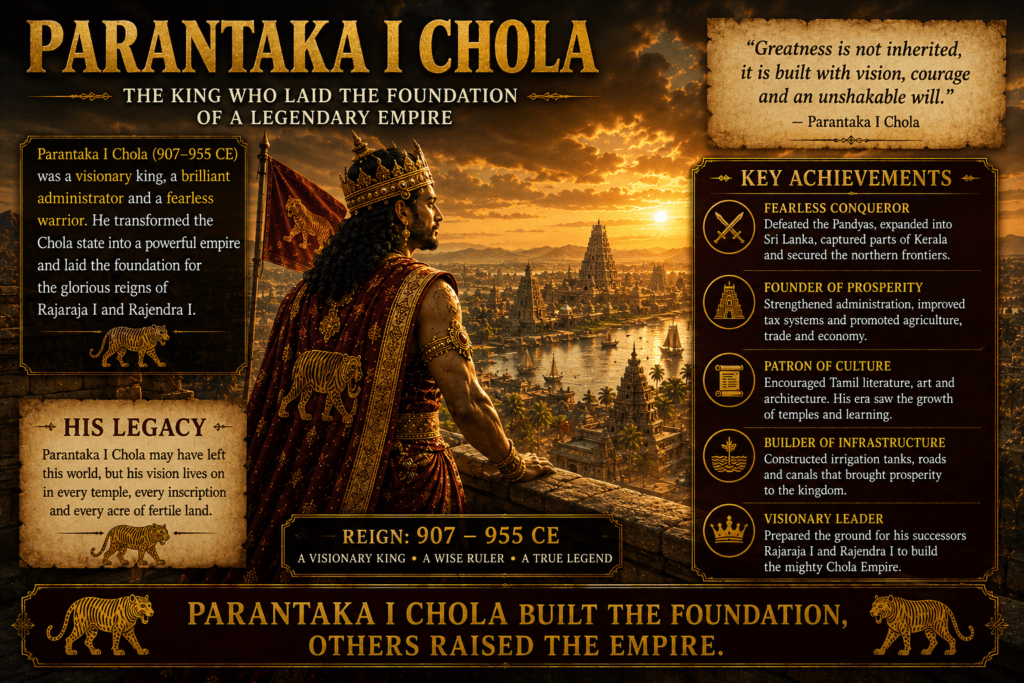
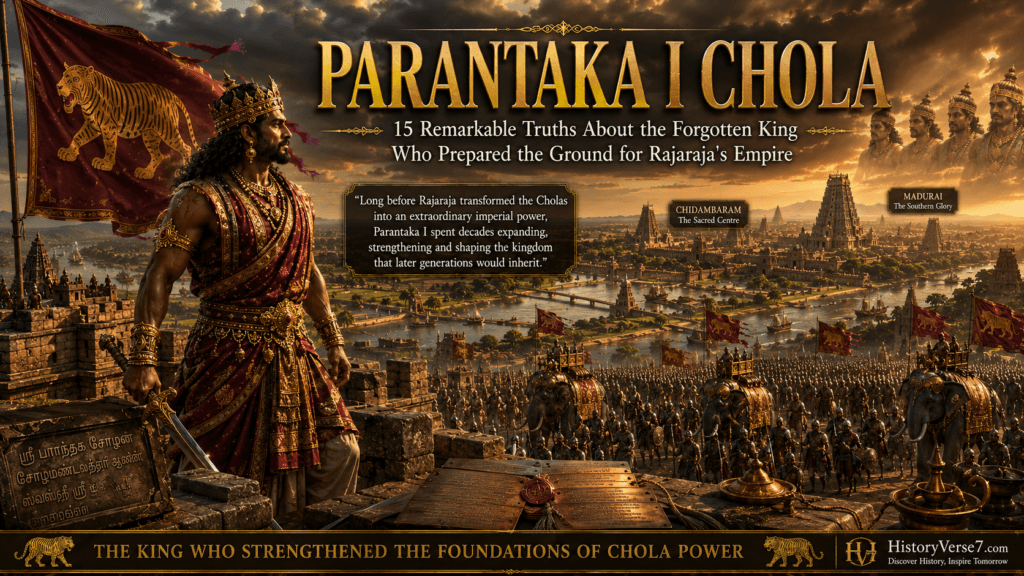
Parantaka I Chola: 15 Remarkable Truths About the Forgotten King Who Prepared the Ground for Rajaraja’s Empire
⚔️ Parantaka I Chola — The Ambitious King Who Expanded Chola Power and Reshaped the Political Map of South India The Chola resurgence did not end with Vijayalaya Chola, nor did it reach its full imperial form under Aditya I. Between the political revival of the ninth century and the later imperial expansion of the…
Parantaka I Chola
Parantaka I Chola: The Ambitious King Who Expanded Chola Power Across Southern India
HistoryVerse7.com | Cluster Article: Parantaka I Chola | International English Edition
By the time Parantaka I inherited the Chola throne around 907 CE, the dynasty had already accomplished something remarkable. Vijayalaya had reclaimed Thanjavur from the Muttaraiyars, planting the Chola flag firmly in the Kaveri delta after generations of political eclipse. Aditya I had then done something more ambitious still: he had marched north, defeated the last significant Pallava king at Sripurambiyam, and opened the entire northern Tamil country to Chola authority. Two generations of careful, determined leadership had transformed a regional chieftaincy into a substantial South Indian kingdom.
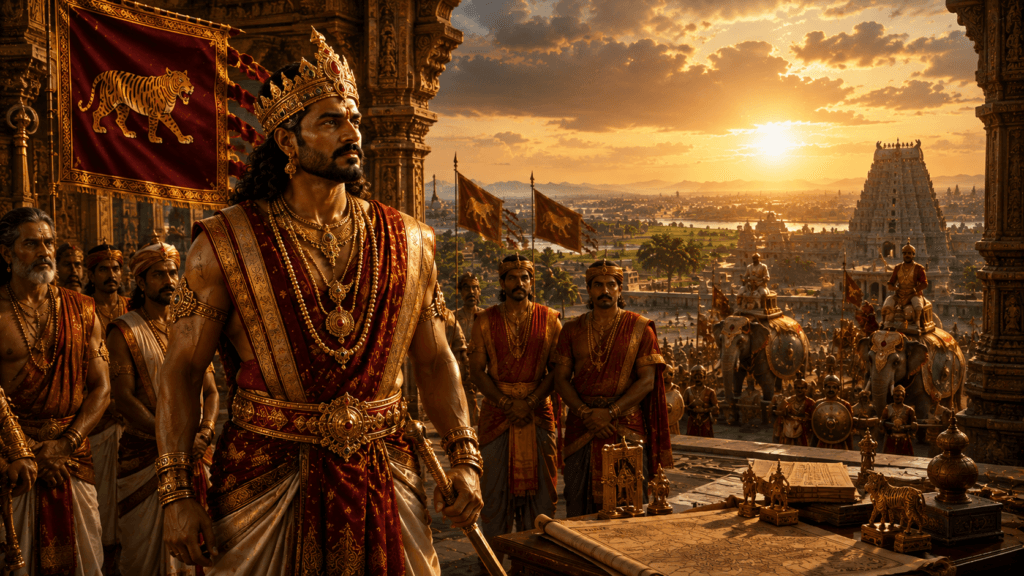
Parantaka I inherited all of this. He also inherited the question that had shadowed every successful dynasty in South Asian history: what comes next? Regional dominance is one thing. Converting it into durable imperial power the kind that outlasts a single reign, generates institutional continuity, and commands the loyalty of subordinate powers across a wide geography is something considerably harder. The Chola kingdom of 907 CE was strong; it was not yet an empire.
What followed was a reign of nearly half a century, one of the longest in the entire Chola dynasty, marked by dramatic expansion, the first serious attempt at island conquest, the reconfiguration of political geography across southern Tamilakam, and, in its closing decades, a sobering encounter with the limits of Chola military power. Parantaka I’s story is the story of a dynasty testing what it was truly capable of and discovering, as all expanding powers eventually do, that ambition and achievement are not always the same thing.
Who Was Parantaka I Chola?
Parantaka I Chola, whose full royal name is sometimes given as Parantaka Viranarayana in later inscriptional tradition, was the son and successor of Aditya I Chola. He ruled for approximately 48 years, from around 907 CE to 955 CE, making his reign one of the longest in the entire Chola dynasty and one of the most consequential for the development of the later imperial Chola state.
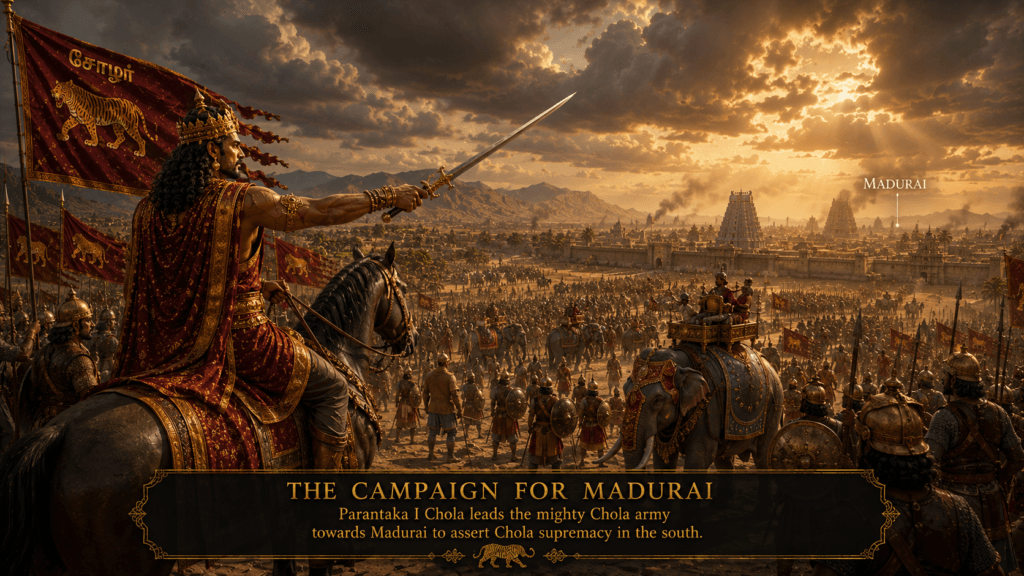
His royal titles, as preserved in Chola inscriptions, include ‘Maduraikonda ‘, ‘He who took Madurai ‘, a title that commemorates the single military achievement most associated with his name in the popular historical tradition. He also bore epithets emphasizing divine favor, martial prowess, and royal magnificence that were conventional in medieval South Indian royal titulature. Unlike his predecessors Vijayalaya and Aditya I, whose reigns are documented primarily through later genealogical inscriptions, Parantaka I’s reign is sufficiently well-documented that a more detailed reconstruction of his activities is possible.
K.A. Nilakanta Sastri, in ‘The Colas,’ treats Parantaka I as a pivotal figure the first Chola ruler to think and act in genuinely imperial terms, campaigning against multiple major South Indian powers simultaneously, organizing systematic administration of newly acquired territories, and developing the patterns of temple patronage and royal religious identity that would characterize the later imperial Chola state. Subsequent scholars, including Noboru Karashima, have accepted this broad assessment while emphasizing the need to distinguish between what contemporary inscriptions establish and what later genealogical tradition has added.
The Chola Kingdom Parantaka Inherited
The Legacy of Vijayalaya Chola
The Chola kingdom that Parantaka I inherited had its foundations in Vijayalaya’s capture of Thanjavur around 848 CE, the act that reestablished Chola political authority in the Kaveri delta after a prolonged period of eclipse under Pallava overlordship. Vijayalaya had secured the delta and established a functioning dynastic administration, but his territorial reach was essentially limited to the Kaveri delta heartland and its immediate environs. The Chola political revival was real, but geographically constrained.
The Expansion Under Aditya I
Aditya I had dramatically changed that picture. His defeat of Aparajita Pallava at the Battle of Sripurambiyam around 890 CE removed the primary political barrier to Chola northward expansion, and the subsequent incorporation of Tondaimandalam, the northern Tamil country centered on the ancient Pallava capital of Kanchipuram, gave the Chola kingdom a substantially enlarged territorial and resource base. When Parantaka I became king, he ruled a kingdom that extended from the Kaveri delta through the former Pallava territories to the north, a kingdom with real military capability and demonstrated political momentum.
The Political Landscape of South India
The South India of 907 CE was still intensely competitive. To the south, the Pandya kingdom of Madurai remained a significant power, ancient, well-organized, and acutely aware that Chola expansion northward had not diminished the Chola appetite for southward influence. The Cheras controlled the western coastal region. The Rashtrakuta dynasty of the Deccan, one of the most powerful political entities in peninsular India, loomed over the entire region from the north, occasionally intervening in South Indian affairs and capable of projecting military force deep into the Tamil country when its interests were engaged. The Gangas of Mysore and various smaller chieftains occupied the interstices between these major powers.
Into this competitive landscape Parantaka I stepped with an inherited kingdom stronger than anything the Cholas had commanded for centuries, and with ambitions that would eventually test the limits of that strength.
How Parantaka I Became King
Succession After Aditya I
The succession from Aditya I to Parantaka I appears to have been smooth and uncontested, consistent with the pattern established by the two previous Chola successions. Parantaka I was Aditya I’s son and direct heir, and the inscriptional record contains no indication of succession disputes or rival claimants at this transition. This pattern of orderly succession father to son, without apparent disruption, was itself a significant institutional achievement for a dynasty only two generations old as an independent imperial power.
The Early Years of His Reign
The early years of Parantaka I’s reign were almost certainly devoted to consolidating the position he had inherited rather than immediately launching new campaigns. The northern territories acquired by Aditya I needed administrative integration; the local power-holders of Tondaimandalam needed to be managed and accommodated within the expanding Chola political system; the revenue streams from the newly incorporated territories needed to be organized. These were not glamorous activities in the way that military campaigns were glamorous, but they were the essential foundation for the more ambitious projects that would follow.
Building Political Legitimacy
Parantaka I’s religious patronage was, from early in his reign, an important element of his political strategy. Temple construction and endowment the act of publicly associating royal authority with the sacred landscape of South India was by this point an established feature of Chola political culture, building on the practices initiated by Vijayalaya and continued by Aditya I. Parantaka I amplified this tradition substantially, and the inscriptional record of his temple patronage is considerably richer than for his predecessors reflecting both his longer reign and the greater administrative sophistication of the Chola state under his rule.
Parantaka I and the Pandya Kingdom
The Conflict for Southern Tamilakam
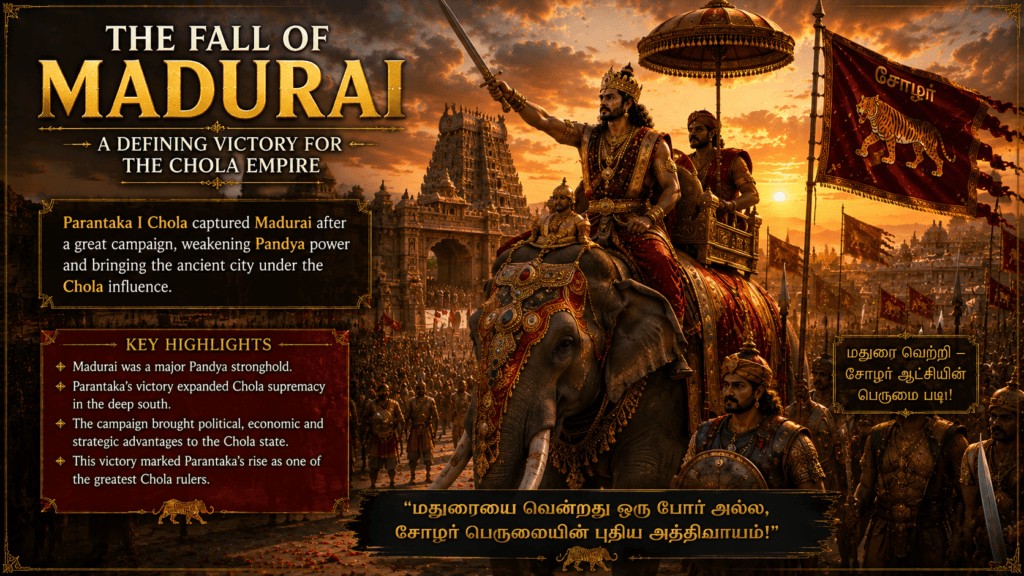
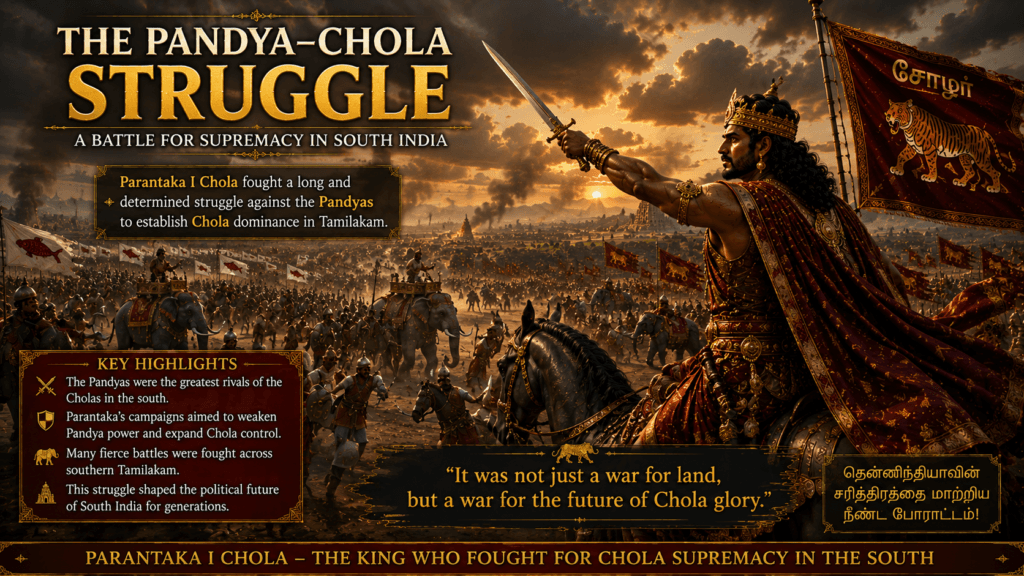
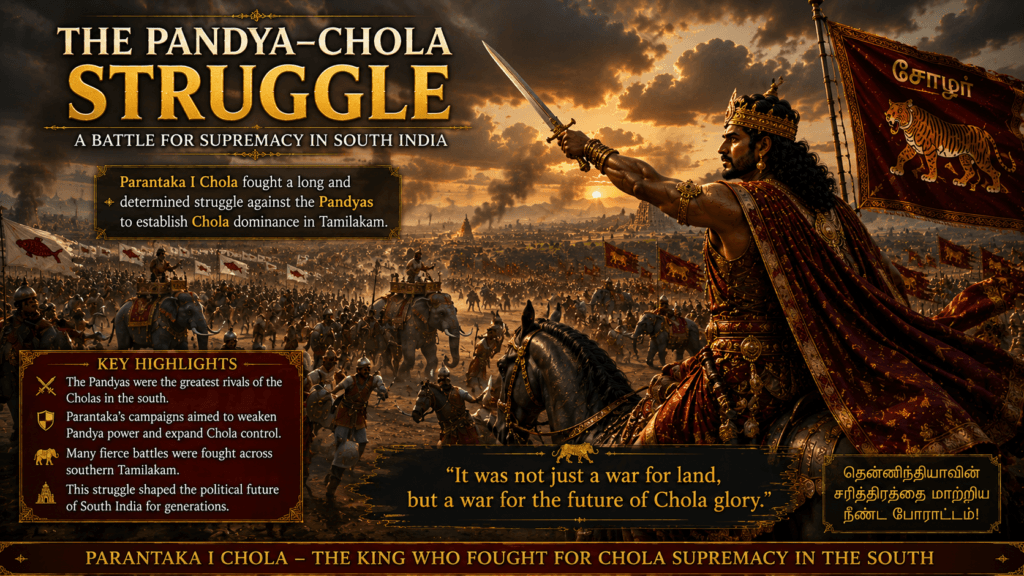
The most celebrated military achievement of Parantaka I’s reign was his campaign against the Pandya kingdom, a campaign that culminated in the capture of Madurai, the Pandya capital, and earned him the royal title ‘Maduraikonda’ (He Who Took Madurai) by which he is still primarily remembered. Understanding why this campaign happened requires understanding both the political geography of southern Tamilakam and the specific political circumstances of the early 10th century.
The Pandya kingdom, based in Madurai and controlling the southernmost Tamil country including the rich pearl-fishing waters of the Gulf of Mannar, had been a significant South Indian power for centuries, one of the original three Tamil muvendar of the Sangam tradition. The Pandya king of this period, Rajasimha II, had been engaged in his own political conflicts, and the instability created by these conflicts provided Parantaka I with an opportunity for intervention.
The Campaign Against the Pandyas
Parantaka I’s campaign against the Pandyas was not a straightforward military confrontation. The political situation involved the Pandya king seeking assistance from sources outside the Tamil country, including, according to later traditions, from Sri Lanka, which itself became a factor in drawing Parantaka I’s military attention toward the island. The specifics of the campaign’s conduct are not described in detail in the inscriptional record, but the outcome the capture of Madurai and the flight or submission of the Pandya king is established by the inscriptional tradition that gave Parantaka I his most famous title.
It is important to note that the Pandya kingdom was not destroyed by this campaign. The Pandyas remained a political force in southern Tamilakam and would reassert themselves repeatedly in subsequent decades and centuries. What Parantaka I achieved was not the permanent elimination of Pandya power but its temporary subordination, a pattern that would characterize the Chola-Pandya relationship throughout the imperial period.
The Capture of Madurai
The capture of Madurai, one of the oldest and most symbolically significant cities in the Tamil world, associated with the legendary Sangam academies and with the Pandya tradition that stretched back to the earliest attested period of Tamil history, was a political and symbolic achievement of the first order. For the Chola dynasty, whose own ancient tradition was rooted in the Kaveri delta of the northeast, to project military power all the way to Madurai in the deep south was a demonstration that Chola ambitions extended across the entire Tamil-speaking world.
Why Madurai Mattered
Madurai’s strategic importance was multiple. It was the administrative and cultural center of the Pandya kingdom and the most important city of southern Tamilakam. It controlled access to the southern trade routes, the routes that connected the Tamil country to the pearl fisheries of the Gulf of Mannar and the ports of the southern coast. It was a major religious center, home to the famous Meenakshi temple tradition. And it was, symbolically, the proof that the Chola kingdom had genuinely transcended its Kaveri delta origins to become a power with legitimate claims over the whole Tamil south.
Parantaka I and Sri Lanka
Why the Island Became Strategically Important
The involvement of Sri Lankan political actors in the Pandya conflicts of the early 10th century drew Parantaka I’s attention toward the island for reasons that were both strategic and political. Sri Lanka, known in medieval South Indian sources as Lanka or Ilankai, was a major maritime trading center whose ports on the northern and northwestern coasts were closely integrated with the commercial economy of the Coromandel coast. The island’s political stability or instability had direct implications for South Indian commercial interests.
The presence of Pandya refugees or political allies in Sri Lanka also created a specific military rationale for Chola intervention. If Pandya forces were able to use the island as a base for recovering their position in southern Tamilakam, then the gains of the mainland campaign could be threatened. Whether this was actually Parantaka I’s reasoning cannot be established from the available evidence, but the political logic is clear enough.
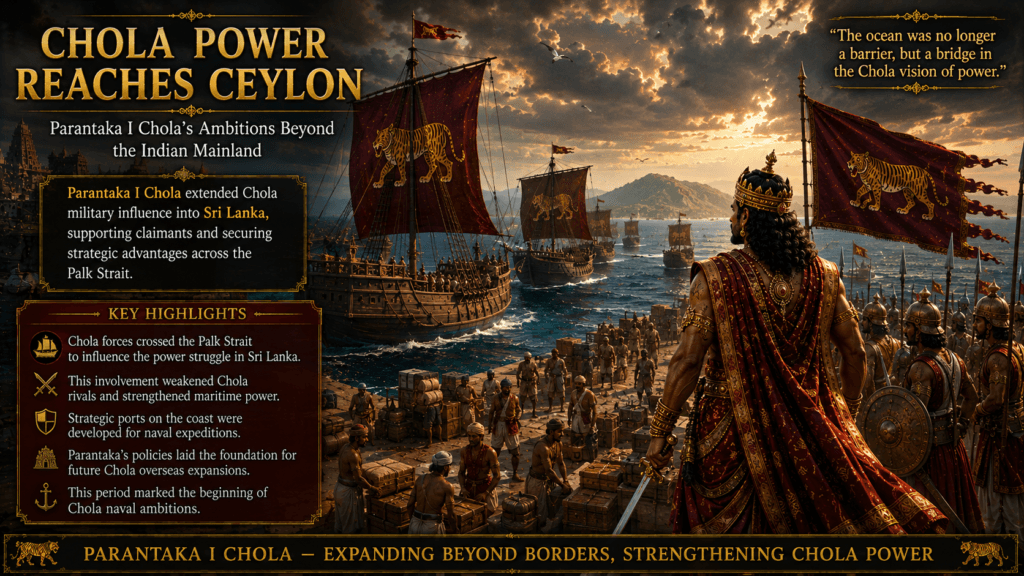
The Chola Campaign
Parantaka I’s campaign against Sri Lanka is documented in later Chola inscriptions that credit him with military action on the island. The nature and extent of this action, whether it constituted a full-scale invasion, a punitive expedition, or a demonstration of military force, is not specified in detail by the sources. Later tradition credits Parantaka I with achieving some degree of Chola authority over at least the northern part of the island.
Historical Evidence and Limits of Chola Control
The historical evidence for the Sri Lankan campaign is primarily from later Chola inscriptional tradition rather than contemporary sources, and historians exercise appropriate caution about the extent and permanence of any Chola presence on the island during this period. What seems clear is that Parantaka I conducted some form of military or political intervention in Sri Lanka, an action that would be followed by much more systematic Chola engagement with the island under later rulers, particularly the major conquest under Rajaraja I and the prolonged Chola administration of Sri Lanka that followed.
The Sri Lankan campaign is historically significant less for what it immediately achieved than for the precedent it established. By projecting Chola military power across the Palk Strait, Parantaka I demonstrated that the Chola kingdom was beginning to think about its interests in maritime as well as continental terms a strategic orientation that would become central to the imperial Chola identity under his successors.
The Expansion of Chola Territory
The geographical scale of territorial expansion under Parantaka I was, by any measure, extraordinary. At the beginning of his reign, the Chola kingdom controlled the Kaveri delta, Tondaimandalam to the north, and some adjacent territories. By the peak of his military success, approximately the 930s CE, Chola power had been asserted from the northern Tamil country all the way to the southern tip of the subcontinent, and across the Palk Strait into northern Sri Lanka.
Northern Tamilakam, inherited from Aditya I, was consolidated and more systematically administered during Parantaka I’s reign. The inscriptional record from this region becomes substantially richer under Parantaka I, suggesting a more organized royal administration extending into the former Pallava territories.
Southern Tamilakam, the Pandya country centered on Madurai, came under at least nominal Chola authority following the conquest of the Pandya capital. How effectively this authority was exercised, and how continuously it was maintained over the following decades, is a question the sources do not answer definitively. The Pandyas reasserted themselves periodically, and Chola control of the south was never as secure as Chola control of the Kaveri delta heartland.
The strategic consolidation of these gains required the development of administrative systems capable of managing a much larger and more geographically diverse territory than the Chola dynasty had ever previously governed. This administrative development, building on the foundations established by his predecessors and creating new institutions suited to the new imperial scale, was perhaps Parantaka I’s most significant and least celebrated achievement.
Parantaka I and the Rashtrakutas
The Rise of Rashtrakuta Power
The Rashtrakuta dynasty of the Deccan was, in the first half of the 10th century, one of the most powerful political entities in peninsular India. Based in the region of modern Karnataka and Maharashtra, the Rashtrakutas had been a dominant force in Deccan politics for more than a century, periodically intervening in the affairs of their southern neighbors and capable of mobilizing military forces of considerable size. Their relationship with the Chola dynasty in the north was a complex one, involving periods of relative cooperation, competition, and outright conflict.
Changing Alliances
The political dynamics of the Chola-Rashtrakuta relationship were complicated by the involvement of the Gangas of Mysore, who occupied a strategically important position between the two powers. The Gangas at various points allied with both the Cholas and the Rashtrakutas, depending on the specific political circumstances. The triangular relationship among Cholas, Rashtrakutas, and Gangas defined much of the political history of the Deccan-Tamil borderlands in the 10th century.
Parantaka I appears to have initially maintained reasonably stable relations with the Rashtrakutas, focusing his military energies on the south against the Pandyas and toward Sri Lanka rather than on the northern frontier where Rashtrakuta power was most directly relevant. This strategic choice allowed him to pursue his southern ambitions without simultaneously antagonizing the most powerful northern neighbor. Whether this was conscious strategic calculation or simply the product of political circumstances cannot be established from the available evidence.
The Growing Conflict
As Parantaka I’s power expanded and as the Rashtrakuta dynasty itself underwent internal political changes, the relationship between the two powers became more adversarial. The specific sequence of events that led to direct Rashtrakuta-Chola military conflict is not entirely clear from the surviving sources, but by the 940s CE the situation had deteriorated to the point where a major battle became inevitable. That battle, Takkolam, would prove to be the most consequential military event of Parantaka I’s later reign.
The Battle of Takkolam
Why the Battle Happened
The Battle of Takkolam, fought around 949 CE at a site in the northern Tamil country generally identified with the area around modern Arakkonam in Tamil Nadu, was the direct military confrontation between Chola and Rashtrakuta power that the political dynamics of the preceding decade had been building toward. The precise political circumstances that triggered the specific confrontation are not described in detail by the surviving sources, but the broader context of Rashtrakuta expansion southward, Chola resistance to that expansion, and the involvement of the Ganga kingdom on the Rashtrakuta side is established by the inscriptional and literary evidence.
The Major Powers Involved
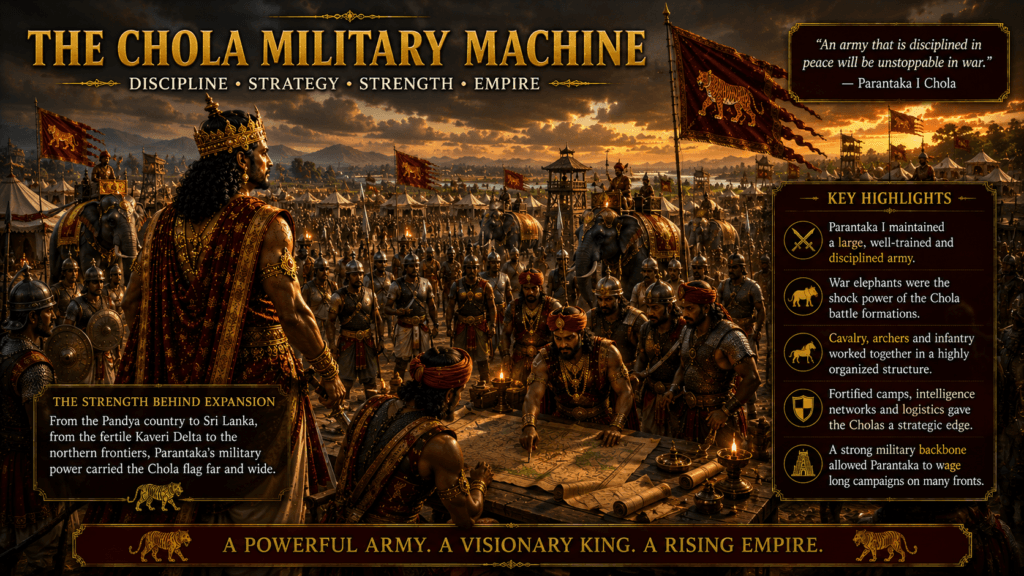
The Rashtrakuta forces at Takkolam were led, according to the inscriptional and literary tradition, by Krishna III, one of the most capable Rashtrakuta rulers, who had been conducting an aggressive southward expansion policy that directly challenged Chola northern positions. The Gangas of Mysore fought alongside the Rashtrakutas. On the Chola side, the forces were commanded by Rajaditya Parantaka I’s son and heir-apparent, who had been given command of the northern military operations.
Rajaditya Chola
Rajaditya was, by the accounts preserved in later Chola inscriptional tradition, a significant military commander who had been active in Chola campaigns in the years preceding Takkolam. He was Parantaka I’s eldest son and the expected successor to the Chola throne; his presence in command at Takkolam reflects both the seriousness with which the Chola court viewed the northern threat and the degree to which Parantaka I had delegated northern military command to his heir.
The Death of Rajaditya
The battle at Takkolam was a Chola defeat, and the most painful consequence of that defeat was the death of Rajaditya Chola on the battlefield. Later inscriptions describe him as having died fighting on elephant-back, and his death was commemorated in subsequent Chola tradition in ways that suggest it was experienced as a serious dynastic as well as military loss. The death of an heir-apparent on the battlefield was not merely a personal tragedy; it was a political disruption that affected the succession and the morale of the Chola political system.
Later sources, including some Tamil literary texts, describe Rajaditya’s death in terms that celebrate his martial courage, a tradition that reflects the South Indian aristocratic value system in which dying in battle was honorable. Historians treat these literary accounts with appropriate caution while accepting the basic fact of Rajaditya’s death at Takkolam as established by the broader historical record.
The Chola Setback
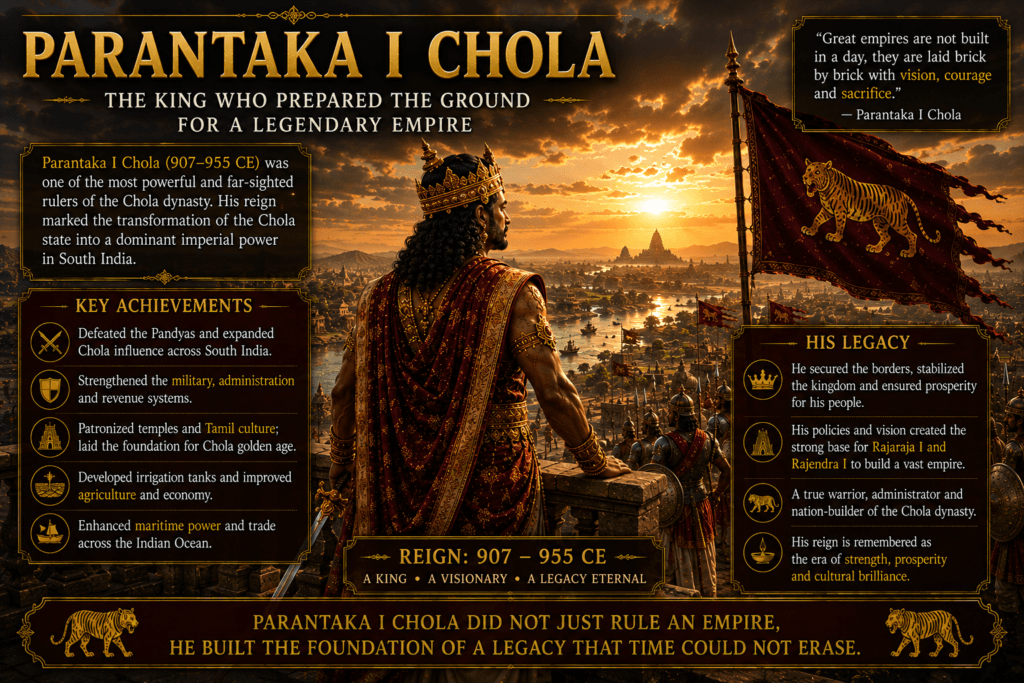
The defeat at Takkolam had immediate territorial consequences. The Rashtrakutas under Krishna III advanced southward, occupying territories in the northern Tamil country that had been part of the Chola sphere since Aditya I’s northward expansion. Tondaimandalam, the former Pallava heartland that the Cholas had absorbed following the defeat of Aparajita, came under Rashtrakuta influence. The Chola kingdom was pushed back from its northern positions, losing the gains that had defined Aditya I’s most significant military achievement.
Why Takkolam Changed the Political Balance
Takkolam mattered for reasons that extended beyond the immediate territorial losses. The defeat demonstrated, for the first time in the Chola dynasty’s imperial period, that the Chola military had real limits and that there were powers in peninsular India capable of defeating Chola forces in open battle and reclaiming territories the Cholas had controlled. This was a significant recalibration of political reality after four decades of Chola military success.
The death of Rajaditya also created a succession problem. Parantaka I would reign for several more years after Takkolam, but the designated succession had been disrupted. The subsequent Chola succession through other sons of Parantaka I involved a period of political adjustment that historians have associated with some of the instability that characterized Chola politics in the decades immediately following Parantaka I’s death.
Parantaka I’s Military Strategy
Reconstructing Parantaka I’s military strategy requires the usual caution about inferring deliberate calculation from outcomes that may have resulted from circumstances as much as from planning. With that caveat, several strategic patterns are visible in the record of his reign.
The most striking feature of Parantaka I’s military strategy was its geographical ambition: the willingness to project Chola military power in multiple directions simultaneously, pursuing southern expansion against the Pandyas while managing the northern frontier and conducting operations toward Sri Lanka. This multi-directional approach required a military and logistical capacity that significantly exceeded anything the Chola dynasty had previously deployed, and building that capacity must have been one of the major projects of his reign.
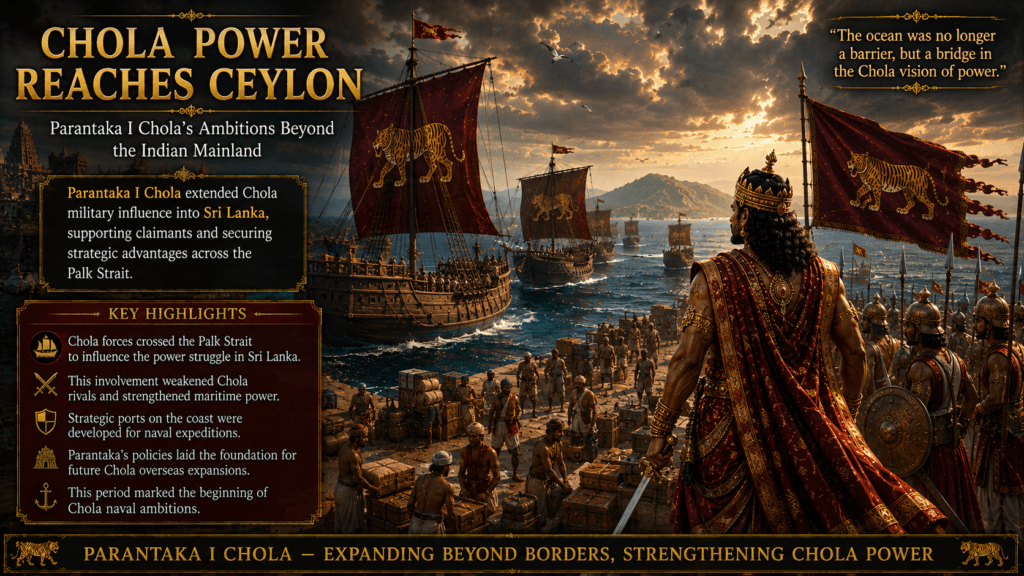
The sequencing of his campaigns suggests a strategic logic: secure the south before engaging the north. The Pandya campaign and Sri Lankan operations preceded the Rashtrakuta confrontation. This sequencing allowed Parantaka I to achieve his most spectacular military successes: the capture of Madurai and the assertion of Chola authority in Sri Lanka before the Rashtrakuta challenge escalated to the point of direct military confrontation.
What the Battle of Takkolam revealed was the limits of this strategy. A kingdom that had expanded rapidly in multiple directions, incorporating diverse territories with varying degrees of genuine loyalty and administrative integration, was inherently more vulnerable to a determined external challenge than a kingdom that had consolidated more carefully. The Rashtrakuta advance under Krishna III found Chola northern positions less secure than they might appear from the inscriptional record of victories.
Administration Under Parantaka I
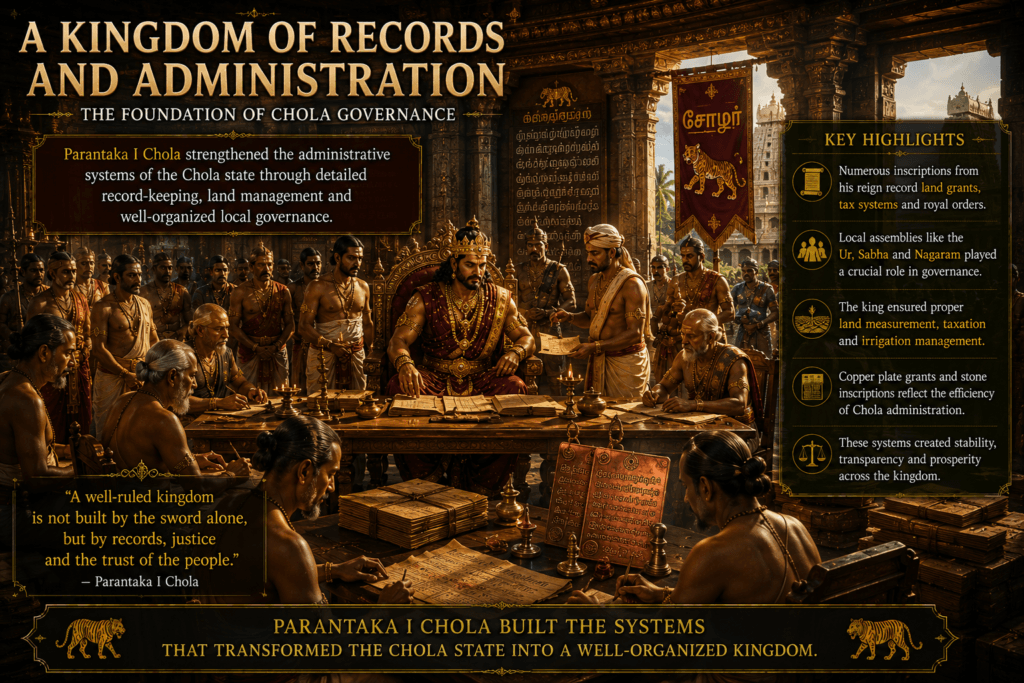
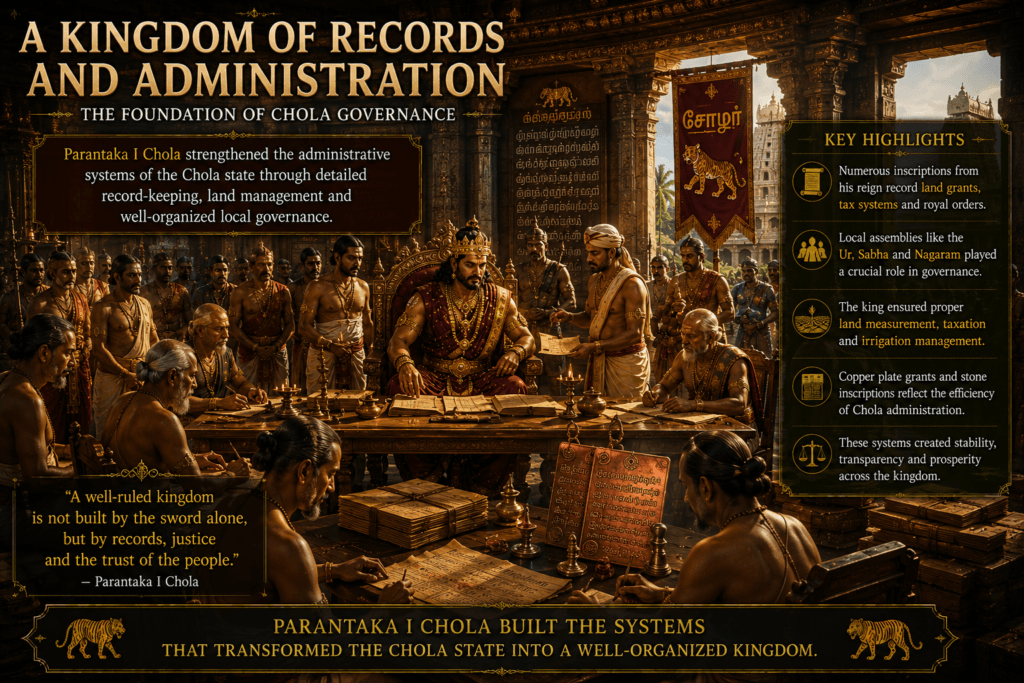
The administrative record of Parantaka I’s reign is substantially richer than for his predecessors, reflecting both the greater length of his reign and the more developed administrative apparatus of the Chola state by the 10th century. The land grants, temple endowments, and other administrative documents from this period allow historians to reconstruct the outlines of Chola governance during his reign with considerably more confidence than is possible for the reigns of Vijayalaya and Aditya I.
Land grants, the primary administrative documentary record of the medieval South Indian state, were issued in significant numbers during Parantaka I’s reign. These grants transferred revenue rights from specific villages or agricultural lands to specific temples or Brahmin recipients, serving simultaneously as expressions of royal piety, instruments of political integration (by creating local stakeholders in the Chola system), and documentary records of royal authority over specific territories.
The geographical distribution of land grants from Parantaka I’s reign provides evidence about the extent of effective Chola administrative authority and the territories in which the king’s grants were recognized and implemented. The concentration of grants in the Kaveri delta and the former Pallava territories of the north reflects the areas of most secure Chola administration; the sparser record from the southern territories reflects both the more recent and potentially less stable nature of Chola authority there.
The relationship between the Chola royal administration and existing local institutions the village assemblies (sabhas), the merchant communities, the temple managing bodies was evolving during Parantaka I’s reign in ways that created the foundations for the more elaborate local governance systems documented in detail under Rajaraja I and his successors. The specific mechanisms of this evolution are not always recoverable from the surviving evidence, but the general direction toward a more systematic integration of local institutions into the royal administrative framework is established.
Economy and Agriculture Under Parantaka I
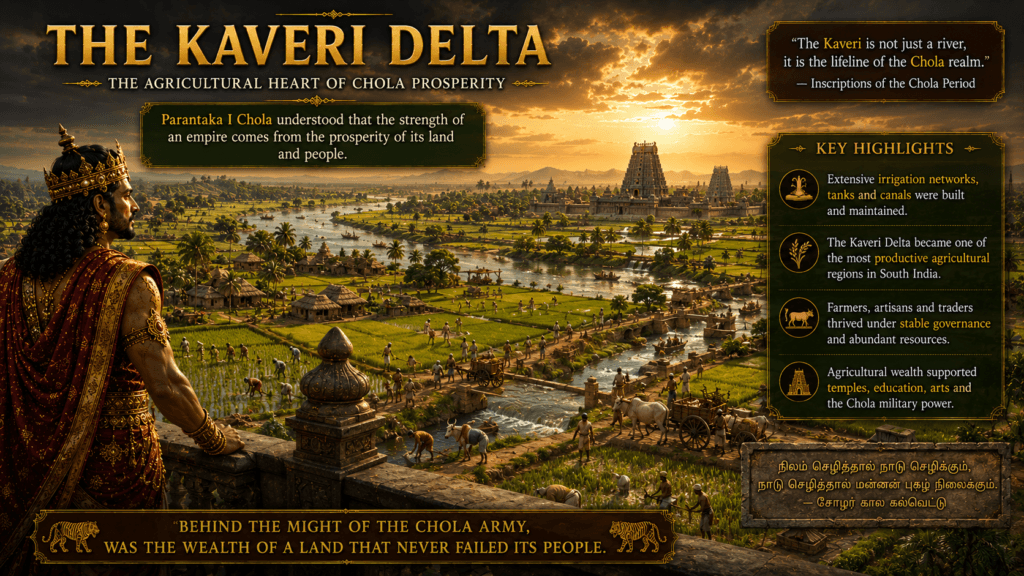
The economic foundations of Parantaka I’s military ambitions lay primarily in the agricultural productivity of the Kaveri delta, one of the most fertile agricultural landscapes in South Asia, capable of supporting intensive rice cultivation across a broad area when its irrigation systems were properly maintained and extended.
The land grant records from Parantaka I’s reign contain detailed descriptions of agricultural land, its extent, its productivity, the water sources serving it, and the revenue obligations attached to it, which allow historians to reconstruct something of the agricultural economy of the Chola heartland in the 10th century. These records show a sophisticated administrative awareness of agricultural conditions and a state capacity for systematic land revenue management that was considerably more advanced than anything visible in the earlier Chola period.
Irrigation maintenance and development were a royal responsibility both practically, because the state needed the agricultural surplus that irrigation-supported rice cultivation produced, and symbolically, because the protection and development of the water systems on which agricultural communities depended was one of the most tangible expressions of royal beneficence. The continuation and development of Kaveri delta irrigation under Parantaka I’s long reign was an important element of the economic foundation that sustained his military campaigns.
The extension of Chola authority into the Pandya territories also brought new agricultural and commercial resources under Chola control: the pearl fisheries of the Gulf of Mannar, the agricultural lands of the Tirunelveli plains, and the trade routes connecting the southern coast to the wider Indian Ocean commercial network. These resources, however, were only available as long as Chola authority in the south was maintained, a condition that proved more difficult to sustain than to achieve.
Parantaka I and Temple Patronage
Temple Construction and Endowment
Temple patronage under Parantaka I was more extensive and better documented than under his predecessors. The inscriptional record from his reign includes numerous references to royal grants supporting temple maintenance and construction across the Chola territories, with particular concentration in the Kaveri delta heartland and in the Tondaimandalam region of the north.
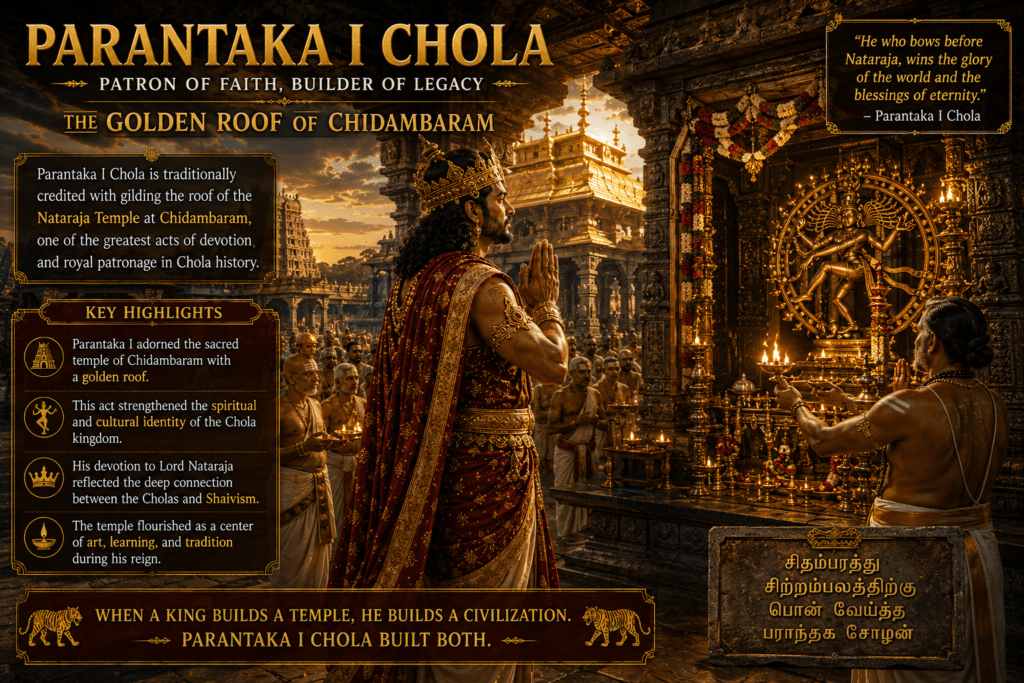
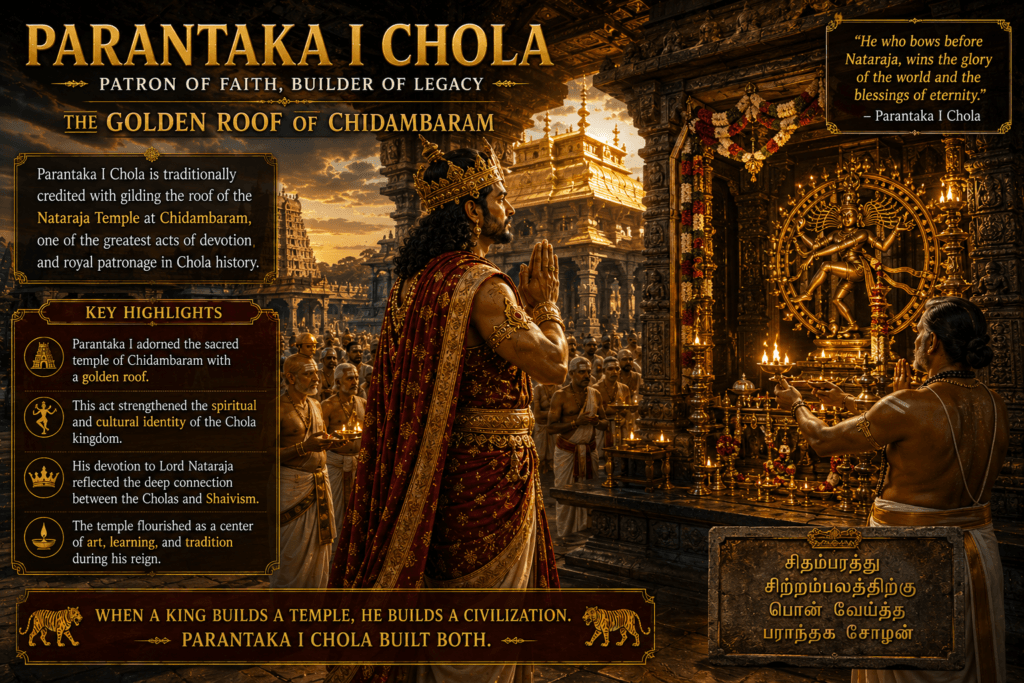
Parantaka I is particularly associated in the later tradition with the sheathing of the towers (vimanas) of the Chidambaram temple in gold, an act of spectacular royal munificence that was simultaneously an expression of personal Shaivite devotion and a public political statement of the highest order. Chidambaram, home to the famous Nataraja (Dancing Shiva) shrine, was one of the most important Shaivite pilgrimage centers in the Tamil world. Royal patronage of this scale at this location announced Parantaka I’s claim to be the paramount protector of Tamil Shaivite religious culture.
Political Meaning of Temple Building
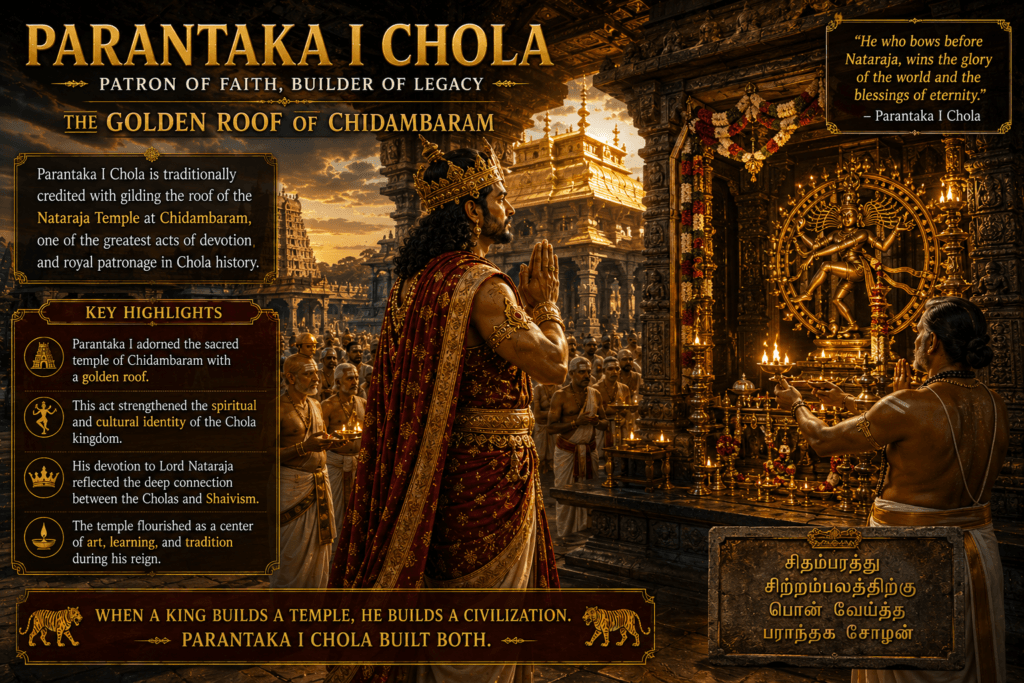
The political meaning of Parantaka I’s temple patronage operated on several levels simultaneously. At the most direct level, generous temple endowments created communities of beneficiaries: priests, musicians, artisans, and administrators whose livelihoods depended on royal generosity and who therefore had practical reasons to support the continuation of royal authority. At a broader level, royal temple patronage constructed a public narrative of divinely sanctioned kingship, the Chola ruler as the earthly guardian of the sacred landscape of Shaivite Tamil civilization.
This narrative became increasingly important as the Chola kingdom expanded beyond its Kaveri delta heartland into territories where the dynasty had no ancient roots. In the Pandya south, in Tondaimandalam, in the former Pallava territories, the Chola king’s claim to legitimate authority rested more on demonstrated military power and public religious munificence than on any ancient territorial tradition. Temple patronage was a way of building that legitimacy by inscribing the royal presence into the sacred geography of newly incorporated territories.
Parantaka I’s Greatest Achievements
An evidence-based assessment of Parantaka I’s achievements requires distinguishing between those that had genuine long-term significance and those that were impressive in the short term but less durable.
The institutional development of the Chola state during his reign was, from a long-term perspective, perhaps his most significant achievement. The administrative apparatus documented in his inscriptional record the systematic land survey and management, the organized temple endowment system, and the integration of local institutions into the royal framework provided the foundations on which his successors would build the much more elaborate Chola imperial administration.
The geographical extension of Chola authority southward to Madurai and beyond, across the Palk Strait to northern Sri Lanka, established precedents for subsequent Chola rulers, demonstrating that the dynasty’s ambitions could encompass the entire Tamil-speaking world and the island immediately to its south. Even if these extensions were not permanently sustained during Parantaka I’s own reign, they established aspirational horizons that later Chola rulers would pursue with greater success.
The temple patronage tradition that Parantaka I developed, particularly the dramatic royal patronage of Chidambaram, created a model of Chola royal religious identity that his successors would elaborate into one of the most distinctive features of the imperial Chola political culture. The identification of the Chola king as the paramount patron and protector of Tamil Shaivite religious life, expressed through the royal endowment of major temples, was central to the legitimating ideology of the later imperial Chola state.
Parantaka I’s Death and Succession
Parantaka I died around 955 CE, after a reign of approximately 48 years, one of the longest in Chola dynastic history. The circumstances of his death are not described in surviving sources. He was succeeded not by a single direct heir but by a sequence of sons whose reigns collectively bridged the period between Parantaka I’s death and the accession of the great imperial Chola rulers of the late 10th century.
Gandaraditya, the first successor, reigned briefly. Arinjaya followed, also for a short period. Sundara Chola (Parantaka II) then ruled for a more substantial period and is associated with some recovery of Chola military fortunes, including campaigns that partially addressed the northern setbacks of Takkolam. It was Sundara Chola’s son Aditya II Karikala (who predeceased his father) and then his other son Rajaraja I who would eventually bring the Chola dynasty to the imperial heights that have made it famous in world history.
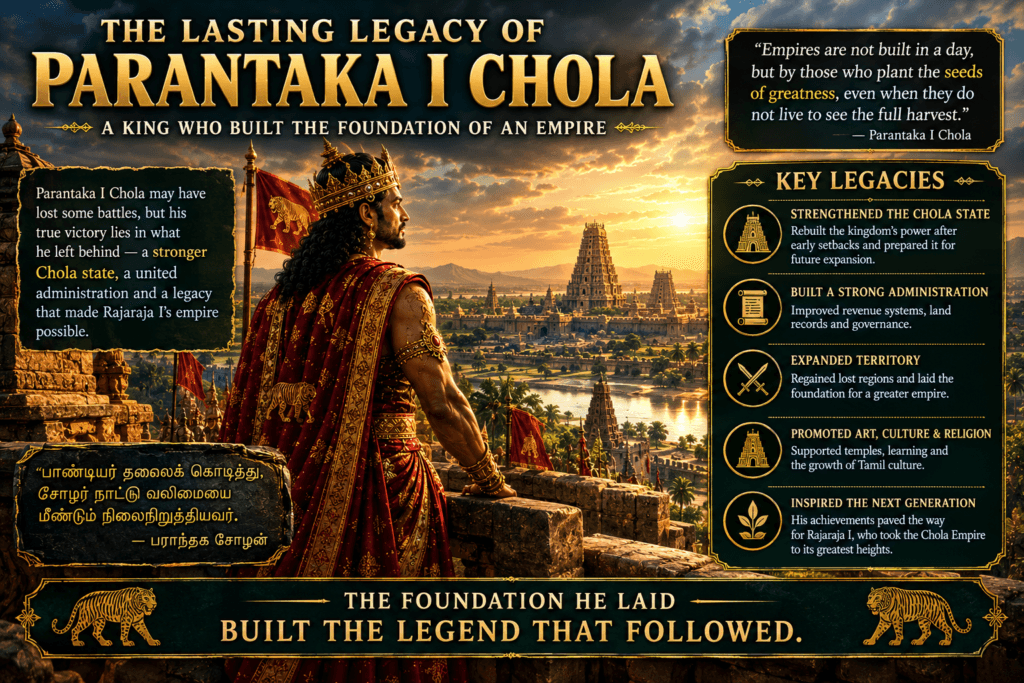
The political continuity across this complex succession sequence the Chola dynasty survived the challenges of Takkolam and the disrupted succession without losing its essential political coherence speaks to the institutional foundations that Parantaka I had helped to build during his long reign. A dynasty that can sustain a difficult period of military setback and leadership transition without fragmenting has achieved a degree of institutional maturity that is not guaranteed and not trivial.
How Parantaka I Prepared the Ground for the Later Chola Empire
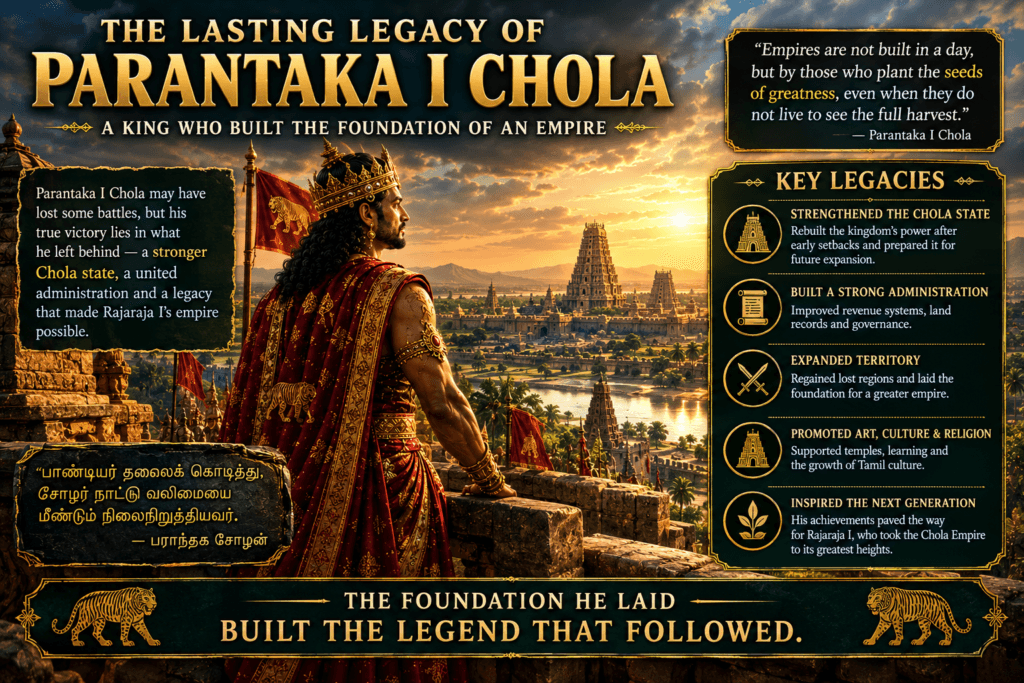
The chain from Vijayalaya to Aditya I to Parantaka I to the later imperial Cholas is one of the clearest examples of multi-generational dynastic development in South Asian history. Each generation built on the previous one, and Parantaka I’s contribution to this chain was substantial even where its specific achievements were subsequently eclipsed by his successors’ greater accomplishments.
Vijayalaya established the base: the Kaveri delta, the Chola name, the foundational political institution. Aditya I established the scale: the northward expansion, the Pallava defeat, the emergence of a kingdom capable of competing with major South Indian powers. Parantaka I established the imperial horizon: the first genuine attempt to project Chola authority across the entire Tamil world, the institutional development of an administrative system capable of managing a geographically diverse empire, the elaboration of a royal religious identity centered on Shaivite temple patronage that could serve as the ideological foundation of imperial authority.
Rajaraja I and Rajendra I would build on all of this. The Brihadeeswara Temple, the systematic land surveys, the mature administrative apparatus, the naval expeditions all of these drew on foundations that Parantaka I had helped to construct. The incomplete projects of his reign the Sri Lankan campaign that did not produce permanent administration, the southern expansion that was not fully consolidated, the northern recovery that was disrupted by Takkolam became the unfinished business that his successors would eventually complete.
Author’s Perspective
Parantaka I presents the historian with a case study in the relationship between ambition and sustainability, perhaps the central challenge for any expanding political power in any period. The Chola dynasty under his rule achieved things that would have seemed extraordinary from the perspective of his grandfather Vijayalaya: the capture of Madurai, military engagement with Sri Lanka, the assertion of Chola authority across virtually the entire Tamil-speaking world. These achievements were real. They also proved, in several respects, to exceed the administrative and military capacity of the Chola state to sustain them.
The Battle of Takkolam is historically instructive precisely because it was a defeat. History has a tendency to present successful dynasties as unbroken sequences of triumph, eliding the setbacks and failures that were as much a part of their story as their victories. Takkolam reminds us that the Chola imperial project was not inevitable; that it faced genuine challenges from powers capable of defeating Chola armies, and that the ultimate success of the imperial Chola state required not just military ambition but also the capacity to absorb setbacks, adjust strategies, and maintain political coherence through difficult periods.
Parantaka I managed that, to his credit. His reign did not end in dynastic collapse. The Chola state survived his defeats as well as his victories, and it continued to develop the institutional foundations that would eventually support his successors’ more durable achievements. Transitional rulers those who expand inherited foundations and create new possibilities without fully realizing them rarely receive the recognition they deserve in historical memory. Parantaka I is a case in point.
15 Lesser-Known Facts About Parantaka I Chola
- The administrative innovations associated with Parantaka I’s reign, particularly in the organization of land revenue and temple endowment, influenced the later Chola administrative system that has been extensively studied by historians, including Noboru Karashima.
- Parantaka I’s reign of approximately 48 years was one of the longest in the entire Chola dynasty, outlasting many of his contemporaries among South Indian rulers.
- His title ‘Maduraikonda ‘- He Who Took Madurai became his defining royal epithet, appearing consistently in inscriptions and establishing the Pandya campaign as his most celebrated achievement even during his own lifetime.
- The sheathing of the Chidambaram Nataraja temple towers in gold, one of the most spectacular acts of royal religious patronage in the Chola record, is associated with Parantaka I’s reign in later tradition.
- Rajaditya Chola, the heir-apparent who died at Takkolam, was later commemorated in Tamil literary tradition in ways that suggest his death was experienced as a significant cultural as well as political loss.
- The Battle of Takkolam is one of the few Chola military defeats that is explicitly acknowledged in the historical record, a reminder that the Chola imperial story involved setbacks as well as triumphs.
- Krishna III of the Rashtrakuta dynasty, the king who defeated the Cholas at Takkolam, is considered one of the most capable Rashtrakuta rulers, making the defeat somewhat less extraordinary than it might otherwise appear.
- Parantaka I’s land grant records are substantially richer than those of his predecessors, providing historians with considerably more detailed evidence about 10th-century Chola administration, agriculture, and temple organization than is available for earlier reigns.
- The Sri Lankan campaign of Parantaka I’s reign established an important precedent; it was the first documented Chola military engagement with the island that would be conquered comprehensively by Rajaraja I several decades later.
- The Pandya kingdom that Parantaka I temporarily subdued was not destroyed; it reasserted itself and remained a persistent challenge to Chola southern ambitions throughout the imperial period.
- Parantaka I was succeeded not by a single direct heir but by a sequence of sons, Gandaraditya, Arinjaya, and Sundara Chola, whose reigns collectively bridge the period between his death and the accession of Rajaraja I.
- The inscriptional evidence from Parantaka I’s reign is geographically distributed across both the Kaveri delta heartland and the former Pallava territories of Tondaimandalam, suggesting a more comprehensive administrative reach than his predecessors had achieved.
- Parantaka I’s reign was roughly contemporary with the reigns of Otto I (the Great) of the Holy Roman Empire, a useful reminder of the global historical context within which the Chola imperial project was developing.
- The political geography of South India at the end of Parantaka I’s reign, with Chola power reduced from its peak but still substantial, provided the foundation from which his successors, particularly Sundara Chola and then Rajaraja I, would rebuild and extend Chola authority.
- The title ‘Viranarayana’ borne by Parantaka I in some inscriptions reflects Vaishnava as well as Shaivite religious associations, a reminder that even a dynasty primarily identified with Shaivism maintained broader religious connections.
Conclusion: Ambition, Achievement, and the Limits of Power
Parantaka I Chola inherited a revived and strengthened Chola kingdom and transformed it into something considerably larger: a political entity whose military reach extended across the entire Tamil-speaking world and whose administrative apparatus was becoming sufficiently sophisticated to manage that expanded territory. He earned his famous title ‘Maduraikonda’ through the capture of one of the ancient world’s most celebrated cities. He established the precedent for Sri Lankan engagement that his successors would pursue more completely. He elaborated the Chola tradition of royal temple patronage into a more systematized and politically potent institution than his predecessors had created.
He also faced, in the later decades of his reign, the political and military consequences of having expanded faster than his kingdom’s administrative capacity could fully consolidate. The Battle of Takkolam and the death of Rajaditya were the sharpest expressions of this challenge, the moment when the limits of rapid expansion became visible in the most painful possible way. The Chola kingdom survived this setback, and the institutional foundations Parantaka I had built were robust enough to sustain the dynasty through the complex succession period that followed his death.
The later imperial Chola state the civilization that built the Brihadeeswara Temple, sent fleets to Southeast Asia, and received ambassadors from Song Dynasty China was built on foundations that Parantaka I helped to lay. His ambition opened horizons that his successors would eventually reach. His setbacks taught lessons about sustainability that the imperial Chola state would eventually learn. Both the achievements and the limitations of his reign were, in their different ways, essential contributions to the story of one of medieval Asia’s greatest civilizations.
Written & Researched by Abhishek Chavan — HistoryVerse7| © 2026 HistoryVerse7 | Cluster Article: Parantaka I Chola
References and Further Reading
Historical research based on inscriptions, archaeological evidence, academic scholarship, and established historical sources including K.A. Nilakanta Sastri, Noboru Karashima, Burton Stein, Upinder Singh, and the Archaeological Survey of India South Indian Inscriptions series.
- Tiruvalangadu Copper Plates — Epigraphia Indica Vol. III. Archaeological Survey of India.
- Nilakanta Sastri, K.A. — The Colas (2 vols). University of Madras, 1935 (revised 1955). [Primary scholarly authority on Chola history]
- Nilakanta Sastri, K.A. — A History of South India. Oxford University Press, 1955.
- Karashima, Noboru — A Concise History of South India. Oxford University Press, 2014.
- Stein, Burton — Peasant State and Society in Medieval South India. Oxford University Press, 1980.
- Singh, Upinder — A History of Ancient and Early Medieval India. Pearson Education, 2008.
- Champakalakshmi, R. — Trade, Ideology and Urbanization: South India 300 BC to AD 1300. Oxford University Press, 1996.
- Archaeological Survey of India — South Indian Inscriptions series. asi. nic.in
- Epigraphia Indica — Multiple volumes. Archaeological Survey of India.
FAQ — Parantaka I Chola
Q1: Who was Parantaka I Chola?
Parantaka I Chola was the son and successor of Aditya I Chola, ruling approximately from 907 to 955 CE. His reign of about 48 years was one of the longest in Chola history, marked by dramatic southward expansion including the capture of Madurai, a Sri Lankan campaign, and later the significant defeat at the Battle of Takkolam.
Q2: What does ‘Maduraikonda’ mean?
‘Maduraikonda’ means ‘He who took Madurai’ in Tamil. It was the royal title earned by Parantaka I following his capture of Madurai, the ancient Pandya capital, and became his most consistently used royal epithet throughout his reign.
Q3: What was the Battle of Takkolam?
The Battle of Takkolam, fought around 949 CE in the northern Tamil country, was a major defeat for the Chola forces by the Rashtrakuta king Krishna III. The Chola heir-apparent Rajaditya was killed in the battle. The defeat resulted in the loss of northern territories that Aditya I had acquired following the defeat of the Pallavas.
Q4: What were Parantaka I’s greatest achievements?
His most significant achievements included: the capture of Madurai and assertion of Chola authority across southern Tamilakam; the institutional development of the Chola administrative system; the elaboration of temple patronage as a political instrument (particularly at Chidambaram); and the establishment of precedents for Sri Lankan engagement that his successors would pursue more completely.
Q10: How did Parantaka I influence Rajaraja Chola I?
Parantaka I was Rajaraja I’s great-uncle rather than direct grandfather — the succession passed through several intermediate kings. But institutionally, the administrative systems Parantaka I developed, the geographical horizons his campaigns established, and the temple patronage traditions he elaborated all contributed to the imperial Chola state that Rajaraja I inherited and built upon.
Share this content: