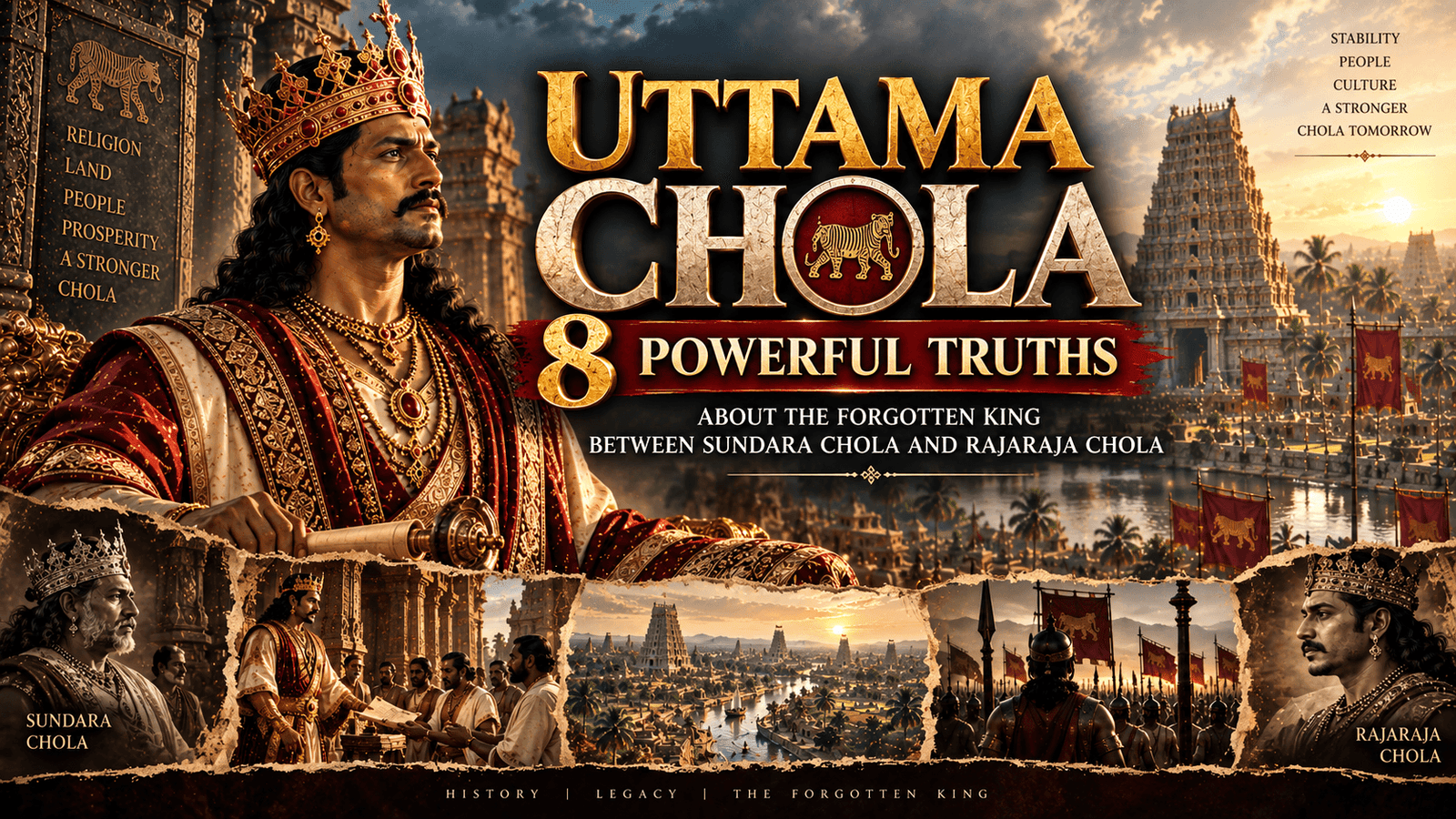
Uttama Chola: 8 Powerful Truths About the Forgotten King Between Sundara Chola and Rajaraja Chola
Uttama Chola: The Overlooked King Who Preserved Chola Power Before the Rise of Rajaraja I The history of the Cholas is often dominated by the achievements of Rajaraja I and Rajendra I. But between the difficult final years of Parantaka I and the beginning of the great imperial age, the Chola dynasty passed through a…
Uttama Chola
Uttama Chola: The Forgotten King Who Stood Between Sundara Chola and Rajaraja Chola
HistoryVerse7.com | Cluster Article:Uttama Chola| International English Edition
In the long story of the Chola dynasty, some reigns define epochs and some reigns connect them. Rajaraja Chola I belongs to the first category; his name is synonymous with the Brihadeeswara Temple, with systematic imperial administration, with Chola power at its most visible and most celebrated. The king who preceded him, Uttama Chola, belongs to the second. He ruled for approximately sixteen years between roughly 969 and 985 CE, inheriting a kingdom still recovering from the political turbulence of the late Sundara Chola period, and bequeathing to his successor a throne stable enough to launch one of the most ambitious imperial programmes in medieval South Asian history.
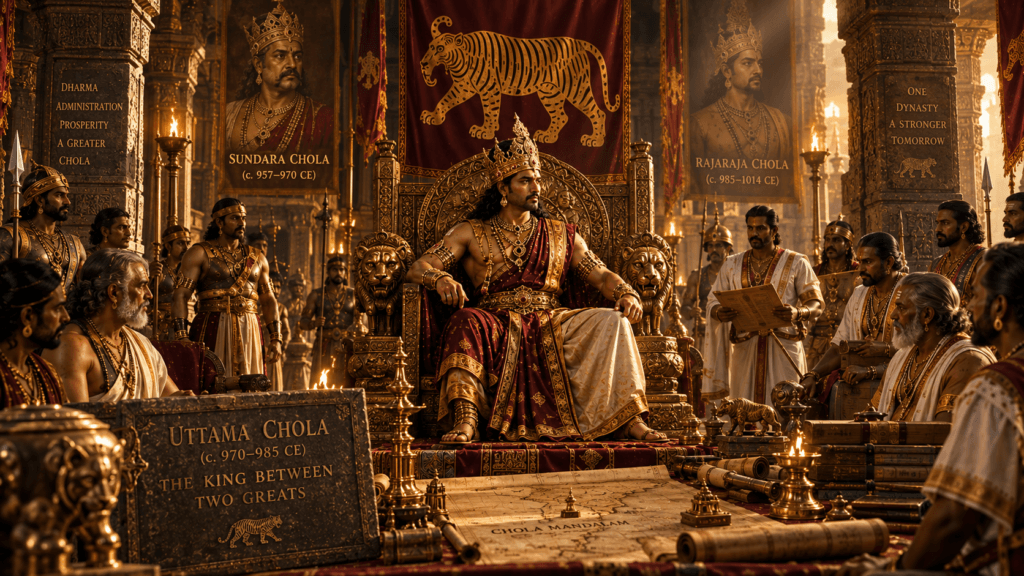
The historical question worth asking about Uttama Chola is not whether he matched Rajaraja’s achievements; he did not, and no one suggests he did. The question is whether his reign provided the political continuity, institutional stability, and dynastic coherence that made Rajaraja’s subsequent achievements possible. That is a harder question to answer, and a more interesting one. It requires looking at Uttama Chola as a historical figure in his own right rather than simply as the penultimate entry in a list of kings leading up to a more famous name.
His story also touches on one of the more contested questions in Chola dynastic history: the nature of the succession after Sundara Chola and the relationship between Uttama Chola and the young Arulmozhivarman, the prince who would become Rajaraja I. Whether that relationship was cooperative, competitive, or something more complex is a question the evidence does not resolve with complete clarity, and honest historical analysis requires holding that ambiguity rather than resolving it with a convenient narrative.
Who Was Uttama Chola?
Uttama Chola, also known as Madhurantaka and sometimes identified in inscriptions as Madhurantaka Uttama Chola, was a member of the Chola royal family who became king after the death of Sundara Chola (also known as Parantaka II) around 969 CE. His precise birth date is unknown, as is typical for figures of this period in medieval South Indian history. The inscriptional record establishes his dynastic position and the approximate duration of his reign.
His relationship to the main Chola dynastic line requires careful explanation. Uttama Chola was the son of Gandaraditya, one of the sons of Parantaka II, who had briefly occupied the Chola throne in the mid-10th century, making him a cousin rather than a son of Sundara Chola. This cousinly relationship is central to understanding the succession controversy that some historians have attached to his accession, and it distinguishes him from the sons of Sundara Chola, Aditya Karikala and Arulmozhivarman, who were also potential claimants to the throne.
His name ‘Madhurantaka,’ meaning ‘Destroyer of Mathura’ in Sanskrit, a royal epithet with epic resonances, appears in inscriptions and suggests the martial and royal aspirations that medieval South Indian rulers expressed through their titles. ‘Uttama’ means ‘excellent’ or ‘highest,’ again a conventional epithet of royal self-presentation. These names and titles tell us something about how Uttama Chola wished to present his authority; they tell us rather less about what that authority actually consisted of in practice.
K.A. Nilakanta Sastri’s account in ‘The Colas’ gives Uttama Chola a relatively brief treatment; his reign was not marked by the kind of dramatic military or architectural achievements that generated rich inscriptional records, and historians working primarily from that inscriptional record have less material to work with than for the reigns of Parantaka I or Rajaraja I. This relative thinness of the inscriptional record has contributed to Uttama Chola’s historical obscurity without necessarily reflecting the actual significance of his reign.
The Chola Dynasty Before Uttama Chola
Vijayalaya Chola and the Chola Revival
The Chola dynasty’s imperial story began with Vijayalaya Chola’s capture of Thanjavur around 848 CE, the foundational act that reestablished Chola political authority in the Kaveri delta after generations of eclipse under Pallava overlordship. Vijayalaya’s seizure of the delta heartland created the territorial and agricultural base on which all subsequent Chola development would rest.
Aditya I and Early Expansion
Aditya I expanded that base dramatically by defeating the last significant Pallava king Aparajita around 890 CE and absorbing the northern Tamil country Tondaimandalam into the Chola sphere. The Chola kingdom had, within two generations, transformed from a delta chieftaincy into a major regional power capable of defeating one of South India’s oldest dynasties.
Parantaka I and the Takkolam Crisis
Parantaka I’s long reign (c. 907–955 CE) pushed Chola ambitions further still southward to Madurai and across the Palk Strait toward Sri Lanka before the catastrophic defeat at the Battle of Takkolam around 949 CE contracted the dynasty’s northern reach and killed the heir-apparent Rajaditya. The succession that followed Parantaka I’s death involved multiple shorter reigns: Gandaraditya, Arinjaya, and then Sundara Chola, which represented the Chola dynasty navigating a period of internal adjustment and external challenge.
Sundara Chola’s Reign
Sundara Chola (also known as Parantaka I) ruled from approximately 956 to 969 CE. His reign saw some recovery from the Takkolam setback, including campaigns that reasserted Chola authority in the north. He was the father of two princes whose fates would have significant implications for the succession question that defined the beginning of Uttama Chola’s reign: Aditya Karikala and Arulmozhivarman (the future Rajaraja I). Sundara Chola’s death, the circumstances of which are not fully clear from the available evidence, triggered the succession that brought Uttama Chola to the throne rather than either of Sundara Chola’s own sons.
How Uttama Chola Became King
The succession after Sundara Chola is among the more complex and debated episodes in early Chola dynastic history. The basic facts, as established by the inscriptional record, are these: Sundara Chola died around 969 CE; Uttama Chola, a cousin rather than a son of Sundara Chola, then ruled; and Rajaraja Chola I Arulmozhivarman, son of Sundara Chola, succeeded Uttama Chola around 985 CE.
Why Uttama Chola became king rather than either of Sundara Chola’s sons is a question with multiple possible answers, none of which can be established with certainty from the surviving evidence. The most straightforward explanation, and one that does not require positing dramatic political conflict, is that Sundara Chola’s sons were simply too young at the time of their father’s death to assume effective royal authority, and Uttama Chola, as the next senior member of the Chola royal family, was the appropriate person to hold the throne until a suitable successor from the next generation was ready.
Aditya Karikala, Sundara Chola’s elder son, died before his father, an event that itself complicated the succession picture. His death, which some later sources connect to political violence in ways that remain unverified, removed one potential successor from the equation. Arulmozhivarman, the younger son who would become Rajaraja I, was apparently too young for independent rule at the time of Sundara Chola’s death, making Uttama Chola’s interim reign at least partially explicable in straightforward dynastic terms.
This is not the only interpretation available. Some later literary and traditional sources suggest a more contested succession, with Uttama Chola’s accession framed in terms that imply political maneuvering or worse. These sources deserve analysis, but they also deserve critical scrutiny; they were composed after Rajaraja I’s reign, which gave their authors reasons to frame the preceding succession in ways favorable to the dynasty’s narrative of Rajaraja as the legitimate and destined inheritor of Chola imperial authority.
The Succession After Sundara Chola
Dynastic succession in medieval South India was not governed by simple primogeniture in the way that some European medieval systems were. The Chola royal family was large, with multiple lines descending from Parantaka I’s many sons, and the specific dynamics of succession at any given moment reflected the age, capability, and political position of the available candidates as much as any fixed rule.
The succession from Sundara Chola to Uttama Chola fits a pattern that appears elsewhere in Chola dynastic history: a lateral move to a senior cousin or uncle when direct heirs were unavailable, too young, or otherwise unable to assume the throne. Gandaraditya’s succession to Parantaka I (followed by Arinjaya’s brief reign and then Sundara Chola’s) had already established that the Chola throne could move laterally within the royal family rather than strictly vertically from father to son.
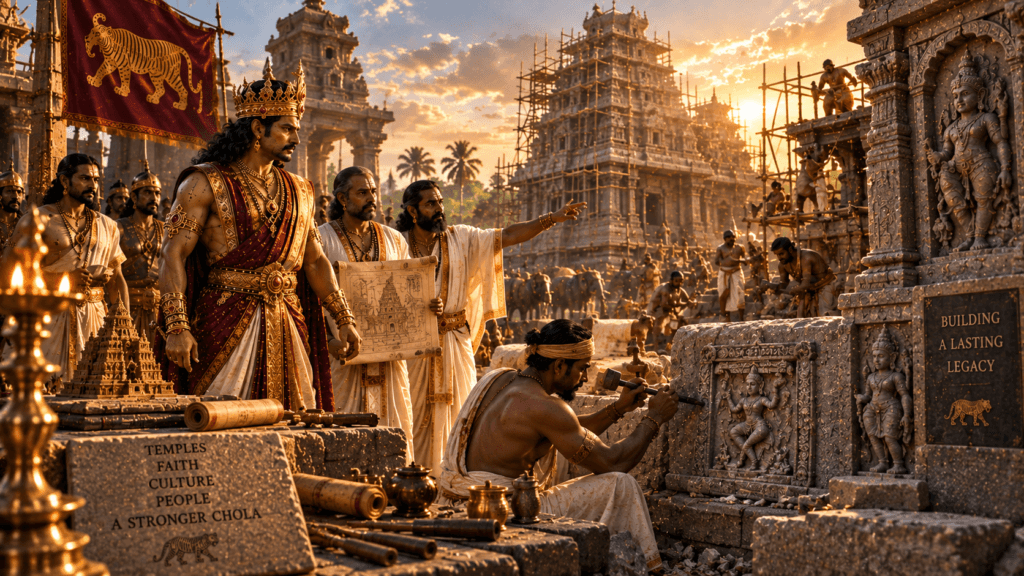
What the inscriptional evidence does not establish is any overt conflict at the succession. The transition from Sundara Chola to Uttama Chola is documented in inscriptions that treat Uttama Chola as the legitimate king without the kind of defensive or explanatory language that might suggest a contested or irregular accession. This absence of conflict in the contemporary record is not conclusive; inscriptions were royal documents that would not typically record dynastic disputes even when they existed, but it is worth noting when evaluating the more dramatic later narratives.
The political landscape Uttama Chola inherited included a kingdom that had recovered substantially from the Takkolam crisis but was still navigating the adjustment of managing a large territorial domain with varying degrees of effective central control. The administrative systems developed under his predecessors the organized land revenue management, the systematic temple endowment networks, and the hierarchy of local institutions provided the framework within which his government would operate.
Uttama Chola and Rajaraja Chola I
The relationship between Uttama Chola and Arulmozhivarman, the prince who would become Rajaraja I, is the aspect of Uttama’s reign that has attracted the most historical and popular attention, and it is also the aspect where the evidence is most limited and the interpretive tradition most colored by later perspectives.
What the inscriptional evidence establishes is relatively modest: Arulmozhivarman was a Chola prince of the royal family during Uttama Chola’s reign; he held positions of some prominence (later inscriptions of his own reign reference his activities during this period); and he eventually succeeded Uttama Chola as king around 985 CE. Whether this succession was smooth, whether it was anticipated and planned within the royal family, or whether it involved any form of political conflict is not established by direct contemporary evidence.
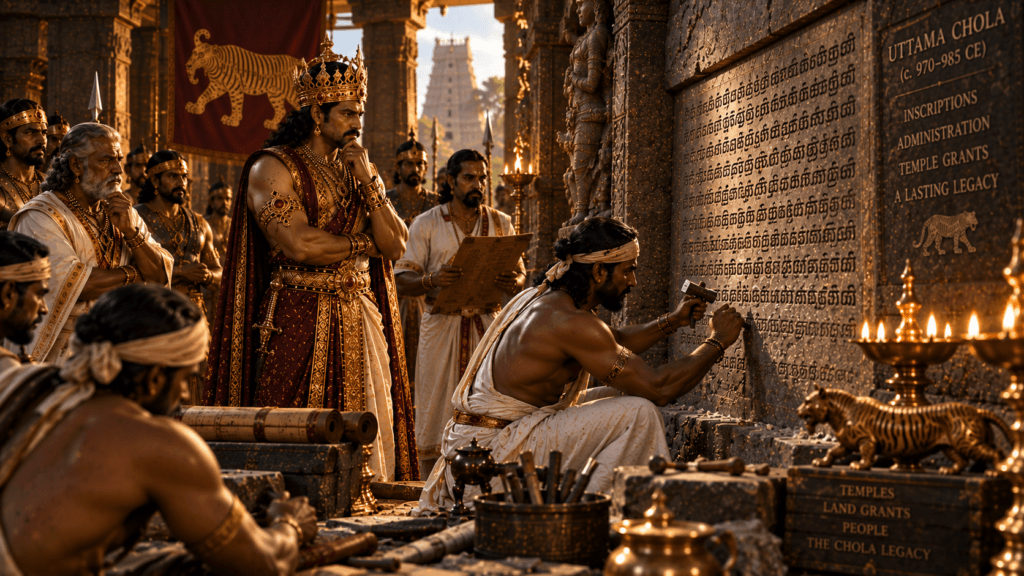
The later tradition developed in inscriptions, and literary texts produced during and after Rajaraja I’s own reign present Arulmozhivarman as a prince of exceptional capability who was in some sense destined for imperial greatness. This narrative naturally frames Uttama Chola’s reign as a period during which the eventual greatness of Rajaraja I was developing but not yet fully expressed. It is a narrative that serves Rajaraja’s political legacy; whether it accurately reflects the political dynamics of Uttama Chola’s reign is a different question.
There are traditions not established by contemporary inscriptions that suggest Arulmozhivarman was involved in military and political activities during Uttama Chola’s reign that prefigured his later imperial projects. Sri Lankan sources, which sometimes provide perspectives on Chola history different from those available in Tamil Nadu inscriptions, contain references to Chola military activity in the island during this period that some historians have associated with Arulmozhivarman’s activities. The interpretation of this evidence is contested, and conclusions based on it should be held tentatively.
What can be said with reasonable confidence is that the Chola royal family during Uttama Chola’s reign was not a static institution; the princes of the next generation were active participants in Chola political and military life, developing the capabilities and the networks that would define their future reigns. Uttama Chola’s role in this process may have been more important than his historical reputation suggests, even if the specifics cannot be recovered from the available evidence.
Was Uttama Chola a Usurper?
The question of whether Uttama Chola was a usurper in the sense of having illegitimately displaced Sundara Chola’s rightful heirs has generated more historical discussion than the surviving evidence strictly supports. It is a question worth examining seriously, because the answer (or the acknowledgment that the answer is uncertain) shapes how we understand his reign and its relationship to the imperial Chola state that followed.
The case for calling him a usurper rests primarily on the following observations: he was not the son of the previous king; Sundara Chola had sons who might have been expected to succeed; the elder son Aditya Karikala died under circumstances that some sources connect to political violence; and later literary tradition sometimes depicts the succession in ways that imply irregularity. These observations are real, but they are not, individually or collectively, sufficient to establish usurpation in any strict historical sense.
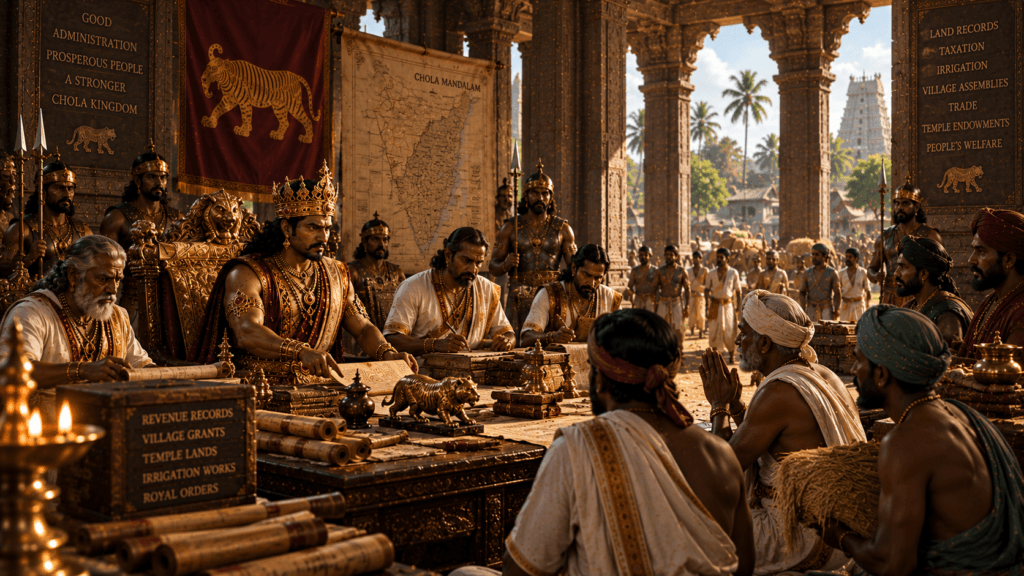
The case against the usurper narrative is also substantial. The Chola succession had moved laterally before without being described as usurpation. The youth of Arulmozhivarman at Sundara Chola’s death provides a straightforward non-conspiratorial explanation for Uttama Chola’s accession. The contemporary inscriptional record does not describe Uttama Chola’s accession in terms suggesting illegitimacy. And the transition from Uttama Chola to Rajaraja I was apparently smooth; if Uttama Chola had been a usurper who had displaced Rajaraja’s legitimate claim, the transition back to the Sundara Chola line might have been expected to generate more friction than the evidence suggests it did.
K.A. Nilakanta Sastri, reviewing the available evidence, did not endorse a usurpation narrative for Uttama Chola’s accession. More recent scholars, including Noboru Karashima, have emphasized the need to distinguish carefully between what contemporary inscriptions establish and what later literary tradition has constructed. The honest historical assessment is that Uttama Chola’s accession was unusual in its lateral character, that the death of Aditya Karikala created circumstances favorable to his accession, and that the specific nature of the dynastic politics surrounding these events cannot be recovered with confidence from the surviving evidence.
Uttama Chola’s Reign and Political Stability
Whatever the complexities of how Uttama Chola became king, his reign of approximately sixteen years appears to have been a period of relative political stability for the Chola kingdom, a stability that was not inevitable given the dynastic turbulence of the preceding decades and that had real value for the institutional development of the Chola state.
The inscriptional record from Uttama Chola’s reign, while not as abundant as for the reigns of Parantaka I or Rajaraja I, shows a functioning royal administration issuing land grants, maintaining temple endowments, and conducting the routine business of a significant South Indian kingdom. There is no inscriptional evidence of serious internal revolts, major territorial losses, or political fragmentation during his reign negative evidence, to be sure, but meaningful in its way.
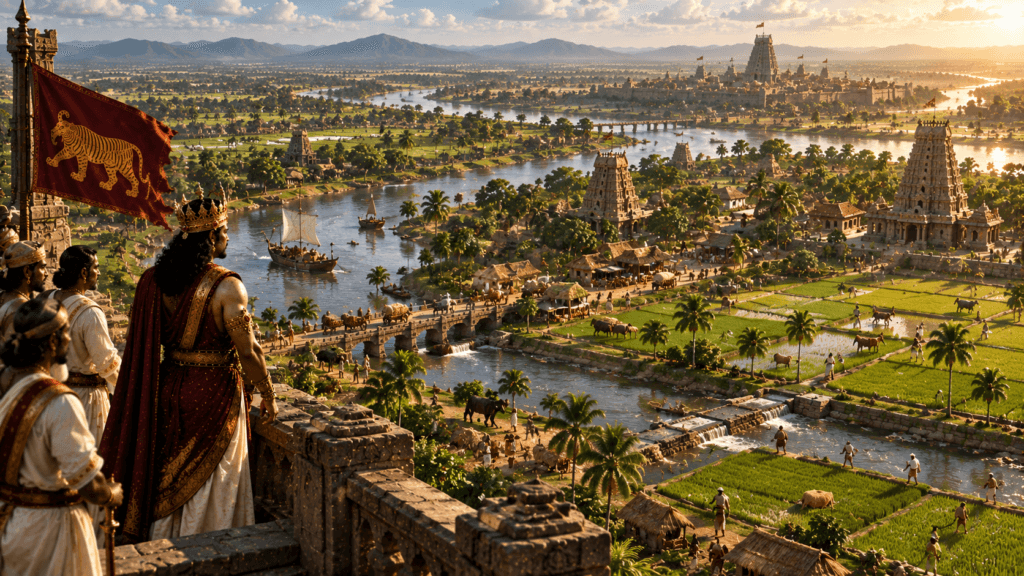
The territorial extent of the Chola kingdom under Uttama Chola is not precisely recoverable from the available evidence. The kingdom that Sundara Chola had managed was reduced from the peak of Parantaka I’s expansion but still covering the Kaveri delta, Tondaimandalam, and significant southern territories was apparently maintained through his reign. The administrative systems developed over the preceding century continued to function, and the patterns of royal patronage and temple endowment that had become central to Chola political culture were sustained.
Relations with neighboring powers during Uttama Chola’s reign are not well documented. The Pandya kingdom to the south, the western coastal states, and the powers to the north continued to be factors in the regional political landscape, but there is no evidence of the kind of major military confrontations that had characterized the reigns of Parantaka I, or that would define the early campaigns of Rajaraja I. This relative quiescence, if that is what it was, may reflect successful diplomacy, a deterrent military posture, or simply the absence of immediate threats serious enough to generate the inscriptional records that survive.
Military Affairs Under Uttama Chola
The military record of Uttama Chola’s reign is, by the standards of the broader Chola imperial tradition, relatively sparse. There are no campaigns credited to his reign that match the scale or significance of Parantaka I’s Pandya campaign or Rajaraja I’s conquest of Sri Lanka and northward expansion. Whether this reflects actual military quiescence or simply a failure of the historical record to preserve relevant evidence is genuinely uncertain.
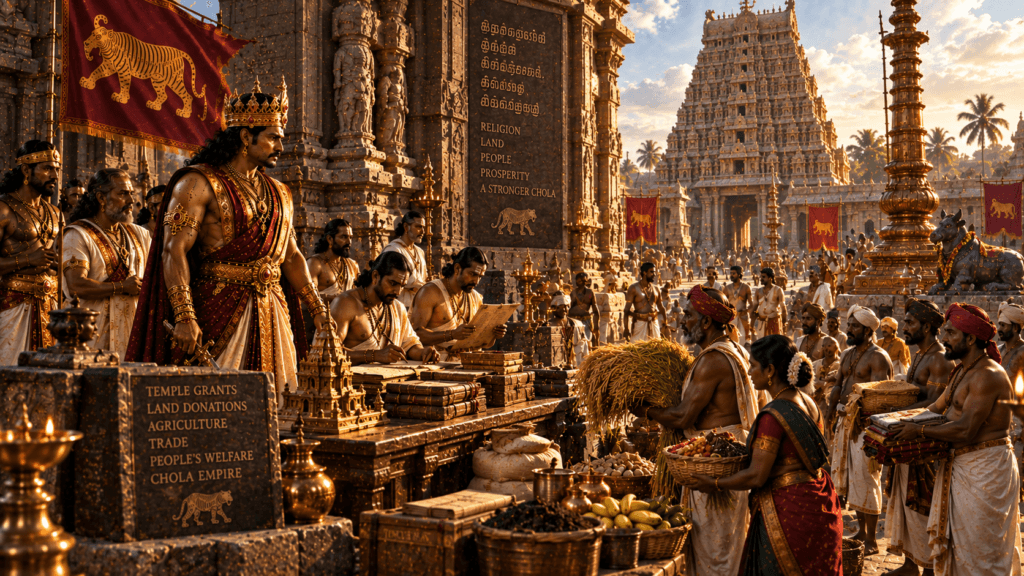
The Chola military institution the professional forces, the feudatory contributions, the organizational structures that had been developing since Vijayalaya’s time continued to exist and function during Uttama Chola’s reign. The infrastructure of military power that Rajaraja I would later deploy for his ambitious campaigns was not created from scratch by Rajaraja; it was inherited from and maintained through the preceding period, including Uttama Chola’s reign.
Some historians have associated military activity in Sri Lanka during the period of Uttama Chola’s reign with Arulmozhivarman rather than with Uttama Chola himself, an interpretation that, if correct, would suggest that the prince who became Rajaraja I was already developing his military capabilities and his understanding of the Sri Lankan theatre during Uttama Chola’s reign. This interpretation is based primarily on Sri Lankan chronicles and later Chola tradition rather than contemporary Tamil inscriptions, and it should be treated as suggestive rather than established.
The absence of major military campaigns documented in Uttama Chola’s inscriptions should not be automatically interpreted as weakness or passivity. A period of military consolidation following the turbulence of the Takkolam crisis and the subsequent succession complexities may have been precisely what the Chola kingdom needed before the ambitious expansion programmes of Rajaraja I could be successfully launched.
Administration Under Uttama Chola
The administrative record of Uttama Chola’s reign, while less rich than for Rajaraja I’s systematic surveys and reorganizations, shows a kingdom conducting the routine business of medieval South Indian governance with apparent continuity from preceding reigns. Land grants in Uttama Chola’s name have been identified in the inscriptional corpus, though they are fewer than for kings with longer or more administratively intensive reigns.
The land grant records from his reign follow the established Chola pattern of documenting agricultural land in specific detail: its extent, its water sources, its revenue obligations in ways that show administrative continuity from the patterns established under Parantaka I. The local institutions that managed agricultural land and temple affairs the village assemblies, the merchant communities, the temple managing bodies continued to operate within the framework that earlier Chola rulers had developed.
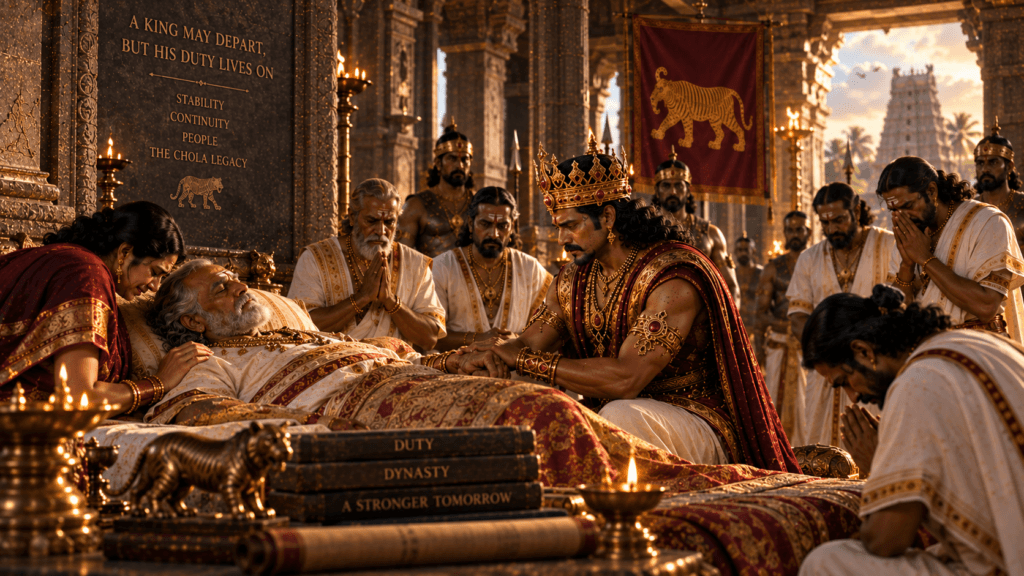
Temple administration, which was becoming an increasingly important element of Chola governance, continued to develop during Uttama Chola’s reign. The network of endowed temples throughout the Chola territories maintained their administrative and economic functions, continuing to serve as local institutions of social welfare, cultural production, and economic management. The inscriptions associated with these temples from Uttama Chola’s period provide some of the most specific evidence available about his reign’s administrative character.
Officials and administrators whose careers spanned the reigns of Sundara Chola, Uttama Chola, and Rajaraja I provided an important element of institutional continuity. In a pre-modern state, the continuity of experienced administrative personnel across royal transitions was often more important for governmental effectiveness than the specific policies of individual kings. The available evidence suggests that Uttama Chola’s reign did not disrupt the administrative cadre in ways that would have compromised this continuity.
Uttama Chola and the Chola Economy
The economic foundations of the Chola state during Uttama Chola’s reign rested on the same agricultural base that had supported the dynasty since Vijayalaya’s time: the extraordinarily productive rice cultivation of the Kaveri delta, managed through a combination of royal investment in irrigation infrastructure and systematic land revenue administration.
The land grant records from Uttama Chola’s reign provide evidence about the agricultural economy of the Chola heartland in the late 10th century, documenting the types of land being granted, the revenue obligations associated with them, and the institutional frameworks within which agricultural production was managed. These records show an agricultural economy that was functioning within the administrative framework developed over the preceding century, without suggesting either dramatic expansion or significant contraction during this specific period.
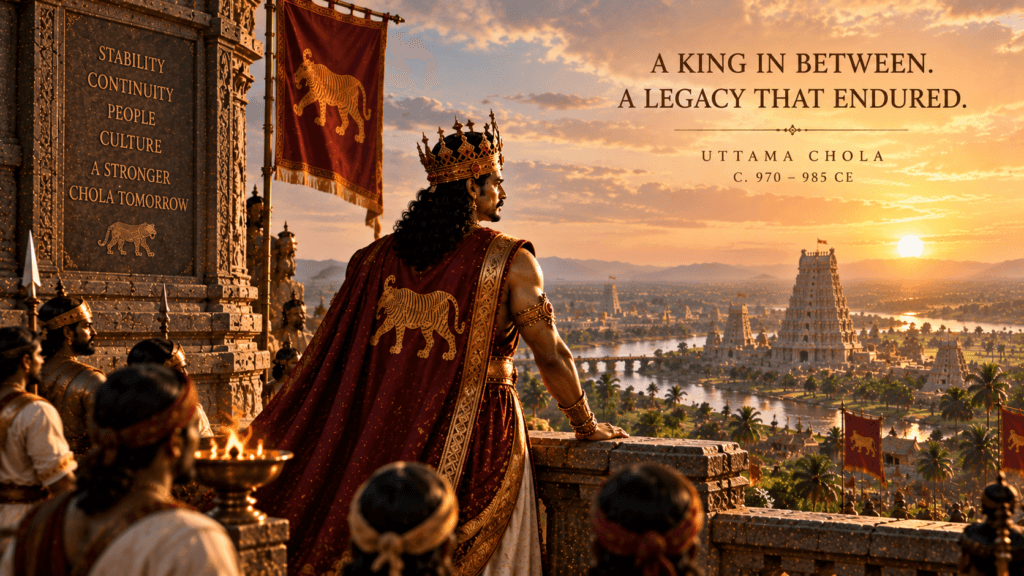
Temple economies, the economic institutions centered on endowed temples that managed significant landholdings and provided employment for substantial communities of religious and service personnel, continued to function as important local economic institutions. The temple endowments from Uttama Chola’s reign maintained the networks of economic activity associated with major temples, continuing patterns of royal investment in these institutions that had been building since the dynasty’s earliest years.
Trade and commercial activity in the Chola territories during this period is less well documented than the agricultural economy, but the commercial infrastructure the ports of the Coromandel coast, the merchant communities operating under guild organizations, and the routes connecting the Tamil interior to coastal markets continued to function. The economic base that Rajaraja I would later draw upon for his ambitious projects was being maintained and incrementally developed during Uttama Chola’s reign, even if the documentary record of that maintenance is limited.
The Later Years of Uttama Chola
The later years of Uttama Chola’s reign, roughly the decade preceding his death around 985 CE, were a period during which the prince Arulmozhivarman was presumably becoming increasingly prominent within the Chola political system. The young man who would become Rajaraja I was, by this point, reaching an age at which active participation in royal affairs and military activities would have been expected and appropriate.
Some later traditions associate significant military activities with Arulmozhivarman during this period, activities that prefigured his later imperial campaigns. The evidence for these traditions is primarily from later Chola inscriptions and Sri Lankan chronicles rather than contemporary Tamil inscriptional sources, making it difficult to determine with confidence what exactly was happening during these years and what Uttama Chola’s role in organizing or authorizing such activities may have been.
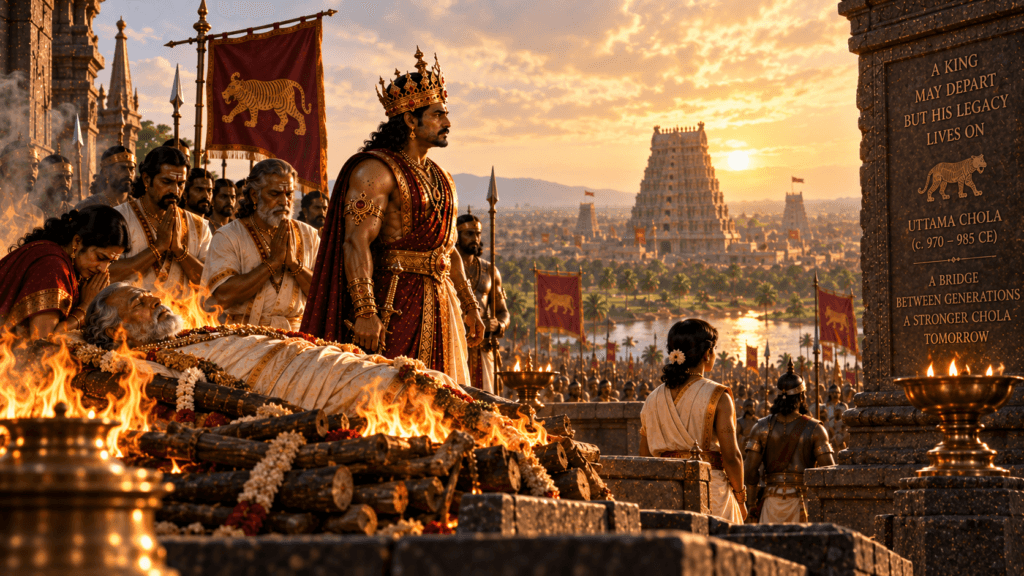
The political transition from Uttama Chola to Rajaraja I, when it came, appears to have been orderly. There is no inscriptional evidence of the kind of violent or contested succession that might have been expected if the transition involved the reversal of an earlier usurpation or the displacement of an entrenched political network. The smoothness of the transition to the extent that it is recoverable from the evidence is consistent with the interpretation that Uttama Chola’s reign was understood, within the royal family, as an interim arrangement pending the maturity of Sundara Chola’s surviving son.
The Death of Uttama Chola
Uttama Chola died around 985 CE, after a reign of approximately sixteen years. The circumstances of his death are not described in surviving sources. He was succeeded by Arulmozhivarman, who took the throne name Rajaraja Chola I, a regnal name meaning ‘King of Kings’ that announced imperial ambitions of the highest order.
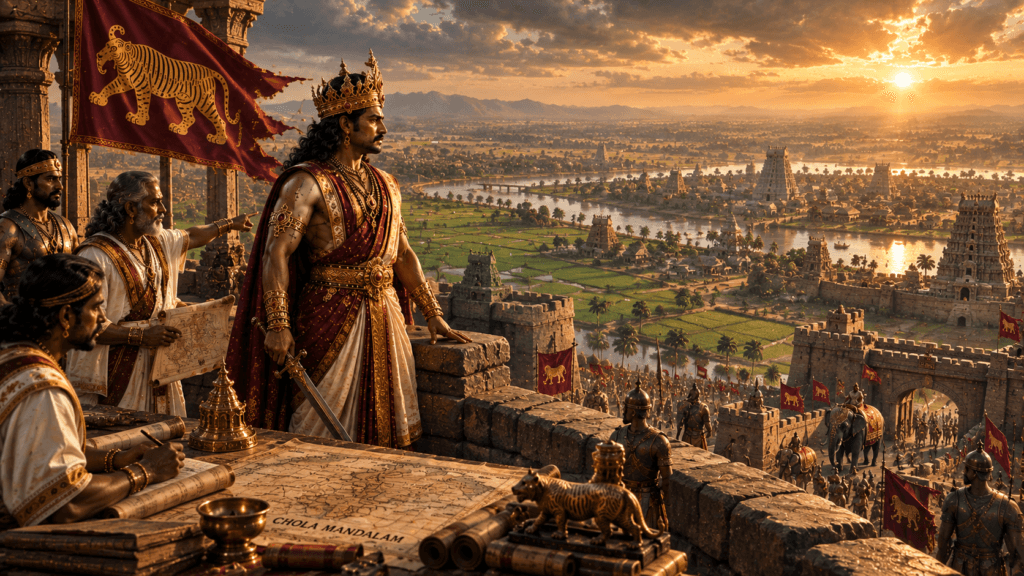
The transition from Uttama Chola to Rajaraja I marked the beginning of a new phase in Chola history: the imperial phase that would produce the Brihadeeswara Temple, the conquest of Sri Lanka, the Southeast Asian naval expedition, and the systematic administrative reorganization that K.A. Nilakanta Sastri and subsequent historians have studied in such detail. From the perspective of that imperial phase, Uttama Chola’s death is primarily significant as the event that cleared the way for Rajaraja I’s accession.
From the perspective of Uttama Chola’s own reign, his death represents the end of a period that was important in its own terms: a period of relative political stability, administrative continuity, and dynastic coherence during which the foundations for subsequent imperial development were maintained and incrementally strengthened.
Was Uttama Chola an Effective King?
Evaluating the effectiveness of a medieval ruler is always a complex undertaking, and evaluating Uttama Chola is made more complex by the thinness of the historical record and the overwhelming presence in popular and scholarly consciousness of the ruler who immediately followed him. The temptation is to judge Uttama Chola entirely by what Rajaraja I achieved, and to treat his reign as interesting primarily because of what came after. That temptation should be resisted.
Measured against the challenges he actually faced managing a complex dynastic succession, maintaining Chola institutional integrity during a period of political adjustment, and sustaining the territorial domain and administrative systems that had developed over the preceding century Uttama Chola appears to have been adequately effective. The Chola kingdom did not fragment under his rule. The institutional systems developed by his predecessors continued to function. The dynastic succession passed smoothly to the next generation.
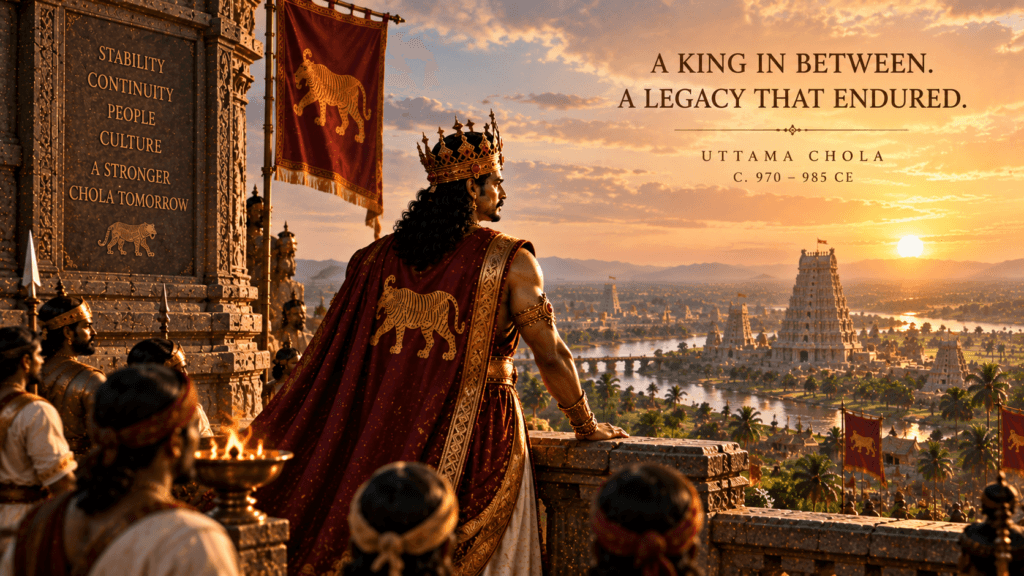
These are not the achievements that generate historical fame. They are the achievements of a ruler who did not make things worse, who maintained what he inherited and provided the stability within which more dynamic successors could operate. This is a different kind of historical importance from the importance of a Rajaraja I or a Parantaka I, but it is historical importance nonetheless.
Where Uttama Chola falls short by conventional measurements of medieval royal effectiveness is in the absence of documented military expansion and in the relatively modest inscriptional record of spectacular religious patronage. A medieval South Indian king was expected to expand his territory and to demonstrate his royal virtue through conspicuous religious munificence. Uttama Chola did neither on the scale associated with the most celebrated Chola rulers. Whether this reflects the actual character of his reign or simply the limitations of the historical record is a question that cannot be definitively answered.
Uttama Chola Timeline
| Date / Period | Event | Historical Significance |
| c. 907–955 CE | Parantaka I’s long reign; Chola expansion and Takkolam setback | Context for subsequent dynastic turbulence |
| c. 955–969 CE | Sundara Chola’s reign; partial Chola recovery | Direct predecessor; father of Rajaraja I |
| Date uncertain | Death of Aditya Karikala (Sundara Chola’s elder son) | Removes one potential successor from the equation |
| c. 969 CE | Death of Sundara Chola; Uttama Chola becomes king | Lateral succession; Arulmozhivarman apparently too young to rule |
| c. 969–985 CE | Uttama Chola’s reign | Period of relative stability; administrative continuity |
| c. 969–985 CE | Arulmozhivarman (future Rajaraja I) active as prince | Develops capabilities for later imperial role |
| c. 969–985 CE | Land grants, temple endowments documented | Administrative continuity; institutional maintenance |
| c. 985 CE | Death of Uttama Chola; Arulmozhivarman becomes Rajaraja Chola I | End of transitional reign; imperial Chola phase begins |
| 985–1014 CE | Reign of Rajaraja Chola I | Imperial Chola zenith; Brihadeeswara Temple; systematic expansion |
Uttama Chola: Evidence vs. Popular Tradition
| Claim | Available Evidence | Historical Assessment |
| Uttama Chola was a usurper who displaced Sundara Chola’s sons | Not established by contemporary inscriptions; later literary tradition ambiguous | Possible but unproven; legitimate lateral succession equally plausible |
| He reigned c. 969–985 CE (approximately 16 years) | Derived from later Chola genealogical chronologies | Approximate dates accepted; precise years uncertain |
| Aditya Karikala was killed by political enemies | Some later sources suggest political violence; no contemporary confirmation | Death established; circumstances uncertain; conspiracy unproven |
| Arulmozhivarman conducted campaigns during Uttama’s reign | Sri Lankan chronicles; later Chola tradition; no direct contemporary Tamil inscriptions | Possible; evidence from non-Tamil sources treated cautiously |
| Uttama Chola maintained Chola administrative systems effectively | Land grants and temple records from his reign exist | Administrative continuity supported by inscriptional evidence |
| The transition to Rajaraja I was smooth | No evidence of conflict at the succession | Smooth transition suggested by absence of contradictory evidence |
| His title ‘Madhurantaka’ refers to a specific military victory | Title in inscriptions without specific military context | Title’s specific referent unclear from surviving evidence |
Uttama Chola: Historical Expectations vs. Actual Reign
| Historical Expectation | Evidence | Actual Historical Situation |
| Major military campaigns expected of Chola ruler | No major campaigns documented in inscriptions | Reign appears militarily quiescent; reasons uncertain |
| Spectacular temple construction | Routine temple endowments documented; no major construction recorded | Patronage maintained but not at peak scale |
| Clear inscriptional record of achievements | Inscriptions fewer than for major reigns | Historical record limited; activities may exceed documentation |
| Smooth succession to Sundara Chola’s son | Lateral succession to cousin instead | Unusual succession; Arulmozhivarman apparently too young in 969 |
| Political stability during reign | No evidence of revolts or fragmentation | Stability appears to have been achieved and maintained |
| Transition to Rajaraja I as expected successor | Transition appears smooth; no conflict documented | Succession worked as intended within royal family framework |
8 Lesser-Known Facts About Uttama Chola
- Uttama Chola’s historical obscurity is partly an artifact of the relative abundance of historical material for the reigns immediately before and after his the richness of Sundara Chola’s political drama and Rajaraja I’s inscriptional record makes Uttama Chola’s comparatively modest legacy appear thinner than it might in a different historiographical context.
- Uttama Chola is also known as Madhurantaka, a Sanskrit title meaning ‘Destroyer of Mathura,’ though no specific military campaign against Mathura is documented in his inscriptions.
- He was the son of Gandaraditya, who had briefly occupied the Chola throne following Parantaka I’s death, making him Sundara Chola’s cousin rather than son.
- His reign of approximately sixteen years (c. 969–985 CE) was substantially shorter than those of Parantaka I (approximately 48 years) or the reign that would follow under Rajaraja I (approximately 29 years).
- The inscriptional record of Uttama Chola’s reign is notably thinner than for either the preceding or following reigns, a gap that reflects the relative modesty of documented activities rather than necessarily the actual significance of his governance.
- Aditya Karikala, Sundara Chola’s elder son who might otherwise have succeeded to the throne, died before his father, an event that materially affected the succession dynamics leading to Uttama Chola’s accession.
- Later Tamil literary tradition sometimes depicts the period of Uttama Chola’s reign in ways that emphasize the future greatness of Arulmozhivarman (Rajaraja I) rather than Uttama Chola’s own achievements, a perspective that reflects the dominance of Rajaraja I in the Chola historical tradition.
- Sri Lankan chronicles, which sometimes provide perspectives on Chola history not available in Tamil inscriptions, contain references to Chola activity during this period that historians have interpreted in different ways with respect to Uttama Chola’s role.
Myths About Uttama Chola
| Popular Claim | Historical Status | Evidence Assessment |
| Uttama Chola was definitely a usurper | Unproven; tradition only | Lateral succession has precedent; usurpation not established by contemporary evidence |
| He suppressed or imprisoned Arulmozhivarman | No contemporary evidence | Later narrative; not supported by inscriptional record |
| Aditya Karikala was assassinated on Uttama’s orders | Unverified by contemporary sources | Death established; circumstances unknown; conspiracy is tradition not evidence |
| His reign was a period of Chola decline | No inscriptional evidence of decline | Administrative continuity documented; ‘decline’ narrative unsupported |
| Rajaraja I immediately reversed Uttama’s policies | No evidence of policy reversal | Institutional continuity from Uttama to Rajaraja I better supported than discontinuity |
| Uttama Chola was universally recognized as illegitimate | Not supported by contemporary inscriptions | His inscriptions treat him as legitimate king without defensive language |
Author Perspective
The history of any successful dynasty includes figures whose importance is primarily transitional rulers who neither founded the dynasty nor brought it to its greatest achievements, but who occupied the crucial middle ground between foundation and flourishing. Uttama Chola is one such figure, and his historical situation raises questions about how we assess medieval rulers that go beyond the specific case of 10th-century South India.
The dominant tendency in popular historical writing is to organize dynastic history around its peaks: the most famous kings, the most spectacular monuments, the most dramatic military campaigns. This is understandable: peaks are interesting, visible, and memorable. But a dynasty’s peaks do not stand alone. They stand on the accumulated institutional work of preceding generations, including the generations that are now remembered primarily as the people who came before the famous ones.
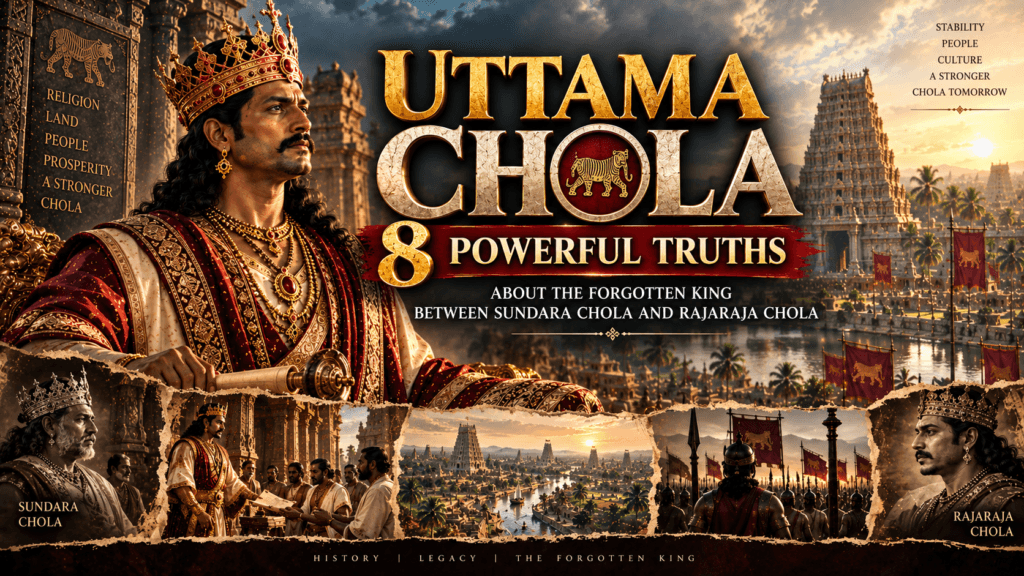
Uttama Chola’s reign presents a specific version of this challenge. The question of whether he was a usurper, whether his accession was irregular or illegitimate, has attracted attention partly because it is dramatic and partly because it connects Uttama Chola to Rajaraja I in a way that makes him interesting by association. But the more historically significant question may be the less dramatic one: how did the Chola state function during his reign, and did that functioning contribute to the conditions that made Rajaraja I’s achievements possible?
Based on the available evidence, the answer appears to be yes cautiously and tentatively yes. The Chola kingdom that Rajaraja I inherited was not in crisis. Its institutions were functioning, its administrative systems were operational, and its dynastic continuity was intact. Uttama Chola’s reign helped maintain those conditions. That is not the stuff of legendary reputation, but it is genuine historical contribution.
Conclusion: The King the Empire Needed
Uttama Chola will never occupy the same place in popular historical consciousness as Rajaraja Chola I. He built no Brihadeeswara Temple. He launched no spectacular naval expeditions. He left no inscriptional record of dramatic military victories. By the conventional measures of medieval royal achievement conquest, construction, conspicuous patronage his reign appears modest in comparison with the rulers who surrounded him in the Chola dynastic sequence.
But the historical question worth asking is not whether Uttama Chola was as spectacular as Rajaraja I. The question is whether the Chola kingdom needed, at this particular moment in its development, precisely the kind of king that Uttama Chola appears to have been: a ruler capable of maintaining institutional coherence through a period of dynastic complexity, of sustaining the administrative and military systems that his predecessors had built, and of providing the political stability within which the next generation of Chola leadership could mature.
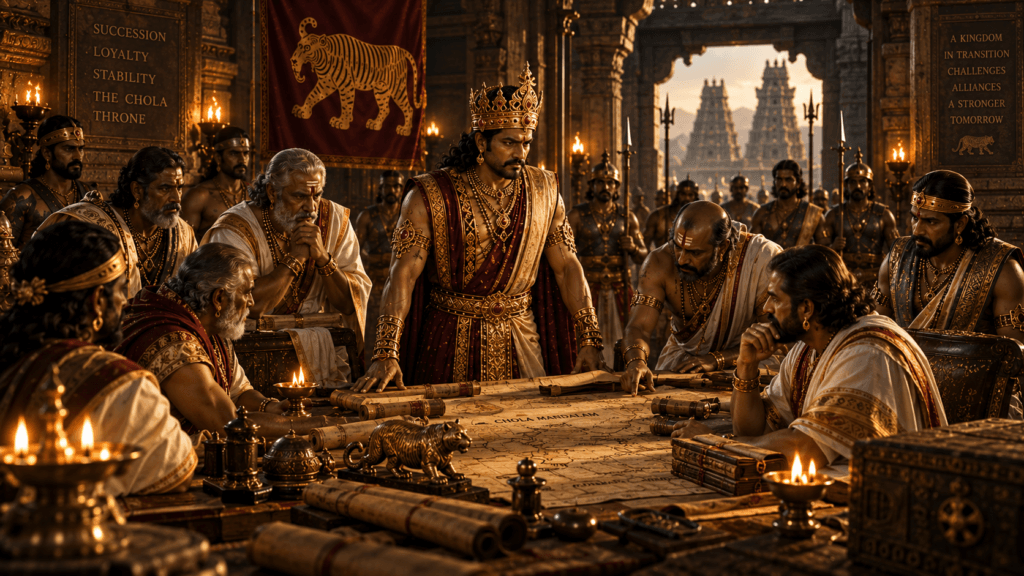
The answer, based on the available evidence, appears to be yes. The Chola kingdom that Rajaraja I inherited around 985 CE was not a kingdom in crisis. Its institutions were functioning. Its territory was intact. Its dynastic continuity had survived the succession complexities of the late 10th century without fragmenting. These are not glamorous achievements, but they are real ones.
Whether Uttama Chola was an active architect of that stability or merely its beneficiary, whether his reign was a period of deliberate institutional maintenance or of fortunate political quiescence, the historical record cannot fully resolve. The evidence is too limited, and the question too subtle, for confident answers. What can be said is that the stability of his reign was historically consequential: it was one of the conditions that made possible the imperial transformation that followed under Rajaraja I. That is a form of historical importance that does not make for dramatic storytelling, but that deserves historical recognition nonetheless.
Written & Researched by Abhishek Chavan — HistoryVerse7| © 2026 HistoryVerse7 | Cluster Article: Uttama Chola
References and Further Reading
Historical research based on inscriptions, archaeological evidence, academic scholarship, and established historical sources, including K.A. Nilakanta Sastri, Noboru Karashima, Burton Stein, Upinder Singh, and the Archaeological Survey of India South Indian Inscriptions series.
- Culavamsa (Sri Lankan chronicle) — for references to Chola activity in Sri Lanka during this period.
- Nilakanta Sastri, K.A. — The Colas (2 vols). University of Madras, 1935 (revised 1955).
- Nilakanta Sastri, K.A. — A History of South India. Oxford University Press, 1955.
- Karashima, Noboru — A Concise History of South India. Oxford University Press, 2014.
- Stein, Burton — Peasant State and Society in Medieval South India. Oxford University Press, 1980.
- Singh, Upinder — A History of Ancient and Early Medieval India. Pearson Education, 2008.
- Champakalakshmi, R. — Trade, Ideology and Urbanization: South India 300 BC to AD 1300. Oxford University Press, 1996.
- Archaeological Survey of India — South Indian Inscriptions series. asi. nic. in
- Epigraphia Indica — Multiple volumes. Archaeological Survey of India.
FAQ —- Uttama Chola
Q1: Who was Uttama Chola?
Uttama Chola, also known as Madhurantaka, was a Chola king who ruled from approximately 969 to 985 CE. He was the son of Gandaraditya and a cousin of Sundara Chola, becoming king after Sundara Chola’s death rather than one of Sundara Chola’s own sons.
Q2: Was Uttama Chola related to Rajaraja Chola I?
Yes. Rajaraja Chola I (Arulmozhivarman) was Sundara Chola’s son, making him Uttama Chola’s cousin once removed. Uttama Chola was the king who preceded Rajaraja I on the Chola throne, and the transition between their reigns around 985 CE appears to have been orderly.
Q3: Why did Uttama Chola become king instead of Sundara Chola’s sons?
The most straightforward explanation is that Sundara Chola’s elder son Aditya Karikala had died before his father, and the younger son Arulmozhivarman (Rajaraja I) was apparently too young to rule effectively at the time of Sundara Chola’s death around 969 CE. Uttama Chola, as the next senior member of the Chola royal family, was the appropriate person to hold the throne in the interim.
Q4: How long did Uttama Chola rule?
Approximately sixteen years, from around 969 CE to around 985 CE. These dates are derived from later Chola genealogical chronologies and should be treated as approximate.
Q5: What were Uttama Chola’s major achievements?
His documented achievements — relative to the inscriptional record — are primarily administrative continuity rather than dramatic military or architectural projects. He maintained the Chola administrative systems, continued patterns of temple patronage, and presided over a period of relative political stability that provided the foundation for Rajaraja I’s subsequent imperial expansion.
Share this content: